
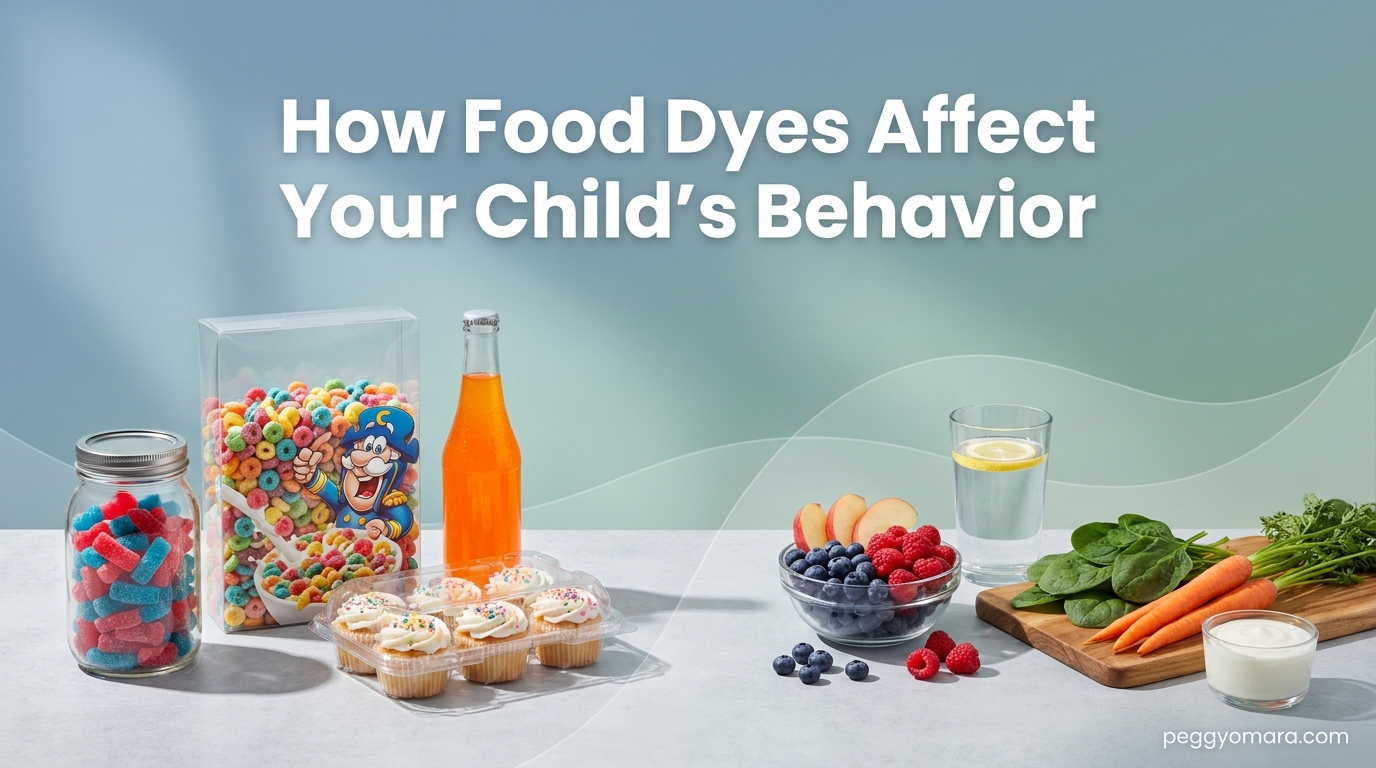
Artificial food dyes can make some children hyperactive, irritable, and moody according to decades of research. Studies show that about 3-5% of children experience significant behavioral changes when exposed to synthetic food coloring, with effects sometimes appearing within hours of consumption. Understanding how these dyes affect your child’s behavior and what the research actually shows can help you make informed decisions about your family’s diet.
I’ve spent months reviewing the scientific literature on food dyes and child behavior, and the evidence tells a compelling story. Parents consistently report dramatic improvements when they remove artificial colors from their children’s diets. The research supports what many families have observed firsthand.
In this guide, you’ll learn what food dyes are made from, which specific dyes pose the greatest concerns, and how to conduct a simple two-week elimination test at home. We’ll examine the landmark Southampton study, the California OEHHA report, and recent FDA actions including the 2026 ban on Red Dye 3. By the end, you’ll have a clear action plan for protecting your child’s behavioral health.
Table of Contents
What Are Food Dyes and Where Do They Come From?
Food dyes are substances added to foods and beverages to enhance or restore their color. They make cereal more vibrant, candy more appealing, and drinks more visually striking on store shelves.
There are two main categories of food colorings: artificial (synthetic) dyes and natural colorants. The distinction matters enormously for your child’s health and behavior.
Artificial Food Dyes: The Petroleum Connection
Most artificial food dyes used in the United States are derived from petroleum products. These synthetic chemicals were originally developed from coal tar in the late 1800s, and today’s versions are manufactured from crude oil derivatives. The nine artificial dyes currently approved by the FDA include Red 40, Red 3, Yellow 5, Yellow 6, Blue 1, Blue 2, Green 3, Orange B, and Citrus Red 2.
These petroleum-based dyes are classified as “certified color additives,” meaning the FDA tests batches for purity and compliance with regulations. However, certification does not mean these substances are benign or safe for all children.
Natural Food Colorants
Natural colorants come from plants, animals, or minerals. Common natural alternatives include beet juice for red, turmeric for yellow, spirulina for blue, and beta-carotene for orange. These have been used for centuries without the behavioral concerns associated with synthetic dyes.
Natural dyes are generally less stable than artificial ones, meaning they may fade faster or produce less vibrant colors. Food manufacturers often prefer synthetic dyes because they’re cheaper, more consistent, and create more eye-catching products that appeal to children.
The European Union requires warning labels on foods containing certain artificial dyes, noting they “may have an adverse effect on activity and attention in children.” The United States has no such requirement, though the FDA announced in January 2026 that Red Dye 3 will be phased out due to cancer concerns.
How Food Dyes Affect Your Child’s Behavior and What the Research Shows
The connection between artificial food dyes and childhood behavioral problems has been studied extensively over the past 45 years. Multiple well-designed studies consistently demonstrate a relationship between synthetic food coloring and adverse behavioral outcomes in children.
The research shows that food dyes don’t cause ADHD or other behavioral disorders directly. Instead, they can trigger or worsen symptoms in susceptible children, creating noticeable changes in attention, mood, and impulse control.
The Landmark Southampton Study (2007)
The most influential study on food dyes and child behavior came from researchers at the University of Southampton in the United Kingdom. Published in 2007, this double-blind, placebo-controlled trial tested mixtures of food dyes and sodium benzoate (a preservative) on 153 three-year-old and 144 eight-to-nine-year-old children.
Researchers found that children showed significantly increased hyperactivity when consuming artificial food colors compared to placebo. The effect was observed across the entire spectrum of children tested, not just those with pre-existing hyperactivity or ADHD. This finding suggested that any child could potentially be affected, though some are more sensitive than others.
The Southampton study prompted the European Union to mandate warning labels on foods containing the tested dyes. The six specific dyes examined were Tartrazine (Yellow 5), Sunset Yellow (Yellow 6), Carmoisine (Red 3), Ponceau 4R, Quinoline Yellow, and Allura Red AC (Red 40).
The California OEHHA Report (2021)
In 2021, the California Office of Environmental Health Hazard Assessment (OEHHA) released a comprehensive review of the scientific literature on synthetic food dyes. Their report analyzed 27 clinical trials and 35 animal studies examining the neurobehavioral effects of these additives.
The OEHHA concluded that synthetic food dyes are associated with adverse neurobehavioral outcomes in children, including hyperactivity and other behavioral problems. They found that even low levels of exposure could affect sensitive children, and that current FDA acceptable daily intake levels might not protect all children from behavioral effects.
California’s assessment was particularly significant because it came from a state environmental protection agency reviewing the full body of evidence, not industry-funded research. The report recommended additional safety measures and called for updated regulatory standards.
Meta-Analyses and Systematic Reviews
Multiple meta-analyses have pooled data from numerous studies to assess the overall evidence. A 2012 meta-analysis published in the Journal of the American Academy of Child and Adolescent Psychiatry found a significant effect of artificial food colors on hyperactivity in children with ADHD. The effect size was smaller but still present in children without ADHD diagnoses.
Researchers have also examined whether removing food dyes from the diet improves behavior. Studies consistently show that elimination diets free from artificial colors result in reduced hyperactivity and improved attention for many children. The benefits are most pronounced in children with existing behavioral challenges, but some children without diagnoses also respond positively.
What the FDA Says
The FDA maintains that artificial food dyes are safe for most people when consumed at typical levels. However, the agency has acknowledged that some children may be sensitive to these additives and experience behavioral changes.
In January 2026, the FDA announced that Red Dye 3 will lose authorization for use in foods and ingested drugs. This decision followed the Delaney Clause, which prohibits additives shown to cause cancer in humans or animals. Red 3 was linked to thyroid tumors in rat studies conducted decades ago. The phase-out gives manufacturers until January 2027 to reformulate products.
The FDA has not required warning labels like those in Europe, though they did issue a statement in 2011 noting that synthetic food colors may affect some children. The agency continues to review new research but has been slower to act than European regulators.
The Worst Offenders: Which Food Dyes to Avoid
Not all food dyes carry the same level of concern. Based on research evidence and clinical reports from parents and pediatricians, certain dyes consistently appear as the most problematic for children’s behavior.
| Dye Name | Common Names | Primary Concern | Found In |
|---|---|---|---|
| Red 40 | Allura Red AC | Hyperactivity, irritability | Candy, cereal, drinks |
| Yellow 5 | Tartrazine | Hyperactivity, mood changes | Snacks, pickles, desserts |
| Yellow 6 | Sunset Yellow | Restlessness, inattention | Cereal, snacks, sausage |
| Blue 1 | Brilliant Blue | Behavioral shifts | Frosting, ice cream, candy |
| Red 3 | Erythrosine | Cancer risk, hyperactivity | Candy, cherries, frosting |
Red 40: The Most Problematic Dye
Red 40 is the most widely used artificial food dye in the United States and also the one most frequently linked to behavioral problems. Parents in online forums consistently report that Red 40 produces the most dramatic and immediate behavioral changes in their children.
This petroleum-derived dye appears in countless products marketed to children, including fruit-flavored snacks, breakfast cereals, candy, sports drinks, and flavored yogurts. It’s also commonly found in medications and vitamins, creating hidden exposure sources that many parents miss.
Clinical observations suggest that Red 40 may trigger hyperactivity, emotional dysregulation, and aggression within 30 minutes to 2 hours of consumption in sensitive children. The effects typically last several hours before gradually subsiding.
Yellow 5 and Yellow 6
These two yellow dyes frequently appear together in processed foods. Yellow 5 (Tartrazine) has been associated with hyperactivity and has also been linked to allergic reactions in some individuals, including asthma and hives. Yellow 6 (Sunset Yellow) appears in many cheese-flavored snacks, cereals, and baked goods.
The combination of multiple dyes in a single product may have additive or synergistic effects, meaning children eating foods with several artificial colors might experience stronger behavioral reactions than those consuming single dyes.
Red 3 and the FDA Ban
Red 3 (Erythrosine) presents unique concerns beyond behavioral effects. This dye has been linked to thyroid tumors in animal studies and is being phased out under FDA orders beginning in 2026. While primarily a cancer concern, Red 3 also appears in behavioral research and should be avoided for both reasons.
Products containing Red 3 include bright red candies, maraschino cherries, and some frostings. The FDA has given manufacturers until January 2027 to remove this dye from their formulations.
How Dyes Affect Behavior: Symptoms and Timeline
Understanding how food dyes affect behavior requires looking at both the observable symptoms and the timeline of effects. Parents often want to know exactly what to watch for and how quickly changes might appear.
Common Symptoms of Food Dye Sensitivity
Children sensitive to food dyes may display a range of behavioral and emotional symptoms. The most commonly reported effects include:
- Increased hyperactivity and difficulty sitting still
- Reduced attention span and trouble focusing
- Irritability and emotional meltdowns
- Mood swings and sudden emotional changes
- Restlessness and fidgeting
- Impulsivity and poor decision-making
- Aggression or defiance
- Sleep disturbances
Some parents report that dyes affect their child’s emotional regulation more than physical hyperactivity. These children might become weepy, anxious, or emotionally volatile rather than physically bouncing off the walls.
The Timeline: How Quickly Do Effects Appear
One of the most common questions parents ask is how quickly food dyes affect behavior. The answer depends on the child, the specific dye, and the amount consumed.
For many sensitive children, behavioral changes appear remarkably fast. Some parents report noticeable differences within 30 minutes of their child eating dyed foods. More commonly, effects become apparent within 1-3 hours after consumption.
The duration of effects varies but typically lasts 3-6 hours, sometimes extending into the evening if the exposure occurred late in the day. Some parents notice their child has difficulty falling asleep after consuming dyes in the afternoon or evening.
During elimination testing, behavioral improvements usually become noticeable within 3-7 days of removing dyes completely. Full effects of elimination may take up to two weeks to become apparent, particularly if the child has accumulated exposure from multiple sources.
Possible Mechanisms of Action
Researchers are still investigating exactly how food dyes affect the brain and behavior. Several mechanisms appear to be involved.
Some studies suggest that artificial dyes may interfere with neurotransmitter function, particularly dopamine regulation. Dopamine plays a crucial role in attention, motivation, and impulse control. Children with ADHD often have atypical dopamine systems, which may explain why they’re more susceptible to dye effects.
Other research points to histamine responses. Some artificial dyes may trigger histamine release or interfere with histamine metabolism. Genetic variations in histamine-related genes appear to influence which children are most affected by food dyes.
The gut-brain axis may also play a role. Artificial dyes could affect gut microbiota or intestinal permeability, potentially influencing brain function through the gut-brain connection. Research in this area is ongoing but suggests multiple pathways may be involved.
Which Children Are Most Affected
Not every child reacts to food dyes. Research suggests that approximately 3-5% of the general childhood population experiences significant behavioral effects from synthetic food coloring. However, certain groups show much higher sensitivity rates.
Children with ADHD and Related Conditions
Children diagnosed with attention-deficit hyperactivity disorder (ADHD) show the highest rates of food dye sensitivity. Studies estimate that 30-50% of children with ADHD may respond to artificial food color elimination with measurable behavioral improvements.
The effects aren’t limited to hyperactivity. Many parents report improvements in attention span, emotional regulation, and impulse control when dyes are removed. Some children who don’t meet full diagnostic criteria for ADHD but show attention or behavioral challenges also respond positively to dye elimination.
Children with oppositional defiant disorder (ODD), anxiety disorders, and autism spectrum conditions may also be more vulnerable to food dye effects. The overlapping nature of these conditions means many children have multiple factors that increase sensitivity.
Age and Gender Patterns
Younger children appear more susceptible to food dye effects than adolescents and adults. The peak sensitivity window seems to occur between ages 3 and 8, though individual children vary considerably.
Boys are diagnosed with ADHD at much higher rates than girls, and this pattern extends to food dye sensitivity. However, girls who are sensitive to dyes may show different symptoms, with more emotional dysregulation and less physical hyperactivity than their male counterparts.
Genetic Factors in Dye Sensitivity
Emerging research suggests that genetic variations influence who responds to food dyes. Children with certain genetic profiles affecting dopamine receptors or histamine metabolism appear more likely to experience behavioral effects from artificial colors.
While commercial genetic testing for food dye sensitivity isn’t yet available, family patterns can provide clues. Parents who recall having behavioral challenges as children, or who notice they personally feel different after consuming dyed foods, may have children with similar genetic susceptibilities.
Can Food Dyes Affect Children Without ADHD
Yes. The Southampton study demonstrated that children without ADHD diagnoses still showed increased hyperactivity when consuming artificial food colors. While the effect size was smaller than in children with ADHD, it was statistically significant across the general population tested.
Many parents of typically developing children report noticeable behavioral improvements after removing dyes. These children might not have clinical diagnoses, but their parents observe reduced irritability, better focus, and more stable moods without artificial colors in their diet.
Hidden Sources: Where Food Dyes Hide
Eliminating food dyes requires more than avoiding brightly colored candy and cereal. Artificial colors appear in surprising places that many parents overlook. Understanding these hidden sources is essential for a successful elimination trial.
Medications and Vitamins
One of the most overlooked sources of food dye exposure comes from medications and supplements. Children’s fever reducers, antibiotics, vitamins, and even some ADHD medications contain artificial colors to make them visually appealing.
Chewable vitamins are particularly likely to contain dyes, often in amounts comparable to candy. Liquid medications frequently use dyes to distinguish different flavors or dosages. Parents conducting elimination trials should check every medication and supplement their child takes.
Ask your pharmacist about dye-free alternatives for prescription medications. Many pharmacies can compound medications without artificial colors, or your doctor may be able to prescribe a different formulation. For over-the-counter products, look for dye-free or clear versions.
Personal Care Products
Toothpaste is a surprising source of dye exposure. Many children’s toothpastes contain artificial colors to create attractive stripes or bright colors. Children absorb some of these chemicals through oral tissues and may swallow small amounts while brushing.
Mouthwash, bubble bath, and even some shampoos marketed to children may contain artificial dyes. While the primary concern is ingestion, skin absorption and behavioral conditioning toward bright colors are additional considerations.
Restaurant and Packaged Foods
Restaurant foods often contain more artificial dyes than home-cooked meals. Brightly colored sauces, breading, and dessert items are common culprits. Even foods that don’t appear artificially colored may contain dyes to enhance their appearance.
White frosting may contain titanium dioxide for brightness, but also often includes artificial colors to create specific shades. Pickles, salad dressings, and foods you wouldn’t expect to contain dyes sometimes include them for visual appeal.
Reading ingredient labels becomes essential. Look for terms like “artificial color,” “FD&C,” followed by a color and number, or specific dye names like “Allura Red AC” or “Tartrazine.” When dining out, ask about ingredients or choose simpler, whole-food options.
How to Test for Food Dye Sensitivity
If you suspect your child might be sensitive to food dyes, a systematic elimination test can provide clarity. This approach, often called the two-week food dye elimination test, is the gold standard for identifying dye sensitivity at home.
The Two-Week Elimination Protocol
The elimination phase requires removing all artificial food dyes from your child’s diet for two full weeks. This means reading every label, checking medications, and being vigilant about unexpected sources.
Week 1: Complete Elimination
Remove all artificial food colors from your child’s diet. Check labels for Red 40, Yellow 5, Yellow 6, Blue 1, and other synthetic dyes. Don’t forget medications, vitamins, toothpaste, and any other ingestible products.
Keep a daily behavior journal noting sleep quality, mood, attention span, and any behavioral challenges. Record what your child eats to ensure complete elimination and to identify any accidental exposures.
Week 2: Systematic Reintroduction
After one week of complete elimination, introduce a single artificial dye while maintaining the dye-free diet otherwise. Red 40 is often the best starting point since it’s the most commonly problematic.
Give your child a known amount of Red 40 (such as a small piece of red candy or a few ounces of red drink) and observe for the next 4-6 hours. Record any behavioral changes, mood shifts, or physical symptoms.
Wait 48 hours before testing another dye to allow any effects to clear. Repeat the process with Yellow 5, Yellow 6, and Blue 1 if desired.
What Results Mean
If your child shows behavioral improvements during the elimination week and clear reactions when dyes are reintroduced, you have strong evidence of sensitivity. The strength of the reaction and the specific dyes that trigger symptoms will guide your long-term dietary decisions.
Some children react dramatically to specific dyes while tolerating others fine. Other children seem sensitive to all artificial colors. The reintroduction phase helps you understand your child’s individual pattern.
If you see no changes during elimination or reintroduction, your child likely isn’t sensitive to food dyes. This is valuable information that allows you to focus on other factors that might be affecting behavior.
Getting the Whole Family On Board
Successful elimination testing requires household cooperation. Explain the test to family members and ask for their support in keeping the house dye-free during the test period. Grandparents, babysitters, and school staff should all understand the protocol.
Some families choose to make the entire household dye-free during testing to avoid temptation and mistakes. Others successfully manage just the test subject’s diet while keeping dyed foods for other family members in designated areas.
Practical Tips for Going Dye-Free
Transitioning to a dye-free lifestyle requires planning and commitment, but many families find the behavioral improvements well worth the effort. Here are practical strategies for maintaining a dye-free diet long-term.
Navigating School and Social Situations
School lunches and classroom celebrations present challenges for dye-free families. Pack lunches at home using whole foods and dye-free packaged options when needed. Communicate with your child’s teacher about dye restrictions for classroom parties and consider sending dye-free alternatives for your child.
Birthday parties require advance planning. Feed your child a substantial dye-free meal before the party, send dye-free treats they can enjoy, and discuss expectations beforehand. Some parents find that allowing occasional dye exposure at special events works fine once the baseline diet is dye-free.
Finding Dye-Free Alternatives
Many mainstream products now offer dye-free versions. Major brands have responded to consumer demand by creating lines without artificial colors. Health food stores and natural food sections of grocery stores offer extensive dye-free options.
Whole foods naturally contain no artificial dyes. Focusing on fruits, vegetables, whole grains, and unprocessed proteins eliminates label-reading concerns while improving overall nutrition.
When you need convenience foods, look for brands that specifically advertise “no artificial colors” or read ingredient labels carefully. Apps and online resources can help identify dye-free products.
Managing Costs
Dye-free alternatives sometimes cost more than conventional products, though the price gap has narrowed considerably. The most economical approach focuses on whole foods rather than specialty products.
Simple swaps like regular oatmeal instead of colored instant packets, plain yogurt with fresh fruit instead of flavored varieties, and homemade treats instead of packaged candy can actually reduce grocery costs while eliminating dyes.
Frequently Asked Questions
How quickly does red dye affect behavior in toddlers?
Red dye can affect toddler behavior remarkably quickly. Many parents report noticing changes within 30 minutes to 2 hours of consumption. The effects typically peak around 2-3 hours after eating and can last 3-6 hours. Some toddlers become hyperactive, irritable, or emotionally dysregulated during this window. The speed and intensity of reaction varies by child and depends on factors like the amount consumed, whether other dyes were eaten, and the child’s individual sensitivity level.
What are the symptoms of food dye sensitivity in children?
Common symptoms of food dye sensitivity include increased hyperactivity, difficulty paying attention, irritability, mood swings, restlessness, impulsivity, aggression, and sleep disturbances. Some children primarily show physical hyperactivity while others experience more emotional symptoms like anxiety or emotional dysregulation. Symptoms typically appear within hours of consuming dyed foods and resolve within several hours. Not all children react to dyes, but those who do often show consistent patterns with repeated exposures.
Which food dyes should be avoided for kids?
The food dyes most commonly linked to behavioral problems in children are Red 40 (Allura Red AC), Yellow 5 (Tartrazine), Yellow 6 (Sunset Yellow), Blue 1 (Brilliant Blue), and Red 3 (Erythrosine). Red 40 appears to cause the most consistent problems across studies and parent reports. Red 3 is being phased out by the FDA in 2026 due to cancer concerns. When possible, choose foods colored with natural alternatives like beet juice, turmeric, or spirulina instead of artificial dyes.
Does food dye cause ADHD or just worsen symptoms?
Food dyes do not cause ADHD. Research shows that artificial food colors can trigger or worsen hyperactivity, inattention, and impulsivity in children who are already predisposed to these symptoms, including those with ADHD. The Southampton study found that even children without ADHD showed increased hyperactivity when consuming artificial dyes, though the effect was stronger in children with existing behavioral challenges. For children with diagnosed ADHD, removing food dyes helps manage symptoms but doesn’t cure the underlying condition.
What is the two-week food dye elimination test?
The two-week food dye elimination test is a systematic method for identifying dye sensitivity at home. Week one involves removing all artificial food dyes from your child’s diet completely while keeping a daily behavior journal. Week two involves reintroducing specific dyes one at a time (typically starting with Red 40) and observing for behavioral changes. Improvements during week one followed by reactions when dyes are reintroduced indicate sensitivity. This test provides clear evidence that can guide dietary decisions going forward.
Are natural food dyes safer than artificial ones?
Natural food colorants are generally considered safer than artificial dyes for children with behavioral concerns. Natural colors derived from plants like beets, turmeric, spirulina, and beta-carotene have not been linked to the hyperactivity and behavioral issues associated with petroleum-based synthetic dyes. While natural dyes can cause allergic reactions in rare cases, they don’t appear to affect neurobehavioral function the way artificial dyes can. For children sensitive to food dyes, switching to naturally colored foods often resolves behavioral symptoms.
How do I know if my child is sensitive to food dyes?
The most reliable way to know if your child is sensitive to food dyes is to conduct a two-week elimination test. Remove all artificial food dyes completely for one week while tracking behavior, then reintroduce specific dyes and watch for reactions. Signs of sensitivity include hyperactivity, irritability, mood swings, or attention problems that appear within hours of eating dyed foods and improve when dyes are removed. Approximately 3-5% of children are sensitive, with higher rates among children with ADHD. Keeping a food and behavior journal helps identify patterns.
Why is Red Dye 3 being banned by the FDA?
Red Dye 3 is being banned because of the Delaney Clause, a federal law that prohibits additives shown to cause cancer in humans or animals. Studies conducted decades ago found that high doses of Red 3 caused thyroid tumors in male rats. While the cancer risk at typical consumption levels is debated, the Delaney Clause requires action when any cancer risk is demonstrated. The FDA announced in January 2026 that Red 3 will lose authorization for use in foods and ingested drugs, with manufacturers given until January 2027 to reformulate products. This ban addresses cancer concerns rather than behavioral effects.
How long do food dye effects last in children?
The behavioral effects of food dyes typically last 3-6 hours after consumption, though this varies by child and amount consumed. Some parents notice their child returns to baseline within 2-3 hours, while others see effects persist into the evening, especially if the dye was consumed later in the day. Sleep disturbances may extend the impact timeline. During elimination testing, most parents notice behavioral improvements within 3-7 days of removing all dyes, with full benefits apparent by two weeks. Individual dyes may have slightly different duration profiles.
Can food dyes affect children without ADHD?
Yes, food dyes can affect children without ADHD. The landmark Southampton study demonstrated that children across the general population showed increased hyperactivity when consuming artificial food colors, not just those with existing behavioral diagnoses. While children with ADHD show stronger reactions and higher sensitivity rates (30-50%), typically developing children may also experience behavioral shifts including reduced attention span, irritability, or mood changes. Not all children are affected, but the potential impact extends beyond diagnosed conditions to the general childhood population.
Conclusion: How Food Dyes Affect Your Child’s Behavior and What the Research Shows
The research is clear: artificial food dyes can affect children’s behavior, with approximately 3-5% of children showing significant sensitivity. The landmark Southampton study, California’s OEHHA report, and decades of clinical observations all point to the same conclusion that synthetic food coloring can trigger hyperactivity, irritability, and attention problems in susceptible children.
You now have the knowledge to make informed decisions about your family’s diet. The two-week elimination test provides a simple, no-cost way to determine if your child is among those affected. Armed with specific information about which dyes to avoid and where they hide, you can take immediate action.
Remember that food dyes don’t cause ADHD or other behavioral disorders. They can, however, make existing challenges worse and create unnecessary struggles for sensitive children. The effort required to eliminate artificial colors is often repaid many times over in calmer, more focused, happier children. Start your elimination test this week and discover what a difference going dye-free can make for your family.