
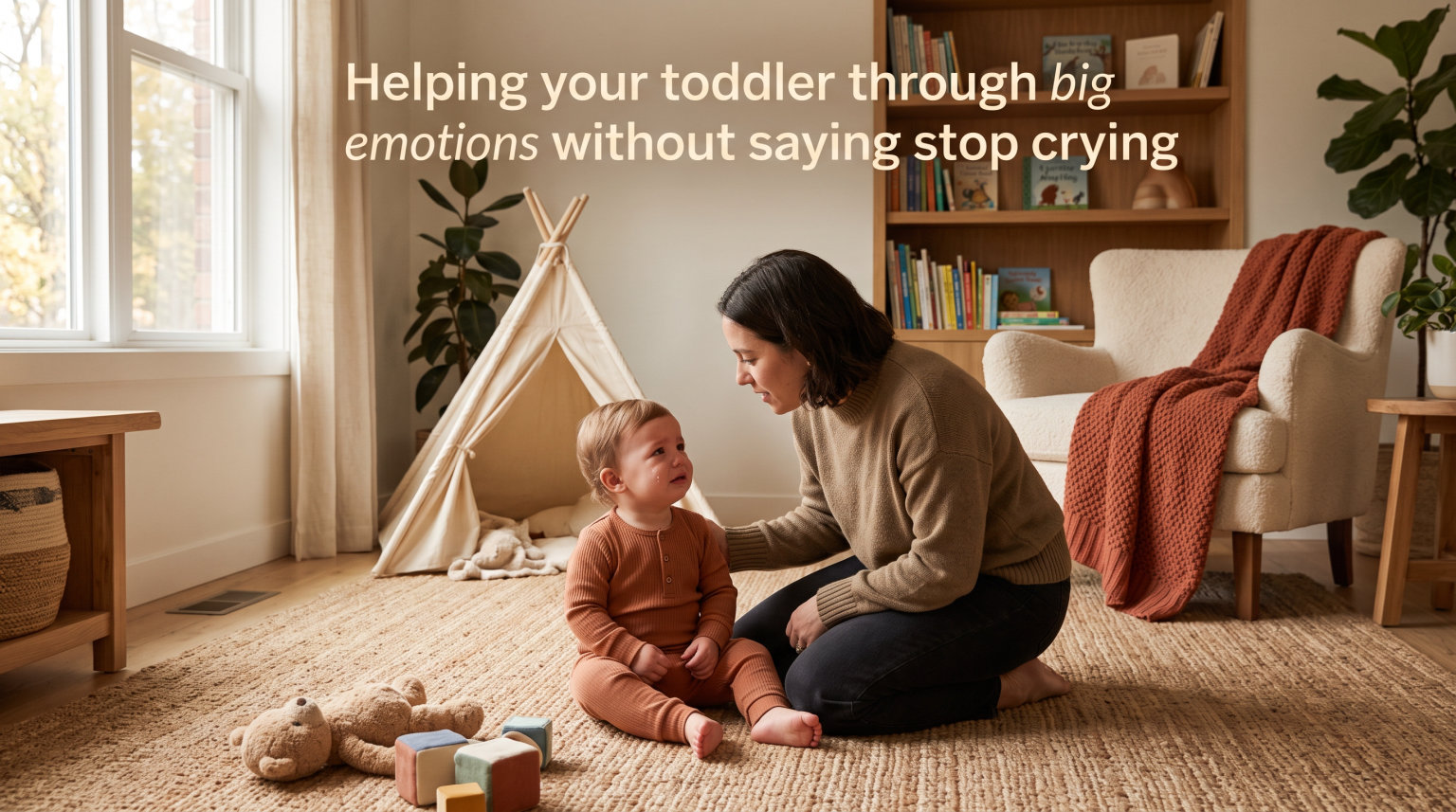
You are in the grocery store checkout line. Your two-year-old spots a lollipop display and wants one. You say not today. Within seconds, they are on the floor, tears streaming, legs kicking, and the sound echoing through the store.
Your face flushes. Other shoppers are looking. The words “stop crying” sit right on your tongue, ready to tumble out.
I have been there more times than I can count. Helping your toddler through big emotions without saying stop crying is one of the most challenging parts of parenting. It requires patience, practice, and a complete shift in how we respond to our children’s feelings.
In this guide, I will share what I have learned from child development experts, fellow parents, and my own journey with three children. You will discover why toddlers have such intense emotions, what happens when we dismiss those feelings, and most importantly, exactly what to say and do instead.
Table of Contents
Understanding Toddler Emotions
Toddlers are not having tantrums to manipulate you. Their brains are simply not developed enough to handle big feelings any other way.
The prefrontal cortex, the part of the brain responsible for rational thinking and impulse control, does not fully mature until the mid-twenties. In toddlers, this area is essentially offline during emotional storms. Meanwhile, their amygdala, the brain’s alarm system, is fully active and firing away.
This means when your toddler cries over a broken cracker, they are experiencing genuine distress. To them, that cracker represented safety, predictability, or simply the one thing they could control in a big overwhelming world. When it breaks, their nervous system registers a real threat.
Big emotions in toddlers are normal. They are a sign that your child is developing exactly as they should. The goal is not to suppress these feelings but to help your child learn that emotions are manageable and that they can come to you for support.
Toddler emotional regulation develops gradually. An 18-month-old has almost no capacity to self-soothe. By age two, they can sometimes use simple calming strategies if you have been modeling them. By age three, many children can name their feelings and ask for help, though they still need significant support during intense moments.
Understanding this developmental reality changes everything. Your child is not giving you a hard time. They are having a hard time. This shift in perspective is the foundation of everything that follows.
Why Saying Stop Crying Is Harmful
Those two words seem harmless enough. We want the crying to stop because the sound triggers our own stress response. We want to help. But “stop crying” sends a message that cuts deeper than we intend.
When we tell children to stop crying, we teach them that their feelings are unacceptable. We show them that their emotional experience is an inconvenience rather than something worthy of attention. Over time, this creates what psychologists call emotional invalidation, a pattern that can affect a child’s ability to trust their own feelings well into adulthood.
Children who consistently hear “stop crying” learn to stuff their emotions down. They may appear well-behaved on the surface, but those suppressed feelings do not disappear. They resurface as anxiety, aggression, or physical symptoms. Many adults in therapy trace their emotional struggles back to childhood messages that their feelings were too much, wrong, or unwelcome.
There is also an immediate practical problem. Telling a dysregulated child to stop crying simply does not work. Their nervous system is in fight-or-flight mode. They cannot access the rational thinking required to comply with your request. The phrase becomes just another demand their overwhelmed brain cannot meet, often escalating the tantrum further.
I have noticed in my own parenting that when I focus on stopping the behavior rather than supporting the child, we both end up more frustrated. When I shift to helping my child feel understood, the storm passes more quickly even though that was not my immediate goal.
The Foundation: Co-Regulation
Before we talk about what to say, we need to understand how toddlers actually calm down. They do not do it alone. They do it through co-regulation.
Co-regulation is the process by which a child borrows the calm from a regulated adult. When you stay steady during your child’s emotional storm, your regulated nervous system literally helps theirs find its way back to baseline. It is one of the most powerful tools in your parenting toolkit.
This is why your calm is their calm. When you match their dysregulation with your own stress, frustration, or anger, you feed the storm. When you remain anchored, you offer them a lifeline back to safety.
The science behind this is fascinating. Human nervous systems are wired for social connection. A child’s stress response system develops in response to caregiver interactions. Every time you help your child through a big feeling with patience and presence, you are literally wiring their brain for emotional resilience.
Attunement is the skill that makes co-regulation possible. It means reading your child’s cues and responding to their emotional needs rather than just their outward behavior. An attuned parent notices not just the tantrum but what led to it, the subtle signs of building distress, and the unique ways their child seeks comfort.
This does not mean you must be perfectly calm all the time. That is impossible. It means developing enough self-awareness to notice when you are becoming dysregulated yourself and taking steps to return to center before engaging with your child. Sometimes this means pausing, breathing, or even saying, “I need a moment to calm down so I can help you.”
What to Say to a Toddler Instead of Stop Crying
Words matter. The phrases we reach for in emotional moments either build connection or create distance. Here are specific alternatives that validate your child’s experience while offering the support they need.
You are safe. I am right here.
This simple phrase addresses the underlying fear that often drives big emotions. When the amygdala is firing, safety is the primary need. Your physical presence paired with these words reminds your child that they are not alone in their distress.
I use this one often during nighttime wakings or separation anxiety moments. It acknowledges the feeling without trying to fix it immediately.
I see you are really upset.
Validation does not require agreement with the cause of the upset. You do not have to think the broken cracker was worth crying over to acknowledge that your child is genuinely distressed. This phrase shows you are paying attention and taking their feelings seriously.
Labeling emotions is powerful. When children learn to name their feelings, they gain a sense of control. The feeling becomes something they are experiencing rather than something that has taken over their entire being.
It is okay to cry. I cry when I am sad too.
This phrase gives permission. It normalizes emotional expression and removes shame. Many parents worry that allowing crying encourages dramatic behavior. The opposite is true. When children feel safe expressing emotions, they process them more fully and return to baseline faster.
I have found that when I share my own emotional experiences in age-appropriate ways, my children learn that feelings are part of being human. They see that even adults need to cry sometimes.
You wanted that toy and I said no. That is hard.
This is the phrase for disappointment. It acknowledges the specific situation without changing the boundary. You are not giving in. You are simply recognizing that limits are genuinely difficult for young children to accept.
I use variations of this constantly. “You wanted to stay at the park and we had to leave. That is frustrating.” “You wanted the blue cup and I gave you the red one. I understand that is disappointing.” The acknowledgment often reduces the intensity of the protest.
I am going to breathe with you.
When your child is ready for calming strategies, breathing together can be magical. Do not expect a dysregulated toddler to breathe on command. Instead, breathe loudly and visibly near them. Children naturally sync with a regulated adult’s breathing pattern.
I make it playful. “Let us blow out birthday candles together.” “Can you smell the soup? Now blow to cool it off.” The pattern matters more than the words.
I love you even when you are angry.
Unconditional acceptance is the heart of secure attachment. This phrase reminds your child that their difficult emotions do not diminish your love. It is especially powerful after a tantrum when you are reconnecting.
I often follow up with physical connection. A hug, holding hands, or simply sitting nearby reinforces the words.
Your feelings are big right now. I will help you through them.
This positions you as an ally rather than an adversary. It acknowledges the intensity without being overwhelmed by it. You are confident that these feelings are manageable, and your confidence helps your child believe it too.
I have noticed that my tone matters as much as my words with this one. Calm, steady, and certain. I am not asking if they want help. I am calmly informing them that help is available.
Let us find a cozy spot together.
Sometimes a change of environment helps. This phrase offers movement and connection without demanding that the child stop crying. The cozy spot might be a blanket fort, a special chair, or simply sitting together on the floor.
Physical comfort often precedes emotional comfort. The act of moving to a safe space together begins the regulation process.
You are having a hard time. I am here with you.
This is my go-to when I am not sure what else to say. It is simple, honest, and connecting. It names the reality without judgment and offers your presence as the solution.
I have used this phrase in grocery stores, during car rides, at family gatherings, and in the middle of the night. It works across contexts because it addresses the universal need beneath all tantrums: to be seen and supported through difficult moments.
All feelings are welcome here.
This is a powerful family value statement. It sets the emotional tone of your home. When spoken regularly, it reminds both you and your child that no emotion needs to be hidden or suppressed.
I say this proactively during calm moments too. It becomes part of the family language around emotions.
Practical Co-Regulation Strategies
Words are important, but they are only part of the equation. These practical strategies help you move from theory to action during real emotional moments.
Get on their level
Towering over a crying child can feel intimidating. Kneeling down puts you at eye level and removes the physical power dynamic. It also helps you see the world from their perspective quite literally.
This physical shift often changes the emotional temperature immediately. I have watched my children’s faces soften simply because I got down on the floor with them.
Offer physical connection
Some children want to be held during big emotions. Others prefer proximity without touch. Pay attention to your child’s unique needs. A hand on their back, sitting nearby, or offering a hug without demanding they accept it all communicate safety.
Physical touch releases oxytocin, the bonding hormone that counters stress. Even brief, gentle contact can help shift a child’s nervous system toward regulation.
Use the magic of water
Water has remarkable calming properties. A drink of water, splashing cool water on faces, or even looking at fish in a tank can shift attention and soothe the nervous system. I keep this strategy in my back pocket for especially intense moments.
Bath time has become a regulation strategy in our house. The warm water, the sensory input, and the focused attention often help my children process emotions they have been holding in.
Create a calm-down space
A designated cozy corner with soft pillows, favorite books, and sensory items gives children a physical place to retreat when overwhelmed. This is not a time-out space. It is a resource they can choose when they need help regulating.
We created a “peace corner” in our living room with a small tent, soft blankets, and a basket of calm-down tools. My children use it proactively now, often retreating there before they completely melt down.
Practice breathing games during calm times
You cannot teach a drowning person to swim. Breathing techniques need to be practiced when children are already calm. Make it fun. Blow bubbles. Practice “smelling the flower and blowing out the candle.” Use pinwheels or feathers.
Once these games become familiar, you can reference them during emotional moments. “Remember how we blow the bubbles? Let us try that together.”
Keep your own cup full
You cannot pour from an empty cup. Parent self-care is not selfish. It is essential for co-regulation. A sleep-deprived, stressed parent has a much harder time staying calm during a toddler tantrum.
I notice my own reactivity increases dramatically when I am hungry, tired, or have not had any time to myself. Meeting my basic needs makes me a much more effective emotional coach for my children.
Have a regulation menu
Different children need different regulation strategies. Some need physical activity to discharge energy. Others need quiet and stillness. Some respond to music, others to silence. Create a mental menu of what works for your unique child.
My oldest needs vigorous physical activity followed by quiet snuggles. My middle child needs immediate physical connection and verbal reassurance. My youngest needs space and then gentle reconnection. Knowing these differences helps me respond effectively rather than using a one-size-fits-all approach.
Managing Your Own Emotions as a Parent
Here is the truth nobody told me before I became a parent. Your child’s tantrum will trigger your own emotional memories. The crying hits something deep in your nervous system. The public meltdowns activate your social anxiety. The repeated demands wear down your patience.
Helping your toddler through big emotions requires you to regulate yourself first. This is the hardest part.
I have learned to recognize my own warning signs. Tight chest. Raised voice. Urgency to make it stop immediately. When I notice these signals, I know I am moving out of my window of tolerance and into my own stress response.
In those moments, I use the oxygen mask principle. I take care of my own regulation so I can help my child with theirs. Sometimes this means a few deep breaths while my child cries. Sometimes it means saying, “I need to take a moment to calm my own body so I can help you. I will be right back.”
Self-compassion is essential. You will not respond perfectly every time. You will lose your cool. You will say the wrong thing. When this happens, repair is more important than perfection. A simple, “I am sorry I yelled. I was feeling frustrated too. Let us try again together,” models emotional recovery and rebuilds connection.
Remember that this is hard work. Supporting a dysregulated child is physically and emotionally demanding. Give yourself credit for showing up, even when it is messy. Your effort matters even when the results are not immediate.
FAQs
How to help a 2 year old with big emotions?
Help a 2 year old by staying calm yourself, getting on their physical level, offering simple validation like I see you are upset, and providing physical comfort if they want it. Two-year-olds need heavy co-regulation support since their prefrontal cortex is not developed enough for self-soothing. Use short phrases, simple breathing games, and lots of patience. Remember that their distress is genuine even if the trigger seems small.
What to say to a toddler instead of stop crying?
Say phrases that validate and connect like You are safe I am right here, It is okay to cry, I see you are really upset, or You are having a hard time and I am here with you. These alternatives acknowledge your child’s feelings without dismissing them. Label emotions to help your child learn to name their feelings. Offer physical presence and calm energy rather than demanding immediate behavioral compliance.
What is the 7 7 7 rule in parenting?
The 7 7 7 rule refers to pausing before responding to your child’s behavior by taking 7 seconds to breathe, considering if the issue will matter in 7 minutes, and whether it will matter in 7 years. This technique helps parents respond thoughtfully rather than reactively during challenging moments. It creates space between the trigger and your response, allowing your prefrontal cortex to engage.
What is the 3 3 3 rule for toddlers?
The 3 3 3 rule for emotional regulation involves having your child name 3 things they can see, 3 things they can hear, and 3 things they can touch. This grounding technique helps shift attention away from overwhelming emotions and back to the present moment. It works best with preschool-aged children who have enough language skills to participate. Practice during calm times first.
Helping Your Toddler Through Big Emotions Without Saying Stop Crying
This journey is not linear. Some days you will respond with grace and patience. Other days you will be exhausted and reactive. Both are part of being human.
The goal is not perfection. It is progress. Each time you choose validation over dismissal, co-regulation over isolation, and connection over correction, you are building your child’s emotional foundation. You are showing them that all feelings are acceptable, that they can handle difficult moments, and that they never have to face those moments alone.
Your toddler will not remember every tantrum or every word you say. But they will internalize the pattern. They will grow up knowing that emotions are safe, that help is available, and that they are worthy of support even at their most difficult moments.
That is the gift of helping your toddler through big emotions without saying stop crying. It is not just about surviving the toddler years. It is about raising emotionally healthy humans who know how to feel, how to heal, and how to connect.
You have got this. One breath, one phrase, one moment of connection at a time.