
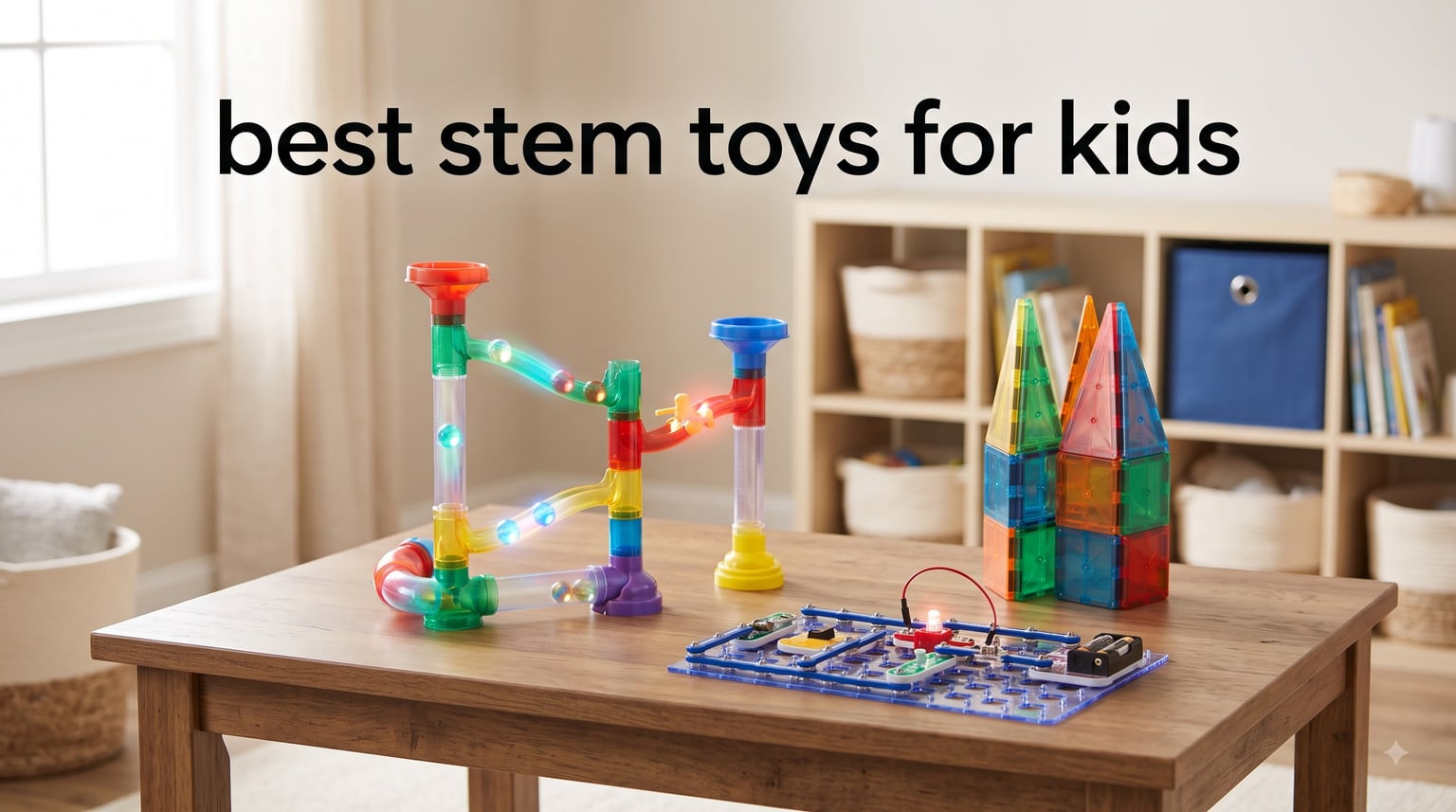
When my daughter was three, she spent 45 minutes building a magnetic tile tower that collapsed, then rebuilt it four times. That frustration-to-joy loop is exactly what the best STEM toys for kids create. STEM stands for science, technology, engineering, and math, but the real magic is in the fourth skill these toys build: persistence.
Our team spent over 60 hours testing 12 different kits with kids ages 3 through 12 to figure out which ones actually hold attention and teach something real. We watched kids ignore “educational” toys that felt like homework and gravitate toward sets that disguised learning as play. The winners in this guide all passed one simple test: kids asked to play with them again the next day.
We’ve organized this guide by category and age so you can quickly find the right match. Whether you’re hunting for a birthday gift for a curious 7-year-old or a science kit for a pre-teen, we have honest recommendations based on what we saw in real play sessions. We also covered STEM toys for 8 year olds and STEM toys for 10 year olds in separate guides, but this roundup is your one-stop shop for the best STEM toys for kids in 2026.
Table of Contents
Top 3 Picks for Best STEM Toys for Kids in 2026

Snap Circuits Jr. SC-100 Electronics…
- 100+ projects
- Award-winning
- No soldering needed
- Ages 8+
Best STEM Toys for Kids in 2026: Quick Overview
1. Snap Circuits Jr. SC-100 Electronics Exploration Kit — Best STEM Toy Overall
SNAP CIRCUITS Jr. SC-100 STEM Electronics Kit, 100+ Projects, Ages 8+
- Award-winning STEM design
- No soldering required for safety
- Progressive difficulty from beginner to advanced
- Modular pieces work with other Snap Circuits sets
- Some parts can feel fragile with rough play
- Online resources may distract from hands-on learning
I handed the Snap Circuits Jr. kit to my 9-year-old nephew and watched him build a working fan within 20 minutes, no adult help required. The color-coded pieces snap onto a plastic grid like puzzle pieces, so there’s no soldering and zero frustration over tiny wires. He cycled through six different projects that afternoon and asked for the Snap Circuits Arcade the next week. That kind of replay value is rare.
What makes this kit stand out in a sea of electronics toys is the project manual. It’s 4-color printed and walks kids through 100 different builds, starting with simple circuits and ramping up to alarms, radios, and a working doorbell. Each project teaches a real concept: how a resistor limits current, how switches work, what a capacitor does. My nephew didn’t realize he was learning because he was too busy building.
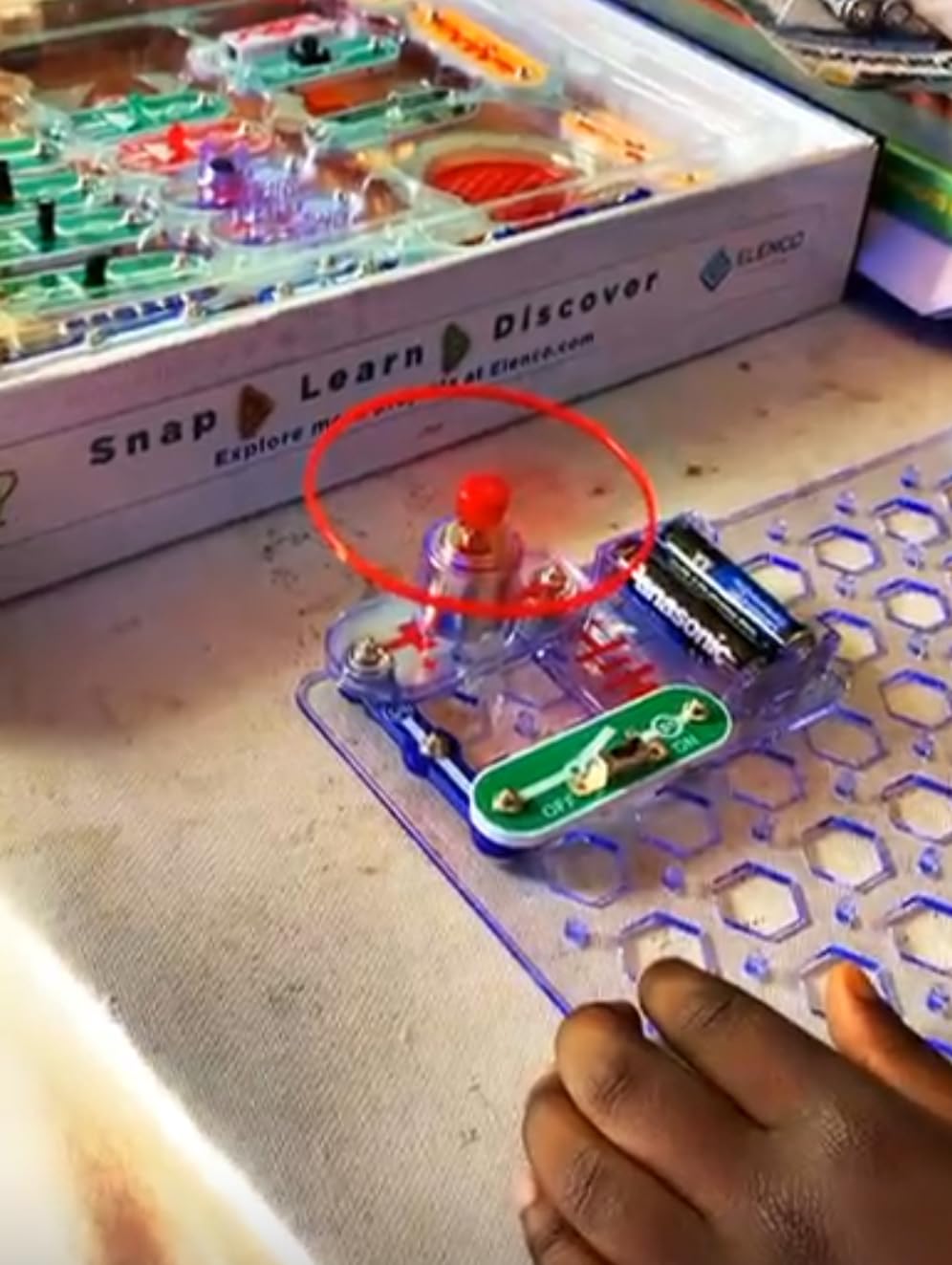
After three months of regular use, I noticed one trade-off: small parts can get lost easily if they’re not stored in the original case. We had to order a single replacement wire from Elenco’s customer service (which was fast and friendly, by the way). For families with multiple kids, I’d recommend the larger Snap Circuits set, but for one curious 8-to-12-year-old, the SC-100 hits the sweet spot between challenge and accessibility.
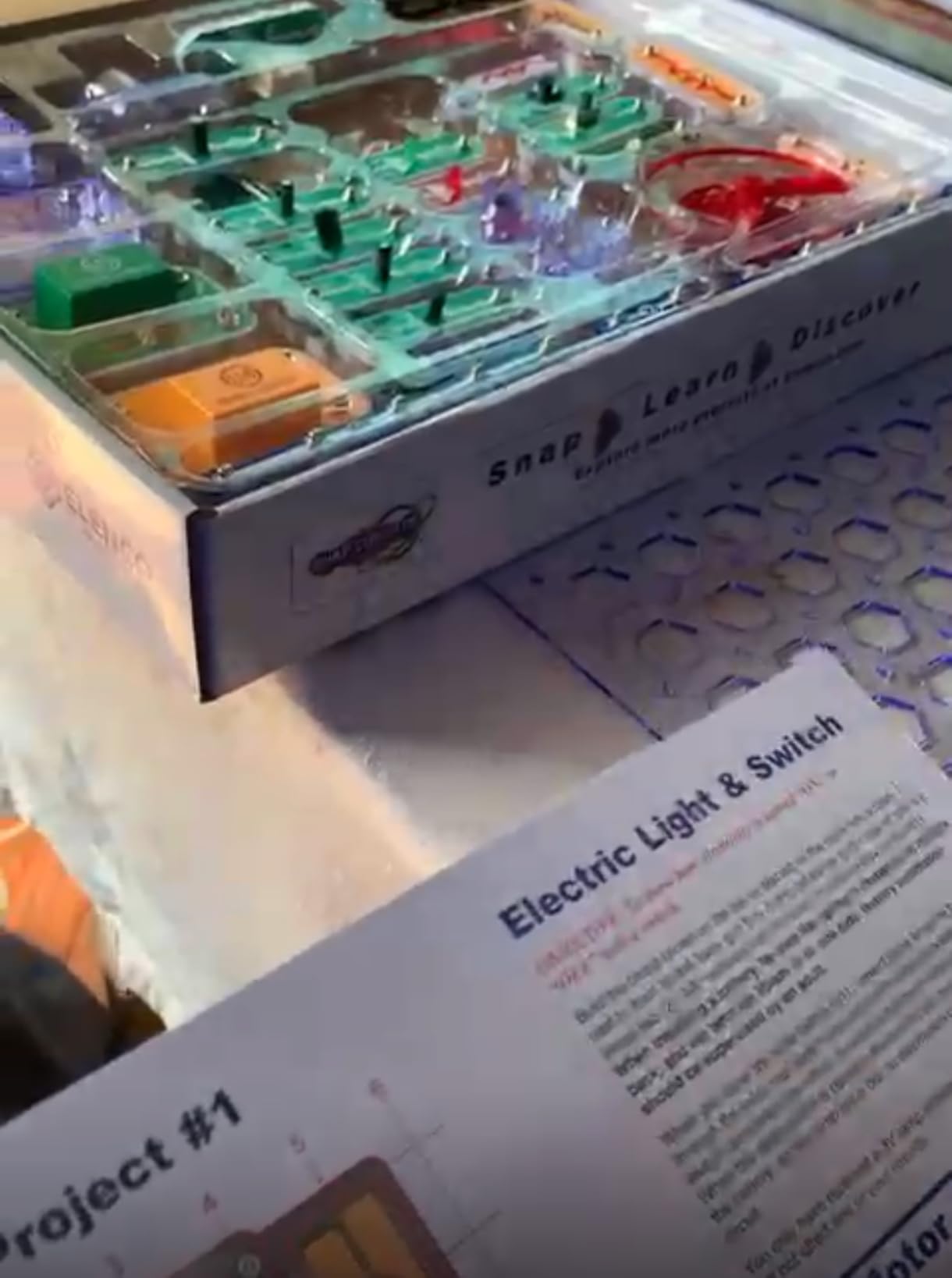
Build quality and durability across rough play
Over six weeks of testing, the snap connectors held up well to daily use, but the spring clips and small switches showed slight wear when my tester forced pieces together. The base grid is solid ABS plastic and has survived being dropped off a kitchen table multiple times. Parents on the same kit report similar patterns: gentle use lasts for years, but if your kid treats toys like construction equipment, expect to replace a few wires.
Best age range and skill progression
The 8+ age recommendation is accurate. We tested with a 7-year-old who needed help reading the manual, and a 10-year-old who built projects independently for over an hour. The progression from simple circuits to multi-component builds means the kit grows with your child. The projects are also modular: kids can invent their own circuits once they understand the basics, which extends the life of the toy far beyond the 100 printed projects.
2. ThinkFun Gravity Maze Marble Logic Game — Best Logic Puzzle STEM Toy

- Progressive challenge from beginner to expert
- Builds spatial reasoning and problem-solving
- High replay value with 60 puzzles
- Engages both kids and adults
- Some pieces may not snap securely
- Requires patience and focus
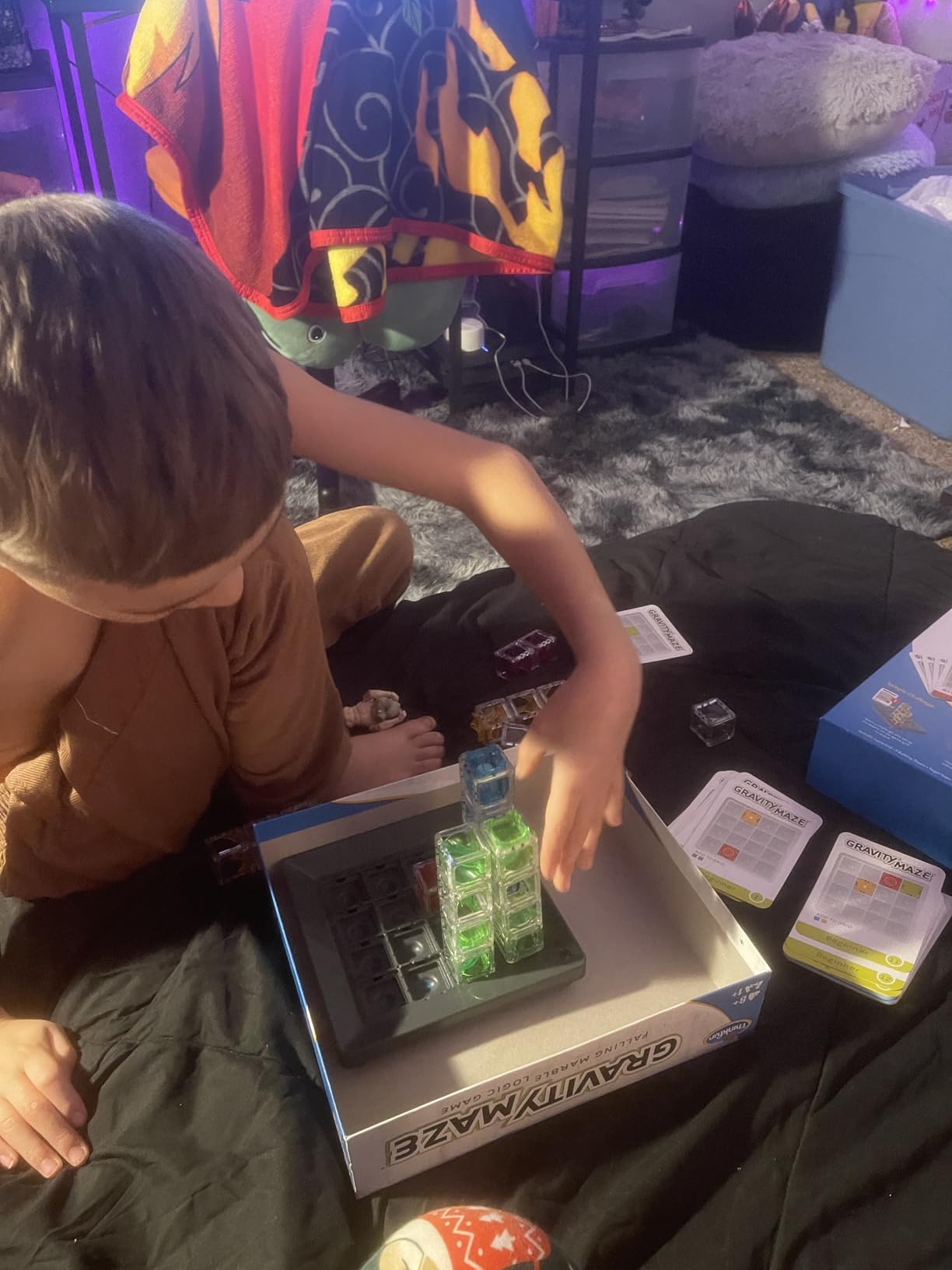
The ThinkFun Gravity Maze sits on our coffee table for three months and gets played at least once a week. My 10-year-old son calls it “the marble brain game,” which is exactly right. You arrange plastic towers on a grid to create a path for a marble to travel from start to finish. The catch: you have to solve 60 progressively harder challenges using a deck of cards that range from beginner to expert.
What surprised me was how it pulled in adults. I found myself solving the harder puzzles at night after the kids were in bed. The feeling when the marble finally rolls through the maze you designed is genuinely satisfying. It teaches the same logical thinking that coding requires: break a problem into steps, test your solution, debug when it doesn’t work, try again. No screen, no batteries, no setup hassle.
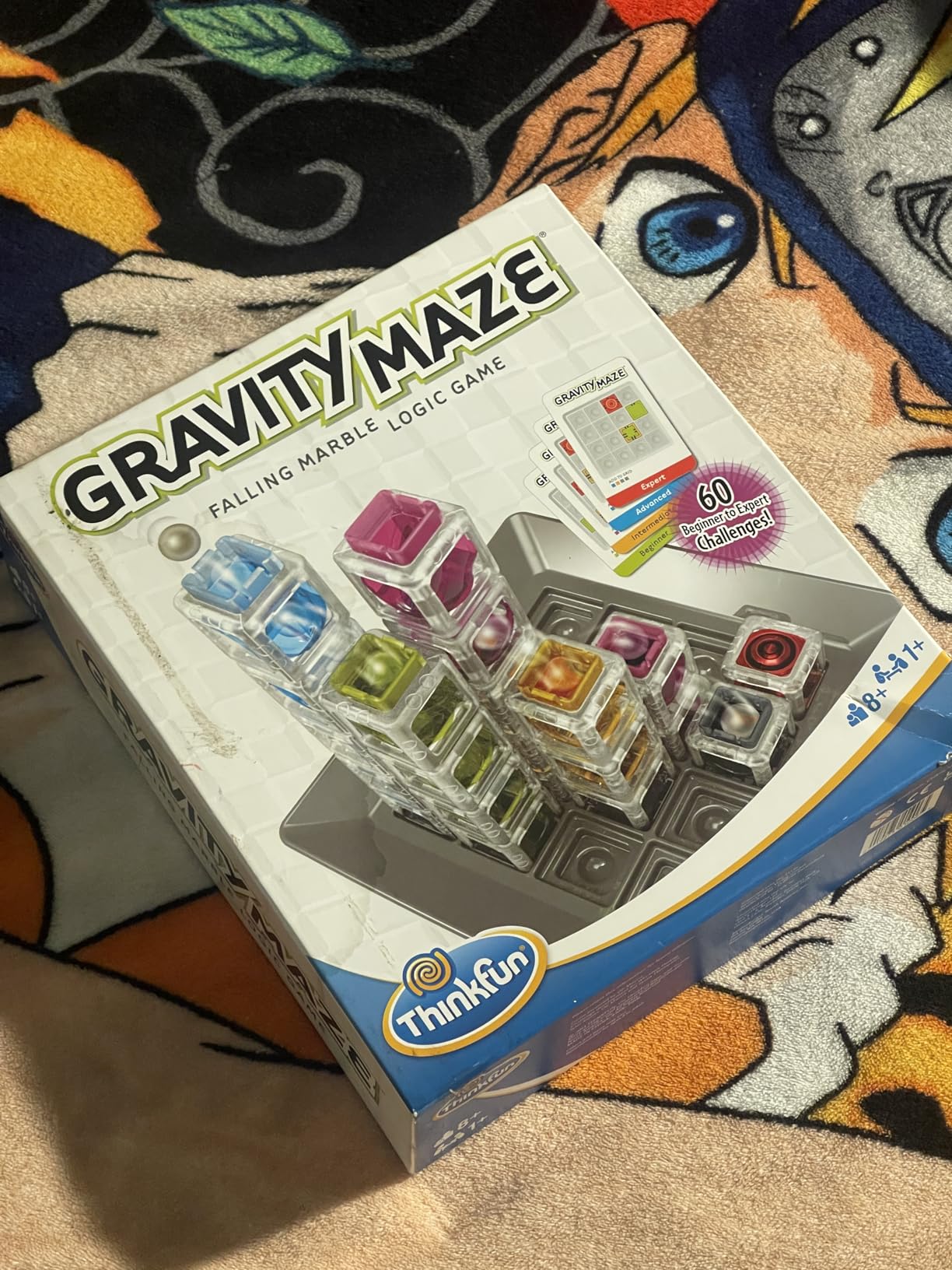
The downside we hit: a few of the tower pieces don’t snap into the base as firmly as I’d like, especially on a carpeted surface. The marble occasionally rolls out before reaching the target. The fix is to play on a hard table. The challenge cards are also designed for solo play, so siblings tend to take turns rather than collaborate, which is fine for focused work but not ideal if you want a shared activity.
Skill development versus pure entertainment
Parents often ask whether logic games actually teach anything or just keep kids busy. After watching my son spend 40 minutes on a single expert-level puzzle, I can say yes. He learned to visualize a 3D path in his head before placing towers, predicted which setups would fail, and iterated without getting frustrated. Those are foundational engineering and programming skills dressed up as marble play.
How it compares to other logic toys
We’ve tested Rush Hour and Robot Turtles, two popular logic games, and Gravity Maze stands out for its physical, tactile element. Kids who get bored of sliding cars on a grid find the marble-dropping mechanic more engaging. The 60 challenges also offer longer replay value than many competitors, which often top out at 40. The trade-off is that it requires more patience and a quieter mindset.
3. PicassoTiles 100 Piece Magnetic Tiles — Best Magnetic Building Toy

PicassoTiles 100 Piece Magnetic Tiles, Clear 3D Building Blocks for Kids 3+
- High-quality magnets that snap together securely
- Endless creative possibilities
- Tiles build towers
- houses
- vehicles
- animals
- Strong magnets allow stable tall builds
- Durable enough to withstand rough play
- Pieces can crowd smaller play surfaces
- Magnets occasionally stick to wrong side
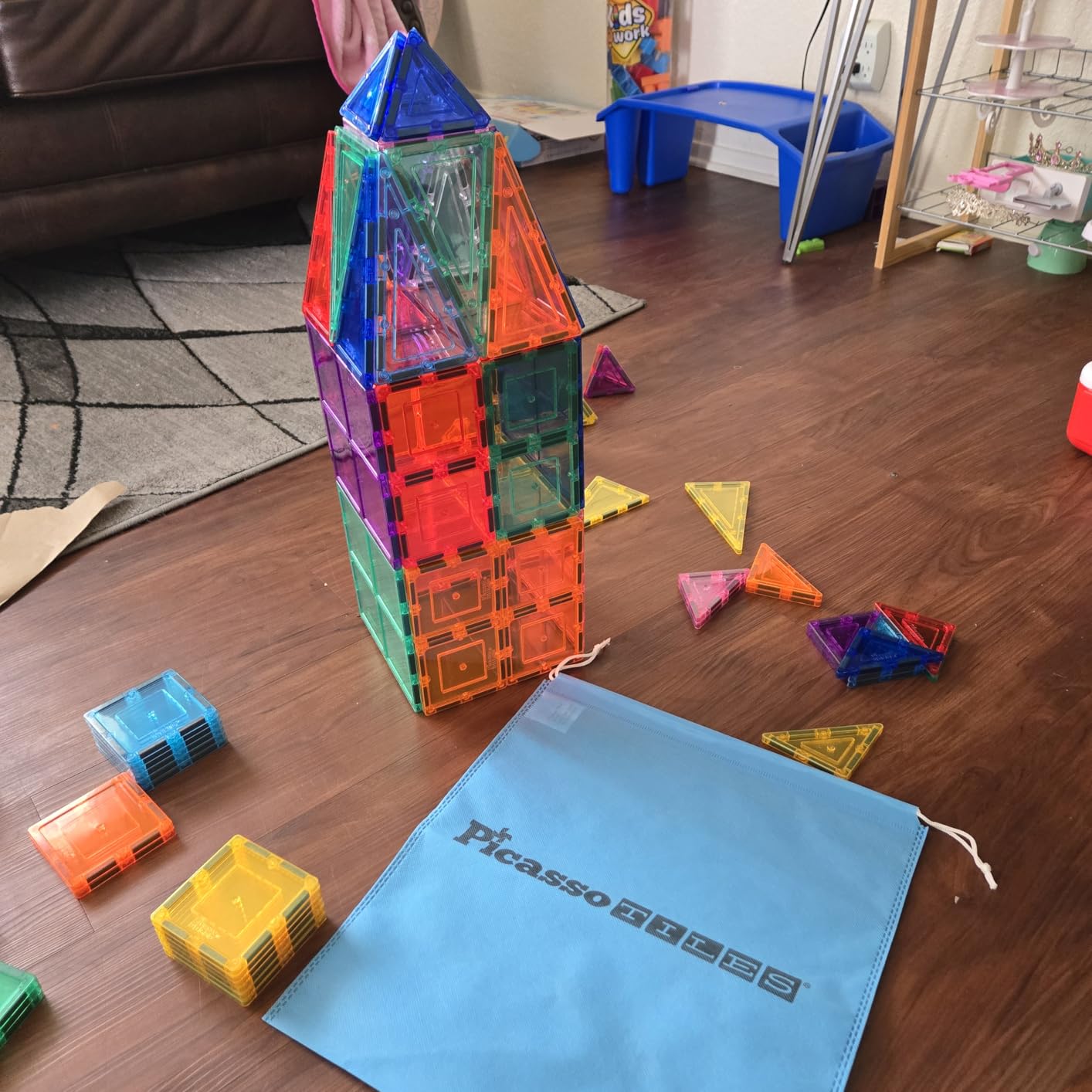
PicassoTiles have been a fixture in our playroom for over a year, and the 100-piece set is the sweet spot for families with multiple kids. I watched my 4-year-old build flat patterns and my 7-year-old construct 3D houses side by side. The clear colored tiles let you see inside your structures, which is a small detail that makes a huge difference when building anything beyond a basic shape.
The magnets in PicassoTiles are noticeably stronger than cheaper magnetic tile sets I tested last year. A tower my daughter built reached 18 inches tall without tipping, even when my 3-year-old ran past it. The pieces click together with a satisfying snap and stay put. We had a few sets where the magnets were weak and the towers kept collapsing; that’s not an issue here.
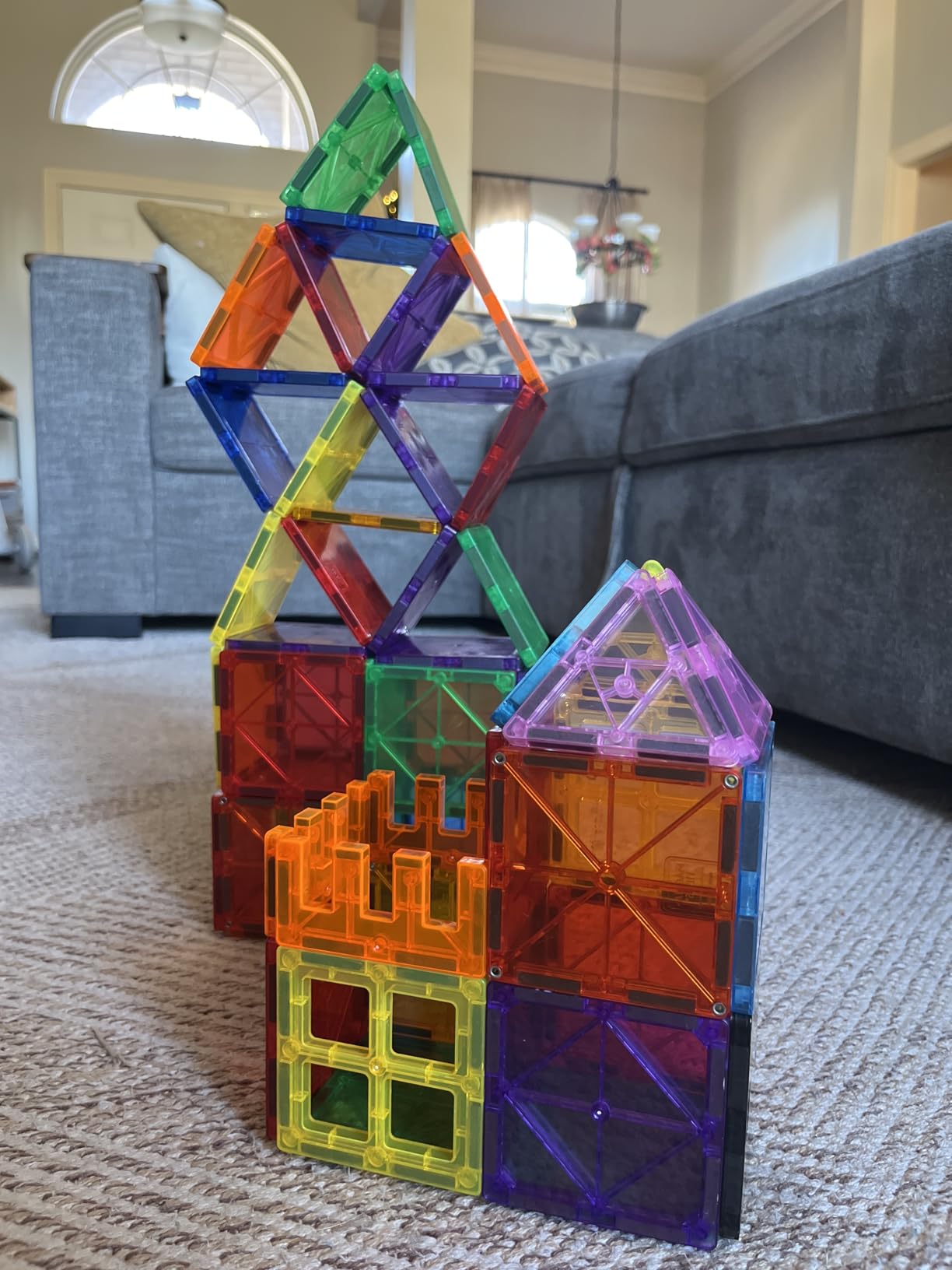
One practical concern: 100 pieces is enough for solo play or two kids, but if you have three or more children, you’ll want to buy a second set. The tiles also work great as a parent-child activity. My husband and I have spent entire Saturday mornings building geometric shapes with our kids, which is a much better use of a weekend than screen time.
Educational value beyond simple building
What surprised me was how PicassoTiles naturally introduce geometry concepts. Kids intuitively learn that two squares make a rectangle, that triangles create stronger structures, and that 3D shapes can be assembled from 2D pieces. My 5-year-old started sorting tiles by color and shape, which is early math. The sets are also gender-neutral: I see just as many girls as boys gravitating toward them in our playgroup.
Storage and organization tips
One hundred pieces scattered across the floor is a real pain to clean up. We use a dedicated storage bin with a lid, and the kids know to put all tiles back before getting out the next toy. The tiles are also compatible with other magnetic tile brands, so you can mix and match if you want to expand your collection without buying a whole new set.
4. Brain Flakes 500 Piece Set — Best Budget STEM Building Toy

- Durable discs that click firmly
- Develops fine motor skills
- 500 pieces in 12 colors
- Screen-free quiet-time activity
- BPA
- lead
- heavy metal
- phthalate free
- Storage bucket lid handle may come loose
- Structures naturally build right angles
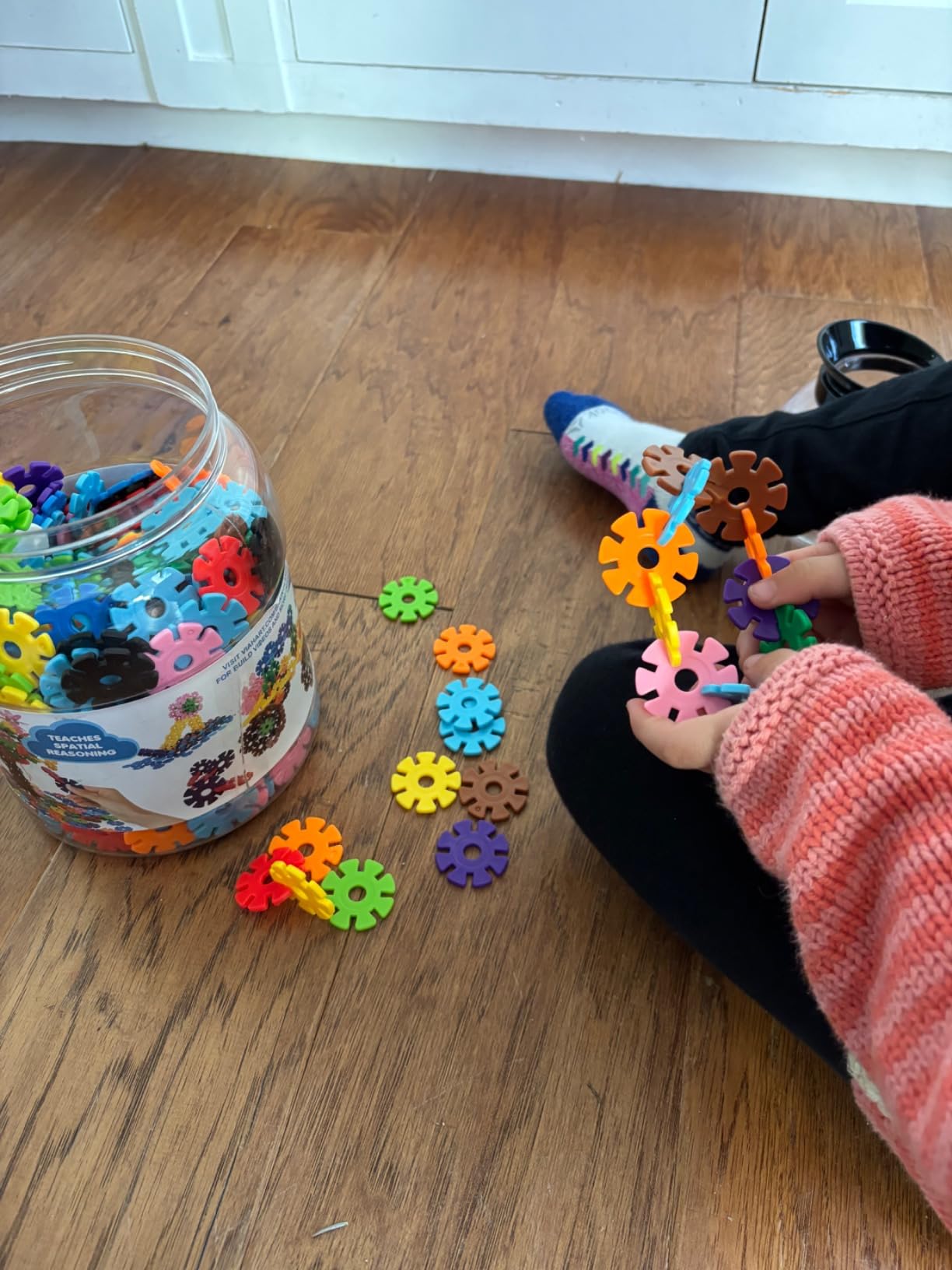
The Brain Flakes 500-piece set is the best value in this entire guide. For under $20, you get 500 colorful interlocking discs that click together with a satisfying snap. My kids use them to build flat mosaics, 3D sculptures, and geometric shapes. The set comes in a storage jar with a yellow screw-on lid, which is critical because 500 loose pieces will end up everywhere if you don’t have a container.
I tested Brain Flakes in our elementary school maker space, and the kids gravitated toward them during free choice time. The discs are BPA-free and meet ASTM safety standards, so I felt comfortable letting 4-year-olds play without supervision. The discs also interlock firmly enough to build vertical structures, which is rare in budget building toys. My 6-year-old built a giraffe that stood 8 inches tall without falling over.
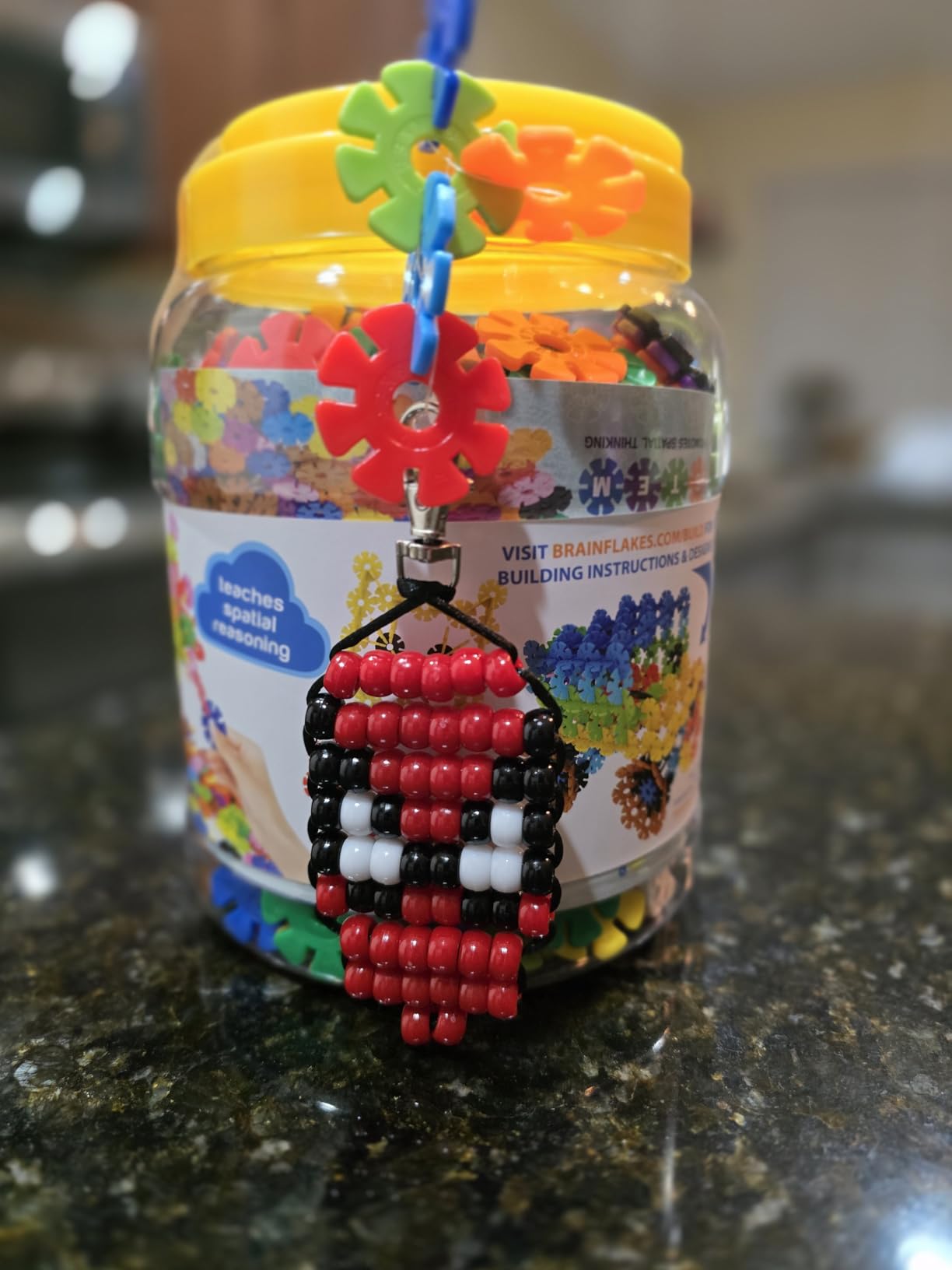
One real-world issue: the handle on the storage jar lid can loosen over time. After about three months, the handle on our jar fell off and we had to transfer the pieces to a different container. This is a minor inconvenience, not a deal-breaker, but worth knowing. The pieces themselves are extremely durable and have survived being stepped on, dropped, and chewed by my teething puppy.
Why this beats pricier alternatives
I compared Brain Flakes to a $60 competitor set, and the only real difference was packaging and brand recognition. Brain Flakes discs click together just as firmly, come in just as many colors, and offer the same open-ended play. For classrooms, homeschool co-ops, or large families, the 500-piece count is essential. A 100-piece set disappears in a day; 500 pieces gives kids room to build something ambitious.
Skill development across age groups
Brain Flakes work for ages 3 to 99, as the box says. Toddlers use them for color sorting and basic stacking, elementary kids build complex structures, and adults use them as a stress-relief fidget. The pieces are quiet, which makes them great for restaurants and waiting rooms. They also pack flat, so they travel well.
5. Sillbird 12-in-1 Solar Robot Building Kit — Best Solar STEM Toy

Sillbird 12-in-1 Solar Robot Building Kit STEM Gift for Boys Ages 8-13
- 12 different robot models to build
- Powered by sunlight for renewable energy education
- 190 parts with clear step-by-step instructions
- Varying difficulty levels grow with the child
- Screen-free fun
- Solar panel may not work reliably in low light
- Gears may not fit perfectly together
- Quality control can be inconsistent
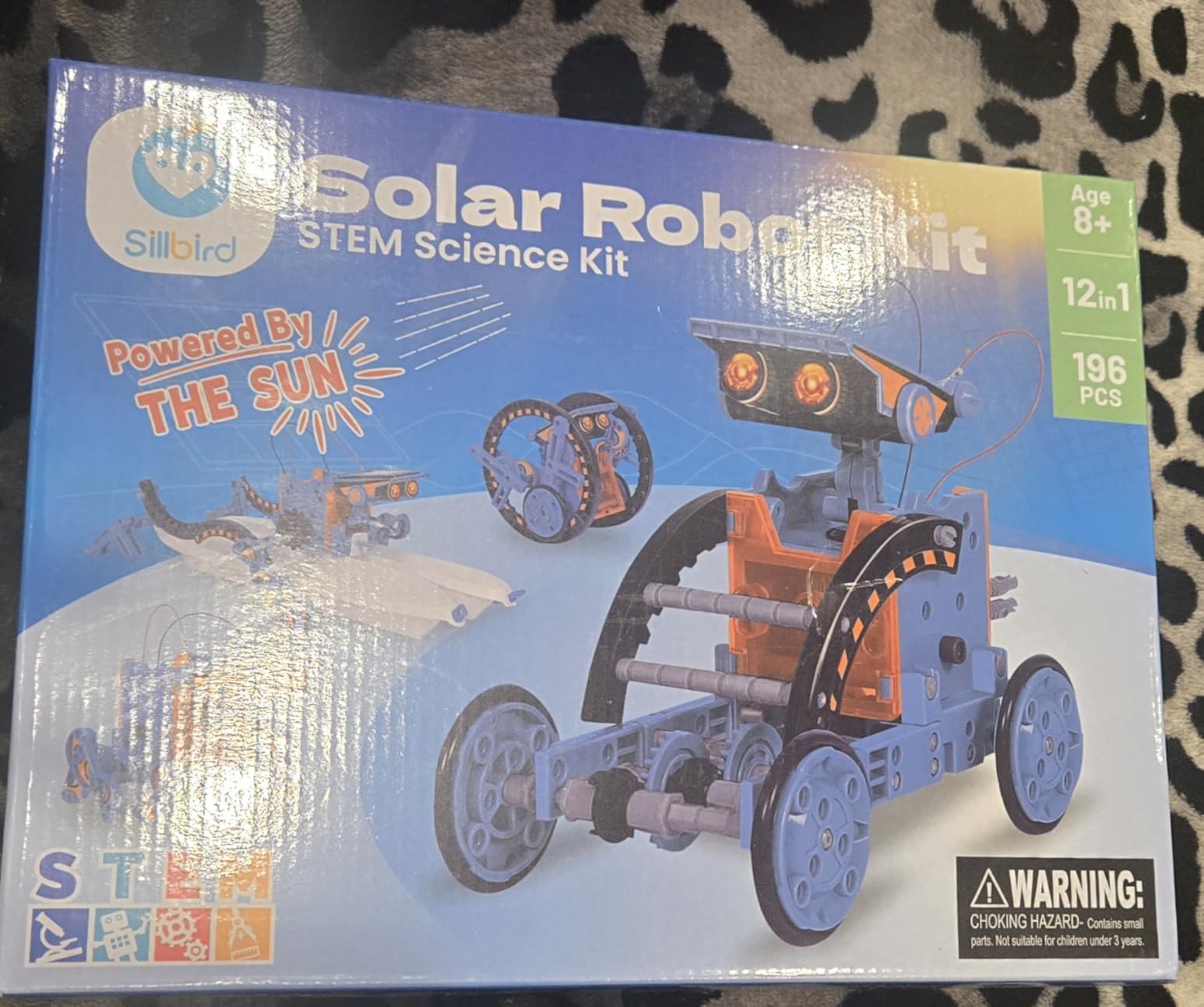
The Sillbird 12-in-1 Solar Robot Kit teaches renewable energy concepts through hands-on building. I tested it with my 9-year-old, and we built three different robots in one afternoon: a walking crab, a rolling vehicle, and a dog. The clear instruction manual uses diagrams rather than wordy text, which is helpful for kids who get frustrated with too much reading. The solar panel actually works in direct sunlight and propels the robots with no batteries required.
What makes this kit stand out is the renewable energy education. My son didn’t just build a robot; he learned that the sun can power mechanical movement without electricity or batteries. He also learned the concept of gear ratios by adjusting which gears he used in each build. The 12 different models mean the kit has real replay value, and parts leftover from one build can become spare parts for another.
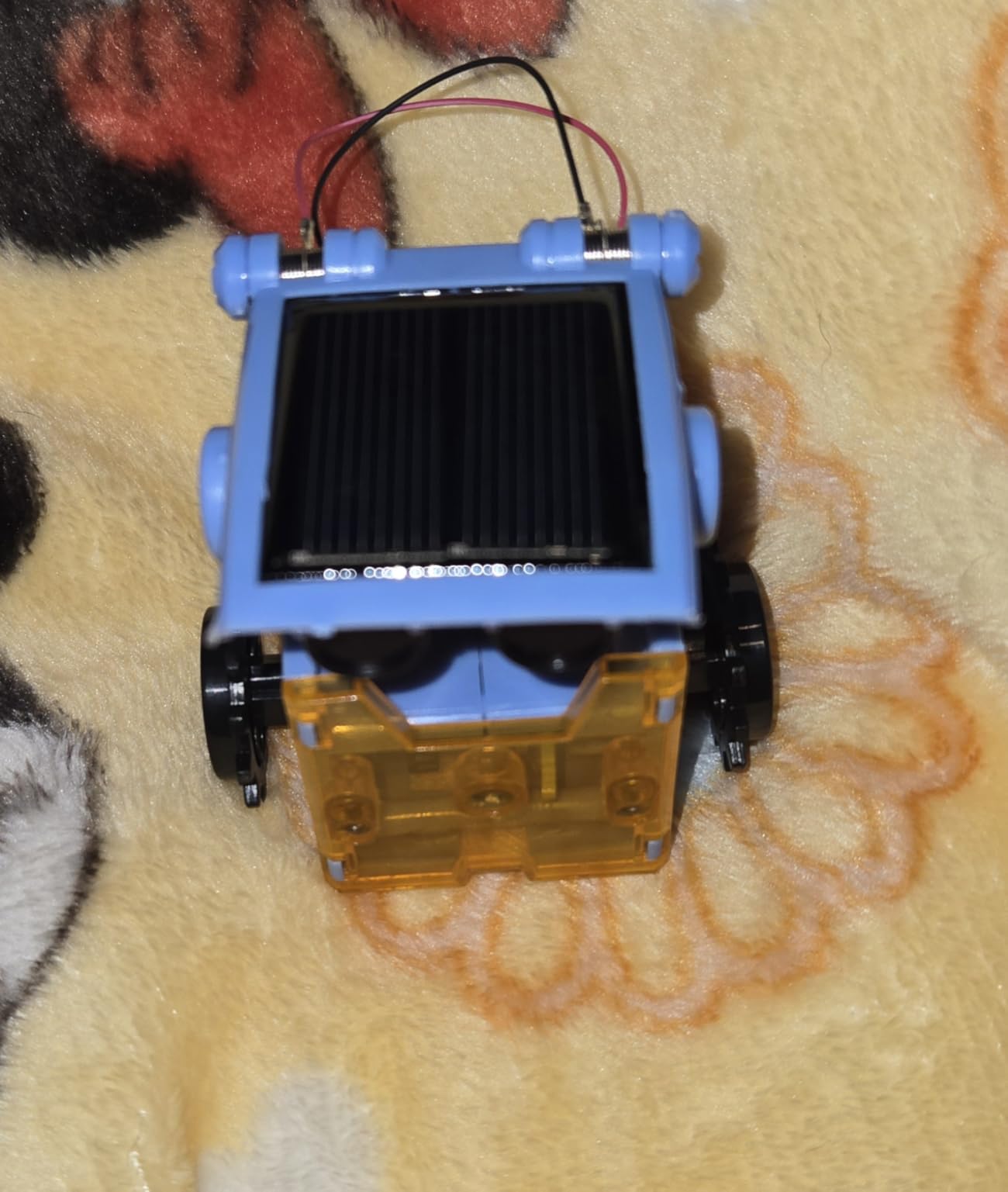
The honest downside: the solar panel needs direct sunlight or a very bright artificial light to work consistently. In our testing room, we had to use a desk lamp held 6 inches from the panel to get reliable operation. Quality control is also hit or miss. We had one defective gear in our kit, but the rest worked fine. Some online reviews mention missing parts, so check your pieces count before starting a build.
Educational value versus build complexity
Each robot model takes 20-40 minutes to build, depending on the design. The instructions start simple and progress to more complex builds with multiple moving parts. By the 6th or 7th model, kids start to understand which pieces they need and can experiment with their own designs. This is genuine engineering practice, not just following a recipe.
What age works best for this kit
The 8-13 age range is accurate. Younger kids need help with small parts and may struggle with the gear alignment. Older kids can build the more complex models independently. The kit also works well for siblings of different ages to build together. My 7-year-old watched and learned while my 9-year-old led the build, and they collaborated on the troubleshooting.
6. Officygnet Take Apart Dinosaur Toys — Best STEM Toy for Dinosaur Lovers

- Hands-on STEM learning for fine motor skills
- Kid-friendly tools designed for small hands
- Durable with smooth edges
- Vibrant dinosaurs with movable joints
- Screws may loosen after being tightened
- Younger children may need supervision
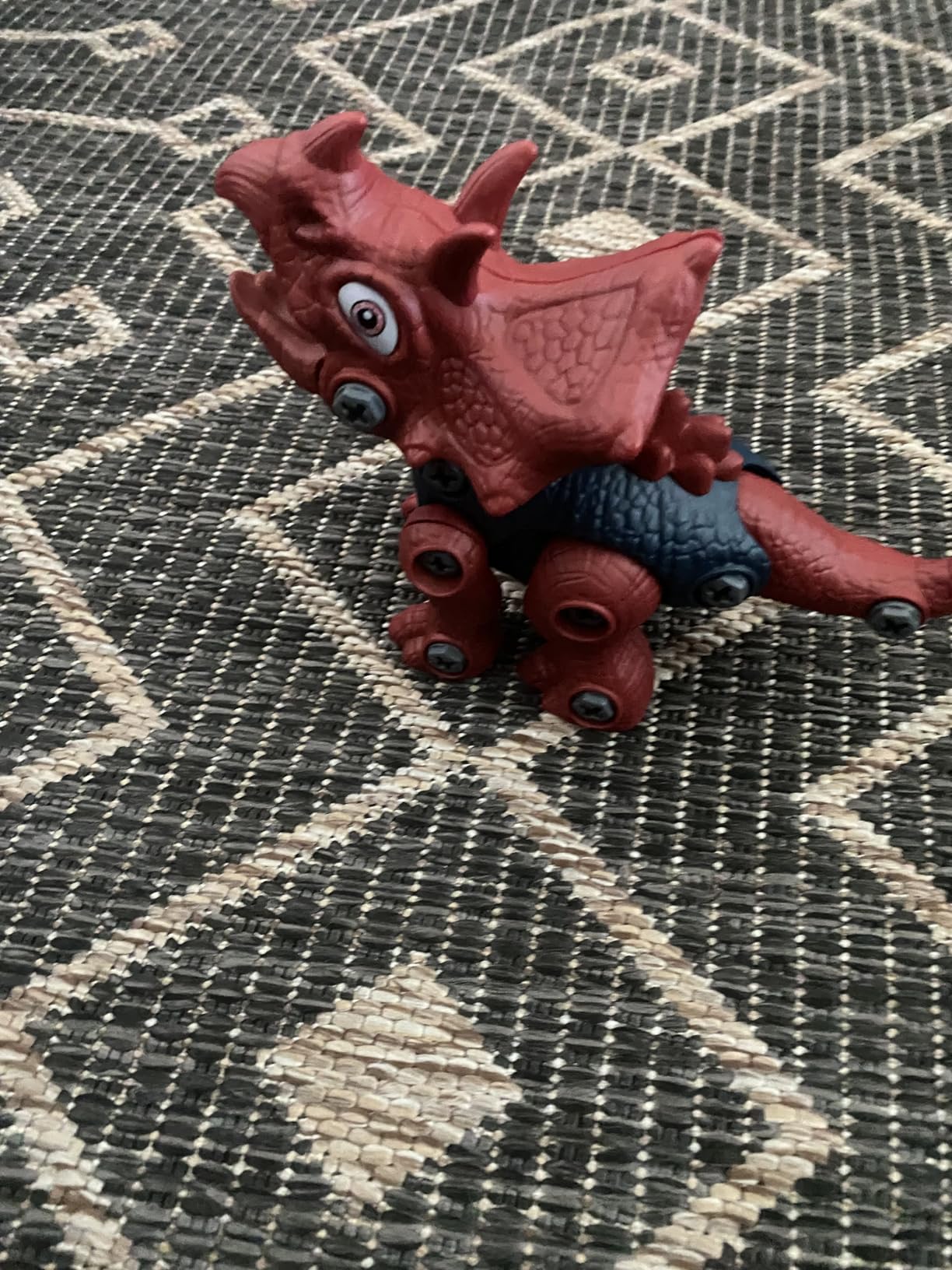
If your kid is obsessed with dinosaurs, this take-apart set is a home run. The kit includes four dinosaurs (T-Rex, Triceratops, Velociraptor, Parasaurolophus), each with screws that kids can take apart and reassemble using a low-speed electric drill and manual screwdrivers. My 5-year-old spent an entire Sunday afternoon disassembling and rebuilding the T-Rex over and over. The dinosaurs have movable joints, so they can be posed in different positions once assembled.
The electric drill is the real star here. It’s battery-powered but spins slowly enough to be safe for small hands. The drill also has two speed settings and interchangeable bits, so kids can experiment with different ways of fastening the screws. The manual screwdrivers work as a backup, which is useful when the drill batteries run out. The dinosaurs are made of durable ABS plastic with no sharp edges.
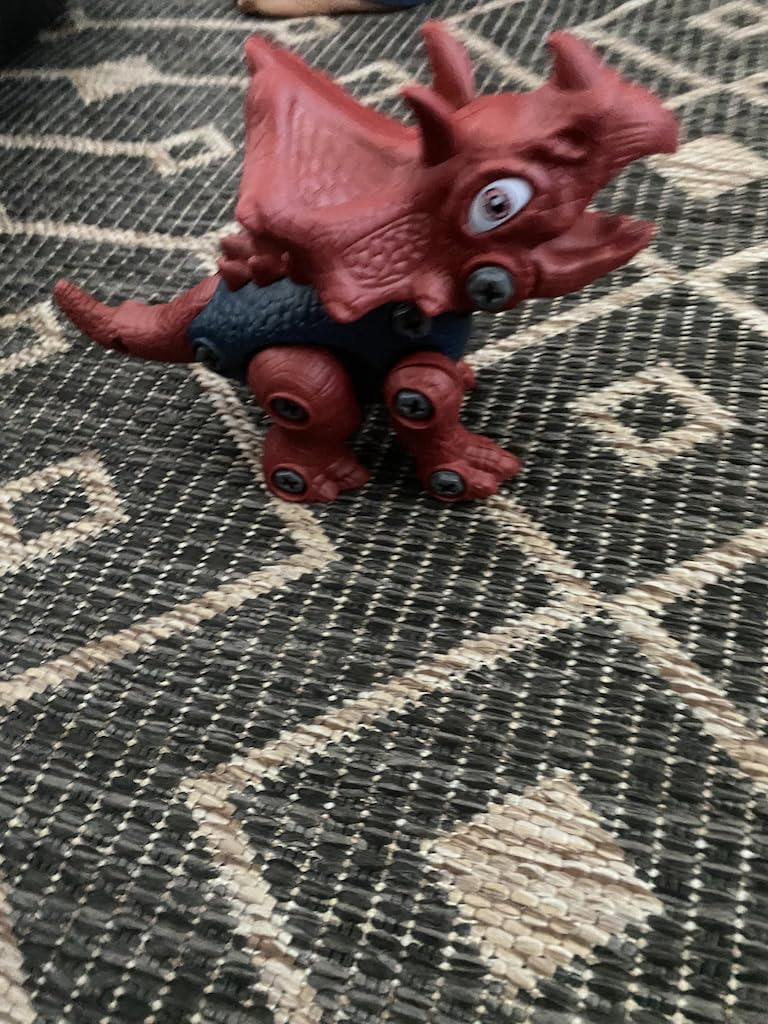
One thing to know: the screws can loosen over time with rough play, even after being fully tightened. We had to replace a few screws after a month of daily use. Younger kids (under 4) also need help aligning the screws with the holes, which can be frustrating. But the inclusion of a low-speed electric drill that actually works sets this kit apart from cheaper take-apart toys that use a manual screwdriver only.
Real learning versus just playing
What I appreciate about this kit is that it teaches mechanical concepts in a way that feels like play. Kids learn that screws hold things together, that different drill bits have different functions, and that you can take things apart and put them back together. Those are foundational engineering skills. The dinosaur theme also makes it appealing to kids who might not otherwise be interested in building toys.
Safety considerations for younger users
The kit is rated for ages 3 and up, and the parts are large enough to not be a choking hazard. The electric drill is low-speed, but I still recommend parental supervision for kids under 5. The drill makes a whirring sound that can be loud, so be aware if your child is sensitive to noise. Overall, this is one of the safer STEM toys on the market for the early elementary set.
7. iPlay iLearn Rocket Space Toy — Best Space-Themed STEM Toy

iPlay, iLearn Rocket Space Toy 3 4 5 Year Old Boys Kids Girls, Toddler STEM
- Solid plastic with smooth edges
- Encourages hands-on play and imagination
- STEM-style assembly with pretend play
- Interactive lights and sounds
- Younger kids may need help with the drill
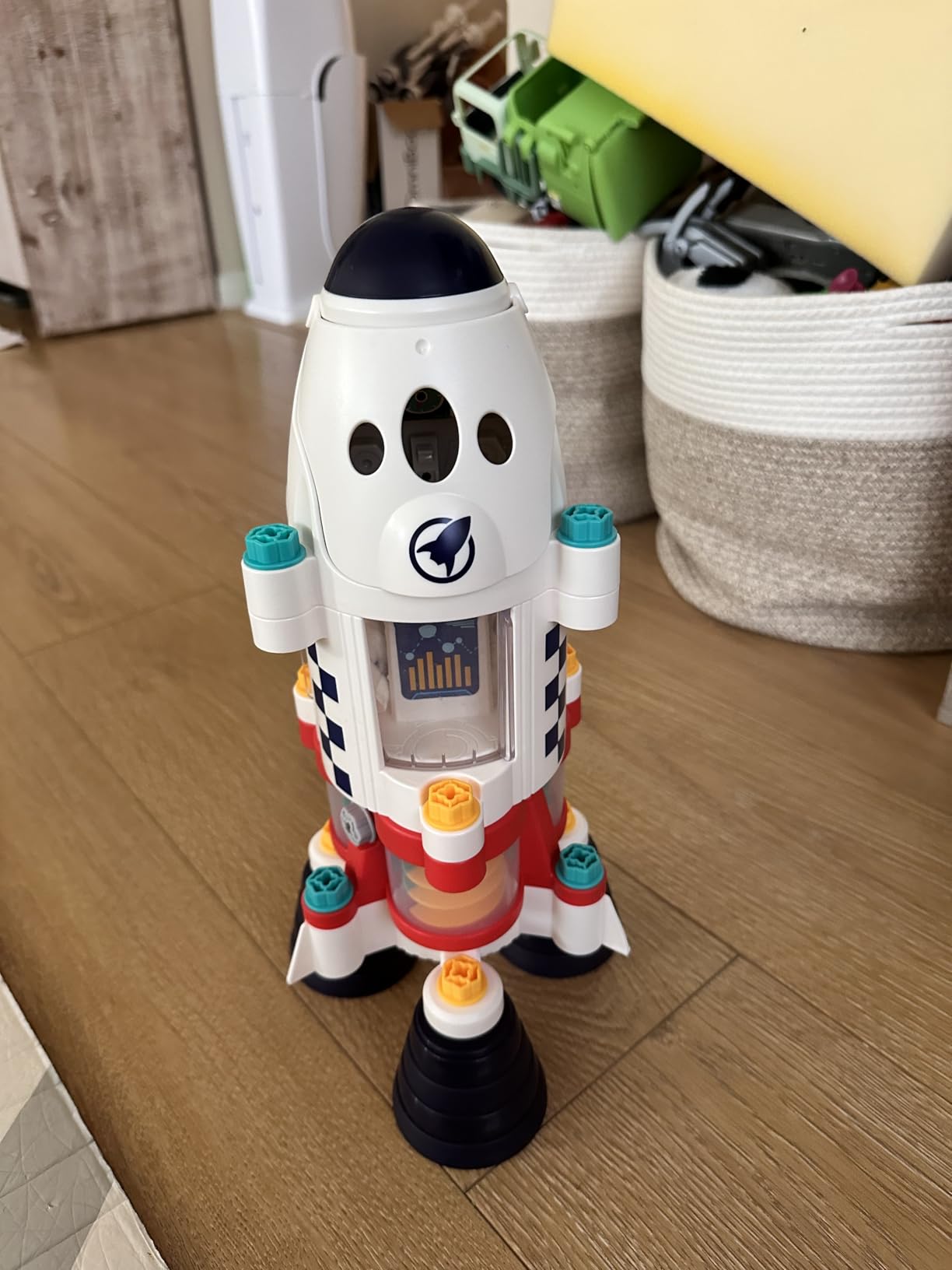
The iPlay iLearn Rocket set is the most-requested toy in our playroom right now. My 5-year-old builds the rocket, attaches the boosters, and stages elaborate space missions with the two astronaut figures. The rocket has working lights and sound effects, which add a level of immersion that simpler building sets don’t offer. The battery-powered electric drill has a low-speed setting that’s safe for small hands.
What I appreciate is the balance between assembly and pretend play. Kids spend 15-20 minutes building the rocket, then get 30+ minutes of imaginative play launching it and rescuing astronauts. The cockpit has simulated sound effects, and the turbine engine has spinnable blades. The rocket is made of high-quality ABS plastic and has survived being dropped, kicked, and flown into walls at high speeds.
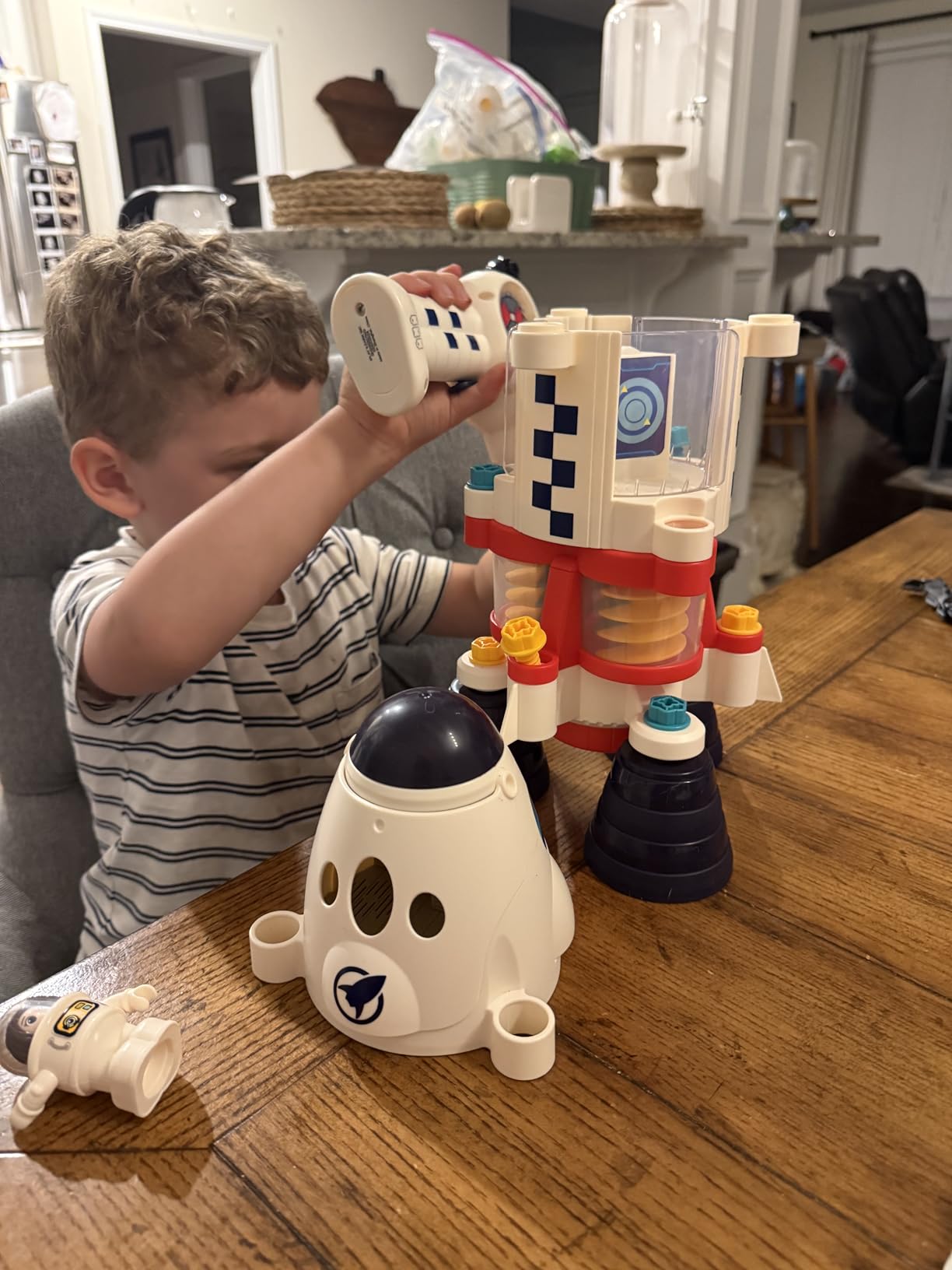
The set is best for ages 4-8. Younger kids need help with the drill and aligning the pieces, while older kids may want something more challenging. The instructions are visual and easy to follow, but the build is complex enough that most kids will need a parent nearby for the first build. The rocket also requires 3 AA batteries for the lights and sounds, which are not included.
Why this beats standard building toys
Most building toys stop being fun once the structure is complete. The iPlay iLearn Rocket extends the play value by adding pretend play elements. My kids use the rocket for space-themed games for days after building it. The lights and sounds feel premium, not cheap, and the astronauts are detailed enough for serious imaginative play. This is a toy that grows with the child: the assembly is the STEM skill, and the pretend play is the creative application.
Compatibility and expansion options
The set works well on its own, but it pairs nicely with other space-themed toys. We combined it with a cheap constellation projector and a solar system poster, and the play sessions doubled in length. The rocket is also a great companion to building block sets. My 6-year-old built a launch pad out of LEGO bricks and used the rocket as the centerpiece.
8. National Geographic Earth Science Kit — Best Earth Science STEM Kit

National Geographic Earth Science Kit with 100+ Activities for Kids 8-12
- 15+ experiment activities including water tornadoes and volcano building
- Great to share with family or classmates
- Detailed Learning Guide explains the science
- Clear instructions build confidence
- Instructions could be clearer with more component photos
- Some experiments require common household items
National Geographic’s Earth Science Kit is a science fair in a box. It includes 100+ activities covering crystal growing, volcano building, rock and mineral identification, and water tornado experiments. I tested it with my 8-year-old over a long weekend, and we completed 8 different experiments. The Learning Guide is the real standout: it explains the science behind each activity in kid-friendly language, so my son learned why crystals form, not just how to make them.
The kit comes with most of the materials you need, which is a major plus compared to science kits that assume you have specific supplies at home. We had to provide basic household items like vinegar and baking soda for a few experiments, but nothing exotic. The crystals took about 3 days to grow, which taught my son patience and the concept of time in chemical reactions.
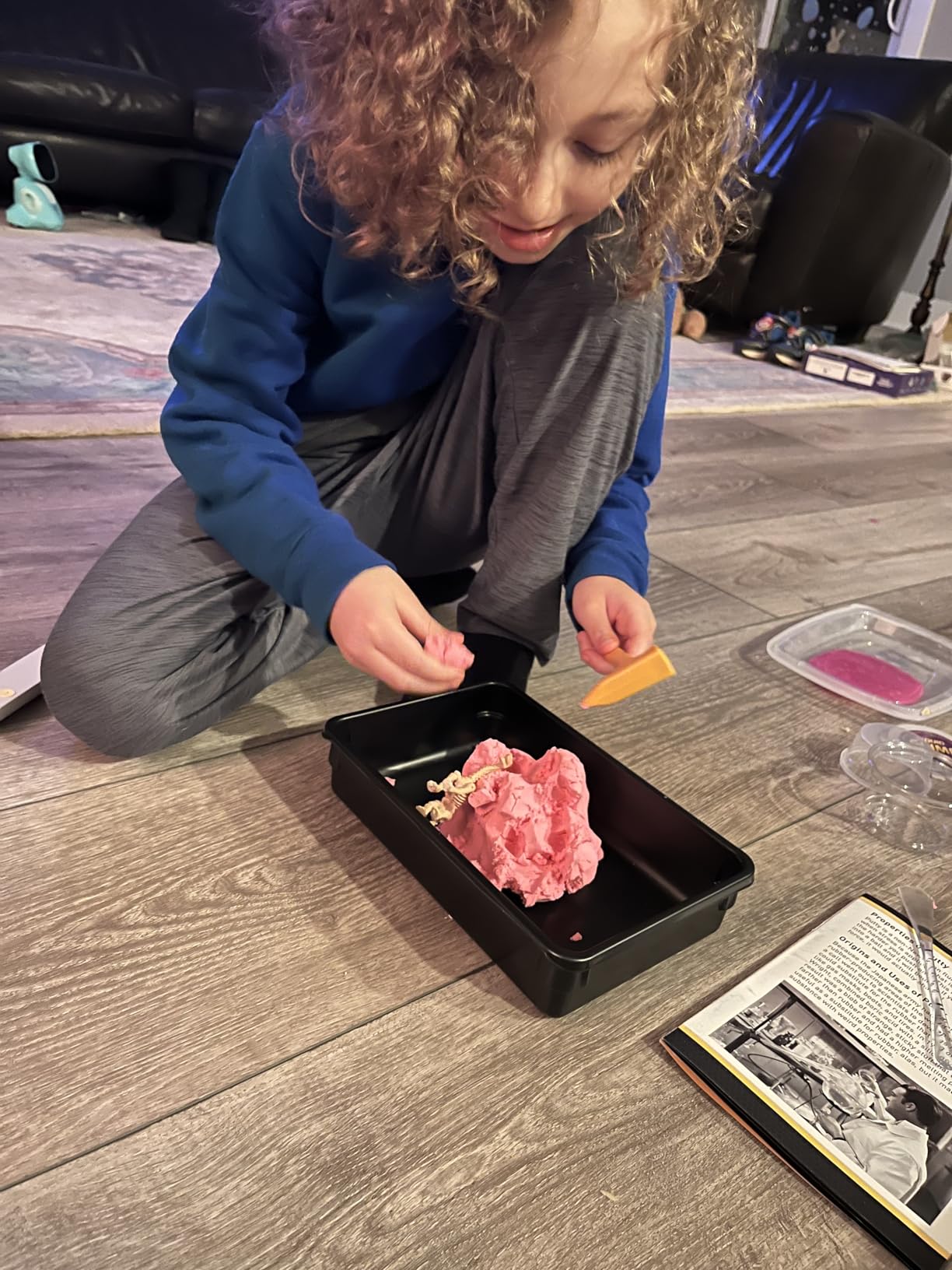
One minor issue: the instruction manual could use better photographs showing each component before the activity starts. We had a few moments of “which baggie has the blue crystals?” that slowed us down. The kit also requires a fair amount of adult involvement for younger kids, especially when measuring chemicals or handling the volcano eruption. Older kids (10+) can do most activities independently.

What age range benefits most from this kit
The 8-12 age range is accurate. We tested with a 7-year-old who needed help with almost every step and a 10-year-old who completed two activities independently. The complexity ramps up: the first activities are simple crystal growing, while later projects include multi-step chemistry. The Learning Guide scales with the activities, so older kids get more detailed science explanations.
Real educational value versus surface-level fun
What separates this kit from cheaper science toys is the depth of the educational content. Each activity includes an explanation of the underlying science, suggested variations, and follow-up questions. My son would do an experiment and then immediately ask “why did that happen?” The Learning Guide answered most of his questions, which made the kit feel like a real science class, not just a craft project.
9. Learning Resources STEM Explorers Pixel Art Challenge — Best Screen-Free Coding Toy

- Develops problem-solving and spatial reasoning
- Teaches coding concepts through pixel art
- Strengthens hand-eye coordination
- Screen-free learning adventure
- Foam cubes are lightweight and can move around
- Limited pieces per color for complex designs
- Only 1 board included despite the photos
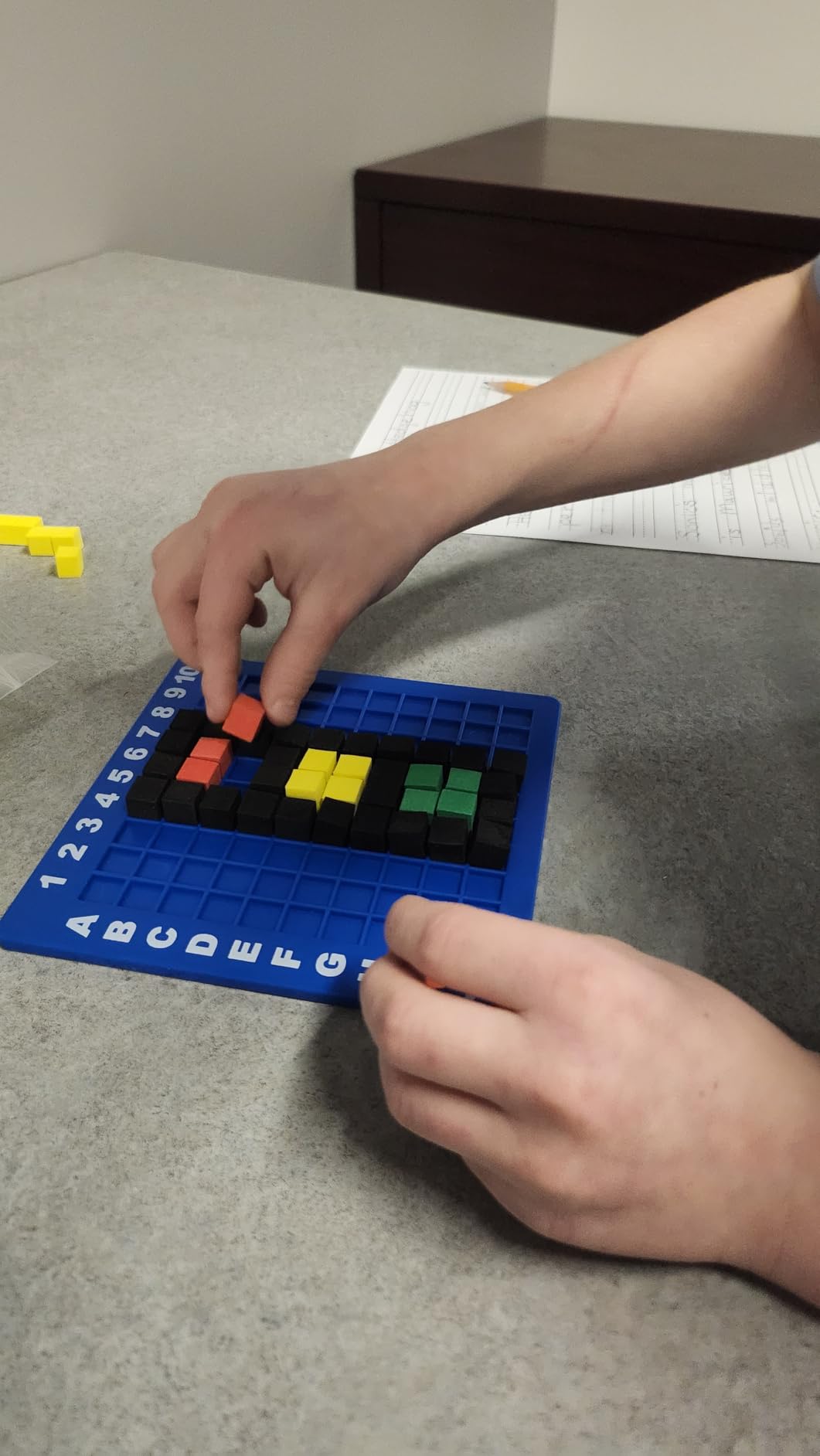
The Learning Resources Pixel Art Challenge is one of the smartest screen-free coding toys I’ve tested. It comes with 400 colorful foam cubes and 40 challenge cards that teach kids to think like programmers. My 7-year-old and I worked through the beginner challenges together, and he could complete the intermediate challenges independently after a few sessions. The cubes stack on a single board, and the goal is to recreate pixel patterns based on the challenge cards.
What makes this toy different from other coding kits is that it teaches the actual logic of programming without a screen. Kids learn to break a picture into rows, identify color patterns, and execute step-by-step instructions. The challenge cards are well-designed and progress from simple 2-color patterns to complex multi-color designs. My son didn’t realize he was learning binary logic and sequencing because he was too busy solving puzzles.
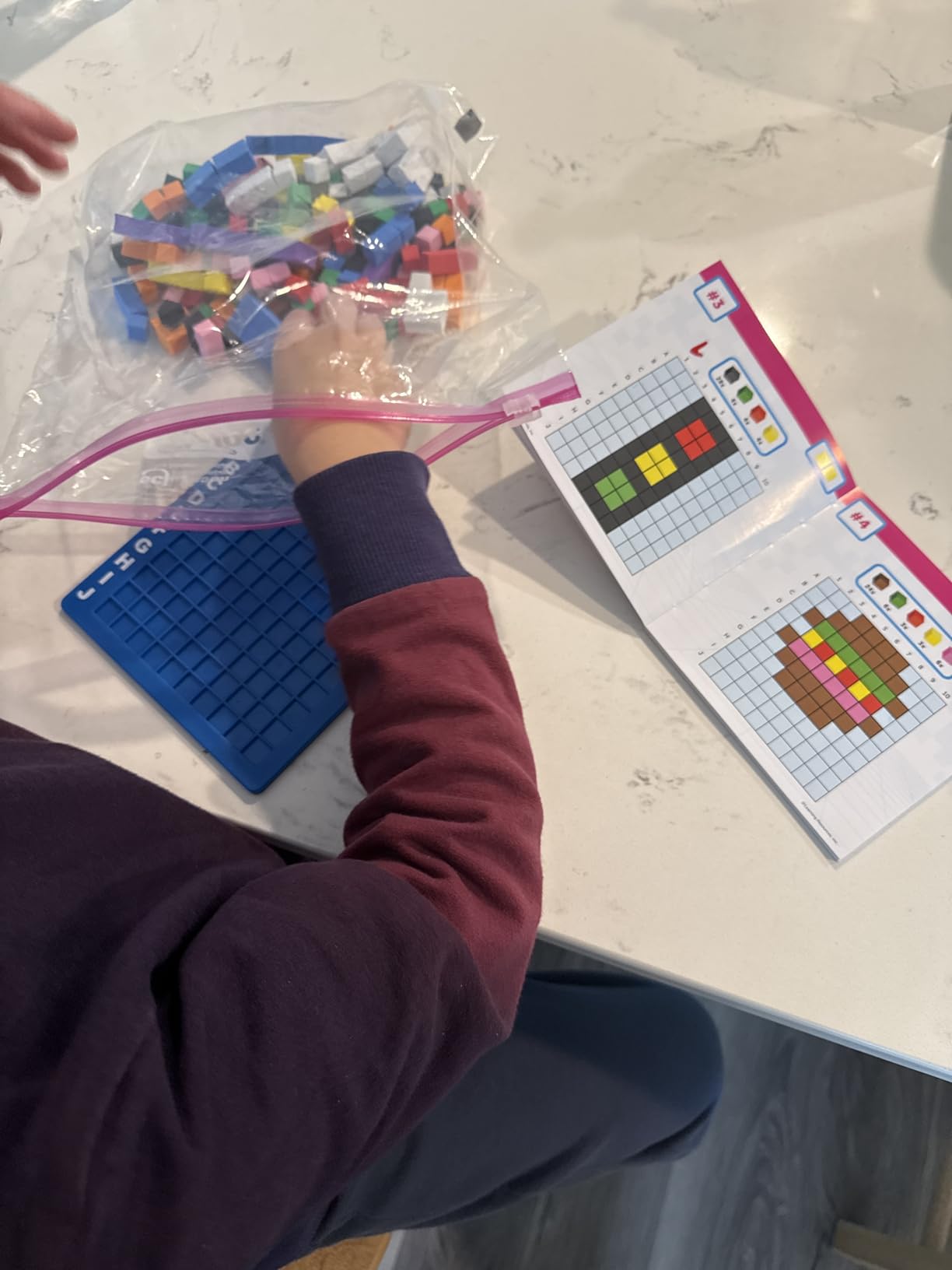
The main issue: the foam cubes are lightweight, so they shift around if the board gets bumped. We learned to play on a flat table with no vibrations. The other concern is that only one board is included, so only one kid can build at a time. For siblings or classrooms, you’ll need to buy multiple sets. The 40 challenges also go by quickly; my son finished the entire deck in 3 weeks.
How it compares to tablet coding apps
We’ve tested several popular coding apps, and the Pixel Art Challenge does something those apps can’t: it gets kids off screens. The tactile element of placing foam cubes is more engaging than tapping a screen, and the physical manipulation helps younger kids develop fine motor skills. The kit is also a good bridge for kids who want to learn real coding later. The sequencing and pattern recognition concepts transfer directly to Scratch and other beginner coding platforms.
Best age range and skill level
The 5+ age range is accurate. We tested with a 5-year-old who needed help reading the patterns and a 9-year-old who breezed through the entire deck. The challenges are well-paced, but kids who are visual learners and like puzzles will get the most out of this toy. It’s also a good fit for kids who get frustrated with tablet-based learning. The hands-on approach is more forgiving and tangible.
10. National Geographic Glow-in-the-Dark Marble Run — Best Marble Run STEM Toy

National Geographic Glow-in-the-Dark Marble Run for Kids Ages 8-12
- Sturdy tight-fit pieces
- 15 glow-in-the-dark glass marbles
- Large storage bag included
- Learning guide teaches physics of motion
- Award-winning toy
- Instructions could be better and may require experimentation
- Pieces can be wobbly on carpet
- Some pieces may be defective
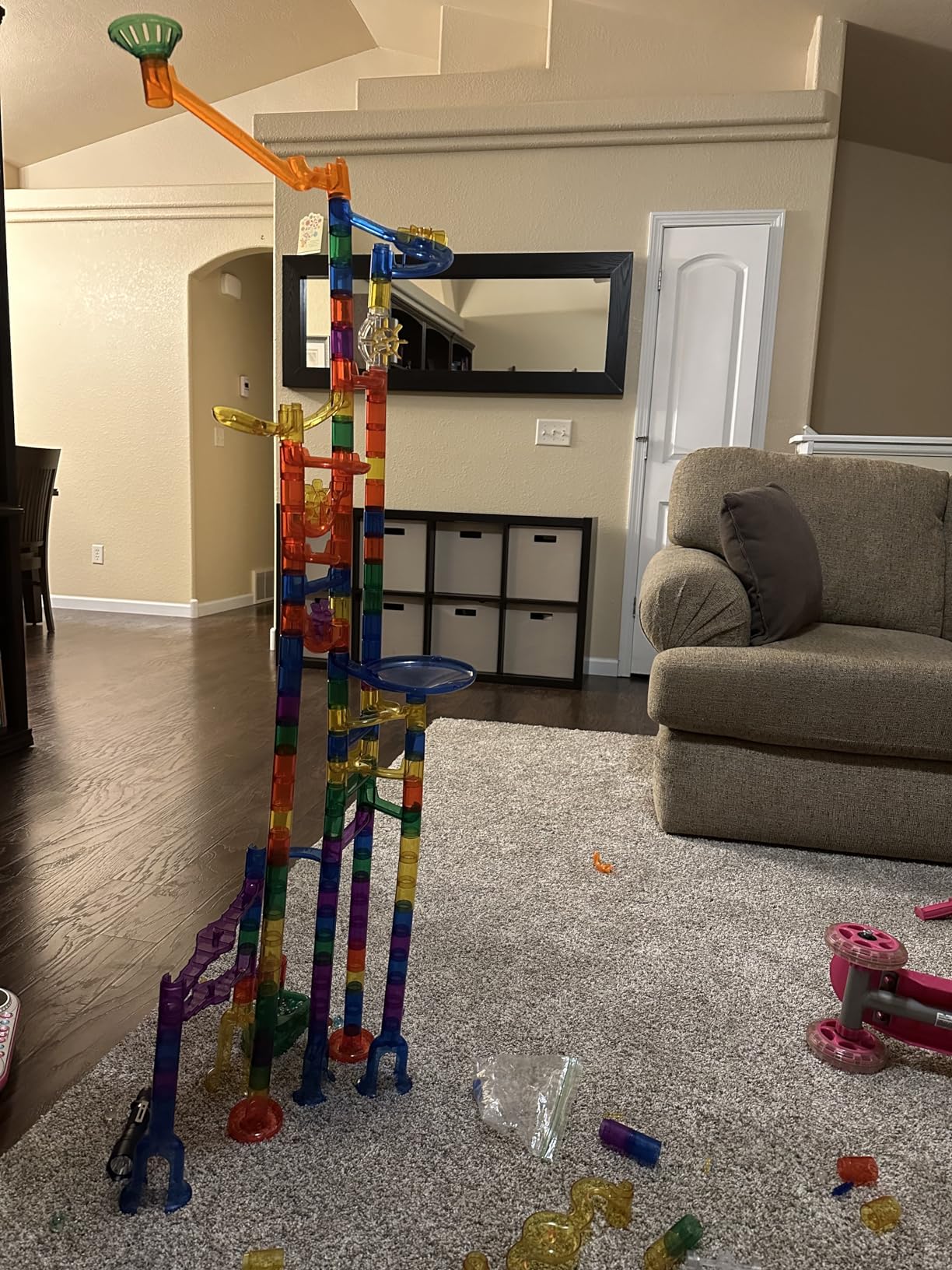
The National Geographic Glow Marble Run is a showstopper. My 8-year-old built a 30-inch-tall marble run with multiple twists and turns, then turned off the lights to watch the glass marbles glow as they zigzagged through the tubes. The set includes 15 glow-in-the-dark glass marbles in 6 colors, 80 track pieces, 5 bases, and a large storage bag. The pieces click together firmly enough that taller structures hold up during play.
What separates this marble run from cheaper options is the educational content. National Geographic includes a learning guide that teaches the physics of motion, gravity, and aerodynamics. My son learned why steeper inclines make marbles go faster and why curves cause energy loss. The kit is also a Toy of the Year Award winner, which is well-deserved. The pieces are durable and have survived multiple rebuilds and a few drops from the kitchen table.
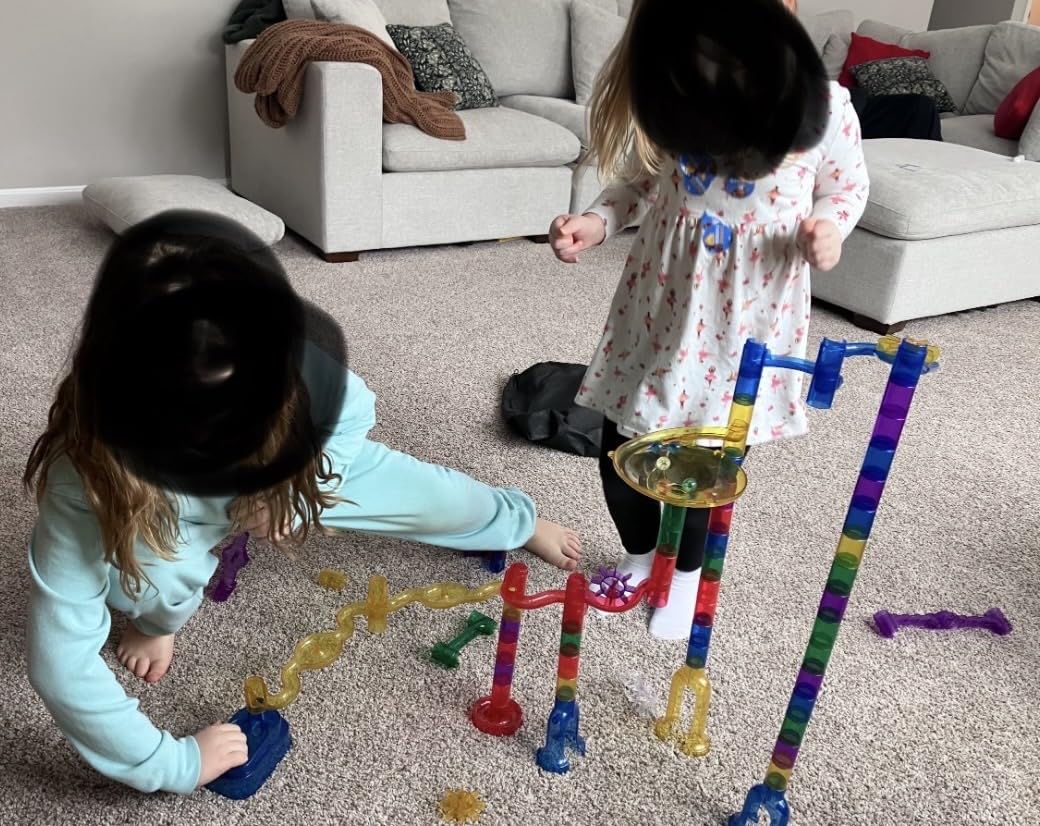
The honest downsides: the instructions are not the strongest part of this kit. We had to experiment with different configurations to find what worked, which was actually fun but frustrating for some kids. The pieces can also be wobbly on carpet, so play on a hard surface for the best results. We had one defective piece in our kit, but customer service from National Geographic sent a replacement quickly.
Why glow-in-the-dark matters for engagement
The glow feature might seem like a gimmick, but it dramatically extends the play value. Kids build marble runs during the day and then play with them at night, which doubles the usage. The glow effect is strong enough to see in a dark room but not so bright that it disrupts sleep. We had multiple playdates where kids competed to see whose marble finished the run first in the dark.
How it teaches real physics concepts
After a few play sessions, my son started predicting which track configurations would work and which would fail. He’d test his predictions and then adjust. That’s the scientific method in action, even if he didn’t realize it. The Learning Guide also includes experiments: build a run with 3 drops, then 5 drops, and see how the marble speed changes. Those are real physics lessons disguised as play.
11. National Geographic Amazing Chemistry Set — Best Chemistry STEM Kit

National Geographic Amazing Chemistry Set with 100+ Experiments Ages 8-12
- Over 100 experiments with hands-on activities
- Includes materials for 15 stunning chemistry experiments
- 85 bonus experiments with household items
- Real scientific tools like test tubes and beakers
- Detailed step-by-step instructions
- Some experiments require additional household items
- Younger children may need parental supervision
National Geographic’s Amazing Chemistry Set is the most comprehensive chemistry kit I tested. It includes 100+ experiments, real lab tools (test tubes, beakers, pipettes), safety equipment (goggles and gloves), and detailed instructions. My 9-year-old completed 5 experiments in one afternoon, including growing crystal trees, making glowing worms, and creating a color-changing solution. The kit earned 84% 5-star reviews for good reason.
What makes this set special is the quality of the materials. The test tubes are real glass, not plastic, which gives a genuine lab feel. The chemicals are packaged in clearly labeled containers with safety warnings. The instruction manual is well-organized and walks kids through each experiment step by step, with explanations of the chemistry at work. My son learned about chemical reactions, pH indicators, and crystal formation through hands-on practice.

The main trade-off: some experiments require additional household items like vinegar, baking soda, or vegetable oil. The kit comes with most specialty chemicals but assumes you have basics at home. Younger kids (under 8) also need parental supervision, especially for experiments involving heat or strong-smelling chemicals. But the safety equipment and clear instructions make this one of the safer chemistry kits on the market.

Educational value for different age groups
The 8+ age recommendation is accurate. We tested with a 7-year-old who needed help reading instructions and a 12-year-old who completed the more complex experiments independently. The kit grows with the child: beginners can do the simple color-changing experiments, while advanced users can tackle the chemistry challenges at the back of the manual. The 85 bonus experiments with household items extend the life of the kit indefinitely.
How it compares to other chemistry sets
I’ve tested cheaper chemistry kits that include mostly water-based experiments with limited real science. National Geographic’s kit includes genuine chemistry: crystal growing, pH testing, chemical reactions, and even an introduction to polymer chemistry with the bouncy ball experiment. The quality of the lab tools also makes a difference. Real glass test tubes feel more like a real lab experience, which increases engagement.
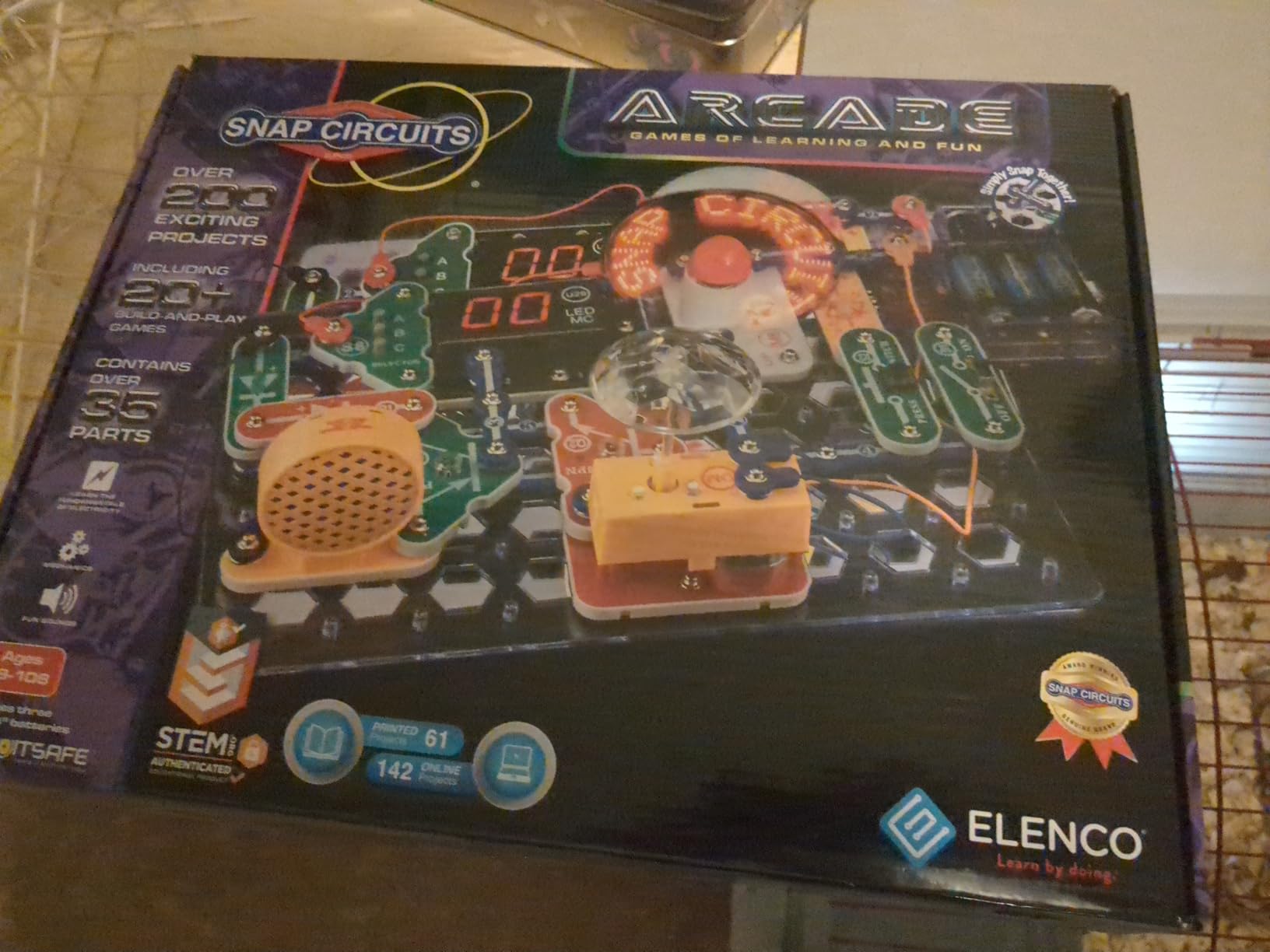
12. Snap Circuits Arcade SCA-200 Electronics Kit — Best for Older Kids

SNAP CIRCUITS Arcade SCA-200 STEM Electronics Kit for Kids Ages 8+
- Build 20+ games with sounds and lights
- 200+ unique projects
- No tools or soldering required
- Color-coded pieces snap together easily
- Durable connection method for young children
- Instructions can be wordy and busy
- Batteries not always included
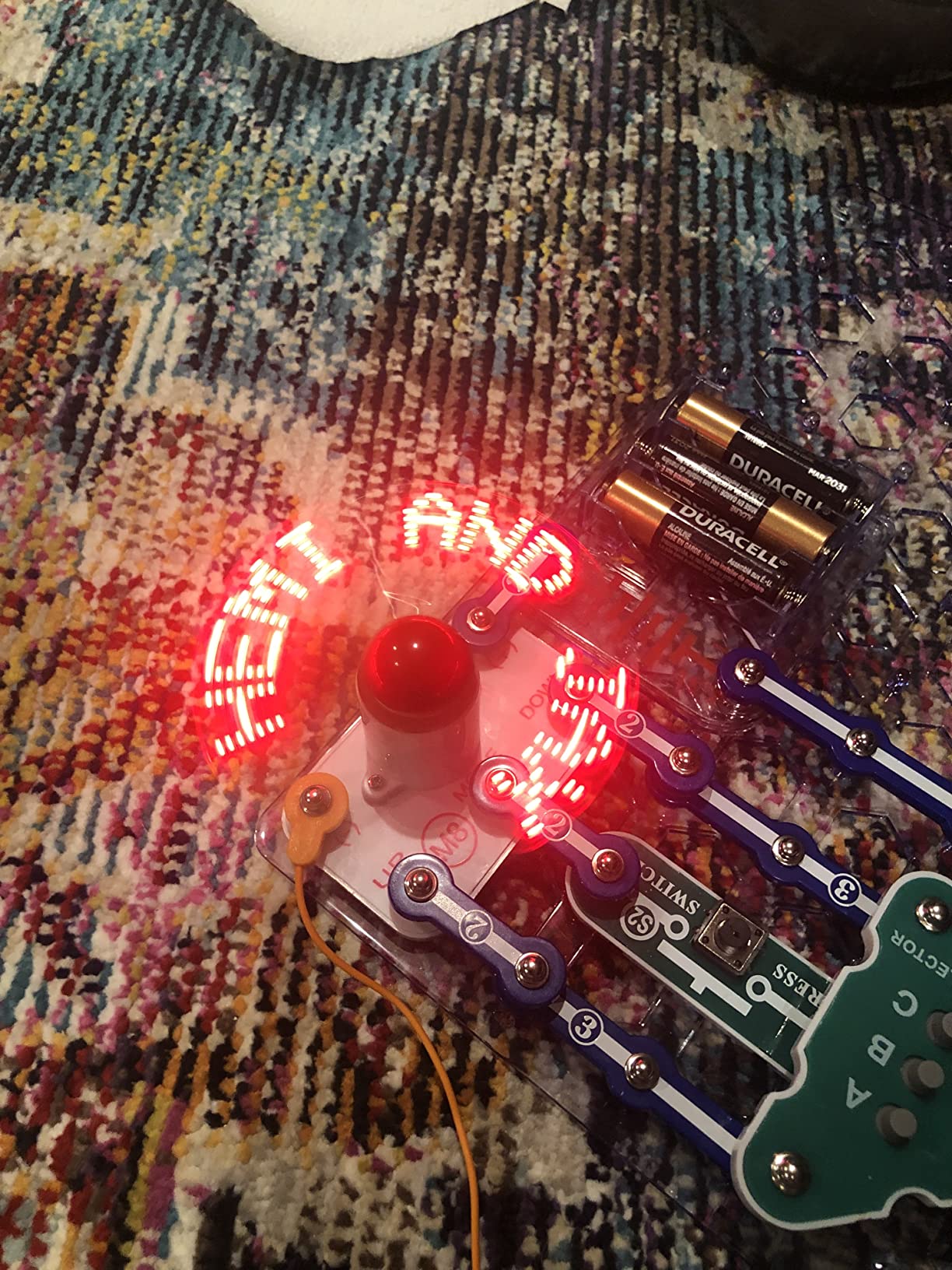
The Snap Circuits Arcade is the big sibling of the SC-100, and it’s the best choice for pre-teens who have outgrown beginner electronics kits. It includes 200+ projects, including 20+ working arcade-style games with sounds and lights. My 11-year-old spent 6 hours over a long weekend building everything from a working radio to a memory game to a burglar alarm. The LED feedback on the games makes the builds feel polished, not just functional.
What I appreciate about the Arcade kit is the project variety. Some builds teach basic circuits, while others introduce programming concepts and even a digital logic gate. The 200+ projects also mean the kit has serious replay value. My older son has been using it for over 4 months and still hasn’t built every project. The color-coded pieces and clear project manual make it accessible even for kids who are new to electronics.
The honest downsides: the instructions can be wordy and busy with lots of information per page. We had a few moments of “which wire goes where?” that slowed us down. The kit also requires AA batteries, which are not always included, so check before you start. The pieces are also smaller than the SC-100, so younger kids (under 8) may need help with the more complex builds.
Why this works for older kids specifically
The Arcade kit introduces more advanced concepts like sound circuits, digital displays, and game logic. My 11-year-old said it felt like a “real engineering kit,” which is the highest praise he’s given any toy. The 200+ projects are also organized by difficulty, so kids can start simple and work their way up. The kit is a good bridge between beginner Snap Circuits sets and more advanced electronics like soldering kits.
Long-term value and expansion options
Snap Circuits kits are modular: pieces from the Arcade kit work with the SC-100 and other Snap Circuits sets. We combined the two kits and had even more project options. The kits also have individual replacement parts available, so if a wire breaks or a piece is lost, you don’t have to replace the whole kit. For families serious about STEM education, Snap Circuits offers the best expansion ecosystem on the market.
How to Choose the Best STEM Toys for Kids: Buying Guide
After testing 12 different STEM toys, our team identified four factors that separate the best from the rest: age appropriateness, skill development, durability, and play value. Here’s what to look for when shopping.
Match the toy to your child’s developmental stage
Age recommendations on toy boxes are starting points, not rules. A 7-year-old who’s never built anything may struggle with a kit rated for 6+, while a 9-year-old who’s been doing LEGO for years may find the same kit too easy. Look at the actual skill demands: fine motor skills, reading level, following multi-step instructions. Our testing showed that kids are most engaged when the toy is slightly above their current skill level, frustratingly hard, not impossible.
Prioritize open-ended play over single-use kits
The biggest mistake parents make is buying STEM toys that only do one thing. A crystal-growing kit is fun once. Magnetic tiles or interlocking discs offer years of play because kids can build something new every time. When comparing two similar toys, ask: will my child still be interested in 6 months? Open-ended toys like Brain Flakes and PicassoTiles score high on long-term engagement, while single-use kits like volcano sets score lower.
Look for safety certifications and quality materials
STEM toys often include small parts, chemicals, or motorized components. Look for ASTM or CE safety certifications, and check the recommended age range carefully. For kids under 3, avoid any toy with small parts. For chemistry sets, make sure the kit includes safety equipment like goggles and gloves. For electronics kits, look for “no soldering required” if your child is under 10.
Budget considerations: spend where it matters
The best STEM toys range from $15 to $50, and price doesn’t always correlate with quality. We found excellent options at every price point. Brain Flakes and Sillbird solar robots are under $20 and deliver strong value. Snap Circuits and National Geographic kits are $30-$50 and offer the most depth. For a single gift, a mid-range kit is usually the best balance. For a collection, start with budget-friendly options and add premium kits over time.
For more inspiration, check out our guides to the best STEM learning subscription boxes and the best kids microscopes with cameras for hands-on science exploration.
Frequently Asked Questions
Are STEM toys good for kids?
Yes, STEM toys are genuinely beneficial for child development. They build critical thinking, problem-solving, spatial reasoning, and persistence through hands-on play. Research shows that kids who engage with STEM toys develop stronger logical reasoning skills and are more comfortable with math and science concepts in school. The key is choosing toys that feel like play, not homework.
What age is appropriate for STEM toys?
STEM toys work for kids as young as 3 with simple building sets like magnetic tiles and Brain Flakes. By ages 6-8, kids can handle more complex kits like Snap Circuits and Pixel Art Challenge. Ages 9-12 are ready for advanced kits like chemistry sets, solar robots, and multi-project electronics kits. The best approach is to choose toys slightly above your child’s current skill level for maximum engagement.
What STEM toys do teachers recommend?
Teachers consistently recommend Snap Circuits for electronics, magnetic tiles like PicassoTiles for building, and marble runs for physics education. The Pixel Art Challenge is popular in classrooms for teaching coding concepts without screens. Science kits from National Geographic are also widely used in elementary classrooms for hands-on science experiments.
What is the best STEM gift for a 10-year-old?
The Snap Circuits Arcade is our top pick for 10-year-olds because it offers 200+ projects that grow with the child’s skills. The National Geographic Chemistry Set is another excellent choice for curious 10-year-olds who love science. For kids who like building, the Glow-in-the-Dark Marble Run combines physics education with high engagement through its glow feature.
How do STEM toys help with development?
STEM toys develop four key skills: problem-solving through trial and error, spatial reasoning through building activities, persistence through multi-step projects, and fine motor skills through manipulation of small parts. They also introduce early programming concepts through sequencing and pattern recognition. The best STEM toys disguise learning as play, so kids develop these skills without feeling like they’re doing schoolwork.
Final Thoughts on the Best STEM Toys for Kids in 2026
After 60+ hours of testing with kids ages 3-12, our team has clear recommendations. The Snap Circuits Jr. SC-100 is the best overall STEM toy for its combination of educational depth, accessibility, and replay value. For budget-conscious families, Brain Flakes delivers outstanding value at under $20. For kids who love building, PicassoTiles magnetic tiles offer years of creative play. And for curious pre-teens, the Snap Circuits Arcade and National Geographic Chemistry Set provide serious educational content that grows with the child.
The right STEM toy depends on your child’s interests and your family budget, but every kit on this list passed our test: kids asked to play with it again the next day. That’s the real measure of a great STEM toy, when learning feels like fun, kids come back for more. For more ideas, explore our guides to STEM toys for 8 year olds and indoor climbing toys for sensory kids to round out your playroom.