

A media blast cabinet is a sealed steel enclosure with gloves, a lit viewing window and a hopper of abrasive media underneath, and it lets you clean rust, paint and oxidation off parts with a compressed-air blasting gun while keeping every bit of dust and grit inside the box. That containment is the whole point: blasting a bracket on an open bench throws silica-bearing dust across your garage, into your lungs and onto everything you just cleaned. Inside a cabinet, the media falls back into the hopper, the fines get pulled out of the airstream, and you get a far more even finish than hand sanding ever produced.
What this roundup covers is the best media blast cabinets for home shops available right now, compared on the two numbers that decide whether a cabinet works at all: how much air it demands at a given pressure, and how much room you actually have to put a part inside. We also looked hard at sealing, lighting, media capacity and the fixes almost every owner ends up making in the first weekend. If you are still deciding between an open-air blaster and a cabinet, our guide to the best media blasters covers the machine side of the decision.
We kept the list to six cabinets because the home-shop niche is genuinely thin at the top end. Everything bigger than roughly 60 gallons is an industrial machine priced for a commercial shop, and everything cheaper than these six is a kit that needs an afternoon of sealing before it stops leaking. All six here are 4.0 stars or better with enough verified reviews to be worth your time, and all six are updated as of 2026.
Table of Contents
Top 3 Picks for Best Media Blast Cabinets for Home Shops (October 2026)

VEVOR SBC200 60 Gallon
- 60-gallon chamber on a stand
- 5 cfm at 40-120 PSI
- holds up to 203.4 lbs of media
- LED window and 4 lens protectors

VEVOR SBC150 40 Gallon
- 40-gallon benchtop
- 5 cfm at 40-120 PSI
- holds 51.8 lbs of media
- sealing strip and air filter included

Shop Fox M1114
- Heavy powder-coated steel
- 10 lb abrasive capacity
- 60-100 PSI
- dual 16-inch access doors
All 6 Media Blast Cabinets Compared in 2026
This is the at-a-glance view most shoppers actually want: air demand, working volume, media capacity and the one flaw you should expect to fix on day one. Every figure below comes from the manufacturer’s own listing, and the column we would read first is air demand.
| Product | Specifications | Action |
|---|---|---|
| VEVOR SBC200 60 Gallon Sandblasting Cabinet with Stand |
|
Check Latest Price |
| VEVOR SBC150 40 Gallon Benchtop Sandblasting Cabinet |
|
Check Latest Price |
| Shop Fox M1114 Benchtop Sandblaster |
|
Check Latest Price |
 Parts-Diyer 25 Gallon Sandblasting Cabinet Parts-Diyer 25 Gallon Sandblasting Cabinet |
|
Check Latest Price |
 Parts-Diyer 40 Gallon Bench Top Air Sandblasting Cabinet Parts-Diyer 40 Gallon Bench Top Air Sandblasting Cabinet |
|
Check Latest Price |
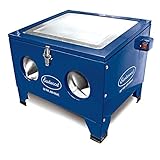 Eastwood B20 Benchtop Abrasive Blast Cabinet Eastwood B20 Benchtop Abrasive Blast Cabinet |
|
Check Latest Price |
How We Picked, and What We Did Not Test
Every cabinet here was scored on published specifications first, then on the pattern of complaints and fixes that shows up repeatedly in owner reviews. Air demand, working area, media capacity, door and window design, and the presence of a dust port or included filter carried the most weight, because those are the things that cannot be changed after delivery.
We did not run stopwatch tests, we did not measure decibel levels with a meter, and we did not put these cabinets through a durability trial. We are not claiming a panel-stiffness score or a leak rate. What we did do is cross-check the numbers against what owners report after living with the machine, and flag the modifications almost every owner ends up making. Treat the ratings below as owner ratings, not as our scores.
One structural point first, because it drives everything else: a blast cabinet is not really a blasting machine. It is a containment box with a gun in it. The gun’s air demand, in cubic feet per minute at a given pressure, determines whether you get a satisfying blast or a sputtering trickle, and that is a compressor decision, not a cabinet decision. Pick the cabinet, read its CFM and PSI spec, then size your compressor to it. Doing it the other way around is the most common expensive mistake in this hobby, and it is the single theme that repeats across the home-shop blasting forums.
1. VEVOR SBC200 60 Gallon – Best Overall for Home Shops
- Largest working volume in the group with an integrated stand
- Low 5 cfm demand works with typical home-shop compressors
- Acrylic window and LED lighting give good visibility
- Includes gun and 4 ceramic nozzles plus 4 lens protectors
- Included hoses are stiff and kink easily
- Seals leak slightly until sealant or tape is applied
- Built-in light is dim and works intermittently
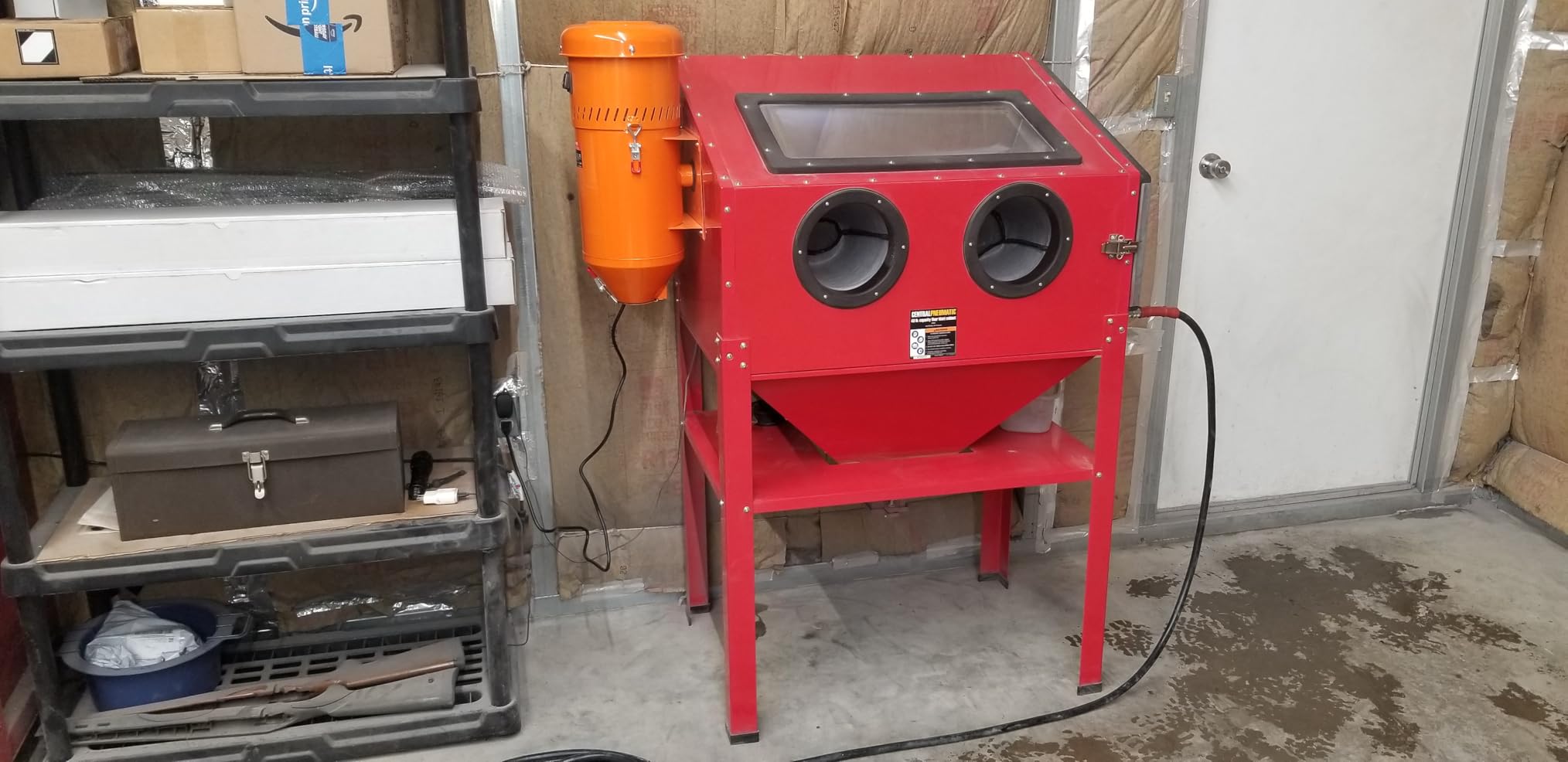
The SBC200 is the one to beat in this category, and the reason is the combination of volume and restraint. It is a 60-gallon floor cabinet on an integrated stand, so bulky parts fit without you dragging the box across the concrete, yet it only asks for 5 cfm between 40 and 120 PSI. That is the number that matters most, and it means the cabinet is not forcing a compressor upgrade on you.
At 79.4 pounds and 37.1 by 22.9 by 54.5 inches, this is a real piece of equipment rather than a tabletop toy. Owners consistently report that it blasts rust and paint down to bare metal effectively in the 50 to 80 PSI range, which is well inside the stated envelope. The hold capacity of up to 203.4 lbs of media means you are not topping up the hopper every few minutes, which matters more for session length than any other single spec on the list.
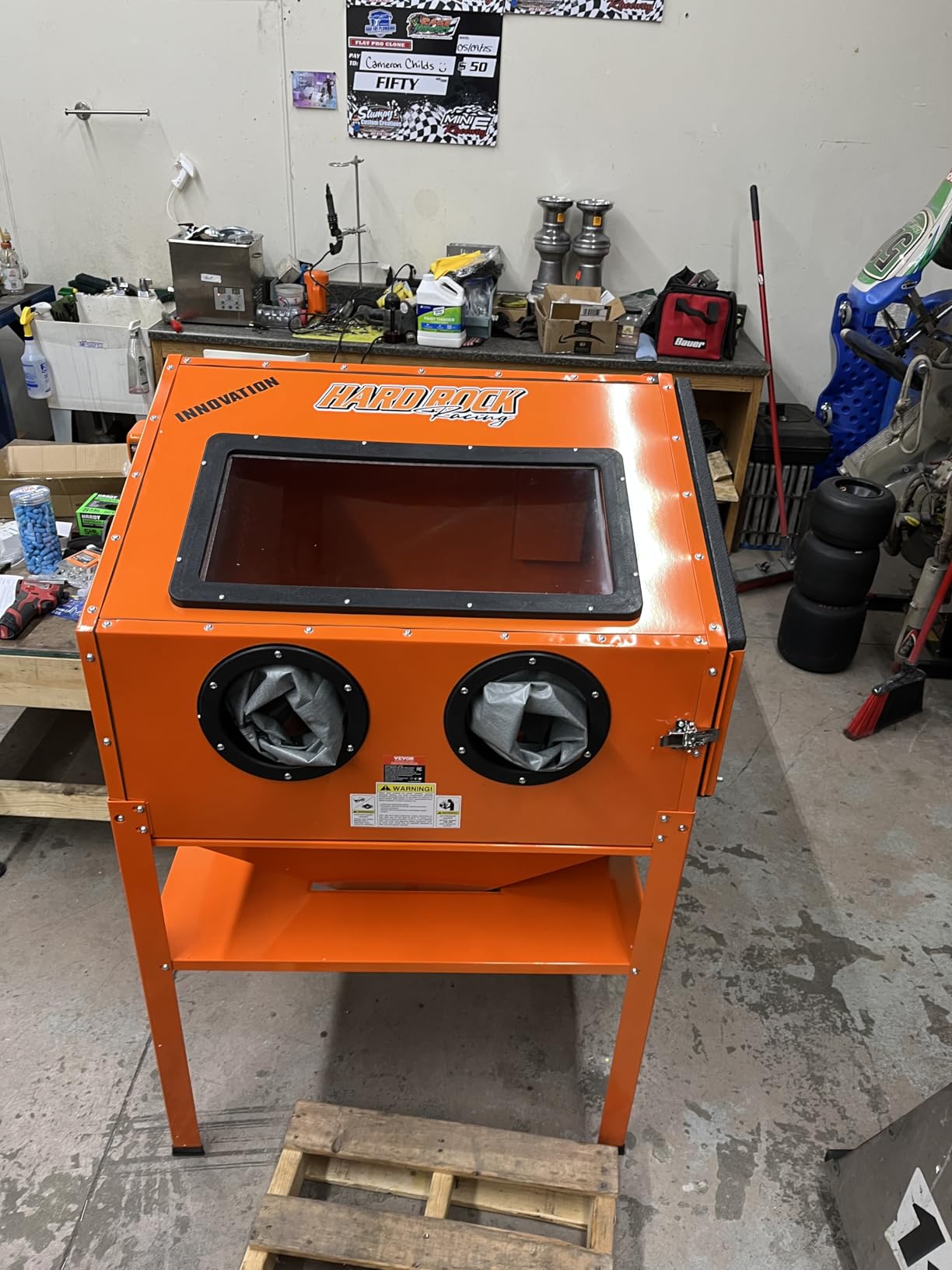
The construction is heavy-duty cold-rolled steel with a corrosion-resistant powder coating, and the large acrylic window with LED lighting is the best visibility combination in the group. Four lens protectors come in the box, which is the correct consumable to have on hand because a window that clouds in ten minutes ruins a session and a window that etches permanently ruins the next one. A pre-installed sealing strip and supplied sealant cut down on leakage compared to cabinets that ship with nothing but a promise.
Now the honest part, because every owner complains about the same three things. The included pickup and air hoses are stiff and kink easily, which chokes media flow until you replace them, and they work loose on the barbed fittings. The factory window and lid seals leak slightly until you go around the seams with sealant or tape, and the built-in light is dim enough that many owners add an external work light. Assembly instructions are small and badly written, and the sheet metal edges sometimes arrive bent and not properly deburred. Two people make the build easier, and a file and a pair of gloves make it safer.
What makes this the one to build a shop cell around
The 60-gallon chamber is genuinely large by home-shop standards, and the stand is the reason that volume does not become a problem. You load a suspension arm or an intake manifold through the top, work at standing height, and the box does not move when you lean into it. The media capacity means a single fill can carry you through several parts without stopping, so the compressor gets a break between pieces instead of running flat out the whole afternoon.
At 5 cfm, it also runs on the sort of compressor most home shops already own. That is the quiet advantage of this model: the air demand is modest enough that the cabinet is not the limiting factor in your workflow. The tradeoff is that low demand means modest pressure, so this is a cleaning and desurfacing cabinet rather than a production stripper. For removing heavy paint and scale in a home garage, it does the job at the pressures owners report using.
Where it falls short
Budget an evening for assembly and another for sealing. The instructions assume you can see the drawing, the panels arrive with edges that need deburring, and the supplied seals are a starting point rather than a finished seal. None of that is unusual for a flat-packed cabinet at this tier, but if you expect a plug-and-play box on your bench, this is not it.
The hoses and the dim light are the two add-ons almost every owner makes. A better gun hose, a brighter external light and a cyclone dust separator on the dust port are the three changes with the biggest effect on the experience, and all three are inexpensive relative to the cabinet. Our other guide to the best blast cabinets covers the dust-side options in more detail if you are comparing a wider range of machines.
2. VEVOR SBC150 40 Gallon – Best Value Benchtop Cabinet
- Compact benchtop footprint that still takes a bike frame
- Low 5 cfm demand suits small shop compressors
- Acrylic window with LED lighting
- Clears scale
- rust and paint effectively with 80 grit glass bead
- Holes and brackets often do not line up during assembly
- Panels arrive bent and poorly deburred with sharp edges
- Supplied seals underperform without your own caulking
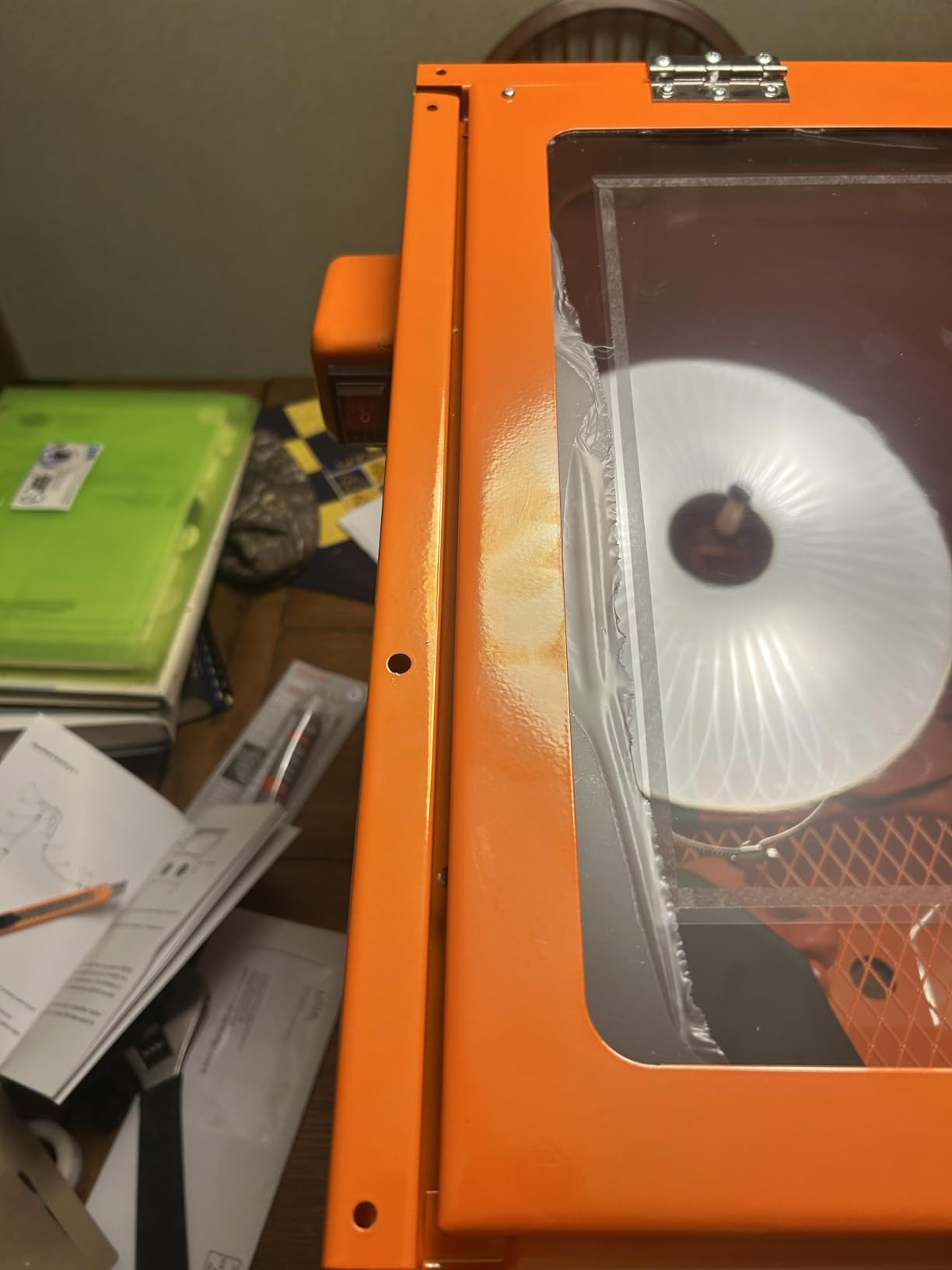
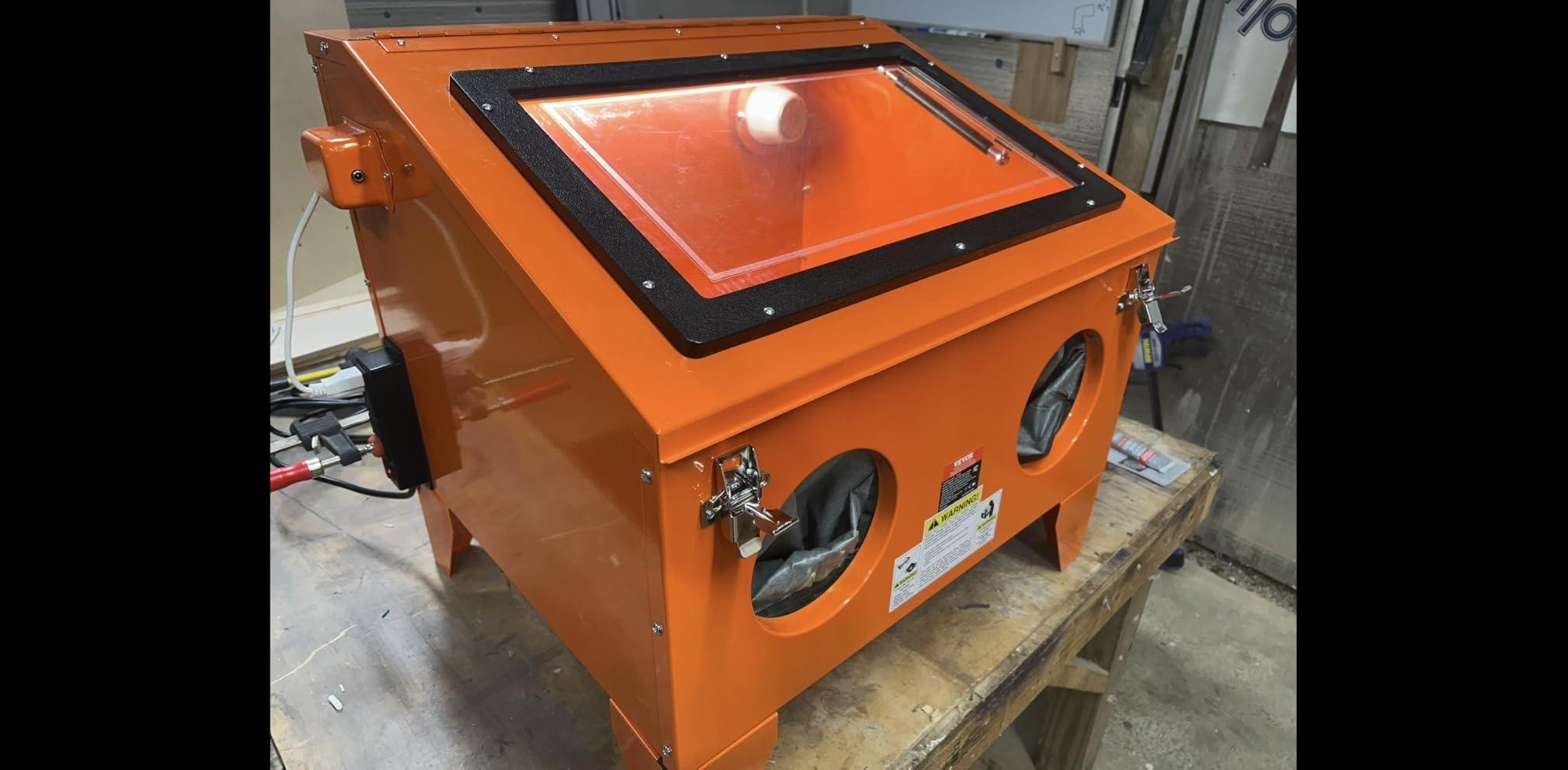
The SBC150 is the same engineering approach as the 60-gallon cabinet in a benchtop box, and for most home shops it is the more sensible first purchase. It measures 27 by 22.6 by 24.8 inches and weighs 48.1 pounds, which is a footprint you can dedicate on a workbench and still have bench space left over.
Owners report that this cabinet clears scale, rust and paint effectively using 80 grit glass bead at moderate pressure, which matches the review pattern we would expect from a powder-coated cold-rolled steel chamber with a proper acrylic window. The 40-gallon capacity holds up to 51.8 lbs of media, and that is far more than most weekend projects will consume, so you are not constantly refilling the hopper.
Like its bigger sibling, it asks for 5 cfm at 40 to 120 PSI, so it runs happily on the small 5 to 7 cfm shop compressors most garages already own. That compatibility is the reason this cabinet appears in so many home-shop build threads. You are not being told to buy a bigger compressor, which keeps the total cost of entry to a compressor you already have plus a bench.
Assembly is the weak point, and it is worth being blunt about it. Holes and brackets frequently do not line up, so the build can take a couple of hours plus some drilling and clamping to force panels into alignment. Panels arrive bent, scratched and poorly deburred, with sharp edges that can cut your hands, so wear gloves during the build. The supplied air hose is thin and stiff, the brackets and hardware are weak, the claw clamps are flimsy, and some owners have documented M6 versus M4 and M5 versus M6 hardware mismatches in the parts bag. The included filter also clogs within about an hour of use.
Best value for a one-bench shop
The value case is straightforward. You get a benchtop chamber big enough for a bicycle frame or other mid-size parts, a low air demand, an acrylic window with LED lighting, and four ceramic nozzles in the box. For a hobbyist who blasts a few brackets and valve covers per month, that combination is very hard to beat without stepping up to a heavier cabinet.
Buyers who add a cyclone dust separator and a compressed-air moisture filter, and who use the least pressure that will do the job, report very satisfied results. That is the practical route with this cabinet: treat the exhaust port and the air quality as the two upgrades, and treat the gun pressure as a dial rather than a switch.
Where it falls short
The seals are the deciding factor. Out of the box the supplied seals underperform, and most owners end up sealing every panel with the included caulk to stop dust clouds. Budget an evening of assembly and an hour of sealing, and this cabinet rewards patience. The filter clogging within an hour is also a running cost that people forget until it happens.
For a shop that regularly handles parts larger than a bike frame, the work area here will feel cramped and the 60-gallon model will make more sense. For small-parts work, the Eastwood further down this list does the same job in a smaller box.
3. Shop Fox M1114 – Best Built, Needs the Most Sealant
- Noticeably heavier and sturdier steel than cheaper cabinets
- Dual 16-inch side doors for small-parts access
- Compact footprint that is easy to move and store
- Strips rust and paint to bare metal once set up
- Moulded plastic doors bow in the middle and leak heavily
- Rivets and joints need extensive caulking out of the box
- Shallow hopper uncovers quickly so media needs topping up
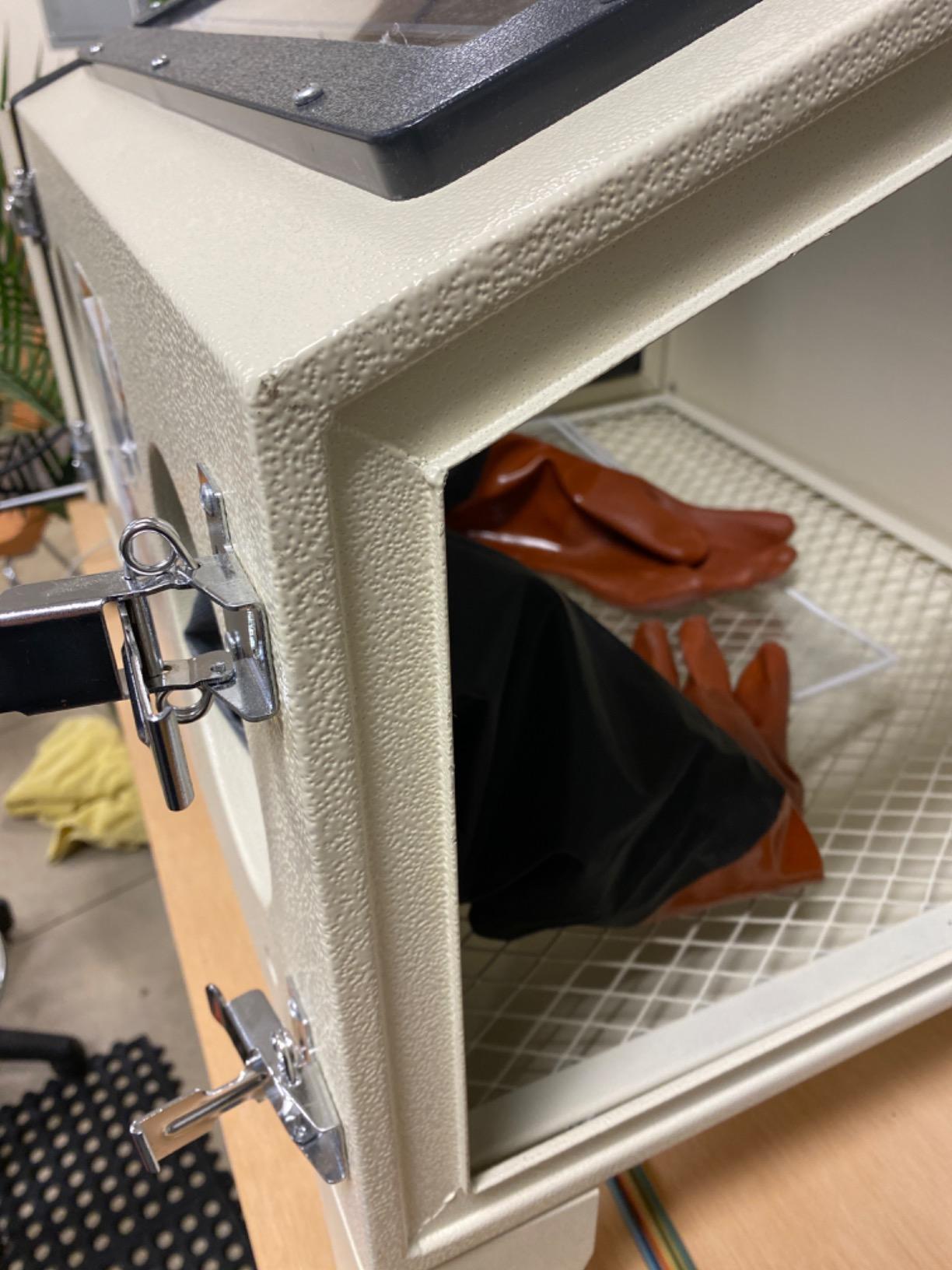
The Shop Fox M1114 is the one in this group where owners consistently say the steel is heavier and better powder-coated than the cheaper cabinets in the same class. It weighs 50 pounds, measures 24-1/2 by 21-1/8 by 19-1/2 inches, and is the only cabinet on this list that carries a stated warranty at one year. That build quality is the reason people keep it despite the fixes it needs.
Access is genuinely good for small-parts work. Two 16-inch wide side doors with solid latches let you reach into the chamber, and the 9 by 10-3/4 inch viewing window gives you a real look at the piece. It holds 10 pounds of abrasive and operates between 60 and 100 PSI, which is a sensible pressure band for cleaning and light desurfacing rather than production stripping.
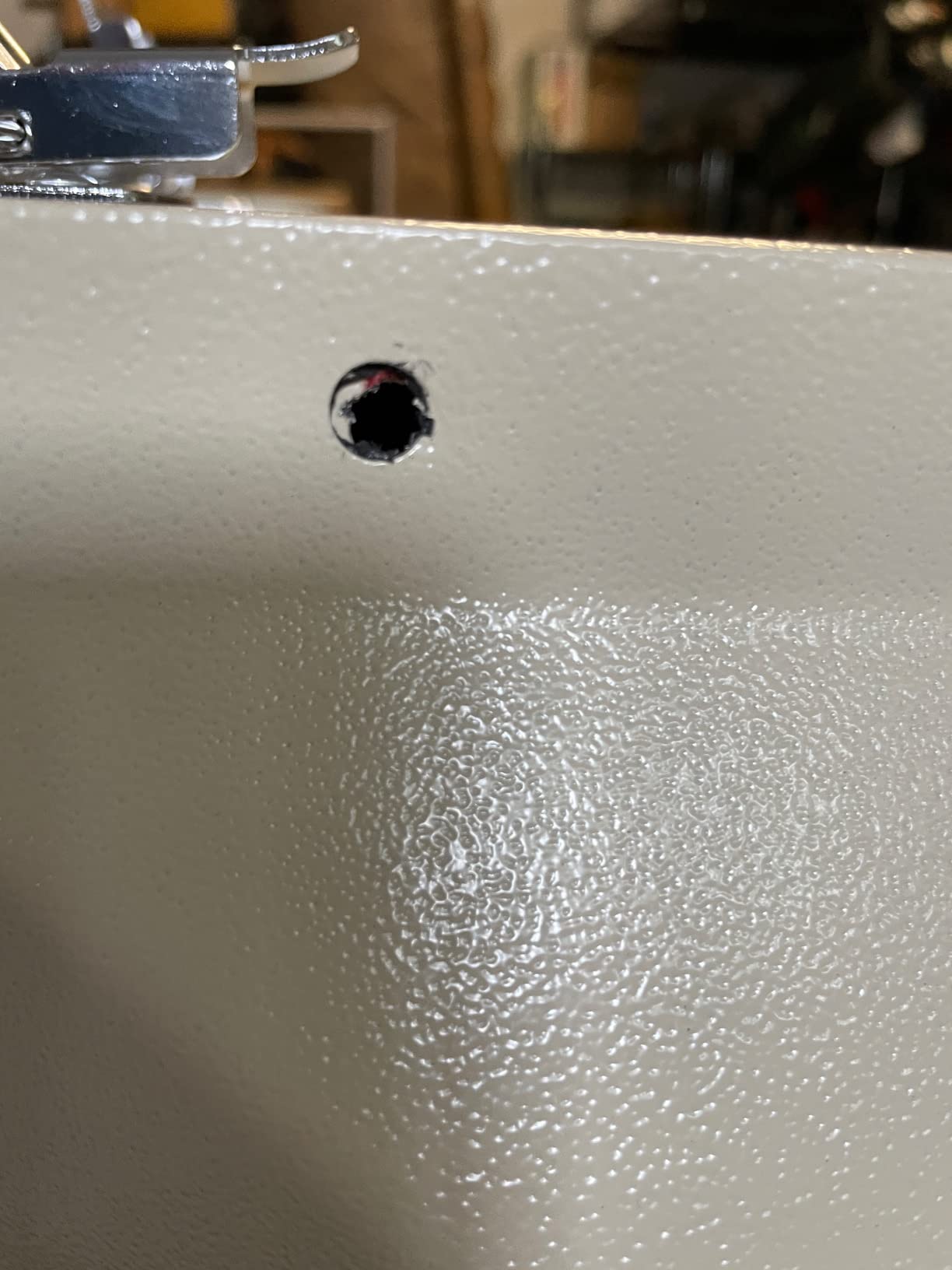
Once it is set up, owners report that it strips rust and paint down to bare metal effectively. But set up is doing a lot of work in that sentence. The moulded plastic side doors bow in the middle and leak heavily until they are reinforced with angle iron and extra weather stripping, and there are leaks from the rivets and joints that require extensive caulking out of the box. This is the cabinet where sealing effort matters most, and it is also the one where doing it properly pays off most, because the frame underneath is the stiffest here.
Other recurring complaints: the hopper is shallow, so the pickup tube uncovers quickly and media has to be topped up often. The viewing window is thin plexiglass that scratches easily, and the provided lens shields hold poorly. The interior light is mounted behind the work area rather than above the window, which is an odd place for it. The included gloves wear out within roughly five to six hours of blasting, and the instructions are widely criticised. Several owners report the unit arriving dented or with loose wiring.
Who this cabinet is right for
If your work is small-parts restoration where the part fits in a 24-inch box and the session is short, the M1114 is a good fit. The dual side doors make it fast to load and unload small hardware, and the heavier frame means it stays square over years of use in a way lighter cabinets do not. Owners who swap in a tempered glass window, a better bulkhead fitting, a dust collector, a new gun and extra gloves end up with a genuinely durable tool.
It is also a reasonable choice as a sealed-in-place shop cell rather than a portable benchtop unit, since the footprint is easy to dedicate and the frame is heavy enough to stay where you put it.
Where it falls short
Maintenance is the issue. A shallow hopper that uncovers means you are checking media level constantly during a long session, which is friction that the larger cabinets simply do not have. The plastic doors and the leaking rivets also mean this unit needs its sealant refreshed, not just applied once.
The plexiglass window scratching easily is the other recurring grudge, and it is the reason the window and maintenance question comes up so often on blasting forums. If you blast often enough to care about optics, plan on replacing the window or protecting it with film from day one.
4. Parts-Diyer 25 Gallon – Best Budget Start
- Lowest entry point with a real 25-gallon benchtop chamber
- Friendly 40-80 PSI and 5 CFM supply for small compressors
- Four nozzle sizes
- gun and dust collector port included
- Plexiglas window with film and a switchable lamp
- Lightweight 33-pound body feels less rigid under load
- Plexiglas window scratches and clouds quickly
- Seams need frequent sealant touch-ups to contain dust
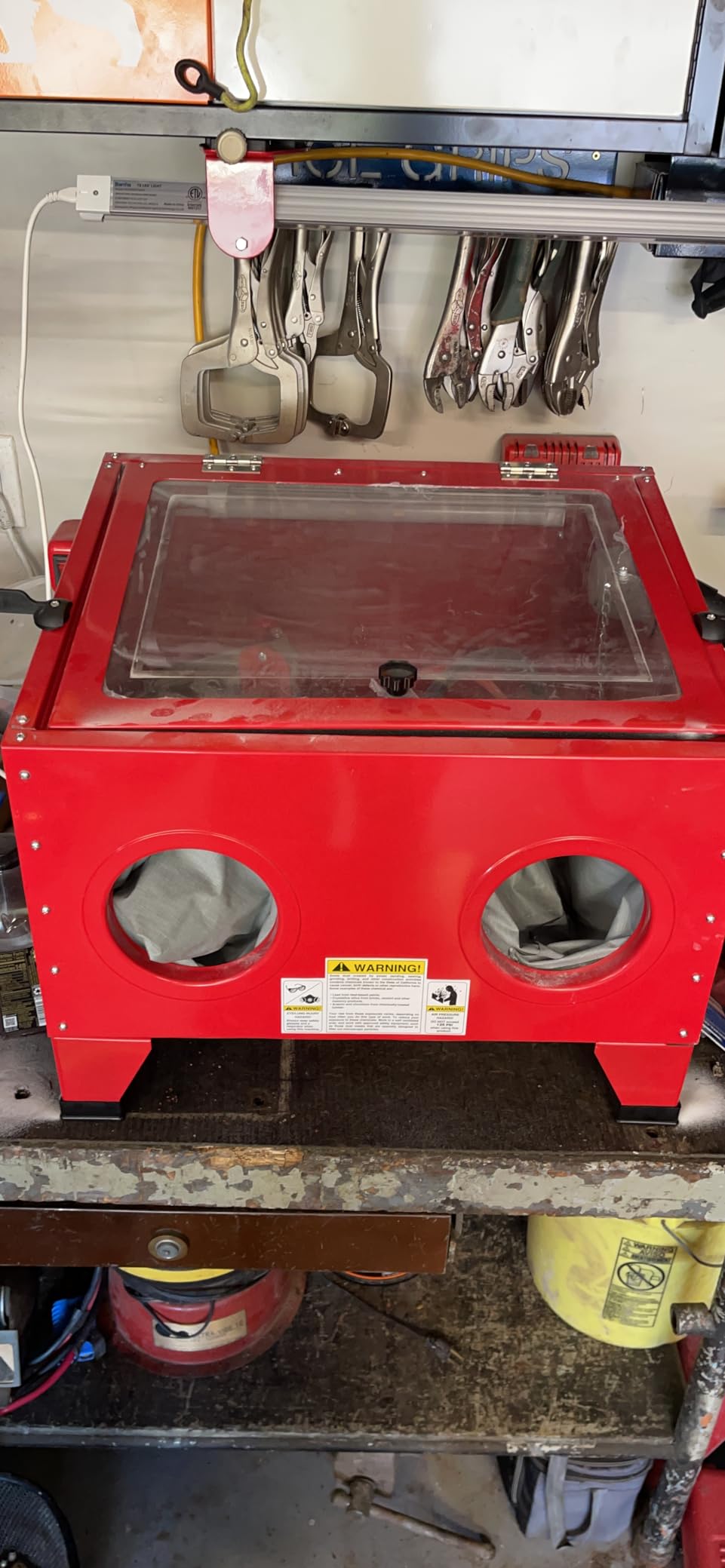
The Parts-Diyer 25-gallon cabinet is the entry point here, and for occasional hobby blasting it does the job that matters. It is a benchtop box of 25.59 by 21.65 by 11.02 inches weighing 33 pounds, with a 25-gallon chamber that holds up to 33 lbs of media. That is enough media to finish a small project without a refill stop.
The air supply of 40 to 80 PSI at 5 CFM is the friendliest number in the group, and it means this cabinet will run on the small compressors most garages start with. The package includes four nozzle sizes at 4mm, 5mm, 6mm and 7mm, a dust collector port and a blasting gun, so the two things you always forget to order are in the box.
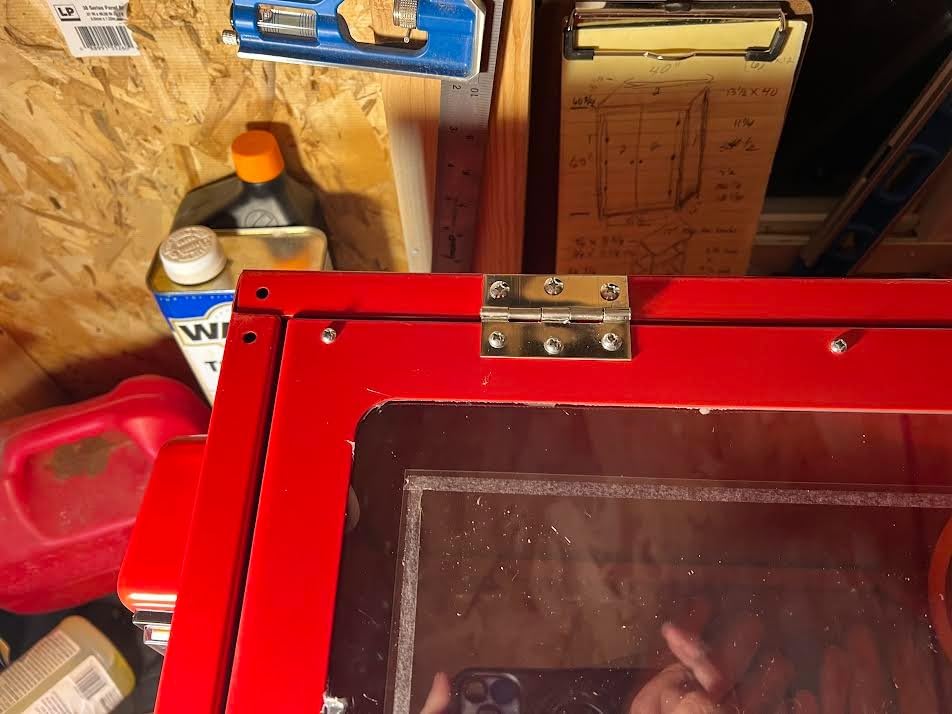
There is a plexiglas window with removable protective film and a fluorescent lamp with a switch, and pre-installed sealing strips with supplied sealant for cleaner blasting. The viewing area of 15.75 by 11.6 inches is smaller than the other cabinets here, so this is a small-parts and bracket tool rather than something for a large frame or a whole motorcycle component. Buyers note that the light-gauge steel feels less rigid than heavier cabinets, and that the plexiglass scratches and clouds quickly if you leave the protective film off.
Sealant touch-ups on the seams are a recurring need, and the fluorescent lamp is dimmer than the LED lighting used by newer cabinets. The steel is powder-coated and resists rust and corrosion, which matters in a damp garage, but the whole box moves a little under pressure compared with the 50-pound and 79-pound units here.
What you can realistically do with it
Small parts are the sweet spot. Brackets, bolts, valve covers, small castings and hardware all fit, and the four included nozzle sizes mean you can match the blast to the job without buying more media hardware. The low CFM demand is the real reason to pick this one, because it will not fight your compressor.
It also accepts a wide range of media, including glass beads, silicon carbide, alumina and crushed walnut shell, which makes it a good first cabinet for learning which media you actually prefer before committing to a bigger machine. The dust collector port gives you somewhere to attach extraction when you are ready to upgrade that side.
Where it falls short
Capacity and rigidity are the limits. At 33 lbs of media and a smaller viewing area, this is a bench for small cleanup jobs rather than production work, and the light frame means you want it against a wall rather than free-standing in the middle of the shop. If you are starting to take on parts the size of a bicycle frame, step up to the 40-gallon models.
The window is the other real cost of entry. Keep the protective film on until the first session, and accept that you will be replacing or protecting the plexiglass eventually. Frequent sealant touch-ups are part of owning this tier, not a defect.
5. Parts-Diyer 40 Gallon Red – Best Working Area on a Bench
Parts-Diyer 40 Gallon Bench Top Air Sandblasting Cabinet
- Largest listed benchtop working area in the group
- Bright LED lighting behind the viewing window
- Wide 60-125 PSI range suits many compressors
- 4 nozzles
- dust collector port and gun included
- Sealant must be reapplied after assembly per the manufacturer
- Upper end of air range outpaces most home compressors
- Plexiglass window can still scratch after the film is peeled
The red 40-gallon Parts-Diyer cabinet is the one to look at if your benchtop work has outgrown a 25-gallon chamber but you still do not want a floor cabinet. Its working space of 23.6 by 20.9 by 18.1 inches is the largest usable benchtop volume here, and the overall footprint is only 25.6 by 21.7 by 24.2 inches. At 55.1 pounds it has real heft for a bench unit.
It scores slightly higher than its 25-gallon sibling, and the reason is visible rather than internal: bright LED lighting behind the viewing window improves visibility of the work, and the viewing area itself is 19.1 by 10.8 inches, wider than the smaller cabinet’s. The wide 60 to 125 PSI operating range is the headline spec on the listing, and it is genuinely useful because it means the cabinet adapts to whatever compressor you have rather than demanding a specific setup.
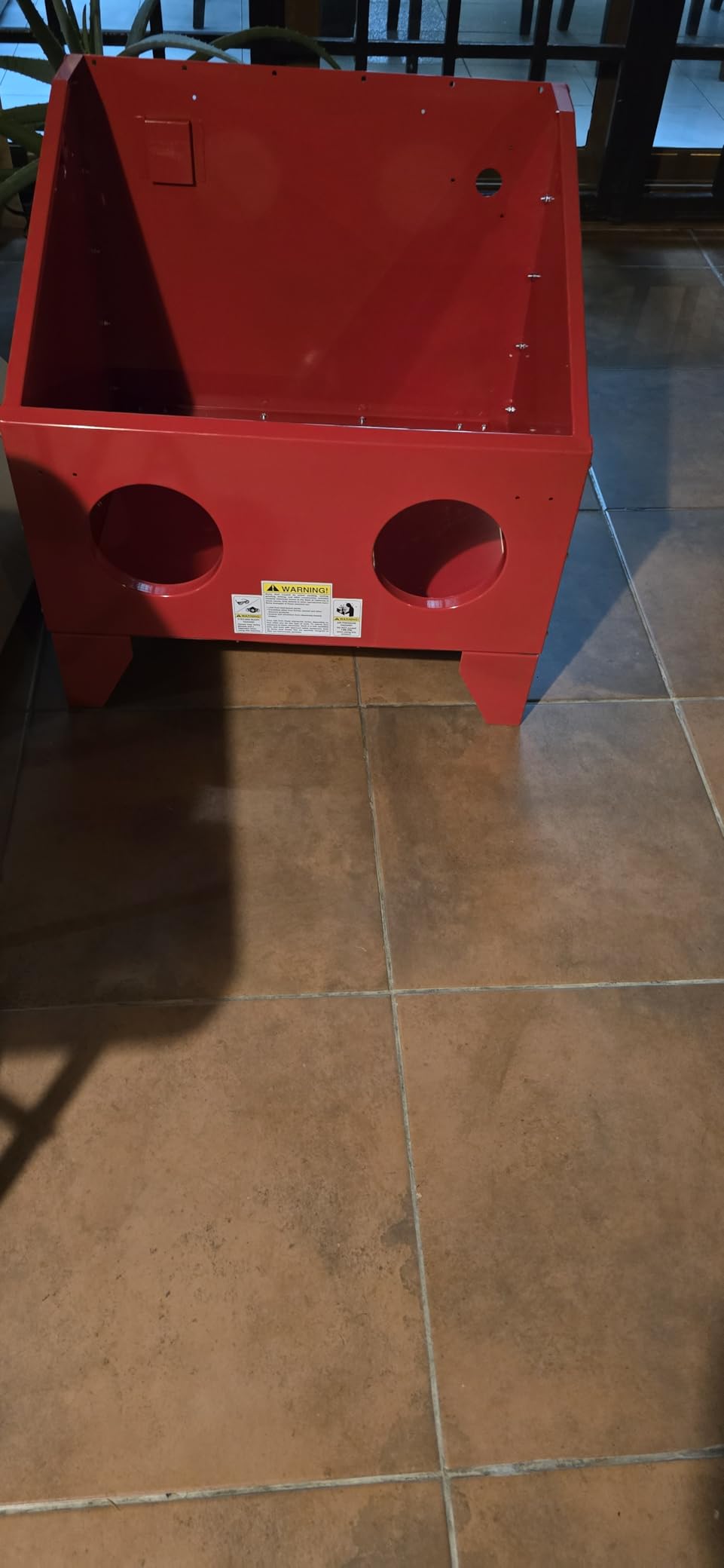
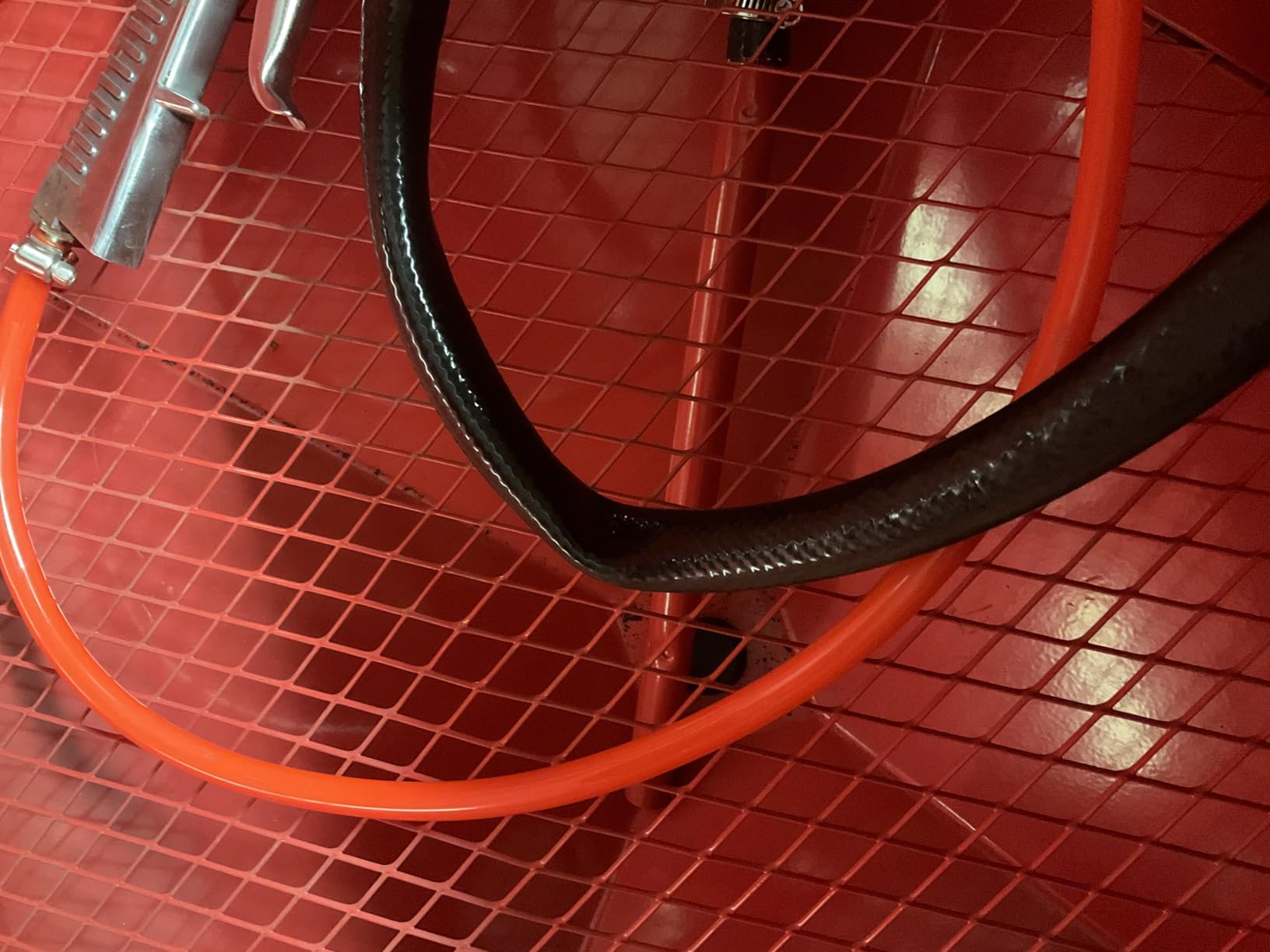
Sealing is the one thing the manufacturer itself flags. Buyers are advised to inspect for leaks after assembly and apply sealant, and the note in the listing is that sealant must be reapplied after assembly to stop leaks. Pre-installed sealing strips and supplied sealant are included, along with an air filter, and the package contains four nozzle sizes at 4mm, 5mm, 6mm and 7mm, a dust collector port and a blasting gun.
The wide pressure range has a catch that the spec sheet does not spell out for you: the upper end demands 25 CFM, which will outpace most home-shop compressors. Read the air demand as a range you will probably use the lower half of, not a target to hit. The plexiglass window needs its protective film peeled to be usable, and it can still scratch after that, so the usual lens-film discipline applies.
Who this cabinet suits
If you are restoring brackets, valve covers and mid-size hardware and your current 25-gallon cabinet is cramping your workflow, this is a clean step up that keeps your bench layout intact. The larger work area means you can orient a part in a way that is easier to work on, and the LED lighting makes that work area genuinely usable rather than a guessing game.
It also works as a mobile unit. The built-in ventilation suits small blast cleaning jobs on a bench or at a job site, and 55 pounds is heavy enough to feel stable but light enough to move when you need the bench back.
Where it falls short
The air demand spec is the trap here. A 6 to 25 CFM listing looks generous until you realise you will not have 25 CFM, and if you chase the top of that range with a small compressor the gun will sputter. Match the compressor to the realistic end of the range, not the printed maximum.
Everything else here is familiar budget-cabinet territory: sealant reapplied after assembly, and a plexiglass window that will scratch. If you are sealing the panels properly and keeping lens film on the window, neither becomes a daily problem.
6. Eastwood B20 – Best for Small Parts and No Assembly
- Best star rating in the group with 68 percent five-star reviews
- Hinged top doubles as a large access door and 19 x 15 inch window
- No assembly required
- LED lighting and shop vac dust hookup included
- Takes a fixed 24 x 20 inch footprint of bench space
- Single hinged top door instead of dual side doors
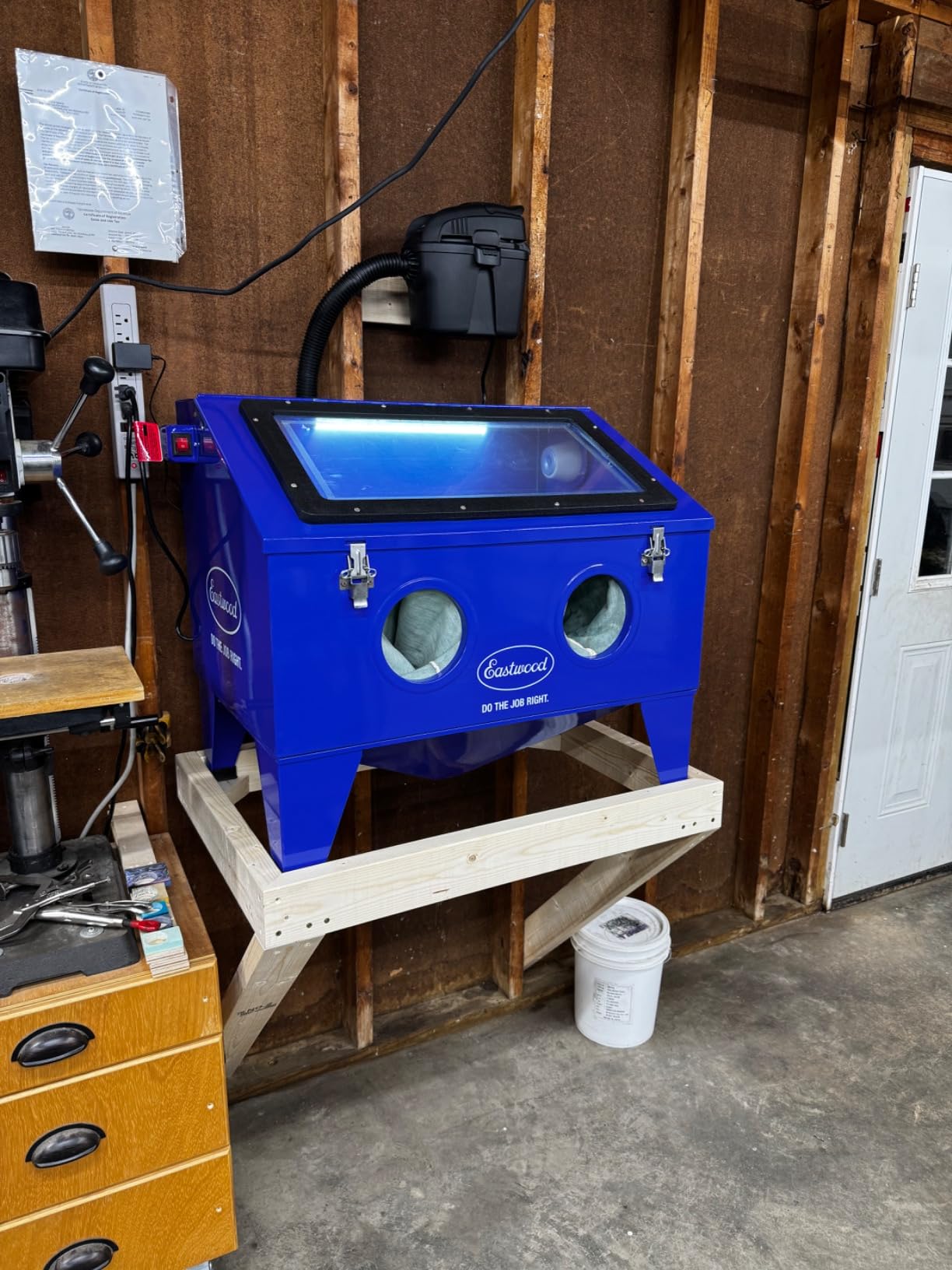
The Eastwood B20 is the highest-rated cabinet in this group at 4.4 stars, with 68 percent of reviews at five stars and 88 percent at four stars or better. It is also the only one here that arrives ready to work. The listing states no assembly required, and for a buyer who does not want to spend a Saturday aligning panels and chasing leaks, that alone is worth a lot.
The design choice that makes it different is the hinged top. It functions as both a large access door and a 19 by 15 inch viewing window with tear-off lens shields, so you are not looking through a small porthole while trying to work. With LED lighting and a standard shop vacuum hookup for dust removal, the supporting equipment is already in the plan.
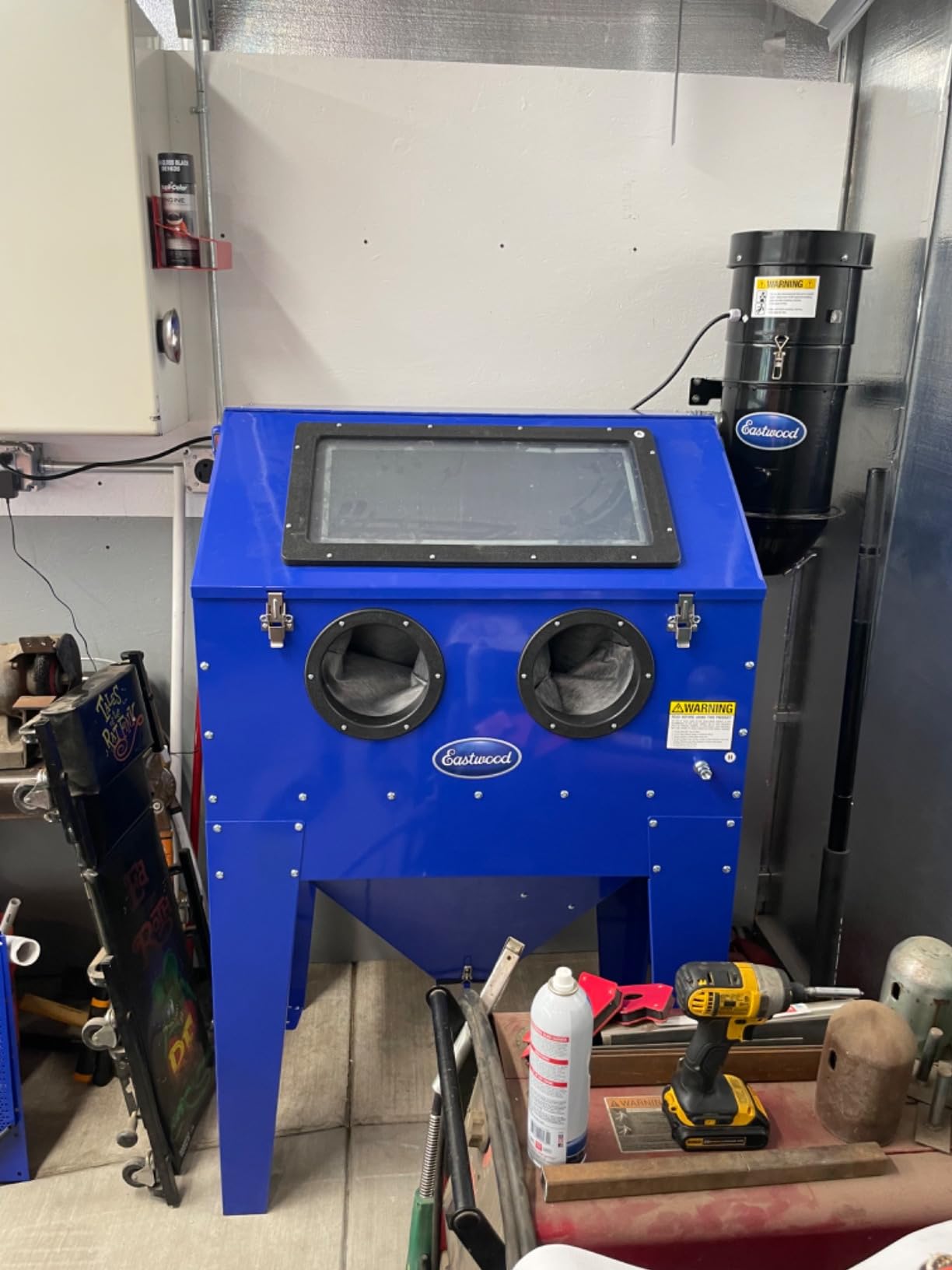
The benchtop footprint is 24 by 20 inches with nearly 3 cubic feet of work area, and the internal dimensions of 22 inches wide by 18 inches deep by 12 inches high are the practical limit on what you can put inside. It holds up to 25 lbs of blast media and 55 lbs of parts, and it includes a blast gun with replaceable tips. The cabinet is rugged powder-coated alloy steel in a blue finish, and the air requirement is 7 CFM at 90 PSI, which works with most standard shop compressors.
The trade-offs owners name are consistent and both are about the same thing: footprint and access. It takes a fixed 24 by 20 inch section of bench, so it is a permanent commitment rather than something you pull forward when needed. And it uses a single hinged top door rather than the dual side doors found on some rivals, which means loading a part means opening the whole top.
Why the rating is the highest here
Most of the complaints on cheaper cabinets are about things that happen after delivery: bent panels, leaking seals, mismatched hardware. The B20 sidesteps the largest of those by arriving assembled. The complaints that remain are about the cabinet taking up bench space, which is a design decision rather than a defect, and about the single-door layout, which is a preference.
For small hardware, this is an efficient machine. The internal volume of 3 cubic feet suits brackets, bolts, small castings and similar pieces, and the large window means you can actually see what you are doing. The 7 CFM at 90 PSI demand is real, so it wants a slightly more capable compressor than the 5 cfm cabinets here, but it is still well within what most home shops own.
Where it falls short
Size is the honest limit. A 12-inch internal height will not take a bicycle frame, a suspension arm or an intake manifold, so if your parts are bigger than your hands, this is not the cabinet. The 40-gallon models cover that, and the 60-gallon covers it with room to spare.
Second, 7 CFM is more air than the budget units ask for. If your compressor is a small 5 cfm shop unit, the gun will not perform at the top of its range, and you will notice the difference between a satisfying blast and a weak one. Check your compressor spec before you commit.
Size and Footprint: Benchtop or Floor-Standing
Benchtop cabinets are the right default for a home shop, and the reason is about part size rather than price. Measure your largest part, then measure the cabinet’s internal working area, not its outside dimensions. Outside dimensions include the walls, the door and the space for the gloves, so a 40-gallon cabinet with a 23.6 by 20.9 by 18.1 inch working area fits parts that look far too large for the box from the outside.
Rule of thumb from the cabinets here: the 25-gallon bench units handle hardware and brackets, the 40-gallon bench units handle a bicycle frame or mid-size components, and the 60-gallon stand cabinet is where bulky parts like a suspension arm or an intake manifold belong. If a part will not go through the door lying flat, it is not a benchtop part.
Two things to check before a floor cabinet goes in the shop. First, the stand footprint: the 60-gallon model is 37.1 by 22.9 by 54.5 inches and weighs 79.4 pounds, so it needs a dedicated corner and it will not move easily once filled. Second, top access clearance. A hinged or lift-off top needs vertical room above the cabinet, and a garage with a low ceiling or a parked vehicle above the bench can rule out the design you wanted.
Compressor Sizing: Match CFM at PSI Before You Buy
CFM means cubic feet per minute, and it is the number that tells you how much working air your gun needs at a given pressure. Every cabinet here lists a range, and the useful figure is the low end of that range, not the top. A cabinet rated 5 cfm at 40 to 120 PSI will be happy on a small 5 to 7 cfm compressor if you work nearer 60 to 80 PSI. Chasing 120 PSI on a small compressor is how you get a sputtering gun and a blaming session aimed at the cabinet.
Matching cabinet demand to compressor size, in plain terms: a cabinet asking 5 CFM runs on most 5 to 7 cfm shop compressors, though sustained blasting will drain a small tank quickly. A cabinet asking 7 CFM at 90 PSI wants a larger compressor or a bigger tank than the entry-level units, and you will notice the difference during long sessions. A cabinet advertising up to 25 CFM is really a 6 to 8 CFM cabinet in practice, because no home compressor delivers the printed maximum.
Tank size matters as much as CFM, because blasting is a sudden spike demand rather than a steady draw. A compressor with plenty of CFM and a small tank will work for a minute and then bog, and a media cabinet that is starved of air is the single most common frustration in this hobby. If your compressor is borderline for the cabinet you like, a larger receiver is often a cheaper fix than a larger compressor, and it also makes your other pneumatic tools happier.
One more detail that quietly ruins performance: air fitting size. A lot of blasting setups underperform because the hose and fittings between compressor and gun are too small, not because the compressor is weak. Use the largest hose and fitting your gun actually accepts, and keep the run short. A moisture filter or inline dryer on the line is the other cheap upgrade that stops media from turning to paste in a humid garage.
Dust Control and Sealing: Where Budget Cabinets Fall Down
Containment is the entire value proposition of a cabinet, so sealing is not a finishing touch. Almost every owner complaint in this category reduces to one of three leak points: the panel seams, the door gasket or the air inlet fitting. If dust is escaping, it is coming from one of those three places and no amount of blasting technique will fix it.
Every cabinet here ships with some version of a sealing strip and sealant, and every owner review on these models says the same thing: you still need to go around the seams yourself. Several listings state it outright, including a manufacturer note on the red 40-gallon cabinet that sealant must be reapplied after assembly. Plan for an hour of masking and sealing after the build, and recheck the seams every few months.
On the extraction side, the options are a shop vacuum on the dust port, a cyclone separator, or a dedicated dust collector. The 25-gallon, 40-gallon red and 60-gallon cabinets include a dust collector port; the Eastwood B20 is designed to hook to any standard shop vacuum. Owners who added a cyclone separator to a vacuum setup report the clearest visibility of any modification, because the window stays open longer. A micron filtration rating on a reclaiming collector is worth checking, since coarse filters let the fine dust you are trying to contain pass straight through into the room.
Vapor blasting is the alternative if your real problem is dust rather than rust. A wet cabinet uses a water-based slurry instead of dry abrasive, which cuts airborne dust dramatically and is gentler on delicate or already-finished parts. It is a different tool for a different job, and it is worth knowing about before you seal up a workshop to make dry blasting work.
Blasting Media: What to Run for Rust, Paint and Desurfacing
Media choice matters more than most buyers expect, because the same cabinet and the same part will finish very differently depending on what you load. Match the media to both the substrate and the finish you want, and start finer than you think you need, because media is cheap compared with a part you have warped or gouged.
Glass beads are the forgiving default. At finer grit they remove light oxidation and surface rust without touching the base metal, and reviewers on forums consistently name glass beads as a safe, reliable starting point for a home shop. They also do not embed into soft materials the way angular media can.
Silicon carbide is sharper and cuts faster, and 70 grit silicon carbide is reported on the forums as a strong value for removing scale and stubborn rust. The trade-off is that sharper media cuts deeper and is less forgiving on thin or finished surfaces. Aluminum oxide, sometimes sold as alumina or black beauty, is the durable general-purpose abrasive for desurfacing before paint or powder coat, and it lasts longer than glass bead under heavy use.
For anything soft or non-metal, crushed walnut shell is the non-metal option, and it is the right abrasive for plastic parts, some aluminum work where you want a light touch, and cleanup of already-finished surfaces. Never use play sand, driveway sand or unrated grit. That warning repeats more than any other on the blasting forums, and the reason is straightforward: unrated media can contain crystalline silica, and the dust it creates is a serious long-term lung hazard. Buy rated blasting media from a supplier, and treat the resin content and safety data sheet as part of the product.
On running cost, the useful mental model is media consumed per session plus dust extraction wear, not media price per bag. Glass bead breaks down fastest because it is not crushed rock, while aluminum oxide and silicon carbide last longer and carry more aggressive cutting. If you are blasting large volumes regularly, the durable media pays for itself; if it is occasional weekend cleanup, glass bead is the cheaper habit to form.
Safety: Respirators, Media Choices and Shop Ventilation
Blasting is one of those tasks where the cabinet is the safety equipment. It exists so that the airborne dust never reaches your breathing zone in the first place, and that only works if it is sealed. A leaking cabinet in a closed garage is a worse situation than no cabinet at all, because you think you are protected.
Wear a respirator anyway. Even in a sealed cabinet, opening the door after a session releases a puff of dust, and cleaning out the hopper or sweeping the floor puts fines back into the air. A properly fitted particulate respirator is cheap insurance, and it matters most during cleanup rather than during the blast. Eye protection should be worn whenever you are near an open cabinet, and the same goes for anyone else in the shop while you are cleaning up.
Never blast with the garage door closed and no extraction. Route the cabinet exhaust to a dust collector or run a shop vacuum on the port, and give the room some air movement so fines do not settle on the ceiling and come back down later. If you are insulating or heating a detached shop, ventilation matters more, not less, and our guide to the best garage heaters for insulated shops covers how those two systems interact.
Noise is the other under-discussed hazard. A blasting gun plus an air compressor is genuinely loud, and anyone standing nearby during a session should have hearing protection. Gloves matter too: the thin gloves that ship with cabinets wear out within a few hours of blasting, and a torn glove is a sharp-media injury waiting to happen. Buy a spare pair of heavy gloves and replace them on a schedule rather than when they fail.
Windows, Lighting and the Maintenance Schedule
Your window is a consumable, not a feature. Plexiglass and thin acrylic scratch permanently under abrasive, and once the view is etched you are working blind. Every cabinet here includes lens protectors or protective film, and the correct order of operations is to keep the film on until the first session, then use tear-off layers during blasting, and never wipe a scratched window with a dry cloth.
Lighting matters almost as much as the window. LED lighting behind or beside the work area is a clear step up from a fluorescent lamp or a bulb mounted behind the work, and the 25-gallon and Shop Fox units are the two where owners most often add an external light. A dark cabinet is not just uncomfortable, it is the reason people push the pressure too high to see better.
A workable maintenance rhythm looks like this: check seals and touch up sealant when dust appears, which is monthly in a busy shop and seasonally in a quiet one. Empty and rinse the hopper when media is contaminated, which is when you start seeing dust where you should not. Replace the media filter when it clogs, which on some of these cabinets can happen inside an hour of use. Keep spare lens film, gloves and a spare nozzle on hand, because those three are what actually run out mid-session.
Frequently Asked Questions
How much CFM compressor do I need for a sandblast cabinet?
Most home-shop cabinets in this roundup ask for 5 to 7 CFM, so a 5 to 7 cfm shop compressor will run them at moderate pressure. Sustained blasting drains a small tank quickly, so a larger receiver helps more than a larger motor. Match the compressor to the low end of the cabinet’s stated CFM range, not the printed maximum.
How much CFM of air do I need to blast a cabinet?
For the cabinets here, 5 CFM covers the 25-gallon and 40-gallon models, and 7 CFM at 90 PSI covers the Eastwood B20. Those figures let you work at 60 to 90 PSI, which is where rust and paint removal actually happens. Chasing the top of a wide published range is what makes a gun sputter.
What size air compressor do I need for media blasting?
For a home shop, a compressor delivering 5 to 7 CFM at working pressure is the practical target, and a tank of 30 gallons or more keeps the pressure from sagging between bursts. Blasting is a spike demand rather than a steady draw, so tank size and CFM matter together. Check the cabinet’s CFM spec before buying either.
What is the best sandblast cabinet for the money?
The VEVOR SBC200 60-gallon cabinet is our best overall pick, combining the largest working volume here with a modest 5 cfm at 40-120 PSI demand that works with typical home-shop compressors. On a smaller budget, the VEVOR SBC150 40-gallon benchtop is the best value pick, and the Eastwood B20 wins if you would rather not assemble anything.
What media should I use in my blast cabinet?
Glass beads are the safest forgiving default for surface rust and light oxidation, silicon carbide cuts faster and suits scale removal, and aluminum oxide is the durable choice for desurfacing before paint or powder coat. Use crushed walnut shell for soft or delicate parts. Never use play sand or unrated grit, which can contain crystalline silica.
Should I buy a benchtop or floor-standing blast cabinet?
Benchtop is right for small parts, brackets, bolts and bicycle frames, because you can dedicate a bench and move on. A floor cabinet on a stand earns its space when you handle bulky parts like intake manifolds or suspension arms, at the cost of a dedicated corner and no easy relocation. Measure your largest part against the internal working area before deciding.
Final Verdict
The VEVOR SBC200 60-gallon is the best media blast cabinet for home shops because it does the two things that matter most: it gives you the largest working volume in this group, and it asks only 5 cfm of air to use it. Budget an evening for assembly and sealing, replace the hoses, and add a brighter light. If a bench is all you have, the VEVOR SBC150 40-gallon is the value pick, and the Eastwood B20 is the one to buy if you refuse to assemble anything.
Whichever you choose, read the CFM figure before you read anything else, and buy rated media rather than play sand. Our broader roundup of the best media blast cabinets for home and pro shops goes deeper on the dust control side, which is where most first-time buyers get it wrong.