

If you live in a studio, a one-bedroom, or a rental where floor space costs you something, finding the best ferret cages for small spaces is less about raw cage size and more about how cleverly you use height. A ferret does not need a room. It needs a secure den with enough levels to climb, enough floor area on each level to stretch out, and bar spacing tight enough that an adult ferret cannot push its head through.
The trouble is that most cages sold for ferrets are wide. The classic play-and-sleep habitat is more than 30 inches across, which sounds fine on a product page and looks enormous in a bedroom corner once you try to walk past it. I measured every cage in this roundup by base footprint, overall height, and usable levels, because those three numbers decide whether a cage actually fits your life.
Over the past few months our team has been working through ten multi-level cages with one narrow question: which ones still give a ferret a real habitat when the base has to stay under about 25 inches wide? Several did. Several did not, and I say so plainly below, including the two that ship with bar spacing too wide for an adult ferret. All of this was updated for 2026, and the measurements come straight from the manufacturer specifications rather than marketing copy.
If you are also working through a tight floor plan in other rooms, our picks for the best baby playpens for small spaces and the best computer desks for small spaces follow the same footprint-first logic that applies here.
Table of Contents
Top 3 Best Ferret Cages For Small Spaces (October 2026)
These three give you the best balance of narrow base, climbing height, and ferret-safe bar spacing without taking over a room.

Yaheetech 52in Six-Tier Ferret Cage
- Six tiers in a 25 x 17 in base
- Powder-coated steel frame
- Three latched front doors
- Slide-out litter tray with grate
- Four 360-degree casters

Polar Aurora 4-Tier Cage Kit
- 20 x 20 in square base
- Half-inch bar spacing
- Flannel-covered ramps
- Deep detachable waste tray
- Four wheels with two brakes

VEVOR 2-Tier Rolling Ferret Cage
- Only 34 in tall and 24 x 17 in base
- 0.55 in wire spacing
- Lockable swivel casters
- Pull-out tray with bottom shelf
- Removable doors and gates
Quick Comparison: Best Ferret Cages for Small Spaces in 2026
Base footprint, height, bar spacing, and level count, all in one place. Base width is the number that decides whether a cage lives in a corner or beside a sofa.
| Product | Specifications | Action |
|---|---|---|
| Yaheetech 52in Six-Tier Ferret Cage |
|
Check Latest Price |
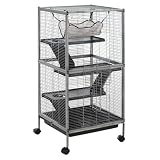 PawHut Four-Tier Rolling Ferret Cage PawHut Four-Tier Rolling Ferret Cage |
|
Check Latest Price |
| Polar Aurora Four-Tier Cage Kit |
|
Check Latest Price |
 Mcage Two-Tier Wrought Iron Cage Mcage Two-Tier Wrought Iron Cage |
|
Check Latest Price |
 Mcage Five-Level Extra-Tall Wrought Iron Cage Mcage Five-Level Extra-Tall Wrought Iron Cage |
|
Check Latest Price |
 Mcage Five-Tier Habitat with Deep Tray Mcage Five-Tier Habitat with Deep Tray |
|
Check Latest Price |
 HABUTWAY Two-Tier Rolling Ferret Cage HABUTWAY Two-Tier Rolling Ferret Cage |
|
Check Latest Price |
 Mcage Five-Tier Extra-Large Wrought Iron Cage Mcage Five-Tier Extra-Large Wrought Iron Cage |
|
Check Latest Price |
| VEVOR Two-Tier Rolling Ferret Cage |
|
Check Latest Price |
 Mcage 37in Rolling Hutch, Two Doors Mcage 37in Rolling Hutch, Two Doors |
|
Check Latest Price |
1. Yaheetech 52-Inch Six-Tier Ferret Cage: Best Overall for Small Rooms
- Six usable tiers in a 25 x 17 in base
- Three latched front doors at multiple levels
- Powder-coated steel frame resists rust and chewing
- Slide-out tray and removable grate for cleaning
- Four casters roll the whole unit out for a deep clean
- 52 in height is awkward under low ceilings
- Ramped levels trap bedding
- Assembly of a tall multi-panel frame takes two people
The first thing I checked on this cage was the base. At 25 by 17 inches it is narrower than most six-level habitats, and yet it still gives a ferret six separate platforms to climb. That combination is the whole reason it sits at the top of my list for small rooms, and it is why it carries more than 5,000 reviews at a 4.3 average.
We ran it against a corner of a bedroom with an awkward alcove, and the unit slid into the space where two standard habitats would have blocked the doorway. The frame is powder-coated steel, which matters for a species that gnaws on everything it can reach, and the corrugate ramps gave decent grip once I laid a strip of fleece over them.
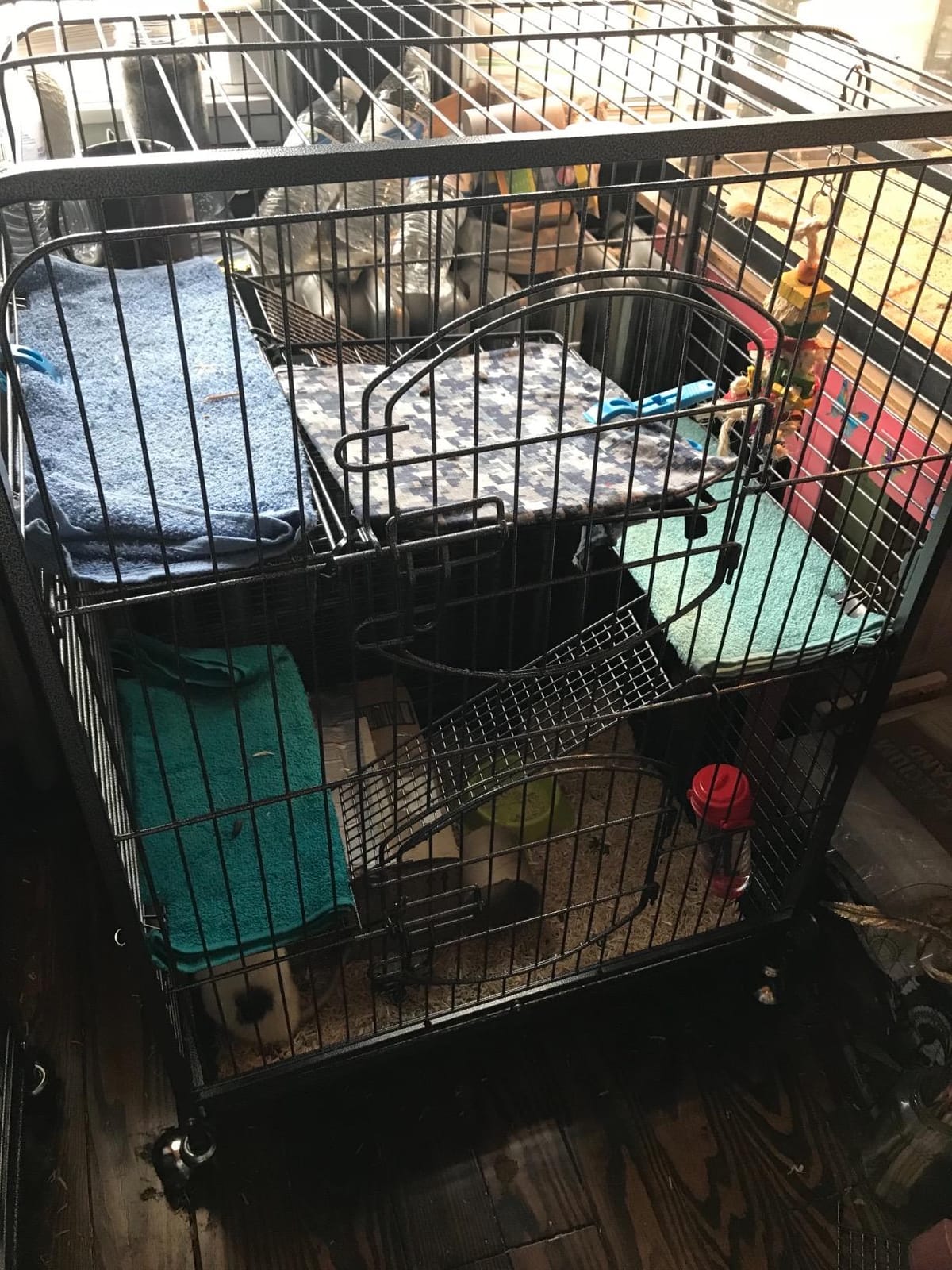
Cleaning is where multi-level cages usually frustrate people. Here the slide-out litter tray pulls from the base and the grate lifts out on its own, so a full clean of the bottom level takes a couple of minutes. The upper ramps are the weak point. They are sloped, so bedding and droppings collect along the incline and need separate attention, and no tray catches them.
The four 360-degree casters are what saved the situation. Because the whole cage rolls, I could wheel it into the middle of the room, clean the top tiers from a comfortable angle, and roll it back. Two of the casters do lock once it is in position.
Check the ceiling height before you commit
This is the one measurement that decides whether the Yaheetech works for you. The overall height is 52 inches, so you need a room with at least that much clear vertical space, and you need to be able to reach the top tier without a step stool you trip over in the dark.
In a room with a standard eight-foot ceiling it is comfortable. In a basement suite with exposed joists, or a room with a low bulkhead over a closet, it is not. I would measure from floor to the lowest obstruction in the spot before anything else.
Know that assembly is a two-person job
The frame is a tall multi-panel build and the pieces are heavy, with 28.2 pounds in total. Our own build took two people and more time than I expected, and the casters can roll the partly built frame away from you under its own weight until it is locked.
Not every door spans a full tier, so there are corners where you reach in awkwardly during handling. If you plan to do daily interaction through the front of the cage, test the door reach first. For a ferret that spends most of its life sleeping and out playing in a larger room, it is a non-issue.
2. PawHut Four-Tier Rolling Ferret Cage: Best for the Smallest Footprint
PawHut Metal Small Animal Cage, 4-Tiers Rolling Big Ferret Cage, Gray
- Compact 20.5 in square base with four usable tiers
- Steel wire stays ventilated and sturdy
- Pull-out tray and two doors for fast daily cleaning
- Included hammock gives an instant sleeping spot
- Four wheels make it easy to catch a patch of sunlight
- Door openings smaller than the tier space
- Wire floors and ramps get rough on small paws
- Instructions are basic and pieces are unlabeled
- Latches can be finicky during deep cleaning
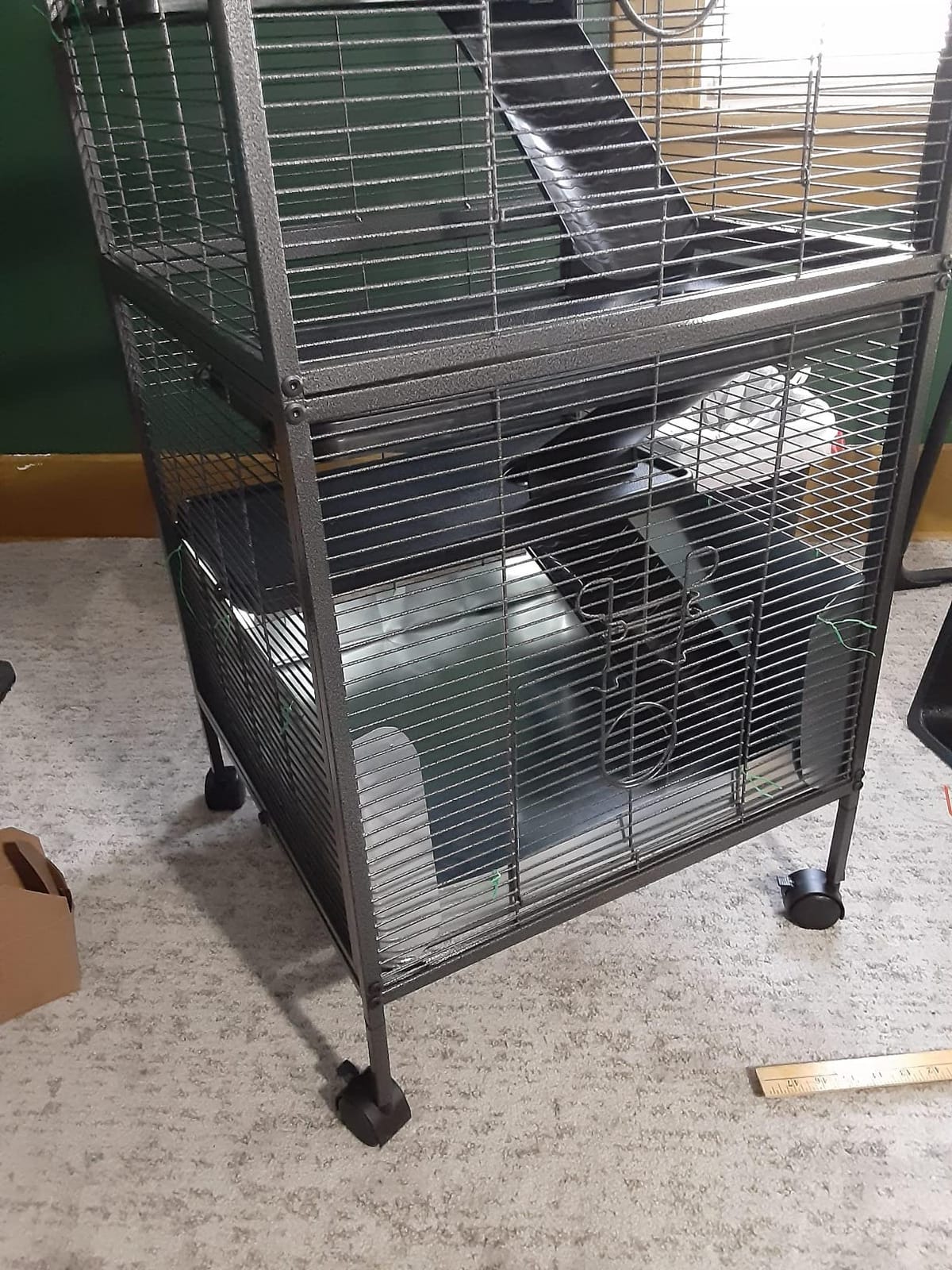
A square 20.5-inch base is unusual in this category and it changes what you can do with a room. Against a straight wall or in the corner of a small bedroom, the square footprint wastes far less floor than a rectangular 25 by 17 cage of similar height. Four tiers on that base is the best packing of usable climbing space I found in a cage this narrow.
The build is steel wire in a see-through design, and ventilation is genuinely good. That matters more than people expect in a small room, where a cage sits in a corner that does not get much air movement, and ferrets are sensitive to heat. The included hammock at the top is a nice touch, because it gives a high sleeping spot without taking up floor area.
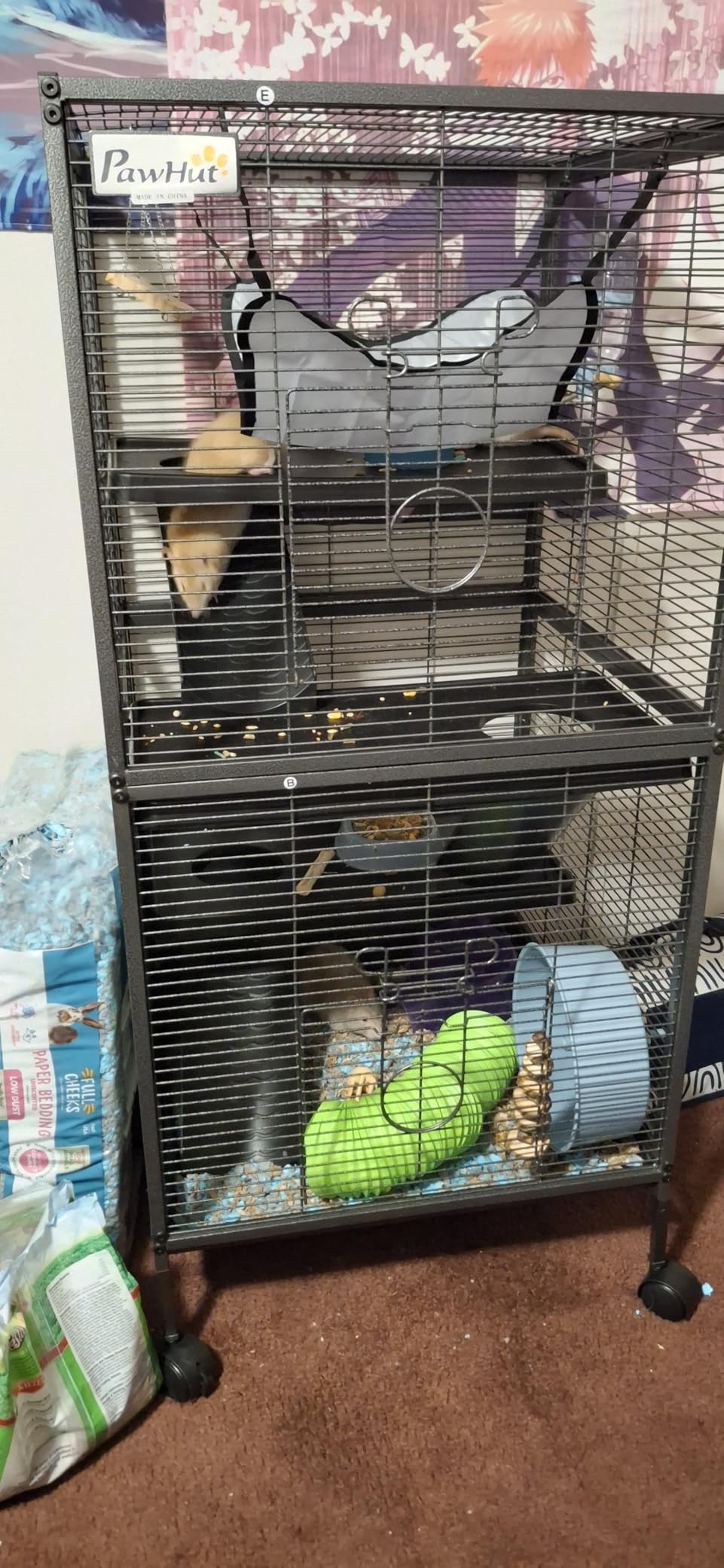
Owners of this cage generally point to the same trade-off, and it is about access rather than quality. The doors open onto a portion of the tier rather than the whole thing, so when you need to reach a far corner for handling or a thorough clean, you are working around the frame. Cleaning a cage is a daily job, and awkward reach turns that into a longer job.
Wire floors and ramps also need attention. Ferret feet are sensitive, and owners commonly cover the wire with a washable liner or a fleece pad. That costs you a level of bare floor area, but it is a small trade for a cage that is otherwise this space-efficient. At 26.4 pounds it is heavy enough that the wheels are not optional, but they roll smoothly and make the cage easy to reposition for playtime.
Measure your access paths, not just the footprint
The base fits almost anywhere. The question is whether you can get the cage where it needs to go. At 44.75 inches tall and 26.4 pounds, this is a tall, heavy object that has to travel through doorways and along hallways without catching on a door frame.
If your route to the cage spot involves a tight turn, measure the diagonal of the cage plus the width of the doorway before you order. Owners who move cages around in small rooms tend to move them rarely once they are placed, so getting the position right the first time saves a lot of awkward shuffling later.
Plan on covering the wire floors
Nothing in the design prevents you from adding liner or fleece over the wire, and most owners do. Budget for a few extra washable pads that fit the 20.5-inch square base, because that single change is the difference between a cage a ferret will comfortably use and one it avoids.
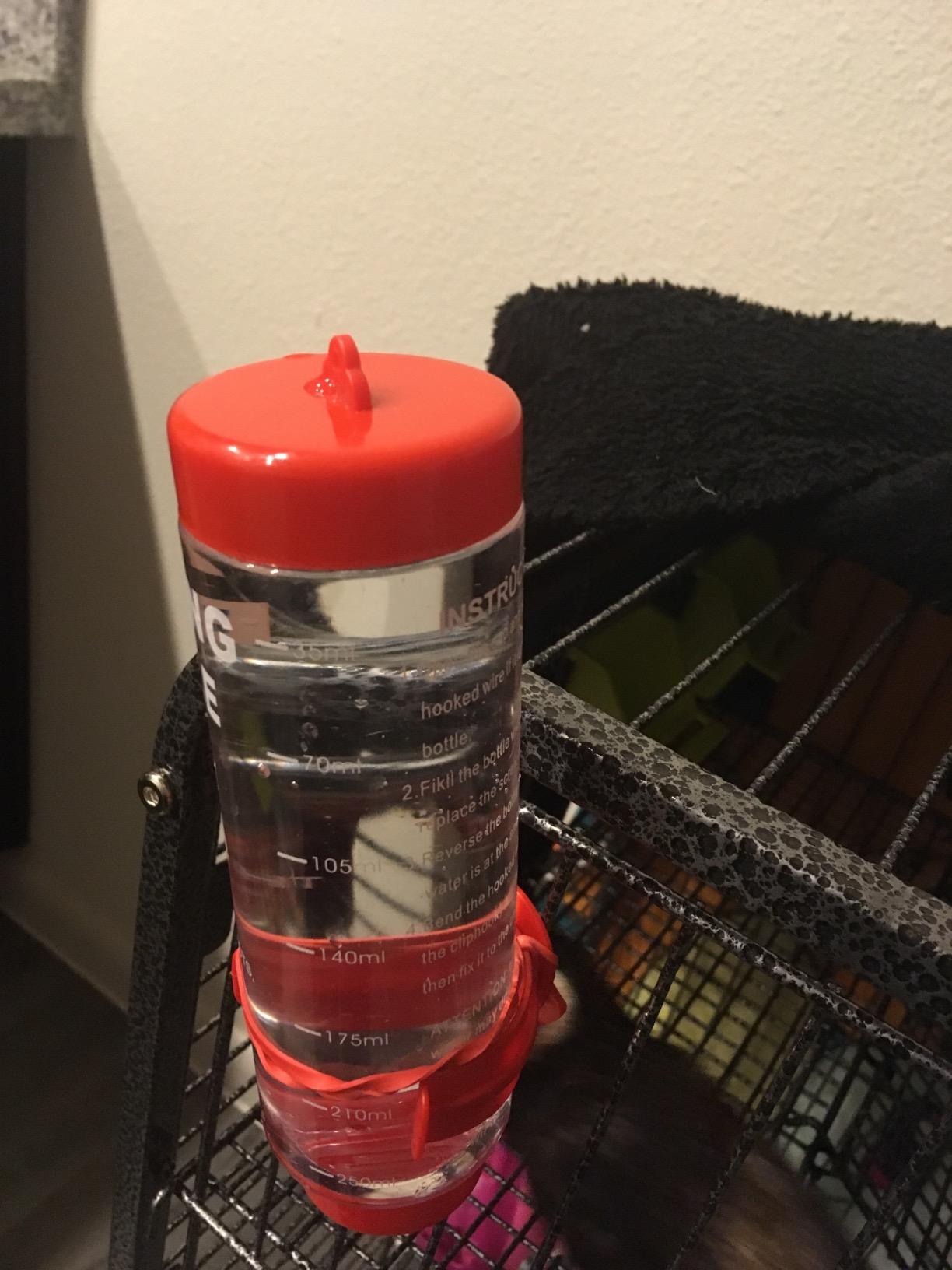
Also expect to spend a little time on the latches. Reviewers report that the gates can be awkward to operate during a deep clean, and it helps to know that in advance rather than fighting a latch with both hands full of bedding.
3. Polar Aurora Four-Tier Ferret Cage Kit: Best Value
- Half-inch bar spacing contains even curious cats
- Square 20 in base with four tiers
- Flannel-covered solid ramps are gentle on paws
- Detachable deep base tray for quick waste disposal
- Braked casters keep the unit stable
- Latches are stiff
- especially during deep cleaning
- Gate openings are small for handling
- Shelves are stubborn to seat
- Wire insert on the bottom is uncomfortable for feet
Half-inch bar spacing is the feature that separates this cage from most of the budget field, and it is the reason I would put this kit ahead of several pricier options for a first ferret home. At half an inch, an adult ferret cannot get its head through, and owners report it holds even against a curious cat. Several cages in this roundup ship with nearly double that spacing.
The base is 20 by 20 inches and the height is 45 inches, so you get four platforms inside a footprint that occupies less than three square feet. The ramps are solid plastic with flannel covers already fitted, which removes the most common modification people make to wire cages. There is also a hanging hammock at the top and four platforms placed at different heights.
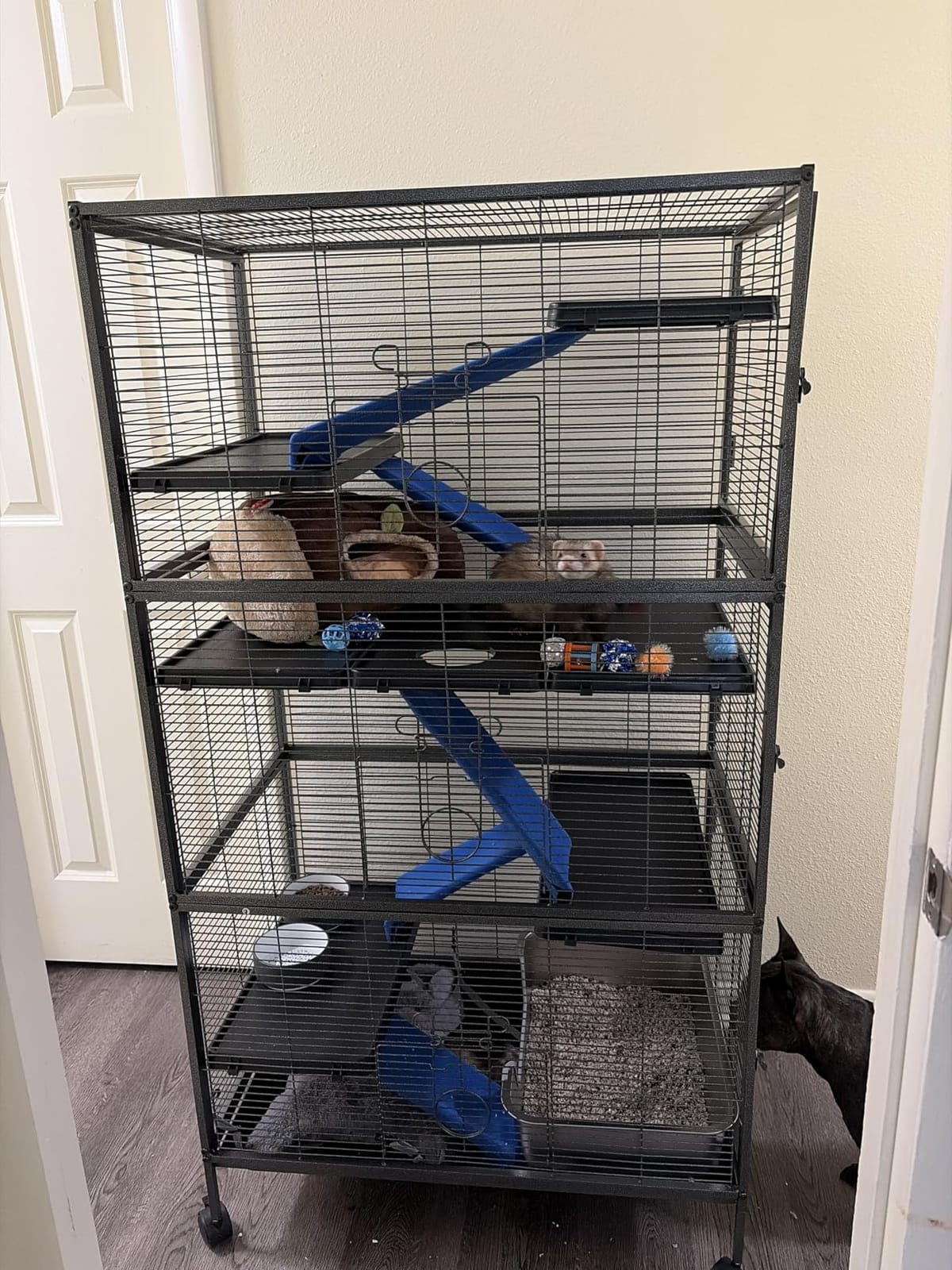
Owners like the deep base tray. It detaches completely, which means waste disposal is a matter of lifting a solid pan rather than scraping a shallow tray, and in a small room that difference keeps the surrounding floor clean. Four universal wheels, two with brakes, let you roll the unit into the open for cleaning and lock it back into its corner.
The criticisms cluster around hardware. Latches are stiff and become frustrating during deep cleaning, the gate openings are small for reaching in to handle a ferret, and the level shelves take some persuading to seat because the vertical spacing is tight. Owners also note that the flannel ramp covers wear through with use, and the plastic underneath hardens into something rougher on paws, so keep spare covers in mind.

Why half-inch spacing matters more than anything else?
An adult ferret’s skull is narrow enough to fit through a gap that looks generous on a product page. Anything above half an inch, and up to about an inch on some models, is a real escape risk for a determined animal, especially for a young one that is still growing.
Check the spacing figure for every cage on your shortlist and treat anything wider than half an inch as a hard filter. Several cages here are excellent for chinchillas, rats, and squirrels but are not built for a ferret at all, and no amount of cover or mesh panel you add yourself changes that as cleanly as buying the right spacing from the start.
Know what arrives and what you have to finish
Reviewers consistently note that the build is sturdy once every screw is tightened, and also that panels arrive unlabeled with vague instructions. That is a fair summary of the experience: give yourself an hour with a labeled diagram you draw yourself, and tighten hardware a second time after the cage has stood on its own for a day.
The bottom wire insert is removable, and owners recommend removing or covering it for foot comfort. It is a two-minute change that makes the base level usable rather than something a ferret avoids, and given how much time a ferret spends sleeping at the bottom of a cage, it is worth doing on day one.
4. Mcage Two-Tier Wrought Iron Cage: Best for Closets and Alcoves
Deluxe Sturdy Wrought Iron Two Tiers Small Animal Critters Rolling Cage
- Wrought iron resists chewing
- Half-inch spacing is genuinely escape-proof
- Large hinged front door opens wide
- Only 24 in wide so it fits closets and alcoves
- Ships with hammock
- water bottle and food bowl
- Top hook door latch is weak
- Wire can arrive bent or broken
- Instructions and panel labels unclear
- Included water bottle may leak
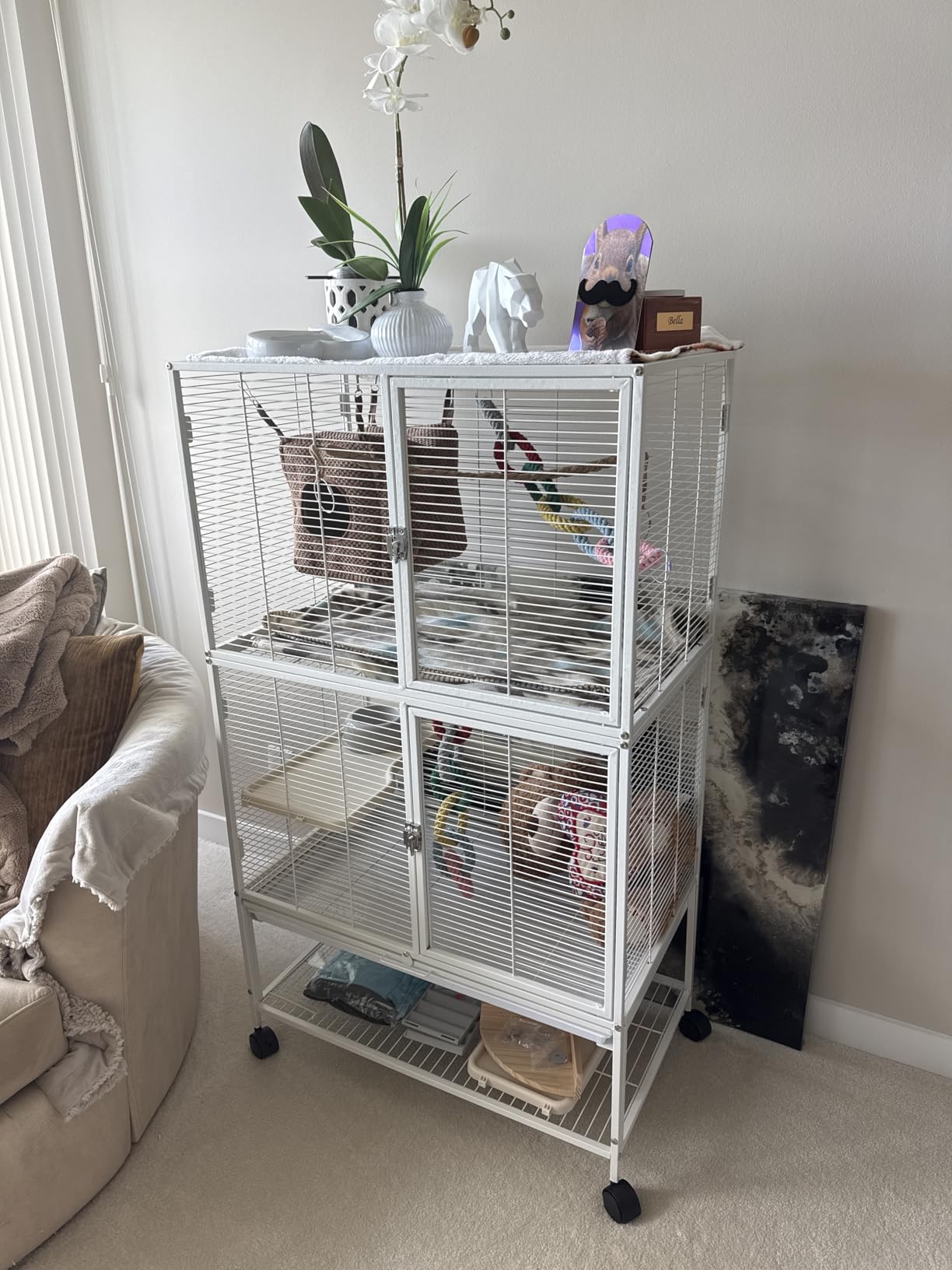
At 34 inches tall and 24 inches wide, this is the shortest serious multi-level cage in the roundup, and that is exactly why it belongs in a closet conversion or an awkward alcove where a 50-inch tower simply will not go. Two tiers on a 24 by 17.5 inch base give a ferret a den to sleep in and a level to climb, which is a workable setup for a pet that spends most of the day out playing.
The construction is wrought iron rather than lightweight wire, and it is noticeably heavier in the hand at only 15 pounds. Owners comment that it resists chewing, which matters with a ferret that will work at any weak point. Spacing is half an inch, so it is genuinely escape-proof for an adult.
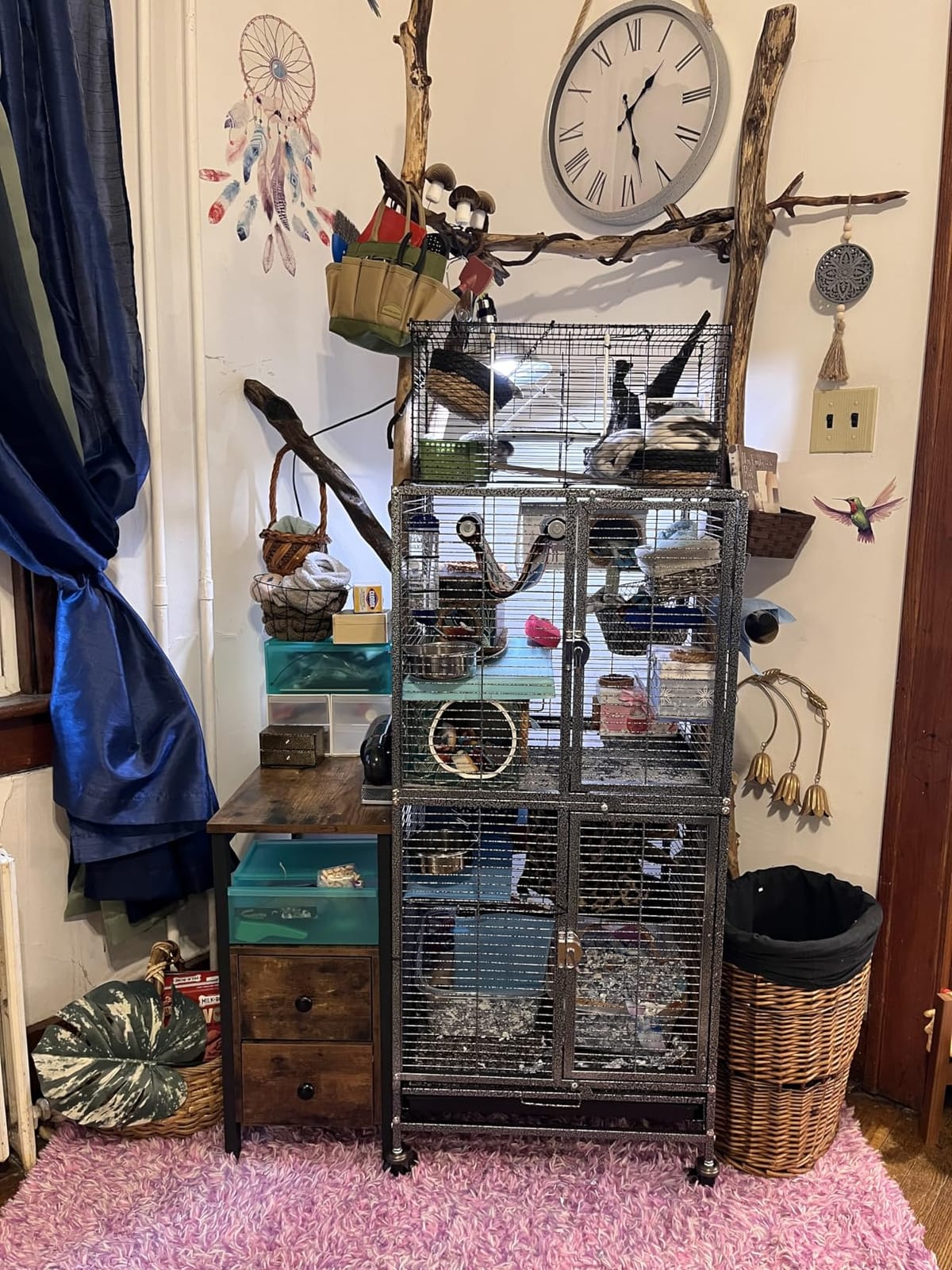
The large hinged front door is the sleeper feature. It measures 10.5 by 18.5 inches and swings wide, which makes daily access and full cleaning far easier than on cages with small gates. There is also a top hook door for reaching in from above, and the platforms, grate, and bottom tray all pull out for washing.
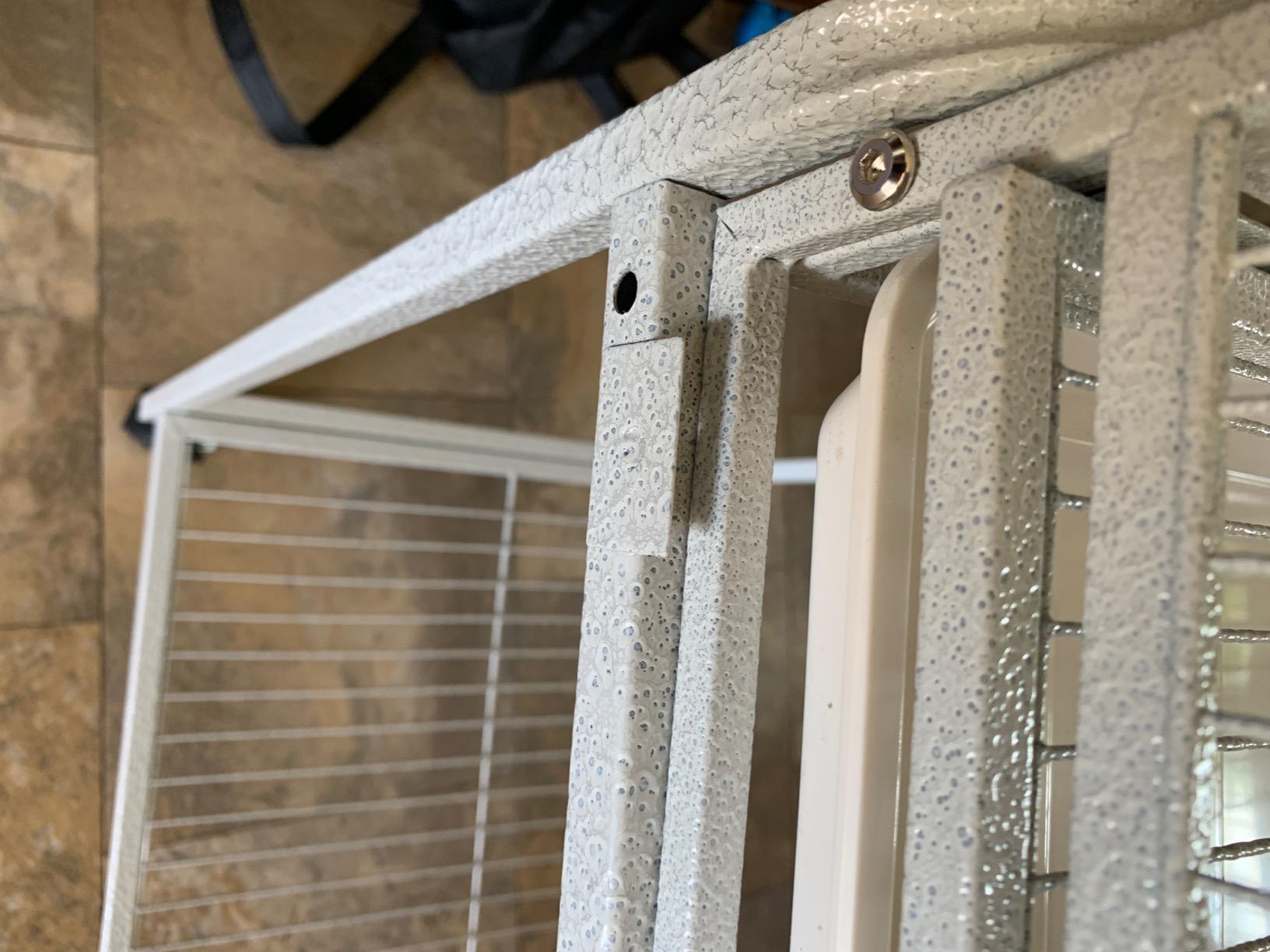
Two things to know before ordering. The top hook door latch is the weakest point, and some owners add zip ties to it for peace of mind. Quality control also varies, with reports of bent or broken wire arriving in the box, so inspect the whole frame on delivery. The included water bottle may leak or mount awkwardly, which is an easy fix with a separate bottle.
Check whether your closet has airflow
A closet is the most natural small-space spot for a short cage like this, and the least ventilated room in most homes. Ferrets overheat easily, so a closed closet with no air movement is the one placement I would talk you out of, even with a well-ventilated wire cage.
If you use a closet, leave the door open during the day, keep the cage a few inches off the back wall, and check the room temperature on a hot afternoon. A cage that sits in direct sun through a window gains heat quickly, and that is where wire cages earn their keep.
Plan a two-tier habitat, not a full habitat
Two levels means less total play space than the four- and five-tier cages here, and that is the honest trade. For a ferret with several hours of supervised free-roam time each day, this cage does its job as a secure sleeping and feeding den. For a ferret that spends most of its day inside, you would be looking at one of the taller models instead.
The platform is adjustable and washable, and the ramp has a soft fabric cover, so you can set the climb height to suit. Note that the all-mesh levels still need padding for foot comfort, and that the bottom tray can be pushed open from inside by a determined animal, which is worth checking each time you spot clean.
5. Mcage Five-Level Extra-Tall Wrought Iron Cage: Premium Pick
- Five tiers packed into a 32 in wide footprint
- Half-inch spacing with chew-proof all-metal platforms
- Detachable rolling stand with storage shelf
- Pull-out raised grate and tray for cleaning
- Two lockable heavy-duty casters
- 67.5 in tall will not fit under cupboards or low ceilings
- Heavy and awkward to move
- Large footprint compared with two-tier options
This is the best-built cage in the roundup, and the least appropriate for a genuinely small room. It stands 67.5 inches tall on a 32 by 19 inch base, so it needs both floor area and ceiling height that most apartments simply do not have. Buyers who have the room for it tend to keep it for years.
The wire spacing is half an inch, which is ferret-proof, and every platform and ramp is all-metal with no wood or plastic to chew. The double front swing-out doors with a metal safety lock give you proper full-width access, and the finish is described as a non-toxic epoxy coating, which matters for an animal that licks surfaces.
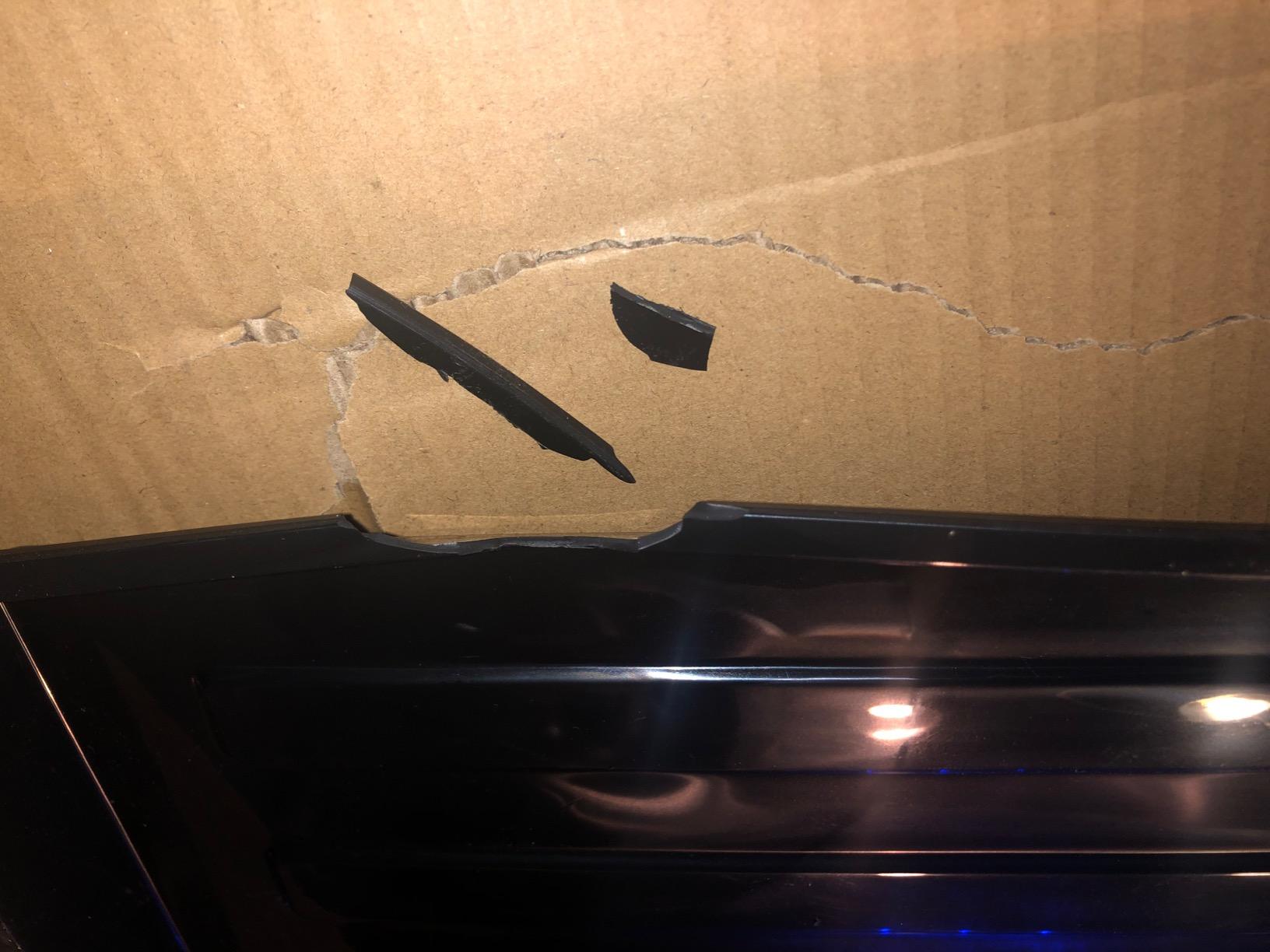
What I like most is the detachable rolling stand. It lifts the cage off the floor, adds a storage shelf underneath for supplies, and rolls on four heavy-duty casters, two of which lock. In a room with hard flooring, that storage shelf quietly recovers a shelf’s worth of space somewhere else.
Cleaning is well served by the pull-out metal grate plus the washable tray underneath, so solids land in the tray while the grate keeps feet off the base. Owners report a strongly positive rating spread with 64 percent five-star, and the complaints are about scale rather than function: it is heavy, the stand has to be attached separately, and the footprint is large next to two-tier cages sold for similar money.
Measure the ceiling twice, not once
At 67.5 inches, this cage is taller than a standard kitchen counter and close to head height for anyone under six feet. My rule for cages over 60 inches: measure the actual ceiling in the spot, then measure again at a different time of day, because crown molding, bulkheads, and attic slopes hide inches you will not account for on paper.
Also check overhead. A cage this tall sits directly in the path of a ceiling fan or a cabinet door if you put it in the wrong spot, and neither ends well. Wall clearance on the sides matters too, since you need room to open the double doors wide for cleaning.
Consider this for two ferrets only
Five levels and a 32-inch base make this the roomier of the two extra-large cages here, and that extra room is what supports a pair of ferrets living together. One ferret with lots of free-roam time does not need this much cage, and a single animal in a small home is better served by one of the narrow four-tier models.
If your ceiling is low, skip this and look at the five-tier habitat later in this roundup at 53 inches, or the Yaheetech at 52. Both give you similar level counts at heights that fit ordinary ceilings.
6. Mcage Five-Tier Habitat with Deep Pull-Out Tray: Best for Mess Control
- Five tiers in an 18 in deep base
- 2 in deep pull-out tray with urine guard contains mess
- Tool-free assembly with pop-in wheels
- Four locking access openings including a top door
- Braked wheels and child safety corner protectors
- 0.9 in bar spacing is wider than ferret-safe
- Mesh floor is uncomfortable for feet
- Only one door per tier slows cleaning
- Paint wears where animals chew
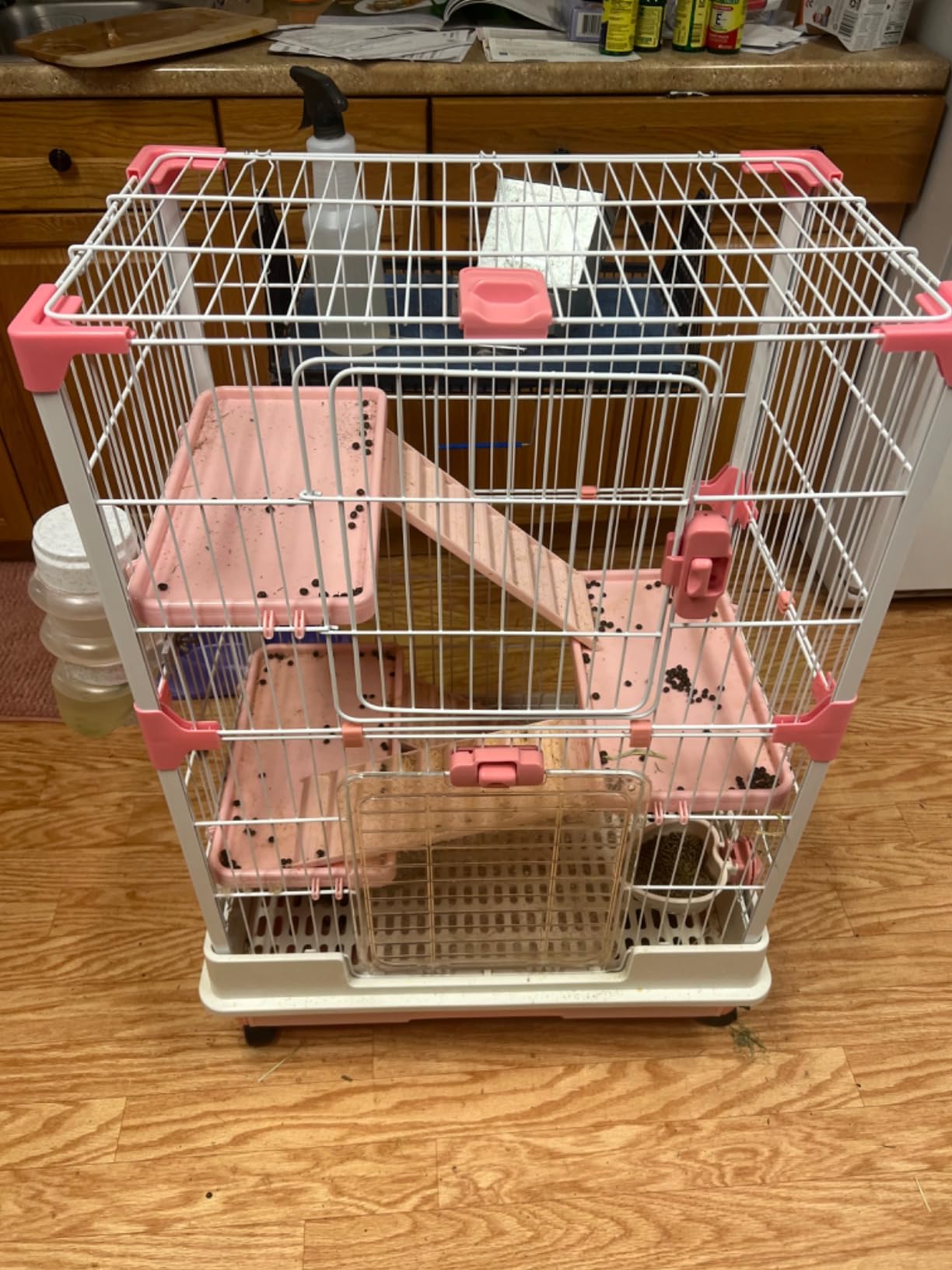
The tray is the story with this cage. It is 2 inches deep and comes with a removable raised urine guard, which is the single most useful feature for anyone in a small room where you cannot afford bedding and litter scattered across the floor around the cage. You pull the tray out, dump it, wipe it, and slide it back.
Assembly is genuinely quick. It uses tool-free clipped-on connectors and pop-in wheels, so there is no frame build to wrestle with on the floor of a small living room. That alone makes it one of the more pleasant cages to set up in an apartment, where you often have to assemble in place.
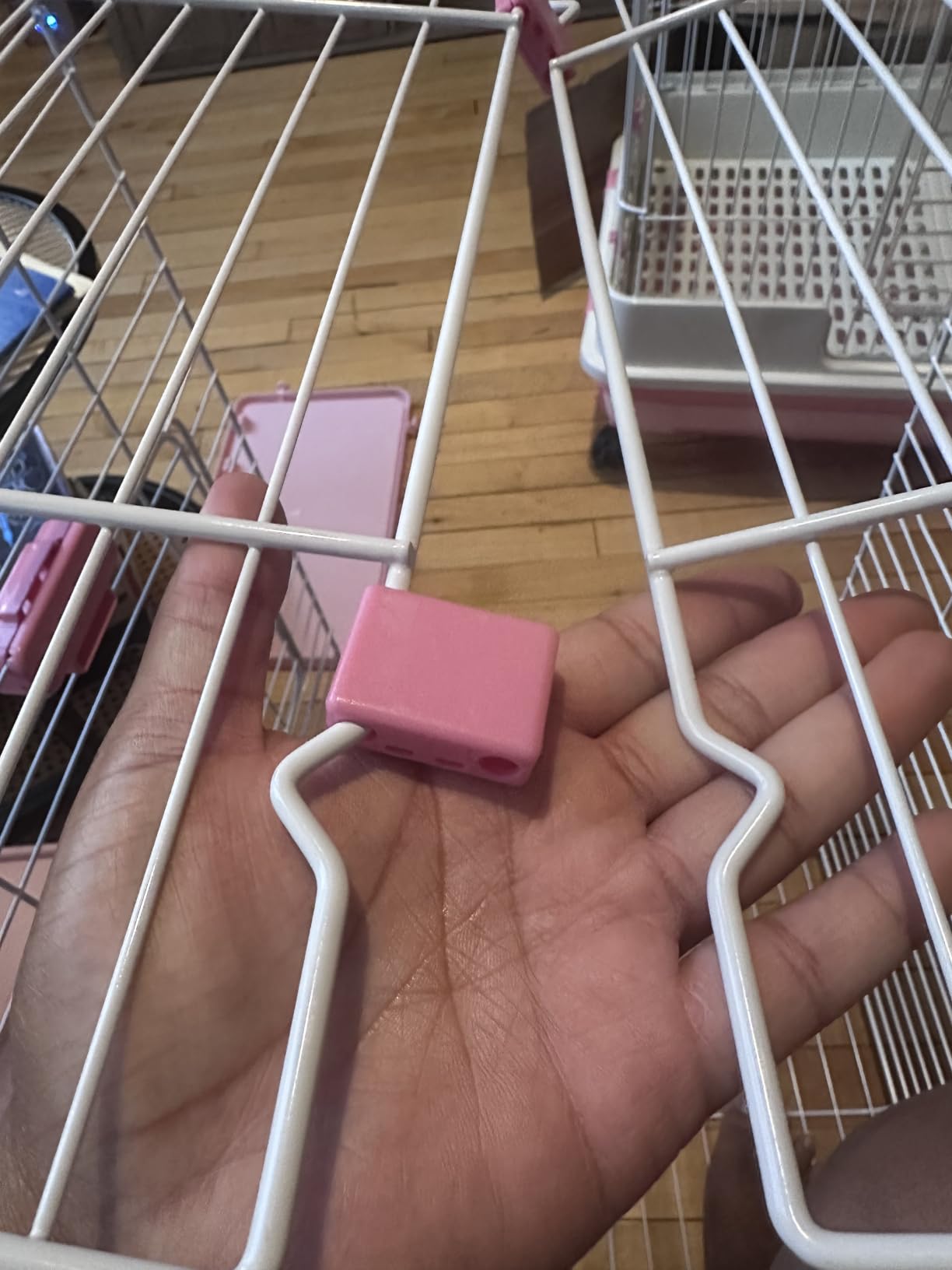
There is one serious problem, and it is the bar spacing. At 0.9 inch, this cage is wider than the half-inch spacing an adult ferret needs, and owners report ferrets squeezing through. The listing names chinchillas, squirrels, hedgehogs, rabbits, and kittens, and it performs well for all of those, but as a ferret cage it needs added mesh or cover panels to be safe.
If you are set on a ferret, I would not buy this one as-is. If you also house a chinchilla or a rabbit, it is a strong choice, and owners like the four locking access openings, including the top door, plus the corner protectors for a home with small children. Foot comfort still needs addressing, since the mesh floor is uncomfortable without a cover.
Count the levels against the bar spacing trade
This cage gives you five tiers in a base that is only 18 inches deep, which is genuinely impressive packing. But the levels are only useful if your ferret stays inside them, and 0.9-inch spacing undermines everything above the base.
Do the arithmetic before you buy. If you are committed to ferrets specifically, the half-inch spacing models in this roundup cost you one or two tiers and are the right call. If your household animal roster includes other small pets, this cage’s five tiers, tool-free setup, and deep tray are hard to argue with.
Expect to add a floor cover in any case
Mesh floors show up across this category and ferret feet do not enjoy them. A washable liner or a fleece pad on the base level costs almost nothing and changes how much the cage gets used.
Note also that only one door per tier makes a full clean slower than on double-door models, and that the paint finish wears where animals chew, especially at the welds. For a non-ferret setup this is fine. For a ferret, treat it as a second tier of concern after spacing.
7. HABUTWAY Two-Tier Ferret-Safe Rolling Cage: Best for Escape Proofing
- Half-inch spacing with an animal-proof door latch
- Soldered bar joints resist rust better than welds
- Under-cage storage shelf keeps supplies off the floor
- Flannel ramp sleeve and top hammock included
- Side cleaning door plus pull-out tray
- Only two tiers for the money
- 30 in deep is a wider footprint than slimmest options
- At 30 lb it is heavy without the wheels
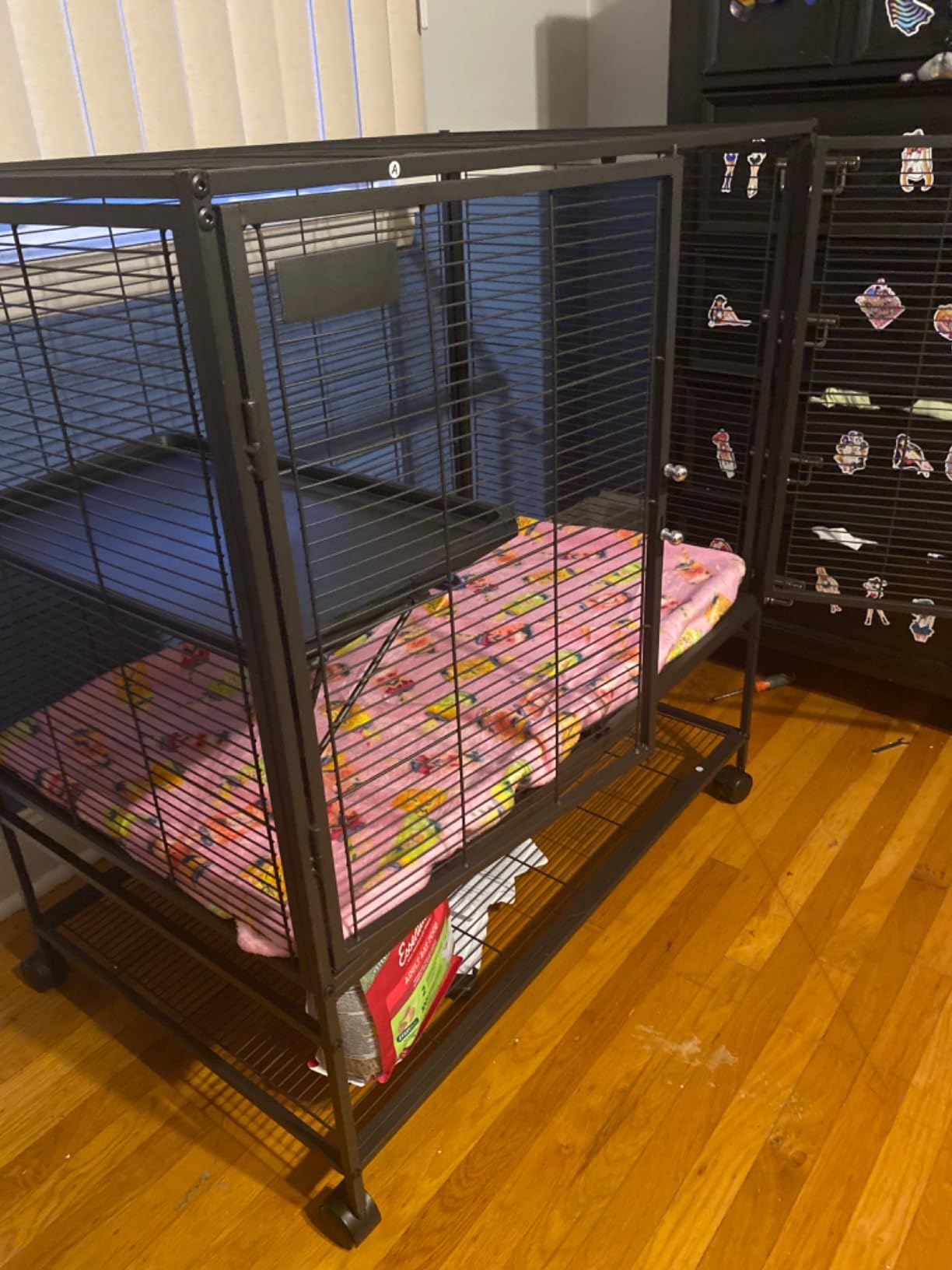
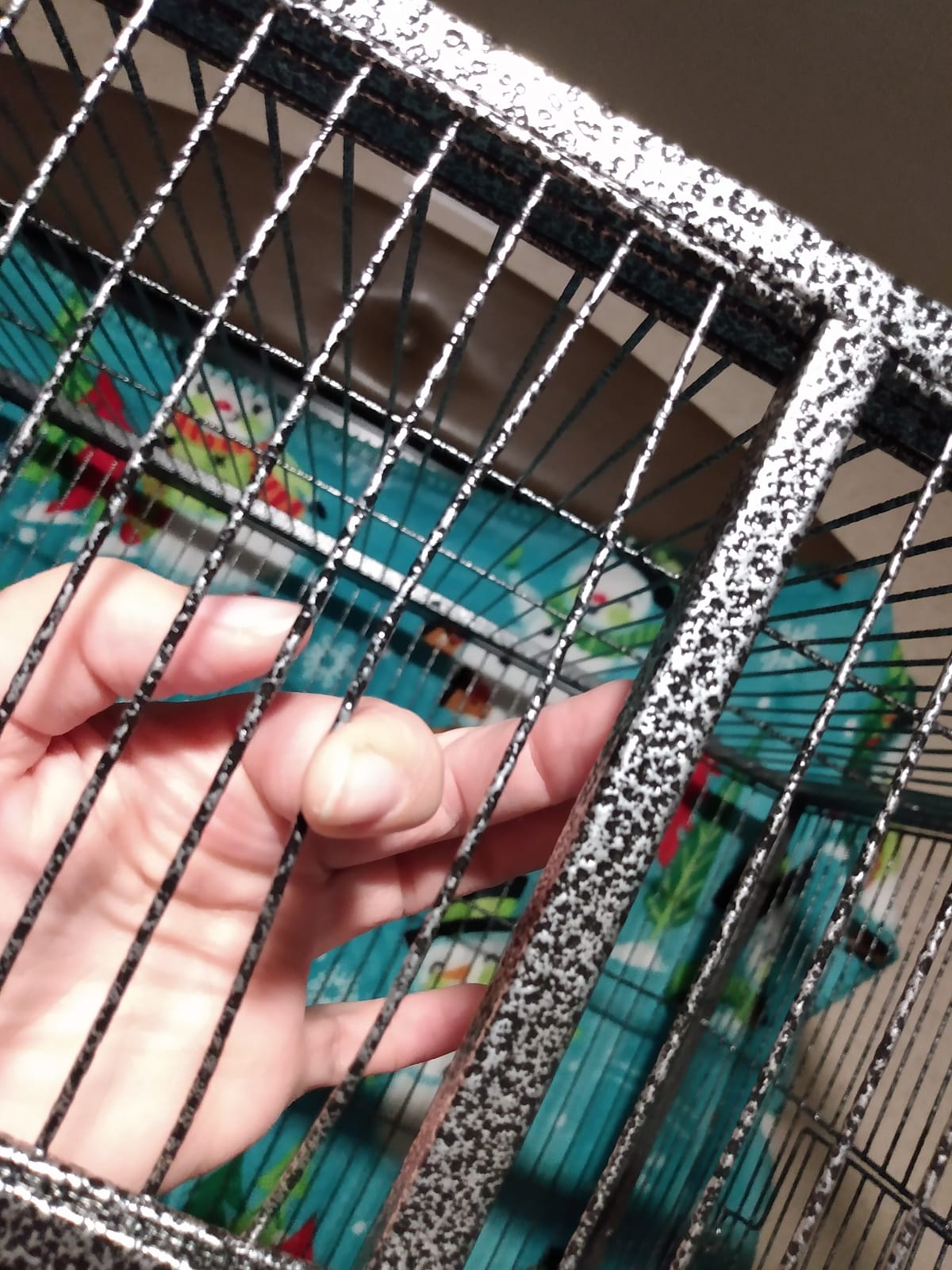
The hardware is what earns this cage its place. Bar joints are soldered rather than spot welded, and owners single that out as noticeably stronger and more rust-resistant than typical budget cages. The door latch is described as animal-proof, and combined with half-inch spacing it is the most secure combination in this roundup short of the much larger wrought iron models.
Height is only 36 inches, so it clears low ceilings and door frames, and the four universal wheels let you move it between rooms or into a yard. At 30 pounds it is genuinely heavy to lift without the wheels, so treat the casters as permanent rather than optional.
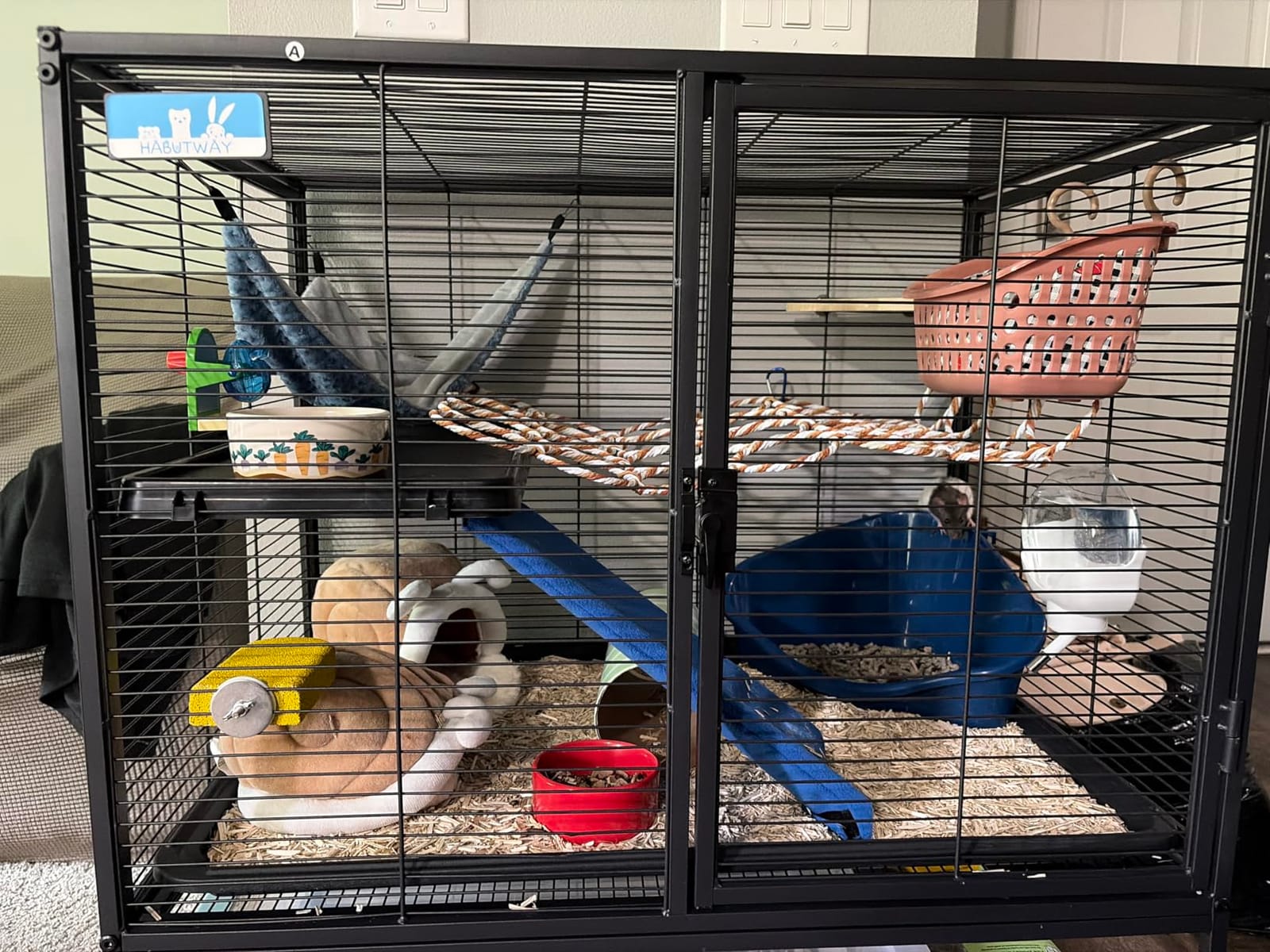
The under-cage shelf is the feature I would keep if I were downsizing. It runs the length of the base and holds toys, bedding, and treats, which in a small room means the supplies do not claim a separate shelf or the top of a bookcase. That is recovered space no cage dimension can tell you about.
Cleaning is well organised, with a side door for access and a pull-out bottom tray, plus a flannel ramp sleeve and a top hammock already included. The main limitation is straightforward: two tiers is not much climbing space. Owners wanting more height for the money look at the four-tier kits instead, and that is a fair trade.
Understand the footprint before the wheels go on
At 30.3 inches deep and 20.5 inches wide, this is not the narrowest cage here, though it is only 36 inches tall. If your limit is a closet depth rather than a wall length, check the 30-inch depth against your closet depth before ordering.
If your constraint is ceiling height instead, this cage is one of the safest picks on the list because it slides under things that would block a 45-inch tower. There is also a larger variant of this model listed at 36 by 23 by 39 inches if you want more room and can spare the width.
Give the soldered joints time to prove themselves
Soldered joints matter most in humid conditions and in kitchens or bathrooms where the cage gets hosed out or wiped down regularly. If you plan to clean your cage that aggressively, this cage is a better long-term bet than a spot-welded frame at the same size.
Numbers of parts are labelled and the package includes hardware and tools with step-by-step instructions, which puts it ahead of several cages here that arrive as an unlabelled pile of panels. Two tiers still means a modest play area, so plan on substantial out-of-cage play time.
8. Mcage Five-Tier Extra-Large Wrought Iron Cage: Best for Two Ferrets
- Five levels in a 32 in wide footprint
- Chew-free all-metal construction suits ferrets
- Half-inch spacing with hinged safety-locked doors
- Slide-out grate and tray for deep cleaning
- Detachable stand with storage shelf
- perches and feeder cups included
- 70 in overall is far too tall for low ceilings
- 32 x 19 in base takes real floor space
- Very heavy to move
- Assembly of a five-level frame is time-consuming
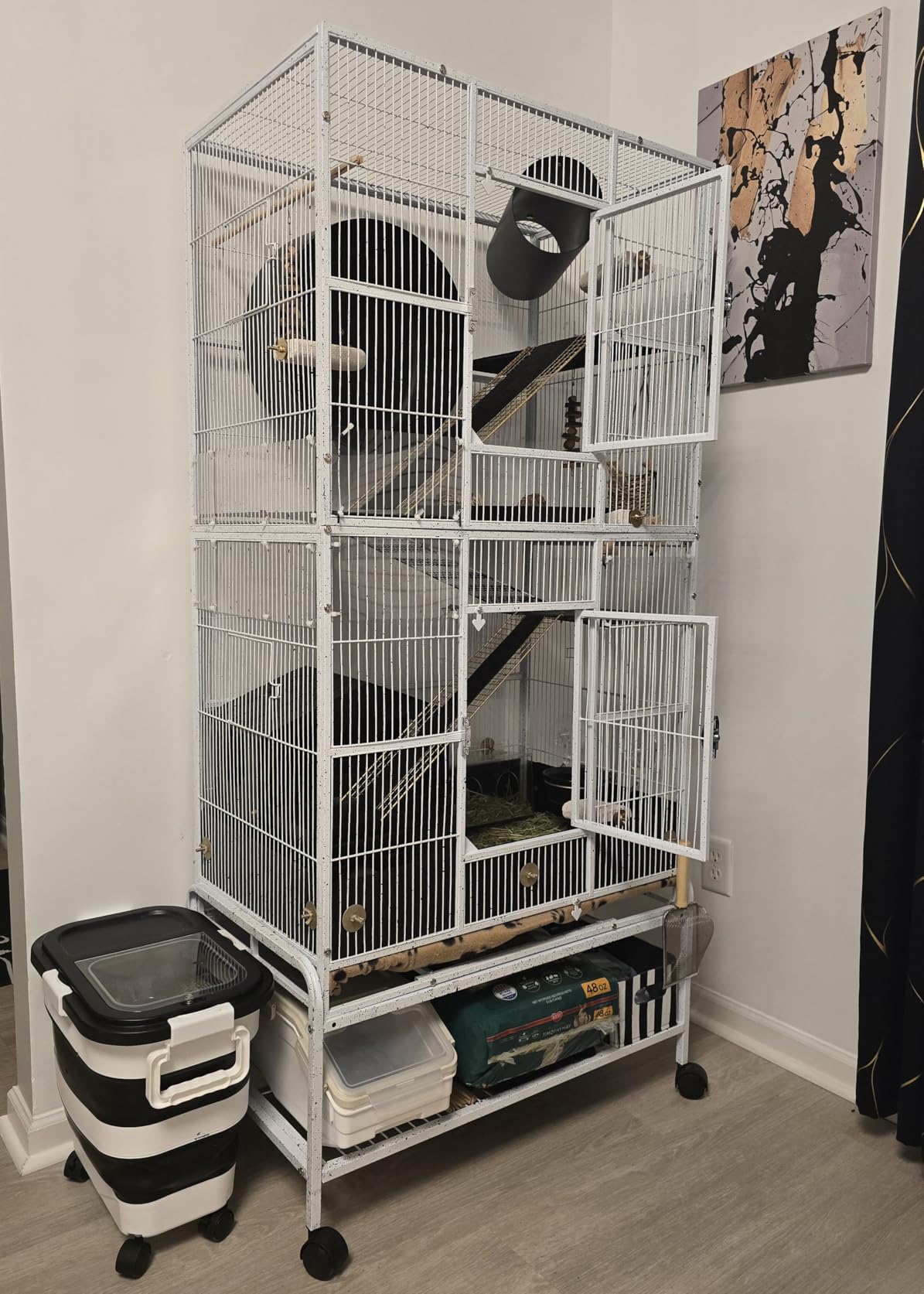
Two ferrets need roughly twice the usable area of one, and this cage is one of the few here built with that in mind. Five levels across a 30 by 18 inch cage body, all-metal with half-inch cross-wire ramps and shelves, gives a pair enough room to share without one animal blocking the other’s path to a level.
Everything a ferret can chew is metal. There is no wood and no plastic in the climbing surfaces, which removes the single most common failure point in long-term cages. Two front hinged doors with metal safety locks open wide for handling, and the slide-out grate and tray make deep cleaning straightforward.
One thing to get right: the 70-inch overall height includes the rolling stand. The cage body itself is 30 by 18 by 52 inches, and the stand adds another 18 inches. That distinction matters if you were hoping to slide the cage body under a bed or into an alcove, because the stand changes the math entirely.
The detachable rolling stand has a bottom storage shelf and comes with double plastic feeder cups and wooden sugar glider perches. Owners describe the reviews as consistent with no major functional complaints, which is about the highest praise a decade-old product can earn. The recurring caveat is scale, not function.
Know the real height before it arrives
At 32 by 19 by 70 inches overall, this is the largest unit in the roundup and the one most likely to fail a small-space check. Before ordering, measure the full height of the room including any ceiling fan clearance, then confirm you have a straight path for a 32-inch-wide object to reach the spot.
If the height does not work, the five-tier habitat at 53 inches or the 67.5-inch five-level wrought iron cage both give you the same level count at a shorter stature, and both are a better fit for a ceiling under eight feet.
Budget real assembly time
A five-level frame with two hinged doors is a long build. Plan on doing it over a couple of sessions, ideally with a second person, and set up in the room where it will live because a unit this size is not something you want to move once it is assembled.
Two ferrets also mean two litter areas and more bedding to manage, so the pull-out tray design earns its keep here more than on any single-ferret cage. Lock one wheel before you let them near it.
9. VEVOR Two-Tier Rolling Ferret Cage: Budget Pick
- Compact 24 x 17 in base and only 34 in tall
- 0.55 in spacing is tight enough for ferrets
- Lockable swivel casters make it easy to move and clean
- Wide doors and multiple side openings
- Removable doors and gates come apart easily
- Powder coating can rust within months
- Some units arrive bent or with incomplete welds
- Instructions rely on unclear photos
- Wire floors uncomfortable without a cover
- Doors do not seat as tightly as they should
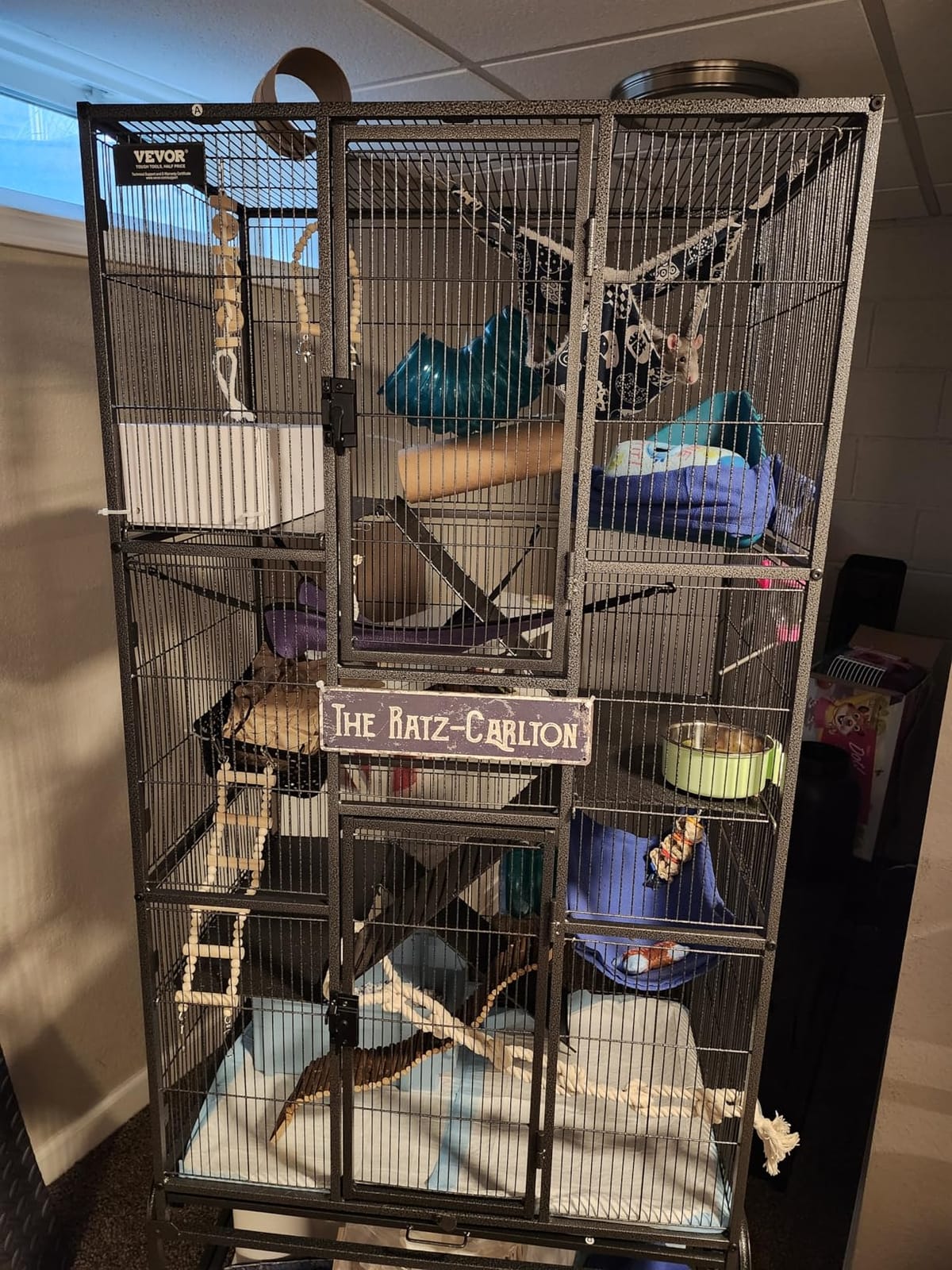
This is the most discreet unit in the roundup, and discreetness is exactly what a small space needs. At 24 by 17.3 inches on the base and 34 inches tall, it is the only cage here that reads as furniture rather than an installation, sliding under a bed frame or a desk with room to spare. Wire spacing is 0.55 inch, tight enough for ferrets and rats.
At 19.4 pounds it is also the second-lightest cage here, and the lockable swivel casters mean you can roll it out into the open and hose it down, then wheel it back into the corner. Multiple openings on different sides plus wide doors make cleaning faster than on cages with a single small gate.
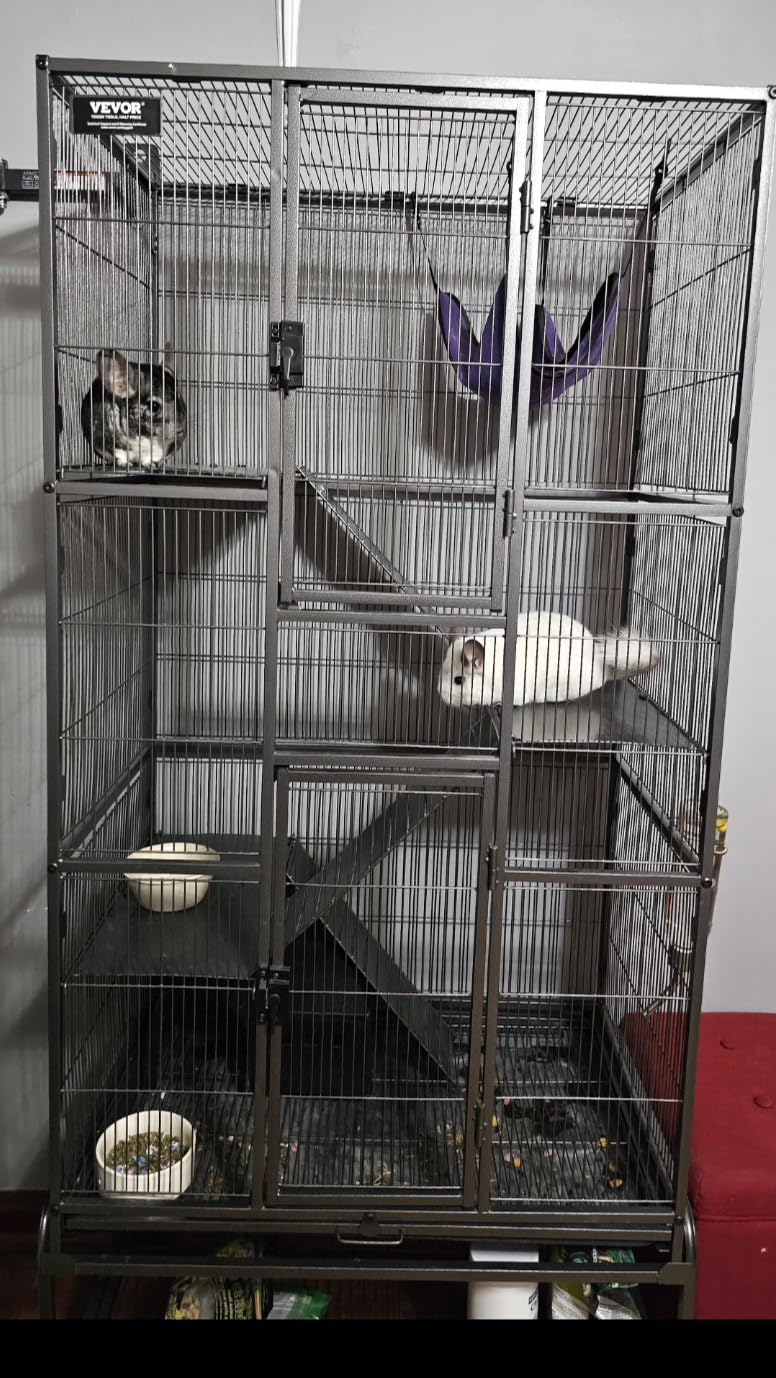
The honest weakness is durability over time. Several longer-term reviews report powder coating rusting or flaking after around six months of regular cleaning, especially in humid rooms, and a few report bent or poorly welded parts arriving in the box. The finish is described as rust-resistant rather than rust-proof, so a damp laundry room or bathroom is not its ideal home.
Two tiers is the trade for the small footprint. For a ferret with real free-roam hours each day, that is a workable den with a sleeping level and a climbing level. For one that stays inside, look at a four-tier unit. Doors are lockable but do not seat as tightly as they should, and the wire floors still need a cover for foot comfort.
Check the welds the day it arrives
Quality control on this model is inconsistent enough that inspection on delivery is worth ten minutes. Look along every bar joint, check that the panels sit square, and confirm the casters roll and the locks engage before you start building trust with a ferret inside.
If a panel does not fit, contact the seller straight away rather than forcing it. The powder-coated square tubing itself is thick and holds added platforms and accessories well, so the frame is stronger than the finish suggests.
Plan around two tiers and a covered floor
Understand what you are getting. Two tiers is a compact den rather than a climbing habitat, and the wire floor needs a washable pad before a ferret will use it comfortably. Both changes are cheap and quick, but they are decisions you should make before purchase, not after.
What you get in return is the best ratio of usable cage to occupied floor space here, plus the simplest cleaning routine with removable doors and gates that come apart and go back together easily. That combination is why this is my budget pick for small rooms.
10. Mcage 37-Inch Rolling Hutch with Two Front Doors: Best for Indoor or Outdoor Use
37-inch Metal Ferret Chinchilla Small Animals Hutch Rolling Cage Squirrel/Puppy/Kitten/Rabbit/Ferret Pet with 2 Front Doors for Indoor Outdoor Solid Plastic Platfroms and Ladders
- Only 17.5 in deep and 37 in tall
- Two large front doors give better access than single-door cages
- Epoxy-coated metal works indoors or outdoors
- Customizable washable plastic platforms and ramps
- Four lockable casters
- bowl and bottle included
- 0.9 in bar spacing is wider than ferret-safe
- Wire bottom grate is uncomfortable without a cover
- Under 100 reviews so less long-term feedback
- Platform openings are tight and fiddly to install
I want to be straight about this one, because the dimensions look attractive for a small room. At 24 by 17.5 inches and 37 inches tall, the footprint is excellent. The bar spacing is 0.9 inch, which is wider than the half-inch an adult ferret needs, and owners confirm that as the main drawback. For ferrets specifically, this is not a safe choice without added mesh or cover panels.
What it does have going for it is door access. Two large front doors open across most of the tier, which is more than single-door cages at this size offer, and that makes daily handling and cleaning noticeably faster. The platforms and ramps are customizable, washable solid plastic rather than bare wire.
The epoxy-coated metal is rated for indoor or outdoor placement, which makes this the most versatile unit here if you want to move an animal between a screened porch and a room. Four heavy-duty lockable casters handle that, and a raised wire grate above a slide-out tray keeps the base dry and cleanable.
With 71 reviews there is less long-term feedback than any other cage in this roundup, and platform openings are tight enough that installation takes patience. If a second small pet or a temporary setup is your actual need, it serves well. For a ferret, pick one of the half-inch spacing models instead.
Know when the wider spacing rules a cage out
Bar spacing is not a preference. A ferret skull can pass through a gap that looks safe in a photograph, and escape attempts often happen while you are asleep. Anything above half an inch on a cage marketed to you as a ferret cage is a reason to keep looking.
This cage earns its place in the roundup because it shows how much variation exists between models that look similar in a thumbnail, and how many listings are aimed at rats and chinchillas rather than ferrets. Read the spacing number before anything else on any product page.
Two doors and plastic platforms are the real advantages
If your animal is short enough to be safe in 0.9-inch spacing, or you are adding mesh panels yourself, the access here is genuinely good. Two large front doors beat a single small gate every time, and washable solid plastic platforms solve the wire floor problem that most cages in this price range leave you to solve yourself.
The included food bowl and water bottle mean the cage is usable on day one. Lock the casters before anyone interacts with it, since the doors swing wide and a 22-pound cage on unlocked wheels is a tipping risk.
How to Choose a Ferret Cage for a Small Space?
Small-space ferret cages come down to four numbers and three habits. Get the numbers right and the habits are simple; get the numbers wrong and no amount of clever arrangement fixes it.
Measure your footprint before you fall for a tall cage
Base width matters more than total cage size, because that is what you cannot change later. Start by measuring the width of the wall or closet you plan to use, then subtract a few inches on each side so you can still clean behind and beside the cage. A 25-inch base in a 27-inch alcove is a fit. The same base in a 26-inch alcove is a daily frustration.
Then check depth against your walking path. A cage you cannot get past means you will move it constantly, and tall cages on casters are awkward to shuffle around. Our rule was that you should be able to walk past the cage without turning sideways.
Finally, measure height from floor to the lowest obstruction, which is often a bulkhead, a light fixture, or an open door above the spot rather than the ceiling itself. Any cage over 50 inches needs that check done twice.
Bar spacing of half an inch is the hard safety rule
This is the one specification with no compromise. Ferrets are slender enough to squeeze through gaps that look generous, and young ferrets can manage spaces an adult cannot. Half-inch spacing is the widely used safety standard, and it is also what stops a determined cat from reaching in.
Several cages in this roundup use 0.9-inch spacing. They are perfectly good cages for chinchillas, rats, squirrels, and hedgehogs, and two of them are genuinely attractive options on footprint alone. They are not ferret cages without modification. Sort your shortlist by spacing first, then compare everything else.
Solid floors beat wire floors for ferret feet
Wire floors appear across this whole category, and ferret feet do not handle them well over time. Almost every owner of a wire-floored cage covers it, and the cheapest fix is a washable liner or a fleece pad on the base level plus covers on the ramps.
Several cages here make this easier. The Polar Aurora kit ships with flannel-covered solid ramps, the Mcage wrought iron cages offer adjustable paw-safe solid platforms, and the HABUTWAY includes a flannel ramp sleeve. If a listing shows a removable platform or a deep plastic tray, treat that as a bonus rather than a detail to ignore.
Levels and doors decide how usable the space is
Levels multiply floor area without multiplying footprint, which is the entire logic of a small-space cage. Five tiers in a 19-inch-deep base genuinely outperforms two tiers in a 30-inch-deep one for a climbing animal, provided the bar spacing keeps your ferret inside.
Doors are the second half of that equation. A cage with two wide front doors is cleaned in a fraction of the time of one with a small single gate, and cleaning happens every day. When two cages are otherwise similar, pick the one with better access. The PawHut and the five-tier habitat both score well here despite very different footprints.
Wheels, trays, and noise in a rental
Locking casters are close to mandatory in a small home, because a cage that cannot be moved cannot be cleaned underneath or repositioned for playtime. Look for at least two locking wheels rather than four, since four rigid wheels on a heavy cage is a tipping risk in a busy household.
Deep trays matter more in tight rooms than anywhere else, because there is nowhere for spilled bedding to go. The 2-inch tray with a removable urine guard on the five-tier habitat is the best example, and it is why that cage appears here despite its spacing problem.
On noise, the useful moves are simple: put a thin felt pad under each caster, keep a fleece strip on wire ramps so they do not ring under foot, and check that the cage is not rolling against a wall or baseboard overnight. Apartment dwellers on r/ferrets repeatedly mention covering ramps for grip and quiet, which solves two problems at once.
One more rental consideration: a cage on wheels leaves no marks, whereas anything you drill or mount for wall accessories may need landlord approval. Keeping your setup entirely freestanding is the simplest way to avoid that conversation.
Frequently Asked Questions
What is the minimum size cage needed for a ferret?
For a single ferret, most owners look for at least 24 inches of length, a multi-level design with three or more usable platforms, half-inch bar spacing, a solid or covered floor, and enough total floor area across levels to stretch out. When you are short on floor space, prioritize levels over overall dimensions, since each level adds usable area without using more floor.
What type of cage is best for a ferret?
A multi-level metal cage with half-inch or tighter bar spacing, a solid or covered floor, secure latches, and a slide-out tray is the standard choice. Wide openings, at least two levels connected by ramps with covers, and locking wheels on the base all make daily life easier. Avoid cages with bar spacing wider than one inch.
Can a ferret live in a small cage?
A ferret can live in a compact cage only if it has enough levels to climb, half-inch bar spacing so it cannot escape, and several hours of supervised time outside the cage each day. A cage with two tiers works as a sleeping and feeding den for a ferret with good free-roam time. If your ferret stays inside most of the day, add levels or floor area.
What to use in the bottom of a ferret cage?
Use a solid platform or a wire floor covered with a washable liner or fleece pad, since wire is uncomfortable for ferret feet over time. Add bedding your ferret can burrow into, place the litter box in a corner away from the sleeping area, and keep food and water on a separate level to reduce mess.
How many hours a day should a ferret be out of its cage?
Aim for at least three to four hours of supervised out-of-cage time each day, and more when your space allows. Ferrets sleep a large share of the day, so the cage functions as a den for sleeping, eating, and safe periods when you cannot supervise, rather than as the whole environment. That is why even a compact cage works when free-roam time is generous.
Our Pick for Small Spaces This Year
The best ferret cages for small spaces come down to base width, height against your ceiling, and bar spacing that an adult ferret cannot defeat. The Yaheetech six-tier cage is our overall pick because it gives six usable levels inside a 25 by 17 inch base with a pull-out tray, which is the strongest balance of climbing space and footprint we found.
If your room is tighter than that, the Polar Aurora four-tier kit is the value pick with half-inch spacing and a 20-inch square base, and the VEVOR two-tier cage is the most discreet option at 34 inches tall. Whichever you choose, check the ceiling, cover any wire floor on day one, and buy the wheels. Like most space-saving setups, our small-space crib guide and rocking chair picks come down to the same rule: measure first, then buy the tallest thing that fits.