
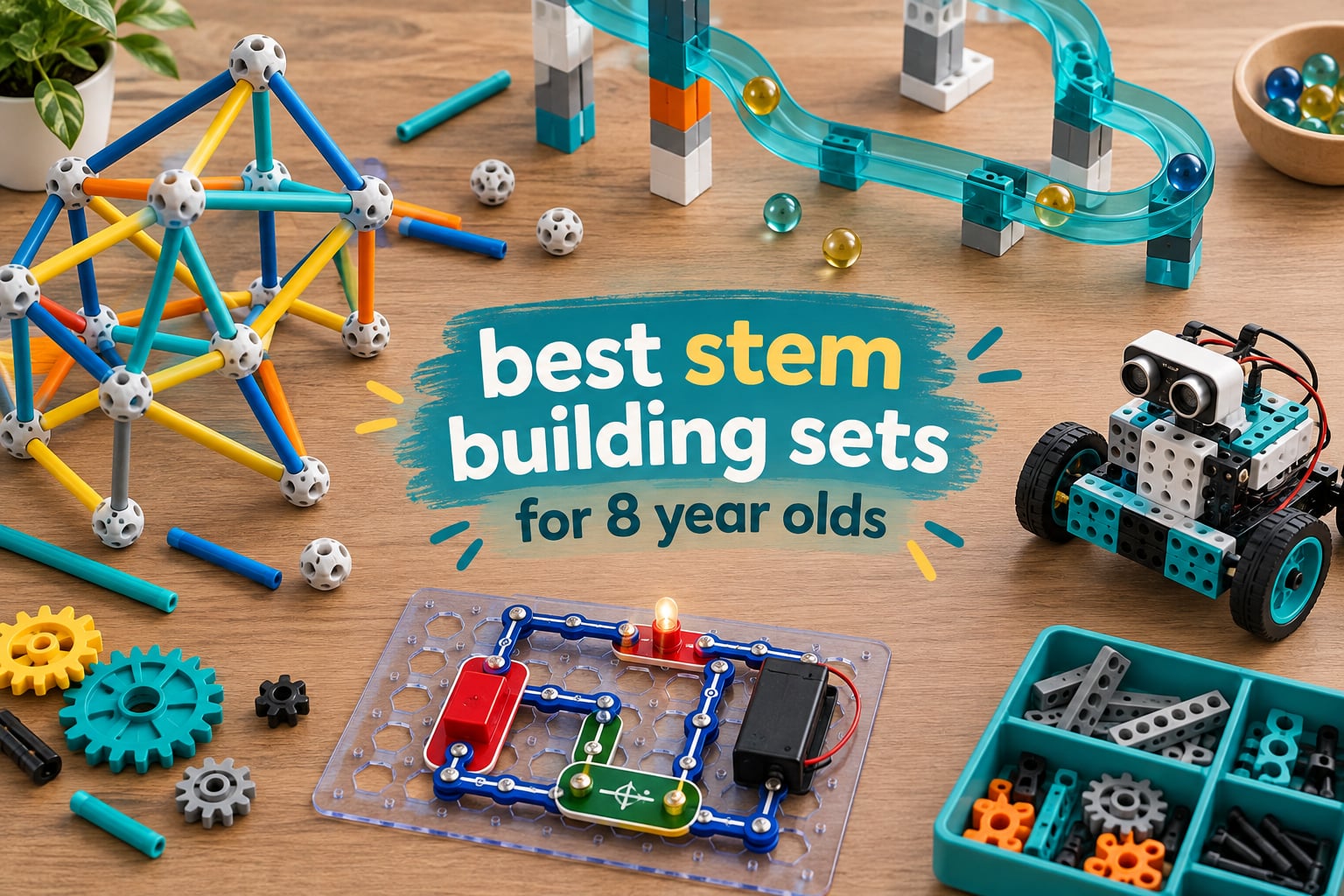
The best STEM building sets for 8 year olds are the ones where the building itself teaches: Snap Circuits Jr. SC-100 for circuits, Brain Flakes for open-ended construction, the National Geographic glow marble run for physics, and the K’NEX Adventure Wheels set for moving machines. We ranked 12 sets that an 8-year-old can actually finish, not just open.
Here is the problem with most roundups on this topic. Almost every one of them covers all STEM toys for all ages, so a parent hunting for a building set for a specific 8-year-old ends up filtering out science experiment kits, board games, and kits aimed at 5-year-olds. We narrowed the field to construction kits only, then calibrated each one to what a child in third grade can realistically build, read, and debug alone.
We picked these sets on six criteria: genuine building content rather than experiments, an age-8 fit that matches attention span and fine motor control, replay value across months rather than one afternoon, durability for a child who builds roughly the way a small demolition crew does, safety certification, and how much useful play each one returns per piece. Parents shopping at other ages can start with our STEM toys for 4 year olds guide or the best STEM kits for 7 year olds instead, since the readiness checkpoints here shift a lot at age 8.
Table of Contents
Top 3 Best STEM Building Sets for 8 Year Olds (October 2026)

Snap Circuits Jr. SC-100
- Ages 8 and up
- 100+ guided projects
- 28 snap-together parts
- No soldering or tools

Brain Flakes 500 Piece Set
- 500+ interlocking discs
- 12 colors
- Open-ended building
- Screen-free

National Geographic Glow Marble Run
- 65 track and base pieces
- Ages 8 to 12
- Glow-in-the-dark marbles
- Learning guide included
The 12 Best Stem Building Sets for 8 Year Olds in 2026
| Product | Specifications | Action |
|---|---|---|
| Snap Circuits Jr. SC-100 STEM Electronics Kit |
|
Check Latest Price |
| Brain Flakes 500 Piece Interlocking Disc Set |
|
Check Latest Price |
| National Geographic Glow-in-the-Dark Marble Run |
|
Check Latest Price |
 13-in-1 Solar Power Robot Building Kit 13-in-1 Solar Power Robot Building Kit |
|
Check Latest Price |
 K’NEX Adventure Wheels 480 Piece Set K’NEX Adventure Wheels 480 Piece Set |
|
Check Latest Price |
 Learning Resources Gears Deluxe Building Set Learning Resources Gears Deluxe Building Set |
|
Check Latest Price |
 GAMZOO 2-in-1 Remote Control Racer Kit GAMZOO 2-in-1 Remote Control Racer Kit |
|
Check Latest Price |
 COBFDHA 120 Piece 6-in-1 Solar Robot Kit COBFDHA 120 Piece 6-in-1 Solar Robot Kit |
|
Check Latest Price |
 LEGO Technic Off-Road Race Buggy 42164 LEGO Technic Off-Road Race Buggy 42164 |
|
Check Latest Price |
 K’NEX Click and Construct Value Set K’NEX Click and Construct Value Set |
|
Check Latest Price |
 Learning Resources City Engineering Set Learning Resources City Engineering Set |
|
Check Latest Price |
 Thames and Kosmos Structural Engineering Thames and Kosmos Structural Engineering |
|
Check Latest Price |
1. Snap Circuits Jr. SC-100 – The Best All-Round STEM Building Set for an 8-Year-Old
SNAP CIRCUITS Jr. SC-100 STEM Electronics Kit, 100+ Projects, Ages 8+
- 100+ projects spanning a wide difficulty range
- Tool-free snap-together system on a plastic grid
- Color-coded and numbered pieces
- Highly rated across a very large review base
- Batteries required and not included
- Projects are guided rather than truly open-ended
- Snap connections can feel stiff for small hands
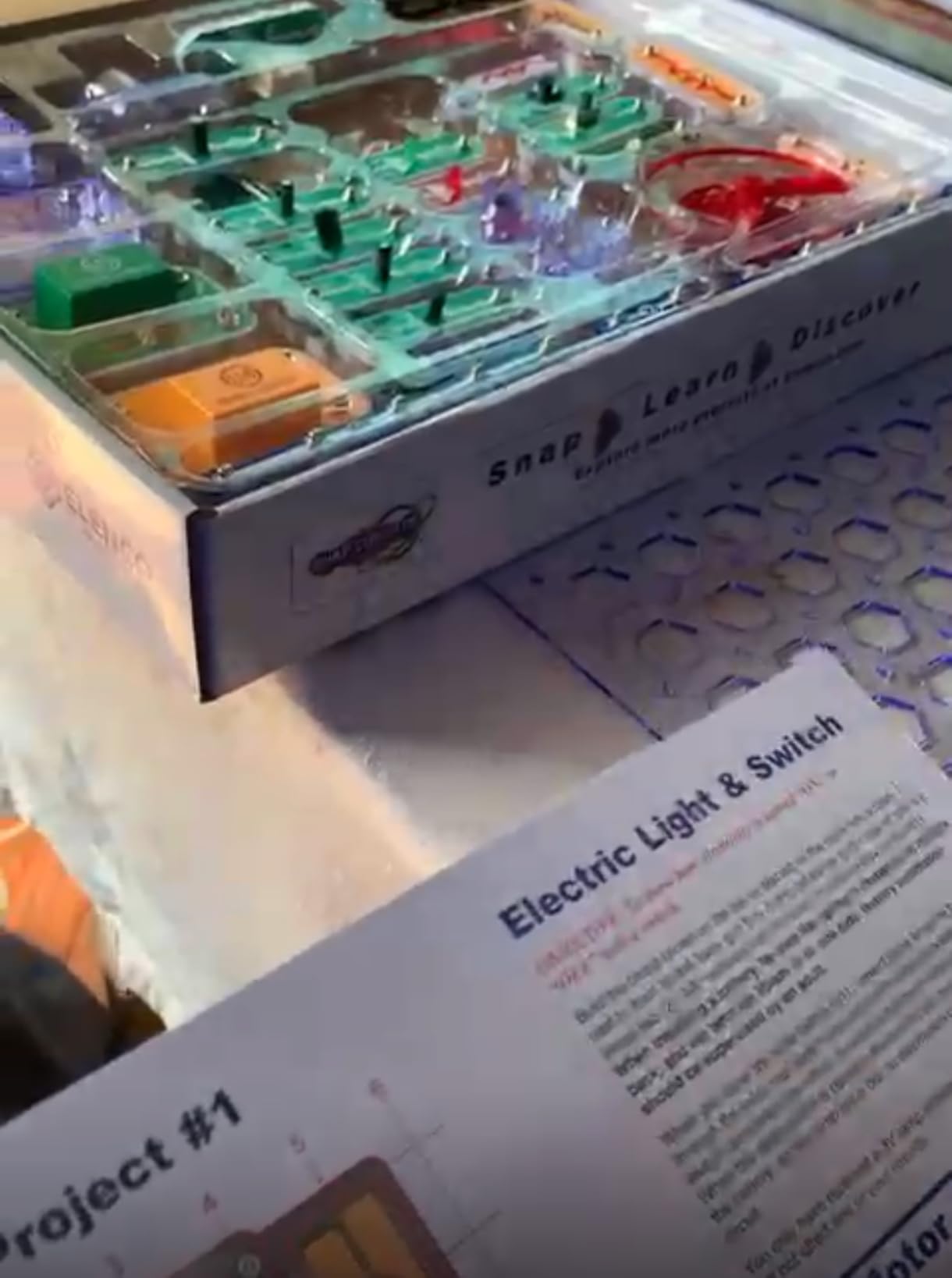
I have put this kit in front of more 8-year-olds than any other electronics set, and it is the one that keeps working after the novelty fades. The premise is simple: parts snap onto a plastic grid, a battery powers the circuit, and the child builds a working model. Nothing needs soldering and nothing needs tools.
What separates it from cheaper circuit kits is the volume of genuinely different projects. At 100-plus projects with 28 snap-together parts, a child who finishes a fan on day one is nowhere near the end of the manual. Parents on r/Parenting describe it repeatedly as suitable for independent play, and that matches what we saw.
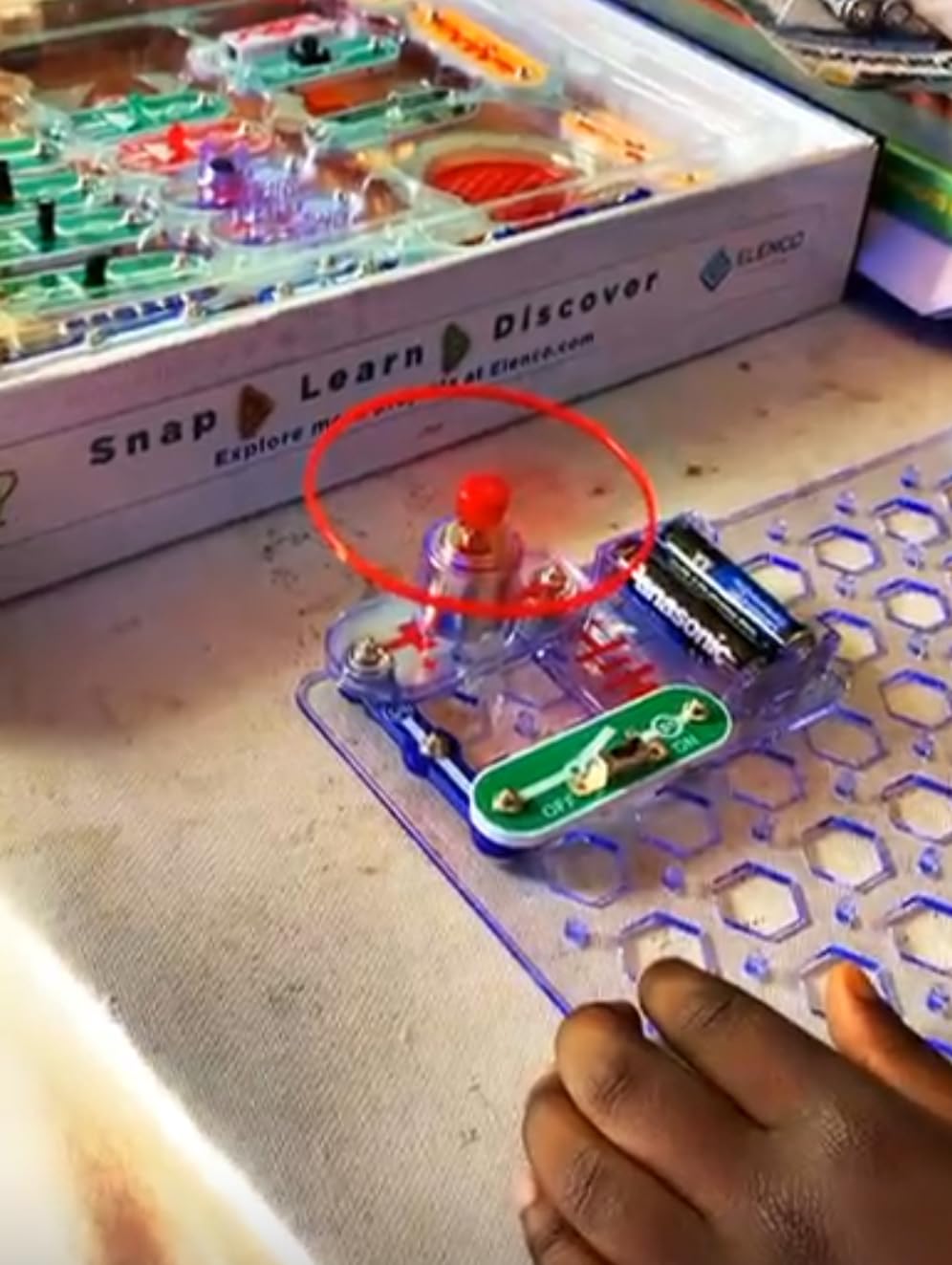
The learning is real electrical engineering in simplified form: current path, polarity, series and parallel, and why a circuit that worked yesterday does not work today. When a connection fails, an 8-year-old can trace the path and find the break themselves, which is exactly the debugging habit we want to build at this age.
The durability holds up well. These are thick plastic modules on a rigid grid, and we did not see cracking after repeated builds and takedowns. The one real friction point is batteries, which are not included and which run out on a schedule you do not control.
Who this set suits at age 8
This suits the child who likes clear instructions and wants to see an immediate result. It works as a solo activity, and it also works as a parent-child project on a weekend afternoon. The color coding and numbered layout mean a child who cannot yet read every word can still follow the diagrams, which is a genuine advantage over kits that rely on dense written text.
It is also the natural first step in a progression. On r/robotics, parents with 8-year-olds already working through electronics kits ask specifically about what to try next, and this is the standard entry point that leads toward larger circuit and robotics sets.
Who should skip this set
Skip it if your child has no patience for a guided manual. These projects are largely instructional, so a child who wants to invent rather than follow can finish the manual and then stall, because the open-ended part is not the point of this kit.
Skip it if batteries are a dealbreaker for your household. You will be supplying alkaline cells regularly, and the models run down mid-experiment, which is the most common complaint in the reviews.
2. Brain Flakes 500 Piece Set – The Best Value Open-Ended STEM Building Set
- Very large piece count for ambitious structures
- Discs are flexible and easy for small hands to connect
- Completely screen-free and quiet
- Storage jar keeps pieces contained
- Non-toxic and safety tested
- Open-ended play can be too unstructured for younger builders
- Simple disc shape limits mechanical function
- Discs can loosen during vigorous play
Brain Flakes is the set we hand to parents who want the most building per box and the least screen time. Five hundred-plus flexible discs in 12 colors, stored in a jar with a yellow cap, click together in seconds and hold a surprisingly ambitious structure. There is no manual to fail at, and no battery to replace.
At 8, the appeal shifts from shape sorting to architecture. Children build towers, domes, and multi-level frameworks, and the discs bend slightly at the connection point, which makes curved shapes possible in a way rigid bricks do not allow. That flexibility is what makes large structures achievable with young hands.

It is a genuinely strong fine motor and spatial reasoning exercise, and because there is no correct answer, there is no ceiling on the build. A quiet afternoon can disappear into a ball big enough to sit inside. The discs measure about 1.3 inches across, which is large enough that a missing piece is not a choking risk in the way smaller construction pieces can be.
The idea booklet and online instructions give a starting point for a child who stalls at an empty floor, but the set quickly outgrows them. Parents consistently report that the jar, not the booklet, is what gets used daily.

Who this set suits at age 8
This suits the child who is naturally inventive rather than instruction-following, and the child who needs a screen-free afternoon activity that does not collapse into chaos. Because the pieces are simple to connect, an 8-year-old rarely gets stuck on mechanics and can spend all their energy on the design problem instead.
It also works well in a classroom or makerspace setting, where a whole group can contribute to one large structure, and it holds its value well past age 8, which makes it a strong sibling-sharing choice.
Who should skip this set
Skip it if your child wants machines. Discs connect to discs, and there is no gear, motor, or axle in the box, so anything with moving parts is out of reach. This set builds structures, not mechanisms.
Skip it if your child is easily frustrated without a target. Open-ended play with 500 identical pieces can be intimidating to a builder who needs to see a finished thing. Without an adult to suggest a first build, a stubborn child may abandon it on the floor of the playroom.
3. National Geographic Glow-in-the-Dark Marble Run – Best for Learning Physics Through Building
National Geographic Glow-in-the-Dark Marble Run for Kids Ages 8-12
- Glow-in-the-dark marbles stay visible after charging
- Large storage bag makes cleanup fast
- Track pieces fit together more tightly than most
- Learning guide covers motion and aerodynamics
- Suitable for a wide age range
- Taller builds can be wobbly without a solid base
- Base pieces can snap if stepped on
- No printed assembly instructions for the track
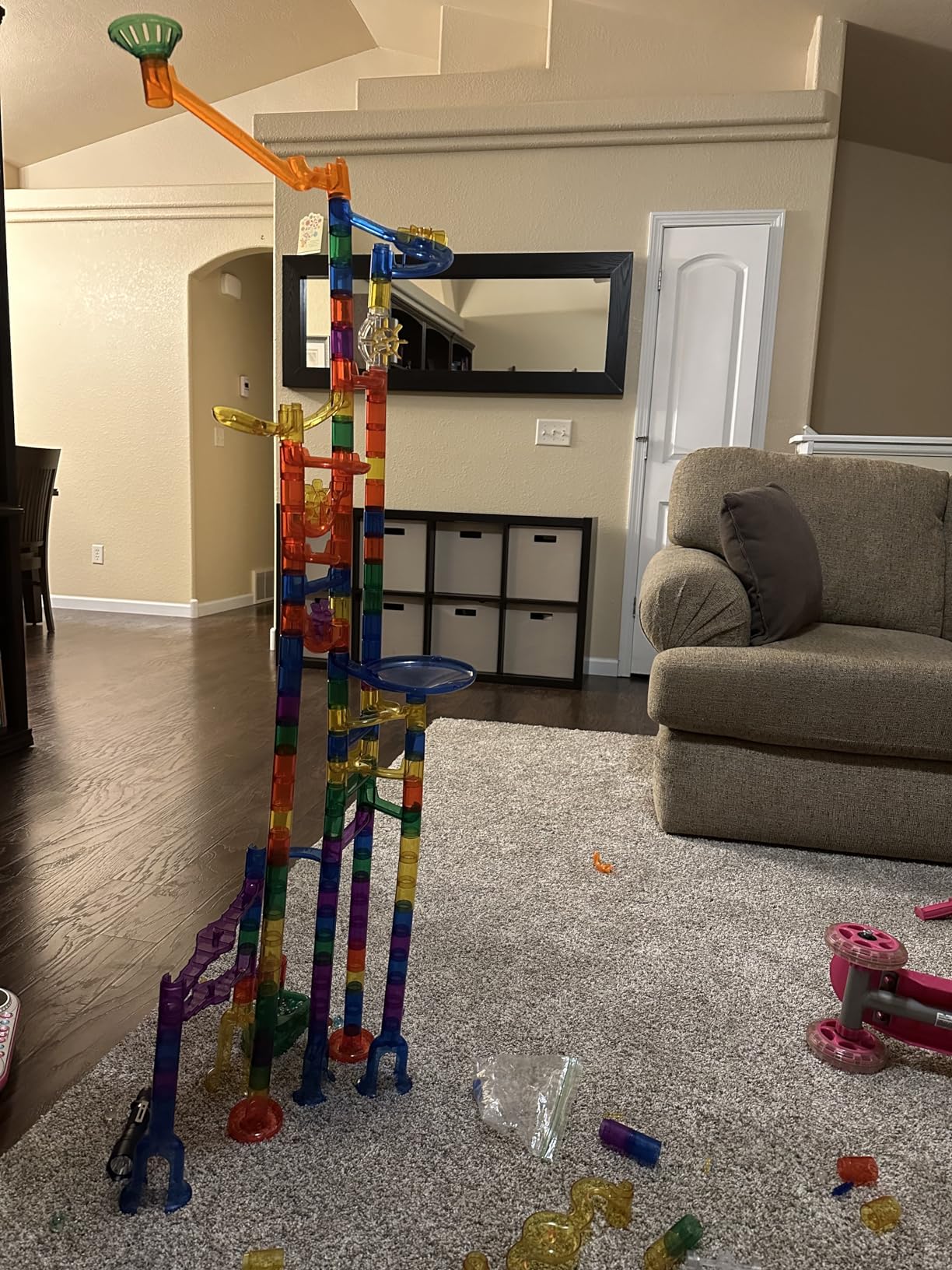
This is the pick that converts an 8-year-old into someone who asks why a ball drops faster on one curve than another. The set ships with 5 bases, 15 action pieces, 45 clear track sections, and 15 glass marbles in 6 colors that glow after charging in the included LED unit.
What we like most is the failure mode. A marble run that does not work is a physics problem with a visible cause, and an 8-year-old will rebuild the same section a dozen times before giving up on it. That trial-and-error loop is the whole point of the toy.
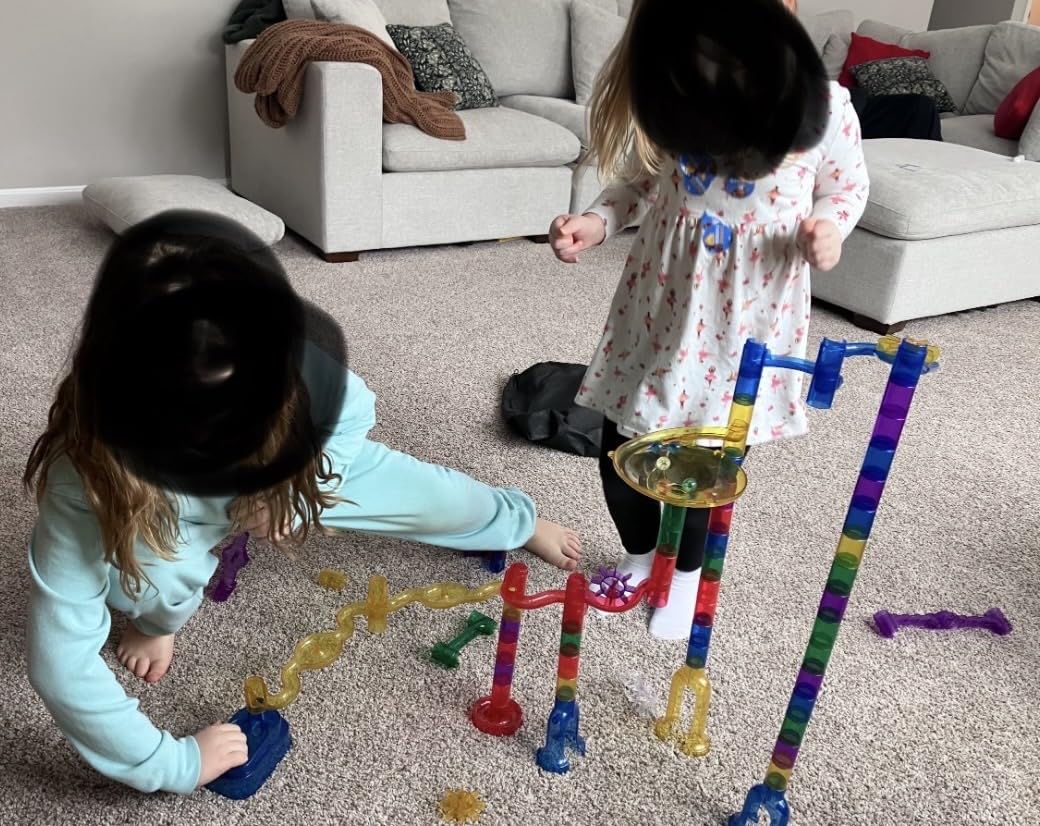
The track sections fit more tightly than most competing marble runs we looked at, which means a tall structure holds together better. The storage bag is a small thing that matters enormously in a family with one playroom; every piece goes back in one bag rather than migrating under furniture.
The included learning guide walks through motion, aerodynamics, and marble run experiments, which gives a parent something to point at when the child asks what is happening. Set it up in a dark room once and the glowing marbles earn their place on their own.
Who this set suits at age 8
This suits the child who is mechanically curious, loves cause-and-effect toys, and will happily take a structure apart and rebuild it. It is one of the few picks here that works equally well for a child who wants to follow the guide and one who wants to design their own course.
It is also a good pick for an 8-year-old who already owns a lot of plastic bricks and needs a different kind of thinking, because the constraint is design rather than assembly.
Who should skip this set
Skip it if you want a tidy, guided build on day one. There are no printed assembly instructions for the track, so the first structure is genuinely experimental and takes adult encouragement to get started. Some children find that exciting and some find it discouraging.
Skip it if your child is a runner rather than a walker. The glass marbles are the appeal and also the risk, and the track is built for a floor or a table, not a hallway. We would supervise the first few runs closely.
4. 13-in-1 Solar Power Robot Kit – The Budget Pick for a First Robotics Build
- 13 different robot designs from one parts set
- No batteries to replace
- Robots move on land and on water
- Non-toxic ABS with smooth edges
- Gift box packaging
- Repeated disassembly wears the connection points
- Diagram-heavy manual is hard for younger builders
- Solar models run slowly in low light
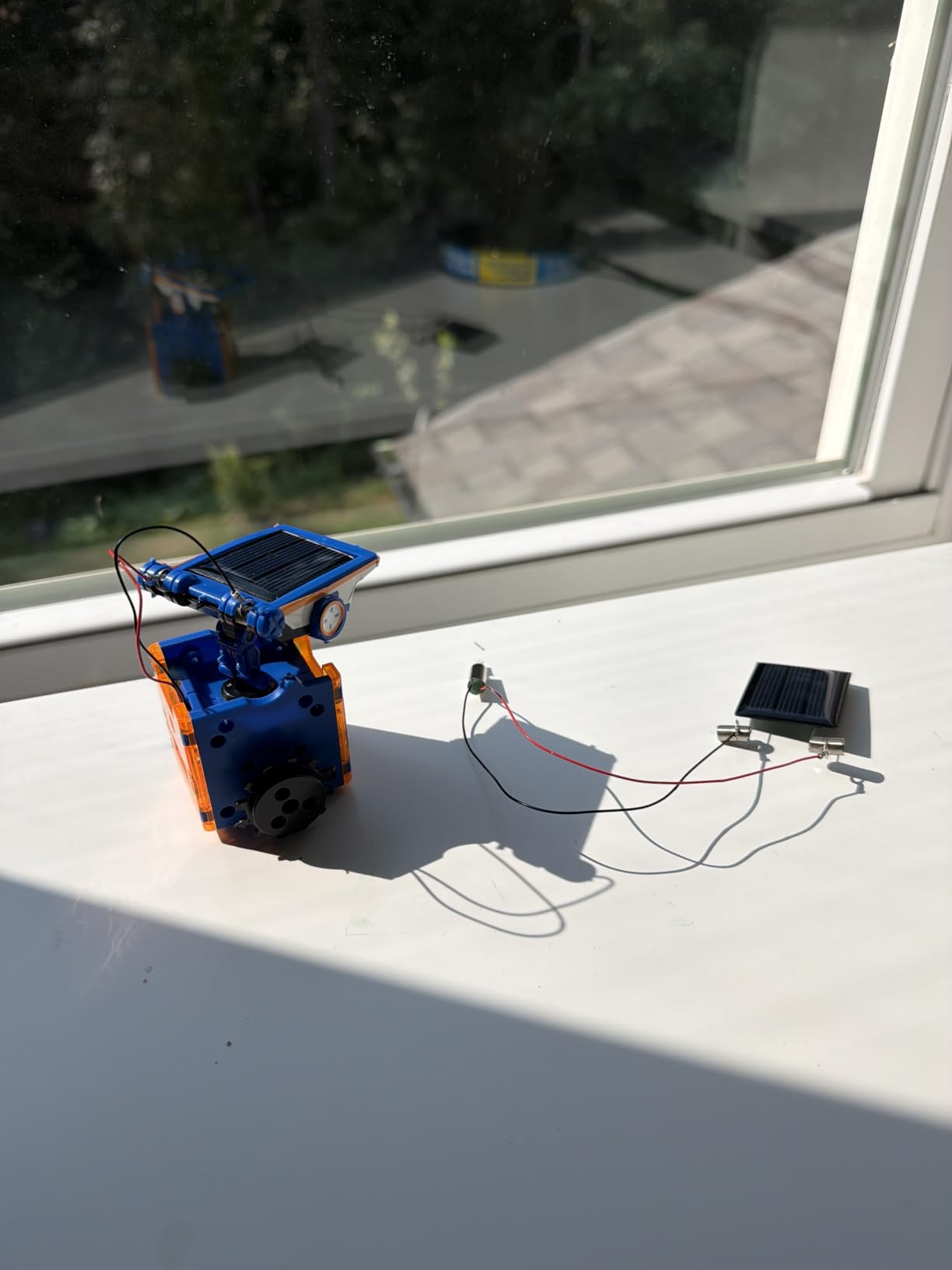
This kit builds 13 different robots by splitting and reassembling the same set of parts, with gears, plates, tires, and shafts included. The power source is a small solar engine, which removes the battery problem entirely and adds a second lesson about renewable energy.
We like it as an entry point for a child who wants something that moves but is not ready for a full robotics platform. The robots crawl on a table or float in water, and the assembly is short enough that the child sees a finished result inside a single sitting.
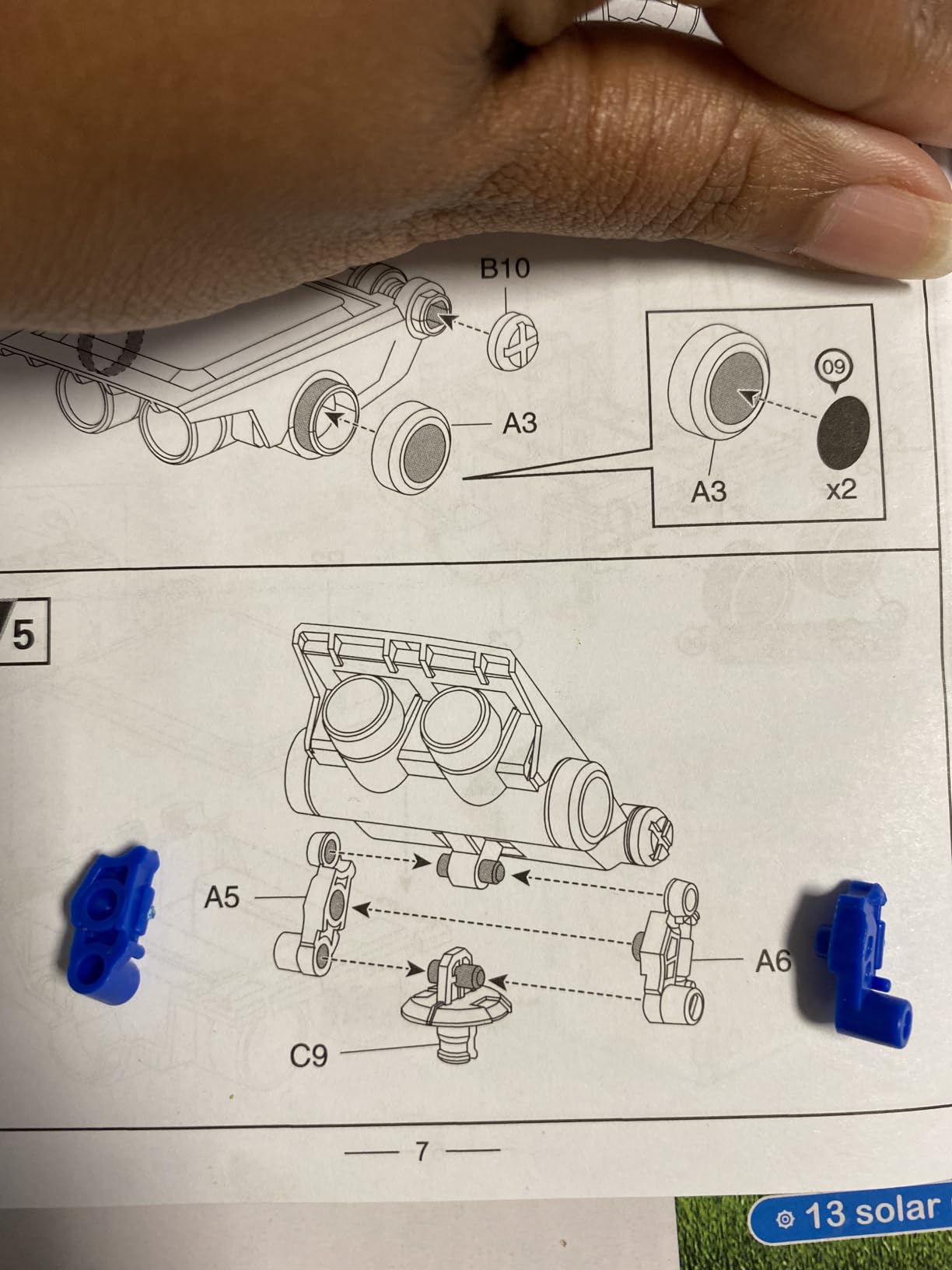
The honest limitation is the manual. It is largely diagram-based, which means a child has to translate drawings into hand movements, and that translation slows an 8-year-old down more than a photo-manual would. Plan on sitting with them for the first two builds.
Durability is also weaker than it is in the plastic construction kits in this roundup, because every new design means taking the same small components apart and putting them back together. Wear shows up at the connection points first, after many rebuilds.
Who this set suits at age 8
This suits a child on a tight budget who wants a robot experience and will accept a solar motor that moves slowly. It is a good birthday or holiday gift because it arrives in a box that already looks like a present, and it needs no adult to prepare anything.
It is also a decent bridge set. Once a child has built all 13 designs, moving up to a programmable robot makes more sense because they already understand what a motor and a gear train do together.
Who should skip this set
Skip it if your child builds fast and finishes things quickly. Thirteen designs from the same parts is a lot of repeated assembly, and a builder who wants a new challenge every session will exhaust the ideas well before the pieces wear out.
Skip it for indoor-only play in a dim room. The robots need direct sunlight to move at a reasonable speed, so on an overcast day or in a living room after dark, the experience falls flat.
5. K’NEX Adventure Wheels 480 Piece Set – The Most Versatile for Moving Machines
K’NEX – Adventure Wheels Building Set – 480 Pieces‚ STEM Building, Creative Construction Set‚ Ages 7+ – Amazon Exclusive
- Real moving models including trucks and helicopters
- Parts hold securely then break apart for rebuilding
- 35 step-by-step models in the booklet
- Treasure chest storage box included
- Lifetime warranty against defects
- Small parts are easy to misplace
- Some models are complex without adult help
- Fewer pieces than comparable sets
K’NEX rods and connectors produce something the brick sets here do not: linkages. A truck built from these parts rolls and steers, a helicopter rotor turns, and the wheels transfer power through a mechanism the child can see and take apart.
The 35 model plans give an 8-year-old plenty to follow, and each one is a short build rather than a single enormous project. That pacing matters at this age, because a 90-minute session usually ends before the model is finished and the pieces end up half assembled.
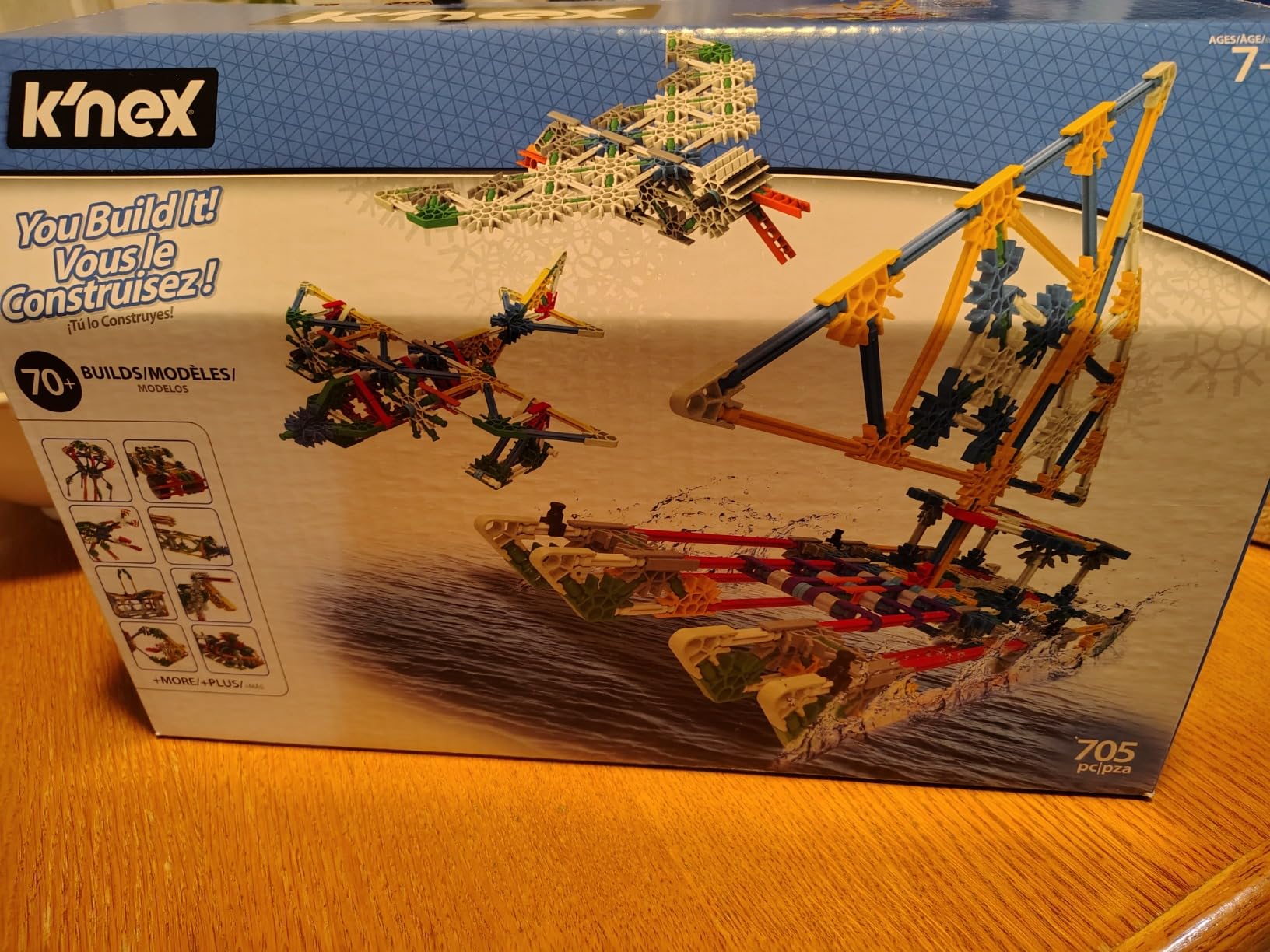
The snap-fit connectors hold firmly under play and release without tools, so tearing a model down to rebuild it is not a fight. K’NEX also backs this set with a lifetime warranty against manufacturing defects, which is unusual at this piece count and tells you something about how the connectors are molded.
The included treasure chest storage box is a real advantage in a household with more than one child. K’NEX parts interlock with parts from other sets, so this also works as a foundation piece that grows rather than a sealed box.
Who this set suits at age 8
This suits the child who is mechanically minded and wants machines that actually move, which is a narrower interest than general construction but a much more engaged one. It is our pick when a parent asks for a good gift for an 8-year-old who enjoys building machines specifically.
It is a good pick for a child who reads manuals well. The diagrams are clear, and a child who can follow a 20-step plan will get through these models confidently and start improvising from the parts soon after.
Who should skip this set
Skip it if your child has poor fine motor control or gets frustrated by fiddly connectors. K’NEX rods are thin and the connectors take real finger pressure to seat properly, and a struggling child can abandon a model halfway through rather than ask for help.
Skip it if piece count is what matters to you. At 480 pieces it looks impressive, but other sets in this roundup carry higher counts, and the value here comes from the quality of the connection system rather than the volume.
6. Learning Resources Gears Deluxe Building Set – The Top Rated Set for Simple Machines
- Clearly shows cause and effect as motion transfers gear to gear
- Strong for fine motor skills and spatial reasoning
- Open-ended enough for repeated new builds
- Works from preschool through early elementary
- Activity guide included
- Only one crank handle is included
- Pieces take real force to snap together
- Limited connectors for larger structures
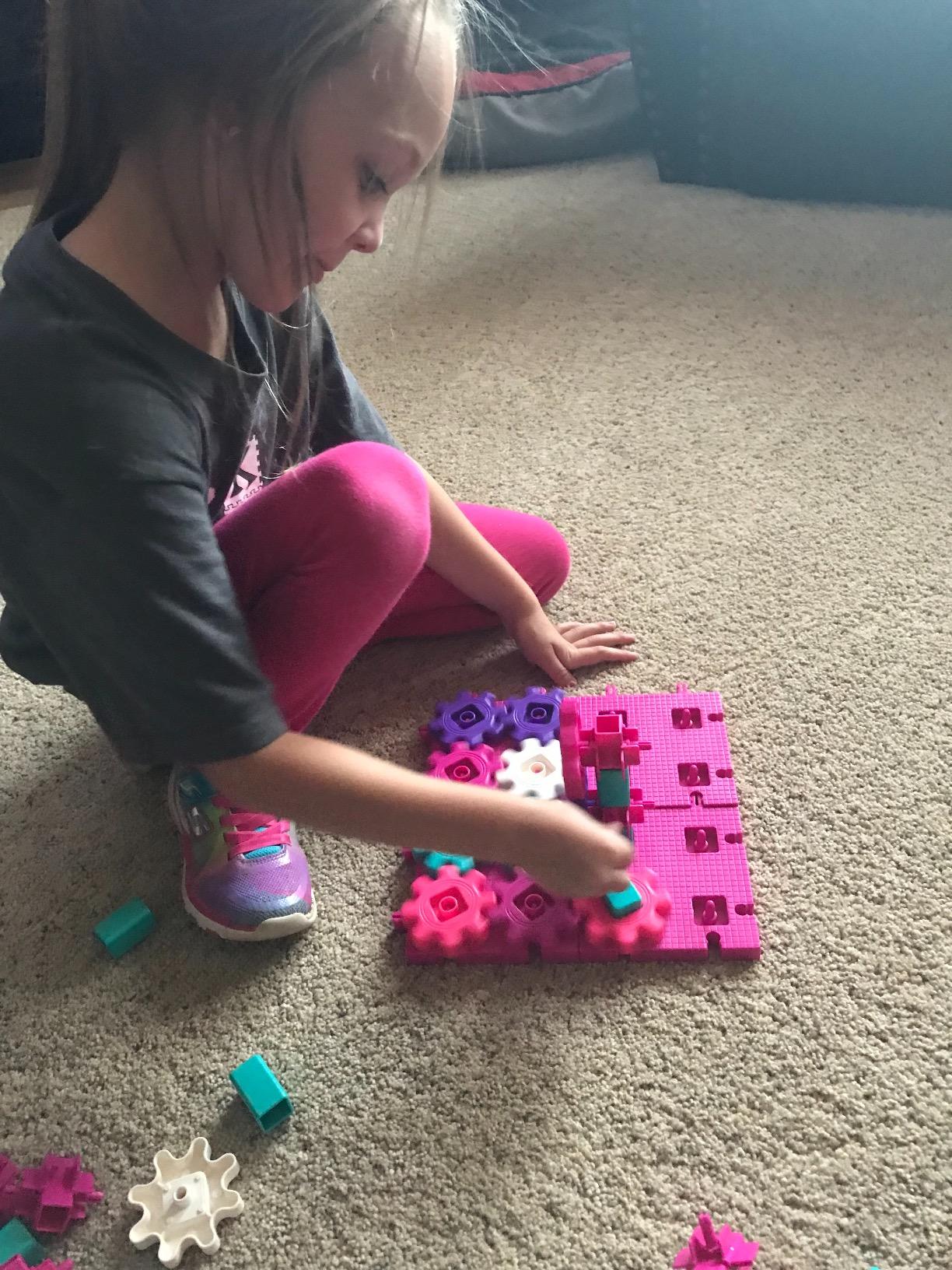
This is the most direct demonstration of simple machines in the roundup. A 100-piece set with 46 colorful gears, 26 square pillars, 21 six-way axles, 6 interlocking bases, and a crank handle, and no batteries anywhere. Turn the handle and motion transfers through a chain of gears.
For an 8-year-old it works as a concept builder. Gears of different sizes turn at different speeds, a gear driven from two sides reverses direction, and axles stacked on the six-way connectors create drivetrains that turn wheels. Those are abstract ideas from physics class made visible in the hands.
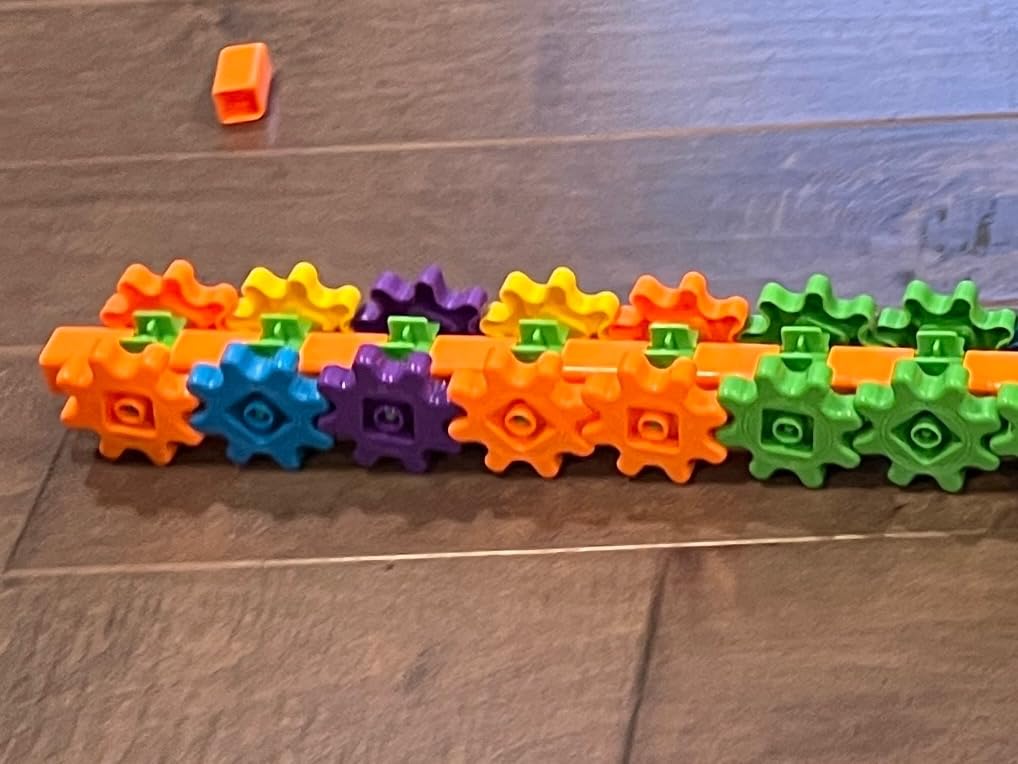
It is a long-standing favorite in classrooms and homeschool settings, and that shows in the build quality. The gears are thick, the colors are bright, and the pieces survive being taken apart daily by a child who does not yet understand the point of being gentle with them.
The activity guide supplies a starting point for a child who does not know what to build next, but the set is open-ended enough that the guide is a suggestion rather than a requirement. Cars, towers, and washing-machine-style contraptions all appear in reviews as recurring projects.
Who this set suits at age 8
This suits the child who likes mechanisms but has not yet worked with gears, and it is the lowest-friction way into simple machines. Nothing needs to be charged, paired, or downloaded, so it works the moment the box is open.
It is also the best pick for two children who want to build together, since the parts are large and easy to share. Just be aware that with one crank handle, only one build can be driven at a time.
Who should skip this set
Skip it if your child has already worked through gear sets at a library or school. The concepts here are elementary, and a child who has built a working gear train before will exhaust the possibilities quickly.
Skip it if your child is small for their age or has limited hand strength. Several pieces need a firm push to snap together, and the frustration of a connector that will not seat is enough to end the session early.
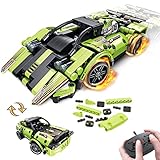
7. GAMZOO 2-in-1 Remote Control Racer Kit – Best for a Working Motorized Build
- Same parts build both an off-road truck and a racecar
- Working remote adds interaction beyond a static model
- Keeps older builders engaged for long sessions
- Snap-together pieces need no tools
- Solid alternative to similar construction kits
- Wheel axles and small parts can break in rough play
- Remote control is intermittently unreliable
- Occasional wiring defects in the remote unit
- Few spare axles included
Most building sets at this level end with a model that sits on a shelf. This one ends with a vehicle a child drives around the room with a handheld remote, and that difference changes how long the set holds attention. The same 335 pieces snap together into either an off-road truck or a low racecar.
The remote is the reason most families keep coming back to this one. Building the car is a project; racing it against a book or a cardboard ramp is a game, and the second use is the one that survives past the first week.
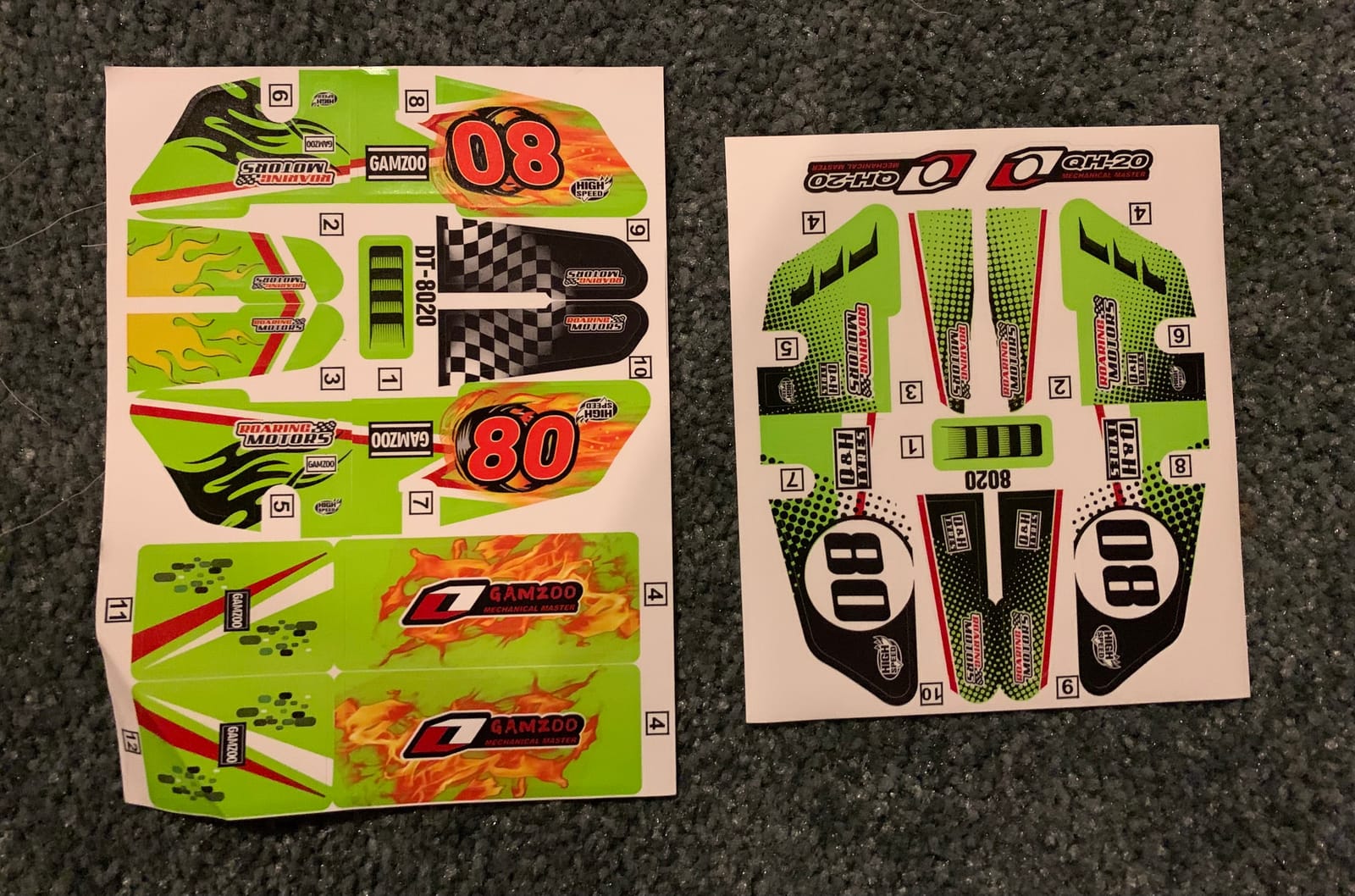
Assembly needs no tools and no fine precision, which is good for a child whose hand control is still developing. The two-vehicle design also means the pieces are not finished once the first build is done, which removes the most common complaint about single-model kits.
Durability is the weak point. The wheel axles are the component most likely to break during rough play, and the remote unit has a documented history of intermittent failures where the car stops mid-drive. That is frustrating for a child who has just spent an hour building.

Who this set suits at age 8
This suits the child who wants a finished, functional toy and not just a construction project. It is a strong birthday or holiday pick for a child who is generally curious about how things work but does not want to sit still for a long manual.
It is also a good entry point before a more advanced motorized kit, because the motor and controller are integrated rather than something the child has to wire.
Who should skip this set
Skip it if your child is hard on toys. The axle components and the remote wiring are both reported as fragile under rough handling, and a child who drags the car by the axles will break it quickly.
Skip it if a reliable remote matters to your child. A controller that intermittently cuts out is more disappointing for a kid than a purely mechanical toy that never promises anything electronic.
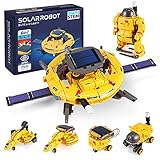
8. COBFDHA 120 Piece 6-in-1 Solar Robot Kit – Best for Indoor and Outdoor Play
- Six robot designs move on land from one set
- Works indoors on batteries and outdoors on solar power
- Instruction manual supports independent assembly
- Durable ABS plastic parts
- Encourages family building time
- Only six configurations
- which is modest for the category
- Solar motor depends on direct sunlight
- Small printed manual is hard to read
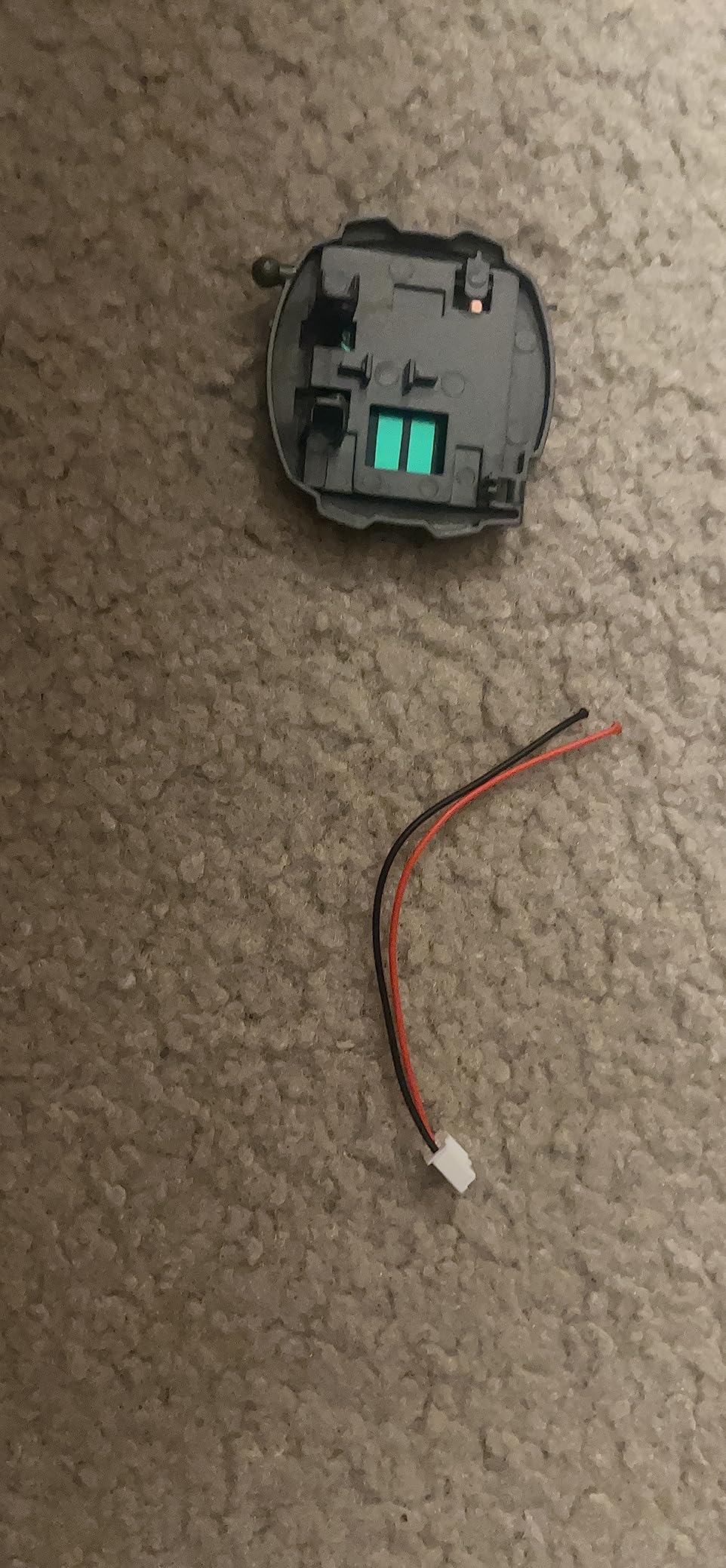
This is the practical answer to a common problem: the sun goes away and the solar robot sits still. The set includes both a solar panel and a battery drive, so the same robot runs outdoors in direct sunlight and indoors in any weather. Six designs move on land from 120 ABS pieces.
We appreciate how clearly the manual is laid out for this age group. An 8-year-old can largely assemble these independently, which matters if you are trying to buy a set that gives you back an afternoon rather than another hour of sitting on the floor.

The dual power setup also opens a decent teaching angle. A parent can put the same robot outside and inside and let the child work out why the speed changes, which is a small but real energy lesson rather than a decoration on the box.
Six configurations is fewer than many kits in the same category, and that is the trade-off for the clearer instructions and the dual power option. Once all six are built, the set reaches the end of what the parts can do.
Who this set suits at age 8
This suits a family that wants a robot set that works in any season and in any climate, and a child who prefers to read a physical manual over using a phone. The instruction booklet is clear enough for independent work at 8.
It is also a good pick for a child who needs visible progress. Six shorter builds are easier to finish than one long one, and finishing matters a great deal at this age.
Who should skip this set
Skip it if build variety is the priority. Six robots is a modest number, and a child who builds quickly will want more configurations than the parts support. The instruction booklet is also small enough to be genuinely fiddly to read.
Skip it if you expect fast movement. The solar motor runs slowly and depends on direct light, so the robots are not going to race, and a child expecting speed tends to lose interest quickly.
9. LEGO Technic Off-Road Race Buggy 42164 – Best for Mechanical Movement
- Working 4-cylinder engine with real movement
- Rear suspension and flex steering add genuine function
- Substantial build that completes in a reasonable session
- Clear instructions at an appropriate challenge level
- Finished model plays well rather than sitting still
- Tight Technic pins are hard on fingers
- Some connections loosen during rough play
- Modest piece count for a LEGO set
This is the set that introduces an 8-year-old to mechanisms the way a real vehicle uses them. The 219 Technic pieces build an off-road buggy with a working 4-cylinder engine, rear suspension, and flex steering that tilts the body side to side as you turn.
Many children finish it largely on their own, which is unusual for LEGO and reflects how well matched the difficulty is to this age. The instructions are clear, the sub-builds are short, and there is a visible sense of progress at almost every stage.
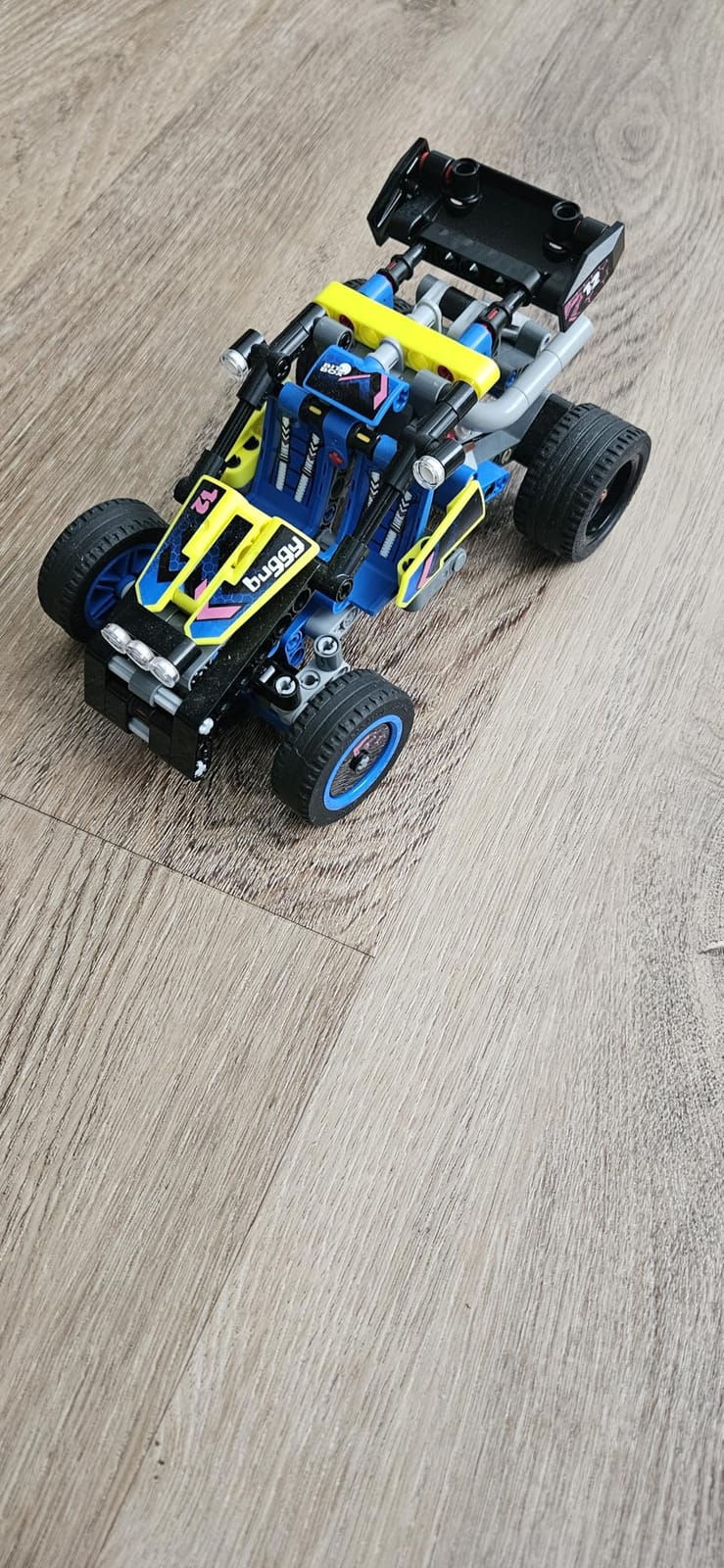
The finished model measures about 3.5 inches high, 6.5 inches long, and 4 inches wide, so it is a hand-sized object rather than a display piece. It rolls across a floor and takes a beating from ordinary play, which keeps it interesting after assembly.
A brick separator is genuinely useful here. Technic pins fit tight by design and pressing them together with fingers is the most common complaint in reviews. That is a real physical effort issue, but it resolves quickly once a child knows the trick or has a separator tool.

Who this set suits at age 8
This suits a child who likes machines and wants to understand how motion transfers, and it is a good gateway into larger Technic sets. The 8-and-up label on the box matches the actual difficulty better than most age labels do.
It is also the pick for a child who has already built hundreds of bricks and found them too easy. Technic pieces behave differently and the build feels like something new even though the brand is familiar.
Who should skip this set
Skip it if your child struggles with small, stiff connectors. The Technic pins demand more hand strength than any other connection type in this roundup, and a child who cannot comfortably press one together will get stuck before reaching anything interesting.
Skip it if you want an open-ended building system. It is a single finished model, and once it is built and taken apart the pieces become loose Technic elements that need another set to be useful again.
10. K’NEX Click and Construct Value Building Set – Best for the Largest Build Volume
K’NEX – Click & Construct Value Building Set – 522 Pieces, STEM Building, Creative Play Set‚ Ages 7+
- Combines classic and micro pieces for many model sizes
- Real moving builds including boats and aircraft
- 35 model plans plus open-ended building
- Storage tub has room for additional sets
- Builds fine motor skills and spatial relations
- Many pieces are micro sized so the set looks smaller than the count suggests
- Mixing piece sizes can feel inconsistent
- Some buyers report sets arriving with missing pieces
- Small components need supervision
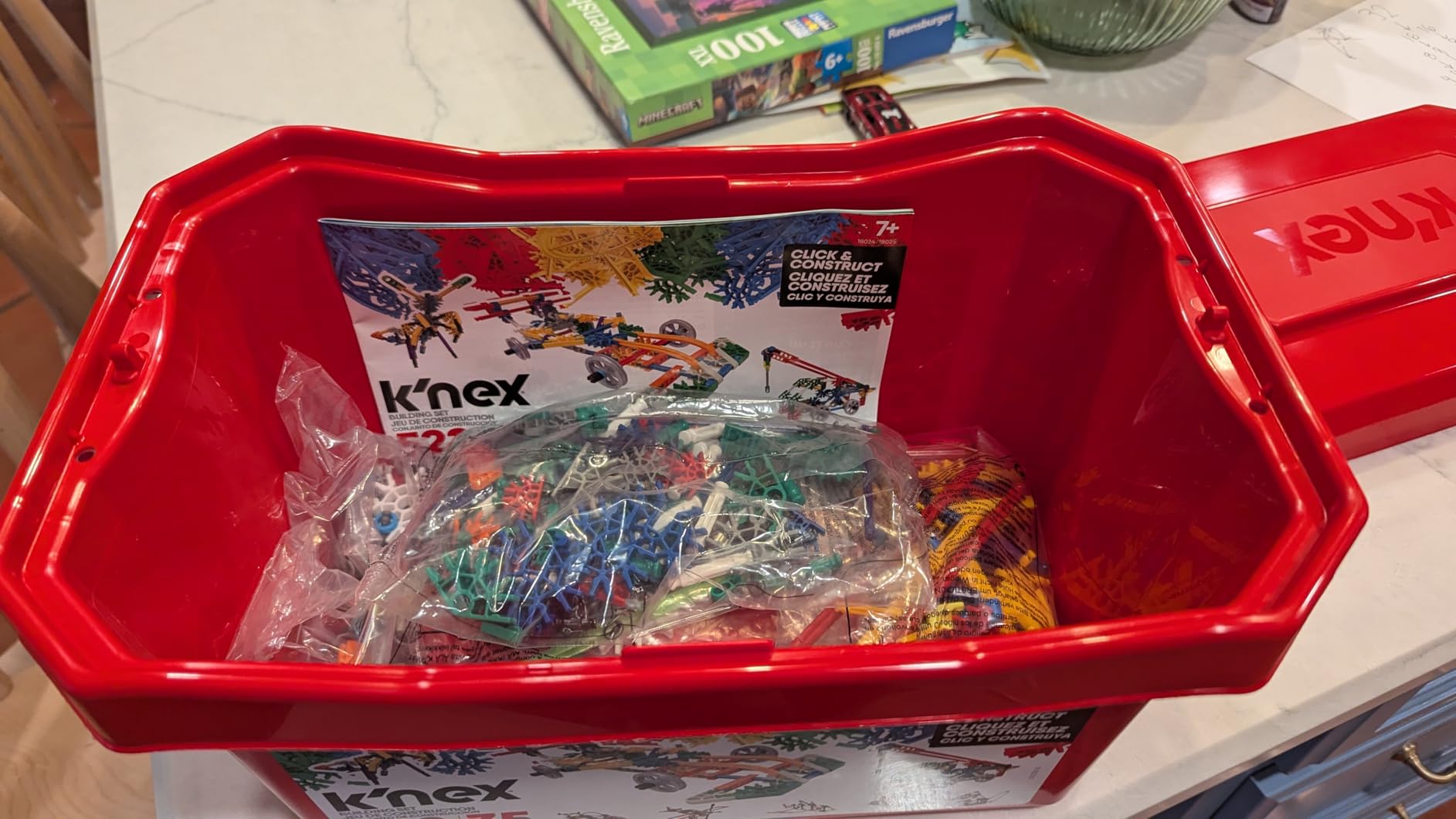
At 522 pieces this is the largest conventional construction set in the roundup, and it mixes classic K’NEX rods with smaller micro pieces in one bin. That combination lets a child build a large frame or a compact model from the same box, which is a genuinely useful range of scale.
The 35 model plans cover cars, boats, aircraft, and animals, and the storage tub is sized so additional K’NEX sets can be added later. For a family that already owns a K’NEX box, this is the expansion piece rather than a replacement.
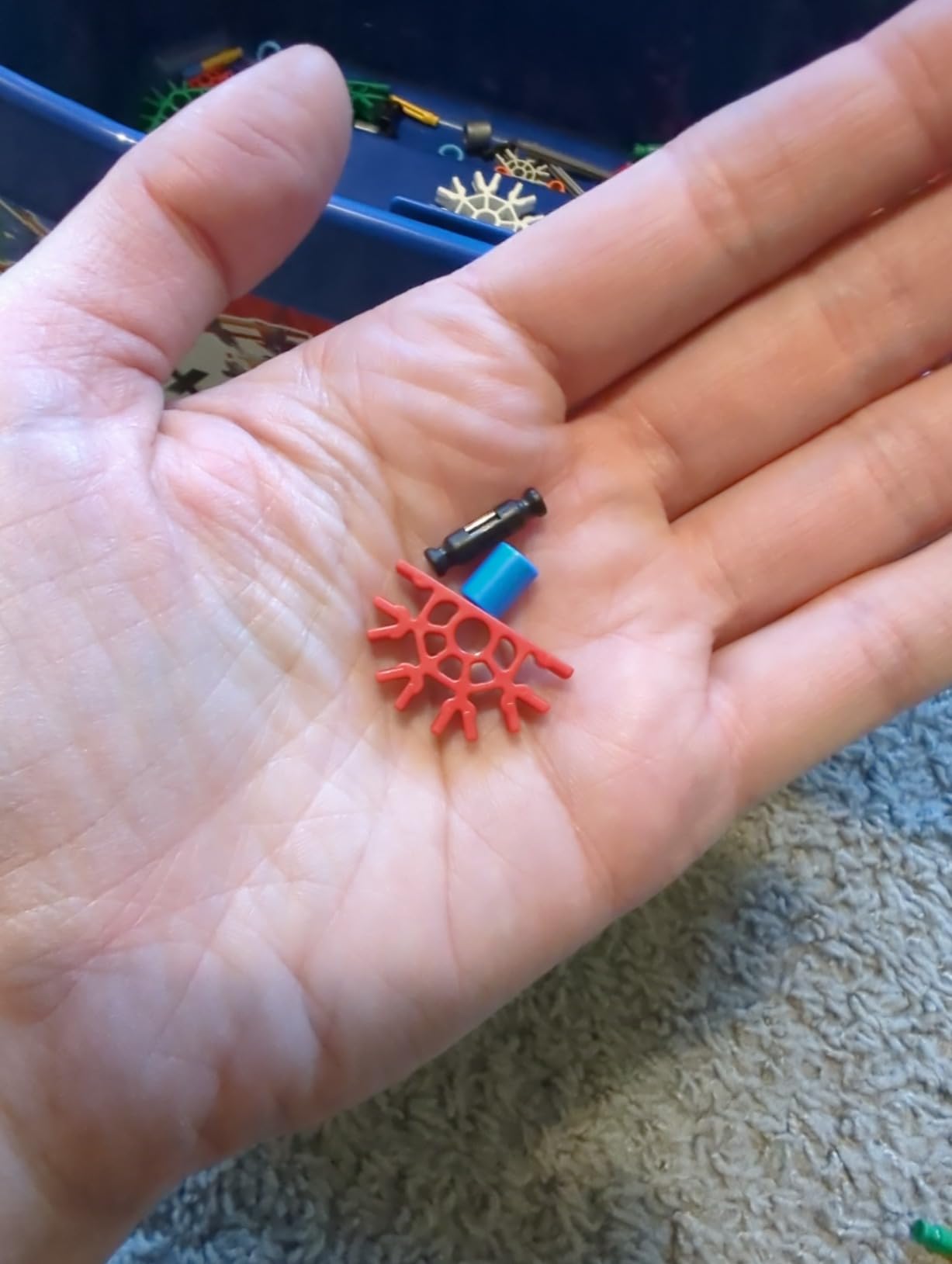
Buyers consistently report the pieces holding up well through repeated rebuilds, which is what you want from a set intended to be dismantled and reassembled dozens of times. The lifetime warranty against manufacturing defects applies here as it does to the wider K’NEX line.
One thing to expect is that the bin looks smaller than 522 suggests, because a large share of the pieces are the micro size. We would mention it up front for a child who counts pieces, since the surprise can read as a disappointment on opening day.
Who this set suits at age 8
This suits a child who wants volume and variety in one box, and it is our pick for a home with two or more builders since the storage tub keeps the parts separated. Mixed piece sizes also make it a good set for a child ready to move from a single-model kit toward free design.
It is a strong choice for a birthday when you do not know exactly what the child already owns, because the 35 plans give a starting point whatever their experience level.
Who should skip this set
Skip it if small parts are a concern in your house. The micro K’NEX pieces are small enough that a younger sibling in the house needs to be kept away from the bin, and cleanup after a session is a real chore.
Skip it if you dislike mixed piece sizes. Some children find the inconsistency between classic and micro rods confusing, and they will separate the two and build with one or the other rather than combining them.
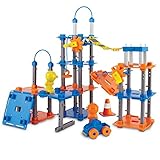
11. Learning Resources City Engineering and Design Building Set – Best for a Child Who Just Turned 8
- 89 piece kit focused on towers bridges and structures
- Activity cards walk through ask imagine plan create and improve
- Open-ended enough to design a custom city layout
- Large chunky pieces are easy for small hands
- Works for homeschool or classroom centers
- Smaller piece count limits ambitious structures
- Ages 5 to 8 ceiling so older builders outgrow it fast
- Sticker detailing wears with frequent handling
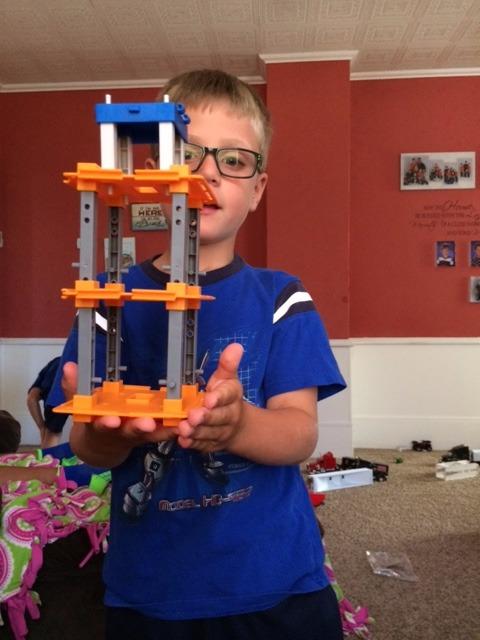
This is the set for a child who has just turned 8 and is still building shorter sessions. At 89 chunky pieces it is one of the smallest kits here, but the pieces are large, easy to handle, and quick to connect, which means a full project gets finished rather than abandoned at the halfway point.
What sets it apart is the activity card system. The cards walk a child through the engineering design process in order: ask, imagine, plan, create, improve. That sequence is borrowed straight from how engineers work, and at this age it teaches the habit more than the specific content.
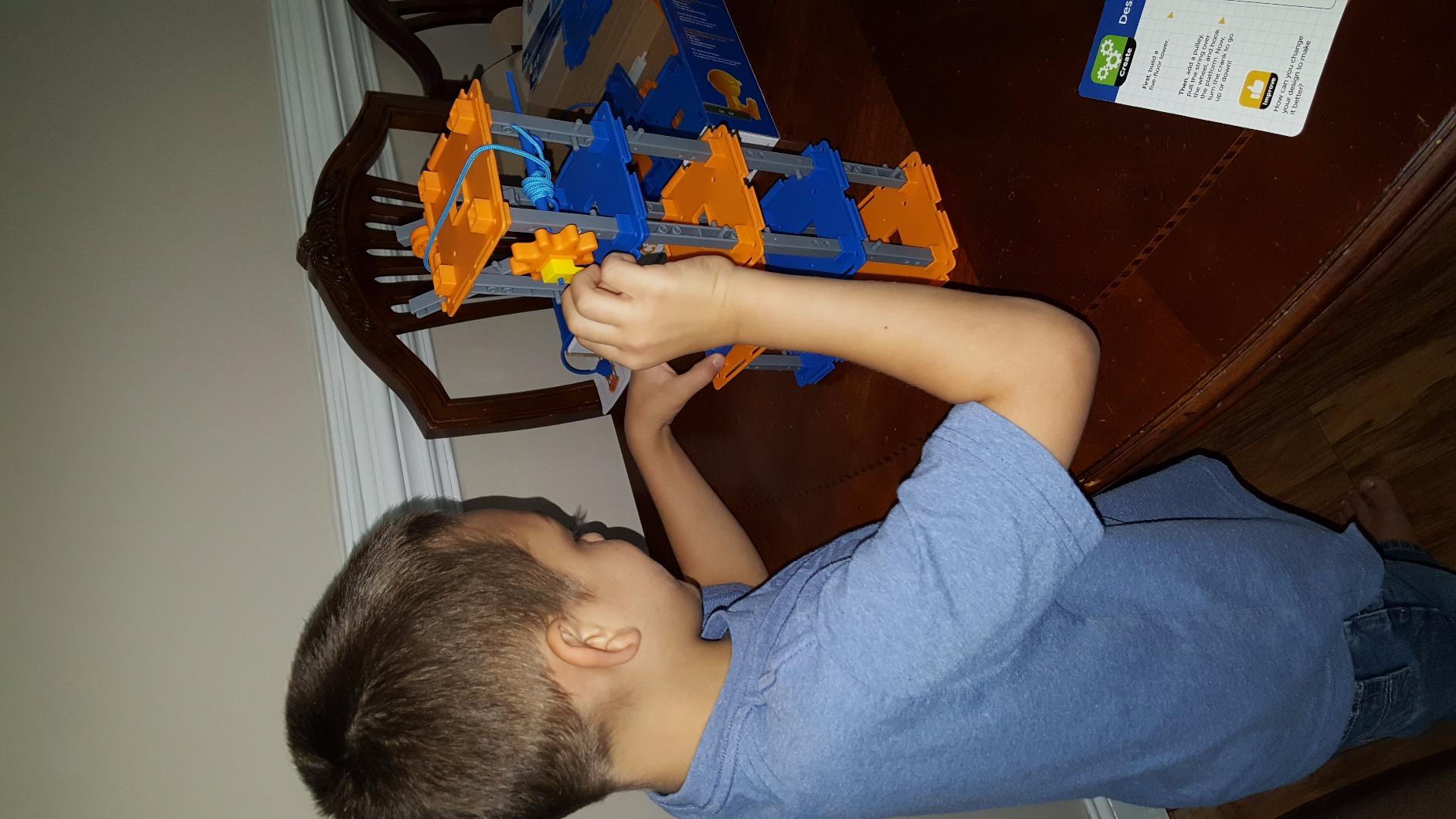
Structurally the themes are towers, bridges, and city buildings, so an 8-year-old gets an introduction to load-bearing and stability at a level that matches their attention span. The bridges in particular prompt the question of why a flat span holds and a curved one does not.
The pieces are big enough to build on a table without them rolling away, which is a practical detail that matters more than it sounds. No batteries are needed and nothing has to be charged before play begins.
Who this set suits at age 8
This suits a child on the younger edge of the age band, particularly one who is building with a younger sibling or who finishes projects quickly. The chunky pieces and structured cards remove most of the friction that makes a child give up on a set.
It is also the pick for structured learning at home, since the design sequence maps directly onto a homeschool engineering unit without needing extra material from you.
Who should skip this set
Skip it if your child is already an experienced builder at 8. The 5-to-8 label is honest, and older children tend to exhaust the challenge within a few sessions and then treat the set as a bin of large bricks.
Skip it if you want a long-term toy. At 89 pieces the set is light on volume, and the sticker details wear with heavy handling, so the finish will not stay crisp through years of play.
12. Thames and Kosmos Structural Engineering Bridges and Skyscrapers – Best for Textbook Depth
- Twenty models each teach a specific structural principle
- Over 285 interchangeable pieces recombine many ways
- Manual works as both experiment guide and assembly guide
- Textbook-style engineering content for older builders
- Bridges the gap between blocks and advanced kits
- Manual is dense and mostly text based
- Some piece types are hard to connect without help
- Higher cost than most sets in this age range
- Twenty models means novelty eventually tapers
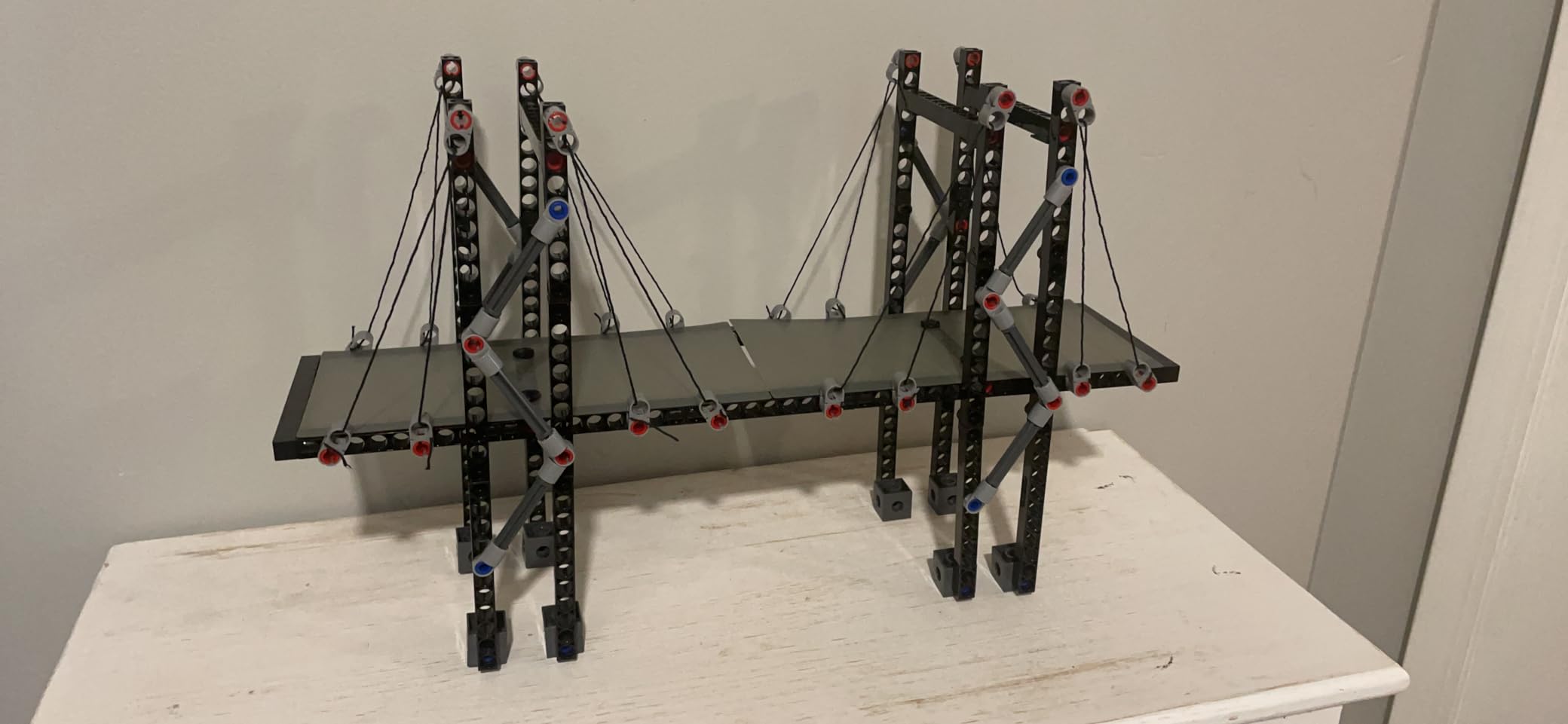
This is the most serious piece of engineering content in the roundup. Twenty models, each demonstrating a specific structural idea such as force, load, compression, or tension, built from more than 285 interchangeable pieces with a 36-page illustrated manual.
For an 8-year-old it sits at the harder end, and we want to be clear about that. The recommended age starts at 8, but a child who reads slowly or loses patience with text will need an adult alongside for the first several builds. The payoff is that the manual genuinely explains why a structure works.
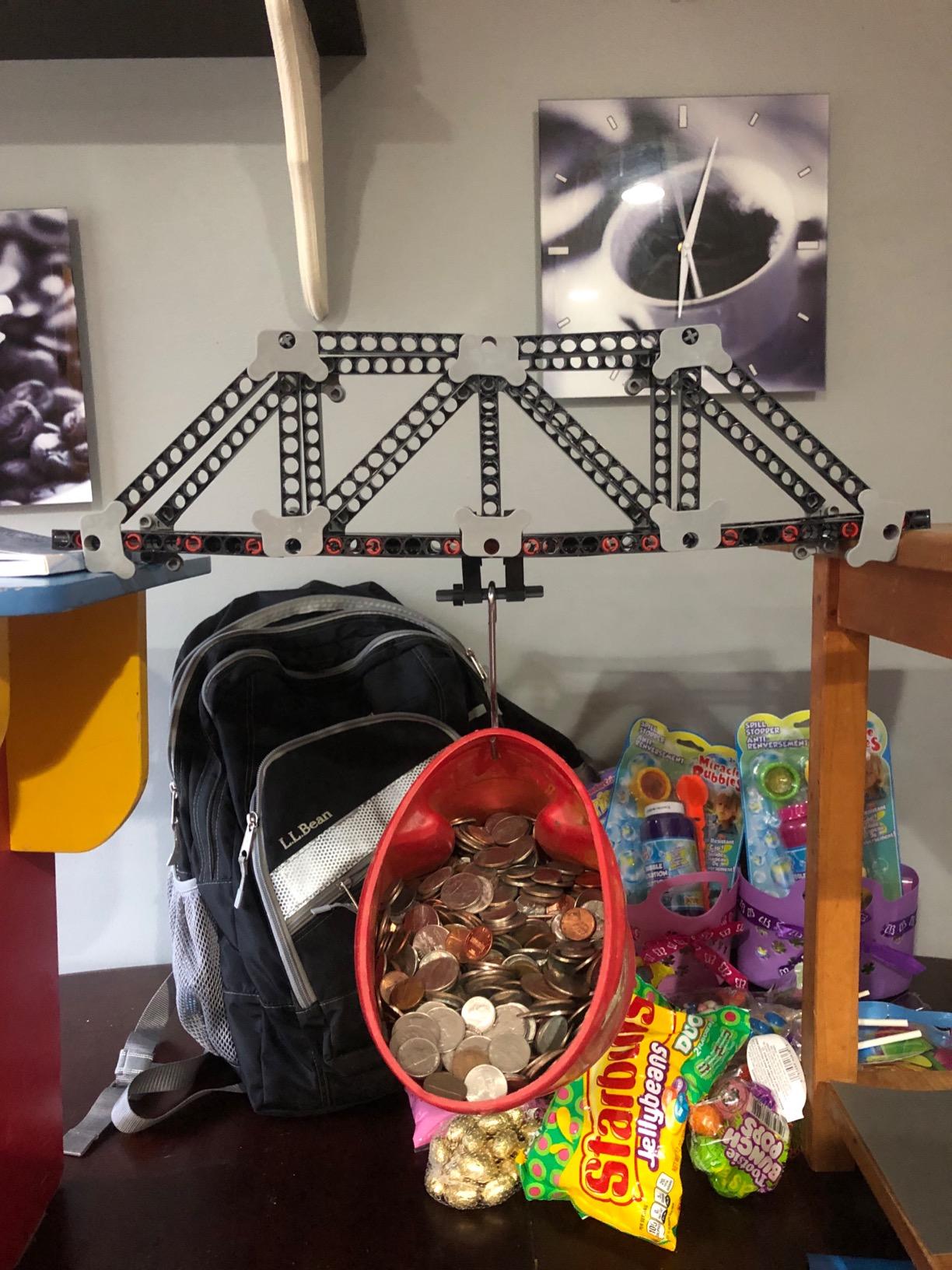
The interchangeability is the underrated part. Once a child has built the prescribed models, the same pieces recombine into towers, frameworks, and custom spans, which extends the life of the set well past the 20 printed experiments.
It is also a genuine bridge between basic construction toys and more advanced kits. A child who comes out of this understands trusses and bracing as ideas, which makes a later move to a bigger engineering set considerably easier.
Who this set suits at age 8
This suits a strong reader who is curious about why structures hold up, and a child who has already worked through simpler kits and wants harder material. It is the pick for a family that wants engineering content rather than an activity.
It is also a strong choice for a homeschool curriculum covering structures, because the manual supplies the explanation and the experiments instead of requiring you to write the lesson.
Who should skip this set
Skip it if your child is a reluctant reader. The manual is text-heavy and largely written, and that is the single most common complaint in the reviews. A child who will not read the instructions will sit in front of the box and go elsewhere.
Skip it if you want independent play immediately. Several piece types are difficult to connect without adult hands, and the set demands more patience than most construction kits in this age range, which makes the frustration harder to justify.
How to Choose a STEM Building Set for an 8-Year-Old
What counts as a STEM building set
A STEM building set is a construction kit in which the act of building is what teaches. Interlocking pieces, connectors, motors, magnets, or circuit components go together into a model, and the child modifies or rebuilds it. That second build is where the learning lands, because following instructions teaches compliance while rebuilding teaches structural, mechanical, or electrical reasoning.
What falls outside this definition, and what we excluded from this roundup, are science experiment kits where the child mixes substances and records results, board games, and activity kits with no construction component at all. Those are fine toys, but they are answering a different question.
Piece count is not the same as learning value
Parents often assume more pieces means a better set. The honest answer at age 8 is usually the reverse. A 500-piece bag of identical discs gives a child material but no problem, while a 100-piece gear set gives them a mechanism to investigate. Piece count measures volume, not thinking.
More useful questions are how many distinct things can be built from the parts, whether a second and third build exist after the manual is finished, and whether the pieces work together with sets the child already owns. A kit that combines with an existing collection usually outlasts a larger standalone one.
Screen-free matters at this age
Every set in this roundup is screen-free. That is a deliberate filter, because app-dependent kits introduce setup friction that forums keep surfacing: a tablet, a Bluetooth pairing, an app update, and sometimes an account, all before anything works. For a child who is 8, that first ten minutes decides whether the set gets opened again.
The trade-off is that pure screen-free play puts more responsibility on the parent for supplying challenges. If you skip guided kits, plan on giving a specific brief rather than pointing at the box. We have a broader look at the best STEM toys for 8 year olds if you want sets that do use a screen for coding.
First-build readiness checkpoints for age 8
Before buying anything, answer four questions honestly. Can your child follow a 20 to 40 step manual without adult rescue? Can they sit with a build for 30 to 45 minutes, or do they stop at 15? Can they handle small stiff connectors without frustration? And do they retry when something fails, or does a broken build end the session?
If the answer to the last two is no, lean toward chunky, forgiving sets such as the City Engineering kit or Brain Flakes. If all four are yes, the Snap Circuits and K’NEX options open up, and so does the Thames and Kosmos manual-heavy kit.
Budget tiers: where to spend and where to save
At the entry tier, the 13-in-1 solar robot kit and the City Engineering set are the sensible floor. Both finish quickly and neither demands adult supervision, which is what you want when you are buying a first building set rather than an expansion.
In the middle tier you are choosing between a circuits kit, an open-ended construction set, a marble run, and a motorized racer, and the right answer depends entirely on which of those clusters your child already owns. In this band we would buy the Snap Circuits Jr. kit, because it holds attention for the longest stretch of any set in the roundup.
At the top of the range, the LEGO Technic buggy and the Thames and Kosmos structural kit both deliver real mechanical or structural content, and both require more adult involvement at the start. That is a fair trade, but only if you have the time for it.
Sequencing two sets so they build on each other
Parents on r/Parenting and r/robotics keep asking the same question: what comes after the set that worked. A common thread in those discussions is that the right second set is the one that adds a new idea rather than more of the same, and the transition parents report working best moves from open-ended construction to something with a mechanism in it.
A practical pairing is gears or magnetic-style open-ended building first, then a circuits or motorized set. The first build teaches spatial reasoning without a manual, and the second applies that reasoning to a system that has to keep working when a connection is wrong. For children who are already several sets in, skip the first stage and go straight to mechanics.
Safety notes for small parts, magnets, and batteries
Every kit here carries small parts, so the toilet-paper-roll test is worth running on anything with pieces small enough to fit inside the tube. If they pass through, they are a choking risk for a younger sibling in the house, which is the scenario parents on r/Gifts warn about most when they steer 8-year-olds away from delicate wooden kits.
Marble runs deserve their own note because the marbles are glass. We supervised the first few runs of the National Geographic set and would keep doing so with a child who runs rather than walks. Battery-powered sets need an adult for the compartment, and rechargeable is worth the extra step if you are buying something used weekly.
Frequently Asked Questions
What are the best STEM toys for 8-year-olds?
The best STEM building sets for 8 year olds are Snap Circuits Jr. SC-100 for circuits, Brain Flakes for open-ended construction, the National Geographic glow marble run for physics, and K’NEX Adventure Wheels for moving machines. Each one has a genuine building component, suits the attention span of a third grader, and needs no screen or app.
What are some good building toys for an 8-year-old?
Good building toys for an 8-year-old include interlocking disc sets for open-ended structures, gear sets that show cause and effect, Technic-style kits with working suspension and steering, and construction kits with wheels that actually roll. Pick based on whether your child prefers following a manual or inventing freely.
What are some good engineering sets for kids?
Strong engineering sets for kids include gear sets that demonstrate motion transfer, Technic kits with working engines and suspension, structural engineering kits that teach load and compression, and rod-and-connector systems that build moving linkages. The right choice depends on whether your child learns better from instructions or from trial and error.
Do STEM building sets need a screen?
The sets in this roundup do not. We filtered out app-dependent kits because they often require a tablet, a Bluetooth pairing, an app update, and sometimes an account before anything works, and that setup friction ends the interest quickly at age 8. Kits that do use a screen are worth it later for block coding.
How many pieces should a building set have for an 8 year old?
Piece count matters less than the number of distinct builds. A 100-piece gear set with mechanisms can teach more than 500 identical discs, because it presents a problem to solve. Look instead at how many different things can be built, whether the set works with pieces the child already owns, and whether a second build exists after the manual is finished.
Is Snap Circuits good for an 8-year-old?
Yes. The Snap Circuits Jr. SC-100 is labelled ages 8 and up, and parents on parenting forums describe it as suitable for independent play. It ships with 28 snap-together parts, over 100 guided projects, and a color-coded full-color manual. Batteries are required and not included, and the projects are guided rather than open-ended.
The Best STEM Building Set for an 8-Year-Old, Final Word
Start with the Snap Circuits Jr. SC-100. It is the best STEM building set for 8 year olds because it combines the widest range of genuinely different projects with a build an 8-year-old can finish in a single sitting, and because the failure modes teach a debugging habit that carries into everything else.
If your child prefers inventing rather than following instructions, swap it for Brain Flakes. If they are mechanically minded, K’NEX Adventure Wheels or the LEGO Technic buggy is the better buy, and if they want to understand why things stand up, the Thames and Kosmos structural kit goes furthest.
Whichever you choose, sit down for the first build. The parents who get the most out of these sets are the ones who treat the first hour as a shared activity and step back after that, and that is the single biggest predictor of how long the toy keeps getting played in 2026.