
If you run anything wider than 31s away from pavement, the best portable air compressor for off-roading is the VIAIR 400P: 150 PSI, 2.30 CFM free flow, a 25 foot hose rated for tires up to 35 inches, and a 4.8 star rating across 1,289 owner reviews. For a small second unit that lives in the back of the truck, the GSPSCN 202 handles the spare, the air mattress and the firewood on 6 pounds.
That answer matters because of what a compressor is actually for. Off-road tires run at low pressure on the trail for traction and flotation, and the same tire at trail pressure on pavement will overheat and blow out. You also need to drop and recover pressure repeatedly, and if you have locking differentials you need air the instant a tire loses grip.
We went through the current off-road compressor market end to end for 2026, comparing airflow, duty cycle, max working pressure, hose reach, current draw and weight across eight units from budget single-cylinder pumps to a twin-motor on-board system. What follows is what the numbers mean in practice, which unit fits which tire size, and where each one falls down. For a broader look at portable units beyond the trail, see our guide to the best portable air compressors.
Table of Contents
Top 3 Best Portable Air Compressors for Off-Roading In 2026

All 8 Portable Air Compressors at a Glance (October 2026)
Every compressor below runs on 12 volt DC power from your vehicle. Airflow, duty cycle and reach are the three numbers that decide whether a unit keeps up with your tires.
| Product | Specifications | Action |
|---|---|---|
| VIAIR 400P |
|
Check Latest Price |
 VIAIR 300P VIAIR 300P |
|
Check Latest Price |
 VIAIR 450P-RV VIAIR 450P-RV |
|
Check Latest Price |
 ARB CKMTA12 Twin ARB CKMTA12 Twin |
|
Check Latest Price |
 ALL-TOP ATACR300 ALL-TOP ATACR300 |
|
Check Latest Price |
 GSPSCN 202 GSPSCN 202 |
|
Check Latest Price |
 VEVOR YD-127D VEVOR YD-127D |
|
Check Latest Price |
 AstroAI T3 AstroAI T3 |
|
Check Latest Price |
1. VIAIR 400P – Best Overall for Tires Up to 35 Inches
- Top rated in this roundup at 4.8 stars across 1289 reviews
- Handles tires up to 35 inches
- 25 foot hose with inline gauge makes tire-to-tire moves simple
- IP54 housing resists dust and water
- Comes as a complete kit with bag and sand tray
- 33% duty cycle forces cool-down pauses on long fills
- Needs a running vehicle and pulls up to 30 amps
The VIAIR 400P is the unit we keep coming back to because it is the rare compressor that is neither too slow nor too heavy. At 10.87 by 5.83 by 7.48 inches and 10.7 pounds, it fits behind a passenger seat or in a swing-out drawer without turning into a lifting problem.
Owners rate it 4.8 stars across 1,289 reviews, with 87% of those reviews at five stars. That is the highest average rating in the roundup, and the reasons owners give are consistent: it starts on the first try, the gauge is easy to read, and it does not sound like a shop tool.
The kit is unusually complete for a portable set. You get a 25 foot 5-in-1 hose that inflates and deflates from one fitting, an 8 foot power cord, three inflation tips, a Presta adapter, an aluminum I-beam sand tray, a 40 amp inline fuse holder and a dual-compartment carry bag. Nothing needs a second purchase before the first fill.
On paper the headline figure is 2.30 CFM at zero pressure, which is the number most brands lead with. Real flow at working pressure is lower, and that is exactly why the duty cycle matters. This unit is rated at 33% duty cycle at 100 PSI, so it runs hard then needs a rest before the next tire.
What 2.30 CFM Actually Gets You on a 35
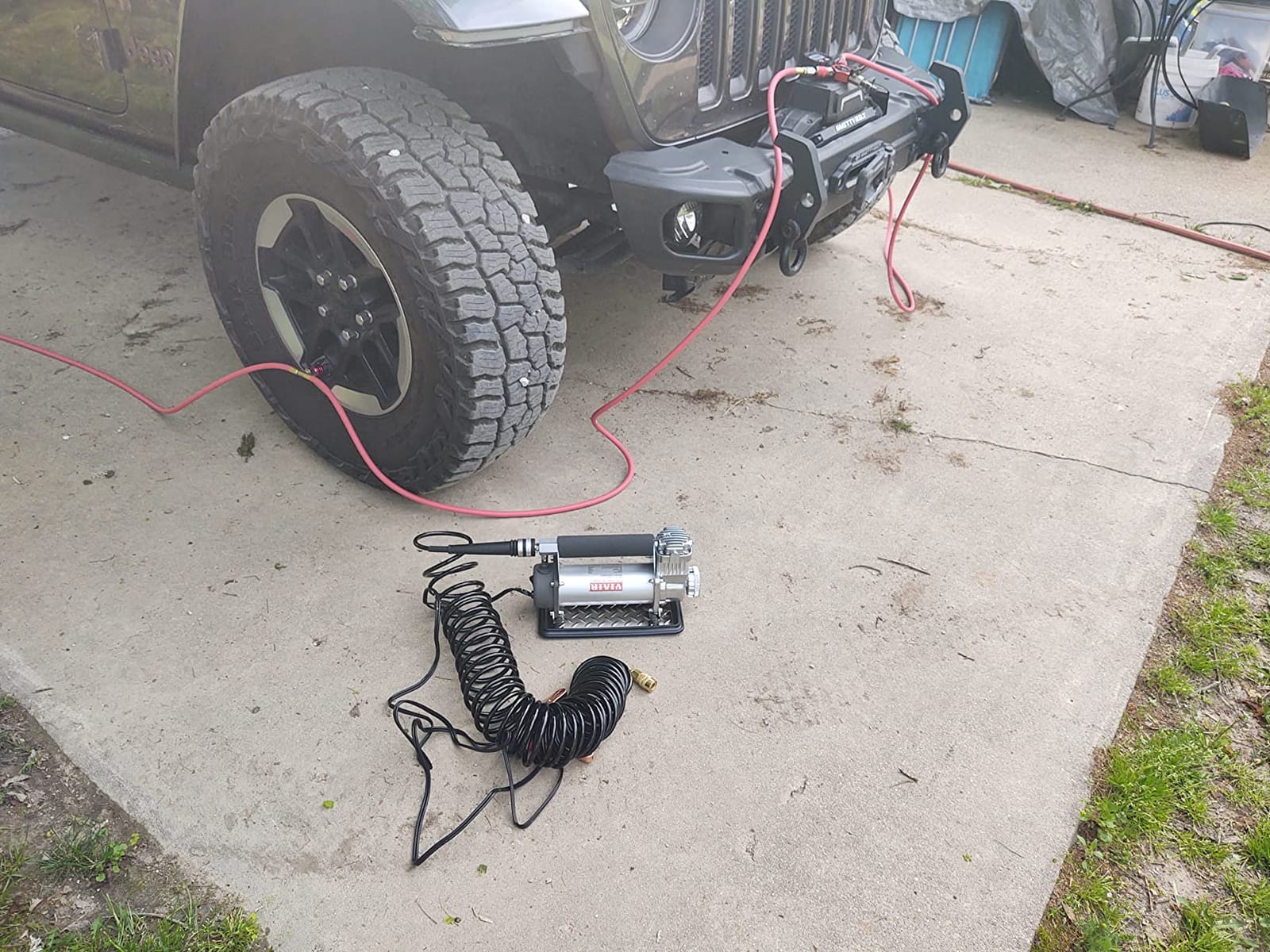
Owners running 35 inch mud tires report around six minutes to take a tire from empty to 30 PSI, and roughly four minutes for a 20 to 35 PSI top-off on a tire that was aired down on the trail. For a full four-tire recovery after a day of low-pressure running, plan on the better part of half an hour with one or two cool-down pauses.
That pace is fine if you start airing up before you pack the camp. It is frustrating if you are doing it in the dark at a trailhead with a group watching. If your tires are 35s and you want faster than that, step up to one of the dual-cylinder units further down the list.
Battery Draw, Wiring and Runtime
This is a battery-clamp unit, not a plug-in socket unit, and it pulls up to 30 amps. That is a meaningful load on a smaller auxiliary setup, so keep the engine running and use heavy gauge cable between the clamps and the compressor.
The 40 amp inline fuse holder is included, which is more than many competitors ship. Clamp quality is the other thing to check after a few trips, because small alligator clips that lose bite on a hot battery cause voltage drop and erratic shutdown mid-fill.
2. VIAIR 300P – Best Value for 31 and 33 Inch Tires
- 4.7 stars across 2498 reviews
- Same 2.30 CFM airflow as the 400P in a smaller body
- Lightest and most compact VIAIR in this group
- Anti-vibration tray and carry bag included
- 33% duty cycle needs cool-down on long fills
- Engine must be running for full voltage
- Sized for tires up to 33 inches only
The 300P is the same pump in a smaller case, and for a lot of rigs that is the whole argument. If you run 31s or 33s, you get the same 2.30 CFM free flow as the unit above for two pounds less and a tighter footprint at 9 by 4.9 by 7.5 inches.
With 2,498 reviews averaging 4.7 stars, this is the most thoroughly reviewed VIAIR in our group. Owners describe it as a workhorse that has been in the back of the truck for years and simply keeps starting.
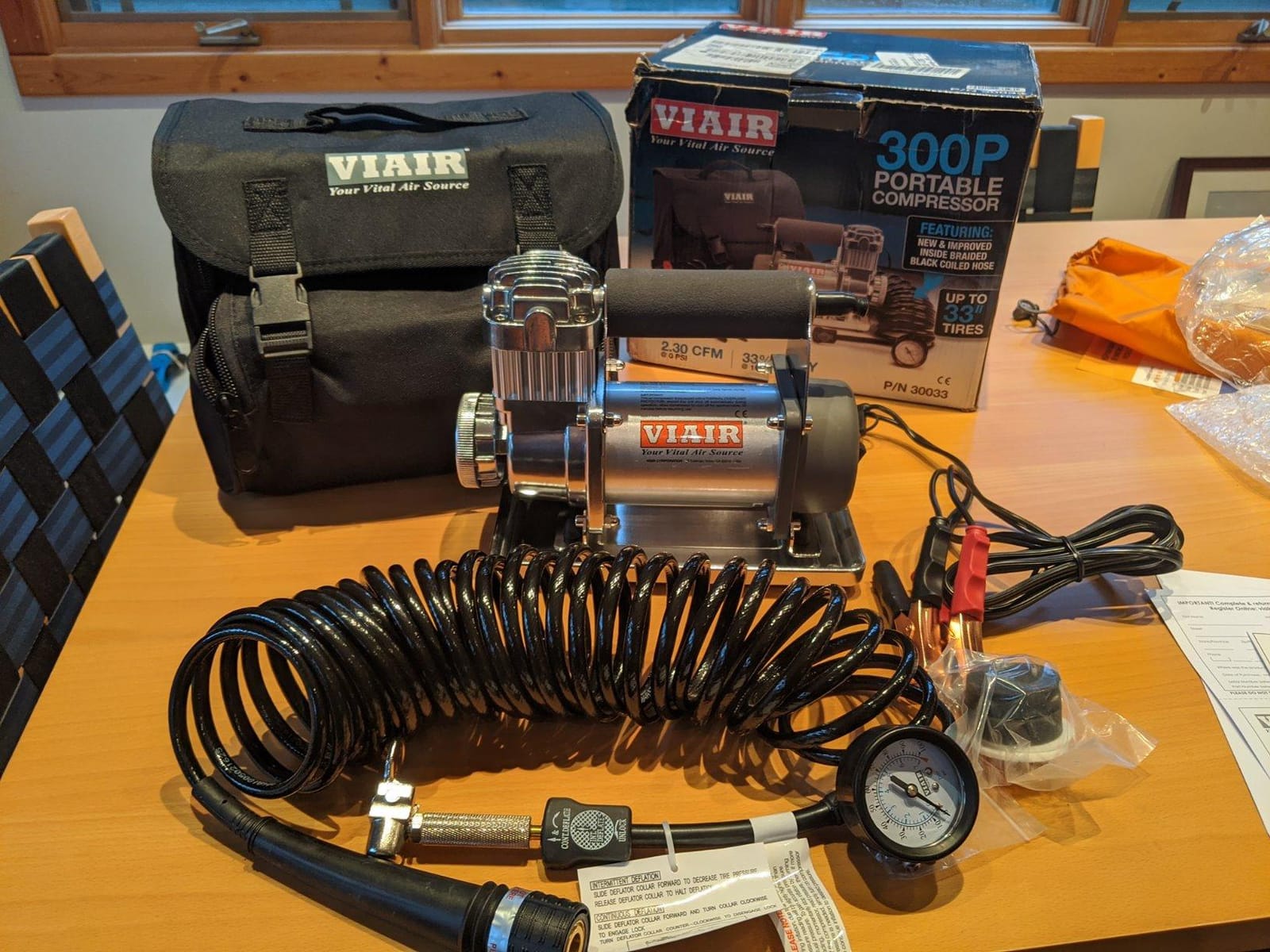
It draws up to 30 amps and is rated at 414 watts. The power cord is 8 feet and the hose is 25 feet, which is enough to reach around most pickups and SUVs from a single battery connection without dragging the unit across the ground.
The included 5-in-1 hose handles both inflation and deflation with an inline 100 PSI gauge, so the same fitting handles airing down at the trailhead and back up on pavement. Owners of air-down setups treat the deflator function as a requirement rather than a bonus, and this one has it.
Why Owners Keep This One for Years
Long-running threads on off-road forums describe exactly this experience: compressors that start every morning, survive washouts, and never need a rebuild. Durability over several seasons is the trust signal people care about most, and more reports describe that pattern for VIAIR units than for any other brand in this roundup.
That longevity matters because the alternative is buying twice. Compressors that die from water and dust ingress after a fording or a washout are the most common regret reported by owners, and a metal-bodied unit with sealed motor ends is a better bet than an all-plastic shell.
Where It Falls Short Against 35s and Bigger
The 33% duty cycle is the same constraint as the 400P, and it becomes more noticeable on larger tires because each tire takes longer. On 35s and 37s you will spend a lot of the job waiting on cool-down pauses.
The bigger limitation is the stated tire ceiling. VIAIR sizes this one for tires up to 33 inches overall diameter. If you have already moved to 35s or plan to, the 400P is the more sensible buy.
3. VIAIR 450P-RV – Best for High-Pressure RV and Dually Tires
VIAIR 450P-RV Automatic 12V Air Compressor, 150 PSI for RVs and Trucks
- Only 100% continuous duty at 100 PSI rating in the group
- Two 30 foot coil hoses reach every tire on a dually from one connection
- Handles Class A motorhome tires up to 42 inches
- Built for 110 to 135 PSI tires that lighter units cannot manage
- 1.80 CFM is the lowest free flow of the VIAIR group
- Inline gauge reads a few PSI off
- Battery power only and the case runs hot during long fills
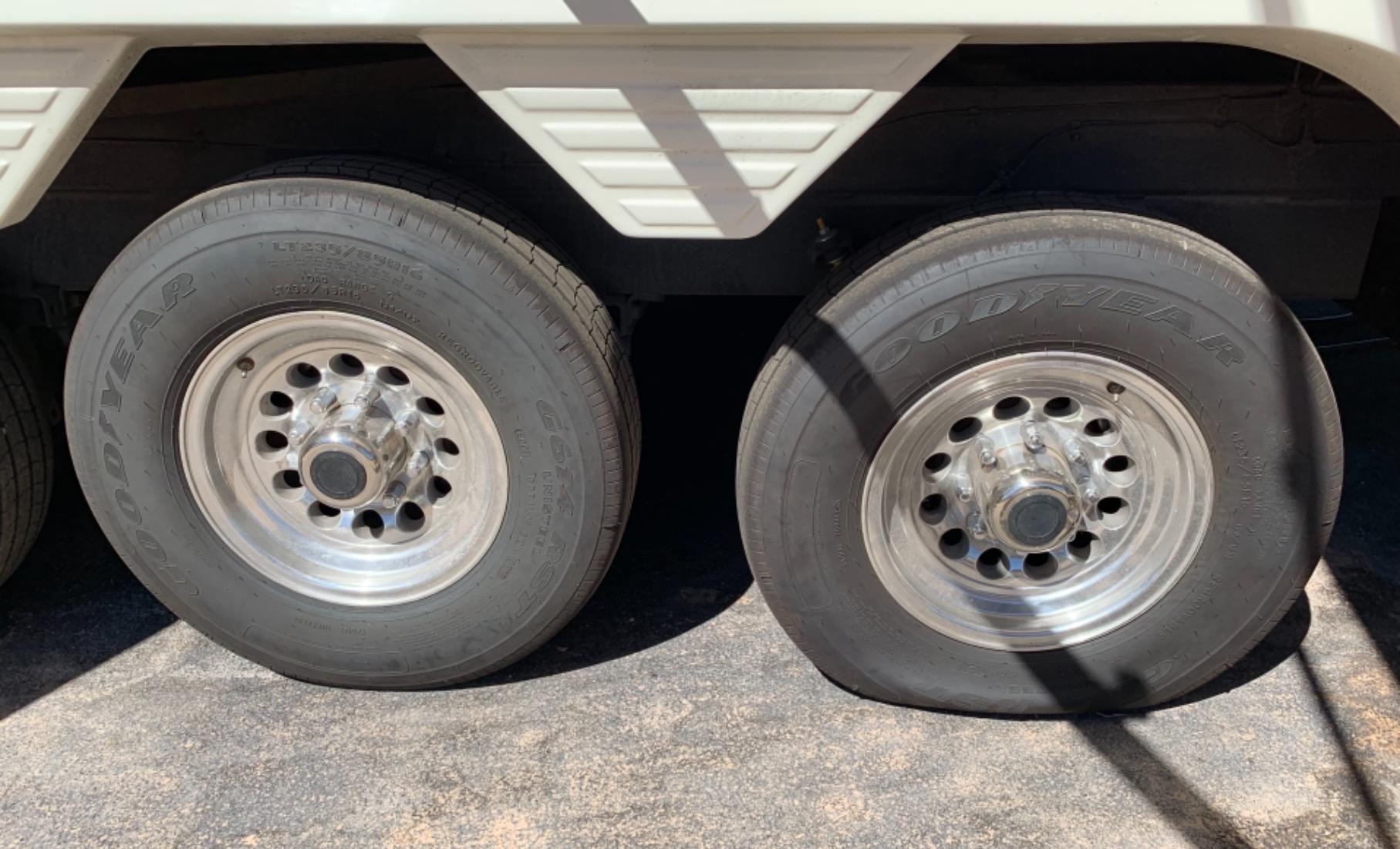
The 450P-RV is a different job from the other two VIAIRs. It is not built to fill 35 inch off-road tires quickly. It is built to fill tires that need a lot of air, at pressure, for a long time, without shutting down halfway through.
That is the 100% duty cycle at 100 PSI rating, and it is the reason RV and truck owners switched to it. The review summary on record is blunt: many buyers switched after lighter compressors burned out trying to hold high motorhome pressures.
At 1.80 CFM free flow it is the slowest of the VIAIR units here, and it is rated to 69 dB. It draws 23 amps, the lowest of the VIAIR group, which makes it easier to run off a modest auxiliary circuit than the 30 amp units.
The integrated pressure cut-off sensor auto-cycles the unit while the inflation gun is engaged, so it holds pressure without hunting. The sand tray is vibration-isolated and pre-mounted, which matters on a metal truck bed or a roof rack.
The 100 Percent Duty Cycle Question
Duty cycle is the percentage of the time a unit can run before it needs to cool. Most portable 12V compressors sit at 33%, which sounds fine until you multiply it by a four-tire job on a 42 inch tire and watch the clock.
A 100% duty cycle rating means the motor is designed to run continuously at that pressure, with thermal protection as a backup rather than a routine event. If your tires take 110 PSI or more, that is the single most important spec on the page.
Reach, Gauge Accuracy and Storage
Two 30 foot coil hoses give 60 feet of reach from a single battery connection, which is what makes it useful on a dually truck or a long fifth wheel. A shorter hose on a large vehicle means moving the unit, and moving a 13.1 pound compressor four times is a bad afternoon.
The two recurring caveats are the inline gauge, which reads a few PSI off on lower-pressure tires, and the case, which gets hot enough to notice during extended fills. Confirm final pressures with a separate gauge if you are running low pressures.
4. ARB CKMTA12 Twin – Best for Air Lockers and On-Board Setup
- Top sustained airflow of any on-board system in this roundup
- Water sealed motors with all ball bearings rated for long service life
- Full wiring loom and dash switch included for air locker solenoids
- Thermal protection and safety valve with dual Maxi-Fuses
- Compact enough to mount under a Wrangler passenger seat
- Installation is a serious electrical project with hours of wiring
- Sold as bare compressor with no hose or coupler or tank or inflation kit
- Vibration transfers into the cab without rubber dampeners
The ARB CKMTA12 is the only on-board system in this group, and it is the only unit here that feeds air lockers. Everything else on this page lives in a drawer and gets clamped to a battery when you need it. This one lives in the vehicle permanently and runs off the electrical system.
At 6.16 CFM free flow it moves roughly two and a half times what a premium portable does, and it runs on a 100% duty cycle. Owners report airing four tires from 20 to 35 PSI in about four minutes, and filling eight 33 inch tires consecutively without the motor complaining.
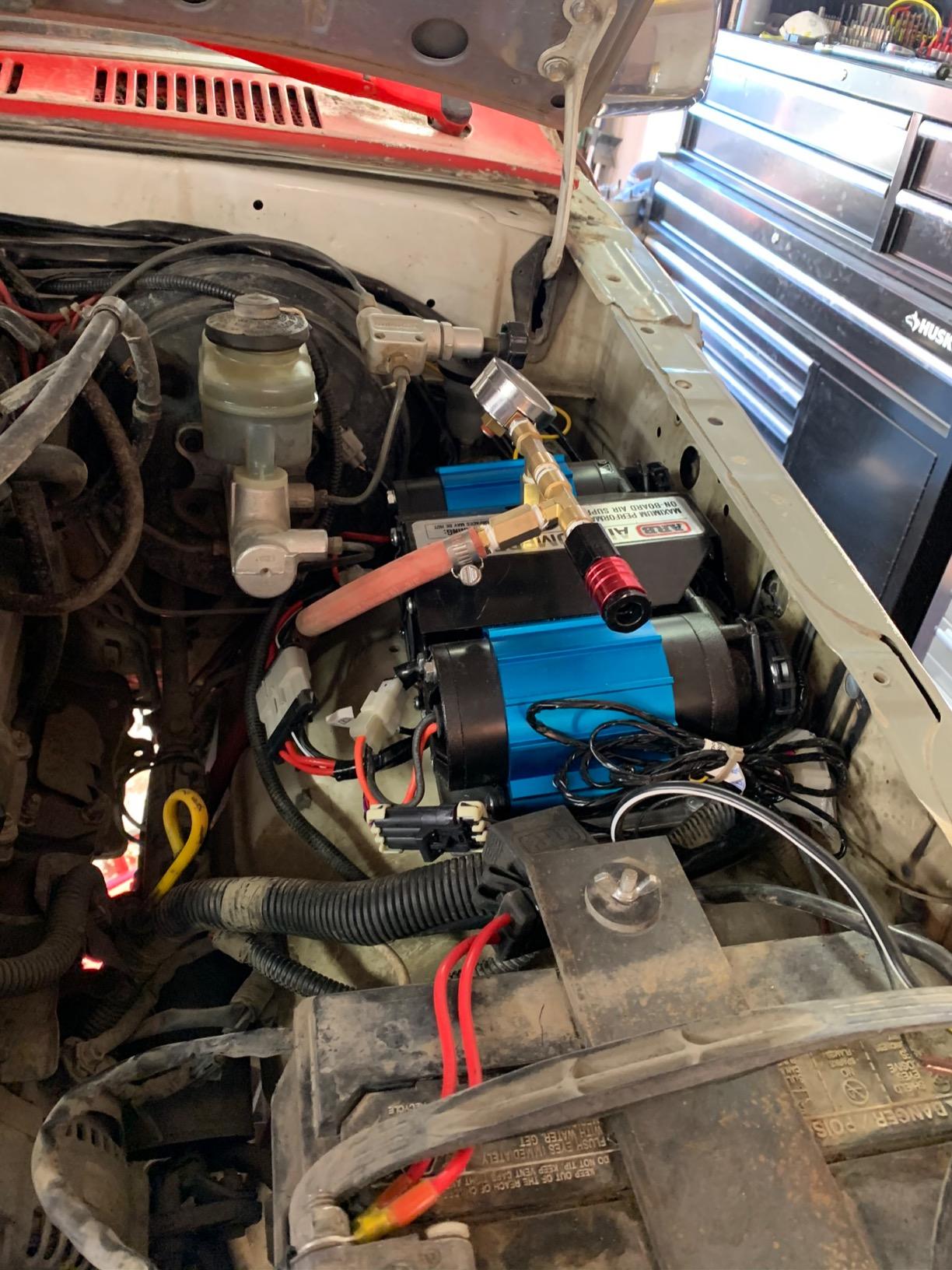
Motors are water sealed with all ball bearings, and the build is European made cylindrical roller bearing pistons with hard-anodized bores and PTFE impregnated seals. Two relocatable splash-resistant air filters use washable sintered bronze cartridges, which is the part that usually fails first on a simpler pump.
Inside are internally thermally protected motors, an over-pressure safety valve and dual Maxi-Fuses. It measures 11 by 5 by 20 inches, so it fits behind a seat or under a bench, and the noise figure is listed at 6 sones, which is quiet for something that moves this much air.
The Installation Is the Hard Part
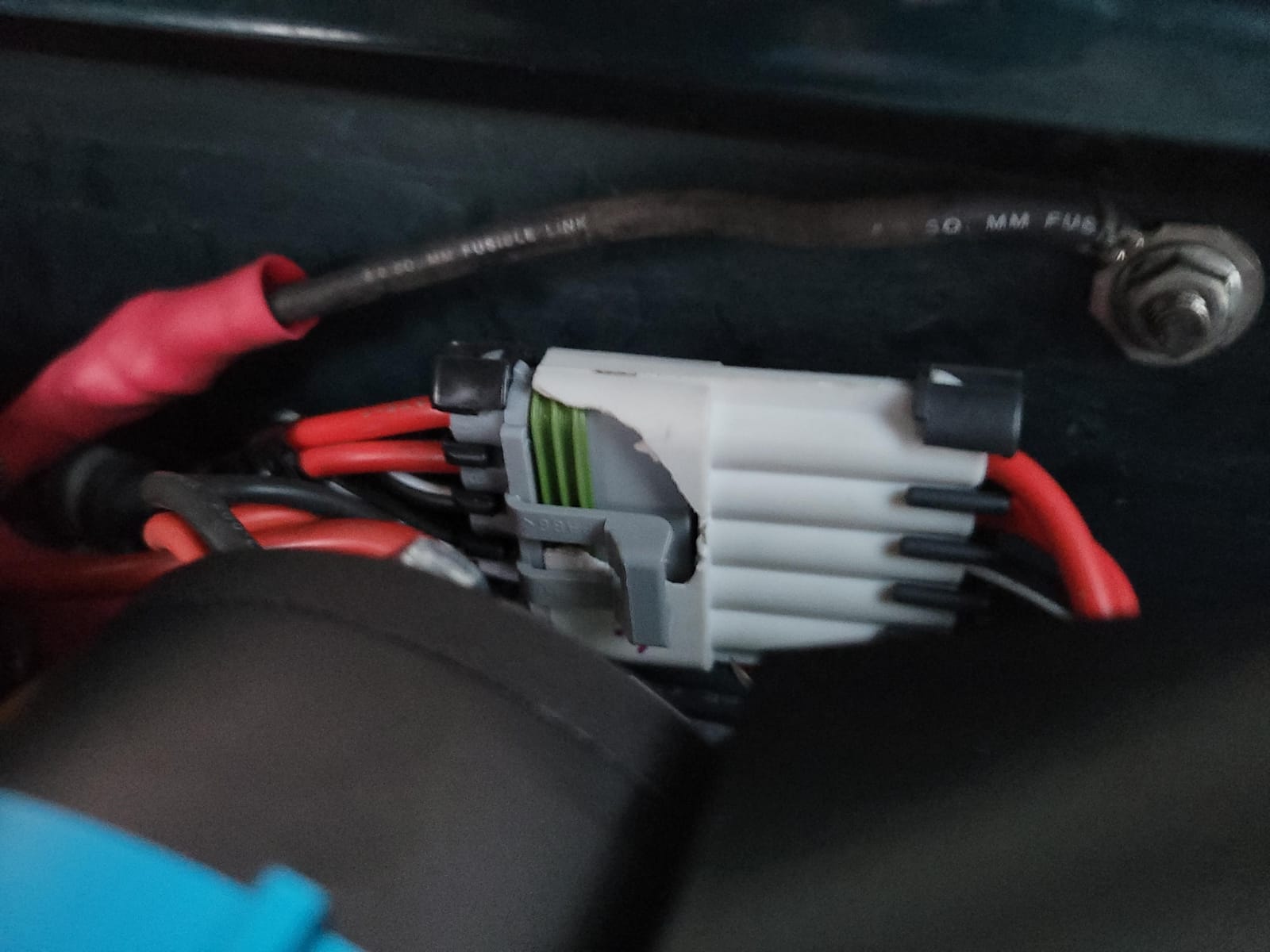
Budget for a full day the first time. The wiring loom is included and the dash switch is included, but you are still running heavy gauge wire, mounting a fuse block and routing the harness. This is not a first electrical project, and it is not a weekend-afternoon job if you have never done one.
You also buy the rest of the system separately. No hose, no quick coupler, no tank and no inflation kit come in the box, so the true cost of a working air locker setup is well above the compressor alone. Add the air locker manifold kit for solenoids.
On-Board Versus Carrying a Portable
Owners with lockers are blunt about the portable option: a small portable unit cannot keep up with lockers cycling on technical terrain. The moment you need pressure to engage a diff, waiting four minutes is the difference between climbing and walking back.
The trade-off goes the other way too. A portable needs no wiring and can move between vehicles. A group airing up five rigs before dark will get more done with five portables than one on-board unit and a spool of wire.
5. ALL-TOP ATACR300 – Best Dual-Cylinder Flow Without a Tank
- Roughly five times the airflow of a 2.30 CFM portable
- Owners time 37 inch KO2 fills from 26 to 38 PSI in about 90 seconds
- Has held up in 95 degree heat while airing four tires
- 26 foot hose reaches around a full size truck
- Backed by a 2 year warranty
- No automatic pressure shut-off so you stop it yourself
- Built in gauge is noticeably inaccurate
- Short 6.5 foot power cord
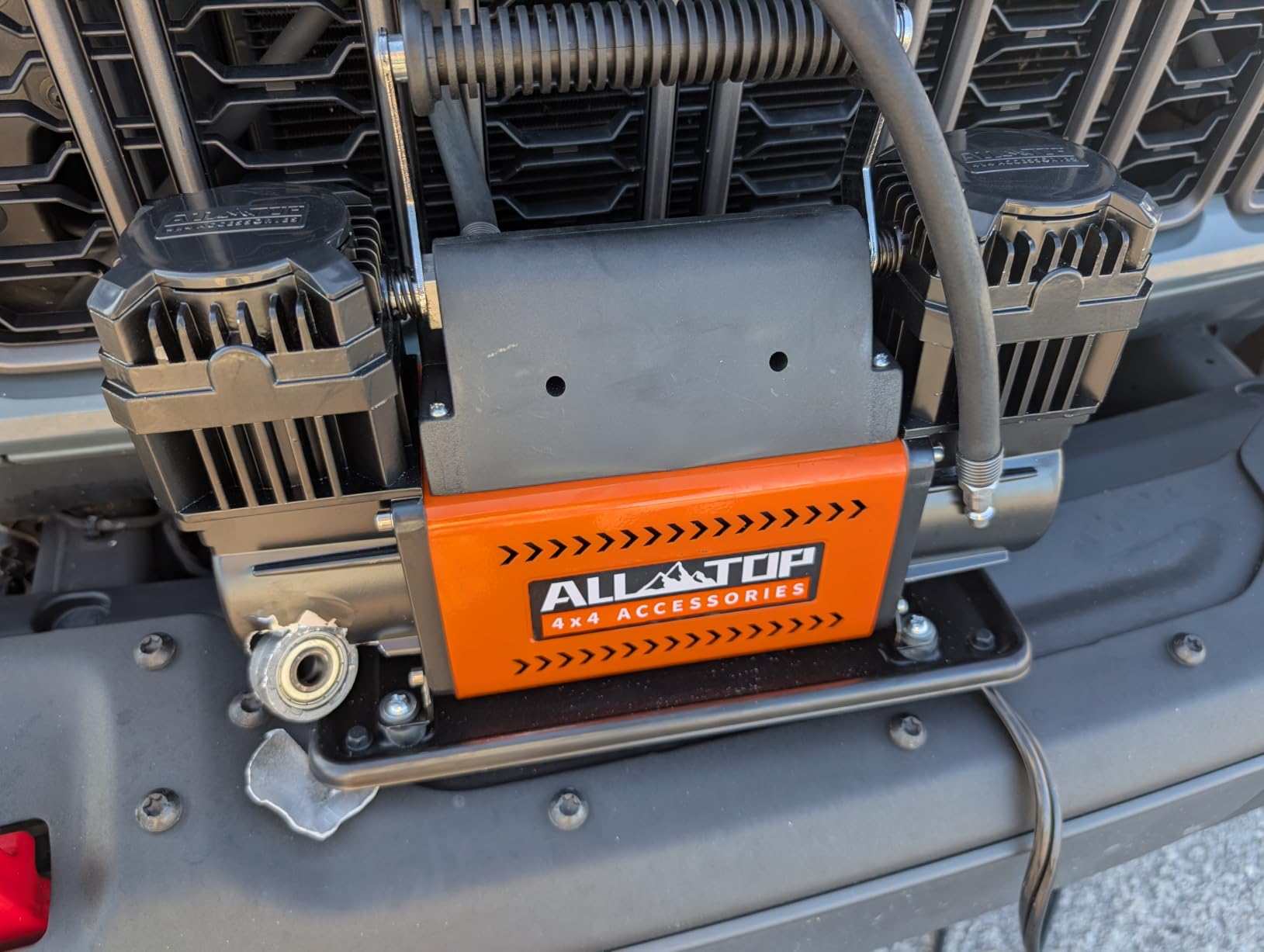
The ALL-TOP ATACR300 is where the jump from portable to serious happens. Its dual aluminium cylinders push 350 litres per minute, listed as 12.35 CFM, which is the highest airflow number of any portable unit in this group.
At 4.5 stars across 590 reviews, owners are not buying it for the badge. You are buying it because a 37 inch tire goes from 26 to 38 PSI in about 90 seconds, which is roughly five times what a premium portable delivers on the same tire.
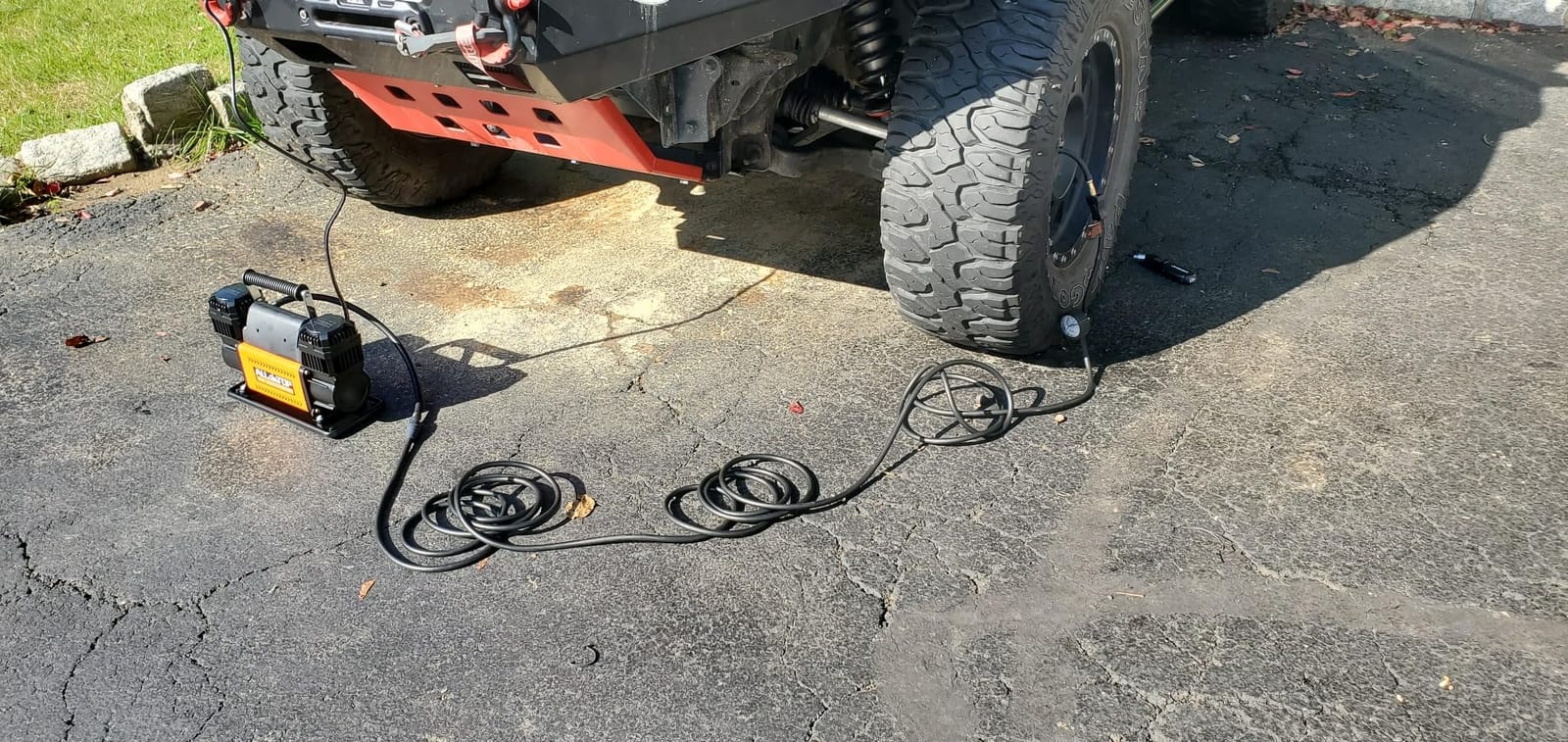
The hollow metal shell is there for heat dissipation rather than looks, and it is paired with an auto thermal cut-off switch and over-current protection. Four anti-vibration rubber feet and a rubber handle keep it stable and safe to carry when the case is hot.
The kit includes the compressor, a nylon tool bag, a 6.5 foot power cord, a 26 foot rubber hose with gauge, three nozzle adapters and a thumb lock adapter. It draws 307 watts and is rated at 0.41 horsepower.
Real Fill Times on 35s and 37s
Owners consistently time 35 and 37 inch tire fills at one to two minutes and compare the unit favorably against a VIAIR 400P on the same tires. On a four-tire airing up job with 37s, that is the difference between ten minutes and forty.
Heat is the usual failure point for big pumps, and the reported experience here is that it held up while airing four tires in 95 degree conditions without overheating. The auto thermal cut-off is a safety net, not the thing that is constantly tripping.
No Auto Shut-Off Is a Real Gap
There is no automatic pressure shut-off. You watch the gauge and stop the pump yourself, and the built-in gauge is inaccurate enough that many owners add a pressure switch, extra cooling and an Anderson connector to make it hands-off.
The 6.5 foot power cord is also short relative to the 26 foot hose, so the unit has to sit near the battery even though the hose reaches everywhere. At 24 pounds it is not a one-person carry over rough ground.
6. GSPSCN 202 – Best Budget Backup Pump
- Largest review base in the roundup at 11679 ratings
- Metal cylinder and motor and connecting rod rather than plastic internals
- Quiet at 70 dB
- Only 6 pounds so it is easy to carry and stow
- About 2.4 CFM is well short of heavy duty dual cylinder output
- Short 11.5 foot cord and hose restrict reach on large trucks
- 20 amp draw still needs a healthy battery
The GSPSCN 202 exists because most rigs need two compressors, not one. A fast unit for the tires, and a cheap unit in the back for the spare, the air mattress, the inflatable and the tube on the firewood. At 6 pounds it is the easiest thing here to carry.
It has 11,679 ratings averaging 4.5 stars, the largest review base of any product in this roundup by a wide margin. Buyers treat it as a capable backup pump rather than a primary trail compressor for 33s and up.
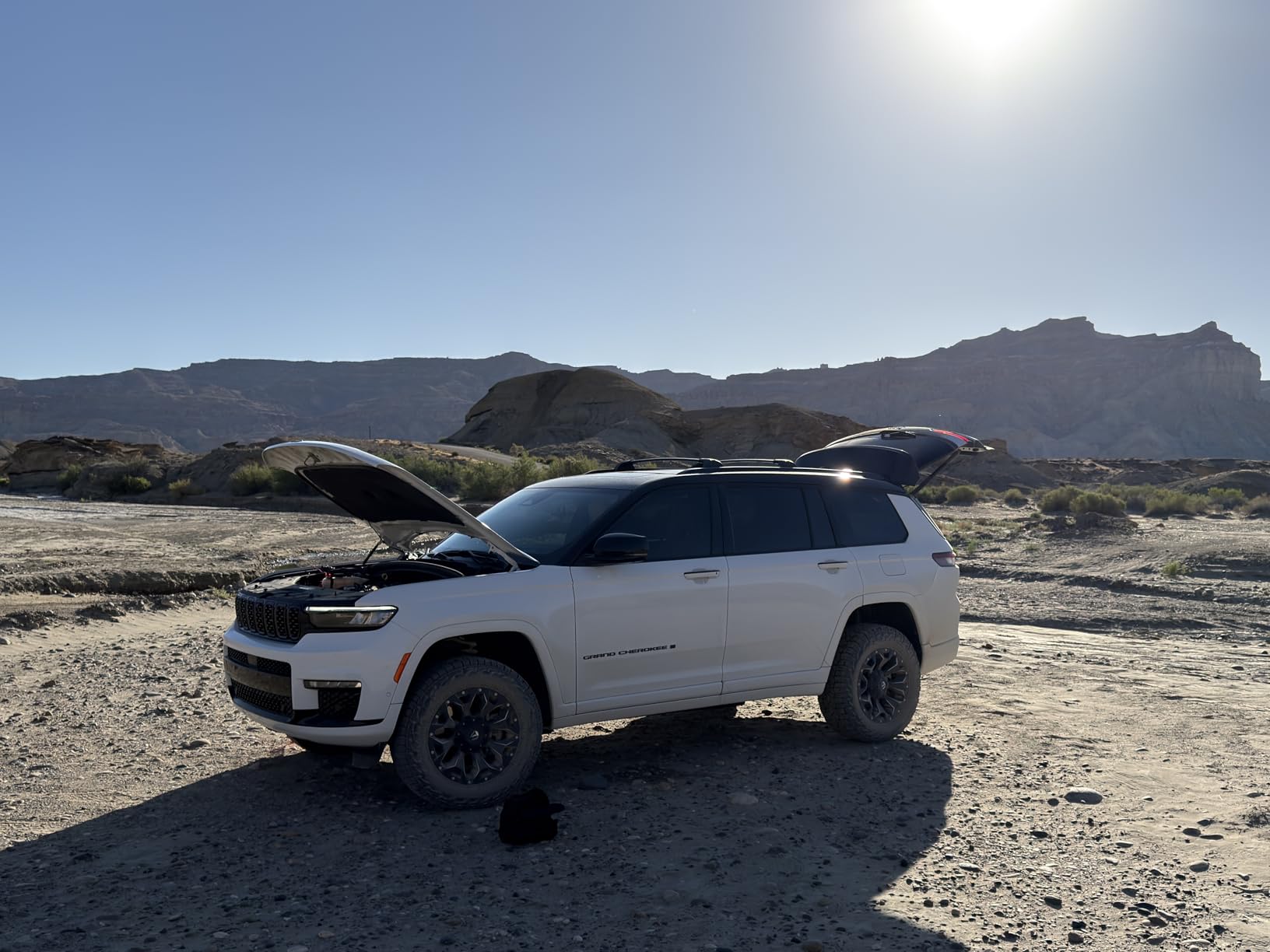
Despite the price point, the internals are metal. Integrated molding technology produces a metal cylinder, motor and connecting rod, and that is the difference between a pump that survives a few seasons and one that does not. The direct-drive motor runs at low RPM, which is where the 70 dB figure comes from.
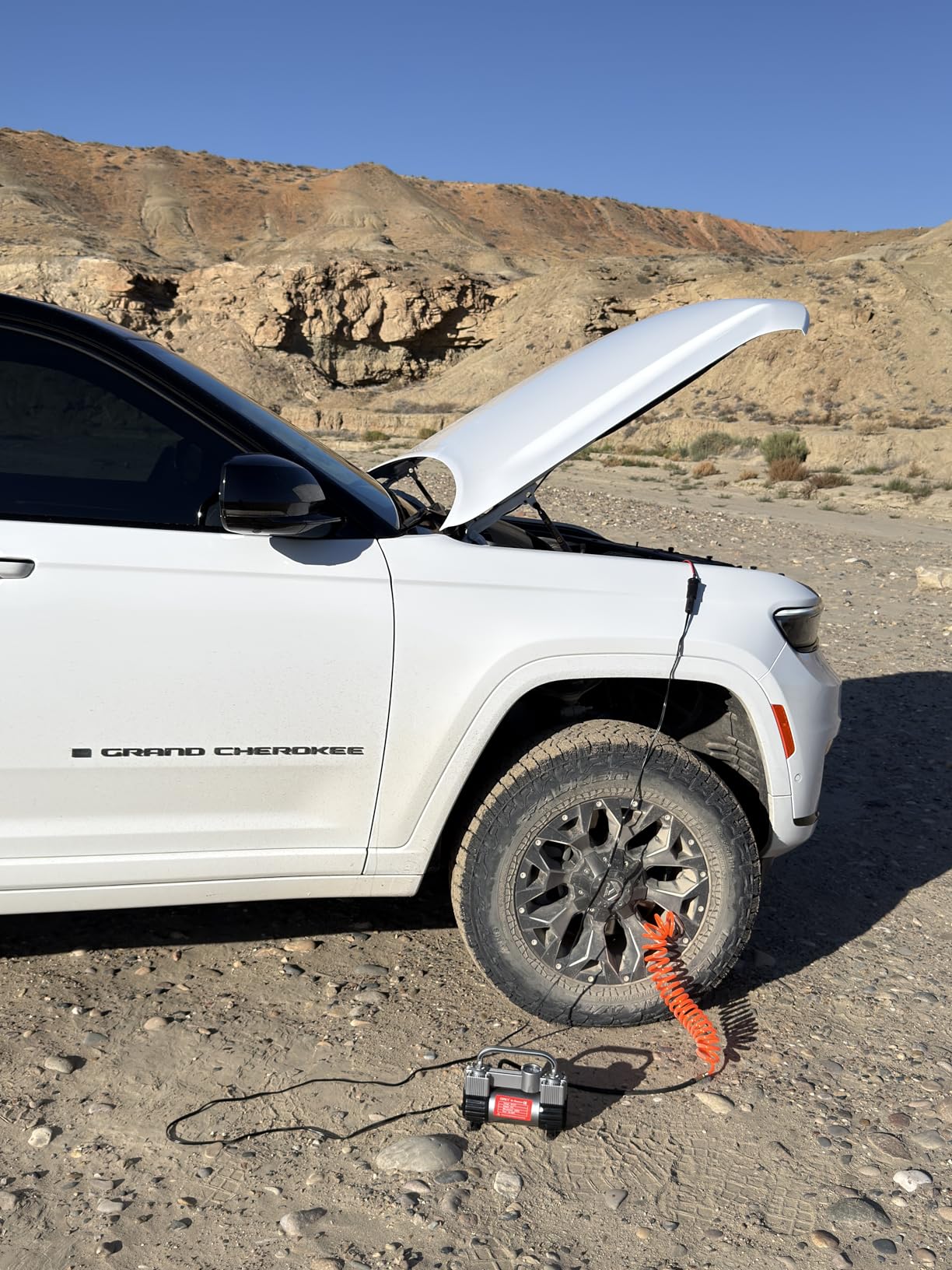
It draws 20 amps and is rated at 240 watts, the lowest draw in the group. The kit includes battery clamps, three inflation adapters, a replacement fuse and an Oxford storage bag.
What 70 Litres per Minute Really Covers
70 litres per minute works out to roughly 2.4 CFM, which is close to a premium portable. The catch is that this is dual-cylinder flow from a small direct-drive motor, and real loaded flow at working pressure drops more than it does on a piston pump of similar size.
For 33 inch tires and smaller it is entirely workable. For 35s and 37s it is the slow option, and the common owner comment is exactly that: slower than a heavy dual-cylinder compressor on large off-road tires, but never once failed to start.
Cord and Hose Length Limits
Both the power cord and the air hose are 11.5 feet. On a mid-size SUV that is plenty. On a full-size truck or a long bed you will be moving the unit between corners rather than walking around it once.
If you can live with repositioning, this is the simplest way to make sure a flat at 9pm does not end your trip. The stated noise level of 70 dB is quiet enough to use at a camp without waking the site.
7. VEVOR YD-127D – Best High-Flow Option for 37 Inch Tires
- Second highest airflow figure in the group at 10.6 CFM
- 26 foot hose reaches all four tires from one battery connection
- Auto thermal cut-off overheat protection
- Includes nozzle adapters and a thumb lock and a tool bag
- Heaviest unit in the roundup at 25.4 pounds
- 90 dB is the loudest figure here
- Draws up to 75 amps so heavy gauge wiring is essential
- Mechanical hose gauge rather than a digital readout
The VEVOR YD-127D is the airflow play of this group: 10.6 CFM from a 1080 watt dual-cylinder pump rated to 150 PSI. Owners buying it are usually running 37s and want the fill over with before the light goes.
At 4.4 stars across 132 reviews, the sample is small, but the reports are consistent. Very rapid fills of truck and off-road tires, and a hose long enough to service an entire vehicle from one battery connection.
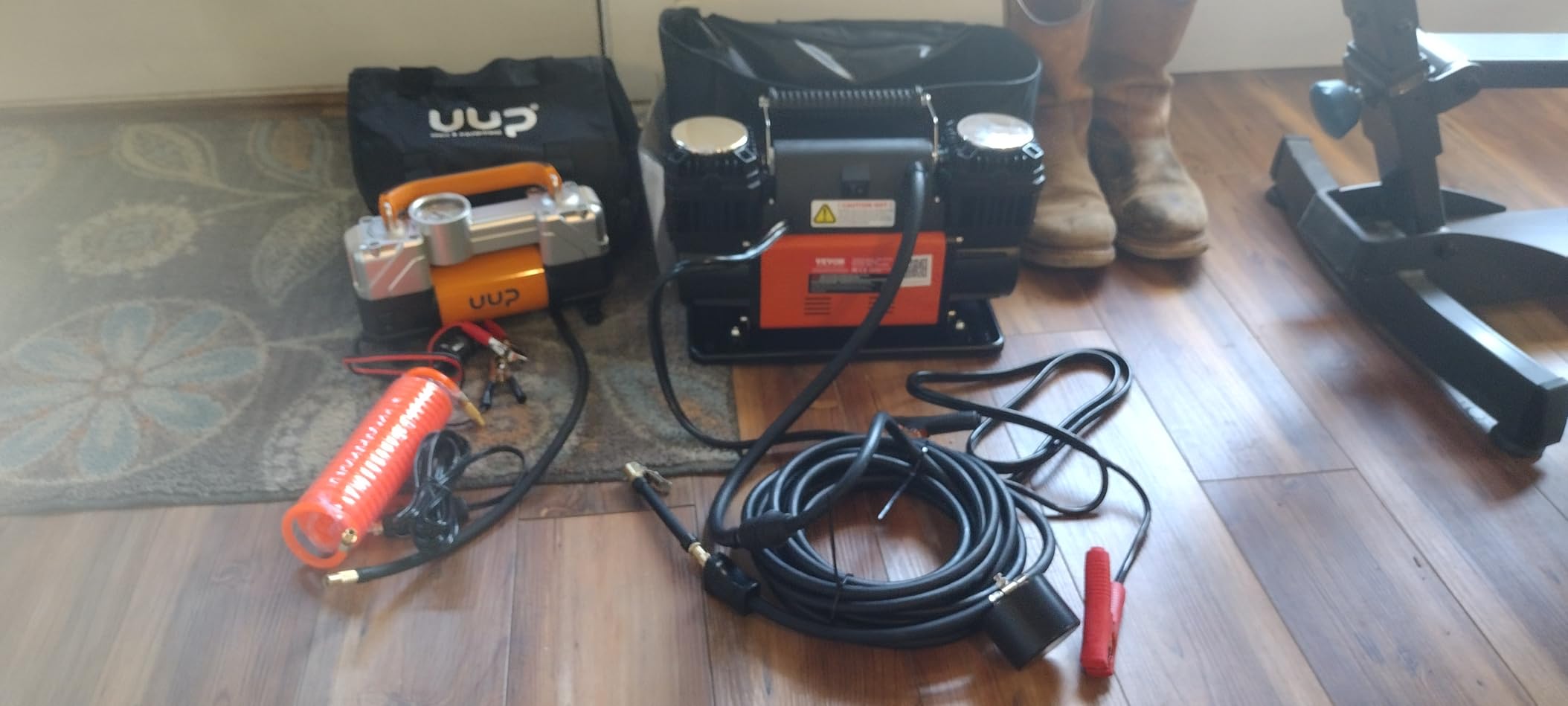
Measured at 14.37 by 5.91 by 8.94 inches, the body is long and wide. It ships with a 26 foot rubber hose carrying a mechanical pressure gauge, a 6.5 foot power cord, three nozzle adapters, a thumb lock adapter and a portable tool bag.
Auto thermal cut-off is built in, so it protects itself during a long fill rather than cooking the motor. Rated noise is 90 dB, which is genuinely loud and worth thinking about at a quiet camp.

75 Amps Is the Whole Story
The maximum current rating is 75 amps. That is the highest draw of any unit here by a wide margin, and it dictates everything about how you use it. Heavy gauge wiring, a solid battery connection and an engine that is running hard enough to keep up.
On a dual battery system or a secondary circuit this is manageable. On a small start battery with an idling engine, the voltage drop is the most likely reason a big compressor like this quits mid-tire. Check the connection before every long fill, not just the first one.
Weight, Noise and Trail Realities
At 25.4 pounds this is the heaviest unit in the roundup, and you feel it when you are carrying it from the passenger seat to the far side of a 37 tire in the dark. Plan where it lives before the trip, not during it.
The mechanical hose gauge is the other compromise. It is readable in direct sun, which a backlit screen is not, but it is not precise. Verify pressures with a separate gauge before you set off on pavement.
8. AstroAI T3 – Best for Night Work and Small Spare Tires
- Automatic LED work light switches on when the unit is powered
- 25 minute continuous runtime is longer than most portable 12V pumps
- 16.1 foot hose gives better reach than most pumps in the class
- Selectable kPa and PSI and BAR and KG/cm2 units
- 120 PSI ceiling is the lowest here
- 1.97 CFM is noticeably slower than dual cylinder units
- Requires a 10 minute rest after a 25 minute run
- Smallest review base in the roundup at 126 ratings
The AstroAI T3 is the small unit for the jobs nobody needs a big pump for. The spare tire, the air mattress, the inflatable, the pool toy, and the tire on a 33 inch rig that just needs a few PSI back.
At 6.67 pounds it is the second-lightest thing on this page, and the LED work light that switches on automatically with the power is genuinely useful. A dark trailhead with a glowing gauge and a lit chuck is a better experience than a phone flashlight balanced on the bumper.
The 120 PSI Ceiling and What It Rules Out
The 120 PSI maximum is the lowest in this roundup, and it is the reason this one cannot be a primary off-road compressor. Truck and RV tires at 80 PSI and motorhome tires at 110 to 135 PSI are simply out of reach for it.
Flow is 1.97 CFM, so it is the slowest of the portable units here too. On a 33 inch tire the rated figures are a 275/60R20 from 40 to 45 PSI in 38 seconds, and 36 to 45 PSI in about 1.25 minutes. Those are manufacturer figures, and real loaded flow on an off-road tire will be slower.
Runtime, Cool-Down and Mounting
Continuous runtime is 25 minutes with a recommended 10 minute cool-down. That is a long session for a unit this size, and it is a much better duty cycle in practice than the 33% figure implies, because the rating covers a single tire rather than a four-tire job.
The motor uses pure copper windings with ferrite, rated by the manufacturer at 30% longer service life than a standard motor. Hose is 4.9 meters, or 16.1 feet, with a 2.5 meter power cord and alligator clips. It comes with two nozzles, a Presta-to-Schrader adapter and a storage bag.
How to Match a Portable Air Compressor to Your Tires
Most buyers pick on max PSI, and PSI is the least useful number on the box. A 150 PSI rating on a 33 inch off-road tire is headroom you will never touch. Airflow, duty cycle and reach are what decide whether you are standing there for four minutes or forty.
For a wider look at how these units behave outside of a trail setting, our roundups on the best portable air compressors for tires and the most reliable air compressors cover the general buying case.
1. CFM is the number that matters, and free flow overstates it
CFM is cubic feet per minute, and it is the number to compare between compressors. The catch is that brands almost always quote free air flow, measured at zero pressure. Real flow at 30 PSI is lower, sometimes considerably so, because the pump is working against back pressure.
Rough guidance from what owners actually report: 3 to 4 CFM for 31 and 33 inch tires, 5 to 7 CFM for 35s, and 7 CFM or more for 37s and 40s. Above that you are in on-board territory.
2. Duty cycle tells you when to expect a pause
Duty cycle is the percentage of time the motor can run before it needs to cool. Most portable 12V compressors are rated at 33%, which means it can run for about 20 minutes and then rest for as long again.
A long run time with a low duty cycle is a trap. Read the two numbers together. If a product claims 45 minutes of run time with no duty cycle figure, assume it needs a long cool-down partway through the third tire.
3. Match the unit to your tire size, not the other way around
Tire size sets the ceiling. A compressor sized for tires up to 33 inches will do that job well and will frustrate you on 35s. If you have 37s or 40s, single-cylinder portables are the wrong category entirely.
Somewhere between four and eight CFM covers most people. Above that, look at a dual-cylinder unit or a compressor with a tank, and accept the weight.
4. Power source decides where you can put the unit
Battery clamps pull the most current and reach the whole vehicle. A 12 volt socket is convenient but limited, and anything drawing more than about 120 watts through a factory accessory circuit risks damage to the vehicle electrical system.
Cordless 20V units are for cars, motorcycles and inflatables. Owners are consistent that they are not fast enough for off-road tires, whatever the headline PSI number on the box says.
5. Hose and cord length decide how much you move it
Twenty-five feet of hose is the practical minimum on a full-size truck. Sixty feet of reach is what you want on a dually or a fifth wheel. A short power cord with a long hose still forces you to sit the unit near the battery.
Coiled hoses are worth it on a long vehicle, because a straight hose kinks and a kink costs you a fill.
6. Gauge type is a real accuracy difference
Analog gauges are generally trusted more by owners and are easier to read in direct sun. Digital displays are better at night and give you more precise figures, but cheap units in both formats are frequently off by enough to matter.
Either way, confirm final pressures with a known-good gauge before you get back on pavement.
7. Air lockers change the calculation entirely
A portable unit cannot keep up with lockers cycling on technical terrain. If you run locking differentials and need pressure to engage a diff mid-climb, the answer is an on-board system with a tank, not a faster portable.
8. Airing up a group takes one compressor per vehicle
Five rigs with 35s need five compressors to get back on pavement before dark, not one and a long evening. This is the single most common planning mistake in group trips.
9. Cold, altitude and water all cut into output
Battery voltage drops in cold weather, and a compressor that runs happily in September can stall at 10 PSI on a freezing dawn. High altitude reduces the oxygen a small engine has to work with, and fill times lengthen.
After a fording or a washout, dry the unit fully before closing it up, keep the air hose off the ground and store it somewhere the seals are not sitting in water. Water and dust ingress is the most common reason inexpensive compressors die.
Frequently Asked Questions
What CFM air compressor do I need?
Plan on 3 to 4 CFM for 31 and 33 inch tires, 5 to 7 CFM for 35s, and 7 CFM or more for 37s and 40 inch tires. Compare loaded flow rather than the free air figure brands print on the box, because free flow is measured at zero pressure and overstates what you get at 30 PSI. Above roughly 8 CFM, a dual-cylinder unit or a compressor with a tank is the practical answer.
Are VIAIR air compressors good for off-roading?
VIAIR is the most frequently recommended brand in off-road owner communities, mostly for longevity rather than raw speed. The 300P, 400P and 450P-RV all hold 4.7 or better across more than a thousand reviews each. The common complaint is speed on 35 inch tires and larger, where a 2.30 CFM portable is slow and a dual-cylinder unit is faster.
Which VIAIR compressor is best for off-roading?
The 400P is the best all-round choice, rated for tires up to 35 inches at 2.30 CFM with a 25 foot hose. The 300P covers the same airflow for tires up to 33 inches in a lighter body. The 450P-RV is the pick for tires needing high pressure, since it runs at 100 percent duty cycle and handles Class A motorhome tires up to 42 inches.
How do I choose between battery clamps and a 12V socket?
Battery clamps pull more current and let you reach every tire from one connection, which is what most off-road tires need. A 12V socket is more convenient but usually limited, and a draw above about 120 watts through an accessory circuit can damage the vehicle electrical system. Keep the engine running on either, and use heavy gauge cable with clamps.
Will a portable compressor drain my vehicle battery?
It can, but only if you let it. Every unit here runs off 12 volt DC and draws between 20 and 75 amps, so keep the engine running during a fill, connect directly to the battery with proper clamps, and avoid running a high-draw unit alongside a winch on the same circuit. A dual battery setup gives you margin on long fills.
Do I need a separate tire deflator?
Most owners treat air-down capability as a requirement, not a bonus. Several units here, including the VIAIR 300P and 400P, ship with a 5-in-1 hose that inflates and deflates from the same fitting. If your compressor is inflate-only, budget for a separate deflator and use the chalk-line technique so you return to the same pressure every time.
Which Portable Air Compressor Should You Buy?
The VIAIR 400P is our pick for the best portable air compressor for off-roading, because it handles 35 inch tires with a complete kit, a 4.8 star rating and a 10.7 pound weight that you can still lift one-handed. Add a second unit like the GSPSCN 202 for spares and gear, and you have covered everything a trail day can throw at you.
Move up to the ALL-TOP or VEVOR if you are on 37s and want the fill over in minutes rather than half an hour. Move up to the ARB twin if you run air lockers, because no portable keeps up with a diff engaging on technical terrain. And the 450P-RV is the answer for high-pressure RV and dually tires, where 100% duty cycle matters more than airflow.
Tell us your tire size, how many vehicles you air up at once and what you are working with, and we will point you at the right tier. Our 2026 picks reflect everything currently on the market.