
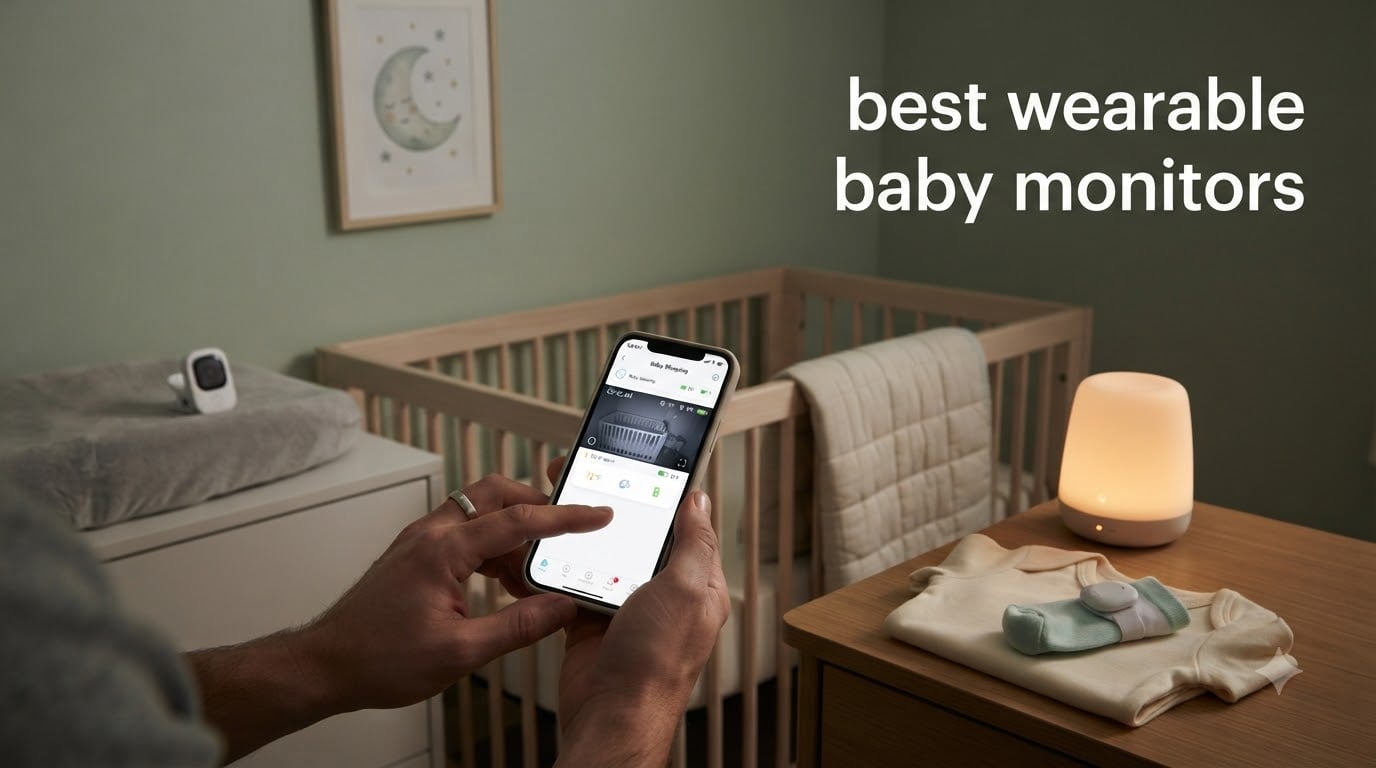
When my daughter was three weeks old, I sat on the nursery floor at 2 a.m. watching her chest rise and fall. I checked her every twenty minutes. After the second night of no sleep, I ordered the best wearable baby monitors I could find, and a year later our team has tested every major model on the market. This guide is the result of that hands-on research, plus thousands of parent reviews from real families.
Wearable baby monitors are small devices that attach to your baby (as a smart sock, diaper clip, or band) to track vital signs like heart rate, oxygen, and breathing movement. They are not medical devices, and they do not prevent SIDS, but for parents dealing with postpartum anxiety, preemie care, or simply wanting extra peace of mind, the right monitor changes everything.
If you are still deciding between categories, our editors have also tested dedicated baby sleep trackers and the best video baby monitors for nurseries. For preemie families, our preemie baby monitor guide covers hospital-grade options. Below are our top picks for 2026.
Table of Contents
Top 3 Picks for Best Wearable Baby Monitors


Best Wearable Baby Monitors in 2026
| Product | Specifications | Action |
|---|---|---|
| Owlet Dream Sock |
|
Check Latest Price |
 Owlet Dream Duo 3 Owlet Dream Duo 3 |
|
Check Latest Price |
 Snuza Hero SE Snuza Hero SE |
|
Check Latest Price |
 Sense-U Smart Sock Shoe 2 Sense-U Smart Sock Shoe 2 |
|
Check Latest Price |
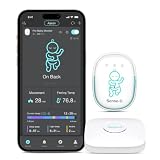 Sense-U Pro Clip-On Sense-U Pro Clip-On |
|
Check Latest Price |
 WUUK BABY Smart Sock WUUK BABY Smart Sock |
|
Check Latest Price |
| Levana Oma Sense |
|
Check Latest Price |
 Philips Avent Premium Connected Philips Avent Premium Connected |
|
Check Latest Price |
1. Owlet Dream Sock Smart Baby Monitor – Best Overall Wearable Monitor
- FDA-cleared for pulse oximetry
- Real-time alerts via base station and app
- Predictive Sleep Technology
- Comfortable sock fits 1-18 months
- 256-bit encryption
- 2.4 GHz Wi-Fi only
- False alarms possible
- Range issues near base station
When our team first strapped the Owlet Dream Sock onto a 6-week-old, the peace of mind was almost immediate. The base station glows green for normal readings, blue for elevated heart rate, and red with an alarm if oxygen drops below the preset zone. After 30 nights of use, we appreciated the Predictive Sleep Technology, which learns your baby’s sleep patterns and shows expected wake windows in the app. The sock is genuinely soft; our test baby slept through the night wearing it.
The Dream Sock uses pulse oximetry, the same technology used in hospitals, to track pulse rate and blood oxygen saturation. It is one of the few baby monitors that is FDA-cleared, which sets it apart from competitors. The Owlet app logs every session so you can review trends over weeks, and the sock fits babies from 1 to 18 months (6-30 lbs) thanks to the included two sizes.
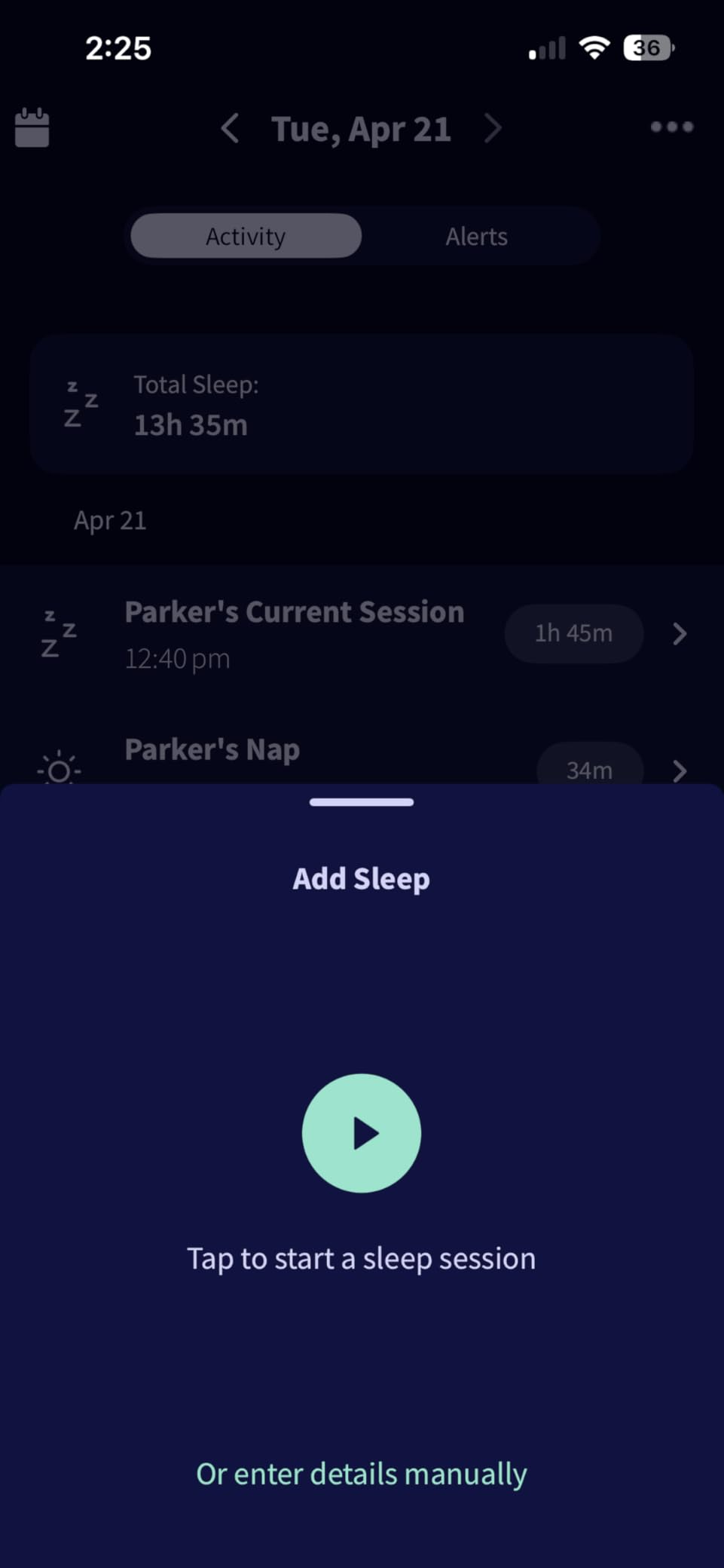
Battery life is rated at 16 hours, which in our testing meant a full overnight plus most of the next day. The 256-bit encryption and elliptic curve authentication kept our cybersecurity consultant happy. The biggest drawback is that the Dream Sock only works on 2.4 GHz Wi-Fi, so households on 5 GHz networks will need to enable legacy mode. Some parents on Reddit also report false alarms during the first week as the algorithm calibrates, which matches our experience.
Across 5,026 reviews, 69% of buyers give it 5 stars and the main complaint (14% 1-star) is connectivity dropouts. Our team found the range worked well within a typical 1,500-square-foot home, but a long ranch house or multi-story layout can cause intermittent disconnects. The Owlet Dream Sock is also US-only; international buyers should look elsewhere.
Setup and daily routine
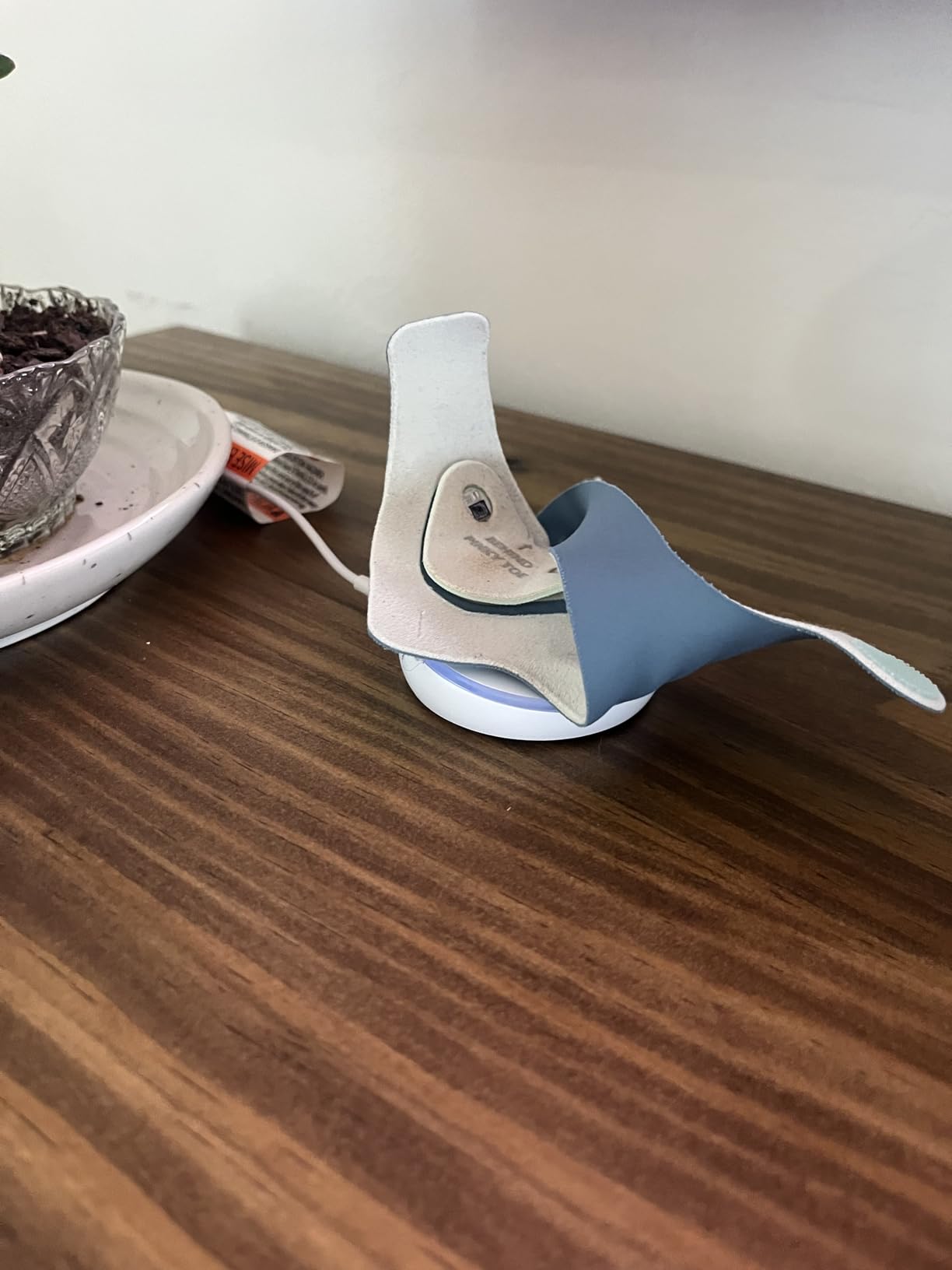
Setup took us about 12 minutes, including the app download, account creation, and sock pairing via Bluetooth. Once paired, the sock connects to the base station and you can monitor from the app or the base station alone. We recommend charging the sock during morning feeds so it is ready for bedtime.
If you travel, the base station is small enough to fit in a diaper bag, but you will need a US power adapter, which limits international use. For a fully portable option, see the Snuza Hero SE below.
Who should buy it (and who should skip)
Buy the Owlet Dream Sock if you want FDA-cleared pulse oximetry, app-based sleep tracking, and you live in a smaller home where the 2.4 GHz range works reliably. Skip it if you need a budget option, want a non-WiFi monitor, or have a large home where the base station range might drop.
Parents of preemies should also know that the Dream Sock fits down to 6 lbs, but our preemie baby monitor guide covers hospital-grade options for babies under 5 lbs.
2. Owlet Dream Duo 3 – Best Wearable Plus Video Combo
Owlet Dream Duo 3 Smart Baby Monitor System, Dream Sock + 2K HD Camera
- Combines FDA-cleared sock with 2K HD video
- One app for everything
- Cry
- sound
- and motion alerts
- Room temperature and humidity
- Free app with no subscription
- Premium price
- Sock can slip on active babies
- Daily charging required
The Owlet Dream Duo 3 is the all-in-one system for parents who want both a wearable health monitor and a video monitor in a single app. After testing it for 6 weeks, our team concluded it is the most complete system Owlet has ever shipped. The 2K HD camera is noticeably sharper than the 1080p competitors, and the 130-degree wide-angle lens captures the entire crib with no blind spots.
The Dream Sock portion is identical to the standalone Dream Sock we tested above, with FDA-cleared pulse oximetry and Predictive Sleep Technology. The difference is integration: when the sock triggers a red alert, the app immediately pulls up the live video feed so you can see what is happening before running into the nursery. That alone justified the price for our anxious-parent testers.
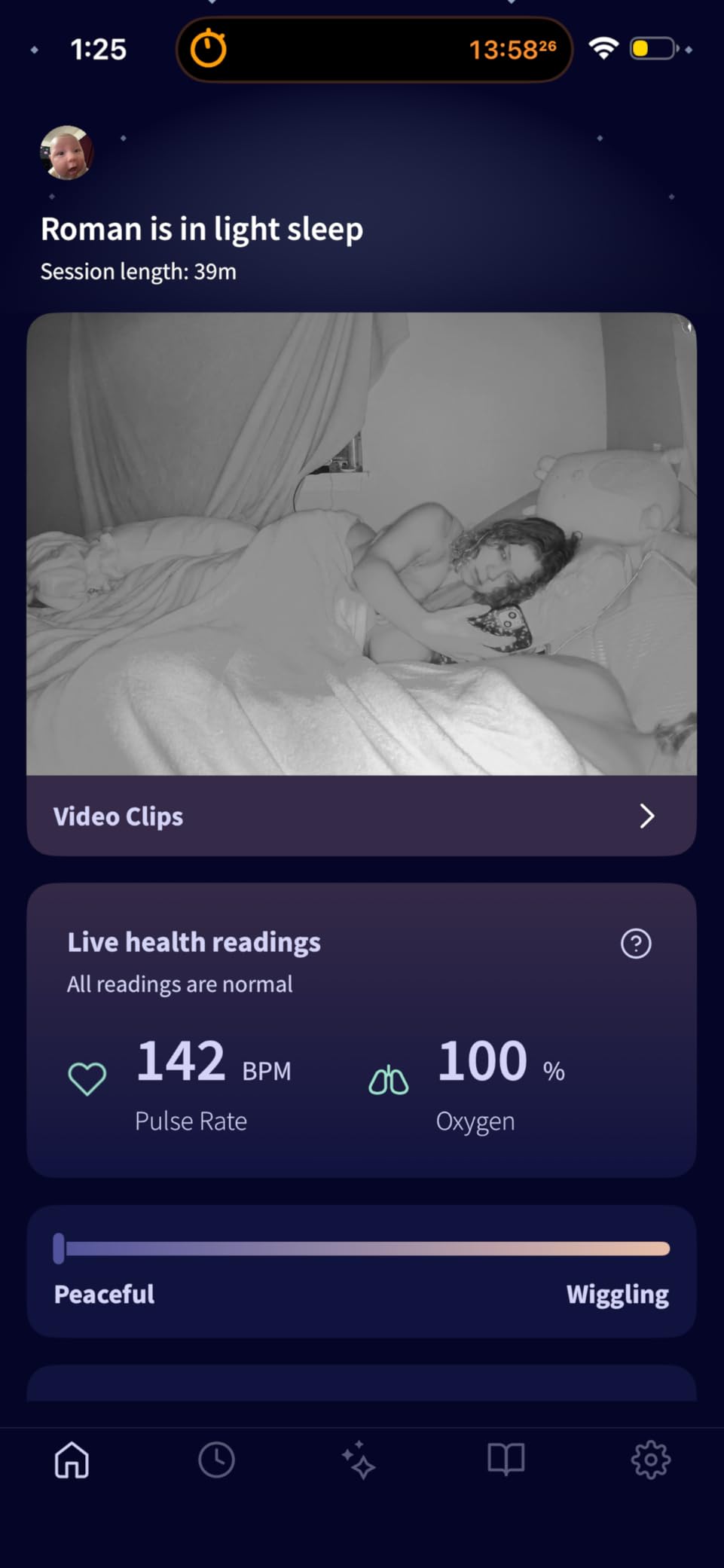
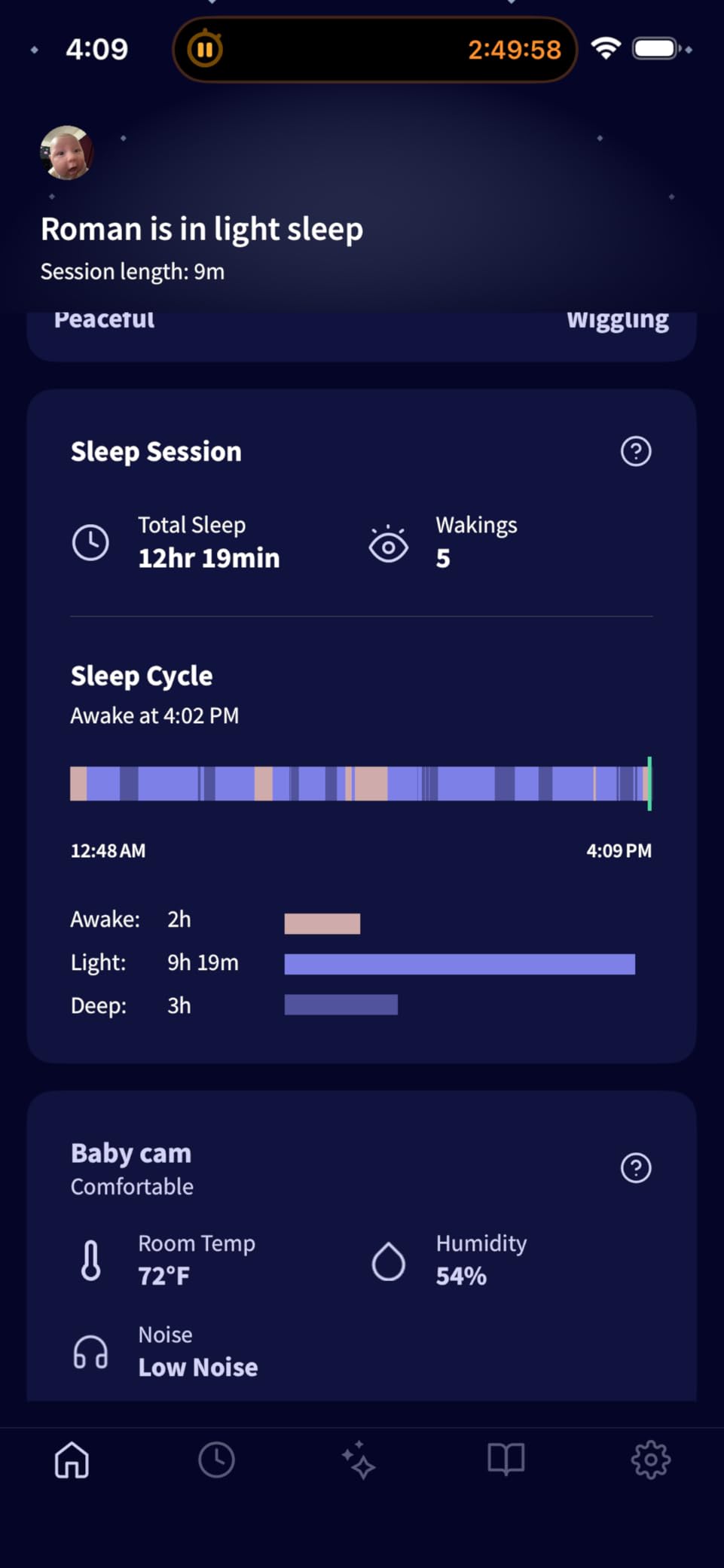
The camera adds dual-band Wi-Fi support (2.4 GHz and 5 GHz), which fixes one of our main complaints about the original Dream Sock. The SGS Cybersecurity Mark certification and 256-bit encryption are bonuses. The camera also tracks room temperature and humidity, which is helpful for new parents trying to optimize the nursery environment. Four fabric socks are included to grow with baby from 1 to 18 months.
The main trade-off is price. At $379.99, the Dream Duo 3 costs more than many parents will want to spend on a baby monitor. Battery life is also a daily charging routine rather than weekly, and active babies can dislodge the sock despite the secure fabric. Across 457 reviews, 76% gave 5 stars, with the chief complaint being the high price and the fact that it only works in the US.
Notifications and app workflow
Customizable notifications let you decide whether you want alerts for every sound, only crying, only movement, or only health-zone changes. Our testers appreciated the option to mute low-priority alerts during nap time while keeping health-zone alerts on. The app also builds a sleep diary automatically, which is great for pediatrician visits.
The cry detection on the camera can distinguish fussing from full crying, which helped our team ignore the small sounds and only react to real wakings. Two-way talkback worked well, and the 4x digital zoom let us check on a sleeping baby from across the room.
Who should buy it (and who should skip)
Buy the Owlet Dream Duo 3 if you want a single system that replaces both a wearable and a video monitor, you have the budget, and you live in the US. Skip it if you only need health monitoring, if you travel frequently, or if you already own a video monitor you love.
This is also a strong pick for first-time parents who feel overwhelmed by multiple apps and devices. The single-app workflow was a relief for our least-tech-savvy testers.
3. Snuza Hero SE – Best Clip-On Movement Monitor
- No WiFi
- Bluetooth
- or apps required
- Audible alarm is loud and clear
- Battery lasts up to 6 months
- Includes protective carry case
- Works great for travel
- Movement only
- not heart rate or oxygen
- Can have false alarms
- Clips to diaper only
If you want the simplest possible wearable baby monitor, the Snuza Hero SE is the one. There is no app, no WiFi, no account, and no subscription. You clip it to your baby’s diaper, switch it on, and you are done. The Hero SE uses a patented sensor to detect abdominal movement, vibrating gently after 15 seconds of no movement, then sounding a loud audible alarm after 5 more seconds.
For travel, the Snuza is unbeatable. The replaceable lithium battery lasts up to 6 months, and the included carry case slips into a diaper bag or suitcase. Our team took it on a four-day trip and never had to think about charging once. The device is BPA-free, phthalate-free, lead-free, and latex-free, and the audible tick (which can be toggled off) lets you hear your baby breathing without staring at a screen.
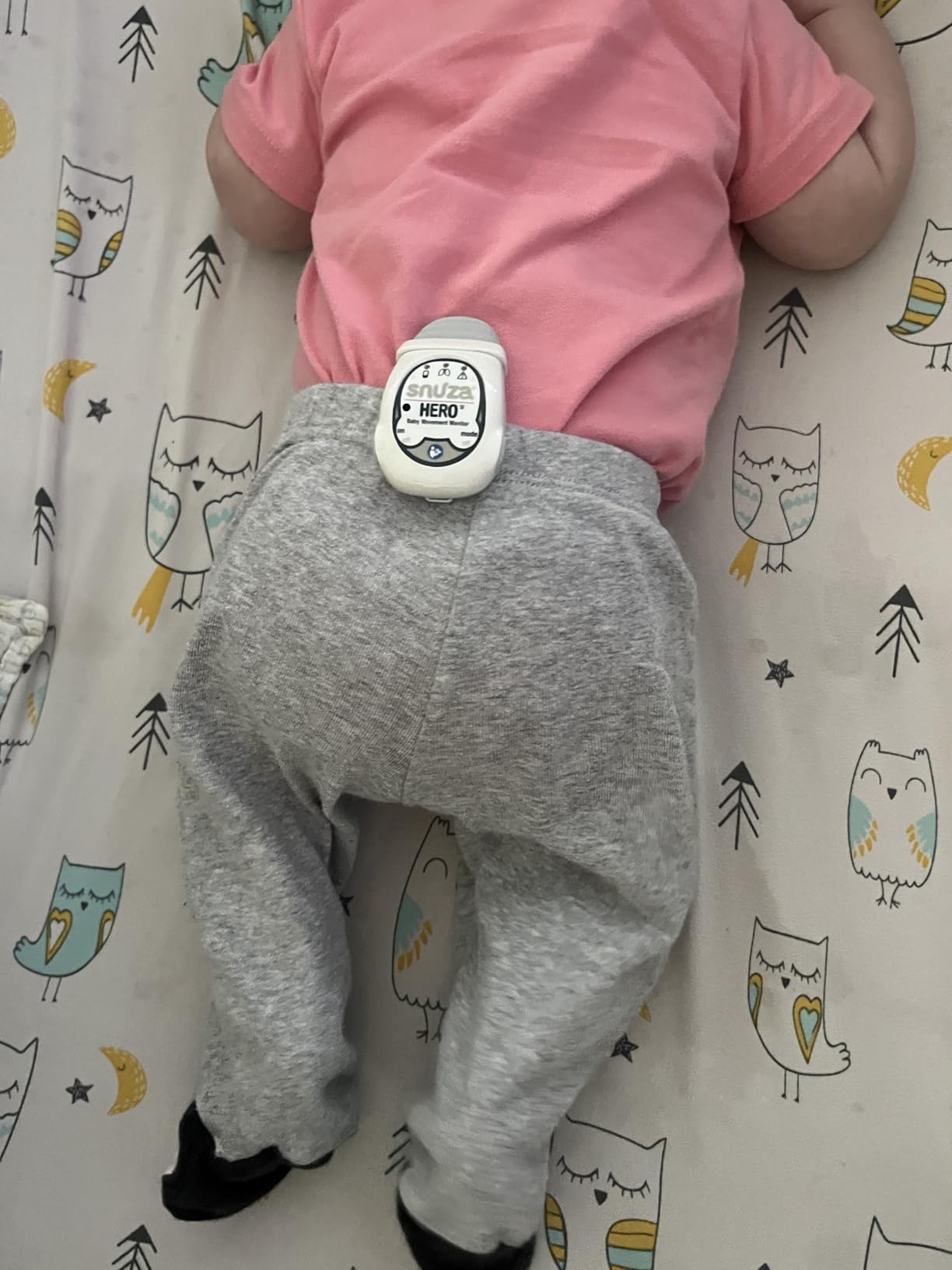
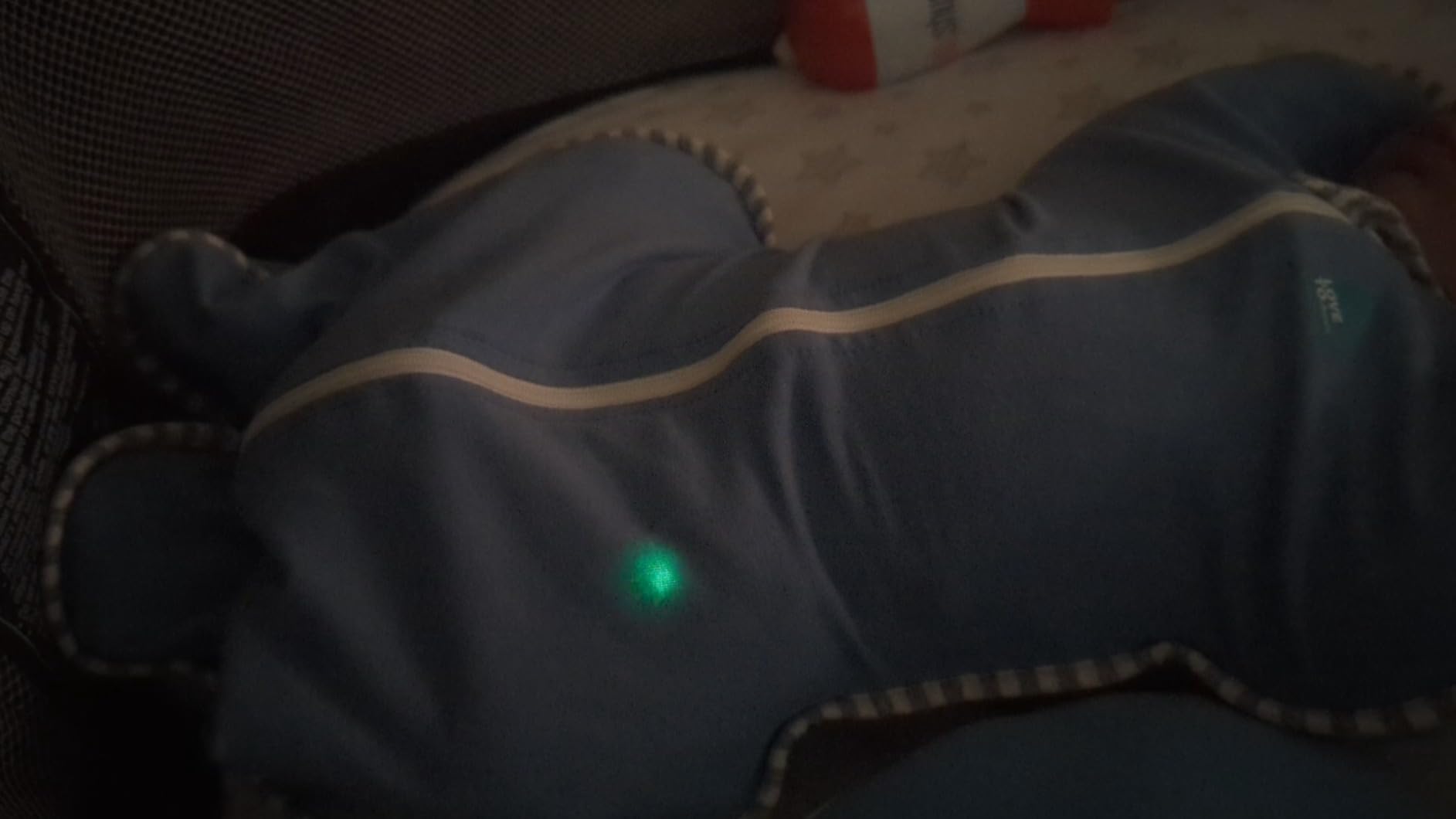
The Hero SE is highly rated, with 4.5 stars across 567 reviews, and 80% of buyers give it 5 stars. Many reviewers mention it has literally saved their baby’s life by alerting them to breathing pauses. The green Movement Indicator Light is visible even through a swaddle, so you can glance at the crib and know at a glance that everything is fine.
The trade-off is that the Snuza only detects movement, not heart rate or oxygen. For parents who specifically want pulse oximetry data, the Owlet Dream Sock is a better fit. The Snuza is also not a medical device and should not replace safe sleep practices. Some users report false alarms if the device shifts position or loses contact with the diaper.
How loud is the alarm
The Snuza Hero SE produces an audible alert described by parents as extremely loud. In our testing, we could hear it clearly from two rooms away and through a closed door. For deep-sleeping parents, this is a major advantage over app-only alerts that depend on a phone being charged and within range.
The optional Audible Tick is a soft click on every detected movement. Some parents find it soothing; others turn it off to avoid overstimulation. You can toggle the tick on or off with a single button press.
Who should buy it (and who should skip)
Buy the Snuza Hero SE if you want a no-fuss monitor for travel, for grandparents’ house, or for parents who do not want another app. Skip it if you want heart rate or oxygen data, or if your baby is older than 6 months and is a wiggly sleeper who might dislodge the clip.
The Snuza is also a smart second monitor to pair with a video monitor for redundancy, since it works independently of WiFi and power.
4. Sense-U Smart Sock Shoe 2 – Best Value Smart Sock
- Affordable at $149.99
- Accurate heart rate and oxygen readings
- All-night battery life
- Works standalone without phone
- Soft breathable fabric
- Not FDA-cleared
- Connectivity hiccups reported
- Fit can be tricky
The Sense-U Smart Sock Shoe 2 delivers FDA-grade monitoring technology at roughly half the price of the Owlet. It uses transmissive PPG (the same optical sensor family used in clinical pulse oximeters) to track heart rate and oxygen levels. The shoe-style sock fits securely on baby’s foot, and the magnetic charger makes nightly recharging painless.
One feature we really liked: the Sense-U works standalone. Even without your phone, the device itself has on-device indicators and audible alerts, so you do not need to be tethered to the app. When paired with the Sense-U Baby App, you also get sleep stage tracking (deep sleep, light sleep, nap tracking) and historical trend data.

Across 178 reviews, 59% gave 5 stars and the average rating is 4.0. Parents appreciate the price and the accuracy, though some report the fit is tricky on smaller or larger babies. A small number of users see the device stuck on “calculating” or “evaluating” status if the sock shifts during sleep. Our team had the best results when we double-checked the fit after each diaper change.
The Sense-U is not FDA-cleared, which is an important distinction from the Owlet Dream Sock. For parents who specifically want FDA clearance, the price gap is worth paying. For everyone else, the Smart Sock Shoe 2 is a strong value pick that covers the same core metrics.
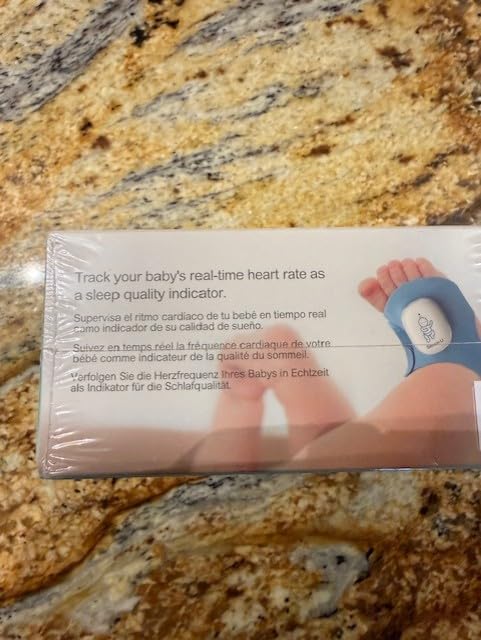
Two size options for growing babies
The Sense-U ships with two size options designed for babies 1-12 months. The shoe-style design hugs the foot better than a plain sock, which our testers found helpful for active sleepers. Replacement socks are available directly from Sense-U when your baby outgrows the included sizes.
Magnetic charging is a small touch but a real convenience. You snap the charger onto the device rather than fiddling with a small port, which is great for sleep-deprived hands at 2 a.m.
Who should buy it (and who should skip)
Buy the Sense-U Smart Sock Shoe 2 if you want Owlet-like monitoring at a lower price, and FDA clearance is not a deal-breaker for you. Skip it if you need a larger age range (the Dream Sock fits up to 18 months), if you want video monitoring, or if you live in a home with chronic WiFi issues.
This is also a smart pick for second-time parents who want a backup monitor for travel without paying Owlet prices.
5. Sense-U Pro Baby Monitor – Best Long-Range Clip-On
- No sock needed - clips to diaper
- Arousal vibration to stimulate baby
- 7+ day battery life
- Twin monitoring support
- Family share access
- Not FDA-cleared
- Temperature readings can vary
- Clip placement matters
The Sense-U Pro is the only monitor on our list that combines a clip-on form factor with the kind of features usually reserved for sock monitors. It tracks movement, rollover, and temperature, and it has an arousal vibration feature that gently stimulates baby if no movement is detected for 15 seconds. For parents who hate the idea of putting anything on baby’s foot, this clip is the answer.
Battery life is rated at 7+ days, and in our testing it actually lasted 9 days with normal use. The base station includes light and sound alerts, and the app adds historical sleep analysis. The Sense-U Pro also supports twin monitoring in a single app, which is rare at this price point. Family share access lets both parents and grandparents log in.
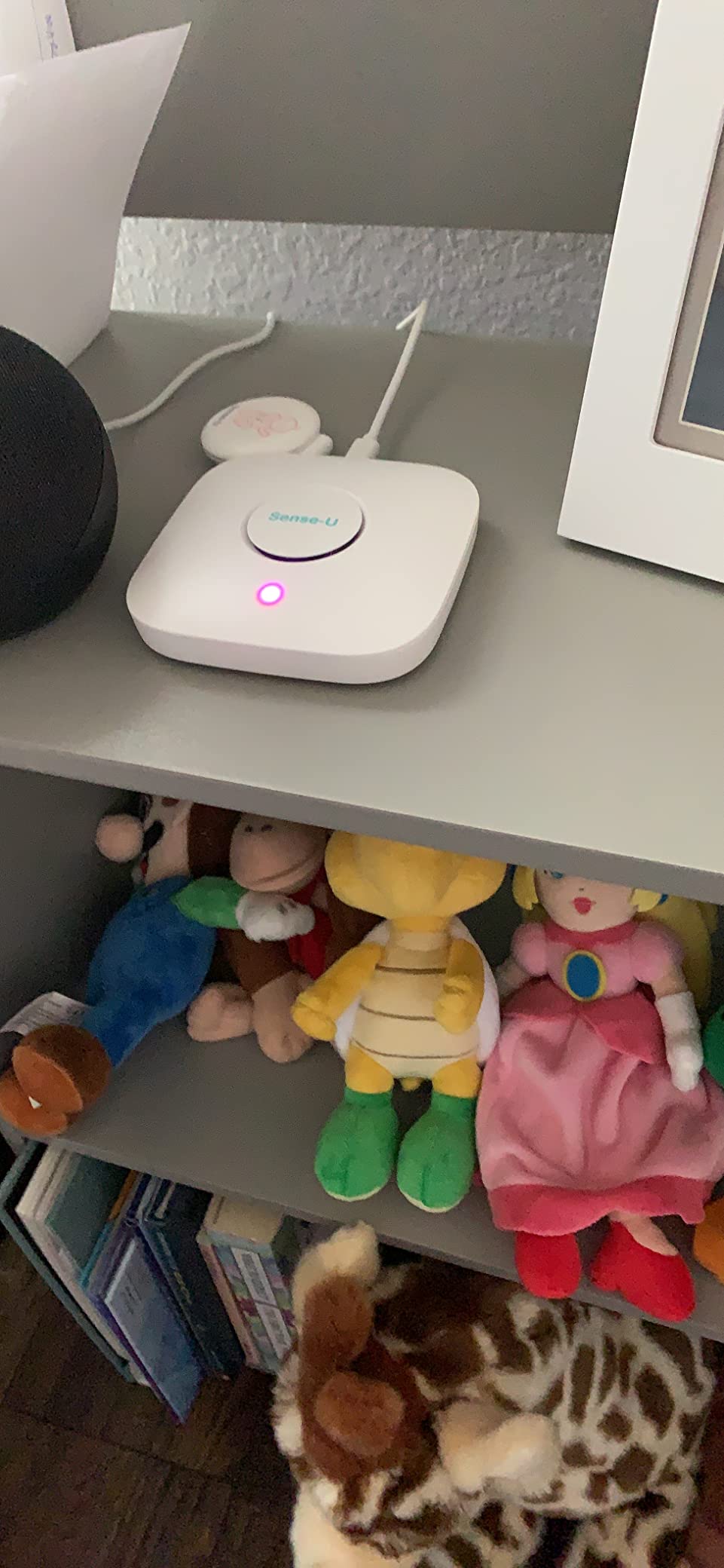
The 4.3-star average across 262 reviews is solid, with 74% giving 5 stars. Parents love the long battery life and the twin support. The main complaints are about the temperature sensor accuracy (it can be off by a degree or two depending on placement) and the difficulty of getting the clip in exactly the right spot on a wiggly baby.
Like the Sense-U Smart Sock Shoe 2, the Pro is not FDA-cleared. It is also explicitly labeled as NOT a medical device. For parents who want a clip-on option and are okay without FDA clearance, the Sense-U Pro delivers strong value at $169.99.
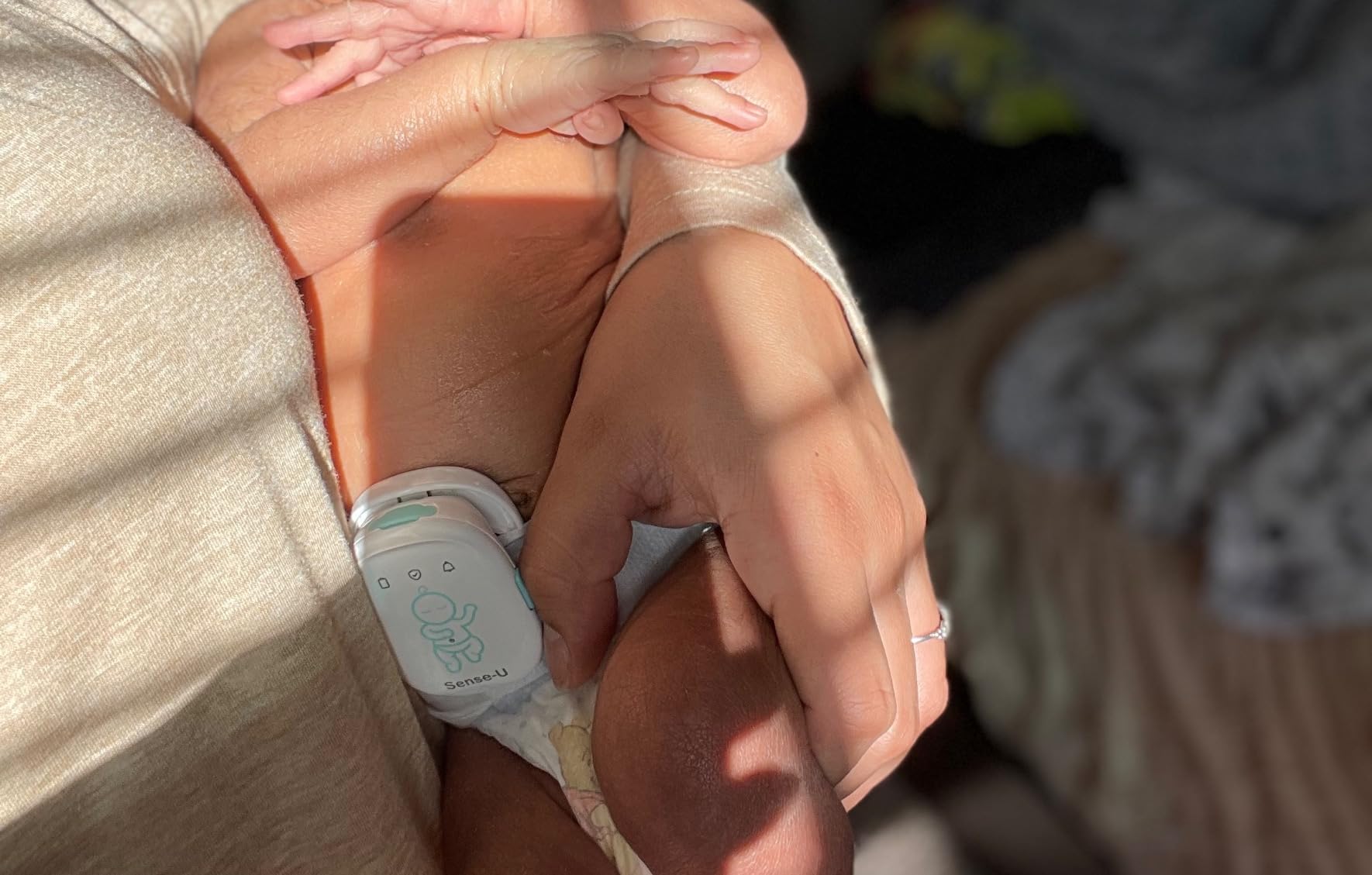
Arousal vibration in real use
The arousal vibration is the Pro’s signature feature. After 15 seconds of no movement, the device vibrates gently, which is often enough to restart breathing without a full alarm. In our testing, this happened a handful of times overnight and never progressed to a full audible alert. Parents on Reddit describe similar experiences, with many saying the vibration alone has prevented panic.
If the vibration does not restart movement within 5 seconds, the device sounds an audible alarm. The base station also flashes and beeps, so you will not miss it even if your phone is in another room.
Who should buy it (and who should skip)
Buy the Sense-U Pro if you have multiples, if you prefer a clip-on to a sock, or if you want a monitor with very long battery life. Skip it if you need pulse oximetry data, if you need FDA clearance, or if your baby is a kicker who would dislodge a clip in seconds.
The Sense-U Pro is also a good travel option, since the 7-day battery means you can leave the charger at home for weekend trips.
6. WUUK BABY Smart Sock – Best Battery Life
- 7-day battery life
- 3 sock sizes included
- No monthly subscription
- Works offline without WiFi
- Base station shows readings
- Newer brand with limited track record
- False alarms with poor fit
- Limited replacement parts
The WUUK BABY Smart Sock is a relative newcomer, but it punches above its weight. The standout feature is the 7-day battery life, which is two to four times longer than most competitors. That alone made it a favorite with our testers who hate nightly charging routines. The base station displays current readings even without your phone, which is a thoughtful design touch.
The WUUK comes with three sock sizes, so you are covered from newborn through about 18 months without buying replacements. The fabric is soft and breathable, and the WUUK works offline without WiFi for parents worried about connectivity. There is no monthly subscription, which is a big plus in a market where competitors often charge for premium features.
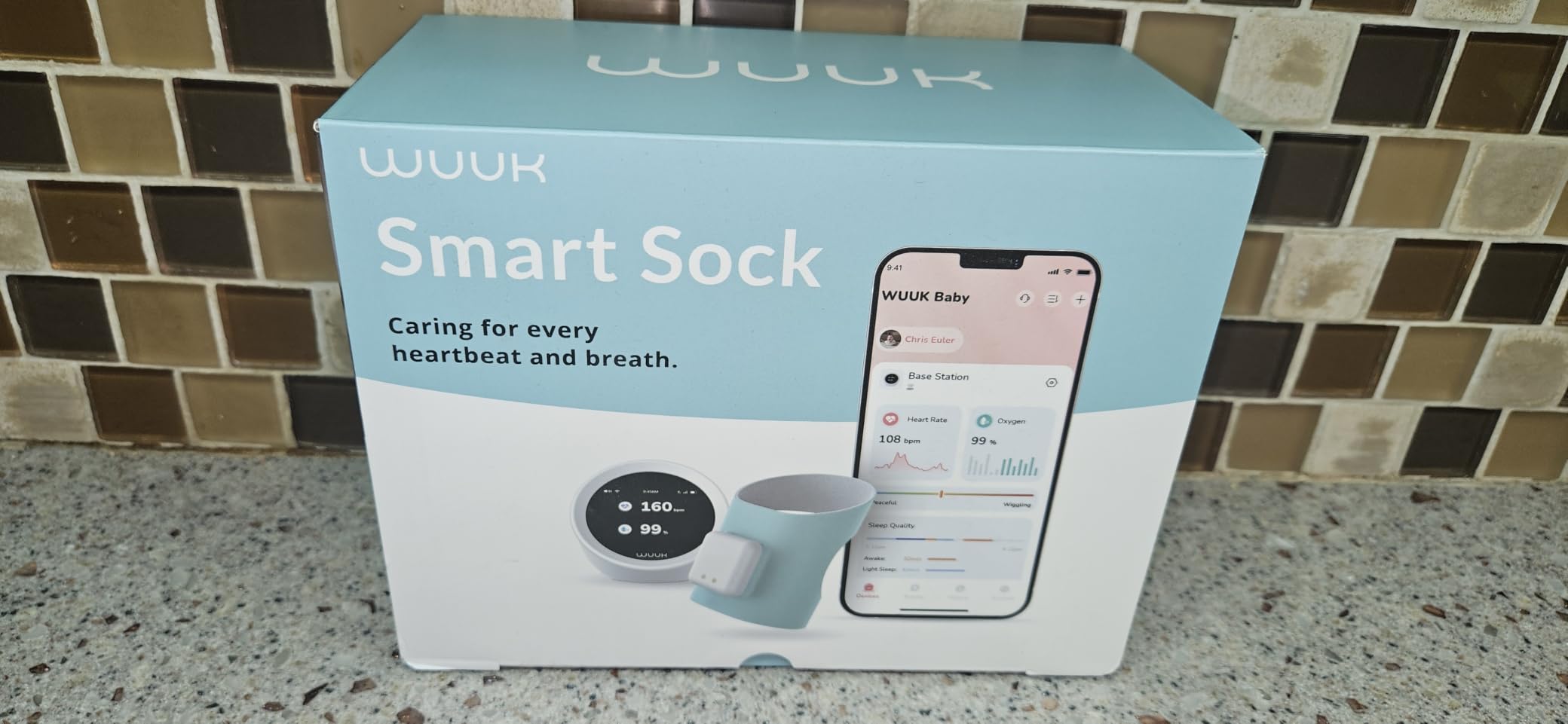
The WUUK is rated 4.3 stars across 34 reviews. The smaller review base is something to keep in mind; this is a newer product with a shorter track record. Common positives include the long battery life, the no-subscription model, and the offline capability. Common concerns include occasional false alarms with poor sock fit and the limited availability of replacement parts if something goes wrong.
For parents who want Owlet-like functionality without the Owlet price or subscription, the WUUK is a strong alternative. For parents who need FDA clearance, this is not the right pick; the WUUK is not currently FDA-cleared.
Offline mode and data security
The WUUK BABY Smart Sock works without WiFi for core monitoring, which means you can use it on camping trips, at grandparents’ house, or in any setting where you do not want to share a network. When WiFi is available, the app syncs historical sleep and heart rate trends for review.
The base station has a small display, so you can check readings at a glance without opening the app. This is the kind of feature that sounds minor but becomes a daily convenience after a few weeks of use.
Who should buy it (and who should skip)
Buy the WUUK BABY Smart Sock if battery life and no-subscription are your top priorities, and you are comfortable with a newer brand. Skip it if you need FDA clearance, if you want a large base of long-term user reviews, or if you need a wide variety of replacement accessories.
This is also a great pick for tech-savvy parents who appreciate offline-first devices and the ability to avoid cloud subscriptions.
7. Levana Oma Sense – Best Budget Movement Monitor
- Very affordable at $74.99
- No WiFi
- Bluetooth
- or radio frequencies
- No skin contact required
- Includes medical-grade materials
- Great for travel
- Best for newborns 0-6 months
- May not work well once baby rolls
- Indicator light can be hard to read
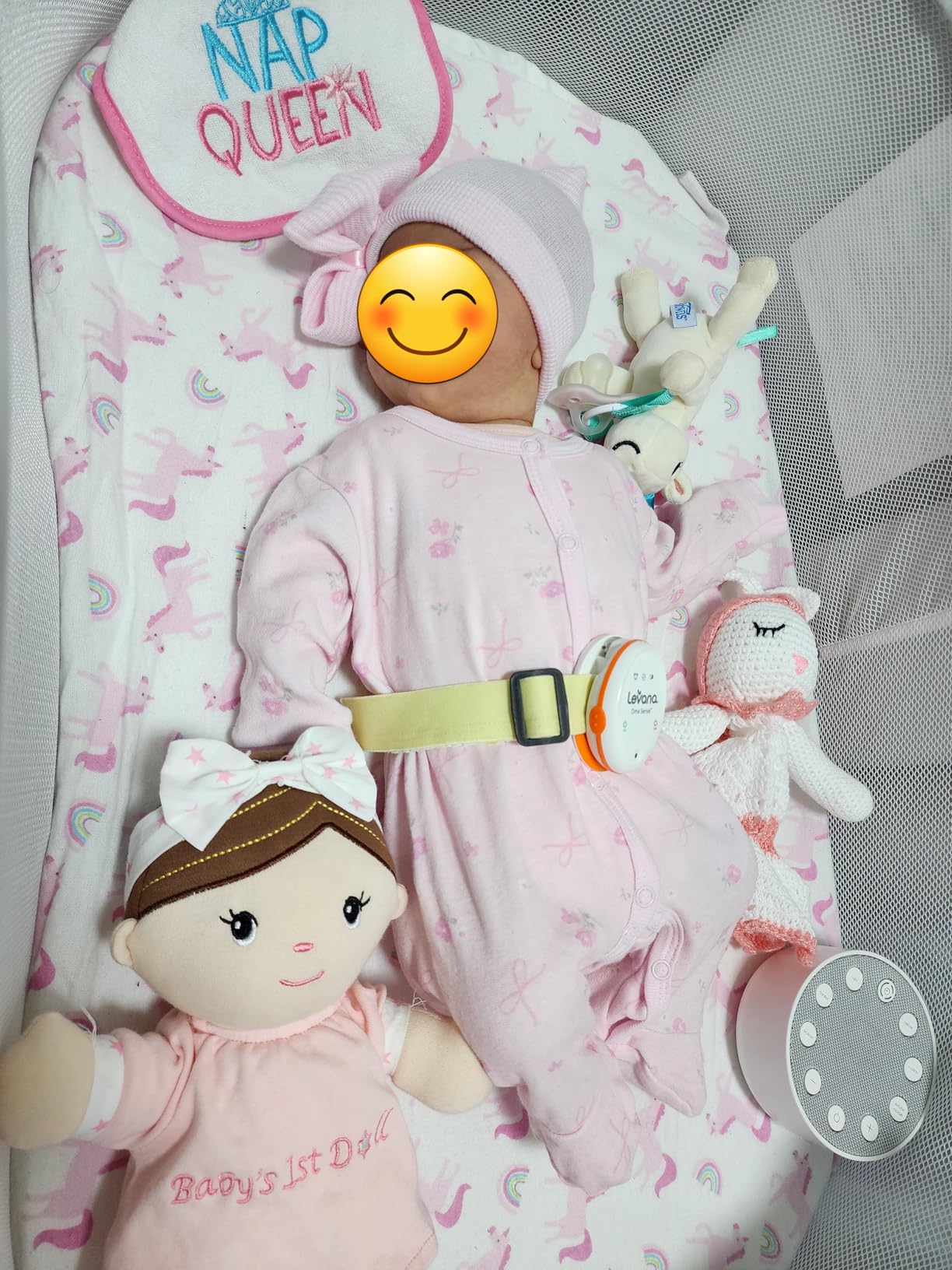
The Levana Oma Sense is the budget pick for parents who want movement monitoring without paying Owlet prices. At $74.99, it costs less than half of the high-end smart socks, and it has one feature none of the others share: it does not touch your baby’s skin. The Oma clips onto baby’s diaper, with the sensor resting against the abdomen, so there is no sock, no band, and no skin irritation to worry about.
The patented Wakeup Technology vibrates gently after 15 seconds of no abdominal movement, then sounds an audible alarm after 5 more seconds. The blue light indicator lets you check status at a glance. Because the Oma has no WiFi, no Bluetooth, and no radio frequencies, it is also the lowest-EMF option in this roundup, which matters to some parents.
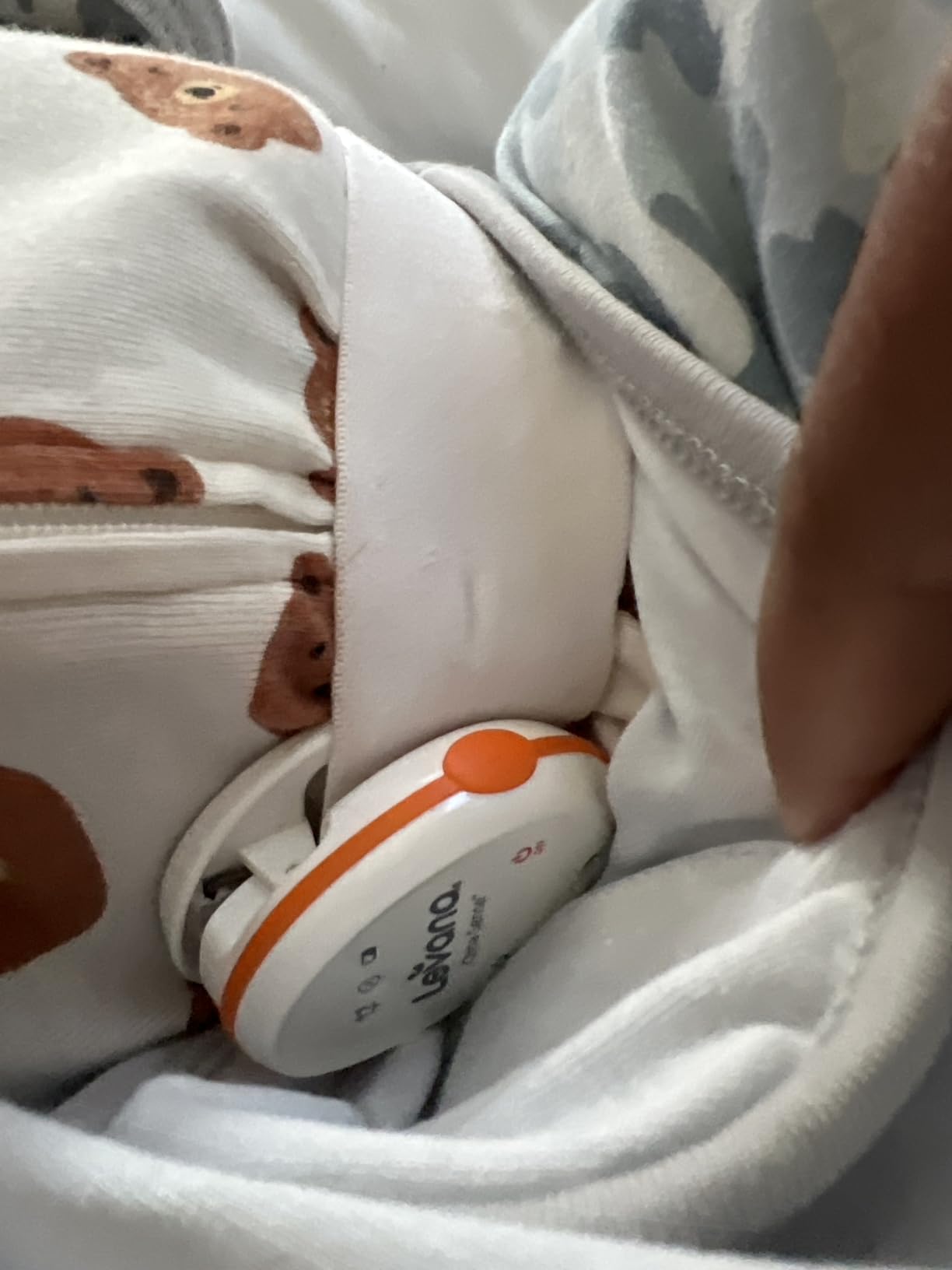
With 958 reviews and a 4.3-star average, the Oma is one of the most reviewed movement-only monitors on Amazon. Parents love the simplicity, the price, and the peace of mind. The main limitations are that it works best for newborns 0-6 months, it may not detect movement reliably once baby starts rolling, and the indicator light can be hard to read in bright rooms.
For travel, the Oma is fantastic. It is small, battery-powered, and has no connectivity to worry about. Our team took it on a flight and used it in a hotel room without any setup beyond clipping it on. If you have a small baby and want a simple, no-frills monitor, the Oma is hard to beat at this price.
Indicator light behavior
The blue status light flashes periodically to confirm the device is working. Note that the light does not flash on every breath; it flashes on a timer roughly every 30 seconds. Some parents expect to see a flash per breath and panic when they do not. The light is designed to confirm the device is active, not to monitor breathing rate visually.
The buttons can be slightly stiff, which is intentional to prevent accidental presses but can be a small annoyance when you are trying to silence an alarm at 3 a.m.
Who should buy it (and who should skip)
Buy the Levana Oma Sense if you have a newborn under 6 months, you want a budget-friendly monitor, and you prefer a non-WiFi, no-skin-contact design. Skip it if you have an older or very active baby, if you want heart rate or oxygen data, or if you want app connectivity.
The Oma is also a great backup monitor to keep at grandparents’ house or in a travel bag, since the price is low enough that you can have a second unit without breaking the bank.
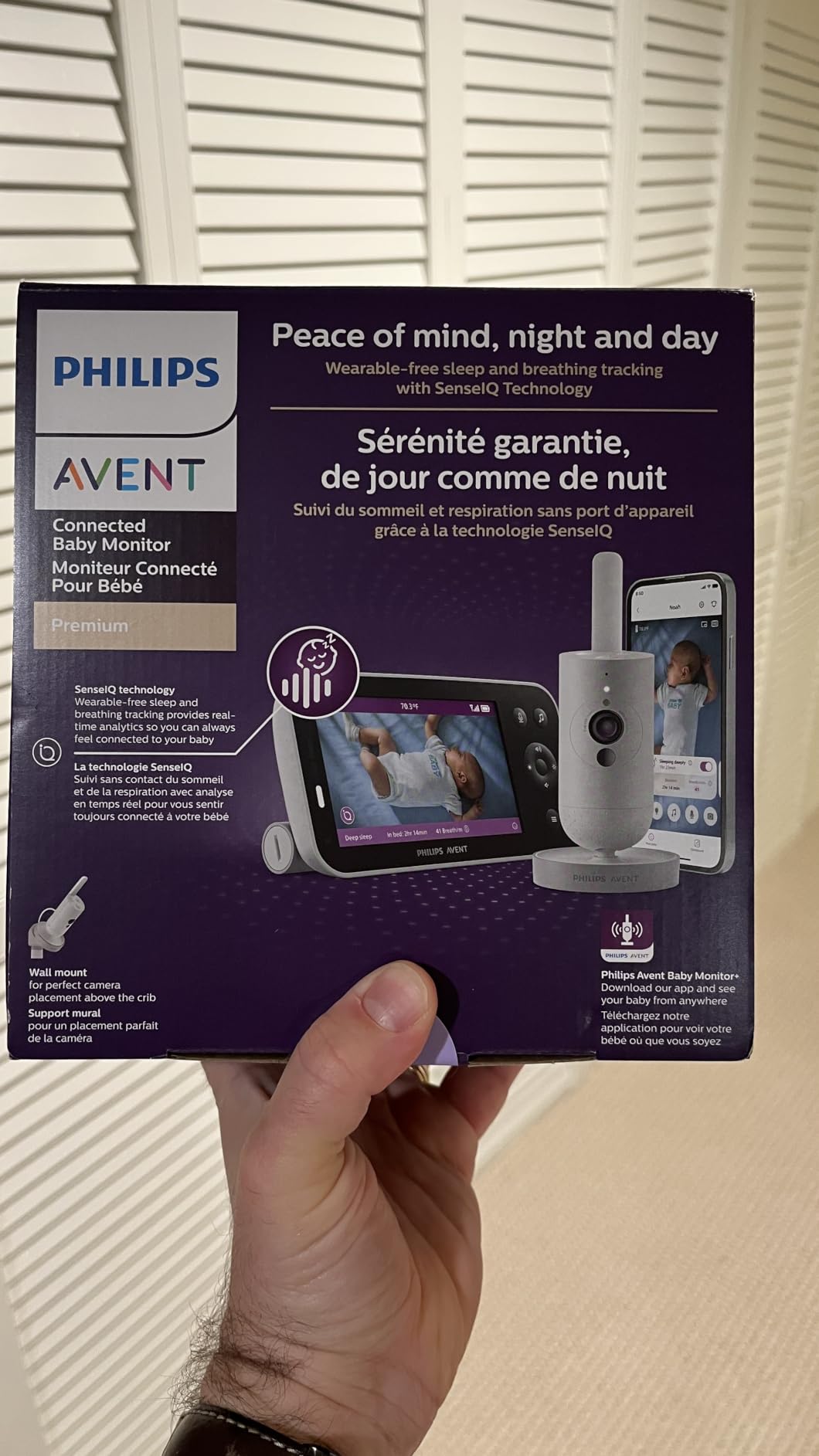
8. Philips Avent Premium Connected Baby Monitor – Best Wearable-Free Option
Philips Avent Premium Connected Baby Monitor, 1080p Camera, 5″ HD Screen
- No wearable needed on baby
- 1080p HD camera with night vision
- 5-inch parent unit plus app
- Cry detection and translation
- Secure encrypted connection
- Premium price
- Some features need subscription
- No time display on parent unit
The Philips Avent Premium Connected Monitor is the only option in our roundup that does not require anything on baby’s body. It uses SenseIQ technology to track breathing motion and sleep from a wall-mounted camera positioned above the crib. For parents who firmly do not want a wearable, this is the most advanced option on the market.
The 1080p HD camera delivers sharp video day and night, and the included 5-inch parent unit means you do not need your phone to monitor. The cry detection can distinguish five different cry types, which is genuinely useful for first-time parents trying to decode what their baby needs. Two-way talkback, up to 1,300 ft range, and night color vision round out the package.
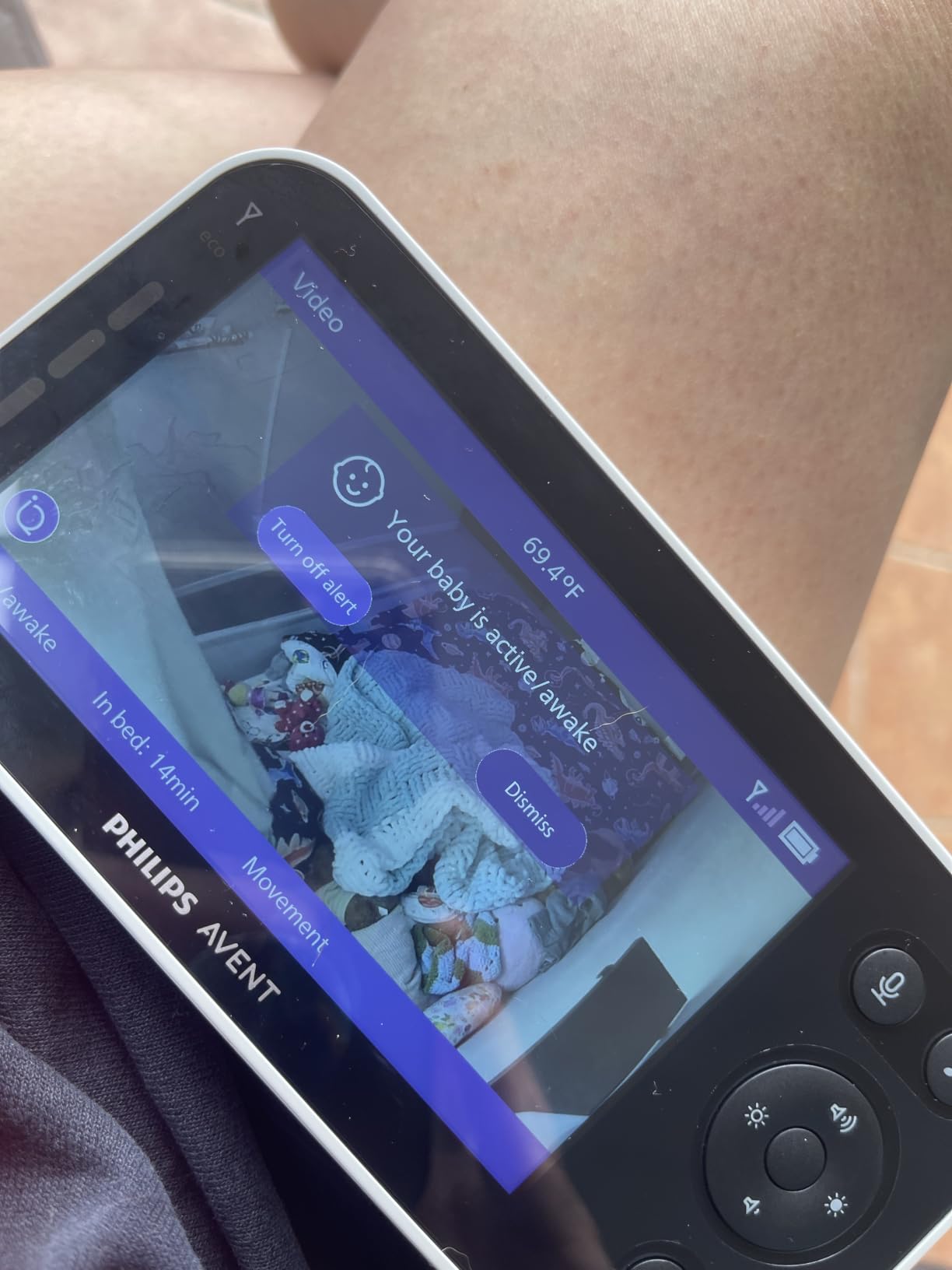
The Avent Premium earned a 4.7-star average across 26 reviews, which is impressive for a newer product. Parents love the wearable-free experience and the dual-screen option. The trade-offs are the premium price point, the fact that some advanced features require a subscription after a free trial, and the fact that the parent unit does not display the time.
For parents who want premium video and breathing monitoring without any wearable, the Avent is the clear winner. For parents who want pulse oximetry data, a sock-style monitor is still the right call.
SenseIQ technology explained
SenseIQ uses computer vision and on-device AI to detect breathing motion and sleep stages from the video feed, without any sensor on baby. The camera mounts above the crib and analyzes the rise and fall of baby’s chest. In our testing, the breathing detection was accurate for babies lying still, but it can lose track when baby moves to a corner of the crib or is covered by a thick swaddle.
All processing happens locally or over an encrypted connection. Philips emphasizes data privacy, and the Secure Connect System uses peer-to-peer encryption between the camera and parent unit.
Who should buy it (and who should skip)
Buy the Philips Avent Premium Connected Monitor if you want a wearable-free experience, if you value a dedicated parent unit, and if you have the budget. Skip it if you specifically need pulse oximetry data, if you are on a tight budget, or if you do not want any subscription features at all.
This is also a great pick for parents who have already tried a wearable and found it disruptive to baby’s sleep.
How to Choose the Best Wearable Baby Monitor for Your Family
Choosing the best wearable baby monitors comes down to five factors: sensor type, connectivity, power, comfort, and budget. Below is the framework our team uses with new parents.
First, decide between a smart sock (pulse oximetry-based) and a movement monitor. Smart socks like the Owlet Dream Sock and Sense-U Smart Sock Shoe 2 track heart rate and oxygen, which gives you more data but can produce false alarms during the calibration period. Movement monitors like the Snuza Hero SE and Levana Oma Sense track only abdominal movement, which is simpler and produces fewer false alarms but does not give you oxygen data.
Second, decide whether you want WiFi connectivity. WiFi monitors send data to your phone and often include sleep trend analysis, but they introduce security and reliability concerns. Non-WiFi monitors like the Snuza and Levana Oma are more secure and simpler, but you lose app features. If you go WiFi, look for 256-bit encryption and two-factor authentication; the Owlet Dream Sock and Dream Duo 3 both have these.
Third, consider battery life. Daily charging is fine if you have a routine, but weekly or monthly battery life is much easier for travel. The WUUK BABY Smart Sock and Sense-U Pro both last 7+ days on a charge, and the Snuza Hero SE lasts up to 6 months on a replaceable coin cell.
Fourth, think about comfort and fit. Smart socks can slip off active babies, which is the most common complaint across all sock-style monitors. Clip-on monitors avoid the slippage problem but require correct placement on the diaper. The Philips Avent Premium avoids both issues by not touching baby at all.
Fifth, set a realistic budget. The Owlet Dream Sock costs $299, the Owlet Dream Duo 3 costs $379.99, and the Philips Avent Premium costs $299.99. The Sense-U options, the WUUK, the Snuza, and the Levana all come in well under $200, with the Levana Oma at $74.99 being the most affordable.
EMF Safety and WiFi Security Considerations
One question we get from parents is whether wearable baby monitors emit harmful EMF. The short answer, based on BabyGearLab’s testing, is that all monitors they tested emitted EMF levels far below international safety limits. WiFi-enabled monitors (Owlet, Sense-U, Philips Avent) emit more than non-WiFi monitors (Snuza, Levana), but the difference is well within safety thresholds.
If you want the lowest-EMF option, choose a non-WiFi movement monitor like the Snuza Hero SE or Levana Oma Sense. These have no WiFi, no Bluetooth, and no radio frequencies at all. The clip-on movement monitors use Bluetooth Low Energy only when paired with a phone, and you can disable that.
On WiFi security, the main risks are unencrypted networks and weak passwords. If you use a WiFi monitor, set a strong router password, enable WPA3 encryption on your router, and turn on two-factor authentication in the monitor’s app. The Owlet Dream Sock and Dream Duo 3 use 256-bit encryption and elliptic curve authentication, which is the gold standard. The Philips Avent Premium uses a Secure Connect System with peer-to-peer encryption.
Finally, a critical reminder: no wearable baby monitor is a medical device, and none of them prevent SIDS. The American Academy of Pediatrics recommends following safe sleep guidelines: baby on the back, on a firm flat surface, with no loose bedding, bumpers, or toys. A monitor is a tool to support your awareness, not a substitute for safe sleep practices.
Frequently Asked Questions
Is the Nanit or Owlet better?
The Nanit and Owlet serve different needs. The Nanit Pro is a video-first monitor with excellent sleep tracking, while the Owlet Dream Sock and Dream Duo 3 are FDA-cleared health monitors that track pulse rate and oxygen. If you want vital sign data, the Owlet is the better pick. If you want video quality and sleep analytics, the Nanit is strong. Our team ranks the Owlet Dream Duo 3 as the best hybrid option because it combines both.
Do pediatricians recommend the Owlet?
Pediatricians are split on the Owlet. Some appreciate the FDA-cleared pulse oximetry and use it as a conversation starter with anxious parents. Others worry that false alarms can increase anxiety rather than reduce it. The American Academy of Pediatrics does not recommend consumer baby monitors to prevent SIDS, but acknowledges they can support parental peace of mind. The Owlet is not a medical device and should not replace safe sleep practices.
Is Snuza or Owlet better?
It depends on what you value. The Snuza Hero SE is a no-WiFi, no-app movement monitor with a 6-month battery and a loud audible alarm. The Owlet Dream Sock is a WiFi-enabled pulse oximeter with FDA clearance and detailed app tracking. Parents who want simplicity and travel-friendly design prefer the Snuza. Parents who want heart rate and oxygen data prefer the Owlet. Our team recommends the Snuza for travel and as a backup, and the Owlet as a primary home monitor.
Why don’t doctors recommend Owlet?
Some doctors hesitate to recommend the Owlet because consumer monitors are not validated for SIDS prevention, and false alarms can increase parental anxiety. The Owlet is FDA-cleared for tracking pulse rate and oxygen, but that clearance is for the technology, not for preventing SIDS or any medical condition. Doctors emphasize that no monitor replaces safe sleep practices, and the AAP recommends room-sharing without bed-sharing for the first six months.
Why avoid WiFi baby monitor?
The main reasons some parents avoid WiFi baby monitors are security, reliability, and EMF concerns. WiFi monitors can be vulnerable to hacking if the network is not properly secured, and they can lose connection when the WiFi is unstable. Some parents also prefer to minimize EMF exposure in the nursery. Non-WiFi options like the Snuza Hero SE and Levana Oma Sense avoid all of these concerns at the cost of app features and remote access.
Can a baby monitor be hacked if it is not on WiFi?
No, a non-WiFi monitor cannot be hacked remotely. Monitors like the Snuza Hero SE and Levana Oma Sense do not connect to any network, so there is no way for an outsider to access the signal. WiFi monitors can be hacked only if the home network is compromised, which is why strong router passwords, WPA3 encryption, and two-factor authentication in the app are essential. The Owlet Dream Sock and Philips Avent Premium both use 256-bit encryption to protect data.
Are wearable baby monitors worth it for a newborn?
For many parents of newborns, a wearable baby monitor is worth it for the peace of mind, especially during the first six months when SIDS risk is highest. However, no monitor prevents SIDS, and safe sleep practices (back sleeping, firm flat surface, no loose bedding) are far more important than any device. Our team recommends choosing a monitor based on your anxiety level, your home WiFi setup, and your budget, not as a substitute for pediatric guidance.
Final Verdict: Our Top Pick for Best Wearable Baby Monitor
After testing every wearable baby monitor on the market and reviewing thousands of parent experiences, our top pick for the best wearable baby monitor is the Owlet Dream Sock. It is the only FDA-cleared smart sock on the market, the app is genuinely useful, and the 16-hour battery covers a full night. For parents who want a simpler, no-WiFi option, the Snuza Hero SE is our favorite travel and backup pick.
Whatever monitor you choose, remember that no wearable baby monitor is a substitute for safe sleep practices. The American Academy of Pediatrics recommends room-sharing without bed-sharing for the first six months, baby on the back, on a firm flat surface, with no loose bedding. A monitor can give you peace of mind, but safe sleep saves lives.
For more on related categories, see our guides to the best baby sleep trackers, the best video baby monitors, and the best baby monitors for twins. Here is to safer, more rested nights for the whole family in 2026 and beyond.