
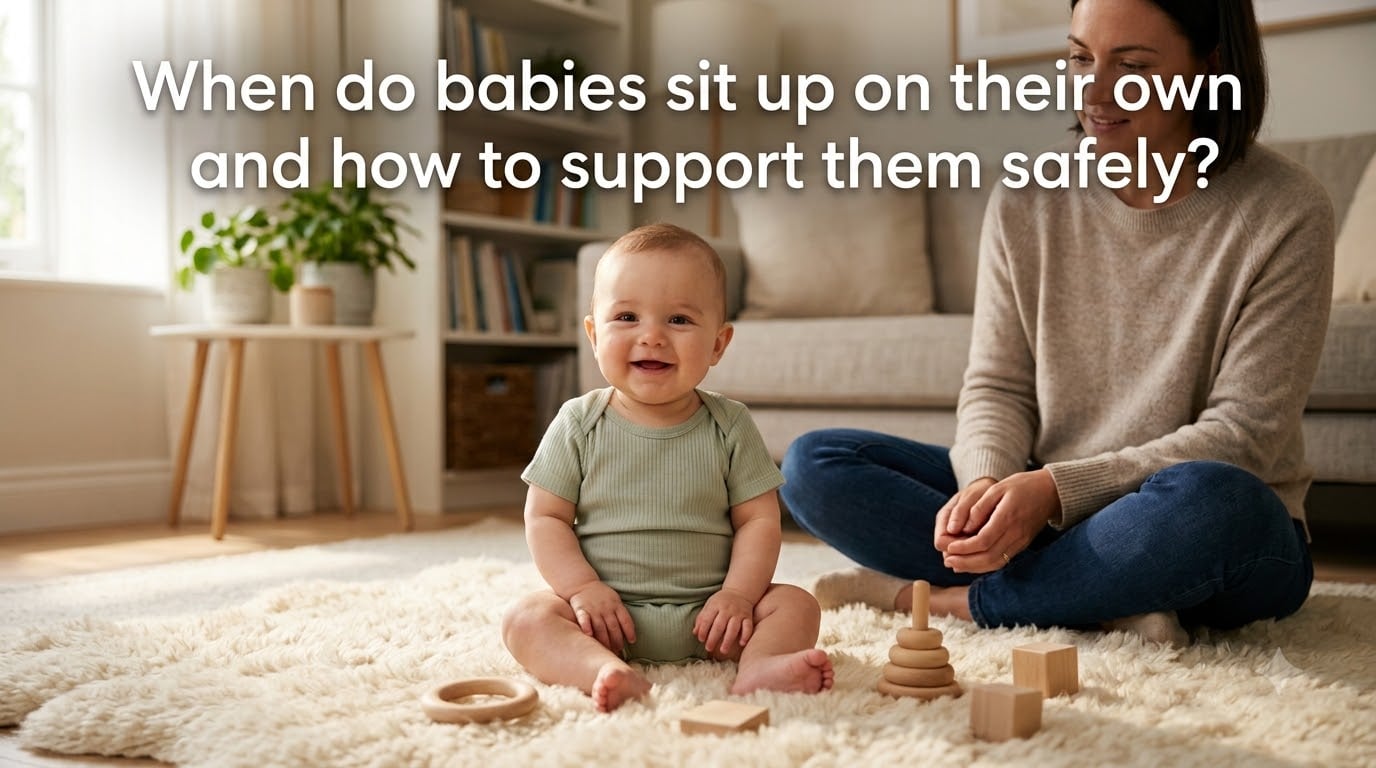
When do babies sit up on their own, and how can you support them safely through this milestone without rushing or worrying? Most babies begin sitting with support around 4 to 5 months and progress to sitting independently somewhere between 6 and 9 months, but the healthy range stretches well beyond those numbers.
I want to start with reassurance, because I know how easily parents can spiral into comparison when one baby sits at 4 months and another waits until 8 months. Sitting is a range, not a deadline. Every healthy baby follows their own timeline, and most who sit later catch up without intervention.
In this guide, I’ll walk you through the actual stages of sitting development, share safe ways to practice with your baby, flag what to avoid, and explain when it makes sense to check in with your pediatrician.
Table of Contents
When Do Babies Sit Up on Their Own? Age Timeline and Stages
Most babies sit independently between 6 and 9 months, with 8 months being a common average. Sitting develops in three overlapping stages, and understanding these stages helps you see exactly where your baby is on their own journey.
Supported sitting (around 4 to 5 months): With your hands, a nursing pillow, or a Boppy cushion, your baby can stay upright briefly while gaining head and neck control. They wobble, and that’s expected.
Tripod sitting (around 5 to 7 months): Your baby props themselves on both hands in front of their body, forming a stable tripod with their bottom. This stage builds core strength and balance reactions.
Independent sitting (around 6 to 9 months): Your baby sits without any support, using their hands to reach for toys and turn their body. By 9 months, most babies have steady, hands-free sitting.
Remember that the 6 to 9 month window is a wide range, not a tight average. Some babies skip tripod sitting entirely. Others scoot into sitting from a crawl position rather than pulling themselves up.
How Babies Learn to Sit: The Development Process
Sitting is a layered skill that depends on earlier milestones. Before babies can sit, they need head control, neck strength, and a foundation of tummy time. Think of sitting as the visible peak of a pyramid of smaller, earlier skills.
Why head control comes first: Around 3 to 4 months, babies learn to hold their head steady during tummy time and upright carrying. This neck strength is the prerequisite for everything that follows.
How core strength builds sitting skills: Tummy time, rolling, and kicking all build the trunk muscles your baby needs to hold their torso upright. A weak core means a wobbly sitter, no matter how determined they feel.
The role of balance and proprioception: Sitting requires constant micro-adjustments, leaning slightly forward to grab a toy, shifting weight when reaching sideways. These balance reactions develop through hundreds of tiny practice moments on the floor.
If your baby is still working on head control or rolling, sitting will follow naturally when those foundations are ready. There’s no way to “skip ahead” by propping them up.
How to Help Baby Sit Up Safely: Step-by-Step Guide
You don’t need fancy equipment to help your baby learn to sit. Floor time, your lap, and a few well-placed toys are usually enough. Here are the safest, most effective ways to practice.
- Start with supported sitting on your lap. Sit on the floor with your back against a couch. Place your baby on your lap facing outward, using your body for support. This builds core strength without any risk of falling.
- Use a nursing pillow as a prop. Place your baby in the center of a Boppy or nursing pillow on the floor. The pillow catches them if they tip while they practice balance. Always stay within arm’s reach.
- Place toys just out of reach. Once your baby is sitting with light support, set a favorite toy slightly to the side or just above their head. Reaching for it activates core muscles and balance reactions.
- Practice in short bursts. Two to three minutes of supported sitting, three or four times a day, is plenty. Watch for signs of fatigue: fussing, slumping, or turning their head away.
- Stay close and spot them. Never leave a baby under 9 months sitting unattended on a couch, bed, or elevated surface. A face-plant from even 2 feet can cause injury.
- Transition to tripod practice. Once your baby props on their hands, place toys at chest level so they reach forward, building the tripod position.
- Celebrate wobbles. Falling over is part of learning. Each time they tip and recover, their balance system gets stronger. Cushion the area with a soft rug and let them try again.
For more context on supporting natural motor development at every stage, our guide on respecting your baby’s developmental pace explores why unhurried practice often works better than structured drills.
Tummy Time and Floor Play: Building the Foundation for Sitting
Tummy time is the single most important activity for building sitting strength. Every minute your baby spends on their tummy strengthens the neck, shoulder, and core muscles they’ll later need to sit upright.
Aim for short sessions spread throughout the day. Newborns start with 1 to 2 minutes after diaper changes. By 3 months, many babies enjoy 15 to 20 minutes of tummy time total per day. By 6 months, most babies are rolling and scooting, and they get floor play naturally.
If your baby hates tummy time, try it on your chest, across your lap, or on a slightly inclined surface. Some babies who scream on the floor happily do tummy time on a parent’s body. The goal is time on their tummy, not a specific surface.
Beyond tummy time, simply letting your baby spend more time on a blanket on the floor (rather than in a swing, bouncer, or car seat) gives them the freedom to roll, reach, and eventually sit when their body is ready.
What to Avoid When Supporting Baby’s Sitting Development
Some well-meaning practices can actually slow sitting development or create safety risks. Here are the most common mistakes I see, and what to do instead.
Don’t prop babies in seats before they can sit themselves. Bumbo seats, baby floor seats, and similar props hold babies upright before their muscles are ready. Pediatric physical therapists have raised concerns that prolonged use may discourage the active muscle work babies need.
Don’t carry babies in sitting positions constantly. It’s tempting to prop a 3-month-old on your lap facing out so they can “see the world,” but their spine isn’t ready for sustained upright postures. Holding them against your chest or in a side-hip carry is better for their developing back.
Don’t leave babies sitting on elevated surfaces. Couches, beds, and changing tables are not safe for sitting practice. Even babies who seem steady can tip suddenly. Always practice sitting on the floor.
Don’t force practice when baby is fussy. Tired, hungry, or overstimulated babies don’t learn well. A 90-second happy session is more productive than a 5-minute fight.
Don’t skip tummy time because of a flat head. Repositioning and supervised tummy time treat flat spots better than keeping baby upright in a seat, which can worsen head shape issues.
When to Worry: Warning Signs and When to Consult Your Pediatrician
Most variation in sitting is normal, but there are a few signs worth raising with your pediatrician. The key threshold to remember is 9 months. By 9 months, most babies can sit independently for at least a few seconds without support.
Reasons to check in with your pediatrician include:
- By 9 months, your baby cannot sit at all, even with support.
- Your baby feels very floppy or stiff when you pick them up.
- One side of the body seems noticeably weaker than the other.
- Your baby shows no interest in moving, reaching, or exploring.
- Sitting seems painful or your baby cries when placed upright.
- Your baby loses skills they previously had (regression).
Most pediatricians follow the “wait until 9 months” guideline before ordering evaluations, but you can always bring concerns earlier. If something feels off, trust your instinct and ask. Early intervention, when needed, makes a real difference.
Signs that warrant an earlier call include persistent head lag past 4 months, very low or very high muscle tone, or a strong preference for using only one side of the body. Your pediatrician may refer you to a pediatric physical therapist for a developmental assessment.
Special Considerations: Preterm Babies and Late Bloomers
If your baby was born before 37 weeks, use their adjusted age (calculated from their original due date, not birth date) for milestone tracking until at least age 2. A baby born 6 weeks early might be expected to sit independently closer to 10 to 11 months of chronological age, which is normal for their adjusted timeline.
Late bloomers within the full-term range also deserve mention. Some healthy, typically developing babies simply take longer to sit. They may focus intensely on rolling, scooting, or crawling and skip the stationary sitting phase entirely. Sitting and crawling are not strict prerequisites, and many babies master one before the other.
If your older baby isn’t sitting yet but is otherwise engaged, reaching, and trying to move, they’re likely on their own healthy timeline. A pediatric check-in can offer peace of mind.
Frequently Asked Questions
What age should a baby sit up without support?
Most babies sit up without support between 6 and 9 months, with around 8 months being a common average. The healthy range stretches from about 5 months for early sitters to 9 months or even slightly later for babies who focus on other motor skills first.
Is 3 months too early for a baby to sit up?
Yes, 3 months is too early for a baby to sit up on their own. At 3 months, babies are still developing head and neck control, and propping them in a seated position can strain their spine and discourage the active muscle work they need.
Can I sit my 4 month old baby up?
You can hold your 4 month old in a supported sitting position on your lap for short periods, but don’t prop them upright on their own. At 4 months, brief supported sitting helps build core strength, while independent sitting typically arrives closer to 6 to 8 months.
How can I help my baby sit up on their own?
Give your baby plenty of floor time and tummy time, practice supported sitting on your lap, place toys just out of reach to encourage reaching and balance, and avoid leaving them sitting unattended on elevated surfaces. Short, frequent practice sessions of 2 to 3 minutes work best.
At what age should a baby be able to sit up with support?
Most babies can sit with support around 4 to 5 months, using a nursing pillow, your lap, or your hands to prop them upright. By 6 months, many babies can sit briefly with just light hand support as they build tripod sitting skills.
Is it normal for a 7 month old to not be sitting up?
Yes, it can be normal for a 7 month old to not be sitting independently yet. The independent sitting range stretches from 6 to 9 months, and some babies focus on rolling, scooting, or crawling before mastering sitting. If your baby is otherwise active and engaged, they’re likely on their own healthy timeline.
My baby is 8 months old and still not sitting up. Should I be worried?
Not necessarily. Many babies don’t sit independently until 8 or 9 months, and some healthy babies focus on other motor skills first. However, it’s worth mentioning to your pediatrician, especially if your baby also shows low muscle tone, stiffness, or one-sided weakness.
How to get baby to sit up unsupported?
Build core strength through daily tummy time, practice supported sitting on your lap and on a nursing pillow, encourage reaching for toys placed slightly out of reach, and let your baby wobble and recover on a soft floor surface. Avoid using prop seats, and be patient; sitting often clicks suddenly after weeks of gradual practice.
Wrapping Up: Trust Your Baby’s Timeline
When do babies sit up on their own and how to support them safely comes down to two simple ideas: babies sit on their own when their bodies are ready, and you support them safely by giving them floor time, supervised practice, and patience. Most babies sit independently between 6 and 9 months, but a healthy range stretches in either direction.
If your baby is in that range, you can relax. If they’re approaching 9 months without sitting, mention it to your pediatrician. If they were born early, use their adjusted age. And if you’re comparing your baby to others on social media, close the app and look at your own baby instead. They’re exactly where they need to be.
Once your baby is sitting steadily on their own, you may want to read our guide to baby-led weaning, since steady sitting is one of the readiness signs for starting solids. For a deeper look at sitting milestones specifically, our updated guide to when babies start sitting up covers similar ground from a different angle.
You’re doing a great job just by paying attention and showing up. Trust yourself, trust your baby, and enjoy the wobbles along the way.