
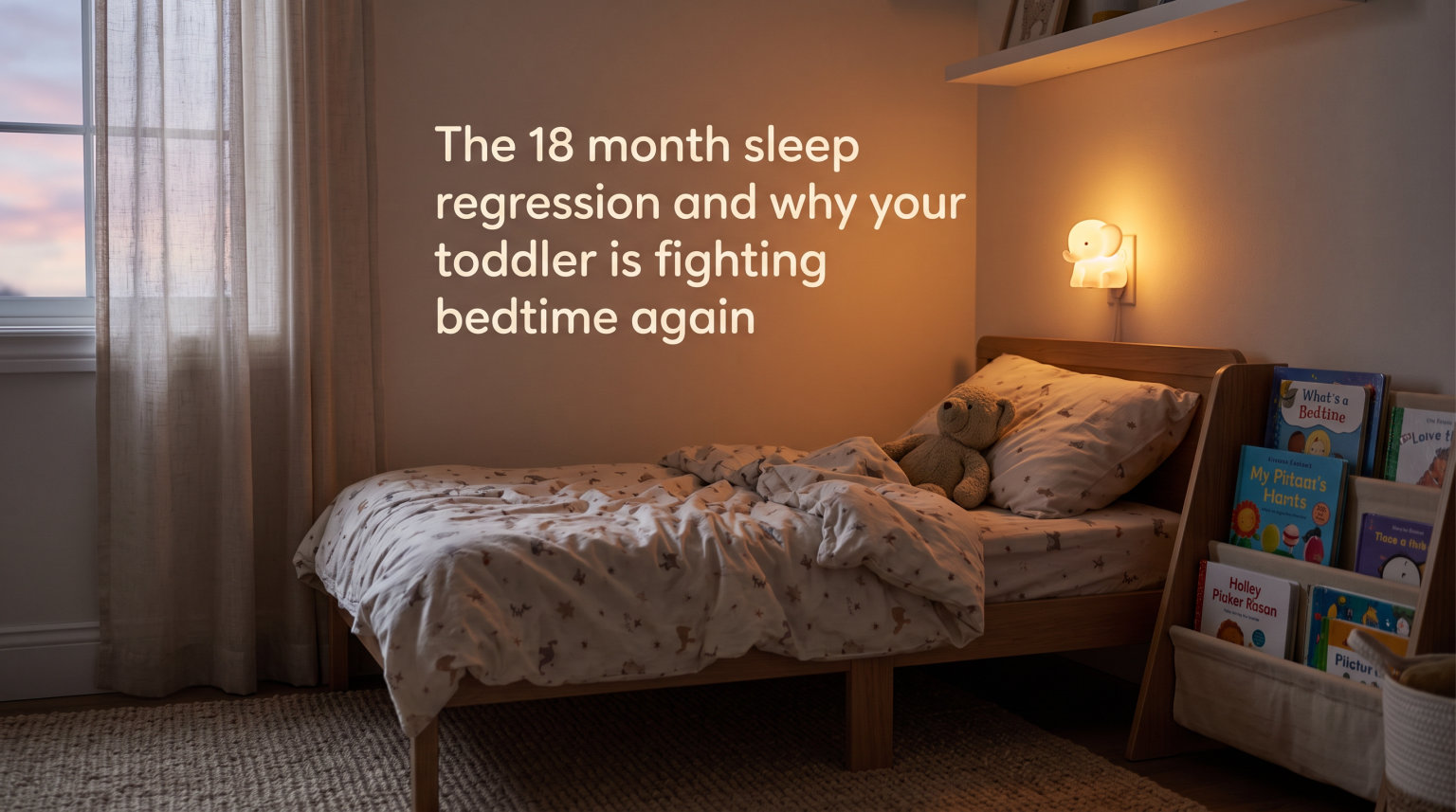
Your toddler was sleeping through the night. Maybe they’ve been a good sleeper for months, or even since they were an infant. Then suddenly, around their 18-month birthday, everything changed.
Bedtime became a battle. They scream when you try to leave the room. They wake up crying at 2 AM and refuse to go back to sleep. Nap time, which used to be predictable, now takes 45 minutes of negotiations ending in tears.
You are not alone. The 18 month sleep regression is real, it is intense, and it has pushed many parents to their breaking point. This guide explains exactly what is happening to your toddler’s sleep, why your 18 month old is suddenly fighting bedtime, and how you can get through this phase without losing your mind.
Table of Contents
What Is the 18 Month Sleep Regression
The 18 month sleep regression is a temporary period of disrupted sleep that typically occurs between 14 and 22 months of age. During this phase, previously good sleepers suddenly struggle with bedtime resistance, night wakings, early rising, and nap refusal.
Unlike the earlier 4-month and 9-month regressions, this one hits differently. At 18 months, your toddler has a voice, opinions, and the ability to protest loudly. They can climb out of cribs, open doors, and make their displeasure known in ways an infant simply cannot.
This regression is not a setback in your parenting. It is a developmental milestone disguised as a sleep disaster. Your toddler’s brain is undergoing explosive growth in three key areas: cognitive development, emotional regulation, and physical independence. These changes are wonderful for their long-term development and absolutely exhausting for everyone in the short term.
Why It Happens: The Perfect Storm of Development
If your 18 month old won’t sleep anymore, it is likely because multiple developmental factors are colliding at once. Understanding these causes helps you respond with empathy instead of frustration.
Cognitive and Emotional Development
Your toddler’s brain is exploding with new abilities. They are learning language rapidly, developing memory, and beginning to understand concepts like object permanence and cause and effect. This cognitive leap is exciting for them and disruptive for sleep.
From an emotional standpoint, 18 months marks the beginning of complex feelings like possessiveness, jealousy, and genuine fear. Your toddler is starting to understand that you can leave them, and they do not like that knowledge one bit.
Separation Anxiety Peaks
Separation anxiety typically reaches its peak between 18 and 24 months. Your toddler now fully understands that you exist when they cannot see you, and they are not convinced you will return. This makes bedtime terrifying.
When you walk toward their bedroom door, they panic. When you say goodnight, their brain screams that you are leaving forever. This is not manipulation. This is genuine anxiety that requires a compassionate but consistent response.
Physical Growth and Teething
Many toddlers cut their first molars around 18 months. These large teeth cause significant discomfort and can disrupt sleep for weeks. Unlike front teeth, molars take longer to erupt and create persistent low-level pain.
Physical growth spurts also happen around this age. Your toddler may be hungry more often, experiencing growing pains, or simply feeling uncomfortable in ways they cannot articulate. Combine this with the mental and emotional changes, and you have a recipe for sleepless nights.
Testing Boundaries
Eighteen months is prime time for boundary testing. Your toddler is discovering that they have choices, and sleep is one of the first areas where they can exercise control. Refusing bedtime is a way of asserting independence.
This behavior is developmentally appropriate but exhausting. Your toddler needs you to hold boundaries firmly while remaining emotionally connected. This balance is the heart of surviving the 18 month sleep regression.
The Nap Transition Factor
Many 18-month-olds are in the process of transitioning from two naps to one. This transition creates chaos in sleep schedules and can contribute to overtiredness. An overtired toddler produces cortisol and adrenaline, making it harder to fall asleep and stay asleep.
The timing of the nap transition varies by child. Some are ready at 15 months, others not until 20 months. If your toddler is fighting naps but clearly still needs them, the transition timing might be the culprit behind their sleep struggles.
Signs Your Toddler Is In the 18 Month Regression
Not every sleep disruption is a regression. Here are the specific signs that indicate your toddler is experiencing the 18 month sleep regression:
1. Bedtime battles that escalate quickly – Your previously cooperative toddler now screams, arches their back, or runs away when it is time for bed. What used to take 10 minutes now takes an hour.
2. Multiple night wakings after months of sleeping through – Your toddler wakes crying at 11 PM, 2 AM, and 4 AM. They want you to stay with them and become hysterical when you try to leave.
3. Early morning wake-ups – Your toddler starts the day at 5 AM or earlier, ready to play, and refuses to go back to sleep even though they are clearly still tired.
4. Nap resistance or nap refusals – A toddler who used to nap for 90 minutes now screams through the entire nap window or takes 45 minutes to fall asleep only to sleep for 20 minutes.
5. Increased clinginess during the day – Your toddler follows you from room to room, wants to be held constantly, and melts down when you leave their sight. This daytime anxiety bleeds into nighttime.
6. New bedtime fears – Your toddler suddenly becomes afraid of the dark, their closet, or monsters. They request specific objects or routines that they never needed before.
7. Physical protests – Climbing out of the crib, banging their head against the mattress, or engaging in repetitive behaviors like rocking or head-banging at bedtime.
How Long Does the 18 Month Sleep Regression Last
The 18 month sleep regression typically lasts between two and six weeks. Most families report the most intense phase lasts about three weeks, with gradual improvement after that.
Here is what the timeline usually looks like. Weeks one through two involve the sudden onset of symptoms and the highest intensity of bedtime battles and night wakings. Weeks three through four often show gradual improvement with some good nights mixed with difficult ones. By weeks five and six, most toddlers have returned to their baseline sleep patterns.
Some toddlers experience a shorter regression of one to two weeks, while others struggle for two months or more. Factors that extend the regression include inconsistent responses from parents, ongoing teething pain, and disruptions like travel or illness.
The regression can also hit later than exactly 18 months. Some toddlers sail through month 18 only to crash at 19 or 20 months. This delayed regression is still considered part of the 18 month developmental phase and responds to the same strategies.
Practical Strategies to Survive the 18 Month Sleep Regression
Surviving the 18 month sleep regression requires a combination of schedule adjustments, emotional support, and boundary-holding. Here are the strategies that work.
Optimize Bedtime Routines
A predictable bedtime routine signals to your toddler’s brain that sleep is coming. At 18 months, aim for a routine that lasts 20 to 30 minutes and follows the same sequence every night.
Include activities that promote connection like reading books together, singing songs, or gentle massage. Avoid screens for at least an hour before bed as the blue light disrupts melatonin production. End the routine in your toddler’s sleep space with a consistent phrase like “sleep tight, I love you, goodnight.”
Consider adding a comfort object if your toddler does not already have one. A small stuffed animal or lovey can provide comfort when you are not present. Make sure the object is safe for sleep and present during both bedtime and nap time.
Adjust Wake Windows
Wake windows are the periods your toddler is awake between sleep sessions. At 18 months, most toddlers need between five and six hours of awake time before their nap and four to five hours before bedtime.
An undertired toddler does not have enough sleep pressure to fall asleep easily. They will play in their crib, call for you repeatedly, or take forever to settle. An overtired toddler produces stress hormones that make it harder to settle and stay asleep. They may fall asleep quickly but wake frequently.
If bedtime is a battle, try moving bedtime earlier by 15 to 30 minutes. A toddler who is overtired often acts wired or hyper. Do not keep them up later hoping they will be more tired. Earlier bedtimes often lead to better sleep and later wake times.
Differentiate Tester vs Anxious Behavior
One of the most helpful frameworks for responding to sleep struggles comes from understanding whether your toddler is testing boundaries or genuinely anxious. These two types require different approaches.
Testers are toddlers who protest bedtime but calm quickly when you set boundaries. They may cry for five minutes, check if you will return, then settle when you do not engage with their requests. These toddlers need consistent limit-holding with brief check-ins.
Anxious toddlers become increasingly upset when left alone. They shake, hyperventilate, or vomit from distress. These toddlers need more support, possibly including the camping out method where you sit in the room and gradually move farther away over nights.
Trust your instincts about which type your child is. Most toddlers show elements of both at different times. Respond to anxiety with comfort and to testing with boundaries. Both approaches can include love and consistency.
Offer Limited Choices
Eighteen-month-olds crave autonomy. Use this to your advantage by offering limited choices throughout the bedtime routine. This reduces power struggles while maintaining necessary boundaries.
Ask “Do you want the red pajamas or the blue pajamas?” instead of “Are you ready for bed?” Offer “Two books or three books?” and “Which stuffed animal comes with you tonight?” Each choice gives your toddler a sense of control.
The key is offering only choices you can live with. Never offer “Do you want to go to bed?” as a choice because the answer will always be no. Frame choices around how to get to bed, not whether to go.
Maintain Active Play During the Day
Physical activity during the day builds sleep pressure that makes bedtime easier. Aim for at least 60 minutes of active play daily, ideally including outdoor time when possible.
Physical play also helps toddlers process big emotions and reduces anxiety. Rough-and-tumble play, running, climbing, and dancing all support healthy sleep. Just avoid intense physical activity in the hour before bedtime as this can be overstimulating.
Getting outside light, especially in the morning, helps regulate your toddler’s circadian rhythm. Natural light exposure supports the production of melatonin at appropriate times and can reduce early morning wake-ups.
Handle Night Wakings Consistently
When your toddler wakes at night, respond consistently using the approach you have chosen. Inconsistency confuses toddlers and can prolong the regression. If you sometimes bring them to your bed and sometimes do not, they will keep testing to see which response they get.
For toddlers who are not bed-sharing, the goal is brief, boring reassurance. Check that they are safe and comfortable, offer a brief phrase like “It is time to sleep, I love you,” and leave. Return as needed with the same minimal interaction.
Some families choose to bed-share during regressions. If this works for your family, do it intentionally rather than out of desperation. Know that you may need to transition back to independent sleep when the regression passes.
18 Month Old Sleep Needs and Sample Schedule
Understanding appropriate sleep expectations helps you set realistic goals during the regression. Most 18-month-olds need 13 to 14 hours of total sleep in 24 hours.
This typically breaks down to 10 to 12 hours at night and 1.5 to 2.5 hours during a single nap. Some high-sleep-need toddlers still take two shorter naps, though most have transitioned to one.
Here is a sample schedule for an 18-month-old on a one-nap routine:
Wake up: 7:00 AM
Lunch: 11:30 AM
Nap: 12:00 PM to 2:00 PM (2 hours)
Wake from nap: 2:00 PM
Dinner: 5:30 PM
Bedtime routine starts: 6:45 PM
Lights out: 7:30 PM
Adjust this schedule based on your family’s needs and your toddler’s wake-up time. The key is maintaining consistent wake windows. If your toddler wakes at 6 AM instead of 7 AM, move the entire schedule earlier by an hour.
During the regression, your toddler may fight this schedule. Keep offering the nap at the same time even if they do not sleep. Consistency in timing helps them return to good sleep patterns once the regression passes.
Supporting Yourself Through This Challenging Phase
The 18 month sleep regression does not just affect your toddler. It hits parents hard. Sleep deprivation impacts your mood, your relationships, and your ability to parent patiently. Taking care of yourself is not selfish. It is necessary.
Managing Your Expectations
This is not the time to tackle new projects, start potty training, or reorganize your house. Lower your standards for cleanliness, meal complexity, and productivity. Surviving is the goal.
Remind yourself daily that this is temporary. The parents who posted on forums two months ago about their brutal 18 month regression are now posting about how their toddler sleeps through the night again. You will get there too.
Accept that consistency does not mean perfection. You will have nights where you bring your toddler to bed with you out of exhaustion. You will have evenings where you lose your temper at bedtime. These moments do not undo your good work. Start fresh the next day.
Building Your Support Network
Reach out for help when you need it. Ask your partner to take over bedtime so you can rest. Accept offers of help from family or friends. If you can afford it, hire a babysitter for a few hours on the weekend so you can nap.
Connect with other parents going through the same phase. Online forums and parenting groups can provide validation that you are not alone. Hearing that another parent’s 18-month-old is also waking at 2 AM with separation anxiety makes your own situation feel more manageable.
Consider speaking with a counselor or therapist if the sleep deprivation is affecting your mental health. Postpartum depression and anxiety can persist well into the toddler years. There is no shame in seeking professional support.
Attachment Parenting Perspective
From an attachment parenting perspective, the 18 month sleep regression is an opportunity to strengthen your bond with your toddler. Responding to their nighttime needs builds security that will serve them throughout childhood.
This does not mean you must respond to every protest immediately. It means approaching your toddler’s distress with empathy rather than frustration. It means holding boundaries with love rather than anger.
Your toddler’s need for connection during this phase is biologically appropriate. Humans are designed to stay close to caregivers during early childhood. Nighttime separation is challenging because it goes against our evolutionary wiring. Responding to that need is not creating bad habits. It is meeting a legitimate developmental need.
When to Talk to Your Doctor
While the 18 month sleep regression is normal, some sleep issues warrant medical attention. Contact your pediatrician if you notice any of the following:
Your toddler snores loudly, gasps, or stops breathing during sleep. These are signs of possible sleep apnea and need evaluation.
Sleep disruptions are accompanied by severe behavioral changes, loss of skills, or regression in other areas like speech or motor abilities.
Your toddler is not growing or gaining weight appropriately, or they seem to be in significant pain that cannot be explained by teething.
The sleep problems persist for more than eight weeks without any improvement, or they are causing severe distress for your family despite consistent intervention.
Trust your parental instincts. If something feels wrong beyond normal regression behavior, seek professional guidance. Your pediatrician can rule out medical causes and refer you to a pediatric sleep specialist if needed.
Frequently Asked Questions About the 18 Month Sleep Regression
Why is my 18 month old suddenly fighting bedtime?
Your 18 month old is fighting bedtime because they are experiencing a developmental leap that includes separation anxiety, increased independence, and cognitive growth. They now understand that you leave when they sleep, which creates genuine anxiety. Combined with boundary testing and possible teething pain, bedtime becomes a battleground. This behavior is developmentally normal and temporary.
Can you sleep train during the 18 month sleep regression?
You can sleep train during the 18 month sleep regression, but it may be more challenging than at other times. Many experts recommend maintaining your existing approach rather than introducing new sleep training methods during the regression. If your toddler was sleep trained before the regression, focus on consistency rather than retraining. If you are starting fresh, gentle methods like camping out work better than extinction methods during this phase.
Is the 18 month sleep regression the hardest?
Many parents and sleep consultants consider the 18 month sleep regression the most challenging because toddlers have more physical abilities and emotional intensity than during earlier regressions. Unlike a 4-month-old, an 18-month-old can climb out of cribs, open doors, and scream at high volumes. The combination of separation anxiety and boundary testing makes this phase particularly exhausting for parents.
How do I know if it is teething or sleep regression?
Teething and sleep regression often overlap at 18 months, but there are differences. Teething symptoms include drooling, chewing on objects, swollen gums, and mild fever. These symptoms come and go as teeth erupt. Sleep regression involves behavioral changes like separation anxiety, boundary testing, and clinginess that persist consistently for weeks. If sleep issues disappear when you give pain relief, teething is likely the main culprit. If they persist despite pain management, it is probably the regression.
Should I let my 18 month old cry it out?
Whether to use cry-it-out methods during the 18 month sleep regression depends on your parenting philosophy and your toddler’s temperament. Some toddlers respond well to brief periods of protest crying and settle quickly. Others become increasingly distressed, which can increase anxiety around sleep. If you choose to use extinction methods, ensure your toddler is not sick, hungry, or in pain first. Many families find gentler approaches like the camping out method more appropriate during this developmental phase.
What is the 5 3 3 rule for sleep?
The 5 3 3 rule is a sleep training approach where you allow your child to cry for 5 minutes before checking on them, then 3 minutes, then 3 minutes, gradually increasing intervals. This is a variation of the Ferber method. At 18 months, some parents find this approach effective for toddlers who protest bedtime but are not genuinely anxious. However, this method is not appropriate for toddlers showing signs of true distress or anxiety.
Can toddlers have nightmares at 18 months?
Yes, toddlers can begin having nightmares and night terrors around 18 months as their imaginations develop and they process daily experiences during sleep. Nightmares typically happen in the second half of the night and your toddler will be awake and frightened afterward. Night terrors occur in the first few hours of sleep, and your toddler may scream and appear terrified while actually still asleep. Both are normal at this age and usually outgrown.
Should I change nap schedules during the regression?
Maintain your existing nap schedule during the 18 month sleep regression rather than making major changes. Consistency helps toddlers return to good sleep patterns once the regression passes. If your toddler is fighting naps, continue offering the nap at the same time for at least 45 minutes. If they truly will not sleep, use the time for quiet rest. Avoid dropping the nap entirely during the regression, as most 18-month-olds still need daytime sleep.
This Too Shall Pass: Finding Your Way Through
The 18 month sleep regression is one of parenting’s greatest tests. It challenges your patience, your confidence, and your physical wellbeing. But it is also a sign that your toddler is developing beautifully.
Every night your 18 month old fights bedtime, they are practicing independence. Every time they cry for you at 2 AM, they are communicating their trust that you will respond. Every early morning wake-up is an opportunity for connection, even when you would rather sleep.
This phase will end. Your toddler will sleep through the night again. You will wake up feeling rested. The memory of this difficult period will fade, replaced by new challenges and new joys.
Until then, be gentle with yourself. Lower your expectations. Accept help when offered. Trust that you are doing enough, even when it feels like you are barely surviving.
The 18 month sleep regression does not last forever. Your relationship with your toddler does. Choose connection over perfection, and know that better sleep is coming for everyone.