
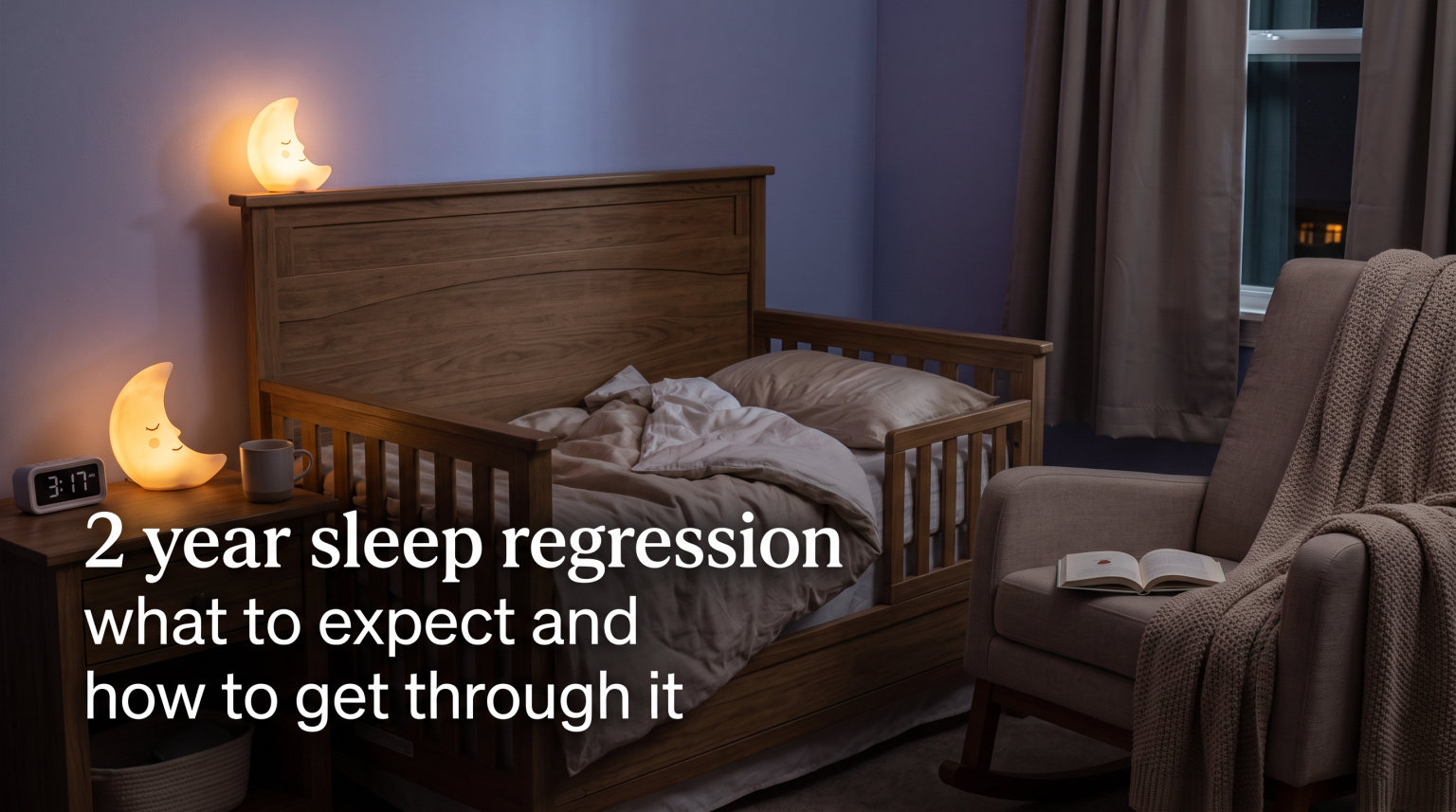
If you are reading this at 3 AM while your two-year-old screams from the next room, you are not alone. The 2 year sleep regression is one of the most challenging phases parents face, and it often hits when you thought you had finally figured out your toddler’s sleep.
I have worked with hundreds of families navigating this regression, and I can tell you this: it is real, it is temporary, and you will get through it. In this guide, I will explain exactly what to expect during the 2 year sleep regression and share practical strategies that actually work.
By the end of this article, you will understand why this regression happens, how long it typically lasts, and what steps you can take to help your toddler (and yourself) survive this phase with sanity intact.
Table of Contents
What Is the 2-Year Sleep Regression
The 2-year sleep regression is a temporary period when a previously good sleeper suddenly resists bedtime, fights naps, wakes frequently at night, or rises too early. This developmental phase typically occurs between 18 months and 30 months, with the peak around age 2.
During this regression, your toddler’s brain is busy processing major developmental milestones. The drive to practice new skills and test independence can override their need to rest. Many parents describe this phase as feeling like they have a newborn again, just when they thought those sleepless nights were behind them.
What makes the 2 year sleep regression particularly challenging is that it coincides with several major developmental transitions happening at once. Your toddler is developing language rapidly, testing boundaries, experiencing separation anxiety, and potentially transitioning from a crib to a bed or dropping naps.
Key Signs Your Toddler Is in a Sleep Regression
Not every sleep disruption is a regression. Here are the telltale signs that your 2-year-old is experiencing this specific developmental phase:
- Bedtime battles that last 30-60 minutes with crying, stalling, and repeated requests
- Night wakings after months of sleeping through the night, sometimes lasting 1-2 hours
- Nap refusal or inconsistent napping after previously reliable daytime sleep
- Early morning waking before 6 AM when your toddler was sleeping until 7 AM or later
- Intense separation anxiety at bedtime, demanding parents stay in the room
- Stall tactics including repeated requests for water, potty, “one more” story, or extra hugs
If you recognize three or more of these signs in your toddler, you are likely dealing with the 2 year sleep regression. The good news is that this phase, while exhausting, is completely normal and temporary.
Why the 2-Year Sleep Regression Happens
Understanding what triggers this regression can help you respond with empathy rather than frustration. Several developmental factors converge around age 2 to disrupt sleep patterns.
Developmental Milestones
Your toddler’s brain is undergoing explosive growth. They are developing language skills at a rapid pace, learning to form complex sentences, and acquiring 50+ new words per week. This cognitive activity does not stop at bedtime. Many toddlers practice their new skills in bed, talking to themselves or singing for hours before falling asleep.
Motor skill development also plays a role. Two-year-olds are mastering jumping, running, climbing, and fine motor tasks. Their brains are processing these physical achievements during sleep, which can cause restless nights and frequent awakenings.
Separation Anxiety Intensifies
Separation anxiety peaks again around 18-24 months, and bedtime becomes the ultimate separation. Your toddler now understands object permanence, meaning they know you exist even when they cannot see you. This realization can trigger intense anxiety about being alone in their room.
Many parents report their previously independent sleeper now demands a parent sit in the room, hold their hand, or sleep in their bed. This behavior is developmentally appropriate, even if it is exhausting for you.
Nap Transitions and Sleep Pressure Changes
Between ages 2 and 3, many toddlers transition from two naps to one, or begin dropping naps entirely. This transition is rarely smooth. Your toddler may need a nap some days but not others, creating an unpredictable schedule that complicates bedtime.
Wake windows also change at this age. A 2-year-old can typically stay awake for 5-6 hours before needing sleep. If naps are inconsistent or bedtime timing is off, your toddler can become overtired, which ironically makes it harder for them to fall and stay asleep.
Boundary Testing and Independence
The “terrible twos” are not just a cliche. At this age, toddlers are discovering they have choices and preferences. Bedtime becomes a prime opportunity to assert independence and test limits. Saying “no” to sleep and pushing boundaries is actually a healthy developmental milestone, even if it feels like a personal attack at midnight.
Two-Year Molars
Many parents overlook the impact of the second set of molars, which typically emerge between 20-30 months. These large teeth can cause significant discomfort, especially at night when your toddler is lying down. If your toddler is drooling excessively, chewing on objects, or showing signs of gum inflammation, teething may be contributing to sleep disruptions.
How Long Does the 2-Year Sleep Regression Last
The 2-year sleep regression typically lasts between 2 to 6 weeks when healthy sleep habits are consistently maintained. Without consistent responses and sleep-friendly routines, this regression can extend to 8 weeks or longer.
Most parents report the most intense phase, with frequent night wakings and bedtime battles, lasts about 2-3 weeks. After that, sleep gradually improves, though naps may remain inconsistent for several additional weeks.
Several factors affect how long your toddler’s regression lasts:
- Consistency in response to night wakings and bedtime resistance
- Age-appropriate sleep schedule with proper wake windows
- Separation anxiety management and gradual independence building
- Whether new transitions (potty training, crib-to-bed, new sibling) coincide
- Illness or teething that compounds sleep issues
If your toddler’s sleep disruption lasts longer than 6-8 weeks, it may have evolved into a habit rather than a developmental phase. At that point, a more structured sleep training approach may be needed to reset patterns.
10 Tips to Help Your 2-Year-Old Through Sleep Regression
These strategies have helped thousands of families navigate the 2 year sleep regression. Not every tip will work for every child, so experiment to find what resonates with your toddler’s temperament and your parenting style.
1. Lock In a Consistent Bedtime Routine
A predictable bedtime routine signals to your toddler’s brain that sleep is coming. The routine should last 30-45 minutes and follow the same order every night. Ours includes bath, pajamas, two books, songs, and lights out.
Consistency matters more than the specific activities. If your routine varies between 20 minutes and 90 minutes, your toddler cannot anticipate what comes next. Start your routine at the same time every night, even if your toddler fights it. The predictability becomes comforting over time.
2. Use the Gradual Retreat Method for Separation Anxiety
If your toddler panics when you leave the room, try the gradual retreat method. Start by sitting right next to the crib or bed. Every few nights, move your chair slightly farther from your child until you are outside the door.
This approach takes 1-2 weeks but builds lasting confidence. Your toddler learns they are safe even when you are not touching them. We found moving our chair just 6 inches every three nights worked well. By day 10, our daughter could fall asleep with us just outside her open door.
3. Adjust Wake Windows to Prevent Overtiredness
A 2-year-old typically needs 5-6 hours of awake time before bed. If your toddler skips their nap, they may need an earlier bedtime to avoid overtiredness. An overtired toddler has elevated cortisol levels, making it harder to fall and stay asleep.
Track your toddler’s wake windows for a week. If bedtime battles worsen after 6 hours awake, try putting them down 30 minutes earlier. Many parents see immediate improvement when they adjust timing rather than fighting an overtired child.
4. Set Limits While Offering Valid Choices
Two-year-olds need boundaries, but they also crave autonomy. Offer limited choices that do not impact sleep: “Do you want the blue pajamas or the red ones?” “Should we read the dinosaur book first or the truck book?”
When stall tactics emerge, use the “one more” rule with a limit. “One more hug, then it is time to sleep.” Be consistent and do not negotiate beyond your stated limit. Your toddler is testing whether you mean what you say.
5. Implement an Early Bedtime on No-Nap Days
If your toddler refuses their nap, move bedtime earlier by 30-60 minutes. A 2-year-old still needs 11-14 hours of total sleep in 24 hours. Missing a nap creates a significant sleep debt that an early bedtime can partially offset.
We aim for 6:30 PM bedtime on no-nap days instead of our usual 7:30 PM. Yes, this makes evenings shorter for parents, but it prevents the meltdown spiral that happens when an overtired toddler stays up too late.
6. Introduce or Reinforce a Comfort Object
A lovey or comfort object can help your toddler self-soothe during night wakings. Choose something safe for sleep (no small parts, breathable if possible) and make it part of your bedtime routine.
Spend 2 weeks incorporating the lovey into every nap and bedtime routine before expecting your toddler to rely on it. Some parents sleep with the lovey themselves for a few nights to transfer their scent, which can provide additional comfort.
7. Optimize the Sleep Environment
Small environmental tweaks can make a big difference. Blackout curtains help with early morning wakings caused by summer sun. A white noise machine masks household sounds that might wake a light sleeper.
If your toddler expresses fear of the dark, a dim night light is appropriate. Look for warm-toned lights rather than blue light, which can suppress melatonin. Some parents use a “toddler clock” that changes color when it is okay to get up, helping with early morning wakings.
8. Replace Forced Naps with Quiet Time
If your toddler consistently refuses naps, stop fighting the battle. Instead, institute a 60-90 minute quiet time in their room. They do not have to sleep, but they must stay in their safe space with books and quiet toys.
About 50% of toddlers will eventually fall asleep during quiet time, especially if you maintain the routine consistently. Even if they do not sleep, the rest period prevents overstimulation and can improve evening behavior.
9. Use the Stay-in-Bed Technique for Crib Climbers
If your toddler has started climbing out of their crib, you face a decision: transition to a toddler bed or try to keep them in the crib longer. Many sleep consultants recommend keeping toddlers in cribs until age 3 if possible.
If you must transition, use the “stay in bed” technique. When your toddler leaves their room, silently return them to bed without talking, eye contact, or emotion. Do this 100 times if necessary. Eventually, the lack of reaction makes leaving bed boring.
10. Prioritize Your Own Rest and Recovery
You cannot pour from an empty cup. The 2 year sleep regression is exhausting, and sleep-deprived parents make poorer decisions and have less patience. Find ways to rest even if you cannot get a full night’s sleep.
Tag-team with your partner if possible. One of you takes the early night shift, the other handles early morning wakings. If you are solo parenting, prioritize a 20-minute nap when your toddler naps or during quiet time. This is not selfish; it is survival.
Nap Guidance During the 2-Year Sleep Regression
Nap challenges are one of the most frustrating aspects of the 2 year sleep regression. Many parents wonder if they should drop the nap entirely or keep fighting for daytime sleep.
Should You Drop the Nap During the Regression?
Most 2-year-olds still need a daytime nap. The average age for dropping naps is between 3 and 4 years old. However, the regression often coincides with nap transitions that can make it seem like your child is ready to give up naps.
Do not permanently drop the nap during the regression unless your toddler is consistently refusing to sleep for 2+ weeks and is not overtired by evening. Instead, treat nap refusal as temporary and keep offering the opportunity daily.
Wake Windows for 2-Year-Olds
Appropriate wake windows help prevent overtiredness. At age 2, most toddlers do best with:
- Morning wake window: 5-6 hours before nap
- Afternoon wake window: 4-5 hours before bedtime
- Total daily sleep: 11-14 hours including naps
- Nap length: 1-2.5 hours
If your toddler takes a short nap or skips it entirely, adjust bedtime earlier to compensate. A 2-year-old who wakes at 7 AM, skips their nap, and goes to bed at 7:30 PM is only getting 11.5 hours of sleep, which is at the low end of their needs.
Quiet Time as a Nap Alternative
If your toddler consistently refuses to nap, quiet time becomes essential. Set up a safe space with books, soft toys, and a dim room. Use a toddler clock or audio cue to signal when quiet time begins and ends.
Even non-sleepers benefit from the downtime. Quiet time gives their brains a rest from stimulation and gives parents a much-needed break. Maintain the routine even on weekends to keep expectations consistent.
Can You Sleep Train During a Regression
Many parents wonder if they should start sleep training during the regression or wait until it passes. The answer depends on your approach and your toddler’s temperament.
Gentle Sleep Training During Regression
Gentle methods work best during the 2 year sleep regression. These approaches acknowledge your toddler’s developmental needs while still encouraging independent sleep skills.
The gradual retreat method described earlier is a form of gentle sleep training. Other options include the “pick up put down” method for younger 2-year-olds, or the “chair method” where you progressively move farther from the bed each night.
Cry It Out: Should You Consider It
Cry it out (CIO) is more challenging during the 2 year sleep regression because your toddler has stronger will and more stamina than an infant. A 2-year-old can cry for 1-2 hours, which is exhausting for everyone.
If you choose CIO, ensure your toddler is not crying due to unmet needs: hunger, teething pain, illness, or genuine fear. Many parents find that CIO works better after the regression has passed and the developmental intensity has decreased.
Maintaining vs. Creating Sleep Associations
During the regression, focus on maintaining healthy sleep associations rather than creating new ones. If your toddler previously fell asleep independently, try to preserve that skill even if it means more crying initially.
Avoid introducing new sleep crutches that will be hard to remove later, like lying with your toddler until they fall asleep every night, unless you are prepared to continue that indefinitely. The regression will end, but new habits can persist.
Taking Care of Yourself During This Phase
The 2 year sleep regression takes a toll on parental mental health. Many parents report feeling desperate, exhausted, and like failures when their toddler will not sleep. These feelings are normal, but they do not have to consume you.
Acknowledge the Difficulty
First, accept that this phase is genuinely hard. One parent on Reddit described it as “hell that is the 2-year sleep regression.” Another said they felt like “everything I do makes it worse.” These are not exaggerations. Sleep deprivation combined with a screaming toddler is one of the most stressful parenting experiences.
Give yourself permission to lower other standards during this phase. Simplify meals, let the house get messy, and decline non-essential obligations. Your only job right now is to get through each day and night.
Practical Self-Care Strategies
Even small moments of self-care help. Try these strategies that worked for parents in our community:
- Swap night duty with your partner in shifts so each gets some uninterrupted sleep
- Take a 20-minute walk outside while your partner handles bedtime
- Accept help from family or friends, even if it is just someone watching your toddler while you nap
- Use delivery services for groceries and meals to reduce your workload
- Connect with other parents going through the same phase for validation
Remember, your toddler’s sleep regression is not a reflection of your parenting. This is a developmental phase that happens to nearly every family. You are not doing anything wrong.
When to Call the Doctor
While the 2 year sleep regression is normal, some sleep issues warrant medical attention. Contact your pediatrician if you notice any of the following:
- Sleep disruptions lasting more than 8 weeks despite consistent sleep habits
- Signs of sleep apnea: loud snoring, gasping, or pauses in breathing during sleep
- Extreme behavioral changes including aggression, withdrawal, or regression in other skills
- Persistent night terrors that occur multiple times per week and affect daytime functioning
- Signs of illness including fever, ear pulling, or unusual fussiness that might indicate an underlying issue
- Significant weight loss or refusal to eat combined with sleep problems
Trust your instincts. You know your child better than anyone. If something feels wrong beyond typical regression behavior, seek professional guidance. Your pediatrician can rule out medical causes and provide additional support strategies.
Frequently Asked Questions
How long does the 2 year sleep regression last?
The 2-year sleep regression typically lasts between 2 to 6 weeks when healthy sleep habits are consistently maintained. Without consistent responses and sleep-friendly routines, this regression can extend to 8 weeks or longer. Most parents report the most intense phase lasts about 2-3 weeks, with gradual improvement after that.
How to break 2 year sleep regression?
To break the 2 year sleep regression, maintain a consistent bedtime routine, adjust wake windows to prevent overtiredness, use the gradual retreat method for separation anxiety, set clear limits with choices, and implement an earlier bedtime on no-nap days. Consistency is key; respond the same way to night wakings every night, and avoid introducing new sleep crutches that will create lasting habits.
What is the 5-3-3 rule?
The 5-3-3 rule is a sleep training method where a parent stays in the child’s room for 5 minutes, then leaves for 3 minutes, returns for 3 minutes, and repeats this pattern until the child falls asleep. This technique provides periodic reassurance while encouraging independent sleep. It differs from cry-it-out by maintaining parental presence at intervals.
Does sleep regression happen at 2 years?
Yes, sleep regression commonly happens at 2 years old, typically occurring between 18 months and 30 months with the peak around age 2. This regression is caused by major developmental milestones including language explosion, boundary testing, separation anxiety, and potential nap transitions. While not every toddler experiences it, the 2-year sleep regression is one of the most common and intense developmental sleep disruptions.
Am I in a sleep regression with my 2-year-old?
You are likely in a sleep regression with your 2-year-old if you notice multiple of these signs: bedtime battles lasting 30-60 minutes, night wakings after months of sleeping through, nap refusal, early morning waking before 6 AM, intense separation anxiety at bedtime, and stall tactics like repeated requests for water or potty. If your previously good sleeper suddenly resists sleep and shows 3 or more of these behaviors, you are probably experiencing the 2-year regression.
What’s the worst sleep regression?
The 4-month and 2-year sleep regressions are often considered the worst. The 4-month regression marks a permanent change in sleep cycles as a baby’s brain matures. The 2-year regression is challenging because toddlers have more stamina to cry longer, stronger wills to resist sleep, and the phase coincides with multiple developmental transitions. However, difficulty varies by child temperament and family circumstances.
Conclusion
The 2 year sleep regression is one of the most challenging phases of early parenting, but it is also temporary. Your toddler is not broken, and you are not failing. This regression signals that your child is developing exactly as they should, processing major milestones, and learning to navigate their world.
Remember the fundamentals: maintain consistent routines, respond with patience, adjust sleep schedules to prevent overtiredness, and take care of yourself along the way. Most families see significant improvement within 2-6 weeks, and many toddlers emerge from this phase as better sleepers than before.
If you are in the thick of it right now, take a deep breath. Tomorrow is a new day. The 2 year sleep regression will end, and your family will sleep again. Until then, use the strategies in this guide, lean on your support system, and give yourself grace. You are doing better than you think.