
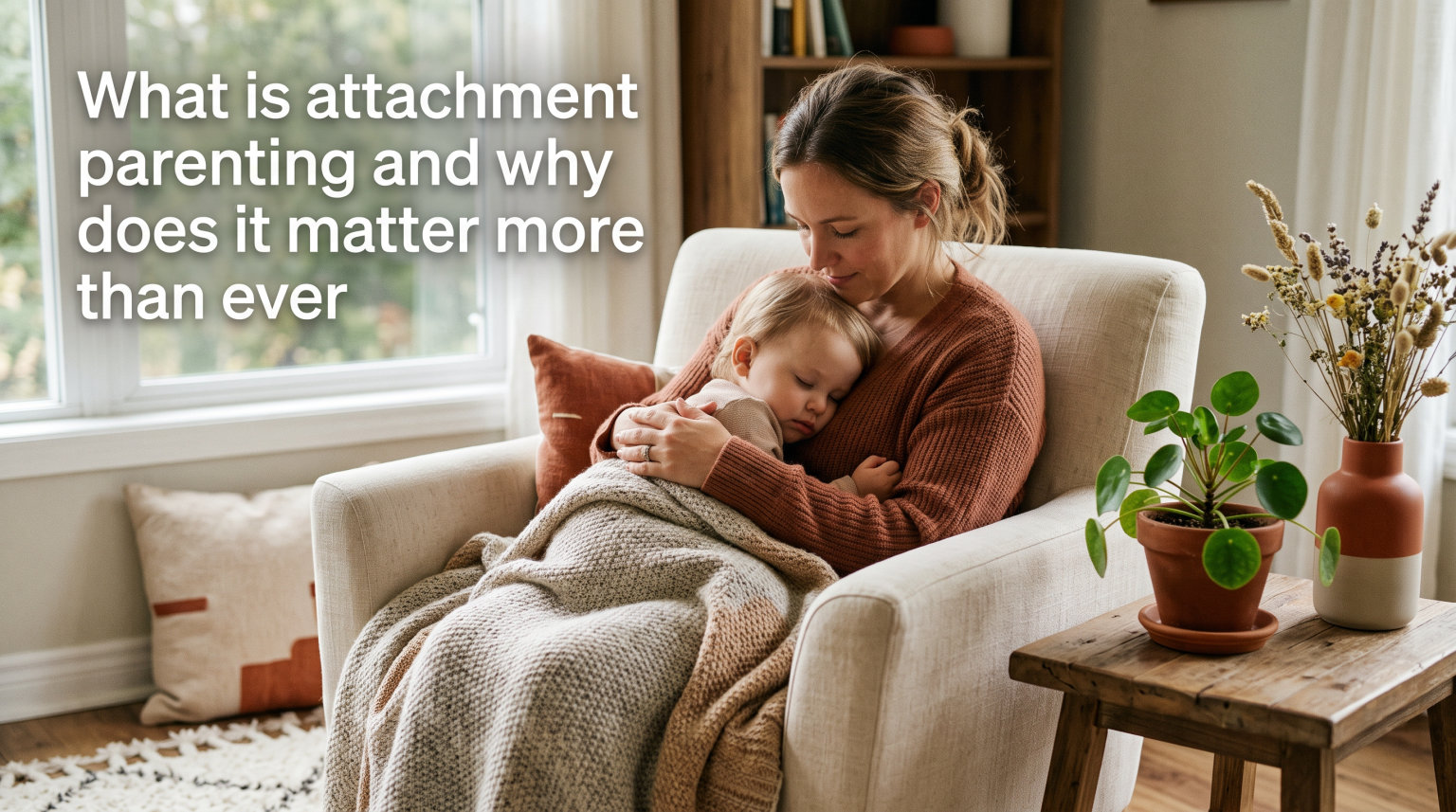
Modern parenting faces challenges our grandparents never imagined. Screens dominate our attention. Social connections happen through devices instead of front porches. Parents report higher stress and isolation than any generation before. In this landscape of disconnection, one approach feels both radical and deeply traditional: attachment parenting. This philosophy matters more in 2026 than it ever has, offering a roadmap back to what children actually need most. Our human connection.
When I first encountered attachment parenting as a new mother, I felt both relief and overwhelm. Relief because finally someone was saying what my instincts already knew. Overwhelm because the list of “shoulds” seemed impossibly long for a working parent. Over the years, I’ve learned that attachment parenting isn’t about following a rigid set of rules. It is about understanding what secure attachment truly means and making intentional choices that work for your family.
In this guide, you’ll learn what attachment parenting actually is (and what it isn’t), the seven principles known as the Baby Bs, why this approach matters more than ever in our digital age, and how to adapt these principles to real life without burning out. Whether you’re a stay-at-home parent, a working mother, or a single dad, there are practical takeaways here for building the kind of secure bond that serves children for life.
Table of Contents
What Is Attachment Parenting?
Attachment parenting is a philosophy developed by pediatrician Dr. William Sears and his wife Martha Sears in the 1980s that emphasizes physical closeness, emotional responsiveness, and building a strong bond between parent and child from birth. The approach is based on attachment theory, the scientific framework developed by British psychiatrist John Bowlby and psychologist Mary Ainsworth in the 1950s and 1960s.
Here’s the crucial distinction many articles miss. Attachment theory is the science of how human beings form emotional bonds. Bowlby observed that infants have an innate drive to seek proximity to caregivers, especially during stress. Ainsworth’s famous “Strange Situation” experiment identified different attachment styles: secure, anxious, avoidant, and disorganized. This research applies to ALL caregiving approaches.
Attachment parenting, by contrast, is a specific set of practices designed to promote secure attachment. The Sears coined the term in their 1993 book “The Baby Book” and outlined what they called the Seven Baby Bs. While rooted in attachment science, attachment parenting is one particular interpretation of how to achieve secure bonds. Not the only way.
At its core, attachment parenting operates on a simple premise: babies communicate their needs through crying, body language, and behavior. When parents respond consistently and sensitively, children learn that their needs matter and that the world is safe. This security becomes the foundation for emotional regulation, independence, and healthy relationships throughout life.
The 7 Baby Bs of Attachment Parenting
The Seven Baby Bs form the practical framework of attachment parenting. Think of them as tools in a toolkit rather than commandments etched in stone. Each B represents a specific practice designed to promote closeness and responsiveness.
Birth Bonding
The first B emphasizes the critical hours and days after birth as a sensitive period for attachment. Birth bonding includes immediate skin-to-skin contact, delaying non-urgent medical procedures, and keeping mother and baby together as much as possible during the hospital stay.
Research supports this principle strongly. Studies show that early skin-to-skin contact helps regulate a newborn’s temperature, heart rate, and breathing. It also promotes breastfeeding initiation and releases oxytocin in both mother and baby. This hormone, sometimes called the “love hormone,” plays a key role in bonding.
However, life doesn’t always follow birth plans. Some mothers require emergency C-sections. Some babies need immediate medical intervention. Some adoptions don’t allow for immediate contact. The principle here is about maximizing early connection when possible, not about perfection or guilt when circumstances intervene.
Breastfeeding
Breastfeeding represents the biological norm for infant feeding and offers unique opportunities for attachment. The physical closeness, eye contact, and responsiveness required by on-demand nursing align well with attachment parenting principles.
Breastfeeding also involves responsive feeding, meaning feeding according to baby’s cues rather than a strict schedule. This responsiveness teaches babies that their communication results in care, building trust and security. The oxytocin release during nursing promotes bonding for both mother and child.
But let’s be clear: breastfeeding challenges are real. Some mothers struggle with milk supply. Some babies have latch issues. Some families choose formula for a variety of valid reasons. Attachment parenting advocates typically emphasize that feeding responsively matters more than feeding method. A bottle-feeding parent who reads baby’s cues, makes eye contact, and responds warmly can build just as secure an attachment.
Baby-Wearing
Baby-wearing means keeping your infant close throughout the day using a sling, wrap, or carrier. This practice provides constant physical proximity while allowing parents to remain hands-free for daily tasks. The baby feels the parent’s heartbeat, warmth, and movement, which mimics the womb environment.
From an attachment perspective, baby-wearing allows for immediate responsiveness. When a baby stirs or makes a sound, the parent notices immediately and can respond before full crying begins. This quick responsiveness builds the baby’s trust that needs will be met.
Research on baby-wearing shows benefits including reduced crying (particularly in the evening “witching hours”), improved sleep patterns, and enhanced parental sensitivity to baby’s cues. Many parents also report practical benefits like having two free hands to care for older siblings or complete household tasks.
Safety matters enormously with baby-wearing. Carriers must support baby’s hips properly to prevent hip dysplasia. Babies need clear airways with chins off their chests. Parents should follow manufacturer guidelines and consult resources like the Baby Carrier Industry Alliance for safe positioning.
Bedding Close to Baby
This B recommends keeping baby in close physical proximity during sleep, either through co-sleeping (baby in parents’ room) or bed-sharing (baby in parents’ bed). The rationale is that proximity allows for easier nighttime feeding, more responsive caregiving, and better sleep for both parents and babies.
Here’s where attachment parenting generates significant controversy and where nuance becomes essential. The American Academy of Pediatrics recommends room-sharing without bed-sharing for at least the first six months, citing reduced SIDS risk. Bed-sharing carries documented risks, particularly when parents smoke, use substances, or sleep on soft surfaces.
Many attachment parenting advocates distinguish between safe bed-sharing practices and dangerous ones. Safe bed-sharing involves firm mattresses, minimal bedding, no gaps where baby could become trapped, and sober, non-smoking parents. Some families use sidecar cribs or co-sleepers that attach to the parents’ bed, creating proximity without full bed-sharing.
The key insight here is intentionality. Attachment parenting emphasizes being responsive to baby’s nighttime needs. This can happen through room-sharing, responsive feeding and comforting, and then returning baby to their own sleep space. Bed-sharing is one option, not a requirement for attachment.
Belief in Baby’s Cry
This principle is perhaps the most philosophically distinctive aspect of attachment parenting. “Belief in baby’s cry” means viewing crying as communication rather than manipulation. Instead of seeing crying as something to be trained out of, attachment parenting treats crying as a signal that needs response.
This B stands in direct contrast to “cry it out” sleep training methods, which involve allowing babies to cry for specified periods before responding. Attachment parenting advocates argue that leaving babies to cry alone floods their systems with stress hormones and teaches them that their communication won’t be answered.
Research on crying does show that responsive care reduces overall crying over time. Babies whose parents respond quickly actually cry less as they get older, having learned that their needs will be met. These babies also show more secure attachment patterns in testing.
However, “belief in baby’s cry” does not mean parents must respond instantly to every sound, dropping everything they are doing. It means taking cries seriously, responding as promptly as circumstances allow, and never leaving a baby to cry alone intentionally as a training method. Sometimes response means picking baby up. Sometimes it means talking soothingly while finishing a task. The goal is communication, not perfection.
Balance and Boundaries
This B often surprises people who think attachment parenting means total self-sacrifice. Balance and boundaries acknowledge that parents have needs too, and that burned-out parents cannot provide the consistent, warm care that secure attachment requires.
Attachment parenting is not about martyrdom. It’s not about neglecting your marriage, your health, or your sanity in service to your baby. William Sears himself emphasized that parents must take care of themselves to take care of their children. This includes asking for help, taking breaks, and maintaining adult relationships.
Boundaries also develop as children grow. Toddlers need different limits than newborns. Secure attachment actually requires age-appropriate boundaries that help children feel safe and learn self-regulation. The responsive parent gradually shifts from meeting every need to teaching children how to meet their own needs.
This B matters enormously for working parents. Many parents cannot be physically present 24/7. Attachment parenting principles can still apply: quality connection during available time, responsive caregiving during those hours, maintaining routines that provide security, and choosing caregivers who will also be responsive and warm.
Beware of Baby Trainers
The final B advises caution about parenting approaches that promise quick fixes through behavioral conditioning. “Baby trainers” refers to methods that emphasize strict schedules, crying it out, or ignoring baby’s signals to establish parent “dominance” or control.
The concern here is not about seeking advice or learning new strategies. It’s about approaches that fundamentally misunderstand infant development. New babies cannot be spoiled. They don’t cry to manipulate. They cry because they need something, whether that’s food, comfort, temperature regulation, or simply closeness.
This B encourages parents to trust their instincts and their baby’s communication rather than external programs that override both. It doesn’t mean rejecting all sleep advice or feeding guidance. It means evaluating such advice against the principle of responsiveness and the reality of your baby’s cues.
That said, this principle can become dogmatic in harmful ways. Parents who genuinely need help with sleep challenges shouldn’t feel guilty for seeking solutions. Some babies have reflux, sensory sensitivities, or other issues that make sleep genuinely difficult. Attachment parenting should support parents in finding what works for their specific situation, not add judgment to an already hard job.
Why Attachment Parenting Matters More Than Ever
Here’s the angle no competitor article adequately covers. Attachment parenting isn’t just a nostalgic return to traditional practices. It’s a desperately needed antidote to modern life in 2026. Our current context makes attachment principles more relevant, not less.
Consider the landscape facing today’s parents and children. Screen time has exploded. The average American child spends 7 hours daily on screens, with infants and toddlers increasingly exposed to phones and tablets. Parents are also screen-saturated, often physically present but mentally absent, scrolling while babies try to catch their attention.
Social isolation has reached epidemic levels. The saying “it takes a village” reflects evolutionary reality, but most parents today parent alone. We lack the multi-generational support, the neighborly networks, the community structures that historically helped raise children. The pandemic worsened this isolation, and many families haven’t recovered their social connections.
Child and adolescent mental health has deteriorated dramatically. Anxiety and depression rates among young people have risen steadily over the past decade. While many factors contribute, research consistently shows that secure attachment in early childhood predicts better emotional regulation, stress resilience, and mental health outcomes throughout life.
Attachment parenting offers a counter-cultural response. It insists that human connection matters more than efficiency. It prioritizes relationship over schedules. It recognizes that babies are humans with legitimate emotional needs, not problems to be managed or projects to be optimized.
The neurobiology supports this urgency. During the first three years of life, a child’s brain forms over one million neural connections every second. These connections are shaped by experience, particularly by relationships. Responsive caregiving actually builds brain architecture, strengthening neural pathways for emotional regulation, empathy, and stress management.
Conversely, early stress without buffering relationships floods developing brains with cortisol, potentially altering stress response systems permanently. The ” Strange Situation” research by Ainsworth showed that securely attached children explore more confidently because they have a “secure base” to return to. Insecurely attached children, lacking this foundation, show either excessive clinginess or premature independence born of necessity rather than confidence.
In our high-stress, hyper-individualistic culture, creating secure attachment requires more intentionality than ever. Our ancestors didn’t need a parenting philosophy for physical closeness. It was simply how life worked. Today’s parents must often make counter-cultural choices to achieve what used to happen naturally.
This is why attachment parenting matters more than ever. Not because the principles have changed, but because the obstacles to implementing them have grown. Every responsive interaction in a world of distractions becomes a small rebellion against disconnection. Every moment of presence in an attention-economy becomes a gift of incalculable value.
Benefits of Attachment Parenting
The benefits of attachment parenting align closely with what research shows about secure attachment generally. These outcomes aren’t exclusive to families following the Seven Baby Bs, but the practices do promote the conditions that create secure attachment.
Emotional Regulation and Stress Resilience
Securely attached children show better emotional regulation skills. When parents consistently respond to distress with comfort, children learn that emotions are manageable and that support is available. This creates what researchers call “emotion coaching,” where children develop the internal capacity to handle feelings rather than being overwhelmed by them.
Long-term studies show that secure attachment in infancy predicts better stress management in adulthood. The hypothalamic-pituitary-adrenal (HPA) axis, which governs stress response, develops partly based on early caregiving experiences. Responsive care appears to buffer the developing stress system, creating resilience that lasts decades.
Cognitive Development and School Readiness
Contrary to fears that attachment parenting creates dependence, research shows that secure attachment actually promotes independence and exploration. When children feel safe with their caregiver as a base, they venture out more confidently. The secure child knows they can return if needed, so they take appropriate risks.
Studies link secure attachment to better language development, problem-solving skills, and academic performance. The mechanism isn’t mysterious. Responsive caregiving involves lots of communication, eye contact, and engagement. These interactions build vocabulary, model thinking patterns, and create the emotional security that allows children to focus on learning rather than vigilance.
Social Competence and Relationships
Attachment patterns tend to persist and generalize. Children who experience secure attachment with caregivers typically form better relationships with peers, teachers, and eventually romantic partners. They show more empathy, better conflict resolution skills, and healthier boundaries.
Attachment theory describes this as “internal working models.” Children develop mental templates for relationships based on early experiences. Secure attachment creates a template that says “people are trustworthy, my needs are acceptable, and relationships are safe.” This template shapes expectations and behaviors in all subsequent relationships.
Physical Health Outcomes
Some research links secure attachment to better physical health outcomes, including stronger immune function and lower inflammation markers. The mechanism likely involves the stress-buffering effects mentioned earlier. Chronic stress suppresses immune function, so early experiences that create stress resilience may have physical health benefits.
Breastfeeding, baby-wearing, and co-sleeping (when practiced safely) also have documented physical benefits. Breastfeeding provides optimal nutrition and immune protection. Baby-wearing may promote physical development and reduce crying-related stress. Room-sharing without bed-sharing reduces SIDS risk while maintaining proximity.
Long-term Mental Health
Perhaps most importantly in our current mental health crisis, secure attachment predicts lower rates of anxiety, depression, and behavioral disorders. While attachment isn’t destiny, and many other factors influence mental health, early security provides a protective buffer.
Attachment parenting specifically has been studied less than attachment theory broadly, but available research suggests that the practices do promote the responsive caregiving that creates security. One study found that mothers practicing attachment parenting showed more sensitivity to infant cues. Another found that attachment parenting practices correlated with more secure attachment classifications in the Strange Situation.
It’s worth noting that these benefits flow from secure attachment, which can develop through various parenting approaches. The Seven Baby Bs are tools for building security, not the only possible tools. Parents who are warm, responsive, and consistent will likely raise securely attached children whether they breastfeed, baby-wear, or bed-share.
Common Criticisms and Finding Balance
No parenting philosophy is perfect for everyone, and attachment parenting faces legitimate criticisms. Addressing these honestly helps parents make informed choices without unrealistic expectations.
Privilege and Accessibility Concerns
The most significant criticism of attachment parenting is that it assumes resources many families lack. Breastfeeding requires time, support, and sometimes workplace accommodations that aren’t available to all mothers. Bed-sharing assumes a safe sleep environment, which not every home provides. Constant responsiveness is easier when parents aren’t working multiple jobs or facing other stressors.
These criticisms have merit. Attachment parenting, as originally formulated, did assume a certain family structure. The Sears wrote from their own experience as a pediatrician father and stay-at-home mother with multiple children. Their advice didn’t always address the realities of single parents, working-class families, or those without extended family support.
The modern attachment parenting community has evolved to acknowledge these disparities. Many advocates now emphasize that the principles matter more than the specific practices. Responsive bottle-feeding can replace breastfeeding. Room-sharing can replace bed-sharing. Quality connection during available hours can replace constant physical presence. The goal is attachment, not a particular method of achieving it.
Parental Burnout and Guilt
Attachment parenting, when taken to extremes, can become a recipe for parental burnout. On-demand feeding, constant baby-wearing, and night-time responsiveness leave little time for self-care. Parents may feel guilty for wanting breaks, for feeling resentment, or for not enjoying every moment of intensive caregiving.
This is where the “Balance and Boundaries” B becomes crucial but is sometimes overlooked. Attachment parenting should not mean parental martyrdom. Parents who sacrifice their own wellbeing ultimately harm their children too, because burned-out parents cannot provide warm, consistent care.
If you’re practicing attachment parenting and feeling overwhelmed, that is information worth heeding. It may mean adjusting your practices, asking for more help, or simply giving yourself permission to be imperfect. A responsive parent who takes care of their own needs models self-respect and sustainable caregiving better than a depleted parent sacrificing everything.
Safety Concerns
Bed-sharing deserves serious safety consideration. The American Academy of Pediatrics maintains that bed-sharing increases SIDS and suffocation risk, particularly for infants under four months, premature babies, and those exposed to parental smoking or alcohol use. These recommendations are based on population-level data showing increased risk.
Attachment parenting advocates sometimes cite international statistics showing that bed-sharing is common in countries with lower SIDS rates, like Japan. This is accurate but incomplete. Safe bed-sharing practices differ from the risky practices common in high-SIDS populations. Safe bed-sharing involves firm surfaces, minimal bedding, and sober non-smoking parents. Even then, some risk remains compared to separate sleep surfaces in the same room.
Parents must make informed decisions weighing risks and benefits. Room-sharing without bed-sharing maintains proximity while reducing SIDS risk. Sidecar cribs and co-sleepers provide middle-ground options. What matters is making an intentional choice with full information, not defaulting to any practice because a parenting philosophy recommends it.
Concerns About Creating Dependent Children
A persistent worry is that attachment parenting creates clingy, dependent children who cannot function independently. This concern misunderstands attachment dynamics. Secure attachment actually produces confident exploration and eventual independence.
Think about it logically. Children who trust that their needs will be met and that their secure base remains available can afford to venture out. Children who feel insecure either cling excessively (anxious attachment) or withdraw prematurely (avoidant attachment). The securely attached child is the one who waves happily at preschool drop-off, knowing Mom or Dad will return.
Long-term research confirms this. Securely attached children show greater independence, social competence, and resilience than insecurely attached peers. They don’t stay dependent longer. They become confident earlier because their foundation is solid.
Flexibility and Individual Differences
Not every baby fits the attachment parenting ideal. Some babies have reflux, colic, sensory processing differences, or other challenges that make standard recommendations difficult. Some babies resist baby-wearing. Some families have circumstances that prevent breastfeeding or bed-sharing.
Attachment parenting should serve families, not constrain them. If a particular practice isn’t working for your baby or your situation, that practice can be modified or set aside. The underlying principle of responsiveness matters more than any specific method. A baby who gets responsive, loving care through different practices will still develop secure attachment.
Some babies also have temperaments that challenge responsive parenting. Highly sensitive babies may need different approaches than easygoing babies. Parents must adapt their responsiveness to the actual child in front of them, not to a theoretical ideal.
Frequently Asked Questions
What are the 7 B’s of attachment parenting?
The 7 B’s of attachment parenting, developed by William and Martha Sears, are: 1) Birth Bonding – immediate connection after birth, 2) Breastfeeding – responsive, on-demand nursing, 3) Baby-Wearing – keeping baby close in a carrier, 4) Bedding Close to Baby – co-sleeping or room-sharing, 5) Belief in Baby’s Cry – viewing crying as communication, not manipulation, 6) Balance and Boundaries – caring for parent’s needs too, and 7) Beware of Baby Trainers – avoiding rigid programs that ignore baby’s cues.
What is the 7 7 7 rule for parents?
The 7 7 7 rule suggests that babies typically cry most at 7 weeks, experience evening fussiness around 7 PM, and the phase usually lasts about 7 weeks. While not specifically from attachment parenting literature, this rule helps parents understand that increased crying is a normal developmental phase that will pass with responsive care.
Why is attachment parenting good?
Attachment parenting promotes secure attachment between parent and child, which research links to better emotional regulation, stress resilience, cognitive development, and long-term mental health. The practices emphasize physical closeness and emotional responsiveness, creating a foundation of trust that supports healthy development throughout life.
What are the 5 B’s of attachment parenting?
The 5 B’s represent a simplified version of attachment parenting principles: Birth Bonding, Breastfeeding, Baby-Wearing, Bedding Close to Baby, and Belief in Baby’s Cry. Some parents find this version more manageable while still capturing the core philosophy of responsive, close caregiving. The full 7 B’s add Balance and Boundaries and Beware of Baby Trainers.
Can you do attachment parenting if you work full-time?
Yes, working parents can practice attachment parenting principles by focusing on quality connection during available time, maintaining responsive caregiving during evenings and weekends, creating consistent routines that provide security, and choosing caregivers who will also be warm and responsive. The Balance B specifically addresses parental needs including work requirements.
Does attachment parenting create clingy children?
No, research shows that secure attachment actually promotes healthy independence. Children who trust that their needs will be met and that their secure base remains available feel confident exploring the world. Securely attached children typically show greater independence and social competence than insecurely attached peers because their emotional foundation is solid.
Conclusion
Attachment parenting offers something precious in our disconnected modern world: a framework for building the kind of secure, trusting relationship that every child needs to thrive. The Seven Baby Bs provide practical tools, but they are means to an end, not the end itself. That end is secure attachment, and it can be achieved through various paths adapted to individual families.
What is attachment parenting and why does it matter more than ever? It matters because our children are growing up in an environment of unprecedented digital distraction, social isolation, and stress. In this context, intentional connection becomes not just a nice idea but a vital intervention. Every responsive interaction, every moment of presence, every instance of truly seeing your child builds neural pathways that will serve them for life.
But attachment parenting must be practiced with wisdom and flexibility. It should not become another source of guilt for already-stressed parents. It should not ignore safety considerations or family realities. It should serve your family, not constrain it. Take the principles that resonate, adapt them to your circumstances, and release the rest without shame.
The research is clear: secure attachment predicts better outcomes across virtually every domain of human development. How you create that security matters less than that you create it. Whether through breastfeeding or responsive bottle-feeding, baby-wearing or simply being present, bed-sharing or room-sharing, what children need most is a caregiver who sees them, responds to them, and provides a safe base from which to explore the world.
In 2026, as screens compete for our attention and isolation strains our resilience, choosing attachment becomes an act of hope. It says that human connection still matters most. It says that our babies deserve our best presence. And it says that the future we’re building starts with how we care for our children right now.