
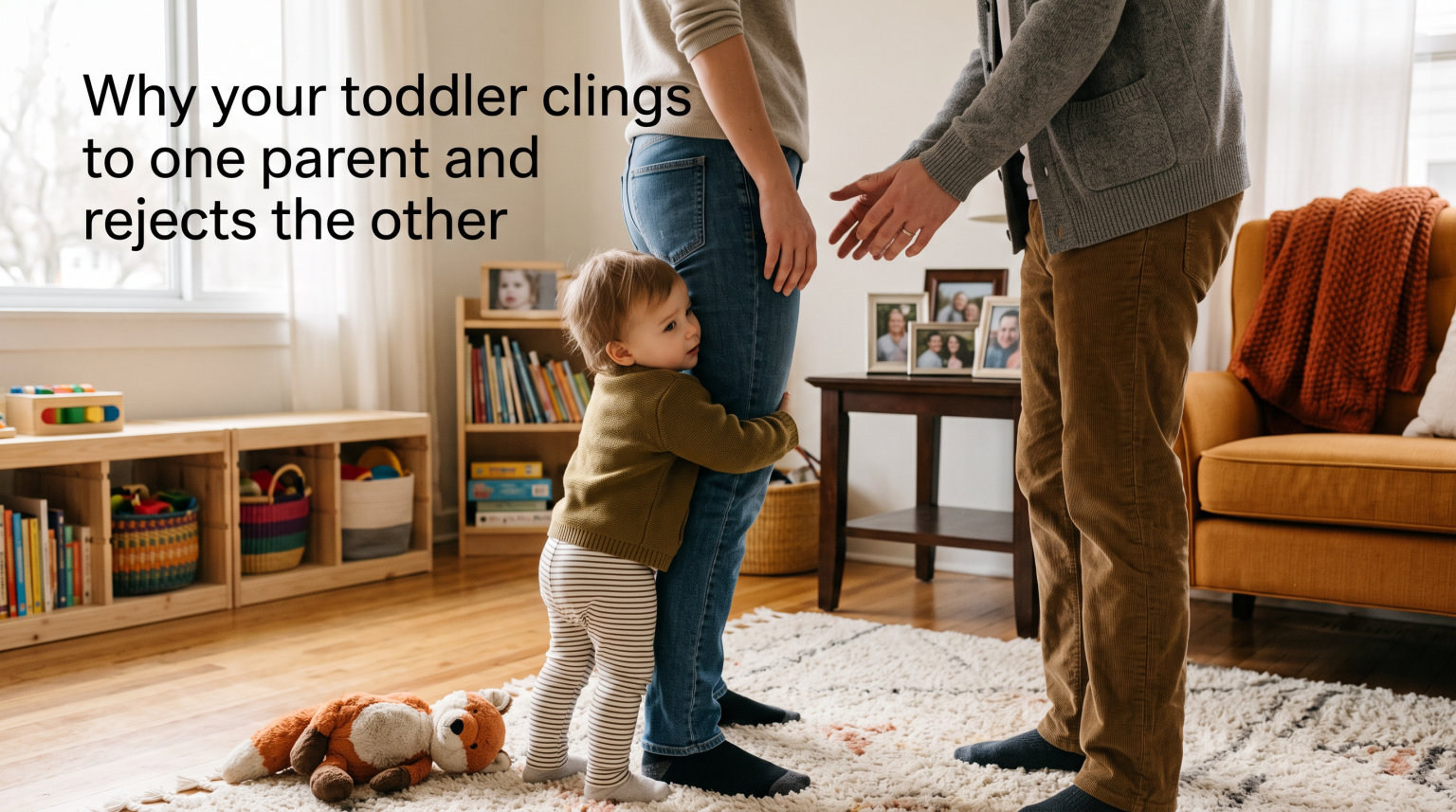
Your toddler screams “No!” when Daddy tries to buckle the car seat. They only want Mommy to read bedtime stories. When you reach for a hug, they turn away and cling to your partner instead. This toddler favoritism feels like a rejection straight to your heart.
Take a deep breath. This is completely normal. In fact, parent preference is one of the most common developmental phases toddlers go through, and it says nothing about your worth as a parent or the love your child has for you.
Our team has spoken with dozens of parents who have walked through this exact experience. We have also reviewed the latest child development research to give you both reassurance and practical strategies. Whether you are the preferred parent feeling guilty or the “rejected” parent nursing hurt feelings, this guide will help you understand why your toddler clings to one parent and what you can do about it.
Table of Contents
Why Your Toddler Clings to One Parent and Rejects the Other
Toddlers gravitate toward the caregiver they feel most familiar with at any given moment. This behavior stems from their developing brains seeking security, predictability, and comfort during a time of rapid growth and change.
According to the American Academy of Pediatrics, attachment theory explains why young children form strong preferences. Toddlers create what researchers call “hierarchies of attachment” — essentially ranking their caregivers based on who makes them feel safest and most understood.
This does not mean your child loves one parent more. It simply means they have identified one caregiver as their current “safe base” during a developmental stage where they need extra reassurance. The preference can shift based on routines, daily activities, or even your toddler’s mood.
Attachment Hierarchies: The Science Behind the Preference
Child psychologists have identified that children naturally organize their attachments in order of familiarity and predictability. The parent who spends more time handling daily routines — meals, naps, bedtime — often becomes the “primary attachment figure” simply because the child associates them with comfort and care.
Research from the Journal of Child Psychology shows that these hierarchies are healthy and normal. They reflect a child’s ability to distinguish between caregivers and express preferences, which is actually a sign of cognitive development. Your toddler is not being manipulative. They are showing you they can recognize different relationships and articulate what they want.
Separation Anxiety and Toddler Independence
The period between 18 months and 3 years is filled with contradictory impulses. Your toddler wants independence — until they do not. They want to explore the world — but only if their safe person is nearby. This push-and-pull creates what looks like toddler clingy to one parent behavior.
During separation anxiety phases, which typically peak around 18 months and again at age 2, children naturally cling to their primary caregiver for security. When they are testing boundaries and asserting their growing autonomy, having one consistent person provides the stability they need to explore.
The Role of Routine and Familiarity
Toddlers are creatures of habit. They thrive on predictability in a world that often feels overwhelming and out of their control. The parent who handles the same routines day after day becomes associated with those comforting patterns.
If Mom always does bath time, the toddler may start to insist only Mom can do bath time. If Dad is the one who plays blocks every morning, suddenly only Dad’s block tower is acceptable. This is not about rejecting anyone. It is about seeking the familiar in a world that changes constantly.
Understanding the Psychology: Why Toddlers Choose Their Favorite
Beyond attachment theory, there is another fascinating explanation for why a child rejects one parent while clinging to another. Some child development experts point to something called “appeasement theory.”
Appeasement Theory: Appeasing the Struggling Parent
Here is an angle many parents have not considered: toddlers are incredibly perceptive. They pick up on emotional undercurrents, stress levels, and relationship dynamics even when we think we are hiding them well.
According to appeasement theory, young children may gravitate toward the parent who seems most stressed or emotionally vulnerable as a way of managing the family emotional system. Your toddler senses when one parent is struggling. By clinging to that parent and rejecting the other, they may be unconsciously trying to regulate the household’s emotional balance.
Think about it: if Mom has been working long hours and seems exhausted and sad about missing time with the toddler, the child may cling to Mom during the limited hours they have together. They sense her need for connection and respond to it. Meanwhile, the well-rested parent who has been present all day gets the rejection simply because they seem more emotionally stable.
Temperament and Personality Factors
Some children are simply more temperamentally cautious. A slow-to-warm-up child may take longer to feel comfortable with both parents equally. Highly sensitive toddlers may need more time and repeated positive experiences before they warm up to a particular caregiver.
Gender can also play a role, though not in the way many assume. Toddlers often go through phases of identifying strongly with one parent based on their developing sense of self. A little girl might suddenly only want Mommy because she is starting to understand “I am a girl like Mommy.” A little boy might attach strongly to Dad during the same developmental phase.
Why This Is Not Real Rejection
When your toddler screams “Go away!” or pushes your hand away while reaching for the other parent, it stings. It feels personal. Many parents describe it as one of the most painful experiences in their parenting journey.
One mother shared on a parenting forum: “My 2.5 year old has had an almost extremist preference towards my husband. He does not want me to do much of anything with him. I have cried about this more than I want to admit.”
Your feelings are valid. The rejection is real to you, and that pain deserves acknowledgment. But here is what you need to understand: from your toddler’s perspective, this is not rejection at all.
What Your Toddler Is Actually Saying
When your toddler pushes you away, they are not saying “I do not love you.” They are saying “I need the predictability of my other parent right now.” They are saying “I feel uncertain and only this person feels safe enough.” They are saying “My brain is overwhelmed and I am seeking my comfort object — which happens to be a person.”
Children this age lack the emotional vocabulary to express complex needs. They cannot say “Dad, I love you so much, but right now I need Mom because she handled my bedtime routine for the past week and my brain craves that predictability.” Instead, they scream “No! Want Mommy!”
The Long-Term Perspective
Almost every parent who has been through this phase will tell you the same thing: it passes. The toddler who only wanted Mommy for six months suddenly becomes Daddy’s biggest fan. The child who rejected Dad at bedtime now insists only Dad can do the tuck-in.
As one experienced parent wrote: “Kids go through phases where one parent is the safe place, and it shifts over time. My toddler was glued to me for months and then suddenly switched to preferring dad. It is just a normal phase of toddler development — it is not personal.”
Tips for the Non-Preferred Parent: What to Do When Your Toddler Rejects You
If you are the parent getting the cold shoulder, you need both emotional strategies and practical approaches. Here is what the research and experienced parents recommend.
Do Not Take It Personally
This is easier said than done, but it is crucial. Remind yourself daily that your child’s preference is about their developmental needs, not your parenting quality. You are still a good parent. You are still deeply loved. You are still essential to your child’s wellbeing.
Create a mantra if you need to: “This is a phase. This is normal. My child loves me even when they cannot show it.” Say it when the hurt feels overwhelming.
Start Small and Low-Pressure
Do not try to force major bonding moments when the rejection is strongest. Instead, find small, low-stakes ways to connect. Sit near your toddler while they play without demanding interaction. Read a book in the same room. Do parallel activities that do not require their direct attention.
Let them come to you. When they do, respond warmly but calmly. Too much excitement can actually create pressure that pushes them away again.
Create Special Routines
Ask the preferred parent to step back from one small routine and make it yours. Maybe you become the official breakfast maker. Maybe you take over the walk to the mailbox. Perhaps you are the one who always does bathtime on Saturday mornings.
Consistency matters more than quantity here. A 10-minute daily routine that is exclusively yours will build more connection than occasional big outings. The predictability helps your toddler feel safe with you.
Play the “Bad Cop” Role Without Guilt
Sometimes the non-preferred parent gets stuck with all the unpopular tasks — discipline, doctor appointments, saying no to candy. This can reinforce the preference if the toddler starts to see one parent as all fun and the other as all rules.
Have a conversation with your partner about sharing both the fun and the firm boundaries. Make sure you are getting equal time for play and cuddles, not just rules and routines.
Process Your Feelings Elsewhere
The pain of rejection is real, and you need support. Talk to friends, a therapist, or your partner. Journal about your feelings. Do not let your hurt leak into interactions with your child through subtle tension or forced cheerfulness that they can sense is fake.
Your toddler can pick up on your emotional state. If you approach them feeling wounded and desperate for their approval, they may sense that pressure and retreat further. Work through your emotions separately so you can be genuinely relaxed and patient with your child.
Tips for the Preferred Parent: How to Help Your Partner
Being the chosen parent comes with its own challenges. You may feel guilty when your partner gets rejected. You might be exhausted from handling all the demanding moments. You could worry that your child’s preference will permanently damage their relationship with their other parent.
Here is how to navigate being the “favorite” while supporting your family.
Acknowledge Your Partner’s Pain
Do not minimize your partner’s hurt by saying “It is just a phase” or “You are being too sensitive.” Validate their feelings. Say things like “I know this is really hard for you” and “I can see how much it hurts when they push you away.”
The rejected parent needs to know you see their struggle and you do not judge them for feeling wounded.
Step Back to Create Space
As hard as it is to hear your child cry for you, sometimes you need to leave the room. When your partner is trying to handle bedtime and your toddler is screaming for Mommy instead, resist the urge to rush in and rescue everyone.
Instead, leave the house for a walk. Put on headphones in another room. Trust your partner to handle the moment, even if there are tears. Your absence creates space for your child and partner to develop their own relationship dynamics.
Share the Good and the Hard
Make sure you are not always the “fun” parent while your partner is stuck with all the unpopular tasks. Trade off who handles doctor appointments, who says no to treats before dinner, who manages the difficult bedtime when your toddler is overtired.
Both parents need experiences of being the comforter and being the one who holds boundaries. This balance prevents your child from seeing one parent as exclusively associated with either fun or rules.
Highlight the Other Parent’s Strengths
In casual conversation, mention how much your partner loves your child. Point out when the other parent does something well. Say “Wasn’t that so fun when Daddy took you to the park?” or “Mommy is so good at making you laugh.”
These comments plant seeds in your toddler’s mind about the other parent’s value. Over time, this positive framing helps shift their perception.
How Long Does Toddler Parent Preference Last?
This is one of the most common questions parents ask. The honest answer is that it varies, but there are some general patterns you can expect.
Typical Timelines by Age
Parent preference often emerges around 18 months when separation anxiety peaks and toddlers become more aware of their attachment figures. It can intensify between ages 2 and 3 as children develop stronger opinions and the language to express them.
Most parent preference phases last anywhere from a few weeks to several months. Some families experience multiple waves — six months of preferring Mom, then a sudden switch to Dad, then back again.
Signs the Phase Is Shifting
You will know things are changing when your toddler starts accepting the non-preferred parent for small tasks without protest. Maybe they let Dad pour the milk without screaming for Mom. Perhaps they accept a hug from Mommy when they fall down instead of pushing her away to find Daddy.
These small wins add up. The shift is usually gradual rather than overnight. One day you realize it has been a week since the last major rejection episode.
What If It Lasts Too Long?
If your toddler’s preference has been intense and unwavering for more than 6-9 months with no signs of flexibility, it may be worth talking to your pediatrician. While still likely within the range of normal, extended periods of intense rejection can strain family relationships and warrant professional guidance.
Trust your instincts. If something feels off beyond normal preference, get support early.
When to Seek Professional Help
Most toddler parent preference is a normal developmental phase. However, there are some situations where professional guidance can help.
Red Flags to Watch For
Consider consulting a pediatrician or child psychologist if you notice any of the following: Your toddler shows extreme distress that lasts for hours when separated from the preferred parent. They refuse to eat, sleep, or play when the non-preferred parent is present. The rejection is accompanied by regression in other areas like toilet training or language.
Also seek help if the family dynamic has become so strained that parents are fighting frequently, if the non-preferred parent is withdrawing emotionally from the child, or if the preferred parent is experiencing burnout from handling all the caregiving demands.
Family Therapy Can Help
A family therapist specializing in early childhood can provide strategies tailored to your specific situation. They can help the non-preferred parent rebuild connection, support the preferred parent in stepping back appropriately, and guide the entire family toward healthier dynamics.
There is no shame in seeking support. Early intervention prevents small issues from becoming entrenched patterns that damage parent-child relationships long-term.
Frequently Asked Questions About Toddler Parent Preference
Why do toddlers reject one parent?
Toddlers reject one parent as a way to assert independence, seek security through familiar routines, and manage their developing sense of attachment. This behavior reflects normal cognitive development, not a lack of love for the rejected parent. It is usually temporary and shifts as children grow.
How long does toddler parent preference last?
Most toddler parent preference phases last between a few weeks and several months. Some children experience multiple waves of favoritism, switching between parents. Intense preference lasting more than 6-9 months without any flexibility may warrant professional guidance.
Is it normal for toddlers to prefer one parent?
Yes, preferring one parent is completely normal and common. According to child development experts, about 80% of toddlers go through phases of strong parent preference. This reflects healthy attachment development and cognitive growth as children learn to distinguish between caregivers and express preferences.
What should the non-preferred parent do?
The non-preferred parent should avoid taking the rejection personally, create special low-pressure routines for connection, let the child come to them naturally, and process their hurt feelings with a partner or therapist rather than letting those emotions affect interactions with the child.
Should parents force their toddler to accept the non-preferred parent?
Forcing interactions usually backfires and increases the child’s resistance. Instead, create opportunities for organic connection through shared routines, give the non-preferred parent space to bond without interference, and remain patient while the child gradually becomes more comfortable.
Conclusion: Why Your Toddler Clings to One Parent and Rejects the Other
Watching your toddler cling to one parent while rejecting the other is one of the more painful aspects of early childhood. But understanding the developmental reasons behind this behavior — attachment theory, routine familiarity, and your child’s need for security — can help you respond with patience rather than hurt.
Remember what experienced parents consistently report: this phase passes. The child who screamed for only Mommy now asks when Daddy will be home. The toddler who pushed Dad away now requests him specifically at bedtime. Your relationship with your child is bigger than this single developmental phase.
Whether you are the preferred parent feeling guilty or the rejected parent nursing hurt feelings, the strategies in this guide can help you navigate this challenging time. Stay patient, stay connected, and trust that your child’s love for you runs deeper than their current preference.
If you are struggling significantly, do not hesitate to reach out to your pediatrician or a family therapist. Support is available, and you do not have to navigate this alone.