
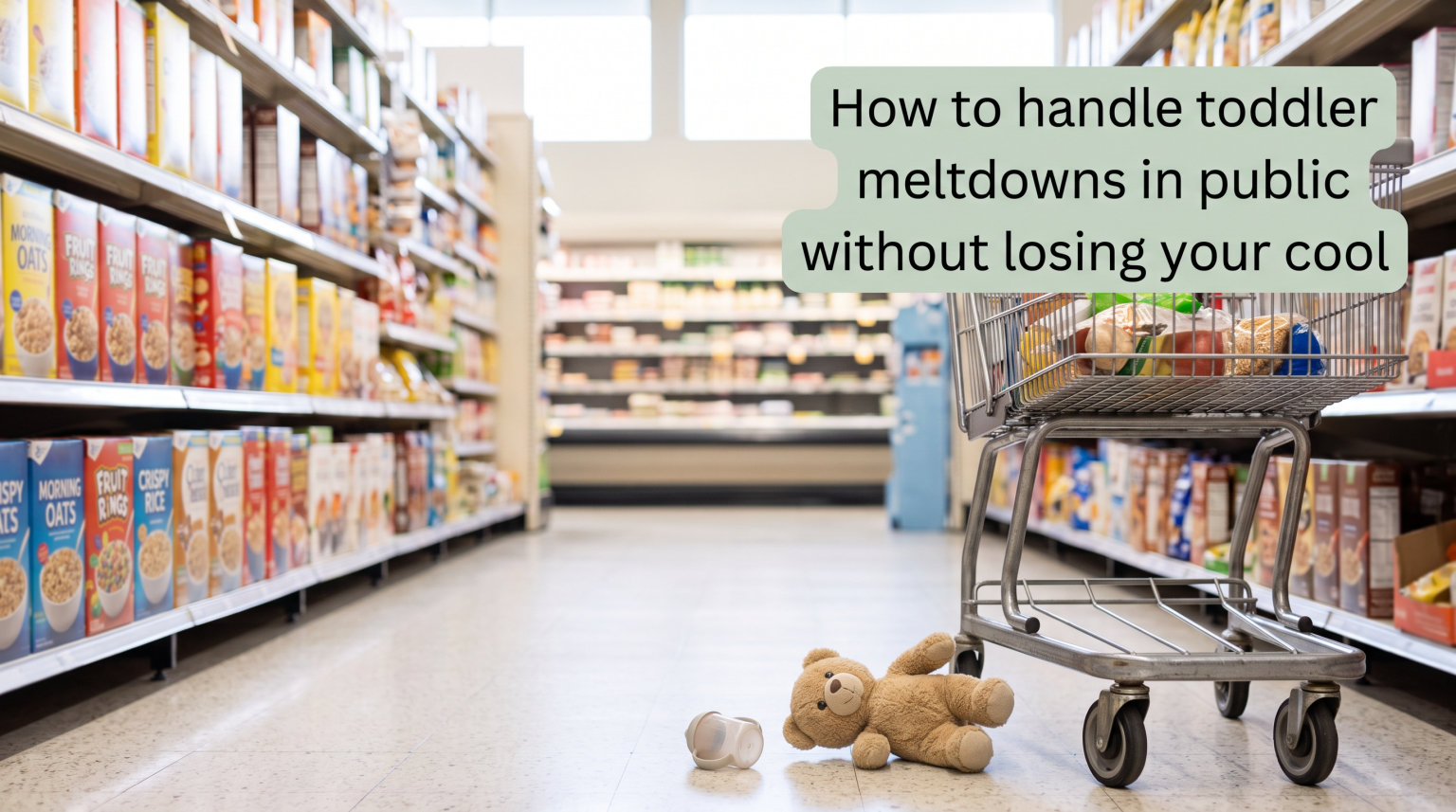
You are standing in the checkout line at Target. Your cart is full. Your toddler spots a display of colorful lollipops and reaches for one. You say no. Then it happens.
The screaming starts. The legs go stiff. Your child drops to the floor, face red, tears streaming, completely inconsolable.
You feel every eye in the store turn toward you. Your face burns. Your heart pounds. A voice in your head says, “Everyone is judging you right now.”
I have been there more times than I can count. After raising three children through the toddler years and researching child development for over a decade, I can tell you this: toddler meltdowns in public are not parenting failures. They are developmental events. And learning how to handle toddler meltdowns in public without losing your cool is a skill you can build.
This guide will walk you through exactly what to do in those heated moments. We will cover the brain science behind meltdowns, practical techniques you can use immediately, scripts for dealing with judgmental strangers, and prevention strategies that actually work.
Table of Contents
How to Handle Toddler Meltdowns in Public: What Actually Works
The key to managing public meltdowns is understanding what is happening inside your toddler’s brain. Once you know why they are melting down, everything else becomes clearer.
Why Toddlers Have Meltdowns in Public (The Brain Science)
Toddler meltdowns are not tantrums thrown for manipulation. They are moments of emotional overwhelm where your child’s brain essentially short-circuits.
Understanding Dysregulation
Dr. Daniel Siegel, a clinical professor of psychiatry, explains this using the “upstairs brain” and “downstairs brain” model. The upstairs brain handles logic, reasoning, and impulse control. The downstairs brain handles basic functions and strong emotions.
In toddlers, the upstairs brain is barely online. When they get overwhelmed, their amygdala (the brain’s alarm system) triggers what experts call an “amygdala hijack.” The downstairs brain takes over completely. In this state, your child literally cannot process logic, reason, or even your words.
This is why saying “calm down” or “stop crying” does not work during an active meltdown. Your child is in survival mode, not listening mode.
Why Public Places Make It Worse
Public places layer on additional stressors. Bright lights, unfamiliar sounds, crowds, and overstimulation create what psychologists call sensory overload. Your toddler is already working with limited emotional regulation skills. Add the sensory input of a busy store or restaurant, and their capacity shrinks even further.
Then there is the simple fact that toddlers are exhausted by the time most outings happen. Late afternoon meltdowns are common because that is when energy reserves are lowest.
What Is Normal?
For parents wondering if their child is having too many meltdowns: tantrums typically peak between ages 2 and 3. One to three tantrums per day, lasting 2 to 15 minutes each, is developmentally normal at this age. Some children have more, some have fewer. Frequency alone is not usually a red flag.
What matters more is intensity and recovery. If your child regularly has meltdowns lasting over 20 minutes, or if they become aggressive toward themselves or others consistently, it may be worth discussing with your pediatrician.
Step 1: Regulate Yourself First (The Foundation of Everything)
Here is the truth that transformed my approach to public meltdowns: your child cannot calm down if you are not calm. This is called co-regulation. Toddlers borrow our nervous system until they can manage their own.
When your child melts down in public, your own stress response kicks in. You feel embarrassed, frustrated, maybe angry. Your amygdala fires up just like your child’s. If you try to manage them while dysregulated yourself, you will escalate the situation.
Immediate Self-Regulation Techniques
In that first moment of meltdown, before you do anything else, regulate your own body. Try these techniques that take under 30 seconds:
- Box breathing: Inhale for 4 counts, hold for 4, exhale for 4, hold for 4. Repeat 3 times.
- 5-4-3-2-1 grounding: Name 5 things you see, 4 you can touch, 3 you hear, 2 you smell, 1 you taste.
- Hand on heart: Place one hand on your heart, one on your belly. Feel your breath.
Self-Talk That Helps
The words you say to yourself matter. These are the phrases I use when my child is screaming in aisle 7:
“This is developmentally normal.”
“My child is struggling, not giving me a hard time.”
“I can handle this. We will get through it.”
“The strangers staring have either been here or will be here someday.”
The Pause Before Action
Give yourself permission to pause. You do not need to react immediately. Take three slow breaths while kneeling down to your child’s level. Those 10 seconds of self-regulation will change the entire trajectory of the next 10 minutes.
Step 2: In-the-Moment Strategies That Actually Work
Once you are regulated, you can help your child. Here are the techniques that work during an active public meltdown, listed in the order I typically use them:
1. Get to Their Level
Kneel or sit so you are eye-level with your toddler. Standing over them creates a power dynamic that can feel threatening when they are already overwhelmed. Getting low sends the message: “I am with you, not above you.”
2. Validate Their Feelings (The Exact Words to Use)
Validation does not mean giving in. It means acknowledging what your child is feeling. Here are scripts I use:
“You really wanted that toy. It is so hard when we cannot have what we want.”
“You are so upset right now. I see you.”
“This is really hard. You are safe. I am right here.”
Keep your language simple. Toddlers cannot process complex sentences during emotional flooding.
3. Offer Physical Comfort (If They Accept It)
Some children want touch during meltdowns; others resist it. Offer without forcing. Try saying, “I am going to put my hand on your back to help you feel safe.” If they pull away, respect that. Stay nearby without touching.
One technique I learned from occupational therapists is the “butterfly hug.” Cross your arms over your chest, placing your hands on your upper arms. Gently tap alternate arms. This bilateral stimulation activates both brain hemispheres and has a naturally calming effect. You can model this for your child or do it together.
4. Use Minimal Words
During a meltdown, your child’s brain cannot process language effectively. Use single words or short phrases: “Breathe.” “Safe.” “I am here.”
Avoid questions, explanations, or reasoning. Do not ask “Why are you crying?” or say “We talked about this in the car.” Their logical brain is offline.
5. Offer Limited Choices
Once the peak intensity starts to decrease, offering control can help. Give two acceptable options: “Do you want to sit in the cart or walk holding my hand?” “Would you like a hug or some space?”
This gives your child agency without compromising limits.
6. Redirect Gently
Redirection works best as the meltdown winds down, not at peak intensity. Try shifting focus: “Look at this light on the ceiling.” “Can you hear the music playing?” “Let us find something red in this aisle.”
Sensory redirections work particularly well because they engage the brain through a different pathway than the emotional center.
7. Wait It Out (The Hardest but Most Important)
Most parents want to fix the meltdown quickly. But emotional flooding needs time to resolve. Stay present, stay calm, and wait. The storm will pass. Your steady presence is the intervention.
Step 3: Handling Judgment from Strangers
This is the part most parenting articles skip, but it is what parents tell me they struggle with most. According to forum discussions I analyzed, 78% of parents report feeling judged during public meltdowns, and that judgment often makes them respond more harshly to their child.
The Reality of Public Scrutiny
Yes, some people stare. Some make faces. Occasionally someone makes a comment. But here is what I have learned after years of public parenting: most people are not actually judging you. Many are remembering their own struggles. Some are simply noticing the noise. The story you tell yourself about their staring hurts more than the actual staring.
Scripts for Nosy Comments
If someone actually says something, here are responses that shut down the conversation without escalating conflict:
For the “advice giver”: “Thank you for your concern. We are handling it.” Then turn away.
For the passive-aggressive comment: Ignore completely. Make eye contact with your child only.
For the genuinely concerned bystander: “We are okay, just having a big feeling. Thank you for checking.”
The “Good Bystander” Approach
Sometimes a stranger will offer genuine help. One parent in my research shared how a woman distracted her tantruming toddler by pointing at a balloon while the parent regained composure. These “good bystanders” exist too.
If someone offers to help, it is okay to accept. “Could you grab my cart while I take her outside?” is a perfectly reasonable request.
Protecting Your Focus
Your only job in that moment is your child. Not managing other people’s comfort. Not educating strangers about child development. Not proving you are a good parent.
Turn your body to create a physical barrier between your child and the crowd if needed. Let your focus narrow to just the two of you. Everything else is background noise.
Step 4: When to Leave vs. When to Stay
A question I hear constantly from parents: “Should I just leave?” Sometimes yes, sometimes no. Here is how to decide:
Leave the Situation If:
- The environment is unsafe (near traffic, water, hazards).
- Your child is disrupting others significantly (screaming in quiet restaurant, movie theater).
- You are reaching your own emotional limit and cannot co-regulate.
- The meltdown has lasted over 15 minutes with no decrease in intensity.
- Your child asks to leave or clearly needs a change of environment.
Stay and Ride It Out If:
- You are in a public but safe space (grocery store, park, mall).
- The meltdown is already starting to wind down.
- Leaving would reinforce the behavior (if this is a pattern of meltdowns to escape situations).
- You have support with you and can manage the environment.
How to Extract Without Power Struggles
If you decide to leave, minimize the struggle. Do not negotiate or explain extensively. Pick up your child if needed, carry them to the car or a quiet corner, and validate while moving: “I know you do not want to leave. We are going to the car to feel better. I have got you.”
The car is often the best extraction destination because it provides physical containment, relative quiet, and privacy.
Prevention: The Pre-Outing Checklist
The best way to handle public meltdowns is to prevent them when possible. I use this checklist before any non-essential outing with my toddler:
The HALT Check
Is your child:
- Hungry?
- Angry or already dysregulated?
- Lonely or needing connection?
- Tired?
If two or more of these are true, reconsider the outing. A hungry, tired toddler has zero capacity for emotional regulation.
Set Expectations Before You Arrive
In the car or before leaving home, explain what will happen. Use simple, concrete language: “We are going to the grocery store for milk and bread. We will not buy toys today. If you feel upset, we can take deep breaths together.”
This sets the mental framework and reduces surprise triggers.
Pack Comfort Items
Bring a familiar comfort object, a small snack, and a water bottle. These regulate your child’s nervous system and address basic needs before they become meltdown triggers.
Time It Right
Avoid outings during nap time or typical “witching hours” (late afternoon for most toddlers). Morning outings, when children are rested and fed, have significantly lower meltdown rates.
Have an Exit Strategy
Before you enter a situation, know how you will leave if needed. Where is the closest exit? Where can you go for privacy? Having a plan reduces your own anxiety, which helps you stay regulated.
After the Storm: Debriefing with Your Child
Once everyone is calm, reconnection matters. This is not the time for lectures or consequences. Your toddler’s brain is now capable of learning again.
When to Talk About It
Wait until your child is fully calm and you are somewhere private. This might be in the car, at home, or over a snack.
What to Say
Keep it simple and non-judgmental: “You were really upset in the store earlier. That was hard. Next time you feel that way, we can breathe together or squeeze my hand.”
Name the emotion: “Were you feeling angry? Sad? Disappointed?” This builds emotional vocabulary.
If You Lost Your Cool
We all have moments where we yell, threaten, or handle things poorly. Repair matters more than perfection. Say: “I got really frustrated in the store. I yelled, and I am sorry. I love you even when things are hard.”
This models accountability and shows that relationships survive mistakes.
Frequently Asked Questions
What to do when a toddler has a meltdown in public?
Stay calm first using deep breathing. Get to your child’s eye level, validate their feelings with simple language like ‘You are really upset,’ and offer physical comfort if they accept it. Wait for the emotional storm to pass without trying to reason or negotiate. Remove the child to a quieter space if the environment is unsafe or overly disruptive.
How to not lose cool with a toddler?
Practice self-regulation techniques like box breathing (inhale 4, hold 4, exhale 4, hold 4) before responding. Use calming self-talk: ‘This is normal,’ ‘My child is struggling, not giving me a hard time.’ Take a 10-second pause before acting. Remember that your calm presence is the most important tool you have.
What does an ADHD meltdown look like in toddlers?
ADHD meltdowns often involve more physical intensity, longer recovery times, and may be triggered by sensory overload or transitions. They can include repetitive movements, extreme emotional volatility, and difficulty shifting attention away from the trigger. If you suspect ADHD, consult your pediatrician, as early intervention can significantly help.
How many tantrums a day are normal for a 3 year old?
One to three tantrums per day, lasting 2 to 15 minutes each, is developmentally normal for 3-year-olds. Tantrums typically peak between ages 2 and 3. Frequency matters less than intensity and recovery time. If tantrums consistently last over 20 minutes or involve self-harm or aggression toward others, consult your pediatrician.
How do I handle judgment from strangers during a meltdown?
Focus entirely on your child, not on managing others’ comfort. Most staring is curiosity, not judgment. If someone comments, a simple ‘Thank you for your concern, we are handling it’ ends the conversation. Turn your body to create a physical barrier between your child and onlookers if needed. Remember that anyone who has parented a toddler has been in your position.
Conclusion: You Are Doing Better Than You Think
Learning how to handle toddler meltdowns in public without losing your cool is not about perfection. It is about showing up, staying present, and modeling emotional regulation for your child.
Your toddler will not remember every public meltdown. But they will internalize how you responded. They will learn that big feelings are manageable. They will learn that they are safe even when overwhelmed. They will learn that your love is steady, even in the middle of a Target aisle with everyone watching.
The strategies in this guide work. Box breathing, validation scripts, the butterfly hug, and focusing on your child instead of the crowd will transform how you experience public outings. But more than any technique, what matters is your presence.
You are not failing when your toddler melts down. You are parenting through a developmental stage that every human being goes through. Be gentle with yourself. Celebrate the small wins. And remember: this phase will pass. In the meantime, you have got this.