
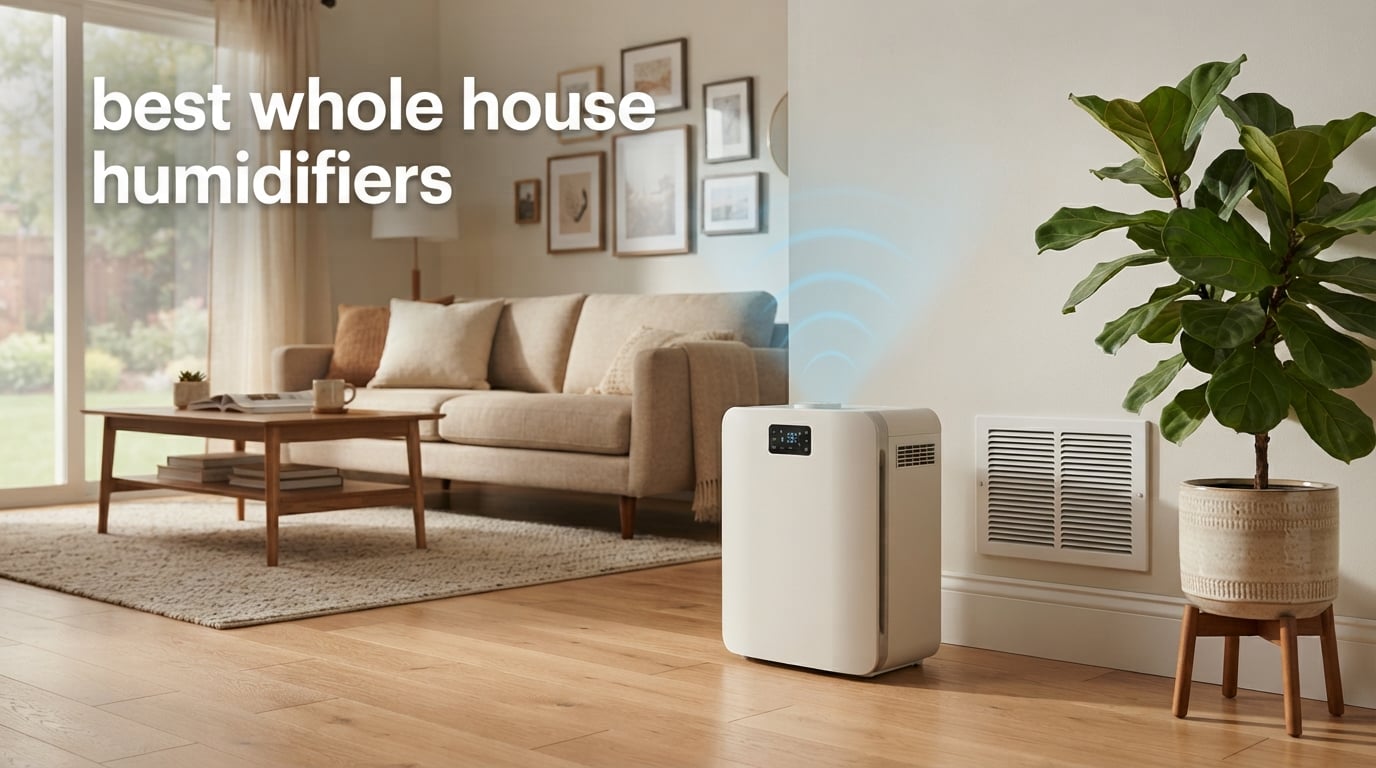
Dry indoor air can turn a comfortable home into a place where skin feels tight, noses feel irritated, static snaps at every doorknob, and wood furnishings can shift. The best whole house humidifiers give you a way to raise moisture across a large living area instead of moving a tiny bedroom unit from room to room.
There are two very different meanings of “whole house” in this category. A true HVAC humidifier, such as the AprilAire 800, feeds moisture into ducted heating and cooling; a large console humidifier, such as the models from LEVOIT, YOKEKON, or LRAZU, sits in the home and treats a broad open area without any ductwork connection.
I think that distinction should come before every other spec. A 3,000-square-foot console can be an excellent choice for an open-plan home, while it cannot promise identical humidity on every floor behind closed doors; a ducted steam system is built for that distribution job but requires installation and ongoing service attention.
A practical indoor target is generally 30 to 50 percent relative humidity. Going too low leaves the familiar dry-air symptoms, while pushing too high can create window condensation and moisture problems, especially during cold weather.
This guide compares seven verified products by stated coverage, tank or daily-output capacity, operating technology, controls, cleaning access, and reviewer feedback. For a single nursery or bedroom rather than a broad living area, our guide to best humidifiers for baby rooms is a more focused place to start.
Humidity is only one part of indoor air quality. If particles or seasonal triggers are also part of the problem, it makes sense to consider these air purifiers for allergies alongside a humidity plan.
Table of Contents
The top three whole-house humidifiers fit three clear household needs 2026

AprilAire 800 Whole-House Steam Humidifier
- 10300 sq ft coverage
- Steam operation
- 11.5 to 34.6 gal per day
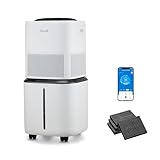

The AprilAire 800 is my clear pick when the goal is to humidify a very large ducted home. Its steam design, output range of 11.5 to 34.6 gallons per day, dual-sensor humidity control, and stated 10,300-square-foot reach make it a fundamentally different machine from a portable console.
The LEVOIT Superior 6000S is the strongest fit for people who want broad freestanding coverage with tap-water-friendly evaporative operation, no white dust, and app-based controls. The Mifasol offers a smaller stated coverage area but adds warm and cool mist modes, a 20-liter tank, and a claimed 25 dB sleep mode.
Neither “best value” nor “budget pick” should replace a sizing check. The right choice is the one whose type, stated output, water-care needs, and placement match your home rather than the one with the longest feature list.
Best whole-house humidifiers in 2026 cover homes from 1,500 to 10,300 square feet
| Product | Specifications | Action |
|---|---|---|
 YOKEKON 5.8 Gallon Humidifier YOKEKON 5.8 Gallon Humidifier |
|
Check Latest Price |
 Honovos 17L Humidifier Honovos 17L Humidifier |
|
Check Latest Price |
 LRAZU 30L Commercial Humidifier LRAZU 30L Commercial Humidifier |
|
Check Latest Price |
 Lacidoll 16L Humidifier Lacidoll 16L Humidifier |
|
Check Latest Price |
| AprilAire 800 Steam Humidifier |
|
Check Latest Price |
| LEVOIT Superior 6000S |
|
Check Latest Price |
| Mifasol Large Room Humidifier |
|
Check Latest Price |
Coverage claims are useful comparison points, not a promise that every bedroom reaches the same reading. Floor plan, ceiling height, stairwells, closed doors, outdoor weather, and your heating system’s airflow all change real-world results.
The table also shows the most meaningful split: AprilAire is a duct-integrated steam humidifier, LEVOIT is evaporative, and the remaining console models use ultrasonic cool mist except where Mifasol adds a warm-mist option. That technology choice affects cleaning, water quality, sound, and how moisture enters the room.
1. YOKEKON is a quiet, high-capacity console choice for open areas
- Large stated coverage
- 36 hour runtime
- Top-fill tank
- Remote and touch controls
- Under 38 dB claim
- Filtered water is recommended
- Plastic construction
I would put the YOKEKON near the top of the list for a living room, open main floor, or shared family space where refilling a small tank every day is not realistic. Its 5.8-gallon, 22-liter tank is stated to cover up to 2,500 square feet and run for up to 36 hours, making capacity its main advantage.
At 12.13 pounds and about 22.44 inches tall, it is a tall console rather than a compact tabletop device. The wheels, remote, touch controls, digital display, timer, and water-level window make the day-to-day routine easier on paper than it is with a basic manual unit.
The ultrasonic system produces cool mist with three mist levels, and the listed noise level is below 38 dB. That is a helpful stated figure for an occupied room, although I would still place any large humidifier away from a bed or desk if sound is a personal sensitivity.
The top-fill design and removable tank matter more than the decorative flame ambient light or night light. Wide, accessible parts are what make it easier to keep a humidifier clean before mineral film and biofilm have a chance to build up.
Its large reservoir makes the YOKEKON better for fewer refill interruptions
A 5.8-gallon tank gives this model more breathing room than the 4.2- and 4.5-gallon consoles here. That can suit a household that needs extended run time but does not want plumbing work or a furnace humidifier.
The extension tube can also direct mist upward, which is useful when the body has to stay low on the floor. Keep the mist stream clear of walls, wood furniture, electronics, and a nearby hygrometer so the local reading does not mislead you.
Its ultrasonic design needs better water habits in hard-water homes
This is filter-free, but filter-free does not mean maintenance-free. The product information recommends filtered water, and that advice is especially sensible where tap water leaves visible mineral deposits.
White dust is a known concern with ultrasonic humidifiers because dissolved minerals can travel with the mist. I would use distilled or appropriately filtered water when that residue is a recurring issue and clean the tank as directed by the manufacturer.
2. Honovos is a flexible console for targeted mist direction
- Four mist speeds
- 360 degree nozzle
- 45 to 95 percent setting
- Top fill
- Four wheels
- Filtered water recommended
- Tap water guidance favors plants
The Honovos focuses on control and positioning. I see it as a good match for someone humidifying a large living zone, plant area, office, or greenhouse-like room where a 360-degree rotating nozzle and an extension tube offer more placement flexibility than a fixed outlet.
Its 17-liter, 4.5-gallon tank is rated for 2,000 square feet, with four mist speeds and an output listed at 800 mL per hour. The unit also has four wheels, a remote with a stated 6-meter range, an LED touch display, a timer up to 16 hours, and automatic shutoff.
The built-in ceramic stone filter is meant to avoid a weekly filter-replacement cycle. That is a useful distinction, but it does not remove the need to inspect the tank, nozzle, and water path regularly.
One feature deserves a careful reading: the product information recommends filtered water for human use to avoid white powder and reserves tap-water guidance for plants. I would treat that as a direct signal that water quality belongs in the purchase decision.
Its adjustable humidity range gives the Honovos more room for controlled operation
You can set a target between 45 and 95 percent, according to the listing. In a typical occupied home, I would begin far below the top end and use an independent hygrometer to avoid over-humidifying a cold room.
That matters because the highest setting is not automatically the healthiest setting. A stable reading in the usual 30 to 50 percent range is more useful than chasing a maximum number and creating condensation on windows.
Its nozzle and wheels suit rooms where the humidifier has to move
The horizontal form factor, four wheels, and rotating nozzle make this more adaptable than a fixed HVAC humidifier. It can be moved between a main living area and a plant room, provided you empty or secure it before rolling over thresholds.
It is still a large appliance, so a level, water-safe surface remains necessary. Do not aim the nozzle into a corner or under cabinetry, where moisture can collect without circulating through the room.
3. LRAZU is the high-output console for very large open spaces
- Largest console coverage
- 30 L capacity
- Up to 120 hour runtime
- Wheels and remote
- Waterless alarm
- Purified water recommended
- Large 31 inch form factor
- Plastic construction
The LRAZU is the console I would examine first for a very large, open home area, office, warehouse, or plant-heavy space. Its 30-liter, 7.93-gallon reservoir and stated 4,200-square-foot coverage exceed the other portable models in this group.
It also lists a 3,000 mL-per-hour mist output and up to 120 hours of runtime at its lowest setting. Those are big numbers, but they should be read together: high-output use will draw water much faster than the lowest setting used for the runtime claim.
The 31-inch-tall machine has three mist-volume modes plus an intermittent mode, a 1-to-16-hour timer, a water-level window, low-water indicator, automatic shutoff, remote control, and four flexible wheels. The sprayer tube is particularly relevant if you need mist delivered higher than the unit itself.
This is not an HVAC humidifier despite the whole-house label. I would expect it to perform best where air can circulate freely, not as a substitute for ducted distribution across separated floors and closed rooms.
Its 3,000 mL-per-hour output is built for substantial moisture demand
A high output can be useful in dry climates, spaces with high ceilings, or areas that lose moisture quickly. It also means you need to watch the hygrometer rather than assume a long runtime makes unattended high-output operation a good idea.
The listed waterless alarm and auto shutoff offer a useful safeguard when the tank empties. They do not replace a routine of checking actual room humidity, water level, and the area around the unit for any unwanted dampness.
Its commercial scale requires room for placement and routine cleaning
The 11-by-11-by-31-inch dimensions help explain why it carries wheels. I would measure the intended location, leave clearance around the machine, and think about where you will take its large tank for filling and cleaning.
Filtered or purified water is recommended in the product details for health benefits. That recommendation, plus the large reservoir, makes regular emptying and cleaning more important than it would be with a small occasional-use humidifier.
4. Lacidoll is a well-reviewed sleep-friendly console for medium-large rooms
- 40 to 90 percent humidistat
- Quiet sleep mode
- Top-fill opening
- Aroma tray
- Remote included
- Hard water can clog pump
- Distilled or purified water recommended
The Lacidoll brings a more established pool of customer feedback than most of the portable models here, with 863 reviews and a 4.4 rating in the supplied product data. I would consider it for a large bedroom, living room, or office where sleep-mode sound and a less imposing footprint matter as much as stated coverage.
Its 16-liter, 4.2-gallon capacity is marketed for 1,500-plus square feet, and the listing describes a smart humidistat range of 40 to 90 percent. It has four mist speeds, an intermittent mode, top filling, a remote, a night light, and an aroma diffuser tray.
The listed sleep mode operates at 35 dB, which is quieter on paper than the YOKEKON’s under-38-dB claim. I treat both numbers as useful comparisons, not a guarantee, because fan and water sound are perceived differently in a silent bedroom.
Its warranty information is also specific: a 30-day replacement period and a one-year manufacturer warranty. The main operating caution is equally specific: hard water may clog the water pump, so distilled or purified water is recommended.
Its sleep mode makes the Lacidoll better suited to occupied quiet rooms
Quiet operation only helps if the humidifier is also placed sensibly. I would keep it on a stable elevated or protected surface where mist can disperse, rather than squeezing it beside a pillow, wall, or bedside electronics.
The night light and aroma box may add comfort for some households, but neither is a reason to skip humidity monitoring. A separate hygrometer remains a simple way to confirm whether the room is actually reaching and holding its target.
Its pump means mineral management is a practical ownership task
For homes with hard water, this model asks for a deliberate water plan. Purified or distilled water can reduce mineral buildup, while regular cleaning helps prevent the pump and water passages from becoming the weak point.
That maintenance point echoes a common owner concern in humidifier discussions: the easiest product to live with is often the one whose cleaning routine you will actually keep. The top-fill, wide-opening design is helpful because it makes that routine less awkward.
5. AprilAire 800 is the ducted steam answer for the largest homes
- Largest stated coverage
- True ducted whole-home operation
- Electrode steam technology
- Six output levels
- Five year warranty
- Professional installation required
- Steam uses more energy
- Steam canister service
The AprilAire 800 is the only product here designed as a true central humidifier for an HVAC system. If your home has compatible ductwork and your goal is even moisture delivery beyond one open room, I would start this comparison with the AprilAire rather than with a large portable console.
It is rated for homes up to 10,300 square feet and has six output levels ranging from 11.5 to 34.6 gallons per day. The unit uses electrode steam technology, which uses water impurities in operation and does not require purified water according to the supplied product information.
Its automatic control uses dual sensors for outdoor temperature and indoor humidity. That pairing is valuable because safe indoor humidity changes with outdoor conditions; reducing the target when outdoor temperatures fall can help limit window condensation.
The 800 has a digital display, humidistat, service filter indicator, continuous runtime, and a five-year manufacturer warranty. At 23 pounds and roughly 7.13 by 10.13 by 20.88 inches, the unit itself is compact for its capacity, but the installation around it is not a casual countertop setup.
Its ducted steam output gives the AprilAire 800 a different coverage advantage
A console humidifier releases moisture into the room where it sits, then relies on natural circulation and your home’s layout. The AprilAire’s steam is intended to move through a forced-air system, which makes it the sensible format for multi-floor homes and many separated rooms.
That does not make installation optional. The included components list a steam hose, drain tubing, valves, and installation instructions, while the product also requires appropriate plumbing and HVAC connections.
Its electrode technology reduces one water concern but adds service planning
Unlike ultrasonic models that can create visible mineral dust, this steam model does not make filtered water a requirement in the product data. Still, steam humidifiers have their own upkeep: the steam canister and drain system need inspection and manufacturer-recommended service.
Forum discussions repeatedly flag maintenance, water use, and installation as the tradeoffs buyers want explained before purchase. I would ask a qualified HVAC professional about electrical requirements, drain routing, canister replacement, and whether the duct system is suitable before choosing this type.
6. LEVOIT Superior 6000S is the smart evaporative pick for white-dust concerns
- Evaporative no white dust
- Tap-water friendly
- Smart app control
- 3
- 000 sq ft coverage
- Detachable pump
- Wick can discolor
- Wick changes may be frequent
The LEVOIT Superior 6000S is my favorite freestanding option for people who dislike the white-dust question that comes with ultrasonic humidifiers. It uses evaporative technology, drawing air through a wet wick rather than dispersing mineral-containing ultrasonic droplets into the room.
The 23-liter, 6-gallon tank is rated for up to 3,000 square feet, with 1,500 mL-per-hour output and a runtime of up to 72 hours. Its 30-watt rating is also much lower than the listed 85 watts for the YOKEKON and 135 watts for the LRAZU, though your actual energy use depends on setting and runtime.
The feature list includes Auto Mode, an enhanced humidity sensor with plus or minus 5 percent accuracy, VeSync app control, voice-assistant support, a detachable pump for cleaning, and foldable storage. I like that the smart features serve a practical job: checking or adjusting a target without walking to the unit.
This is still a console humidifier, not a furnace humidifier. Its stated 3,000-square-foot reach makes it a good candidate for a large open home, especially one without ductwork, but I would not expect app control to overcome closed doors or poor air circulation.
Its evaporative wick is the better fit for homes worried about white dust
Evaporative humidifiers are often preferred in hard-water areas because minerals remain in the wick and reservoir instead of becoming airborne dust. The product is described as tap-water friendly and explicitly claims no white dust, which is a major practical benefit for shelves, floors, and dark furniture.
The tradeoff is a consumable wick. Some customer feedback mentions wick discoloration and potentially frequent changes, so I would check the filter-indicator guidance and treat replacement care as part of normal ownership rather than a defect.
Its app controls are useful when the humidity reading drives the decision
Smart control is most useful with a trustworthy target, not as a novelty. The automatic mode and humidity sensor can reduce constant adjustment, but I still prefer confirming a room reading with a separate hygrometer during the first few days.
For a child’s bedroom where a smaller, dedicated machine may work better, compare the options in our guide to cool mist humidifiers for kids. For a shared main area, the LEVOIT’s wheels and foldable storage add welcome flexibility between dry seasons.
7. Mifasol is the warm-and-cool-mist console for year-round flexibility
Mifasol Cool Mist Humidifier Large Room, Whole House Humidifiers for Home
- Cool and warm mist
- 20 L capacity
- 25 dB sleep mode
- 45 to 90 percent control
- Wheels and handle
- 1
- 500 sq ft stated coverage
- Warm mist feels mild
The Mifasol is the one to look at if warm- and cool-mist flexibility is more appealing than maximum stated coverage. I would place it in a medium-to-large open area, bedroom, plant room, or office that benefits from a 20-liter, 5.3-gallon tank but does not need the reach claimed by LRAZU or LEVOIT.
It is rated for 1,500 square feet with a maximum output of 900 mL per hour and up to 36 hours of runtime. The ultrasonic unit has three mist levels, two 360-degree nozzles, touch and remote controls, auto shutoff, a 1-to-24-hour timer, wheels, and an ergonomic handle.
Its adjustable humidity range is 45 to 90 percent, and the listed sleep-mode noise is 25 dB. That is the lowest claimed sound level among these products, making it worth a look for sleepers who want a large reservoir without a prominent fan presence.
The warm-mist setting is listed at 95 to 100 degrees Fahrenheit, but the product information cautions that it may not feel warm because of its safety design. I would view it as a mode choice, not as a small space heater.
Its two mist modes make the Mifasol more adaptable across seasons
Cool mist can be a comfortable default for many homes, while a warm-mist option can appeal in colder weather. Both modes still add moisture, so the humidity target and cleaning routine matter more than the temperature of the mist.
The dual 360-degree nozzle system lets you direct output rather than concentrating it in one small spot. I would position the unit so both streams have open air in front of them and avoid aiming toward fabrics, walls, or wood surfaces.
Its stated 1,500-square-foot reach makes room layout especially important
This model can make sense for a large zone, but it is not the choice I would make for a very large or multi-level home that needs consistent moisture everywhere. A larger console or an HVAC-integrated system is a more realistic match for that job.
The top-fill design, wheels, and handle help with the work of moving and refilling a 20-liter appliance. Before committing, think through the distance from the water source, the level surface where it will run, and how you will clean it regularly.
These criteria separate a useful humidifier from a poor fit
I assessed these selections from the manufacturer-listed capacity, coverage, output, operation type, humidity controls, water-care guidance, cleaning access, physical dimensions, warranty details where supplied, and available customer-review patterns. I did not treat a large coverage claim or a high star rating as enough on its own.
A humidifier succeeds when its technology fits the home. That is why the AprilAire 800 ranks for ducted, large-home use, the LEVOIT ranks for evaporative white-dust avoidance and smart control, and the larger ultrasonic consoles rank for homes that need portable capacity without HVAC work.
Reviewer feedback also highlighted the factors people live with after setup: noise, refilling, filter or canister service, water quality, and cleaning. Those are the practical details that determine whether a home humidifier system stays in use after the first dry spell.
The right whole-house humidifier depends on size, technology, and upkeep
Choose the coverage format before the feature list. A central humidifier belongs in a compatible forced-air HVAC system, while a console humidifier belongs in the largest open area where you need added moisture and can manage the water reservoir.
Your home layout determines whether a console or HVAC humidifier makes sense
For a home with ductwork, several floors, and dry rooms throughout the house, a professionally installed steam or bypass humidifier can distribute moisture through the HVAC system. The AprilAire 800 is the ducted steam option in this roundup, with a stated capacity for very large homes.
For renters, homes without ductwork, or homes where only the open main level feels dry, a freestanding console is usually the simpler category. Place it in the area of need, leave room for airflow, and use a hygrometer in the places where people sleep or work.
Evaporative, ultrasonic, and steam systems make moisture in different ways
An evaporative humidifier uses a fan and wet wick, then releases moisture as water evaporates. The LEVOIT 6000S uses this approach, is described as tap-water friendly, and is designed to avoid white dust; the wick is the part that needs ongoing attention.
Ultrasonic humidifiers use vibration to create a fine mist. The YOKEKON, Honovos, LRAZU, Lacidoll, and Mifasol use ultrasonic operation, which can be quiet and high-output but may spread mineral residue when hard tap water is used.
Steam humidifiers heat water to create steam. The AprilAire 800 has the broadest stated coverage in this group and avoids the portable placement limits, but it needs correct HVAC, electrical, plumbing, and drain installation and can use more energy than an ultrasonic unit.
Your humidity target should prevent both dry air and condensation
Use a humidistat or separate hygrometer to establish a baseline before changing anything. Start conservatively, watch for several days, and aim for a stable reading in the common 30 to 50 percent relative-humidity range.
If windows begin collecting moisture, lower the target and look for overly direct mist placement. Outdoor temperature matters because colder windows condense water more readily, which is why the AprilAire’s outdoor-temperature sensor is a meaningful feature rather than just another spec.
Your water source changes the cleaning routine and visible residue
Hard water leaves minerals behind in any humidifier, although the result varies by technology. Ultrasonic units can create white dust, so the YOKEKON, Honovos, LRAZU, and Lacidoll guidance toward filtered, purified, or distilled water deserves attention.
The LEVOIT’s evaporative design is the easier direction for a household that wants to use tap water without white dust, though its wick still needs checking and replacement. The AprilAire’s electrode steam design does not require purified water according to its product data, but its steam canister and installed system still need service.
Your maintenance plan should be realistic before you buy
Empty standing water when the unit will not be used, clean the tank and reachable water-contact surfaces on the manufacturer’s schedule, and let parts dry thoroughly. Never assume an automatic shutoff or a filter removes the need for regular cleaning.
For a console, I would choose the widest top-fill opening and simplest removable parts you can find. For a ducted steam unit, ask the installer exactly who will inspect the canister, drain, valves, and humidistat, and when that service is due.
Forum conversations repeatedly describe annual maintenance, sound, and water use as the things owners wish they had anticipated. The best buying decision is one that leaves you with a schedule you can follow, not a machine that only looks powerful in a product listing.
Your final setup should protect surfaces and the people in the room
Set a console on a firm, level, water-resistant surface, away from electronics and direct contact with walls or furnishings. Keep cords dry, direct mist into open air, and do not let children treat the appliance or its water as a toy.
For someone with COPD, asthma, allergies, or another respiratory condition, humidity is not a substitute for medical guidance. Keeping the unit clean and avoiding excess humidity are particularly sensible steps because stale water and damp surfaces can create their own air-quality concerns.
These common whole-house humidifier questions have direct answers
What is the best humidifier for COPD patients?
There is no single best humidifier for every person with COPD. A clean unit that maintains moderate indoor humidity, usually within the common 30 to 50 percent range, is more useful than a high-output setting. Consult a clinician for personal medical guidance, and avoid excess humidity or poorly maintained water reservoirs.
What is the best humidifier for a house Consumer Reports?
The best type depends on the house. A ducted steam model such as the AprilAire 800 suits a compatible forced-air home needing broad distribution, while a large console such as the LEVOIT Superior 6000S suits an open area or a home without ductwork. Compare stated coverage, technology, maintenance, and water needs rather than relying on one universal pick.
What is the downside of a whole house humidifier?
Whole-house humidifiers need regular cleaning or service, use water and electricity, and can cause condensation if humidity is set too high. Ultrasonic consoles may leave white mineral dust with hard water, evaporative models need wick care, and installed steam systems need professional installation plus canister and drain maintenance.
What size whole house humidifier do I need?
Match the humidifier type to the home first, then use stated coverage as a starting point. A console is best sized for the open area where it will sit, while a central humidifier should be sized by a qualified HVAC professional using the home size, construction, climate, and heating-system details.
Are whole house humidifiers worth it?
They can be worthwhile when dry air affects comfort across a broad area and you are ready for the maintenance. A large console can help an open living space without ductwork, while a ducted system can serve a compatible whole home. The right answer depends on humidity need, layout, water quality, and willingness to clean or service the unit.
The best whole house humidifier in 2026 is the one that matches your home
The AprilAire 800 is the clear choice here for a compatible ducted home that needs steam humidification over a very large footprint. The LEVOIT Superior 6000S is the strongest freestanding match for tap-water-friendly evaporative operation and smart control, while the LRAZU brings the largest stated portable coverage.
For quieter bedroom-adjacent operation, Lacidoll and Mifasol are worth closer attention; YOKEKON and Honovos offer strong tank capacity and flexible console controls for open areas. Compare the verified specifications, decide whether you need ducts or portability, and choose a cleaning routine you can realistically keep.
That is the practical way to narrow the best whole house humidifiers: choose the right technology first, size it honestly for the space, and manage humidity rather than merely adding as much mist as possible.