
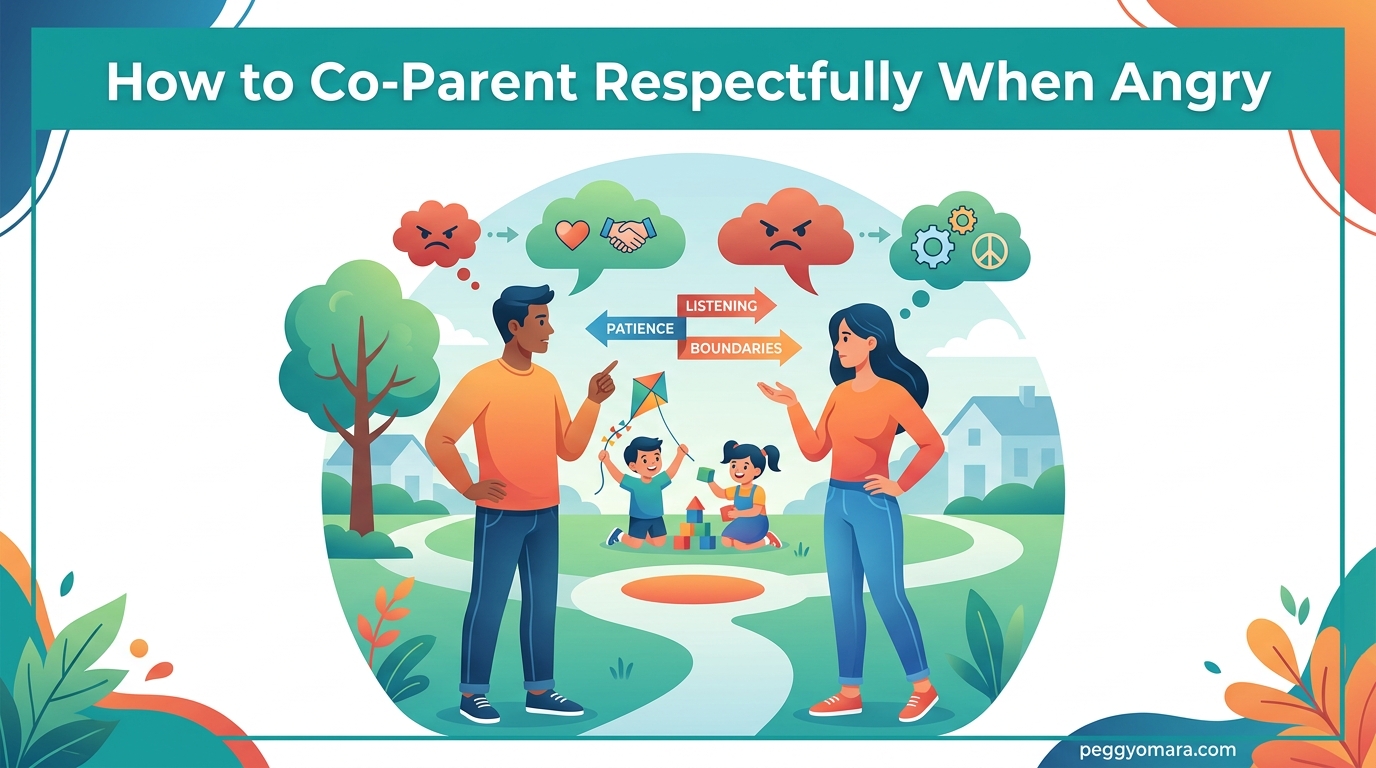
Learning how to co parent respectfully after a divorce when you’re still angry is one of the hardest emotional challenges you’ll face. The person who hurt you most is now someone you must communicate with regularly about the people you love most. That anger you feel? It’s completely normal. Divorce stirs up grief, betrayal, resentment, and even rage. None of those feelings disappear just because the papers are signed.
But here’s what I’ve learned from talking with divorced parents over the years: your children are watching. They’re learning how adults handle conflict, disappointment, and difficult emotions. Every interaction with your ex is a teaching moment, whether you intend it to be or not. This guide will show you practical strategies for managing your anger while maintaining the respectful co-parenting relationship your kids need to thrive.
Table of Contents
Why Managing Your Anger Matters for Your Children
Children exposed to ongoing parental conflict experience measurable stress that affects their development, school performance, and future relationships. When you and your ex argue, speak disrespectfully, or communicate through tense silence, your children absorb that tension. They didn’t choose this divorce, yet they often feel responsible for keeping the peace.
The effects vary by age. Young children may regress developmentally, returning to bedwetting or clinginess. School-age kids often develop anxiety, stomachaches, or difficulty concentrating. Teenagers might pull away from both parents, act out, or struggle with their own relationships because they’ve learned that love equals conflict. I’ve heard from countless adult children of divorce who still carry emotional scars from watching parents battle for years.
Perhaps most damaging is the loyalty conflict that develops when children feel forced to choose sides. When you express anger about your ex in front of your kids, they feel pressured to agree with you to maintain your love. This creates a painful split within them because they also love their other parent. Managing your anger isn’t about protecting your ex—it’s about protecting your children from carrying burdens that don’t belong to them.
The Business-Like Approach: Treating Co-Parenting as a Professional Relationship
The single most effective strategy for respectful co-parenting while angry is adopting a business-like tone. Think of your ex not as your former spouse who wronged you, but as a colleague you must work with on an important project—raising your children. You don’t need to like a colleague to work effectively with them. You don’t need to trust them personally. You simply need clear roles, respectful communication, and shared goals.
This mindset shift changes everything. Business relationships operate with boundaries: specific meeting times, agenda-focused conversations, professional language, and documented agreements. Emotional outbursts aren’t acceptable in professional settings, and they shouldn’t be acceptable in your co-parenting relationship either. The goal isn’t friendship. It’s functional cooperation that serves your children’s best interests.
Here’s what business-like communication actually sounds like: “I’m writing to confirm that I’ll pick up the children at 6 PM on Friday as scheduled. Please let me know if this time doesn’t work with your plans.” Compare that to: “I guess I’ll get the kids Friday since you never care about my schedule anyway.” The first message communicates the necessary information without emotional hooks. The second invites conflict and puts your children in the middle.
Some divorced parents find it helpful to literally imagine they’re writing an email to a coworker or client. Would you send that angry text to your boss? Would you speak that way to a colleague? If not, don’t send it to your co-parent. Wait twenty-four hours before responding to any message that triggers you. Business decisions made in anger usually backfire.
Managing Your Anger: Practical Strategies That Actually Work
Anger management isn’t about pretending you feel fine when you don’t. It’s about processing your emotions in healthy ways that don’t damage your children or escalate conflict with your ex. Here are strategies that actually work for divorced parents dealing with ongoing resentment:
Implement the 24-Hour Rule
Never respond to triggering communication immediately. When you receive a message that makes your blood boil, close it and walk away. Set a timer for twenty-four hours. I know this feels impossible when you want to defend yourself or set the record straight. But immediate responses written in anger almost always make situations worse. They give your ex evidence of your emotional reactions and often lead to exchanges you’ll regret.
Identify Your Triggers
Pay attention to what specifically sets off your anger. Is it when your ex is late for exchanges? When they question your parenting decisions? When they bring up old arguments? When they introduce new partners? Knowing your triggers allows you to prepare emotionally. You can develop specific scripts for these situations and practice responding neutrally. Some parents find it helpful to write out their trigger list and read it before any interaction with their ex.
Create Safe Venting Spaces
You need somewhere to process your anger, but that place cannot be in front of your children, on social media, or in text messages to your ex. Safe venting means talking with a therapist, a trusted friend who won’t share your words, or writing in a private journal. Some parents join divorce support groups where others understand exactly what they’re experiencing. The key is choosing someone who supports your goal of respectful co-parenting rather than someone who will encourage your anger.
Practice Physical Emotional Regulation
Anger lives in your body, not just your mind. When you feel rage building, your heart rate increases, your breathing becomes shallow, and your muscles tense. You can interrupt this physical response. Try box breathing: inhale for four counts, hold for four counts, exhale for four counts, hold for four counts. Take a brisk walk around the block. Splash cold water on your face. These physical interventions can stop anger from hijacking your logical thinking.
Setting Boundaries That Protect Everyone
Boundaries are the rules that define how you will and won’t interact with your ex. Without clear boundaries, every communication becomes an opportunity for conflict. With boundaries, both parents know what to expect, and children experience more stability.
Effective co-parenting boundaries typically include: communication only about the children (not your past relationship), written communication only (text or email, not phone calls), specific response timeframes (twenty-four to forty-eight hours), and defined topics (schedules, health, education—not personal lives or grievances). Some parents also establish boundaries around tone—respectful language only, with immediate disengagement if disrespect occurs.
Understanding Parallel Parenting
Traditional co-parenting involves frequent communication and shared decision-making. But when anger makes cooperation impossible, parallel parenting offers an alternative. In parallel parenting, each parent makes day-to-day decisions independently during their time with the children. You communicate only about major issues like medical emergencies or school changes. Each household operates with its own rules and routines rather than trying to maintain identical environments.
Parallel parenting reduces conflict by minimizing contact. It’s particularly effective when one parent is emotionally immature, narcissistic, or refuses to cooperate respectfully. Over time, as emotions cool, some parallel parenting arrangements evolve into more cooperative co-parenting. But there’s no shame in maintaining parallel parenting indefinitely if that’s what protects your peace and your children’s wellbeing.
What Not to Do When You’re Angry
Knowing what to avoid is just as important as knowing what to do. Here are the biggest co-parenting mistakes angry parents make:
Don’t Use Children as Messengers
Never ask your children to relay information to your ex. “Tell your father you’ll be late Friday” puts your child in the middle of adult communication. Direct communication between parents is non-negotiable, even when it feels uncomfortable.
Don’t Badmouth Your Ex
Speaking negatively about your ex in front of your children damages their self-esteem and creates loyalty conflicts. Even “venting” within earshot hurts them. If your children ask about your divorce or your feelings, keep your answers simple and neutral: “Your dad and I had grown-up problems we couldn’t solve. That doesn’t change how much we both love you.”
Don’t React in Front of Your Kids
If your ex provokes you during an exchange, wait until you’re alone to process your reaction. Children should never witness arguments between parents. If exchanges consistently lead to conflict, arrange them in public places or ask a neutral third party to handle transitions temporarily.
Don’t Post on Social Media
Nothing you post about your ex on social media will help your situation. Public posts create legal problems, fuel conflict, and ultimately harm your children who may see them. Keep all co-parenting issues offline entirely.
Communication Scripts for High-Conflict Moments
Having specific words ready before you need them prevents reactive, emotional responses. Here are scripts that maintain boundaries while addressing common co-parenting situations:
When Your Ex Questions Your Parenting Decisions
“I hear that you have different expectations for the children during your time. I make decisions during my parenting time, just as you make decisions during yours. Unless this is a safety issue, let’s trust each parent to handle their own time with the kids.”
When You Need to Reschedule
“I’m writing to request a schedule change for this weekend. [Explain reason briefly]. Would [alternative time] work for you? I know schedule changes are inconvenient, and I appreciate your flexibility.”
When Your Ex is Disrespectful
“I’m committed to communicating respectfully about our children. When messages contain personal attacks or disrespectful language, I’ll pause communication until we can return to respectful exchange. I’m happy to continue our discussion when we’re both able to communicate professionally.”
The Grey Rock Method
When your ex consistently tries to provoke emotional reactions, the grey rock method can help. Become as interesting and responsive as a grey rock. Keep communication brief, boring, and emotionless. Don’t share personal information. Don’t react to baiting. Answer only questions directly related to the children with minimal detail. Over time, a parent seeking drama often loses interest when they stop getting the emotional response they want.
Frequently Asked Questions
What are the biggest co-parenting mistakes?
The biggest co-parenting mistakes include using children as messengers between parents, badmouthing the ex in front of kids, having inconsistent rules across households, communicating through children rather than directly, and allowing anger to drive decision-making. Other common errors include sharing too much about the divorce with children, making children choose sides, and failing to establish clear boundaries around communication topics and methods.
How to release anger at ex?
Release anger at your ex by establishing safe venting outlets like therapy or trusted friends, practicing physical emotional regulation techniques such as deep breathing or exercise, implementing the 24-hour rule before responding to triggering messages, and focusing on your children’s wellbeing as motivation. Writing unsent letters, joining divorce support groups, and working with a therapist specifically on forgiveness (for your benefit, not your ex’s) are also effective strategies. Time itself is a powerful healer—many parents report significant anger reduction two to three years post-divorce.
What is the 7 7 7 rule of parenting?
The 7-7-7 rule reminds parents to consider how their current parenting choices will matter in 7 days, 7 months, and 7 years. This perspective helps parents avoid reactive decisions based on temporary emotions and instead focus on long-term impact on their children. When applied to co-parenting anger, the rule suggests asking whether your current conflict will matter to your children in 7 years—and whether the relationship you’re modeling is one you’d want them to have in their own future partnerships.
Can you lose custody for not co parenting?
While you generally cannot lose custody simply for being uncooperative, consistent refusal to follow court-ordered custody arrangements or parental alienation (actively turning children against the other parent) can lead to custody modifications. Courts prioritize the child’s best interests, and parents who demonstrate an inability to support the child’s relationship with the other parent may face consequences. However, you cannot be forced to have a friendly relationship—only to comply with legal agreements and avoid harming the child’s relationship with their other parent.
What is considered harassment by a co parent?
Harassment by a co-parent includes excessive communication beyond what’s necessary for parenting, sending threatening or abusive messages, showing up unannounced at your home or workplace, stalking your social media, making false reports to authorities, and preventing scheduled visitation without cause. Document all harassment incidents and consult an attorney if behavior escalates. In severe cases, harassment may warrant restraining orders or court-ordered communication restrictions such as using only co-parenting apps.
How to respond to high conflict co parent?
Respond to a high-conflict co-parent by using the grey rock method—becoming uninteresting and unresponsive to provocation. Keep all communication brief, factual, and focused solely on children. Use written communication only to create documentation. Implement parallel parenting to minimize necessary contact. Don’t defend yourself against false accusations (this fuels the conflict). Set clear boundaries and disengage when boundaries are violated. Consider using court-approved co-parenting apps that monitor tone and flag abusive language.
When does co-parenting get easier?
Co-parenting typically gets easier with time, with most parents reporting significant improvement between two to five years post-divorce. The timeline varies based on the reason for divorce, each parent’s emotional processing, new relationships entering the picture, and children’s changing needs. Co-parenting often becomes easier when new partners stabilize, when children get older and can communicate directly with both parents, and when both parents establish new lives independent of each other. Parallel parenting during the early angry period often creates space for eventual cooperation.
Moving Forward: It Gets Better
You can learn how to co parent respectfully after a divorce when you’re still angry. It won’t happen overnight, and you won’t be perfect. Some days you’ll handle exchanges with grace; other days you’ll need to apologize to your children for reacting badly. Both are part of the process. What matters is your commitment to trying, learning, and growing.
Most divorced parents report that co-parenting gets significantly easier with time. The anger that feels all-consuming in year one often fades to background noise by year three. New relationships, established routines, and simply seeing that your children are thriving all help heal the hurt. In the meantime, focus on what you can control: your responses, your boundaries, and the stable, loving environment you create during your parenting time.
Your children don’t need you to be friends with your ex. They don’t need you to pretend the divorce didn’t hurt. What they need is two parents who love them enough to put their wellbeing above adult conflicts. Every time you choose a business-like email over an angry text, every time you vent to a friend instead of to your child, every time you step away from a potential argument—you’re showing your children what strength and love actually look like. And that’s worth every bit of effort.