
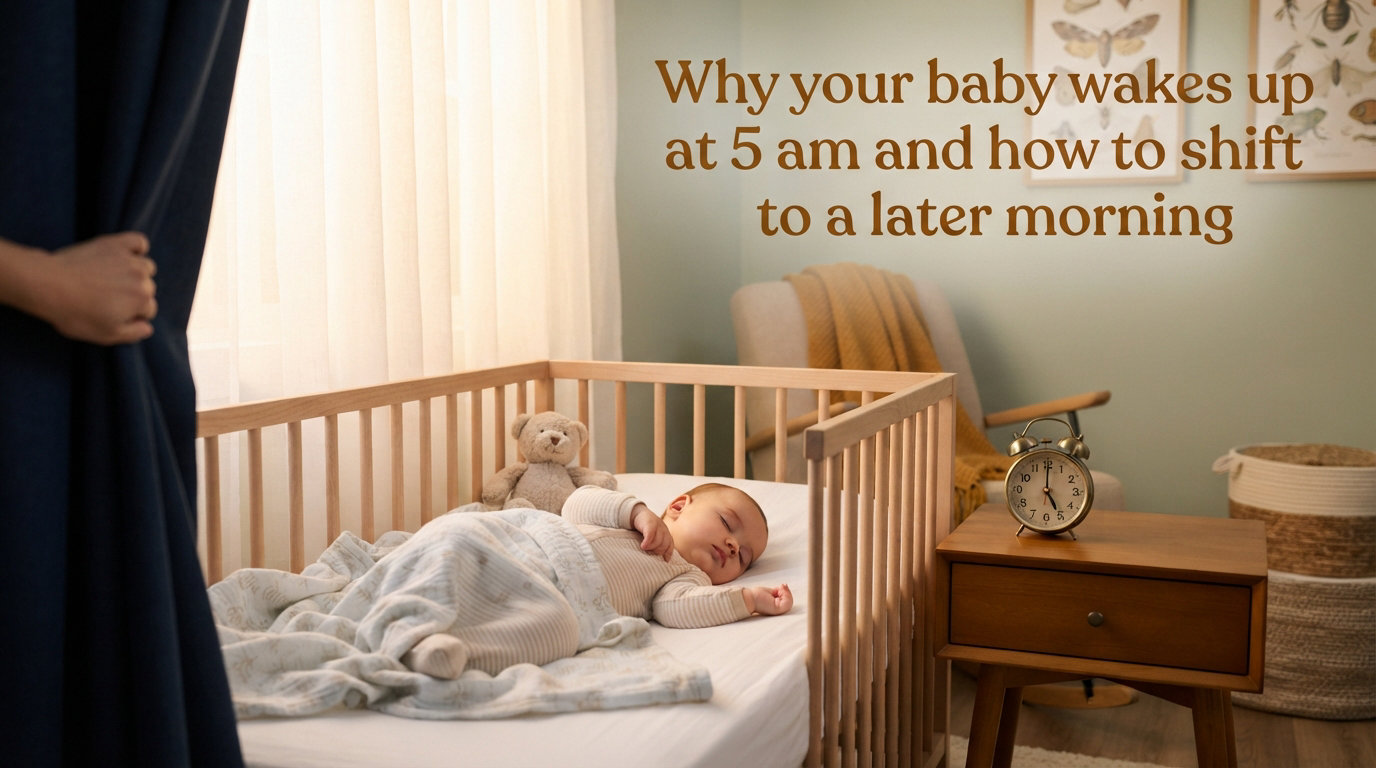
Your baby’s eyes snap open at 5:00 AM, ready to start the day while you are still desperate for another hour of sleep. This early morning waking pattern leaves parents exhausted, frustrated, and wondering what they are doing wrong. After helping hundreds of families through this exact challenge, I can tell you that 5 AM wake-ups are one of the most common and fixable sleep issues parents face.
In this guide, you will learn exactly why your baby wakes up at 5 AM and discover proven strategies to shift their wake time to a more reasonable hour. We will explore the science behind early morning wakings, identify the hidden culprits in your baby’s schedule, and walk through step-by-step solutions you can start using tonight. Whether your little one is 4 months or 24 months old, these evidence-based approaches have helped countless families reclaim their mornings.
Table of Contents
Is 5 AM Too Early for a Baby to Wake Up?
Yes, 5 AM is considered too early for most babies to wake up. For the vast majority of infants and toddlers, a normal wake time falls between 6:00 AM and 7:30 AM. When your baby consistently wakes at 5 AM or earlier and cannot be resettled back to sleep, this is classified as an early morning waking rather than a normal start to the day.
Early morning wakings typically occur between 4:00 AM and 6:00 AM. During these hours, your baby’s body is going through natural biological changes that make returning to sleep difficult without proper intervention. The distinction matters because early wakings require different solutions than middle-of-the-night wake-ups.
Some parents worry their baby is simply an early riser by nature. While genetics do play a small role in sleep preferences, true early waking is almost always solvable with schedule adjustments and environmental changes. Before assuming your baby is wired to wake at dawn, it is worth investigating the fixable causes covered in this guide.
Why Your Baby Wakes at 5 AM: The Science Behind Early Morning Wakings
Understanding the biological mechanisms behind 5 AM wake-ups helps explain why these early risings are so stubborn. Your baby’s body goes through several changes in the early morning hours that work against continued sleep.
The Melatonin Drop
Melatonin, the hormone that promotes sleep, naturally begins to decrease in the early morning hours. By 4:00 or 5:00 AM, your baby’s melatonin levels have dropped significantly, removing the chemical signal that says “keep sleeping.”
At the same time, cortisol, the wake-promoting stress hormone, begins its morning rise. This hormonal shift happens in all humans, but babies are more sensitive to it because their sleep systems are still developing. The combination of low melatonin and rising cortisol creates a perfect storm for early waking.
Sleep Cycles and Light Sleep
Early morning hours are when sleep is lightest. Your baby cycles through stages of deep sleep and light sleep throughout the night, but the proportion of light sleep increases significantly in the hours before normal wake time.
Between 4:00 AM and 6:00 AM, your baby spends more time in REM sleep and lighter stages of non-REM sleep. These lighter stages mean your baby is more easily disturbed by noise, temperature changes, hunger, or the urge to use the bathroom. Without strong self-soothing skills, your baby will likely call for help rather than transition back into deeper sleep.
Sleep Pressure Depletion
Sleep pressure, also called homeostatic sleep drive, is the biological urge to sleep that builds while your baby is awake. Think of it like sleep hunger. The longer your baby has been asleep, the lower this pressure becomes.
By 5:00 AM, your baby has likely been asleep for 8 to 10 hours. Their sleep pressure is at its lowest point of the night, making it physically harder to fall back asleep. This is why a baby who wakes at 5 AM often seems wide awake even though they are still tired.
9 Common Reasons Your Baby Wakes at 5 AM
Now that you understand the science, let us examine the practical factors that trigger 5 AM wake-ups. Each of these culprits is fixable once identified.
1. Bedtime Timing Issues
Bedtime that is either too early or too late can cause 5 AM wake-ups. Many parents assume a later bedtime will lead to a later wake time, but this often backfires.
When bedtime is too late, your baby becomes overtired. An overtired baby produces excess cortisol, which acts like caffeine in their system. This makes it harder to fall asleep initially and causes lighter, more fragmented sleep. Your baby may crash at bedtime but wake early and unable to return to sleep.
When bedtime is too early, your baby may get enough total sleep by 5 AM. If your 10-month-old goes to bed at 6:00 PM and sleeps 11 hours, a 5:00 AM wake-up is mathematically appropriate. Shifting bedtime later by 15 to 30 minutes can often push wake time later without causing overtiredness.
2. Overtiredness
Over tiredness is the single most common cause of early morning wakings. When your baby stays awake too long between naps or has a bedtime that is too late, their body enters a stressed state.
The signs of overtiredness include difficulty settling at bedtime, frequent night wakings, and those frustrating 5 AM starts. Your baby might seem wired or hyper at bedtime, then crash hard only to wake before dawn. Following age-appropriate wake windows is essential to prevent this cycle.
3. Undertiredness
On the flip side, a baby who is not tired enough at bedtime will also wake early. If your baby takes long naps or has too many naps for their age, they may simply be done sleeping by 5 AM.
Undertired babies often wake happy and ready to play. They may have fallen asleep easily at bedtime without much fuss. The solution here is usually to cap naps, transition to fewer naps, or extend wake windows slightly before bedtime.
4. Nap Schedule Problems
Your baby’s daytime sleep directly impacts their morning wake time. Too much daytime sleep robs from night sleep. Too little daytime sleep leads to overtiredness and early waking.
The timing of the last nap also matters. A nap that ends too late pushes bedtime later, potentially causing overtiredness. A nap that ends too early creates a long wake window before bed, also leading to overtiredness. Finding the sweet spot for your baby’s age is critical.
5. Hunger
Babies under 9 months, and sometimes older, may genuinely be hungry at 5 AM. Long stretches of sleep burn calories, and a growing baby needs fuel.
The challenge is distinguishing between hunger and habit. If your baby eats a full feed and goes back to sleep for at least an hour, hunger was likely the cause. If they snack and stay awake, or refuse food entirely, you are dealing with a habit wake. For confirmed hunger wakes, a dream feed around 10 PM can sometimes prevent the 5 AM wake-up.
6. Sleep Environment Issues
The early morning hours present unique environmental challenges. Light begins filtering into rooms before sunrise, and outside noise often increases as early commuters and delivery trucks start their day.
Blackout curtains that truly block all light are essential for preventing early waking. Even a small crack of light can signal your baby’s brain that morning has arrived. White noise helps mask environmental sounds that might disturb light sleep stages. The optimal room temperature is between 68 and 72 degrees Fahrenheit.
7. Sleep Associations
If your baby relies on external help to fall asleep, they will need that same help when they wake at 5 AM. Common sleep associations include feeding to sleep, rocking, patting, or being held.
At 5 AM, when sleep pressure is low and returning to sleep is hardest, a baby who cannot self-soothe will call for the parent who usually helps them. Teaching your baby to fall asleep independently at bedtime often reduces or eliminates early morning wakings entirely.
8. The 5 AM Temperature Drop
One often overlooked factor is temperature. 5 AM is typically the coldest part of the night as the house has been cooling for hours.
If your baby is in a sleep sack that was appropriate at bedtime but becomes insufficient by early morning, they may wake from discomfort. Many parents report their baby feels cold to the touch at 5 AM wake-ups. Consider using a slightly warmer sleep sack or adjusting the thermostat to account for this temperature dip.
9. Developmental Changes
Sleep regressions, nap transitions, and developmental leaps can all temporarily disrupt sleep and cause early waking. The 4-month sleep regression is notorious for introducing early morning wakings that persist if not addressed.
During these periods, your baby may wake early due to practicing new skills, increased brain activity, or changing sleep needs. While you cannot prevent developmental changes, maintaining consistent sleep habits helps your baby return to normal patterns faster.
How to Shift Your Baby’s Wake Time Later
Now that you understand the causes, here is your action plan to move that 5 AM wake-up to 6:30 AM or later. These strategies work best when implemented consistently for at least a week.
Step 1: Adjust Bedtime Strategically
Start by evaluating your current bedtime. If your baby goes to bed before 7:00 PM, try shifting bedtime 15 to 30 minutes later. Do this gradually, moving bedtime later by just 10 to 15 minutes every few days.
If your baby currently goes to bed after 8:00 PM and shows signs of overtiredness, try an earlier bedtime instead. Sometimes a 7:00 PM bedtime actually produces a later wake time than an 8:30 PM bedtime because your baby is not going to sleep overtired.
Track your results. Keep a simple sleep log for one week showing bedtime, wake time, and nap quality. Patterns will emerge showing which direction helps your specific baby.
Step 2: Delay the Morning Nap
One of the most effective techniques for breaking the 5 AM habit is delaying the first nap. When you put your baby down at 8:00 AM after a 5:00 AM wake-up, you are essentially rewarding and reinforcing that early wake time.
Instead, push the first nap later by 15 to 30 minutes. A baby who wakes at 5 AM should not nap before 8:30 or 9:00 AM at the earliest. This builds sleep pressure and teaches your baby that morning does not start immediately upon waking.
Be prepared for some fussiness during this adjustment. Your baby may seem tired, but staying awake a bit longer helps reset their internal clock. Use outdoor light exposure and active play to help them push through.
Step 3: Optimize the Sleep Environment
Make your baby’s room a cave. Use blackout curtains that truly block all light. Do the hand test: if you can see your hand in front of your face after lights are off, the room is not dark enough.
Run white noise continuously all night at a volume similar to a running shower. Position the sound machine between your baby and the door to mask household sounds. Do not use timers that turn off the noise in early morning hours when you need it most.
Address the temperature factor. Check on your baby at 5 AM without waking them. If they feel cool or have cold hands, add a layer or use a warmer sleep sack rated for winter temperatures even in milder months.
Step 4: Break the Habit with Consistent Responses
When your baby wakes at 5 AM, your response matters. If you consistently bring them into your bed, feed them immediately, or start the day, you reinforce the early waking.
Instead, treat 5 AM like the middle of the night for at least two weeks. Keep lights dim, interactions boring, and stay in the bedroom. If your baby is fed, keep the feed brief and put them back in the crib awake or drowsy.
Set a firm “morning starts at” time, ideally 6:00 AM or 6:30 AM. Before that time, it is still night. This consistency helps your baby learn that nothing interesting happens before your designated morning time.
Step 5: Coordinate With Your Partner
Early morning wakings are exhausting, and parents often disagree on how to handle them. One parent wants to bring the baby into bed; the other insists on toughing it out. This inconsistency confuses your baby and prolongs the problem.
Sit down together and agree on your approach. Decide on your morning start time, how you will respond to 5 AM wake-ups, and who will handle which days. Present a united front for at least two weeks before evaluating whether changes are needed.
Consider trading off early morning duty so one parent does not become burned out. Even if your baby does not fall back asleep, having a plan reduces the stress and helps both parents feel supported.
Age-Appropriate Wake Windows: Your Reference Guide
Following age-appropriate wake windows is essential for preventing both overtiredness and undertiredness. Use this table as a starting point, then adjust based on your baby’s individual sleep cues.
| Age Range | Max Wake Window | Number of Naps | Total Day Sleep | Typical Bedtime |
|---|---|---|---|---|
| 4-8 weeks | 45-60 minutes | 4-6 naps | 4-6 hours | 8:00-10:00 PM |
| 2-3 months | 60-90 minutes | 4-5 naps | 4-5 hours | 8:00-9:30 PM |
| 4-5 months | 1.5-2 hours | 3-4 naps | 3-4 hours | 7:00-8:30 PM |
| 6-7 months | 2-2.5 hours | 3 naps | 2.5-3.5 hours | 6:30-8:00 PM |
| 8-10 months | 2.5-3.5 hours | 2-3 naps | 2.5-3 hours | 6:30-7:30 PM |
| 11-14 months | 3-4 hours | 2 naps | 2-3 hours | 6:30-7:30 PM |
| 15-18 months | 4-5 hours | 1-2 naps | 2-2.5 hours | 6:30-7:30 PM |
| 19-24 months | 5-6 hours | 1 nap | 1.5-2.5 hours | 6:30-7:30 PM |
Remember that these are guidelines, not rigid rules. Some babies naturally have slightly longer or shorter wake windows. The key is watching for your baby’s sleep cues before they become overtired.
For babies experiencing early morning wakings, pay special attention to the last wake window of the day. An overtired baby at bedtime almost always wakes early the next morning. When in doubt, err on the side of an earlier bedtime.
Quick Reference: What to Do When Your Baby Wakes at 5 AM
When you hear those first sounds at 5 AM, here is your immediate action plan.
Wait before responding. Give your baby 5 to 10 minutes before entering the room. Sometimes they transition back to sleep on their own, especially if the waking is just between sleep cycles.
Keep it dark and boring. If you need to enter, do not turn on lights or talk much. Maintain nighttime conditions. Your baby should not see your face clearly or think this is morning time.
Address basic needs quickly. Check if your baby needs a diaper change or is too hot or cold. Address discomfort but stay in the bedroom.
Offer a brief feed if needed. For babies under 9 months, a quick feed might help them return to sleep. Keep it brief and put them back in the crib before they fall completely asleep.
Try resettling for 20-30 minutes. Give your baby a chance to fall back asleep. If after 30 minutes they are wide awake and happy, you may need to start the day but keep activities calm until your designated morning time.
Do not start the day before 6:00 AM. Even if your baby is awake, keep the environment dim and quiet. This teaches them that nothing exciting happens at 5 AM.
When to Seek Professional Help
While early morning wakings are usually solvable with schedule adjustments, sometimes professional help is warranted.
Consult your pediatrician if early waking is accompanied by other concerning symptoms such as poor weight gain, breathing difficulties, or signs of reflux. Medical issues like sleep apnea or restless leg syndrome can manifest as early waking.
Consider working with a pediatric sleep consultant if you have tried the strategies in this guide consistently for 2-3 weeks without improvement. A professional can analyze your specific situation and identify factors you might have missed.
Seek support for your own wellbeing if sleep deprivation is affecting your mental health. Parental depression and anxiety are real risks of chronic sleep loss. Taking care of yourself enables you to care for your baby effectively.
Frequently Asked Questions
How can I stop my baby waking up at 5am?
Stop 5 AM wake-ups by adjusting bedtime strategically, delaying the first nap by 15-30 minutes, using blackout curtains and white noise, ensuring optimal room temperature, and maintaining consistent responses to early waking for at least two weeks.
How to get baby to wake up later than 5am?
Shift your baby’s wake time later by gradually moving bedtime 15 minutes later every few days, capping naps to build sleep pressure, exposing your baby to bright light in the afternoon, and treating any wake-up before 6:00 AM as nighttime with minimal interaction.
Is 5am too early to wake up a baby?
Yes, 5 AM is too early for most babies. Normal wake times for babies fall between 6:00 AM and 7:30 AM. Consistent waking before 6 AM is considered an early morning waking that should be addressed with schedule and environmental adjustments.
How to break the cycle of waking up at 5am?
Break the 5 AM cycle by first identifying the cause such as overtiredness, undertiredness, or sleep associations. Then implement changes gradually: adjust bedtime, shift naps later, optimize the sleep environment, and respond consistently to early wakes as if they are still nighttime.
Why is my baby consistently waking up at 5am?
Consistent 5 AM waking usually results from a combination of biological factors and schedule issues. The natural drop in melatonin combined with lighter sleep stages makes early morning the hardest time to stay asleep. Common triggers include bedtime that is too early or too late, poor nap scheduling, hunger, light entering the room, or sleep associations that require parental help to resume sleeping.
What is the 5 3 3 rule for babies?
The 5 3 3 rule refers to a sleep schedule pattern where a baby sleeps 5 hours, then is awake for 3 hours, sleeps 3 hours, and is awake for 3 hours. This pattern is sometimes seen in younger babies but is not a standard recommendation. For early morning wakings, focus on age-appropriate wake windows instead of rigid rules.
How to get baby to sleep beyond 5am?
Help your baby sleep past 5 AM by creating a cave-like sleep environment with blackout curtains and white noise, addressing temperature drops by using appropriate sleepwear, ensuring bedtime is neither too early nor too late, and gradually delaying the first nap of the day to reset their internal clock.
Your Action Plan for Later Mornings
You now have a complete understanding of why your baby wakes up at 5 AM and how to shift to a later morning. Start by identifying which of the nine common culprits applies to your situation. Then implement the relevant solutions gradually over the next two weeks.
Remember that consistency is more important than perfection. Small adjustments maintained for a week will outperform dramatic changes that last only a day or two. Your baby’s internal clock needs time to recalibrate.
Most families see improvement within 7 to 14 days when following these strategies consistently. Some babies respond faster, while others need the full two weeks or more. Stay patient and trust the process. The extra hour of sleep you gain will be worth the effort.