
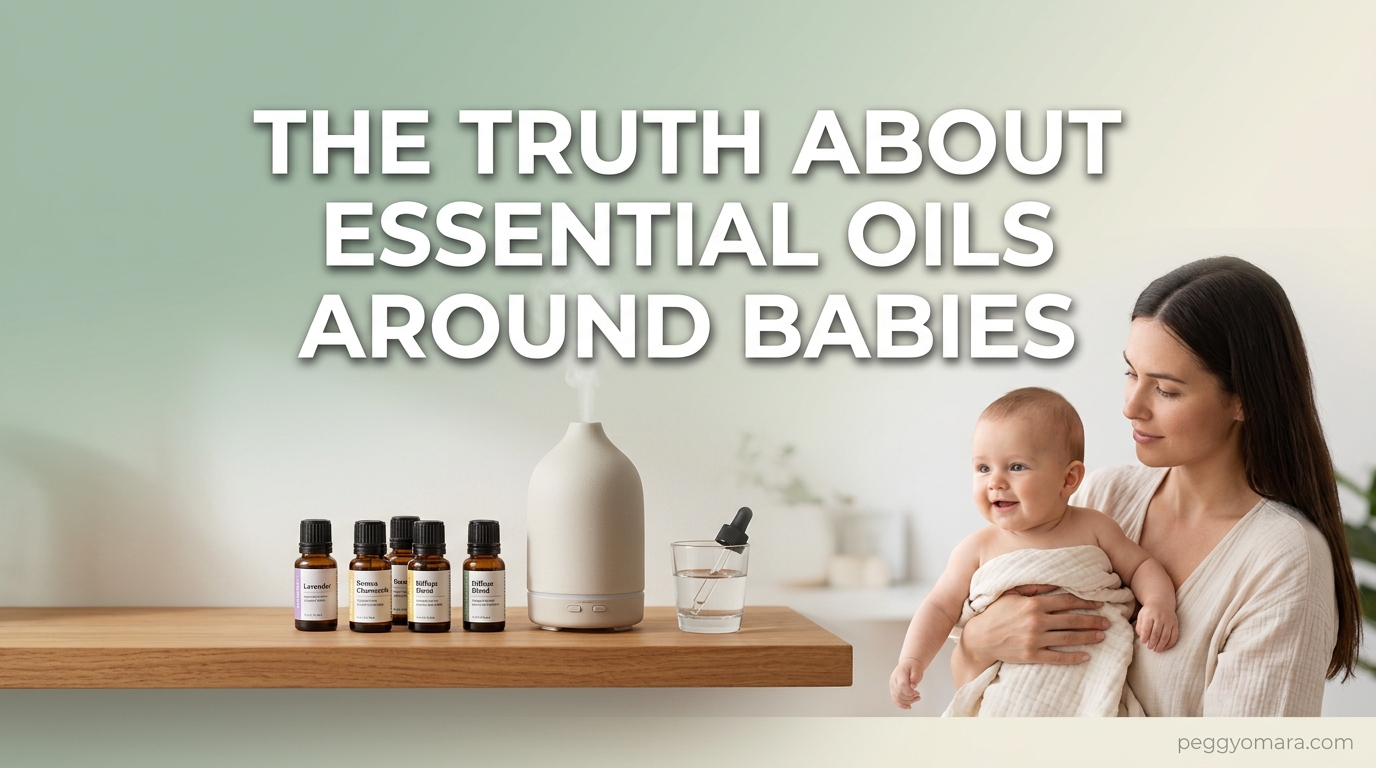
Essential oils can be safe around babies and toddlers, but only with strict age-appropriate precautions and proper dilution. The guidance varies widely depending on your source. Some pediatricians say avoid all oils until age 3, while others approve limited use after 3 months with heavy dilution. Understanding the truth about essential oils around babies helps you make informed decisions that protect your child’s health while addressing your family’s wellness needs.
When I first became a parent, I received conflicting advice about diffusing lavender in my baby’s room. My mother-in-law swore by it, while my pediatrician cautioned against it. This confusion sent me down a research rabbit hole that revealed how much misinformation exists about essential oil safety for infants.
This guide cuts through the conflicting advice with evidence-based information. You’ll learn what age guidelines actually mean, which oils pose real dangers, and how to use oils safely if you choose to do so. We will also address the pressure many parents face from well-meaning friends selling oils through multi-level marketing companies.
Table of Contents
What Are Essential Oils, Really?
Essential oils are concentrated extracts from plants, flowers, herbs, and trees. They capture the natural fragrance and beneficial compounds of their source material through processes like steam distillation or cold pressing. A single drop can represent the essence of pounds of raw plant material.
This concentration is what makes essential oils both powerful and potentially dangerous for babies. Their skin is thinner than adult skin, with a lipid barrier that is still developing. This means essential oils absorb more readily into their bloodstream. Their respiratory systems are also more sensitive, making inhalation a concern even when oils are diffused rather than applied directly.
The potency varies by oil type. Some, like lavender and chamomile, are relatively gentle even in concentrated form. Others, such as eucalyptus and peppermint, contain compounds that can cause serious reactions in young children even at low concentrations.
Why the Age Recommendations Are So Confusing
The conflicting age guidelines for essential oils frustrate many parents. Johns Hopkins Medicine suggests careful use with babies as young as 3 months using 0.25% dilution. Children’s Hospital of Philadelphia recommends waiting until age 3 entirely. The New York Times parenting section cites pediatricians who advise against diffusion before 6 months.
These differences exist because research on essential oil safety in infants remains limited. Most studies focus on adult populations or older children. Pediatricians must weigh anecdotal reports, traditional use, and the known physiological differences between babies and adults.
The more conservative recommendations come from pediatric institutions that prioritize safety over potential benefits. They note that babies do not need essential oils, so the risk-benefit calculation favors caution. More permissive guidelines typically come from aromatherapy organizations that emphasize proper technique over blanket restrictions.
My recommendation: Start with the most conservative guidance from your pediatrician, then adjust based on your child’s specific health needs and your comfort level with risk. A premature baby or one with respiratory issues requires stricter limits than a healthy full-term infant.
The Real Safety Risks You Need to Know
Before using any essential oil around your baby, understand these three primary risk categories. Each presents different dangers and requires different precautions.
Skin Absorption and the Lipid Barrier
A baby’s skin acts differently than adult skin. The lipid barrier, which protects against moisture loss and chemical absorption, remains immature during the first year of life. This makes babies more susceptible to dermal absorption of essential oil compounds.
WebMD reports that certain essential oils can actually degrade this already-fragile lipid barrier. When this happens, the skin becomes more vulnerable to irritation, infection, and further chemical absorption. The risk is highest with undiluted oils or improper carrier oil ratios.
Signs of skin irritation include redness, rash development, unusual fussiness during or after application, and visible skin texture changes. These symptoms may appear immediately or develop over several hours after exposure.
Respiratory Concerns from Diffusion
Diffusing essential oils releases microscopic particles into the air that your baby inhales. Their developing lungs and smaller airways make them more vulnerable to irritation from these concentrated compounds. Several pediatricians on parenting forums report seeing babies with respiratory irritation after parents used diffusers in nurseries.
The risk varies by oil type and diffusion method. Eucalyptus and peppermint oils contain menthol and similar compounds that can trigger breathing difficulties in young children. Even gentle oils like lavender can cause issues if the concentration is too high or the room lacks proper ventilation.
Heat-based diffusers pose additional risks because they can alter the chemical composition of oils, potentially creating compounds not present in the original oil. Ultrasonic diffusers are generally preferred because they do not heat the oil, though they still release particles into the air.
Ingestion Dangers
Essential oils should never be given orally to babies or young children. Even small amounts can cause poisoning, liver damage, or neurological symptoms. The National Capital Poison Center reports regular calls about children who have ingested essential oils, with symptoms ranging from stomach upset to seizures depending on the oil and amount consumed.
Storage safety matters enormously. Keep all essential oils in locked cabinets or high shelves that toddlers cannot reach. Remember that babies explore with their mouths, so any oil residue on your skin or surfaces becomes a potential ingestion hazard.
Essential Oils Generally Considered Safe (When Used Correctly)
Three essential oils consistently appear on safe-for-baby lists from reputable medical and aromatherapy sources: lavender, chamomile, and dill. Each has specific applications and appropriate use cases.
Lavender (Lavandula angustifolia)
Lavender oil ranks as the most researched and widely recommended oil for babies. Studies suggest it may help with sleep quality and colic symptoms when used properly. The key word is properly, meaning heavily diluted and applied with caution.
Many parents report success using diluted lavender for bedtime routines. The scent association can signal to babies that sleep time approaches. Some also use it for infant massage, though the dilution must be extremely conservative for direct skin contact.
Despite its reputation for gentleness, lavender can still cause reactions in sensitive individuals. Always perform a patch test before broader application, and stop use immediately if you notice any skin or behavioral changes.
Chamomile (Matricaria chamomilla)
Roman chamomile, specifically Matricaria chamomilla, offers anti-inflammatory and calming properties that may help with teething discomfort and general fussiness. Traditional use supports its safety profile, though modern research remains limited.
The same dilution rules apply to chamomile as to lavender. Some parents find chamomile particularly helpful during teething episodes when applied to the jawline in a heavily diluted carrier oil. Others use it in room sprays for general calming effects.
Note that chamomile belongs to the ragweed family. Babies with ragweed allergies may react to chamomile even if they have shown no previous allergy symptoms. Monitor closely when introducing this oil.
Dill (Anethum sowa)
Dill oil receives less attention than lavender or chamomile but appears on multiple pediatric-safe lists. Traditional practitioners use it for digestive support and colic relief. The research base is smaller, but historical use suggests a good safety profile when properly diluted.
Use dill only in very low concentrations and never near the face or hands where a baby might ingest it. Some parents add a drop to a warm bath for general calming, though ensure the oil is well-dispersed and the baby is supervised throughout.
Oils to Never Use Around Babies and Toddlers
Some essential oils pose too much risk for use around children under age 3. The following oils should be strictly avoided in any form, including diffusion, topical application, or indirect exposure.
Eucalyptus and Peppermint
These popular oils contain high concentrations of menthol and related compounds that can trigger breathing difficulties in young children. Eucalyptus oil specifically has been linked to respiratory distress in infants, even from diffusion alone.
The concern centers on how these oils affect the respiratory system. They can cause bronchial constriction and mucus production that a baby’s smaller airways cannot accommodate. Symptoms include wheezing, coughing, and in severe cases, breathing difficulty requiring emergency intervention.
Wintergreen and Birch
Both oils contain methyl salicylate, the same compound found in aspirin. This poses a poisoning risk even through skin absorption. Babies metabolize chemicals differently than adults, making this compound particularly dangerous for them.
The poisoning risk exists even with small amounts. A baby does not need to ingest wintergreen oil directly to experience salicylate toxicity. Skin absorption over time or inhalation of high concentrations can produce the same dangerous effect.
Other Oils to Avoid
WebMD and pediatric sources also warn against Idaho tansy, hyssop, sage, clary sage, and camphor around babies. These oils contain compounds that affect the nervous system, respiratory system, or both in ways that are particularly dangerous for developing bodies.
When in doubt about a specific oil, consult your pediatrician or skip it entirely. The potential benefits of essential oils never outweigh the risks of using an inappropriate oil around your baby.
Dilution Guidelines by Age
Proper dilution makes the difference between safe use and potential harm. Essential oils must be mixed with carrier oils before any skin application. The dilution percentage refers to the ratio of essential oil to carrier oil.
The 20-30-50 rule offers a simple framework for remembering age-appropriate dilutions. At age 3 months to 2 years, use 0.25% to 0.5% dilution, which equals approximately 20 drops of essential oil per 100 milliliters of carrier oil. From ages 2 to 6 years, increase to 1% to 2% dilution, or roughly 30 drops per 100 milliliters. After age 6, you can use 1.5% to 3% dilution, approaching 50 drops per 100 milliliters.
Understanding Carrier Oils
Carrier oils dilute essential oils and provide a safe medium for skin application. Good options for babies include fractionated coconut oil, sweet almond oil, and jojoba oil. Each has different properties that may suit different skin types.
Fractionated coconut oil remains liquid at room temperature and absorbs quickly without leaving residue. Sweet almond oil offers additional moisturizing benefits but may trigger nut allergy concerns in sensitive families. Jojoba oil most closely resembles human sebum and rarely causes reactions.
Never use water, alcohol, or synthetic lotions to dilute essential oils. These do not properly disperse the oil and may increase skin irritation rather than reducing it.
Creating Your Dilution
To create a 0.25% dilution for babies 3-24 months, add 1 drop of essential oil to 4 teaspoons of carrier oil. For a 0.5% dilution, use 1 drop per 2 teaspoons. Always measure carefully rather than estimating.
Make small batches that you use within a few weeks to maintain freshness. Store diluted mixtures in dark glass bottles away from heat and light. Label each bottle with the contents, dilution percentage, and creation date.
How to Apply Essential Oils Safely
Three primary methods exist for using essential oils around babies: topical application, diffusion, and personal inhalers. Each carries different risks and requires specific precautions.
Topical Application Methods
When applying oils to a baby’s skin, avoid the face, hands, feet, and any areas with broken skin. The best application sites are the back, chest, or limbs where the skin is intact and the baby cannot easily transfer oil to their mouth or eyes.
Always perform a patch test before using any new oil or blend. Apply a small amount of the diluted oil to the inner arm and wait 24 hours. Check for redness, swelling, or irritation. If any reaction occurs, do not use that oil on your baby.
Never apply essential oils to a baby who is sleeping or unsupervised. You need to monitor for immediate reactions including skin changes, breathing changes, or behavioral shifts.
Diffuser Safety Guidelines
If you choose to diffuse around babies, use an ultrasonic diffuser rather than heat-based models. Place the diffuser in a well-ventilated area at least 5 feet from the baby’s crib or play area. Run the diffuser for 30 minutes or less, then turn it off and air out the room.
Do not diffuse in the same room where a baby sleeps overnight. The continuous exposure increases respiratory risk without providing additional benefits. Some pediatricians recommend avoiding diffusion entirely for babies under 6 months.
Clean your diffuser regularly according to manufacturer instructions. Residual oil buildup can create concentrations higher than intended and potentially harbor bacteria.
Personal Inhaler Alternative
For parents who want the benefits of essential oils without exposing their baby, personal inhalers offer a safe compromise. These small devices allow you to inhale the oil directly without releasing particles into the shared air.
This method eliminates respiratory risk to your baby while still providing benefits to you. The National Association for Holistic Aromatherapy specifically recommends personal inhalers as the safest method for parents who want to use oils while caring for young children.
Warning Signs: When to Stop and Call the Doctor
Knowing when a reaction requires medical attention can prevent minor issues from becoming emergencies. Watch for these symptoms after any essential oil use around your baby.
Skin Reaction Signs
Redness, rash, hives, or blistering at the application site indicate contact dermatitis or allergic reaction. Unusual fussiness during application may signal discomfort from skin irritation even before visible signs appear.
If skin reactions occur, immediately wash the area with mild soap and water. Apply a gentle, unscented moisturizer and monitor for worsening. Contact your pediatrician if the reaction spreads, develops blisters, or does not improve within 24 hours.
Respiratory Symptoms
Wheezing, coughing, rapid breathing, or bluish skin coloration require immediate action. These signs suggest respiratory irritation or distress that can escalate quickly in babies.
Move your baby to fresh air immediately if respiratory symptoms appear after diffusion. If symptoms persist beyond a few minutes or worsen, seek emergency medical care. Breathing difficulties in babies can become life-threatening rapidly.
Ingestion Emergency Response
If your baby ingests any amount of essential oil, contact Poison Control immediately at 1-800-222-1222. Do not wait for symptoms to appear before calling. Some oils cause delayed reactions that are harder to treat once symptoms develop.
Do not induce vomiting unless specifically instructed by Poison Control or emergency personnel. Some oils can cause additional damage on the way back up through the esophagus.
Frequently Asked Questions
Is it okay to have essential oils around babies?
Essential oils can be okay around babies with strict precautions. Wait until at least 3 months of age, use only gentle oils like lavender and chamomile, and always dilute heavily. Many pediatricians recommend waiting until 6 months for diffusion and age 3 for topical use. Never use eucalyptus, peppermint, or wintergreen around babies.
Can I diffuse essential oils around my toddler?
Diffusion around toddlers over age 2 is generally safer than with infants, but precautions remain important. Use only child-safe oils like lavender or chamomile, limit diffusion to 30 minutes, ensure proper ventilation, and keep the diffuser at least 5 feet from your child. Stop immediately if you notice coughing or behavioral changes.
What is the 20 30 50 rule for essential oils?
The 20-30-50 rule helps remember dilution ratios by age. At 3 months to 2 years, use 0.25-0.5% dilution (about 20 drops per 100ml carrier oil). Ages 2-6 years can use 1-2% dilution (about 30 drops per 100ml). Over age 6, use 1.5-3% dilution (approaching 50 drops per 100ml). Always start with the lowest concentration.
Is lavender oil safe for babies to inhale?
Lavender oil is generally considered the safest option for babies when used properly. For inhalation, use an ultrasonic diffuser for 30 minutes maximum in a well-ventilated room. Keep the diffuser at least 5 feet from the baby and never diffuse in the sleep area overnight. Discontinue use if you notice any respiratory symptoms.
Is it safe to use a diffuser in a baby room?
Using a diffuser in a baby’s room requires caution. Many pediatricians recommend avoiding diffusion entirely for babies under 6 months. For older babies, use ultrasonic diffusers only, run for 30 minutes maximum, maintain distance from the crib, and ensure good ventilation. Never leave a diffuser running overnight in an occupied nursery.
Can essential oils cause breathing problems in babies?
Yes, essential oils can cause breathing problems in babies. Their developing respiratory systems are sensitive to concentrated particles from diffusers. Oils like eucalyptus and peppermint pose particular risks. Watch for wheezing, coughing, rapid breathing, or bluish skin. Seek immediate medical attention if breathing difficulties occur.
What age can I start using essential oils on my baby?
Age recommendations vary by source. Conservative guidance suggests waiting until age 3. Moderate guidance allows limited use after 3 months with 0.25% dilution. Many pediatricians approve diffusion after 6 months. The safest approach is consulting your pediatrician and starting with the most conservative option appropriate for your child’s health status.
What should I do if my baby has a reaction to essential oils?
For skin reactions, immediately wash the area with mild soap and water, apply unscented moisturizer, and monitor. For respiratory symptoms, move your baby to fresh air immediately. For ingestion, call Poison Control at 1-800-222-1222 right away. Contact your pediatrician for any reaction that persists or worsens, and seek emergency care for breathing difficulties.
The Bottom Line
The truth about using essential oils around babies and toddlers comes down to caution, proper dilution, and respecting your child’s developing body. Essential oils are not inherently dangerous, but they require respect for their concentration and potency.
Wait until your baby is at least 3 months old before introducing any oils, and consider waiting until 6 months for diffusion or age 3 for topical use if you prefer conservative guidance. When you do use oils, stick to lavender, chamomile, and dill in heavily diluted preparations. Never use eucalyptus, peppermint, wintergreen, or other restricted oils around young children.
Most importantly, consult your pediatrician before using essential oils around your baby. They know your child’s specific health status and can provide personalized guidance. Trust medical sources over marketing claims from oil sellers, and remember that no essential oil is necessary for your baby’s health and wellbeing.
Your baby’s safety always comes first. When in doubt, skip the oils and try other calming methods like white noise, gentle massage with plain carrier oil, or establishing consistent bedtime routines. These proven approaches carry zero risk and often work just as well.