
You have probably heard it more times than you can count. A well-meaning friend, a relative, or even a doctor suggests that you should just relax and pregnancy will happen. For anyone navigating the complex and often heartbreaking path of infertility, this advice feels dismissive, frustrating, and scientifically questionable.
After spending months analyzing research and speaking with fertility specialists, I want to address this question with the nuance it deserves. Does stress actually affect your fertility, and what does the research really say about this connection? The answer is more complex than a simple yes or no, and understanding the science can help you make informed decisions about your reproductive health.
What many people do not realize is that the relationship between stress and fertility works both ways. While stress can potentially impact your ability to conceive, the experience of infertility itself creates significant psychological distress. Studies have shown that women undergoing fertility treatment experience anxiety and depression levels comparable to patients facing cancer diagnoses. This is not a trivial matter of needing to calm down. It is a legitimate health concern with physiological consequences.
In this guide, we will explore what current research reveals about the stress-fertility connection, examine the biological mechanisms at play, and discuss evidence-based strategies for managing stress during your fertility journey. My goal is to provide you with information that validates your experience while offering practical tools you can use.
Table of Contents
Does Stress Actually Affect Your Fertility?
Yes, research indicates that stress can affect fertility through measurable biological pathways, though it is rarely the sole cause of infertility. Multiple peer-reviewed studies have found that women with elevated stress biomarkers take longer to conceive and may face increased odds of infertility.
However, the relationship is nuanced. Stress does not create an absolute barrier to conception, and women become pregnant every day while experiencing significant life stress. The effects are typically reversible, and stress management can support both your overall wellbeing and your fertility outcomes. The key is understanding how chronic stress affects your reproductive system so you can make informed choices about your health.
What the Research Shows: Key Studies on Stress and Fertility
The scientific literature on stress and fertility has expanded significantly in recent years, with several landmark studies providing concrete data on this connection. Understanding this research helps separate fact from fiction when evaluating how stress might be affecting your reproductive health.
The Alpha-Amylase Study: Quantifying the Impact
One of the most frequently cited studies in this field comes from researchers at Ohio State University and was published in the journal Human Reproduction. Courtney Lynch and her colleagues measured salivary alpha-amylase, an enzyme that serves as a biomarker for stress, in women trying to conceive naturally.
The findings were striking. Women with the highest levels of alpha-amylase took 29% longer to get pregnant compared to women with lower levels. Additionally, these women had more than twice the risk of infertility. This was one of the first studies to use an objective biological marker rather than self-reported stress levels, strengthening the evidence for a physiological connection.
Cortisol and Time-to-Pregnancy Research
Other research has examined cortisol, the primary stress hormone, and its relationship with fecundability, which is the probability of conceiving during a given menstrual cycle. A study led by Germaine Buck Louis found that higher stress levels as measured by both perceived stress scales and biomarkers were associated with longer time-to-pregnancy.
What makes this research particularly relevant is that it accounted for other factors that could affect fertility, including age, body mass index, alcohol use, and caffeine consumption. Even after controlling for these variables, the stress-fertility connection remained significant. This suggests that stress operates through distinct biological pathways rather than simply correlating with other lifestyle factors.
Assisted Reproductive Technology Outcomes
The research extends beyond natural conception to fertility treatments as well. Several studies have examined how stress affects outcomes for in vitro fertilization (IVF) and intrauterine insemination (IUI). While findings have been somewhat mixed, a meta-analysis published in Fertility and Sterility found that psychological interventions designed to reduce stress were associated with improved pregnancy rates among women undergoing IVF.
One study specifically found that women who participated in mind-body programs before IVF had higher pregnancy rates than those who received standard care alone. This does not mean that stress reduction guarantees success, but it does suggest that managing stress may improve your odds when undergoing fertility treatment.
Acute vs. Chronic Stress: What the Data Shows
An important distinction emerging from recent research is the difference between acute stress and chronic stress. Acute stress refers to short-term stressful events, like a work presentation or a difficult conversation. Your body is designed to handle these stressors and typically returns to baseline quickly.
Chronic stress, however, involves ongoing elevation of stress hormones over weeks, months, or years. This might include financial strain, a high-pressure job, relationship difficulties, or the accumulated stress of infertility itself. The research suggests that chronic stress is more likely to affect fertility than acute stress episodes, though both can have effects depending on intensity and individual physiology.
How Stress Affects Fertility: The Physiological Mechanisms
To understand how stress might be affecting your fertility, it helps to know something about the hypothalamic-pituitary-ovarian axis, commonly called the HPO axis. This is the hormonal communication system that regulates your menstrual cycle and ovulation. When this system functions properly, your brain and ovaries communicate seamlessly to produce mature eggs and prepare your uterus for pregnancy.
The HPO Axis and Stress Hormones
The HPO axis begins in the hypothalamus, a small region at the base of your brain. The hypothalamus produces gonadotropin-releasing hormone (GnRH) in rhythmic pulses. These pulses signal the pituitary gland to release luteinizing hormone (LH) and follicle-stimulating hormone (FSH), which then travel to your ovaries and stimulate egg development and ovulation.
When you experience stress, your body activates the hypothalamic-pituitary-adrenal (HPA) axis, a parallel system that manages your stress response. The HPA axis triggers the release of corticotropin-releasing hormone (CRH), which leads to production of adrenocorticotropic hormone (ACTH) and ultimately cortisol, the primary stress hormone.
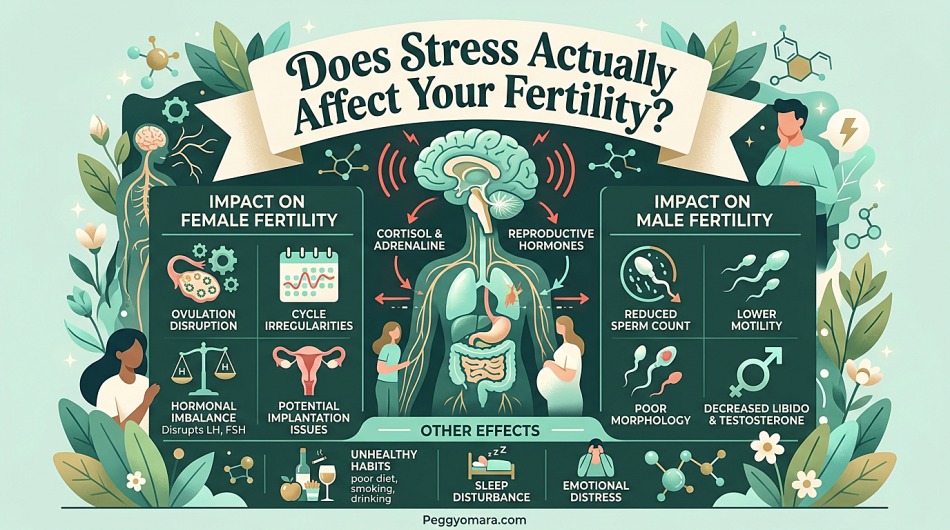
Here is where the fertility connection occurs. Elevated cortisol and CRH can suppress GnRH pulsatility. When your brain is prioritizing survival resources to manage stress, reproductive functions become secondary. This can lead to delayed or suppressed ovulation, irregular menstrual cycles, and in severe cases, hypothalamic amenorrhea, which is the absence of periods due to disrupted brain signals.
Effects on Ovulation and the Menstrual Cycle
The most direct effect of stress on female fertility is through ovulatory dysfunction. Without proper GnRH signaling, the LH surge that triggers egg release may be delayed, weakened, or absent entirely. This results in anovulatory cycles, where no egg is released. Even if ovulation does occur, the timing may be off, making it difficult to identify your fertile window accurately.
Stress can also affect the luteal phase of your cycle, which is the period between ovulation and your next period. During this time, the corpus luteum produces progesterone to support the uterine lining for potential implantation. Chronic stress may contribute to luteal phase defects, where progesterone levels are inadequate to maintain a pregnancy. This can result in early pregnancy loss or failed implantation even when fertilization occurs.
Impact on Implantation and Early Pregnancy
Beyond ovulation, stress may affect implantation, the process by which a fertilized embryo attaches to the uterine lining. Research suggests that chronic stress can alter uterine receptivity through inflammatory pathways. Elevated cortisol and other stress hormones can increase pro-inflammatory cytokines, which may create a less hospitable environment for embryo implantation.
Additionally, stress has been associated with reduced blood flow to the uterus, potentially affecting the thickness and quality of the endometrial lining. While the evidence for implantation effects is less robust than for ovulation disruption, several studies have found correlations between stress biomarkers and reduced pregnancy rates even when high-quality embryos are transferred during IVF cycles.
Male Reproductive Biology and Stress
Stress affects male fertility through somewhat different mechanisms. The hypothalamic-pituitary-gonadal (HPG) axis in men regulates testosterone production and spermatogenesis. Chronic stress and elevated cortisol can suppress this axis, leading to reduced testosterone levels and decreased sperm production.
Research has found that men experiencing high stress levels may have reduced sperm concentration, decreased motility, and higher rates of abnormal sperm morphology. Additionally, stress is associated with increased sperm DNA fragmentation, which can affect fertilization rates and embryo quality. The psychological stress of infertility affects men too, and partner stress dynamics can create additional strain on couples trying to conceive.
Acute Stress vs. Chronic Stress: Different Effects on Fertility
Not all stress affects fertility equally, and understanding the difference between acute and chronic stress can help you prioritize your stress management efforts. Acute stress refers to short-term, time-limited stressors. Your body has evolved to handle these situations, and while they may temporarily disrupt your cycle, the effects are typically short-lived.
Examples of acute stress include a difficult work presentation, a minor car accident, an argument with a friend, or even the stress of a single fertility appointment. Your hypothalamic-pituitary-adrenal axis activates, cortisol rises temporarily, and then returns to baseline once the stressor resolves. For most people, acute stress does not have lasting effects on fertility.
Chronic stress, however, involves sustained activation of the stress response system over weeks, months, or years. This might include ongoing financial difficulties, a toxic work environment, caregiving for an ill family member, or the accumulated stress of months or years of trying to conceive without success. With chronic stress, cortisol levels remain elevated, and the HPO axis suppression becomes more pronounced.
The Unique Stress of the Two-Week Wait
Anyone who has tried to conceive knows about the two-week wait, the period between ovulation and when you can take a pregnancy test. This window creates a unique type of acute-on-chronic stress. You have the baseline stress of your fertility journey, compounded by the specific anxiety of waiting to know if this cycle worked.
Forum discussions reveal that this period is consistently identified as the most stressful part of the fertility journey for many women. The uncertainty, the symptom-watching, and the fear of disappointment create a pressure cooker of anxiety. While this stress is time-limited, it occurs repeatedly cycle after cycle, potentially contributing to the cumulative stress burden.
Workplace and Financial Stress
Research has begun examining specific types of stress and their fertility effects. Workplace stress, particularly job strain characterized by high demands and low control, has been associated with longer time-to-pregnancy in several studies. Financial stress is another significant factor, especially given that fertility treatments can be costly and are not always covered by insurance.
These socioeconomic stressors are often overlooked in fertility discussions but can be just as impactful as the medical aspects of infertility. The pressure to maintain work performance while attending frequent medical appointments, the financial strain of treatments, and the uncertainty about the future all contribute to chronic stress levels that may affect reproductive outcomes.
The Stress-Infertility Cycle: A Two-Way Street
One of the most important findings in fertility research is that the relationship between stress and infertility is bidirectional. Not only can stress potentially affect fertility, but the experience of infertility itself creates profound psychological distress. This creates a cycle that can be difficult to break without proper support.
The Emotional Toll of Infertility
Research published in Human Reproduction found that women with infertility experience anxiety and depression at rates comparable to patients with cancer, hypertension, or recovering from heart attacks. Yet unlike these other conditions, infertility is often invisible, misunderstood, and surrounded by stigma and silence.
The monthly roller coaster of hope and disappointment takes a cumulative toll. Each negative pregnancy test, each menstrual period that arrives right on schedule, each failed treatment cycle adds another layer of grief and anxiety. Many women report feeling like their body is betraying them or that they have lost trust in their own biology. These feelings are completely valid and represent a normal response to a difficult situation.
The Worry-About-Worrying Cycle
A particularly challenging aspect of fertility-related stress is the meta-stress about being stressed. Once you learn that stress might affect fertility, it is easy to fall into a cycle of worrying about your worry. You feel stressed, then worry that this stress is hurting your chances, which creates more stress, which you then worry about. This cycle can feel inescapable.
Forum discussions reveal this is a common experience. Many women report feeling trapped by the paradox that they need to relax to get pregnant, but the pressure to relax creates more stress. This is why the just relax advice is so unhelpful. It adds another burden to an already heavy load and implies that infertility is somehow your fault for being too stressed.
Social Media and Comparison Stress
Modern fertility journeys occur within a digital landscape that adds unique stressors. Social media exposes you to pregnancy announcements, baby photos, and parenting milestones from friends, acquaintances, and influencers. Online fertility communities can provide valuable support, but they can also create comparison stress as you read about others who conceived on their first try or after one round of IVF.
Research on digital health communities has found that while they reduce isolation, they can also increase anxiety through information overload and upward social comparison. Learning to curate your digital environment and set boundaries around fertility-related content can be an important part of stress management.
Male Fertility and Stress: What About Men’s Reproductive Health?
While much of the discussion around stress and fertility focuses on women, research increasingly shows that male fertility is also affected by psychological stress. This is important both for men trying to conceive naturally and for couples undergoing fertility treatment, as sperm quality directly affects fertilization rates and embryo development.
Sperm Quality and Stress Research
Studies examining stress and male fertility have found associations between psychological distress and reduced semen parameters. A meta-analysis published in Fertility and Sterility found that men experiencing stress had lower sperm concentration, reduced motility, and higher rates of abnormal morphology compared to men reporting lower stress levels.
Stress also affects sperm at the molecular level. Research has found associations between chronic stress and increased sperm DNA fragmentation. DNA fragmentation refers to breaks in the genetic material within sperm cells. High levels of fragmentation can affect fertilization rates, embryo development, and may increase the risk of miscarriage.
Hormonal Pathways in Men
The mechanisms by which stress affects male fertility are similar to those in women, involving the hypothalamic-pituitary-gonadal axis. Chronic stress elevates cortisol, which can suppress the production of gonadotropin-releasing hormone and subsequently luteinizing hormone. Since LH signals the testes to produce testosterone, this suppression can lead to lower testosterone levels and reduced sperm production.
Additionally, stress can directly affect sexual function. Erectile dysfunction and reduced libido are common responses to chronic stress and anxiety. For couples trying to conceive, this can create additional pressure around timed intercourse, potentially compounding relationship stress and reducing the frequency of intercourse during the fertile window.
Partner Stress Dynamics
It is important to recognize that fertility stress affects couples, not just individuals. Each partner’s stress level influences the other, and the relationship itself can be a source of either support or additional strain. Research has found that couples who communicate openly about their fertility journey and support each other’s emotional needs tend to have better psychological outcomes.
However, men often experience fertility stress differently than women and may be less likely to seek support. Societal messages about masculinity can make it difficult for men to discuss their feelings about infertility, leading to internalized stress. Creating space for both partners to process their emotions and supporting each other’s coping strategies is essential for maintaining relationship health during fertility challenges.
Evidence-Based Stress Management Strategies for Fertility
Given what the research shows about stress and fertility, developing effective stress management strategies makes sense both for your overall wellbeing and potentially for your reproductive outcomes. The goal is not to eliminate all stress, which is neither possible nor necessarily desirable. Instead, the aim is to build resilience, develop coping skills, and reduce chronic stress load where possible.
Cognitive Behavioral Therapy (CBT)
Cognitive Behavioral Therapy has the strongest research support for reducing fertility-related distress. CBT helps you identify and challenge unhelpful thought patterns, such as catastrophic thinking about the future or self-blame for infertility. A randomized controlled trial published in Fertility and Sterility found that CBT significantly reduced anxiety and depression in women undergoing fertility treatment.
CBT also includes behavioral interventions like relaxation training, activity scheduling to maintain engagement with life outside fertility treatment, and sleep hygiene improvements. Working with a therapist trained in fertility issues can provide targeted support for the specific challenges you are facing.
Mindfulness and Mind-Body Programs
Mindfulness-Based Stress Reduction programs, originally developed for chronic pain patients, have been adapted for fertility contexts with promising results. These programs typically involve meditation practice, body awareness exercises, and techniques for managing difficult emotions. Research has found that women participating in mind-body programs before IVF had higher pregnancy rates than control groups.
The key benefit of mindfulness is not that it eliminates stress, but that it changes your relationship to stress. Rather than getting caught in cycles of worry and rumination, mindfulness practice helps you observe thoughts and feelings without becoming overwhelmed by them. This can be particularly helpful during the two-week wait when anxiety tends to spike.
Yoga and Physical Movement
Several studies have examined yoga specifically for fertility stress. A study published in Fertility and Sterility found that women participating in a six-week yoga program had significant reductions in anxiety and improvements in subjective wellbeing compared to a control group. Yoga combines physical movement, breathwork, and mindfulness, making it a comprehensive stress management tool.
More generally, moderate physical exercise is associated with improved mood, better sleep, and reduced cortisol levels. However, extremely intense exercise can have the opposite effect, potentially disrupting the menstrual cycle. Finding the right balance of movement that feels good and supports rather than depletes your body is important.
Support Groups and Community Connection
Connecting with others who understand what you are going through can significantly reduce the isolation of infertility. Research has found that participating in support groups reduces depression and anxiety scores among fertility patients. Whether in-person or online, these communities provide validation, practical advice, and a space to express difficult emotions without judgment.
However, it is important to choose groups that match your needs and boundaries. Some people find support in large online communities, while others prefer smaller, more private groups. You may need different types of support at different stages of your journey. Give yourself permission to step back from communities if they are increasing rather than decreasing your stress.
Lifestyle Factors: Sleep, Diet, and Exercise
Basic lifestyle factors play an important role in both stress management and fertility. Sleep deprivation significantly increases cortisol and impairs coping capacity. Prioritizing seven to nine hours of quality sleep supports both emotional regulation and hormonal health. If fertility medications or anxiety are disrupting your sleep, discuss this with your healthcare provider as it may warrant specific intervention.
The Mediterranean diet pattern has been associated with both improved fertility outcomes and better mental health. This eating pattern emphasizes whole foods, vegetables, fruits, legumes, whole grains, fish, and olive oil while limiting processed foods and added sugars. While diet alone will not eliminate fertility stress, supporting your body with nourishing foods provides a foundation for resilience.
When to Seek Professional Help
It is important to recognize when stress has moved beyond what self-management strategies can address. If you are experiencing persistent depression, panic attacks, intrusive thoughts, or difficulty functioning in daily life, professional mental health support is warranted. Many fertility clinics now work with mental health professionals who specialize in reproductive psychology.
Seeking help is not a sign of weakness or evidence that you are not handling your fertility journey well. It is a proactive step to protect your mental health during a legitimately difficult experience. Some clinics require counseling before certain treatments, but even when not required, therapy can provide valuable support.
Frequently Asked Questions About Stress and Fertility
Is it harder to conceive if stressed?
Research indicates that high stress levels can extend the time it takes to conceive. One landmark study found women with elevated stress biomarkers took 29% longer to get pregnant and had double the risk of infertility. However, conception is still possible while stressed, and stress is rarely the sole cause of infertility.
Can stress cause infertility in males?
Yes, research shows that stress can affect male fertility. Studies have found associations between chronic stress and reduced sperm concentration, decreased motility, increased abnormal morphology, and higher rates of sperm DNA fragmentation. Stress hormones can also lower testosterone levels and reduce libido, potentially affecting conception chances.
Does stress cause infertility in females?
Stress can contribute to fertility challenges in women by disrupting the hypothalamic-pituitary-ovarian axis, which regulates ovulation. Elevated cortisol can suppress GnRH pulsatility, potentially delaying or preventing ovulation. Stress may also contribute to luteal phase defects and affect implantation, though it is rarely the only factor in infertility.
Can stress prevent implantation?
Some research suggests chronic stress may affect implantation by altering uterine receptivity and increasing inflammatory markers like cytokines. Stress hormones can potentially reduce blood flow to the uterus and affect endometrial quality. However, the evidence for implantation effects is less robust than for ovulation disruption, and more research is needed in this area.
Can stress cause permanent infertility?
No, stress-related fertility effects are typically reversible. Once stress levels decrease and the hypothalamic-pituitary-ovarian axis recovers, normal ovulation and fertility usually resume. Unlike structural problems or genetic conditions, stress-induced hormonal disruption generally resolves with stress management and time.
Can I still get pregnant if I’m stressed?
Yes, women become pregnant every day while experiencing significant stress. While managing stress supports overall health and may improve fertility outcomes, it is not a prerequisite for conception. If you are stressed while trying to conceive, it does not mean pregnancy is impossible. Focus on sustainable stress management rather than eliminating all stress.
These answers reflect the current state of research as of 2026. As new studies emerge, our understanding of the stress-fertility connection continues to evolve. Always discuss your specific situation with a qualified healthcare provider who can provide personalized guidance.
Understanding Does Stress Actually Affect Your Fertility: Key Takeaways
After exploring what the research says about stress and fertility, several key points emerge. First, the connection is real and supported by multiple well-designed studies using objective biomarkers. Women with higher stress levels, as measured by alpha-amylase and cortisol, do experience longer times to pregnancy and increased infertility risk.
Second, the relationship is bidirectional. Infertility itself causes significant stress, with psychological impact comparable to serious medical conditions. The cycle of hope and disappointment month after month creates legitimate psychological distress that deserves acknowledgment and support, not dismissal with simplistic advice to relax.
Third, the biological mechanisms involve the hypothalamic-pituitary-ovarian axis, where stress hormones can disrupt the delicate hormonal balance needed for ovulation and implantation. Chronic stress has more significant effects than acute stress, though both can play a role depending on individual physiology.
Finally, while stress can affect fertility, it does not make conception impossible. Women become pregnant under all kinds of stressful circumstances. The goal of stress management is not to create a perfectly zen state before pregnancy can occur. Rather, it is about supporting your overall health, building resilience, and navigating the fertility journey with as much wellbeing as possible.
If you are struggling with fertility-related stress, consider reaching out to a mental health professional who specializes in reproductive psychology. You do not have to manage this alone, and seeking support is a sign of strength, not weakness. Your fertility journey is valid, your stress is understandable, and help is available.