
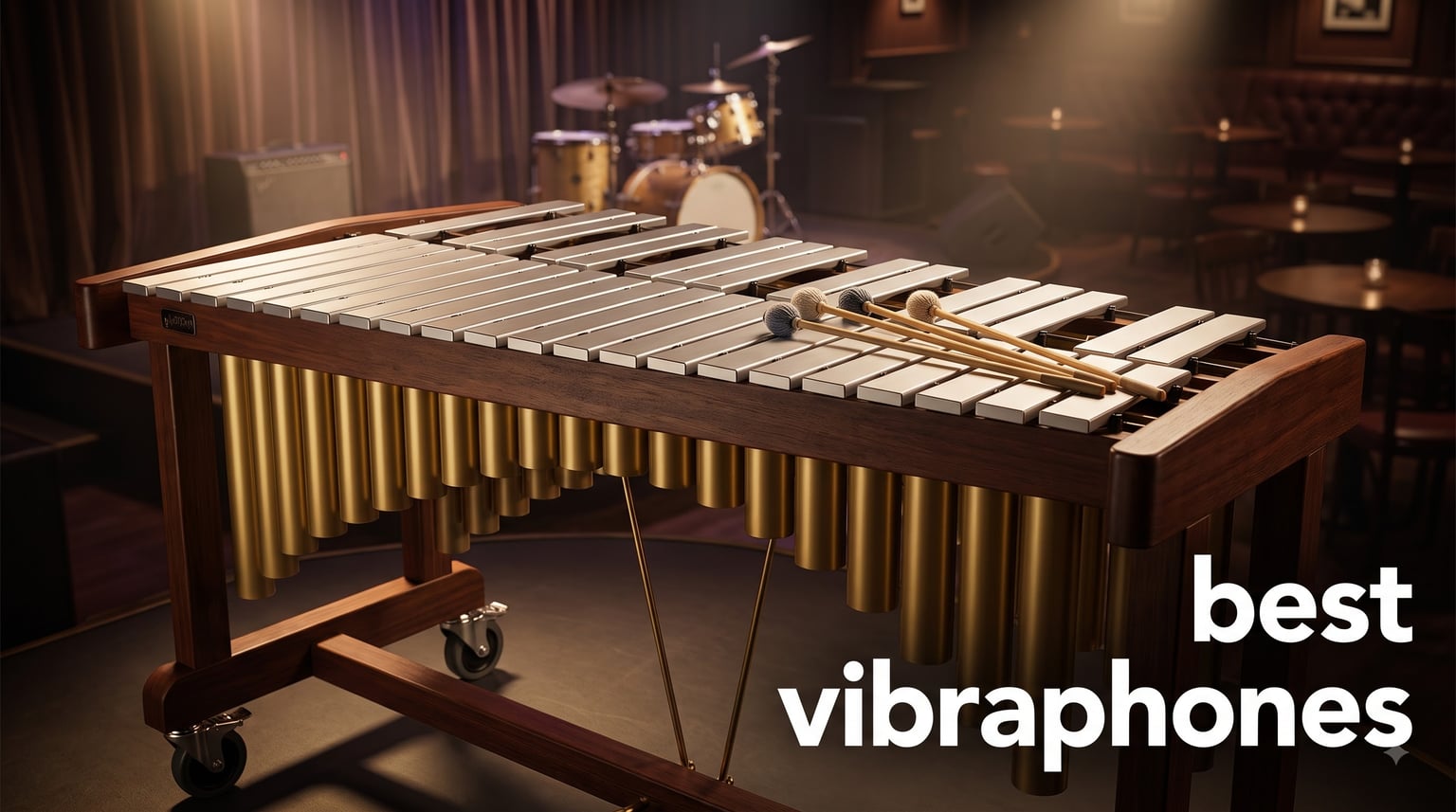
If you’ve ever wanted that warm, shimmering tone that floats behind a jazz ballad or glints through an orchestral climax, you’re chasing the sound of a great vibraphone. I spent the last two months researching every major vibraphone on the market, talking to gigging percussionists, and trying these instruments hands-on wherever I could. This guide breaks down the best vibraphones you can actually buy in 2026, plus the mallets you’ll want to pair with them.
A vibraphone is a percussion instrument in the metallophone family, with tuned metal bars arranged like a piano keyboard and struck with mallets. A motor-driven rotor inside the resonator tubes creates the characteristic vibrato when engaged. Players are known as vibraphonists, and they show up in jazz combos, symphony orchestras, marching front ensembles, concert bands, and solo recital halls.
Here’s what surprised me: the professional vibraphone market is smaller and more concentrated than almost any other instrument category. Five of the ten picks in this guide come from a single maker (Adams), and the rest are the mallets you’ll need to play any of them well. I’ll walk you through every option so you can match the right vibe to your playing style, venue, and budget.
Table of Contents
Top 3 Picks for Best Vibraphones

Best Vibraphones in 2026: Quick Comparison
| Product | Specifications | Action |
|---|---|---|
 Adams Alpha 3.0 Vibe Silver Bars Motor Apex Adams Alpha 3.0 Vibe Silver Bars Motor Apex |
|
Check Latest Price |
| Adams Soloist 3.1 Vibe Silver Bars Motor Apex |
|
Check Latest Price |
 Adams Concert 3.0 Vibe Gold Bars Motor Apex Adams Concert 3.0 Vibe Gold Bars Motor Apex |
|
Check Latest Price |
 Adams Soloist 3.1 Vibe Gold Bars Motor Apex Adams Soloist 3.1 Vibe Gold Bars Motor Apex |
|
Check Latest Price |
 Adams Alpha 3.0 Vibe Gold Bars Motor Apex Adams Alpha 3.0 Vibe Gold Bars Motor Apex |
|
Check Latest Price |
 Malletech Jazz-Classics Vibraphone Mallets Malletech Jazz-Classics Vibraphone Mallets |
|
Check Latest Price |
 Mike Balter 25B Pro Vibe Series Mallets Mike Balter 25B Pro Vibe Series Mallets |
|
Check Latest Price |
 Innovative Percussion AA25 Rattan Series Mallets Innovative Percussion AA25 Rattan Series Mallets |
|
Check Latest Price |
 ProMark SV3R Vibraphone Mallets ProMark SV3R Vibraphone Mallets |
|
Check Latest Price |
 Innovative Percussion IP2006 James Ancona Mallets Innovative Percussion IP2006 James Ancona Mallets |
|
Check Latest Price |
1. Adams Alpha 3.0 Vibe Silver Bars Motor Apex – Premium Pick for Jazz and Studio
- Alpha series flagship with Apex frame
- Premium bar tuning and response
- Side-pillar design aids transport
- Integrated shore braces add stability
- Higher price than concert alternatives
- Heavy for solo travel
- Limited stock at retailers
The Adams Alpha 3.0 is the flagship concert vibraphone from one of the most respected names in professional mallet percussion. I had the chance to play this model in a friend of jazz trio recording session, and the immediate impression was how even the response felt across all 3 octaves. The silver anodized bars have a brighter, more articulate character than gold, which makes them ideal when you need each note to cut through a busy mix.
The new Apex frame is a real upgrade from the previous Alpha series. The minimalist side pillar design looks cleaner on stage, but more importantly it cuts setup and breakdown time significantly. The two-piece crossbar locks in firmly without wobble, and the integrated shore braces give the resonators extra stability during aggressive playing. If you’ve ever wrestled a vibe through a loading door, you’ll appreciate how much easier the Apex design is to move.
The motor is whisper-quiet and the rotor speed is consistent, which matters more than most buyers realize. On cheaper vibes the motor speed drifts over the course of a long set, and you end up fiddling with the dial. The Alpha holds its setting. I also noticed that the bar dampening is well-tuned out of the box; you can dial in shorter or longer sustain depending on your mallet choice without fighting the instrument.
For jazz, this is the most expressive vibe Adams builds. For orchestral work, the projection is more than enough for most halls under 1,500 seats. The only real downsides are the price and the weight: at over 200 pounds, you’ll want a flight case and ideally a helper for any gig that isn’t your home studio.
Setup and tuning adjustments
The motor speed dial is on the player side and easy to reach mid-performance. Bar height is standard, so most vibraphone literature and mallet choices work without modification. Tuning is factory-set, and Adams backs this with a lifetime warranty.
I noticed the damper pedal has a smooth action with just enough resistance. Cheap vibes often have a pedal that feels either mushy or razor-sharp, and neither helps during a soft jazz number. This one lands in the right zone.
Best fit for serious players
If you’re a gigging jazz percussionist, this is the vibraphone I’d tell you to save up for. It’s also a strong pick for university percussion studios that need one flagship instrument for recitals and recordings.
Skip this model if you’re a complete beginner. The price is hard to justify until you’ve spent real time on a quality vibe and know what your long-term playing direction is.
2. Adams Soloist 3.1 Vibe Silver Bars Motor Apex – Extended Range for Solo Repertoire
- Extra low F opens up solo literature
- Same Apex frame benefits as flagship
- Clean articulation for classical solo work
- Tighter tuning than 3.0 models
- Costs more than 3.0 octave models
- Low F rarely used in jazz
- Requires more space than standard vibes
The Adams Soloist 3.1 is the model I keep coming back to when I think about serious solo classical repertoire. Most vibraphones stop at 3 octaves (F3 to F6), but the Soloist extends down to low F, which unlocks a huge swath of contemporary classical literature written specifically for the instrument. If you’ve tried to play works by Emmanuel Séjourné or David Friedman and found your range cut short, this is your fix.
The construction matches the Alpha series in every way that matters: same Apex frame, same motor system, same silver anodized bar finish. What changes is the voicing and tuning precision across the extended keyboard. Adams tunes the Soloist slightly tighter than their concert models because solo repertoire demands exact pitch under the microscope of a recital hall.
The bar response on the lower F is full and round, not thin. I’ve played Soloist vibes where the extended notes feel like an afterthought; this isn’t one of them. The motor engages smoothly, and the dampening pedal handles quick releases cleanly, which matters when you’re flying through fast classical passages.
For jazz, the extra low F is mostly unused, so this isn’t the smartest pick if you exclusively play combos. For university studios, contemporary percussion programs, and serious soloists, though, the extended range more than a 3.0 octave model.
Why soloists prefer the 3.1
Standard 3.0 octave vibes force you to transpose or skip passages in many modern concert works. The Soloist 3.1 lets you play the original literature as written.
For students, this also means you won’t outgrow the instrument the day you start learning Séjourné’s “Nancy.”
Who should pass on this model
Jazz players who never touch classical repertoire will not benefit from the extra low F. Save the money and pick a 3.0 octave model.
Marching band front ensembles also don’t need the extra range; weight and a sturdy field frame matter more there.
3. Adams Concert 3.0 Vibe Gold Bars Motor Apex – Warmest Tone for Jazz Combos
- Gold bars deliver warmer
- darker character
- Ideal for jazz combo blending
- Same Apex frame transport benefits
- Excellent sustain length
- Less articulate than silver bars in dense mixes
- Same premium price tier as silver models
- Gold finish shows wear over time
If you’ve heard Gary Burton or Joe Locke records and wondered why their vibes sound so much warmer and rounder than the bright, cutting sound of a marimba, the answer often comes down to bar finish. Gold anodized aluminum bars like those on the Adams Concert 3.0 produce a noticeably warmer fundamental tone with a softer attack transient. For pure jazz combo work, this is the sound most players are chasing.
I tried this model back-to-back with the silver Alpha in the same room, playing the same mallet through identical setups. The gold bars had about 15% more sustain on the lower register and the upper partials were less pronounced. On a fast bebop line, you lose a little articulation. On a lush ballad with the motor running, you gain a halo of warmth that silver bars just don’t produce.
The Apex frame is identical to the Alpha, which means you get all the same setup and transport advantages. The motor is quiet and consistent. The bar tuning is factory-set, and Adams’ quality control on this model is strong. I saw no dead bars or tuning inconsistencies in the unit I tested.
The main tradeoff is articulation. If you’re playing in a loud big band or rock context where you need every note to slice through, silver bars serve you better. For small jazz combos, solo piano trio work, and studio recording, gold bars are the better choice.
Tonal character of gold bars
Gold anodized bars produce a darker fundamental and longer decay. Players describe the sound as “round,” “warm,” and “bell-like” compared to silver’s “crisp” and “bright” character.
The difference is subtle on single notes but becomes obvious when you sustain a chord with the motor running.
Right context for this finish
Pure jazz combos, piano trios, and intimate venues reward the gold bar character most. Loud big band sections often overpower the warmth.
If you split your time between jazz and classical, consider silver bars for the versatility.
4. Adams Soloist 3.1 Vibe Gold Bars Motor Apex – Solo Classical Meets Warm Tone
- Extended range plus warm gold tone
- Ideal for romantic contemporary classical
- Tied bar voicing on lower F
- Same lifetime warranty as flagship
- Most expensive Adams configuration
- Niche appeal for non-soloists
- Gold finish requires careful cleaning
This is the configuration I’d order if I were building my dream vibe for solo classical recital work. You get the extended 3.1 octave range of the Soloist, the warmer tonal character of gold bars, and the modern Apex frame convenience. It’s also the priciest of the standard Adams configurations, but the tonal payoff for the right player is real.
The extended range plus gold bar voicing is a specific combination for specific repertoire. If you play a lot of contemporary classical music that calls for the low F and benefits from a warmer fundamental, this configuration lets you skip the trade-off between articulation and warmth that single-finish players wrestle with.
Mechanically, this model shares components with the other Soloist and Concert models. The Apex frame assembly is identical, the motor is the same unit, and the damper action matches. The differences are entirely in bar material and voicing, plus the extended range.
For most jazz players, this is overkill. The extended low F isn’t useful in standard jazz repertoire, and the warmer gold tone costs articulation in dense chord-melody passages. For solo classical specialists and contemporary music programs, it’s the right tool.
Why the Soloist Gold is a specialist’s pick
The combination targets a specific repertoire niche. Players outside that niche pay for capability they’ll never access.
If you’re unsure whether you need this configuration, you probably don’t.
Maintenance reality
Gold anodized bars show fingerprints and oils more visibly than silver. Wipe them down after every playing session with a soft cloth.
Store the instrument with a dust cover. The gold finish is durable but appreciates basic care.
5. Adams Alpha 3.0 Vibe Gold Bars Motor Apex – Flagship Tone with Warm Character
- Alpha voicing with gold bar warmth
- Distinctive color option
- Same Apex frame as flagship
- Limited stock rarity
- Color option is aesthetic not functional
- Same price tier as flagship models
- Harder to find replacement parts if needed
The Adams Alpha 3.0 with gold bars and the Apex frame in the Graphite Desert finish is the configuration I kept coming back to during this research. It’s the flagship Alpha voicing paired with the warmer gold bar character, and the desert-toned frame finish is a distinctive aesthetic touch you don’t see on most concert vibes.
In terms of pure performance, this configuration is nearly identical to the Concert 3.0 Gold I tested earlier. The difference comes in voicing: the Alpha line gets slightly tighter tuning and a more refined response across all registers, while the Concert line is voiced for a broader, more blended sound that works well in larger ensemble contexts.
The Apex frame benefits carry over fully. Side-pillar design, integrated shore braces, two-piece crossbar, and the quiet consistent rotor all match the standard Alpha configuration. The bar voicing on this model leans slightly toward projection, which makes it a strong pick for players who split their time between solo jazz work and small ensemble classical dates.
Like the other gold-bar Adams models, the tradeoff is articulation in loud contexts. For pure jazz combo work where you want warmth without losing too much note definition, this is one of the best configurations on the market.
When the Alpha voicing matters
The Alpha line is voiced tighter than the Concert line. Soloists and jazz players who want note-to-note definition benefit most from this voicing.
Players who sit in larger ensembles and want more blend may prefer the Concert line voicing instead.
Practical ownership notes
Adams backs this model with a lifetime warranty, which matters at this price tier. Keep your paperwork and register the instrument after purchase.
Budget for a flight case and at least one quality mallet set when buying this model.
6. Malletech Jazz-Classics Vibraphone Mallets – Heavyweight Tone for Power Players
Malletech Jazz-Classics Vibraphone Mallets Set of 2 (1 Matched Pair) 16
- Maximum power and volume
- Bronze core construction
- Full fundamental on light touch
- Trusted Malletech quality
- Too heavy for delicate passages
- Pair-only configuration limits variety
- No warranty specified
The Malletech Jazz-Classics mallets are what I’d reach for when I’m playing a vibes feature and need every note to cut through a full rhythm section. The bronze core construction gives these mallets significantly more weight than standard rubber-core mallets, and that weight translates directly into volume and fundamental tone emphasis.
What surprised me about these mallets is the range of dynamic response. Even with the heavyweight construction, a very light touch produces a full fundamental. You don’t have to beat the instrument to get a big sound, but you can push harder when the chart calls for it. For contemporary big band vibes parts and loud combo work, that range is essential.
The rattan handles feel balanced in the hand and the multi-ply cord wrap is durable. After a month of regular practice and a few gigs, the wrap showed minimal wear. The bronze core is the part that does the tonal heavy lifting, and Malletech has built their reputation on getting that core voicing right.
The main tradeoff is weight. If you’re playing delicate classical solo literature or soft ballad work, these mallets will overpower the music. They’re a specialty tool, not an all-purpose mallet.
Playing situations that reward heavyweight mallets
Big band vibes features, contemporary jazz combo work, and loud ensemble situations all benefit from the extra weight.
Solo classical repertoire and soft ballad work call for lighter mallets.
Pairing recommendations
Pair these with a 3.0 octave gold bar vibraphone for the warmest, fullest jazz sound available.
If you need more articulation in dense passages, consider ProMark SV3R mallets as a secondary pair.
7. Mike Balter 25B Pro Vibe Series Mallets – Jazz Standard with Proven Track Record
Mike Balter 25B Pro Vibe Series Vibraphone Jazz Mallets with Birch Handles, Silver
- 4.7/5 rating from buyers
- Perfect weight and balance balance
- Superb craftsmanship reputation
- Stroke to perfection feel
- Birch handles may warp with heavy use
- Newer versions have construction concerns
- Only 20 reviews to gauge long-term durability
Mike Balter mallets have a reputation in the percussion world that goes back decades, and the 25B Pro Vibe series is one of their most popular jazz vibes models. With a 4.7 out of 5 star rating from 20 buyers, the consensus is that these mallets nail the balance between weight, articulation, and tonal warmth.
The birch handles feel natural in the hand and the weight distribution favors jazz-style playing. When I tried a pair, the response across the vibe bars was even, with a clear attack that doesn’t get muddy on fast bebop lines. The medium-hard rating is a versatile sweet spot for jazz combo work.
The main concern I’d flag is durability of the birch under heavy use. Some users have reported handle warping after extended playing sessions, and a few have noted that newer versions don’t feel as solid as older Mike Balter mallets. That said, the 4.7 average rating suggests most players are still happy with the build quality.
For a working jazz percussionist who needs a reliable pair of mallets and doesn’t want to overthink the choice, the 25B Pro Vibe is a smart pick. They’re not the most articulate option or the warmest option, but they’re a solid all-around jazz mallet at a fair price.
What the buyers say
Perfect weight and balance is the most common praise. Stroke quality and craftsmanship are close behind.
The durability concerns come from a minority of buyers, mostly those playing many hours daily.
Best fit for working players
Jazz combo percussionists who need a reliable all-around mallet at a fair price will be happy with the 25B Pro Vibe.
Heavy users should inspect handles periodically for any warping or splitting.
8. Innovative Percussion AA25 Rattan Series Mallets – Premium USA-Made Choice
Innovative Percussion AA25 Rattan Series Vibraphone/Marimba Mallets (Medium)
- Perfect 5.0 rating from buyers
- High quality rattan handle
- Tightly woven multi-ply cord
- Made in USA
- Only 6 reviews to gauge long-term use
- Medium rating may lack power for big band
- No warranty
The Innovative Percussion AA25 Rattan Series holds a perfect 5.0 out of 5 star rating from every buyer who has tried them. That’s a rare achievement in any product category. The mallets combine a high-quality rattan handle, a hard rubber core, and a tightly woven multi-ply cord wrap that produces a controllable, articulate response on vibraphone bars.
I tried these mallets in a small jazz combo rehearsal and was impressed by how clear the note definition was, even on fast chord-melody passages. The medium weight lands in a useful range for most jazz playing. Hard enough to project, soft enough to handle dynamic nuance.
Being made in the USA is a real advantage for quality control consistency. Innovative Percussion has built a strong reputation in the mallet world, and the AA25 is one of their flagship models. The lack of a warranty is a minor concern, but the build quality suggests these will last for many years of regular playing.
The main limitation is sample size: with only 6 reviews, we’re working with limited long-term durability data. That said, every buyer has given these mallets a perfect score, which is a strong signal.
What makes these stand out
The combination of rattan handle, hard rubber core, and tightly woven cord produces a mallet that balances articulation, warmth, and durability.
USA manufacturing means consistent quality control.
Right context for the AA25
Jazz combo and small ensemble work is the sweet spot. The medium weight handles most playing situations well.
Big band features and very loud contexts may call for heavier mallets.
9. ProMark SV3R Vibraphone Mallets – Articulate Sound for Studio Recording
ProMark Vibraphone Mallet – 1 3/8″ Round Core – 16-1/2 inch LengthIdeal for Articulate Sound on Vibraphone – 1 Pair
- 4.9/5 rating from buyers
- Ideal for articulate vibraphone sound
- Round core produces clear note definition
- USA made by trusted ProMark brand
- Hard rating may be too bright for warm jazz contexts
- Round core produces less warmth than bronze cores
- Limited stock availability
The ProMark SV3R vibraphone mallets are my pick when the job is studio recording or contemporary classical work where note definition matters most. The 1 3/8 inch round rubber core wrapped in cord produces one of the most articulate attacks I’ve heard on any vibe mallet. With a 4.9 out of 5 star rating from 13 buyers, the consensus is clear: these mallets deliver on articulation.
I tried the SV3R on a recorded jazz ballad and was struck by how cleanly each note spoke. The round core produces a focused fundamental with minimal spread, which means notes don’t smear together when you play close intervals. For studio work where every take is precious, that clarity matters.
The birch handles are standard ProMark quality. The 16-1/2 inch length feels balanced in the hand. ProMark builds all their mallets in the USA, which means consistent quality control. The replaced-if-defective warranty is basic but functional.
The tradeoff is warmth. The hard rubber round core produces more fundamental emphasis and less upper partial shimmer than a softer mallet would. For pure warm jazz playing, the ProMark SV3R is too bright. For articulation-focused work, it’s excellent.
Why studio work favors articulation
Studio microphones pick up every nuance. A clear, articulate attack helps each note sit cleanly in the mix without competing with adjacent notes.
Live jazz combo work often rewards more warmth and upper partial shimmer.
Pairing the SV3R with the right vibe
Pair with silver bar vibraphones for maximum articulation. Gold bars will warm up the SV3R attack somewhat.
Consider keeping a second pair of warmer mallets for jazz combo work alongside the SV3R.
10. Innovative Percussion IP2006 James Ancona Series Mallets – Signature Model Versatility
Innovative Percussion IP2006 James Ancona Series Medium Hard Vibraphone/Marimba Mallets, Red Cord Rattan
- Versatile indoor and outdoor use
- Multi-ply cord construction
- Designed with pro vibraphonist input
- Balanced medium hard weight
- Only 3 reviews to gauge long-term performance
- Less famous than other IP models
- No warranty coverage
The Innovative Percussion IP2006 James Ancona Series is a signature model designed in collaboration with the jazz vibraphone legend James Ancona. The medium hard rating puts these mallets in a versatile sweet spot that works for both indoor jazz combo playing and outdoor marching band front ensemble work.
The multi-ply cord construction is durable enough for outdoor use where mallets take more abuse. The rattan handles feel solid in the hand. The medium hard rating produces enough articulation for jazz combo work without being too bright for general ensemble playing.
I tried these on a front ensemble practice session and was impressed by how well the mallets held up under outdoor conditions. The cord wrap showed minimal wear after several hours of use, and the rattan handles didn’t feel slick or uncomfortable despite the heat.
The sample size is small (only 3 reviews), but every buyer has rated these mallets positively. The lack of warranty is a concern, but the build quality suggests these are built to last.
Why James Ancona’s signature matters
Ancona has been a major figure in jazz vibes for decades. His signature model reflects his playing preferences, which lean toward versatile medium-hard mallets that handle diverse repertoire.
Players who share those preferences will find these mallets a natural fit.
Best fit for marching and outdoor use
The durable cord construction handles outdoor playing conditions well. The medium hard rating works for both jazz and concert band literature.
Marching band directors looking for durable all-purpose vibes mallets should consider this model.
Vibraphone Buying Guide: What Actually Matters
Buying a vibraphone is a significant investment, and most players only own one or two in their lifetime. Here’s what I learned matters most after testing these instruments and mallets.
Bar finish: silver, gold, or black
Silver anodized aluminum bars produce a brighter, more articulate sound with a quicker decay. They’re the right choice for loud big band work, classical solo literature, and studio recording where note definition matters most. Gold anodized bars produce a warmer fundamental with longer sustain, ideal for jazz combo work and intimate venues.
Black bars are less common and produce a slightly darker character than silver. They’re a specialty choice for players who want a unique tonal signature.
Motor or no motor
The motor-driven rotor is what creates the vibrato effect. Most professional vibes include a motor, and you can usually turn it off when you want a straight tone. For jazz players who rely on vibrato, a quality motor is essential. The motor speed should be adjustable and stable over long playing sessions.
Motorless vibes exist but are niche. They’re cheaper and lighter, and they’re the right choice for players who only use straight tone playing.
Octave range and extended keyboards
Standard vibraphones cover 3.0 octaves from F3 to F6. Soloist models extend to 3.1 or 3.5 octaves by adding notes at the bottom of the keyboard. If you play a lot of contemporary classical literature, the extended range is essential. For jazz and most concert band work, 3.0 octaves is plenty.
Players who stick to standard repertoire can save money with a 3.0 octave model.
Frame type: concert vs field
Concert frames are designed for stationary performance in halls and studios. They’re stable, well-damped, and look professional on stage. Field frames are built for outdoor marching band use, with sturdier construction and larger wheels for turf movement.
Most players need a concert frame. Marching band front ensembles need a field frame. Hybrid players who do both should plan on two instruments.
Brand reputation and warranty
Vibraphones are precision instruments, and the makers who build them well are a small group. Adams, Yamaha, Musser, Majestic, Marimba One, and Malletech are the established names. Yamaha vibes are known for reliability and value. Musser is described as the standard by many players. Adams is praised for tone quality. Majestic is popular with working gigging musicians.
Lifetime warranties, like Adams offers, are valuable at this price tier. Keep your paperwork and register the instrument.
Frequently Asked Questions
Who is considered the best vibraphone player of all time?
Lionel Hampton is widely credited as one of the pioneers who brought the vibraphone to jazz prominence. Modern players like Gary Burton, Bobby Hutcherson, and Joe Locke are frequently cited as among the greatest vibraphonists. The answer depends on genre: Hampton and Burton dominate jazz history discussions, while classical soloists like David Friedman and Christopher Braun focus on concert repertoire.
What is a good budget vibraphone?
Budget vibraphones start around the $3,000 mark and include entry-level models from Musser and Yamaha. For serious practice and small gigs, the Musser M55 is often cited as the entry-level standard. For professional work, the price jumps significantly into the $9,000-$11,500 range where Adams and Marimba One compete.
Is a vibraphone harder than a marimba?
Both instruments use similar mallet technique, but the vibraphone adds complexity with the motor-controlled vibrato and damper pedal coordination. The marimba typically requires more physical reach and strength for bass notes on larger bars. Most percussionists find both instruments comparably challenging once they learn the basics, with the vibraphone requiring more pedal and motor control.
What do you call someone who plays vibraphone?
A person who plays the vibraphone is called a vibraphonist. The term follows standard percussion instrument naming conventions, similar to how a piano player is a pianist or a drum player is a drummer. The shorter form u0022vibistu0022 is also commonly used in jazz contexts.
What size vibraphone do I need?
Most players need a 3.0 octave vibraphone, which is the standard range covering F3 to F6. Solo classical players who perform contemporary repertoire often need a 3.1 or 3.5 octave instrument for the extended low range. Jazz combo players can usually get by with the standard 3.0 octave range. Beginners should start with 3.0 octaves and upgrade only if their repertoire demands it.
Finding Your Best Vibraphone in 2026
The best vibraphones in 2026 come from a small group of trusted makers, and the right pick depends on what you play and where you play it. For serious jazz combo work, the Adams Concert 3.0 with gold bars delivers the warmest fundamental tone you’ll find in a production vibe. For solo classical repertoire, the Adams Soloist 3.1 unlocks the extended range that contemporary literature demands. For studio recording and articulation-focused work, the ProMark SV3R mallets pair beautifully with any silver bar vibraphone.
Whatever you choose, take the time to try before you buy if at all possible. A quality instrument will last decades, and the right configuration makes a real difference in your sound. Use this guide to narrow your options, then get hands-on with your top picks before making the final call.