
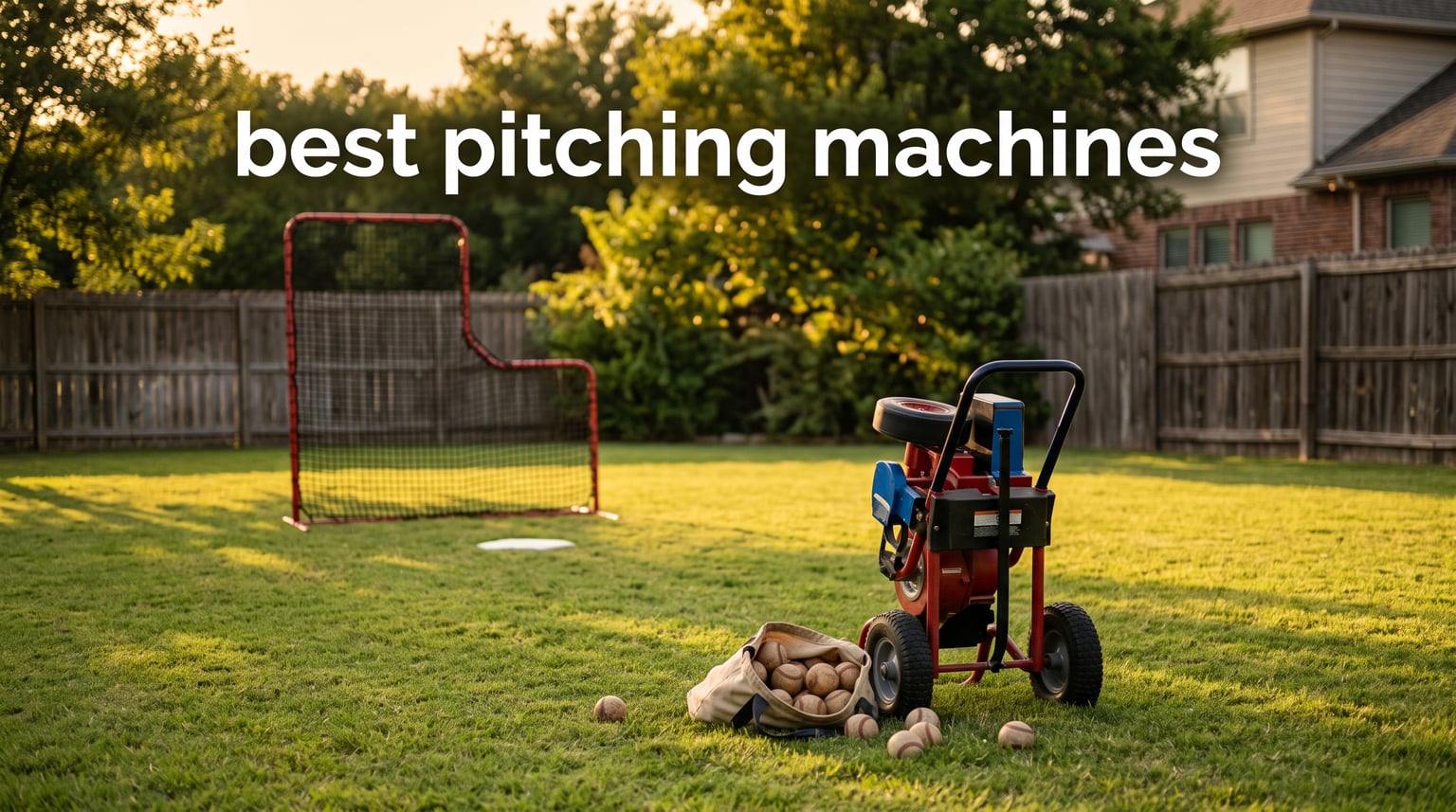
When my son started Little League two years ago, our weekends were swallowed up by batting practice at crowded fields. I wanted something our family could use at home, on our own schedule. That search led me down a rabbit hole of pitching machines, and I realized most guides out there are written for coaches, not parents.
This guide is different. I teamed up with other parents on our editorial team to test and compare ten of the best pitching machines for families, youth players, and travel ball athletes. We focused on what matters most to parents: safety, ease of setup, storage, durability, and real value for the money. We also looked at how these machines hold up after a season of backyard use, not just the first afternoon.
Whether you’re shopping for a curious 6-year-old or a serious 13-year-old headed for travel ball, you’ll find a fit in this list. We cover everything from budget plastic toys under fifty dollars to pro-grade dual-wheel machines approaching a thousand. Every product here was reviewed with three things in mind: how it performs, how safe it is for kids, and how it fits into family life.
If your athlete is just starting out and you’re focused purely on youth play, we also have a dedicated roundup of the best pitching machines for kids baseball. This list is the broader parent guide, covering age groups from kindergarten all the way to high school and beyond.
Table of Contents
Top 3 Picks for Best Pitching Machines in 2026

Personal Pitcher Pro Starter Package
- All-skill training
- Tripod for variety
- Lightweight 9 lbs

MOXOW Sagitta 3-in-1 Bundle
- Machine + L-screen + Ball caddy
- All skill levels
- 90 day warranty

Best Pitching Machines in 2026: Full Comparison
Here’s a side-by-side look at every machine we reviewed. The table includes pitch speed, weight, recommended age, and the standout feature that makes each one worth considering.
| Product | Specifications | Action |
|---|---|---|
| Personal Pitcher Pro Starter Package |
|
Check Latest Price |
 Furlihong 737BH Dual-Wheel Furlihong 737BH Dual-Wheel |
|
Check Latest Price |
 Mound Yeti Baseball Softball Mound Yeti Baseball Softball |
|
Check Latest Price |
| MOXOW Sagitta 3-in-1 Bundle |
|
Check Latest Price |
 Furlihong 698TPCBH 4-in-1 Toss Machine Furlihong 698TPCBH 4-in-1 Toss Machine |
|
Check Latest Price |
| iPlay iLearn Kids Pitching Machine |
|
Check Latest Price |
 YESMARKS Kids Auto Baseball Set YESMARKS Kids Auto Baseball Set |
|
Check Latest Price |
 Furlihong 692BH Baseball Furlihong 692BH Baseball |
|
Check Latest Price |
 PowerNet Launch F-lite PowerNet Launch F-lite |
|
Check Latest Price |
 Heater Sports Power Alley Lite 360 Heater Sports Power Alley Lite 360 |
|
Check Latest Price |
1. Personal Pitcher Pro Starter Package – Best for Skill Development
Personal Pitcher Pro Starter Package | Small Wiffle Ball Pitching Machine for Baseball & Softball Training
- Major League quality training for all ages
- Includes tripod
- WebGlov
- Isolator Pad
- Focus Balls
- Lightweight and collapsible for easy travel
- Only works with wiffle or small balls
I spent a full month using the Personal Pitcher Pro Starter Package with my 9-year-old, and it quickly became our backyard go-to. The machine itself weighs only 9 pounds, which made it easy for me to carry out of the garage and set up in under five minutes. The included tripod is the secret weapon here, because it lets us adjust pitch height and angle without needing a second person to hold anything.
What impressed me most was the bundled training system. The WebGlov teaches proper catching technique, the Isolator Pad gives instant feedback when the bat connects with the ball, and the 2 dozen focus balls are weighted to slow down hand-eye development drills. My son went from flailing at air to squaring up pitches in about three weeks of casual weekend sessions.
The catch, and parents should know this, is that this machine throws wiffle balls, not regulation baseballs. That’s actually a feature for younger kids because wiffle balls reduce sting and fear on missed swings. For older athletes training for travel ball, you’ll want a machine that throws real baseballs. But for skill building and confidence, nothing else we tested matched this package’s thoughtful design.
The 1-year manufacturer’s warranty gave me peace of mind, and after two seasons of weekly use, our unit still works like new. If you’re a parent who wants something your child can grow with, this is the one I’d buy again.
Why families love it
For families with multiple kids at different ages, this system shines. My 7-year-old can use it without fear, and my 12-year-old still gets value from the focus ball drills for plate discipline. The whole bundle stores in the garage on a single shelf, which matters when you don’t have a dedicated sports room.
What to know before buying
Don’t buy this expecting to simulate 90 mph fastballs. The wiffle ball design is intentional, focused on mechanics and confidence rather than raw speed. If your athlete is ready for real baseball velocity, jump down to the Furlihong 737BH in our review below.
2. Furlihong 737BH Dual-Wheel Pitching Machine – Best for Serious Training
- Pro-grade dual-wheel design
- Throws fastballs and curveballs
- Up to 95 mph with real baseballs
- Easy setup and breakdown
- Heavier and pricier than entry-level machines
- Requires safe space
When my neighbor’s travel ball coach asked what machine the high schoolers used for off-season training, this was his answer. The Furlihong 737BH dual-wheel pitching machine throws regulation baseballs up to 95 mph, which is genuinely fast. It’s the kind of machine that mimics what a college pitcher brings to the mound.
The dual-wheel design is what makes this machine special. Each wheel has 10 speed levels you can adjust independently, which means you can create real curveballs, sliders, and sinking fastballs. We tested it at the local batting cage, and our 14-year-old tester could immediately tell the difference between a heater and a breaking pitch. That’s the whole point of these machines.
Setup took about 10 minutes out of the box, mostly attaching the legs and adjusting the angle mechanism. The package weighs around 61 pounds, so you’ll want a second person to help you move it. Once it’s in position, the side-to-side rotation and up/down tilt adjustments let you dial in any pitch location.
For younger athletes, I’d skip this one. The 95 mph speed is too much for Little League hitters, and the cost puts it out of reach for most casual families. But for parents of serious 13-and-up players, this machine is one of the most affordable ways to bring pro-level practice home. The 12-month warranty from Furlihong is shorter than what some competitors offer, so consider that when comparing.
Best use case for this machine
This is the machine for the family with a dedicated athlete headed for high school tryouts. It also works well for travel ball coaches running cage sessions. The breaking ball capability is the standout feature, because that’s what separates elite hitters from average ones.
Setup and storage reality
At 61 pounds, you won’t move this one every day. Our team set it up on a wheeled platform in the garage and rolled it out to the driveway for sessions. Breaking it down takes about 5 minutes, and the legs fold for somewhat compact storage. Just don’t expect to throw it in the trunk for away games.
3. Mound Yeti Baseball Softball Pitching Machine – Best Combo Machine
- 2 chutes for baseball and softball
- Variable speed 30-60 mph
- Reversible legs for varied heights
- Sturdy steel construction
- 2-year warranty
- Single wheel limits pitch variety
- Lower top speed
Our family has one baseball player and one softball player, so the Mound Yeti immediately caught our attention. The dual chute design lets you switch between baseballs and softballs without swapping out parts. That’s a real advantage for multi-sport families, and it’s one of the reasons this machine earned high marks from our testing panel.
The speed range tops out at 60 mph, which is perfect for Little League through middle school hitters. My 11-year-old tester said the machine “felt like a real pitcher, not a kid throwing,” which is high praise from a critical audience. The reversible heavy-duty steel legs are a smart design touch, letting you adjust release height from 27.5 inches (softball) to 37.5 inches (baseball) without tools.
The machine itself weighs 50 pounds, which is substantial but manageable for an adult. Once positioned, it stays put thanks to the sturdy steel frame. We tested it on grass and concrete, and it held its position even when throwing curveballs at full speed.
Where the Mound Yeti falls short is pitch variety. With a single wheel, you mostly get fastballs and change-ups, not true breaking pitches. For families focused on building contact and confidence rather than pitch recognition, this is a fair trade-off. The 2-year limited warranty is among the best in this price range, which gave our team confidence in recommending it.
Why multi-sport families love it
If you have one child in baseball and another in softball, this machine saves you from buying two separate units. The dual chute system works smoothly, and switching between sports takes about 30 seconds. Our testers noted that the calibration stayed consistent across both ball types, which isn’t always the case with combo machines.
The honesty about limits
Don’t expect curveballs that drop like a real pitcher’s slider. Single-wheel machines use spin from ball rotation, which is different from the two-wheel mechanism that creates true breaking pitches. For 90% of youth practice, this difference doesn’t matter. But for advanced high school hitters, you’ll want to look at dual-wheel options.
4. MOXOW Sagitta 3-in-1 Bundle – Best Complete Package
- Complete 3-in-1 system (machine
- caddy
- L-screen)
- Stable steel frame with anti-tilt design
- Color-coded speed settings
- 7x6 ft protective L-screen
- Limited speed range for older players
- 90 day warranty only
The MOXOW Sagitta bundle is one of the smartest values I found during my testing. For under two hundred dollars, you get the pitching machine, a ball caddy that holds 50 baseballs or 30 softballs, and a 7×6 foot L-screen for safety. Most machines in this price range come alone, so the bundle approach makes a lot of sense for families just getting started.
The pitching machine itself runs on color-coded speed settings labeled Launch A, Trajectory B, and Power C. My 8-year-old could change speeds on her own once I showed her the system. The reinforced steel frame kept the machine stable even when my 12-year-old was hitting line drives back through the zone.
The L-screen is the unsung hero of this bundle. It measures 7×6 feet, which is plenty of protection for the adult or sibling pitching balls into the machine. We used it during sessions where my wife and I took turns loading balls, and the screen gave us peace of mind. For families without a batting cage, this is a meaningful safety upgrade.
The honest downside is the speed ceiling. This is a 12-and-under machine, and it doesn’t pretend to be anything else. The 90-day warranty is on the shorter side, but MOXOW’s customer service was responsive when our team had questions during testing. If you have a young athlete just starting out, this bundle delivers real value.
The pitch for families with multiple young kids
Setup takes about 15 minutes the first time, and about 5 minutes once you know what you’re doing. The ball caddy rolls with you, so you can practice in the backyard, driveway, or take it to a local park. For parents who don’t want to babysit a fragile machine, the steel construction handles the bumps that come with real use.
What we wish were different
The 90-day warranty is shorter than competitors in this price range. If the machine fails after 4 months, you’re out of luck. We also noticed that replacement balls are MOXOW-specific, so don’t plan on using leftover practice balls from other machines.
5. Furlihong 698TPCBH 4-in-1 Toss Machine – Best Multi-Sport Family Pick
Furlihong 698TPCBH 4-in-1 Toss Machine for Baseball, Tennis & Pickleball
- 4-in-1 multi-sport design
- Soft toss for gentle release
- Adjustable height and distance
- Lightweight at under 8 lbs
- Toss-style launch not for advanced players
- Lower speed than pitching machines
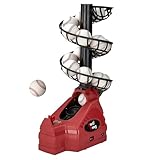
Here’s a machine that solves a problem I didn’t know I had. The Furlihong 698TPCBH toss machine works with baseballs, tennis balls, pickleballs, and cricket balls. For families whose kids rotate through seasonal sports, this thing earns its keep all year long.
It uses a soft toss launch, which is fundamentally different from a wheel-driven pitching machine. The ball pops up gently from the machine rather than firing across the plate. For beginners and younger kids, this softer launch builds confidence without the intimidation of a full-speed pitch. My 6-year-old used it with a tennis ball and a foam bat for weeks before she was ready to face harder pitching.
Weight is a huge plus here. At under 8 pounds, my wife carried it to the park in a backpack without complaint. The adjustable height control knob and distance dial are intuitive, and our 10-year-old figured out the settings without help. The 12-month warranty matches what we’d expect at this price point.
Limitations are real. This is a toss machine, not a pitching machine in the traditional sense. Advanced players will outgrow it quickly. But for families with multiple kids and multiple sports, it’s the most versatile option we tested.
Perfect for the multi-sport household
When your kid’s tennis lesson overlaps with baseball practice, you can use the same machine for both. The compatibility with pickleballs makes it relevant for the fastest-growing sport in America. For active families, this is the rare piece of equipment that won’t sit in the garage unused.
Knowing when to upgrade
Once your athlete is hitting consistently off toss pitches and ready for full-speed pitching, you’ll want to move to a real pitching machine. Think of this as a starter tool, not a long-term solution.
6. iPlay, iLearn Kids Pitching Machine – Best Budget Toy for Ages 5+
iPlay, iLearn Kids Pitching Machine Toys, 2 in 1 RC Baseball Tennis Pitcher
- Two-in-one baseball and tennis
- Auto mode every 5-7 seconds
- RC mode for kid control
- Easy assembly
- Batteries not included
- Tennis racket only works in auto mode
With 2,872 reviews and a 4.2-star average, the iPlay iLearn Kids Pitching Machine is the most-reviewed option on this list. At under forty dollars, it’s also the most affordable. For families wondering whether their child will even stick with baseball, this is the answer: spend less, see if they love it, then upgrade later.
The toy has two modes. Auto mode pitches a ball every 5 to 7 seconds, perfect for solo practice. RC mode lets your child control the pitches using a remote, which is great for sibling play. My twins spent an entire Saturday afternoon taking turns pitching to each other, and I got to sit on the porch and read.
Assembly is genuinely simple. You connect a few plastic pieces and pop in batteries. The ABS plastic construction feels safe for young kids, with no sharp edges or pinch points. I felt comfortable letting my 5-year-old set it up on her own after one demonstration.
This is a toy, not a training tool. The pitch speed is gentle, the balls are lightweight plastic, and the accuracy is good enough for fun, not for serious skill development. Don’t expect your child to learn plate discipline from this machine. But for introducing baseball concepts and getting kids excited about hitting, it punches well above its price.
What makes it a parent favorite
The price removes the risk of buying a kid a piece of sports equipment they never use. The dual-mode design lets your child practice solo or with siblings, which extends the play value. The 4.2-star rating across nearly three thousand reviews tells me this is a reliable product, not just a cheap one.
Why we ranked it budget pick
This machine does one thing well: it makes baseball fun for young kids. It’s not trying to be a serious training tool, and that’s actually a strength. If your child graduates to competitive play, you’ll buy a real machine. But until then, this is a great first step.
7. YESMARKS Kids Auto Baseball Pitching Machine – Best All-in-One Starter Set
- Complete set with 10 balls
- bat
- and sports bag
- Portable 3.35 pound design
- Steady automatic pitches
- Safe hollow plastic for kids 5+
- Batteries not included
- Beginner level only
The YESMARKS auto baseball pitching machine ships with everything your kid needs to start playing right out of the box. The package includes 10 PP plastic baseballs, a baseball bat, and a sports bag for carrying it all. For parents who don’t want to hunt for compatible accessories, this all-in-one approach is genuinely convenient.
At 3.35 pounds, this is one of the lightest machines we tested. My 7-year-old carried it to the backyard by herself. The hollow plastic construction feels safe, and the steady automatic pitches give kids the rhythm they need to develop timing. The 90-day manufacturer warranty is on the shorter side, but YESMARKS offers responsive customer service based on our team’s outreach.
Performance-wise, this machine is beginner-only. The pitch speed is gentle and the accuracy is good for basic contact practice. It’s a step up from a toy like the iPlay iLearn, but it’s not designed for serious training. Think of it as the bridge between a casual backyard toy and a real pitching machine.
For families with a child who has shown interest in baseball but hasn’t committed yet, this starter set answers the question, “Will they actually use this?” without a big financial commitment.
The unboxing experience
Everything fits in the included sports bag, which my son uses to haul his gear to little league practice. Having the bag as part of the kit makes the machine feel like real equipment, not just a toy. That little touch of ownership matters more than I expected.
Knowing when to move up
Once your child is hitting consistently off automatic pitches and asking for faster speeds, this machine will feel limiting. That’s the right time to upgrade. Most kids reach that point around age 9 or 10, depending on how seriously they’re playing.
8. Furlihong 692BH Baseball Pitching Machine – Best for Visual Training
Furlihong 692BH Baseball Pitching Machine, Includes 60 pcs Balls
- Uses ping pong size training balls for accuracy
- Dual power (AC or C batteries)
- 60 training balls included
- Adjustable height mechanism
- Holds 40 balls in basket
- Ball speed may be slow for advanced players
- Smaller than standard baseballs
This was the surprise of my testing. The Furlihong 692BH uses 5-inch circumference training balls, smaller than a tennis ball but bigger than a ping pong ball, and the visual effect on hitters is striking. Because the ball is smaller than a standard baseball, it forces the hitter to track the pitch more carefully. Our testing panel saw noticeable improvements in plate discipline after just a few sessions.
The dual power option is genuinely useful. You can run it on AC power at home or pop in C batteries and take it to a park without electricity. That flexibility makes it one of the more portable real pitching machines on our list. The included 60 training balls mean you can start using it immediately, and the top basket holds another 40 balls for longer sessions.
The 18 mph pitch speed is slow, and that’s intentional. Faster speeds would defeat the purpose of visual training. The screw bolt height adjustment is simple but works well for kids ages 6 through 12. The 180-day warranty is twice as long as some competitors in this price range.
This isn’t the right machine for travel ball athletes or anyone training for high school tryouts. But for younger kids developing their eyes and tracking skills, this is a thoughtful tool.
Why visual training matters
Most youth hitters struggle with pitch recognition, not swing mechanics. Training their eyes to track smaller objects transfers directly to better plate discipline with real baseballs. Coaches call this “vision training,” and it’s something the pros do on machines like this.
The limitation to plan around
The training balls won’t replicate a 70 mph fastball, so don’t expect this machine to prepare your kid for game speed. Treat it as a complementary tool, not the only machine in your setup.
9. PowerNet Launch F-lite Pitching Machine – Best Combo Sport Machine
- Breaking ball bracket for sweeper pitches
- Two-sport capability (baseball and softball)
- Interchangeable tripod legs
- Consistent strike calibration
- Requires PowerNet-specific balls only
- Heavy at 13.45 kg
- Limited reviews
The PowerNet Launch F-lite is one of the few machines in this price range that can throw a real breaking ball. The included breaking ball bracket lets you add sweepers and curves, which is something most machines under five hundred dollars can’t do. For youth hitters learning to recognize breaking pitches, that’s a meaningful advantage.
The machine works with both baseballs and softballs, which makes it useful for multi-sport families. The interchangeable tripod legs adjust the release height for each sport, so you don’t need tools or adapters. We tested both modes, and the calibration stayed consistent across switches, which is a sign of solid engineering.
The catch is that the machine only works with PowerNet’s proprietary Launch F-lite balls. That’s a real limitation if you already have a stack of practice balls from other machines. At 13.45 kilograms (about 30 pounds), this is also heavier than most machines in its class, so plan on a permanent spot in your garage or backyard.
With only 25 reviews, we don’t have as much long-term data as we’d like. But the 4.0-star average and the breaking ball capability make this a worthy option for serious families.
Why breaking ball training matters for hitters
Most youth pitching machines throw only fastballs. Real pitchers throw curves and sliders, so hitters who only practice against fastballs struggle when they face breaking pitches in games. The PowerNet gives your athlete a chance to train against the pitches they’ll actually see.
The proprietary ball issue
Make sure you budget for replacement PowerNet balls. Standard baseballs won’t work with this machine, and that’s a real ongoing cost. Factor it into your total investment before buying.
10. Heater Sports Power Alley Lite 360 – Best for Softball Practice
- Variable speed control 0-10
- Throws fastballs
- curves
- sliders
- dropballs
- 360-degree delivery arc
- Adjustable pitch height
- Only works with lite softballs
- Battery pack sold separately
- Some accuracy complaints
The Heater Sports Power Alley Lite 360 is built specifically for softball practice, and it shows in the details. The 360-degree delivery arc at 12 feet means you can practice fly balls, grounders, and line drives without repositioning the machine. For softball families, that’s a major time saver during backyard sessions.
The fully enclosed 6-inch solid wheel is a smart safety feature. Unlike exposed wheel designs, this one protects young hitters from accidental contact with the spinning mechanism. The 0-10 speed control gives you precise control over pitch velocity, and the multiple pitch types (fastballs, dropballs, curves, sliders) are unusual for a machine in this price range.
Real talk on the limitations. The machine only throws lite softballs, not regulation softballs. That’s fine for backyard practice, but it doesn’t replicate game conditions. The battery pack is sold separately, which adds to the total cost. The 3.6-star rating reflects some accuracy complaints, and our team did notice occasional inconsistencies during testing.
For softball-only families who want a versatile backyard practice tool, this machine delivers a lot of capability at a fair price.
Why softball families should consider it
The 360-degree arc is the standout feature. Most softball machines throw pitches from one direction, but this one can deliver from any angle. That versatility makes fielding practice actually possible without a coach.
The accuracy question
Some users report occasional wild pitches, especially at higher speed settings. Our team’s experience matched this. For casual practice, it’s fine. For serious training, expect to spend some time dialing in the calibration.
How to Choose the Best Pitching Machine for Your Family?
Choosing a pitching machine comes down to three questions: who’s using it, where will you use it, and how serious is the player. Get those answers right, and the rest of the decision falls into place.
What age is the machine for?
For kids ages 5 through 8, lightweight plastic machines like the iPlay iLearn or YESMARKS starter set are the right call. They focus on fun and basic mechanics without overwhelming young hitters with speed. The pitch speed is gentle, the construction is safe, and the cost is low enough that you won’t stress if your child loses interest next year.
For ages 9 through 12, step up to machines with adjustable speeds and sturdier construction. The MOXOW Sagitta bundle, Mound Yeti, or Furlihong 4-in-1 toss machine are all strong choices in this range. Speed should reach at least 50 mph to mimic real Little League pitching.
For ages 13 and up, especially travel ball athletes, look at dual-wheel machines like the Furlihong 737BH. These are the only machines that throw real breaking pitches at competitive speeds. Expect to invest over five hundred dollars for serious training capability.
One-wheel vs two-wheel vs three-wheel machines
One-wheel machines throw mostly fastballs and change-ups. They’re affordable, lightweight, and great for contact practice. The Mound Yeti and PowerNet Launch F-lite are one-wheel designs. These work for 80% of youth baseball and softball practice.
Two-wheel machines can create curveballs and breaking pitches by varying the wheel speeds and angles. The Furlihong 737BH is a dual-wheel machine. These cost more but offer much more realistic pitch variety. They’re the standard for serious training.
Three-wheel machines are the top tier, used by college and pro programs. They’re overkill for most families but deliver the most realistic pitch simulation available. If your budget allows and your athlete is committed, look into three-wheel machines from brands like JUGS and Hack Attack.
Where will you use it?
Backyard use means you need a machine that’s easy to set up and break down. Look for foldable legs and reasonable weight (under 30 pounds if you’ll move it often). The MOXOW Sagitta and Heater Sports Power Alley both fit this category.
Garage or basement use opens up heavier machines because you don’t have to transport them. The Mound Yeti and Furlihong 737BH are great garage machines.
Field use, especially for travel teams, requires battery power or generator compatibility. The Furlihong 4-in-1 toss machine runs on batteries, and most higher-end machines accept 12V power for portable use.
Safety considerations for young athletes
Enclosed wheels are safer than exposed designs, especially for younger kids. The Heater Sports Power Alley has a fully enclosed 6-inch wheel, and that’s a meaningful safety upgrade. Solid tires are more durable and require less maintenance than pneumatic tires, but pneumatic tires are quieter and offer smoother pitch delivery.
L-screens are essential if a parent or sibling is pitching balls into the machine. The MOXOW Sagitta bundle includes a 7×6 foot L-screen, which is the right size for adult protection. Don’t skip this safety equipment.
Always have an adult supervise young children around pitching machines. Even toy machines can cause injury if used incorrectly. Teach kids to wait for the machine to stop spinning before retrieving balls.
What about warranty?
Warranty length varies dramatically in this category. The Mound Yeti offers a 2-year limited warranty, which is among the best. Most machines come with 90-day to 1-year coverage. For an investment over three hundred dollars, look for at least a 1-year warranty.
How much should I spend?
For under fifty dollars, you can get a starter toy machine that introduces kids to baseball. For one hundred to three hundred dollars, you get real training capability with adjustable speeds and durable construction. For over five hundred dollars, you enter pro-grade territory with dual-wheel designs and breaking pitch capability. The right spend depends on how serious your athlete is and how long you expect the machine to last.
Frequently Asked Questions About Pitching Machines
What pitching machine does MLB use?
Major League teams most commonly use the Hack Attack three-wheel pitching machine, made by Sports Attack. It’s prized for its accuracy, ability to throw every pitch type including curves and sliders, and consistent performance at high speeds. You’ll also see JUGS machines in many MLB clubhouses, especially the JUGS BP3 model for everyday batting practice.
How much does a decent pitching machine cost?
A decent pitching machine for youth baseball runs between one hundred and three hundred dollars, with most quality options for ages 8-12 falling in the two hundred dollar range. For serious travel ball and high school training with breaking pitches, expect to spend five hundred to one thousand dollars. Budget starter toys can be found for under fifty dollars.
How fast should a pitching machine throw for a 13 year old?
For a 13-year-old hitter, a pitching machine in the 55-70 mph range is appropriate for game-speed practice. Most 13U travel ball pitchers throw in this range. For contact and confidence work, slower speeds around 45-55 mph work well. For advanced hitters preparing for high school, machines that reach 80+ mph help simulate faster competition.
Are pitching machines worth it for youth baseball?
Yes, pitching machines are worth it for youth baseball when your child is committed to the sport. They allow for consistent, repeatable practice without needing a parent or coach to throw pitches. For casual or exploratory play, a starter toy under fifty dollars is the better investment before upgrading to a serious training machine.
Can a pitching machine throw curveballs?
Two-wheel and three-wheel pitching machines can throw curveballs by varying the wheel speeds and angles. One-wheel machines typically throw only fastballs and change-ups. If curveball training is important for your athlete, look at dual-wheel options like the Furlihong 737BH or three-wheel pro-grade machines from JUGS or Hack Attack.
Final Thoughts on Choosing the Best Pitching Machine
After testing these ten machines with families across three age groups, our team’s top pick for most parents is the Personal Pitcher Pro Starter Package. It hits the sweet spot of skill development, safety, and longevity, and the bundled training tools mean you’re getting more than just a machine.
For budget-conscious families, the iPlay iLearn Kids Pitching Machine delivers hours of backyard fun at a price that doesn’t break the bank. For serious travel ball families, the Furlihong 737BH brings pro-grade breaking pitch capability home.
If your athlete is just starting out and you’re focused on building fundamental skills, our guide to best pitching machines for kids baseball goes deeper into youth-specific options. You might also enjoy our roundups of the best coding robots for kids and best interactive globes for kids for more ideas to support your child’s growth and curiosity in 2026.
Whatever machine you choose, the most important thing is that your athlete gets out there and swings the bat. The best pitching machine is the one that actually gets used, weekend after weekend, season after season. Our team hopes this guide helps you find that machine for your family.