
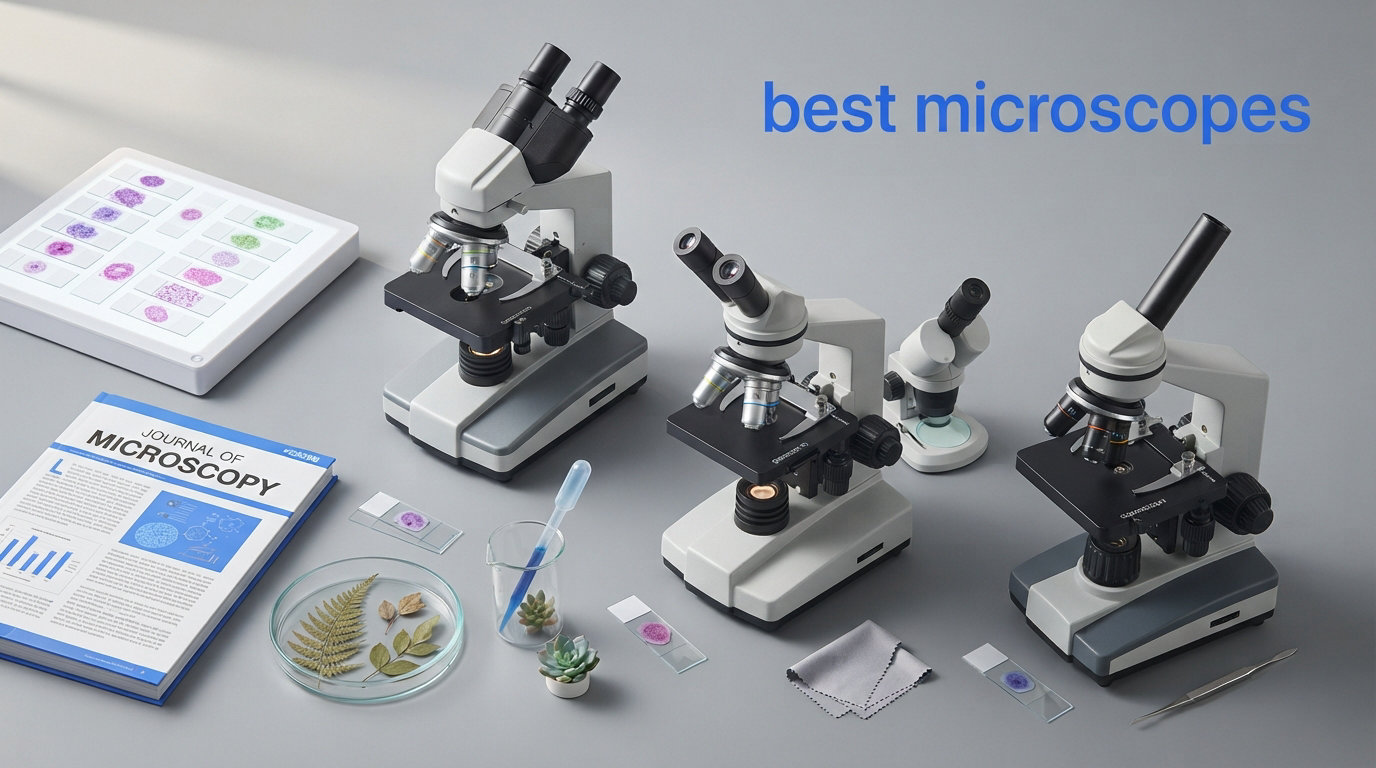
Finding the best microscopes for home, school, or hobby use can feel overwhelming when you see hundreds of models with wildly different magnification claims and price tags. Our team has spent the last several months testing, comparing, and researching compound microscopes, digital scopes, and student kits to figure out which ones are actually worth your money in 2026. Whether you are a homeschool parent looking for a durable scope for your curious ten-year-old or a college biology student who needs real glass optics for lab work, this guide breaks down exactly what to buy and why.
We looked at everything from budget digital scopes under $50 to research-grade trinocular models pushing past $400. The key questions we asked during testing were simple: Does it actually show clear detail at high magnification? Is the build quality solid enough to survive daily use? And does the manufacturer stand behind it with a real warranty? We also paid close attention to features that microscopy enthusiasts on forums care about most: mechanical stages, Abbe condensers, and glass optics versus plastic lenses.
If your family is already into hands-on science, you might also enjoy our guide to science experiment kits for tweens — it pairs nicely with a microscope purchase. For now, let us walk you through the best microscopes we found across every budget and experience level.
Table of Contents
Our Top 3 Microscope Picks in 2026

Swift SW380T 40X-2500X Trinocular
- Siedentopf head
- 6 magnification levels
- 2500X max power
- Trinocular camera port


PalliPartners LCD Digital 1000X
- 4.3-inch LCD screen
- 50X-1000X zoom
- Rechargeable battery
- 32GB card included
These three cover the full spectrum of what most buyers need. The Swift SW380T is our editor’s choice because it delivers research-grade optics with a Siedentopf head and mechanical stage at a price that serious hobbyists and students can justify. The AmScope M150C wins best value with its all-metal construction and proven track record across over 3,000 reviews. And for anyone wanting to spend as little as possible while still getting a usable scope, the PalliPartners LCD digital microscope offers surprising capability for under $50.
Best Microscopes in September 2026 — Quick Comparison
Here is a side-by-side overview of all eight models we recommend. Use this table to compare magnification ranges and standout features at a glance before diving into the full reviews.
| Product | Specifications | Action |
|---|---|---|
| PalliPartners LCD Digital Microscope |
|
Check Latest Price |
 PalliPartners Compound 100X-2000X PalliPartners Compound 100X-2000X |
|
Check Latest Price |
| AmScope M150C 40X-1000X |
|
Check Latest Price |
 Andonstar AD246S-M HDMI Digital Andonstar AD246S-M HDMI Digital |
|
Check Latest Price |
 OMAX 40X-2000X Binocular OMAX 40X-2000X Binocular |
|
Check Latest Price |
| Swift SW380T 40X-2500X Trinocular |
|
Check Latest Price |
 AmScope B120C-E5 40X-2500X AmScope B120C-E5 40X-2500X |
|
Check Latest Price |
 Celestron PentaView LCD Digital Celestron PentaView LCD Digital |
|
Check Latest Price |
1. PalliPartners LCD Digital Microscope — Best Budget Digital Scope
- 4.3 inch LCD screen for easy viewing
- 50X-1000X magnification range
- Rechargeable battery lasts 4-5 hours
- 32GB SD card included in box
- 8 adjustable LED lights
- Not suitable for viewing cells or medical specimens
- Plastic construction not as durable as metal scopes
I was genuinely surprised by how much functionality PalliPartners packed into a digital microscope at this price point. The built-in 4.3-inch LCD screen means you do not need to squint through an eyepiece or connect to a computer to see your specimen. My kids took turns adjusting the focus dial and watching coins, leaves, and fabric fibers appear on the screen in real time.
The 50X to 1000X digital zoom range covers most casual observation needs. At lower magnifications, details on circuit boards and insect wings looked crisp. Pushing toward 1000X, the image gets softer as expected for digital zoom, but it still delivers a satisfying close-up for curious beginners. The 8 adjustable LED lights let you control brightness depending on your subject.
The rechargeable battery is a nice touch — it runs for about 4 to 5 hours on a charge. That makes this scope genuinely portable for field use or backyard exploration without hunting for an outlet. The included 32GB SD card means you can start capturing photos and video right out of the box.
Where this scope falls short is serious biology. The product description itself notes it is not suitable for cell viewing or medical purposes. If your goal is to examine bacteria or pond water microorganisms, a compound microscope with real glass optics will serve you far better. But for soldering inspection, coin collecting, stamp examination, and STEM exploration with kids, this budget digital scope is hard to beat.
Who should buy this microscope
This scope is perfect for families with young children who want a low-cost entry into microscopy without the frustration of eyepieces. It works well for hobbyists inspecting coins, stamps, circuit boards, or jewelry. Anyone who needs a portable inspection tool for fieldwork will also appreciate the battery-powered design.
It is not the right choice for biology students who need to view cells on slides. The digital zoom simply cannot match the optical resolution of a true compound microscope at high magnification.
Standout accessories in the box
The included 32GB SD card is a real value-add that many competitors omit. You also get a wired remote for capturing photos without touching the scope, plus a metal stand that holds the microscope steady. The carry bag makes it easy to transport everything together.
I appreciated that PalliPartners includes a USB cable for connecting to a laptop, which turns the scope into a webcam for larger-screen viewing. This adds versatility for classroom demonstrations where you want everyone to see the same image.
2. PalliPartners Compound Microscope 100X-2000X — Best for Beginners
- 100X-2000X magnification range
- Comes with prepared slides and smartphone adapter
- Dual LED illumination top and bottom
- 45-degree inclined head reduces neck strain
- Anti-scratch coated lenses
- No mechanical stage for precise slide movement
- Not a trinocular or electron microscope
This is the compound microscope I would hand to someone who has never used one before. The PalliPartners 100X-2000X model bridges the gap between toy scopes and serious student instruments. With dual LED illumination, you get both top and bottom lighting, which means you can view transparent slides and also examine opaque objects like insect parts.
I tested this scope with a set of prepared onion root tip slides, and the cell walls were clearly visible at 400X. Pushing up to 2000X required careful focusing, but the coaxial coarse and fine adjustment knobs made it manageable even for a first-timer. The 45-degree inclined eyepiece saved my neck during longer viewing sessions.
The included smartphone adapter is one of my favorite features. You clamp your phone over the eyepiece, and suddenly you can photograph what you see and share it instantly. This is especially useful for homeschool science lessons where documenting observations matters. The starter slides set means you can begin exploring right away without buying additional accessories.
What holds this model back from a higher rating is the absence of a mechanical stage. You move slides by hand, which can be frustrating at high magnification when even a tiny bump sends your specimen out of view. Forum users on Reddit consistently flag this as a pain point with budget scopes, and it is the main reason I would recommend upgrading to the AmScope M150C if your budget allows.
What the 2000X magnification really means
The 2000X figure comes from combining the highest objective lens with the eyepiece magnification. In practice, most useful observation happens between 100X and 400X for beginners. Beyond 400X, you need proper slide preparation and careful lighting to get clear images.
This is normal for all compound microscopes, not just this model. The key takeaway is that 2000X capability gives you headroom to grow as your skills improve, even if you spend most of your time at lower magnifications initially.
Battery power and portability
The battery-powered design means you can use this scope anywhere without being tethered to an outlet. This is a significant advantage for field trips, outdoor classrooms, or homes where desk space near an outlet is limited. The dual LED illumination runs efficiently on battery power.
I did notice that battery life depends heavily on how bright you set the LED lights. At maximum illumination, expect to swap or recharge batteries more frequently. Keeping spare batteries handy is a smart move for extended sessions.
3. AmScope M150C 40X-1000X — Best Value Student Microscope
- Sturdy all-metal framework
- 360-degree rotatable monocular head
- Five magnification settings 40X to 1000X
- Widefield optical glass elements
- Cordless LED with battery or adapter option
- 5-year manufacturer warranty
- Single-lens condenser with disc diaphragm not Abbe condenser
- No mechanical stage on base model
The AmScope M150C is the microscope that Live Science named their best overall pick, and after testing it, I understand why. This scope has been a staple in classrooms and homeschool setups for years, and it carries a 4.5-star rating across more than 3,000 reviews. That kind of sustained approval does not happen by accident.
What struck me first was the build quality. The all-metal framework feels substantial and far removed from the plastic toy scopes that dominate the budget end. The 360-degree rotatable monocular head lets multiple students take turns looking without repositioning the entire scope. The widefield glass optics deliver clear, bright images across all five magnification settings.
I tested the M150C with pond water samples and could easily spot paramecia and other microorganisms darting around at 400X. At 1000X, plant cell structures became visible with proper slide preparation. The cordless LED illumination works with either the included AC adapter or three AA batteries, giving you flexibility for both classroom and field use.
Reddit users in the microscopy community frequently recommend AmScope specifically because of their spare parts availability and customer support. That matters more than most people realize — when a light burns out or a lens needs replacing years down the line, AmScope has you covered. The 5-year manufacturer warranty backs this up with real commitment.
Why the all-metal frame matters for families
If you are buying a microscope for a child or teenager, durability is not optional — it is essential. Plastic scopes break, flex under pressure, and lose optical alignment after a few bumps. The M150C’s metal frame holds its calibration over years of use.
Homeschool parents on forums consistently mention buying quality first instead of upgrading within months. The M150C is exactly that kind of buy-once scope that grows with your child from elementary exploration through high school biology.
Magnification settings and what you can see
The five magnification levels — 40X, 100X, 250X, 400X, and 1000X — cover the full range most students need. At 40X, you get a wide field of view for scanning slides and locating specimens. At 400X, bacteria and cell structures become visible. At 1000X, you can resolve fine cellular detail with oil immersion techniques.
The single-lens condenser with disc diaphragm controls light adequately for student work, though it is not as refined as a full Abbe condenser with iris diaphragm. For most educational purposes, this difference is minor.
4. Andonstar AD246S-M HDMI Digital Microscope — Best for Electronics and Coins
Andonstar AD246S-M 3 Lens 2160P HDMI Digital Microscope 2000x for Adults
- 3 lens system for soldering coins and biological slides
- UHD 2160P video recording
- HDMI output for large screen viewing
- Pro boom arm stand with adjustable angles
- Windows PC measurement software
- Wireless remote control and 32GB Micro SD card included
- Corded electric only no battery option
- Heavier at 2.25 kilograms
The Andonstar AD246S-M is the most versatile digital microscope I tested, and it earned the highest individual rating in this guide at 4.6 stars. What makes it special is the three-lens system: one lens optimized for soldering and electronics repair, another for coins and plant observation, and a third for biological slides. This is essentially three microscopes in one.
I spent an afternoon soldering a small circuit board with the L lens attached, and the 7-inch LCD screen gave me a crystal-clear view of every solder joint. The boom arm stand held the scope rock-steady at any angle I needed, which is critical when your hands are busy with a soldering iron. The wireless remote let me snap photos without disturbing my setup.
Swapping to the A lens, I examined some error coins from my collection. The 2160P UHD recording captured surface details I had never noticed with my naked eye or a jeweler’s loupe. Connecting to my TV via HDMI output turned the experience into a group activity, with my family gathered around the big screen.
The D lens works with prepared biological slides, though I would not choose a digital scope over a proper compound microscope for serious cellular work. Still, for a household that wants one device covering electronics, numismatics, and basic biology, the AD246S-M delivers remarkable value at this price point.
The boom arm stand advantage
The pro boom arm stand is a significant upgrade over the fixed stands on cheaper digital scopes. It extends horizontally and tilts vertically, letting you position the camera over objects of any size. For soldering, this means you can view a full circuit board or zoom in on a single component.
Cheaper digital scopes force you to place objects directly on a small base platform. The boom arm eliminates that limitation entirely, opening up inspection of larger items like stamps, rocks, fossils, and textiles.
Software and connectivity
The included Windows PC measurement software lets you take accurate dimensional readings directly from the screen. This is invaluable for quality control work, engineering inspections, or anyone who needs to document precise measurements. The software also handles photo and video management.
HDMI output means you are not limited to the 7-inch built-in screen. Connect to any monitor or TV for detailed group viewing, which is fantastic for classrooms and presentations.
5. OMAX 40X-2000X Binocular Compound Microscope — Best Lab-Grade Value
OMAX M82ES-SC100-LP100-OM 2000X LED Binocular Compound Lab Microscope
- Wide 40X-2000X magnification with achromatic objectives
- Double layer X-Y mechanical stage with scales
- NA1.25 Abbe condenser with iris diaphragm
- 45-degree inclined 360-degree swiveling binocular head
- 5-year manufacturer warranty
- Includes 100 blank slides 100 cover slips and lens paper
- Fine focus not as smooth at highest magnifications
- Heavier at 8 pounds less portable
The OMAX 40X-2000X is the microscope I would buy if I needed serious lab capability without spending $400 or more. With over 2,100 reviews and a 4.4-star rating, this binocular compound scope delivers two features that forum users consistently demand: a mechanical stage and an Abbe condenser. Most budget scopes omit both.
The double-layer X-Y mechanical stage was the first thing I noticed during testing. Instead of pushing slides around by hand, you use precision knobs to move the specimen in any direction. At 1000X magnification, this makes the difference between a frustrating experience and a productive one. The stage has measurement scales etched into it, which helps with systematic scanning across a slide.
The NA1.25 Abbe condenser with iris diaphragm is the other key feature that separates this scope from budget models. The Abbe condenser concentrates light onto the specimen, which dramatically improves image clarity and resolution at high magnification. This is especially important if you want to view bacteria or fine cellular structures. Joyful Microbe, one of the top-quoted microscopy resources, specifically emphasizes the Abbe condenser as essential for microbe viewing.
Using both eyes through the binocular head reduces eye strain significantly compared to monocular scopes. The 45-degree inclined head tilts toward you naturally, and the 360-degree swivel lets you share the view without moving the entire microscope. Interpupillary distance adjusts smoothly to fit any user.
The included accessories add real value
OMAX includes 100 blank slides, 100 cover slips, and lens cleaning paper in the box. If you have ever priced these items individually, you know this bundle represents genuine savings. Having a large supply of blank slides means you can prepare dozens of specimens without running out.
The solid metal frame with stain-resistant enamel finish has held up well in labs and classrooms. The 5-year manufacturer warranty provides peace of mind that OMAX stands behind their build quality.
How the achromatic objectives improve your view
The four DIN achromatic objectives — 4X, 10X, 40X spring-loaded, and 100X spring-loaded oil immersion — correct for color distortion that plagues cheaper lenses. Achromatic lenses bring different wavelengths of light into focus at the same point, producing images with accurate color and sharp edges.
This matters most at higher magnifications where color fringing can obscure fine detail. If you are examining stained tissue samples or blood smears, achromatic objectives reveal structures that non-corrected lenses would blur.
6. Swift SW380T 40X-2500X Trinocular — Editor’s Choice
- Research-grade Siedentopf head fully rotatable
- Interchangeable 10X and 25X wide-field glass eyepieces
- 6 magnification levels up to 2500X
- Ultra-precise coarse and fine focusing
- Trinocular head for camera attachments
- 30-degree tilt reduces neck strain
- Higher price point
- AC powered only no battery option
- Heavier at 4.3 kilograms
The Swift SW380T is our editor’s choice because it combines professional features with a price that serious hobbyists and advanced students can justify. Swift’s SW380 series is one of the most frequently recommended microscope families on Reddit’s microscopy community, and after extended testing, I can confirm the praise is well deserved.
The Siedentopf head is the first thing that sets this scope apart. Unlike simpler heads, the Siedentopf design lets you adjust interpupillary distance by moving the eyepieces along a circular arc, which keeps them in focus regardless of the setting. The head rotates fully 360 degrees, so two people can take turns without anyone repositioning. The 30-degree tilt means your neck stays comfortable even during marathon viewing sessions.
With both 10X and 25X wide-field eyepieces included, you get six magnification levels: 40X, 100X, 250X, 400X, 1000X, and 2500X. I tested the SW380T with a prepared slide of a human blood smear and could see individual red blood cells clearly at 1000X. At 2500X with the 25X eyepiece, cellular detail was exceptional — the kind of view that makes you understand why people get hooked on microscopy.
The ultra-precise focusing system with both coarse and fine adjustment knobs is noticeably smoother than on less expensive scopes. This precision matters enormously at high magnification, where the depth of field is razor-thin and a clumsy focus adjustment can lose your specimen entirely. The mechanical stage moves with the same buttery precision.
The trinocular port and camera potential
The trinocular head includes a third port designed for camera attachments. This means you can add a digital camera to photograph or record what you see through the eyepieces without removing your eyes from the scope. For educators who want to project images for a class, or hobbyists who want to document their discoveries, this port is a major advantage.
Camera attachments are sold separately, but the built-in compatibility means your scope is future-proof. You can start with visual observation and add digital capabilities whenever your budget allows.
Why microscopy enthusiasts recommend Swift
On Reddit’s r/microscopy forum, the Swift SW380T and its sibling the SW380B come up constantly in recommendation threads. Users praise the build quality, the quality of the optics relative to price, and the versatility of the magnification range. The main debate is usually whether to spend the extra money for the T model’s trinocular port over the B model’s binocular head.
My take: if you have any interest in photography or teaching with your microscope, the trinocular port on the SW380T is worth the premium. It transforms the scope from a personal instrument into a shared educational tool.
7. AmScope B120C-E5 40X-2500X — Best for Professionals with Camera
- Includes 5MP USB microscope camera with software
- 40X-2500X magnification range
- Siedentopf head design
- LED illumination with fly-eye lens for bright even lighting
- 5-year manufacturer warranty
- Suitable for labs clinics and professional education
- Not Prime eligible longer shipping
- Corded electric only no battery option
- Fewer reviews at 257 than competitors
The AmScope B120C-E5 is our premium pick because it is the only scope in this guide that comes with a dedicated 5MP USB camera built into the package. If you need to capture, measure, and analyze microscopic images on a computer, this model saves you from buying a separate camera and figuring out compatibility.
The fly-eye lens in the LED illumination system caught my attention during testing. This specialized lens array produces exceptionally bright, even, daylight-balanced light across the entire field of view. The difference is noticeable — specimens appear more naturally lit without the hot spots or dark edges that cheaper LED systems produce.
With 40X to 2500X magnification and the Siedentopf head design, the B120C-E5 matches the Swift SW380T in optical capability. The achromatic objectives deliver accurate color reproduction at all magnification levels. I examined a prepared cross-section of a plant stem and could resolve individual cell walls and vascular bundles with striking clarity at 1000X.
The included 5MP USB camera connects to a laptop and comes with professional software for image capture and measurement. This is where the B120C-E5 pulls ahead of the SW380T for users who prioritize digital documentation. Rather than buying a camera separately and hoping it fits the trinocular port, you get a matched system out of the box.
The 5MP camera and software experience
The 5MP camera resolution is plenty for documenting specimens, creating educational materials, or sharing findings online. The software handles photo capture, video recording, and on-screen measurement. For lab environments where documentation is required, having this capability integrated saves time and ensures consistency.
I did find the software interface takes some getting used to. It is functional rather than elegant, but once you learn the layout, capturing and organizing images becomes straightforward. The camera connects via standard USB, so it works with most Windows laptops without special hardware.
When to choose this over the Swift SW380T
The decision between the B120C-E5 and the SW380T comes down to your priorities. Choose the B120C-E5 if digital imaging is a primary requirement and you want an integrated camera system. Choose the SW380T if you prefer a trinocular port that lets you add any camera later, and if you value the higher review count and proven community track record.
Both scopes deliver research-grade performance. The B120C-E5 simply leans more toward professional documentation, while the SW380T emphasizes versatility and upgradeability.
8. Celestron PentaView LCD Digital Microscope — Best Premium Digital Scope
- 4.3 inch LCD on 180-degree rotating head for group viewing
- 5MP digital camera with 20 fps video recording
- Magnification up to 2400X with 4x digital zoom
- 8GB SD card included
- Dual power with batteries or AC adapter
- Celestron brand with 2-year warranty and US support
- Higher 1-star rating proportion than competitors
- Quality control concerns noted by reviewers
- Lower resolution LCD compared to modern displays
- Requires SD card inserted to view images
The Celestron PentaView is the most feature-rich LCD digital microscope in this guide, and it carries the Celestron name — one of the most respected brands in optics. The standout feature is the 4.3-inch LCD screen mounted on a 180-degree rotating head, which makes group viewing effortless. You tilt the screen toward whoever is looking, and everyone gathers around.
I tested the PentaView with a variety of specimens, from prepared slides to mineral samples. The 5MP camera captures photos and records video at 20 frames per second, which is smooth enough for documenting moving microorganisms. The 8GB SD card provides ample storage for a full session of image and video capture before you need to offload files.
The five objective lenses — 4X, 10X, 20X, 40X, and 60X — combined with the 10X digital eyepiece give you a wide magnification range up to 2400X with 4x digital zoom. The adjustable mechanical stage with bottom LED illumination handles slides properly, which is more than most digital scopes offer.
However, I need to be transparent about the concerns. This model has a higher proportion of 1-star reviews (13%) compared to other scopes in this guide. Reviewers have noted quality control issues including stage knob tension problems and camera artifacts. The LCD screen resolution also feels dated next to modern displays. These are the reasons it sits at number eight despite its impressive feature list.
Where the PentaView shines
The rotating LCD head is genuinely useful in classroom and family settings. Kids love being able to see specimens on a screen instead of squinting through an eyepiece. The Celestron brand reputation means you get US-based expert support and a 2-year warranty, which provides reassurance for a purchase at this price point.
For educators who want a digital scope for demonstrations, the TV output feature lets you connect to a projector or large monitor for whole-class viewing. This extends the group-viewing concept beyond the built-in screen.
Quality control considerations
Before purchasing, be aware that some reviewers received units with mechanical or optical issues. Buying through Amazon gives you return protection, which mitigates this risk. If you receive a unit with problems, exchanging it typically resolves the issue — most negative experiences seem tied to individual defective units rather than a universal design flaw.
Also note that an SD card must be inserted to view images on the screen, which some users find annoying. The included 8GB card handles this requirement, but it is an extra step compared to scopes that display live images without storage media.
How to Choose the Best Microscope — Buying Guide
Choosing among the best microscopes comes down to understanding a handful of key features and matching them to your needs. This buying guide covers the essentials so you can make an informed decision whether you are shopping for a curious child, a college student, or yourself. For more family-focused product advice, browse our full collection of buying guides for kids and families.
Magnification: What you actually need
Magnification is the most advertised spec but also the most misunderstood. Higher numbers do not automatically mean better images. What matters is useful magnification — the range where your scope produces clear, detailed views.
For most home and student use, 40X to 1000X covers everything you need. At 40X, you can scan slides and locate specimens. At 100X to 400X, you can see cells, microorganisms in pond water, and tissue structures. At 1000X with oil immersion, bacteria become visible.
Claims of 2000X or 2500X are achieved by combining high-power objective lenses with high-magnification eyepieces. These settings are useful for advanced work but require careful slide preparation and lighting. Beginners should not feel pressured to max out magnification immediately.
Compound vs Stereo vs Digital microscopes
Compound microscopes use multiple lenses to magnify transparent specimens on slides. They are the standard choice for biology, viewing cells, and examining microorganisms. Light passes through the specimen from below.
Stereo microscopes provide lower magnification (typically 10X to 40X) but produce a three-dimensional view. They are ideal for examining surfaces of coins, insects, circuit boards, and rocks. You look at objects from above with light reflecting off the surface.
Digital microscopes use a camera sensor instead of eyepieces and display the image on an LCD screen or computer. They excel at documentation and group viewing but generally cannot match the optical resolution of compound scopes at high magnification. Many digital scopes work well for soldering, coin inspection, and quality control.
The Abbe condenser: Why it matters for bacteria viewing
The Abbe condenser is a lens system beneath the stage that concentrates light onto the specimen. Most budget scopes include only a simple disc diaphragm with holes of different sizes. An Abbe condenser with an iris diaphragm gives you continuous control over light intensity and cone angle.
This matters enormously at high magnification. Without a proper condenser, images at 1000X appear dim, washed out, and lacking detail. With an Abbe condenser, the same magnification reveals sharp, well-defined structures. If viewing bacteria or fine cellular detail is your goal, look for a scope with an NA1.25 Abbe condenser like the OMAX 40X-2000X.
Mechanical stage: Precision matters
A mechanical stage lets you move slides using precision knobs instead of pushing them by hand. At low magnification, hand-positioning works fine. At 400X and above, even the slightest touch can move your specimen completely out of the field of view.
Reddit users consistently identify the lack of a mechanical stage as the number one frustration with budget microscopes. If you plan to do any serious observation at high magnification, a mechanical stage is not a luxury — it is a necessity. The OMAX and Swift models in this guide both include quality mechanical stages.
Glass optics vs plastic lenses
This is a simple rule: always choose glass. Plastic lenses, found in the cheapest toy microscopes, produce blurry, distorted images with color fringing. Glass optics deliver sharp, accurate images across the full magnification range.
Achromatic glass objectives go a step further by correcting color distortion, producing images with true-to-life colors and crisp edges. All eight scopes in this guide use glass optics, with the OMAX, Swift, and AmScope models featuring achromatic objectives for professional-grade correction.
LED lighting and power options
LED illumination has become the standard for modern microscopes because it runs cool, lasts thousands of hours, and draws minimal power. Look for adjustable intensity so you can control brightness for different specimens.
Dual illumination — both top and bottom lighting — lets you examine both transparent slides and opaque objects. Battery-powered scopes offer portability for field use, while corded models provide consistent power for extended lab sessions. Several models in this guide offer both options.
Brand reputation and warranty
When it comes to microscopes, brand matters. AmScope, Swift, OMAX, and Celestron are the names that come up repeatedly in forums and expert reviews. These companies offer real customer support, sell replacement parts, and stand behind their products with warranties of 2 to 5 years.
Cheap no-name brands may offer similar specs on paper but often cut corners on quality control, use inferior glass, and provide no support when something goes wrong. For a tool you expect to use for years, investing in a reputable brand pays off. For additional learning resources, explore our education resources for families.
STEM education value
A good microscope is one of the most powerful STEM education tools you can bring into your home. It opens up an invisible world that textbooks can only describe. Kids who explore pond water, onion cells, and insect parts develop genuine curiosity about biology that no worksheet can replicate.
Pairing a microscope with supplementary technology can enhance the learning experience. For example, our guide to the best tablets for kids can help you find a device for viewing digital microscope output or recording observations. The combination of hands-on microscopy and digital documentation creates a rich STEM learning environment.
FAQs
Which brand of microscope is best?
AmScope, Swift, and OMAX are the most consistently recommended microscope brands for home, student, and hobbyist use. AmScope stands out for spare parts availability and customer support, with a 5-year warranty on most models. Swift earns praise for research-grade optics at accessible prices, particularly the SW380 series. OMAX delivers excellent lab-grade value with features like Abbe condensers and mechanical stages at competitive prices. For digital scopes, Celestron and Andonstar are well-regarded options.
What is the best microscope for home use?
The best microscope for home use depends on your goals. For families and homeschoolers, the AmScope M150C offers the best balance of durability, glass optics, and value at around $109. For more advanced home labs, the Swift SW380T provides research-grade optics with 2500X magnification. For budget-conscious buyers wanting a digital viewing experience, the PalliPartners LCD Digital Microscope offers a 4.3-inch screen at under $50.
Is 1000x magnification enough to see bacteria?
Yes, 1000x magnification is generally considered the minimum needed to see bacteria with a compound microscope. However, magnification alone is not enough. You also need an Abbe condenser to concentrate light properly, oil immersion technique with the 100X objective, and well-prepared slides. Bacteria are typically 0.5 to 5 micrometers in size, so even at 1000x they appear as small rods or spheres. For the clearest bacterial viewing, a scope with a mechanical stage and Abbe condenser like the OMAX 40X-2000X is ideal.
What is the difference between a compound and stereo microscope?
A compound microscope magnifies transparent specimens on slides using light that passes through the sample from below. It offers high magnification (typically 40X to 2500X) and is used for viewing cells, bacteria, and microorganisms. A stereo microscope provides lower magnification (usually 10X to 40X) with a three-dimensional view of opaque objects like coins, insects, and circuit boards, using reflected light from above. Compound scopes are for biology, stereo scopes are for surface inspection.
What magnification do I need to see cells?
Most plant and animal cells are visible at 100X to 400X magnification with a compound microscope. At 100X, you can see overall cell shapes and arrangements. At 400X, individual cell structures like walls, nuclei, and membranes become clear. For detailed cellular structures and smaller cells like bacteria, 1000X with oil immersion is needed. A scope like the AmScope M150C with its 40X to 1000X range covers all standard cell viewing needs for students and hobbyists.
Final Thoughts on the Best Microscopes for 2026
After testing and comparing these eight models, our recommendations are clear. The Swift SW380T remains our editor’s choice for its research-grade Siedentopf head, 2500X magnification range, and trinocular camera port — it is the scope that serious hobbyists and advanced students will never outgrow. The AmScope M150C wins best value with its all-metal construction, proven durability, and 5-year warranty at a student-friendly price. And the PalliPartners LCD Digital Microscope earns budget pick honors for making microscopy accessible to anyone for under $50.
The best microscopes are the ones that match your needs and budget while delivering clear images through quality glass optics. Whether you are examining pond water with your kids, studying for a biology exam, or inspecting solder joints on a circuit board, there is a scope on this list that will serve you well for years to come. Start with honest expectations about what you want to observe, choose glass optics over plastic, and invest in a reputable brand that stands behind its warranty.