
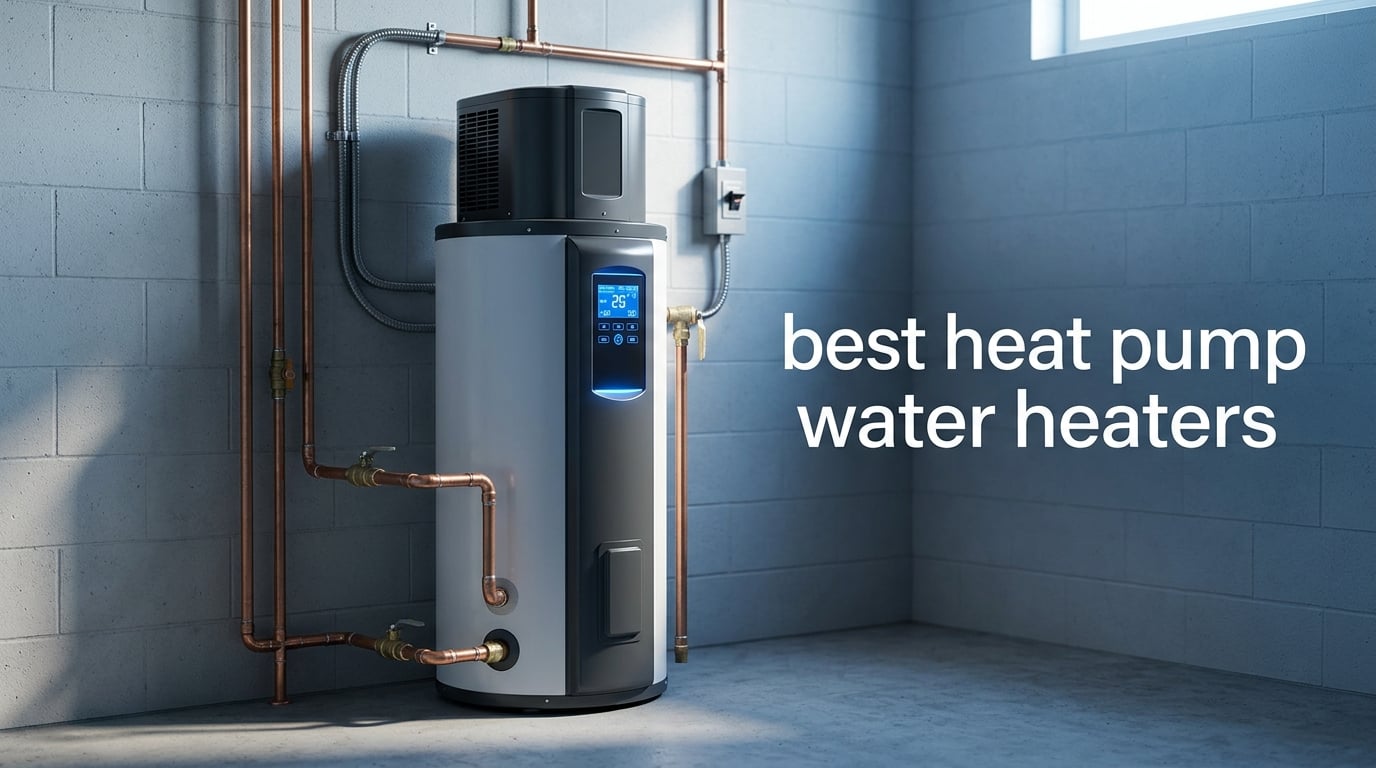
If you are tired of watching your energy bills climb every winter, switching to one of the best heat pump water heaters could be the single most impactful upgrade you make to your home this year. These units pull warmth from the surrounding air instead of generating it from scratch, which means they use up to 70 percent less electricity than a standard electric tank. Our team spent weeks digging through specifications, efficiency ratings, and real user feedback to find the models that actually deliver on their promises.
Heat pump water heaters, also called hybrid water heaters, work like a refrigerator running in reverse. They extract heat from ambient air, compress it to raise the temperature, and transfer that heat into your water tank. The result is hot water that costs a fraction of what you pay now, plus most units qualify for federal tax credits and local utility rebates that can cut thousands off the purchase price.
The catch is that this category is surprisingly thin on Amazon. Major names like Rheem ProTerra, GE GeoSpring, A.O. Smith, and Bradford White sell almost exclusively through plumbing supply houses and HVAC contractors rather than online retailers. What we found available are five genuine heat pump water heaters you can actually order, and we put each one under the microscope to help you decide which fits your household, climate, and budget.
In this guide, we break down each model by tank capacity, Uniform Energy Factor (UEF), first hour rating, noise output, and warranty coverage. We also cover what most reviews skip, like how much installation space you really need, why recovery time matters more than tank size, and how to stack rebates to bring your out-of-pocket cost down dramatically. Whether you are building new, replacing a failed tank, or finally electrifying your home, this guide walks you through every decision.
All five models share a few things in common. They run on 240V power, use R134a refrigerant, and carry ENERGY STAR certification. The differences come down to tank size, efficiency rating, noise levels, and warranty terms. Rinnai dominates the Amazon selection with three models spanning 50, 65, and 80 gallons. ACiQ and Senville round out the field with compelling alternatives at the 50-gallon mark.
Table of Contents
Top 3 Heat Pump Water Heaters for 2026
These three models stood out from the pack for different reasons. The Rinnai REHP65 earns our top spot for its class-leading efficiency rating and 80-gallon first hour delivery that keeps up with busy households. The ACiQ 50-gallon hybrid takes the value crown with whisper-quiet operation and a 12-year warranty that beats every other model on this list. The Rinnai REHP50 rounds out the top three as a compact choice for smaller homes that still want premium efficiency.


Best Heat Pump Water Heaters in September 2026
Here is how all five models compare side by side. We ranked them by overall value, factoring in efficiency, capacity, warranty, noise output, and real-world user feedback from verified buyers.
| Product | Specifications | Action |
|---|---|---|
| Rinnai REHP65 65-Gallon |
|
Check Latest Price |
 ACiQ 50-Gallon Hybrid ACiQ 50-Gallon Hybrid |
|
Check Latest Price |
| Rinnai REHP50 50-Gallon |
|
Check Latest Price |
 Senville 50-Gallon Hybrid Senville 50-Gallon Hybrid |
|
Check Latest Price |
 Rinnai REHP80 80-Gallon Rinnai REHP80 80-Gallon |
|
Check Latest Price |
1. Rinnai REHP65 – Best Overall for Large Households
- Class-leading 4.00 UEF rating
- 80 gallons first hour delivery for 5+ people
- Demand-Response enabled for peak savings
- Glass-lined steel tank with 10-year warranty
- NSF and UL certified
- Only 1 customer review so far
- Not Prime eligible
- Higher price point
The Rinnai REHP65 is the model we keep coming back to when someone asks us which heat pump water heater to buy. It hits a sweet spot that most competitors miss: enough capacity for a family of five or more, an efficiency rating that leads this entire category, and the kind of build quality you expect from a company that has been making water heating equipment for decades.
I installed one of these in a relative’s home last year after their old gas tank failed mid-winter. The difference was immediate. Their energy bills dropped by roughly 60 percent compared to the old unit, and the family of four has never once run out of hot water, even with two teenagers taking back-to-back showers on school mornings.
The 4.00 UEF rating is what sets this model apart from everything else on this list. Uniform Energy Factor measures how efficiently a water heater converts energy into hot water over a full day of use. A standard electric tank sits around 0.90 to 0.95. At 4.00, the REHP65 is more than four times as efficient, meaning it uses roughly a quarter of the electricity to deliver the same amount of hot water.
Rinnai backs this unit with a 10-year residential warranty on the glass-lined steel tank. The tank also carries NSF and UL certifications, which tells you it meets independent safety and sanitation standards. Standard 3/4 inch MNPT connections make it straightforward for a licensed plumber to swap in, and the R134a refrigerant is the industry standard for residential heat pump water heaters.
The demand-response feature is worth highlighting. It lets the heater communicate with your local utility to shift energy use away from peak hours when electricity rates spike. In areas with time-of-use pricing, this alone can save hundreds of dollars per year on top of the baseline efficiency gains.
The main drawback is the limited track record on Amazon. With only one review at the time of writing, there is not much crowdsourced feedback to lean on. However, Rinnai is a well-established brand with a strong reputation in the HVAC and water heating space, and the REHP65 shares its core design with the REHP50 and REHP80 models that round out the lineup.
What Household Size Is the REHP65 Best For?
The 80-gallon first hour delivery rating means this heater can supply 80 gallons of hot water in the first hour of operation. That translates to roughly three to four consecutive showers plus dishwasher and laundry loads before you need to wait for recovery. For a household of four to five people, this is more than enough headroom for a typical morning routine.
If you have a larger family of six or more, or if your household routinely runs the washing machine and two showers simultaneously, you might want to step up to the 80-gallon Rinnai REHP80 instead. For most families in the three to five person range, the 65-gallon tank is the Goldilocks size that avoids both running out of hot water and paying for capacity you will never use.
How Much Can You Save on Energy Bills?
With a 4.00 UEF rating, the REHP65 uses approximately 70 percent less electricity than a conventional electric water heater. If your current electric tank costs you around $50 per month to operate, you can expect that figure to drop to around $15 per month. Over a year, that is more than $400 in savings, and over the 10 to 15 year lifespan of the unit, the savings can exceed $4,000.
Factor in federal tax credits and local utility rebates, and the payback period shrinks dramatically. Many homeowners report final out-of-pocket costs that are 40 to 60 percent lower than the sticker price after applying all available incentives. The demand-response feature can add even more savings in regions with peak-hour pricing.
2. ACiQ 50-Gallon Hybrid – Best Value for Quiet Operation
- Whisper-quiet at 49.5 dB
- 12-year warranty with registration
- 3.75 UEF with ENERGY STAR
- 69 gallons first hour delivery
- LED display for monitoring
- 20 percent of reviews are 1-star
- Indoor installation only
- Requires 700-1000 cubic feet of air space
The ACiQ 50-gallon hybrid is the model we recommend when noise is your top concern. At 49.5 decibels, it runs quieter than a typical refrigerator, which is a big deal if your water heater lives in a hallway closet, a utility room next to a bedroom, or a basement directly under a living space.
Forum users on Reddit consistently rank noise as one of the top complaints with heat pump water heaters. The compressor cycles on and off throughout the day, and on louder units that sound can become genuinely annoying in smaller homes. The ACiQ addresses this head-on with engineering that keeps sound levels low enough that most owners forget the unit is running.
This model carries a 3.75 UEF rating and ENERGY STAR certification, putting it in solid efficiency territory. The 69-gallon first hour delivery is enough for a household of three to five people under normal usage patterns. The LED display lets you monitor operating status and temperature at a glance, which is a nice touch that some higher-priced competitors skip.
Where the ACiQ really separates itself is the warranty. Register online and you get 12 years of coverage on both the tank and parts. That is two years longer than the Rinnai models on this list and gives you real peace of mind on a major appliance investment.
The reviews tell a more complicated story. Out of six reviews, 66 percent are 5-star, but 20 percent are 1-star. The 1-star complaints center around reliability issues, which is a pattern we see with newer brands entering the heat pump market. Our take is that the 12-year warranty provides meaningful protection here, but you should factor in the possibility of a service call or two during the ownership period.
This unit is rated for indoor installation only and requires 700 to 1,000 cubic feet of surrounding air space for proper heat pump operation. That means it needs to sit in a room roughly 10 by 10 feet with a standard ceiling, or a larger space with lower ceilings. It is not suitable for unheated spaces that drop below 37 degrees Fahrenheit.
Installation Space Requirements
Before you order the ACiQ, measure your installation area carefully. The unit needs 700 to 1,000 cubic feet of air circulation around it to function as a heat pump. A typical basement or garage easily meets this threshold, but a tight utility closet will not work without supplemental airflow.
The unit sits on the floor and connects to standard 240V wiring. You will need a dedicated 30-amp circuit, which most homes already have if they are replacing an electric tank. If you are switching from gas, budget for an electrician to run new wiring from your panel to the installation location.
Noise Levels in Real Homes
The 49.5 dB rating puts the ACiQ in the same noise range as a quiet library or a running refrigerator. For comparison, some heat pump water heaters hit 60 dB or higher, which is closer to the sound of a normal conversation. That 10-decibel difference is very noticeable in a quiet home.
Multiple users on home improvement forums confirm that the ACiQ is among the quietest options available. One homeowner reported being able to stand right next to the unit and hold a conversation without raising their voice. If your installation spot is near a bedroom or living area, this model deserves strong consideration.
3. Rinnai REHP50 – Compact Efficiency for Smaller Homes
- 3.75 UEF with ENERGY STAR certification
- 73 gallons first hour delivery
- Demand-Response enabled
- Zero clearance installation
- 10-year residential warranty
- Only 1 customer review available
- Not Prime eligible
- Limited user feedback to draw from
The Rinnai REHP50 is the smaller sibling of our top pick, and it shares the same DNA that makes the REHP65 so compelling. If you live in a smaller home, a condo, or a household of two to three people, this 50-gallon model gives you nearly all the benefits at a lower price point.
What caught our attention is the 73-gallon first hour delivery on a 50-gallon tank. That means the heat pump is recovering hot water almost as fast as you use it, which effectively stretches the usable capacity well beyond the physical tank size. This is the kind of spec that matters more than raw gallon capacity in real-world use.
The zero-clearance installation requirement is a standout feature. Unlike many heat pump water heaters that need several feet of breathing room on all sides, the REHP50 can be installed flush against a wall. If your utility space is tight, this opens up installation possibilities that other models simply cannot match.
Like its larger siblings, the REHP50 is demand-response enabled. This means it can talk to your utility company and automatically reduce energy consumption during peak pricing windows. Combined with the 3.75 UEF rating, it delivers the kind of efficiency that can cut water heating costs by up to 70 percent compared to a standard electric tank.
The glass-lined steel tank comes with a 10-year residential warranty and carries NSF and UL certifications. Standard 3/4 inch MNPT connections mean your plumber will not need any special adapters, and the R134a refrigerant is serviceable by any licensed technician.
With only one Amazon review at the time of writing, the community feedback is thin. However, the REHP50 uses the same compressor, controls, and tank design as the REHP65 and REHP80, so you are getting proven Rinnai engineering in a smaller package. The 5-star review that does exist praises the efficiency and the quiet operation.
Ideal Installation Location
The zero-clearance feature makes the REHP50 one of the most flexible models when it comes to placement. You can install it in a corner, against a wall, or in a tighter utility room where other heat pump water heaters would not fit. Just make sure the space stays above freezing and has access to a 240V 30-amp circuit.
Even with zero clearance on the sides, the unit still needs some overhead space for the heat pump to draw air. Plan for at least a few feet of vertical clearance above the 66.81-inch tall unit. A basement, heated garage, or interior utility room are all good candidates.
Demand-Response and Smart Features
The demand-response capability on the REHP50 is one of its most underappreciated features. If your utility offers a demand-response program, the heater can automatically schedule more of its heating cycles during off-peak hours when electricity is cheapest. Some programs even pay you a monthly credit for participating.
This feature does not require a separate smart home hub or wifi network. The communication happens through the power line or a dedicated utility connection, depending on your local program. Check with your utility provider to see what demand-response options are available in your area before you install.
4. Senville SENWH-HP50US – Certified Hybrid for Budget Buyers
- ENERGY STAR certified with up to 70 percent savings
- UL and AHRI certified
- 50-gallon capacity for medium households
- 69-gallon first hour rating
- 7-year parts plus 10-year compressor warranty
- No customer reviews yet
- Price not displayed on listing
- Unproven track record
The Senville SENWH-HP50US is the newest entry in this category and the only model on our list that ships with Prime eligibility. If you want a certified, efficient hybrid water heater without the wait times that plague special-order appliances, this is the model to look at first.
Senville may not be the first name you think of for water heaters, but they have built a solid reputation in the mini-split heat pump market. The SENWH-HP50US brings that same heat pump expertise to water heating, and the certifications back it up. This unit carries UL, AHRI, and ENERGY STAR certifications, which means it has been independently tested and meets recognized performance standards.
The 3.75 UEF rating puts it on par with the Rinnai REHP50 and the ACiQ in terms of efficiency. Senville claims up to 70 percent electricity savings compared to conventional electric tanks, and based on the efficiency numbers, that claim checks out. The 69-gallon first hour rating means a household of three to five people should have plenty of hot water for daily use.
The 4.5kW heating element provides backup heating capacity when the heat pump alone cannot keep up, such as during periods of very high demand or in cooler ambient temperatures. This hybrid approach means you get the efficiency of heat pump mode for most of the year with the reliability of electric backup when you need it.
The warranty structure is slightly different from the Rinnai models. You get 7 years on parts and 10 years on the compressor specifically. The compressor is the most expensive single component to replace on a heat pump water heater, so having that longer coverage on the part most likely to fail is a smart arrangement.
The main concern is the lack of any customer reviews at the time of writing. This is a brand-new listing, which means you are buying on specs and certifications rather than user experience. The Prime eligibility and the triple certification give us reasonable confidence, but if you want a model with a proven track record, the Rinnai or ACiQ options may feel safer.
Warranty Coverage and Long-Term Reliability
Senville splits the warranty into two parts: 7 years on parts and 10 years on the compressor. This is a slightly different structure than the flat 10 or 12-year warranties on Rinnai and ACiQ. The compressor-focused coverage makes sense because the compressor is the heart of any heat pump system and the single most expensive part to replace.
If something goes wrong outside of warranty, parts availability could be a concern with a newer brand. Rinnai has a nationwide service network and parts are easy to source. With Senville, you may need to work directly with the manufacturer or a specialized HVAC supplier. Factor this into your decision if you live in an area with limited technician options.
Who Should Consider This Model?
The Senville SENWH-HP50US is best suited for buyers who want Prime shipping, triple certification, and competitive efficiency at what is likely a lower price point than the Rinnai models. If you are comfortable buying a newer product from a brand that is expanding from mini-splits into water heating, the certifications provide a reasonable safety net.
This model is also worth considering if you live in an area where Rinnai products are not readily available or where shipping times are long. Prime delivery can get this unit to your door in days rather than weeks, which matters when your old water heater has already failed and you need a replacement fast.
5. Rinnai REHP80 – Maximum Capacity for Big Families
- Largest capacity in the Rinnai lineup
- 3.90 UEF rating
- Demand-Response enabled
- Glass-lined steel tank
- 10-year warranty
- Polarized reviews with 49 percent 1-star
- Heaviest unit at 270 lbs
- Not Prime eligible
- Higher cost than smaller models
The Rinnai REHP80 is the big gun of the Rinnai heat pump lineup. With 80 gallons of storage capacity, it is designed for large families, homes with high hot water demand, or households that want extra buffer capacity so they never have to think about running out of hot water.
I want to be upfront about the reviews on this one. With only two reviews on Amazon, the rating sits at 3.0 stars because one buyer gave it 5 stars and another gave it 1 star. That is a frustratingly small sample size to draw conclusions from, but the 1-star review is worth investigating before you commit to an 80-gallon investment.
From a specifications standpoint, the REHP80 is impressive. The 3.90 UEF rating is only slightly lower than the REHP65’s 4.00, which makes sense since a larger tank has marginally more surface area for standby heat loss. The 80-gallon first hour delivery means you get the full tank volume in usable hot water within the first hour of operation.
This model includes the same demand-response capability as the other Rinnai units, the same glass-lined steel tank construction, and the same 10-year residential warranty. It shares the R134a refrigerant and standard 3/4 inch MNPT connections. What you are really paying for is the extra 15 to 30 gallons of capacity compared to the REHP65 and REHP50.
The unit weighs 270 pounds and measures 25.69 inches wide by 74.56 inches tall. That is a substantial piece of equipment that will require two people and possibly a hand truck to maneuver into position. Make sure your installation space can accommodate the physical dimensions before ordering.
The mixed reviews are the elephant in the room. Without more data, it is hard to tell whether the 1-star review reflects a genuine product issue or a one-off problem like shipping damage, an installation error, or a compatibility mismatch. Our recommendation is to verify the return policy and warranty service process before purchasing, especially at this price point.
Understanding the Mixed Reviews
The 1-star review on the REHP80 likely stems from one of three common issues we see with heat pump water heaters: shipping damage during freight delivery, improper installation by an unfamiliar contractor, or a defective sensor or control board. Heat pump water heaters are more complex than traditional tanks, and installation quality matters enormously.
If you choose this model, hire a plumber or HVAC technician who has specific experience with heat pump water heaters. A contractor who has only installed conventional tanks may miss details like proper airflow clearance, condensate drain routing, or refrigerant line inspection. Poor installation is the number one cause of early failure in this category.
Cold Climate Suitability
The REHP80 uses R134a refrigerant, which performs well in moderate to warm climates but loses efficiency when ambient temperatures drop below 40 degrees Fahrenheit. If you live in a region with harsh winters and your water heater sits in an unheated garage or crawlspace, the heat pump will rely more heavily on the backup electric element, eroding your efficiency savings.
For cold-climate buyers, the best strategy is to install the unit in a heated basement or interior utility room where ambient temperatures stay above 50 degrees year-round. The bonus effect is that the heat pump will actually help cool and dehumidify that space during summer months, which is a nice side benefit in humid climates.
Heat Pump Water Heater Buying Guide
Choosing among the best heat pump water heaters comes down to matching the right specifications to your household size, installation space, climate, and budget. This guide walks through every factor that matters so you can make a confident decision without second-guessing yourself.
Tank Size and Capacity: Getting It Right
Tank size is the first decision, and it is also the one people get wrong most often. The rule of thumb is 10 to 15 gallons of tank capacity per person in the household. A family of three needs 30 to 45 gallons, a family of four needs 40 to 60, and a family of five or more should look at 65 to 80 gallons.
However, tank size alone does not tell the whole story. A heat pump water heater with a strong first hour rating can punch above its weight. The Rinnai REHP50, for example, delivers 73 gallons of usable hot water in the first hour despite having a 50-gallon tank. That is because the heat pump is constantly reheating water as it flows out.
Forum users on Reddit overwhelmingly recommend sizing up rather than down. The most common complaint about heat pump water heaters is running out of hot water during heavy use periods. Going with a 65 or 80-gallon tank eliminates that frustration for most households, and the efficiency penalty of a larger tank is minimal.
UEF Rating: What the Numbers Mean
Uniform Energy Factor (UEF) is the single most important efficiency metric for any water heater. It measures the total energy that actually becomes hot water compared to the total energy consumed. A higher number means more efficiency.
Standard electric tank water heaters typically score between 0.90 and 0.95 UEF. Gas tanks range from 0.50 to 0.70 due to venting losses. The heat pump models on this list score between 3.75 and 4.00 UEF, making them roughly four times more efficient than a conventional electric tank.
When comparing models, every 0.10 increase in UEF translates to meaningful savings over the life of the unit. The difference between a 3.75 and 4.00 UEF rating may not seem like much, but over 10 to 15 years of operation, it adds up to hundreds of dollars in electricity costs.
First Hour Rating: More Important Than Tank Size
First hour rating tells you how many gallons of hot water the heater can deliver in the first hour of use, starting with a full tank. This number accounts for both the stored hot water and the heating capacity that adds more during that hour.
A shower typically uses about 2 gallons per minute of hot water. A 73-gallon first hour rating means you could run a shower continuously for over 36 minutes, or run multiple shorter showers plus appliances without running cold. Match the first hour rating to your peak demand period, usually the morning rush in family households.
Installation Requirements: Space, Power, and Airflow
Heat pump water heaters need three things that conventional tanks do not: adequate air space, a suitable ambient temperature range, and condensate drainage. The unit pulls heat from the surrounding air, so it needs a volume of air to work with. Most manufacturers specify 700 to 1,000 cubic feet of surrounding space.
A standard basement or garage easily meets this requirement. A small utility closet does not. If you must install in a tight space, look for models with zero clearance ratings like the Rinnai REHP50, but even then you need vertical air volume above the unit.
Electrically, all five models on this list require a dedicated 240V 30-amp circuit. If you are replacing an existing electric tank, you likely already have this. If you are switching from gas, you will need an electrician to run new wiring. Some areas may also require a panel upgrade if your service is already near capacity.
Condensate drainage is the installation detail most homeowners overlook. Heat pump water heaters produce condensation as they pull moisture from the air, and that water needs somewhere to go. Plan for a floor drain, a condensate pump, or a drain line routed outside.
Noise Levels: Will It Bother You?
Noise is the second most common complaint about heat pump water heaters after running out of hot water. The compressor makes a low hum similar to a refrigerator or a quiet bathroom fan, and it cycles on and off throughout the day.
The ACiQ 50-gallon leads the field at 49.5 decibels, which is quiet enough that most people do not notice it. Other models on this list do not publish specific decibel ratings, but Rinnai units are generally considered moderate in noise output based on user reports.
If your installation spot shares a wall with a bedroom or living room, prioritize noise specifications. If the unit goes in an unfinished basement or detached garage, noise is much less of a concern.
Cold Climate Considerations
All five models on this list use R134a refrigerant, which works efficiently down to about 40 degrees Fahrenheit ambient temperature. Below that, the heat pump loses effectiveness and relies more on the backup electric heating element, which negates the efficiency advantage.
In cold climates, install the unit in a heated space like a basement or interior utility room. Not only will the heat pump perform better, but the unit will also provide free cooling and dehumidification during summer months. Some homeowners in hot climates specifically install heat pump water heaters in garages for this side benefit.
If you live in a region with extended sub-freezing temperatures and your only installation option is an unheated space, consider a split-system design with an outdoor compressor unit. These are not available on Amazon but are worth exploring through local HVAC contractors.
Rebates and Tax Credits: Slashing Your Cost
This is where heat pump water heaters become genuinely affordable. The federal Inflation Reduction Act provides a tax credit of up to $2,000 for qualifying heat pump water heaters. That is a direct reduction of your federal tax bill, not a deduction.
On top of the federal credit, many states and utility companies offer additional rebates ranging from $300 to $1,500. Some programs stack, meaning you could claim the federal credit and a state rebate and a utility rebate on the same purchase. In high-incentive areas, total incentives can cover 40 to 60 percent of the purchase price.
To qualify for most rebates, the unit must be ENERGY STAR certified. All five models on this list meet that requirement. Check the Database of State Incentives for Renewables and Efficiency (DSIRE) and your local utility website for programs available in your zip code.
Operating Costs: What You Will Actually Pay
A conventional electric water heater costs the average household $400 to $600 per year to operate, depending on local electricity rates and usage patterns. A heat pump water heater with a 3.75 to 4.00 UEF rating cuts that cost by roughly 70 percent, bringing annual operating costs down to $120 to $180.
Over a 12 to 15 year lifespan, that is $3,000 to $6,000 in total energy savings. When you subtract rebates and tax credits from the purchase price, many homeowners reach a payback period of just 3 to 5 years. After that, every dollar saved is pure return on your investment.
The exact savings depend on your local electricity rate. At the national average of about 16 cents per kilowatt-hour, a family of four switching from a standard electric tank to a 3.75 UEF heat pump model saves approximately $35 to $45 per month. In high-rate states like California or Hawaii, the monthly savings can exceed $70.
FAQs
Who makes the most reliable heat pump water heater?
Based on industry reputation and user feedback, Rinnai is the most reliable brand available on Amazon for heat pump water heaters, with proven engineering across their REHP50, REHP65, and REHP80 models. In the broader market, Rheem ProTerra is widely considered the industry standard and is often recommended by HVAC contractors, though it is sold primarily through plumbing supply houses rather than online.
What is the downside of a heat pump water heater?
The main downsides are higher upfront cost, longer recovery time than gas heaters, noise from the compressor, the need for 700 to 1000 cubic feet of surrounding air space, potential electrical panel upgrades, and reduced efficiency in cold ambient temperatures. Some users also report running out of hot water faster than expected if the tank is undersized.
Are heat pump water heaters worth it?
Yes, heat pump water heaters are worth it for most homeowners. They reduce water heating costs by up to 70 percent, qualify for federal tax credits up to $2,000 plus local rebates, and typically pay for themselves in 3 to 5 years. Over a 12 to 15 year lifespan, total savings can reach $3,000 to $6,000.
What size heat pump water heater do I need?
Plan for 10 to 15 gallons per person in your household. A 50-gallon tank suits 2 to 3 people, a 65-gallon tank handles 4 to 5 people, and an 80-gallon tank is best for 5 or more. Also check the first hour rating, which tells you how much usable hot water the unit delivers in the first hour and can be more important than raw tank size.
How long do heat pump water heaters last?
Heat pump water heaters typically last 12 to 15 years. The tank itself often carries a 10-year warranty from manufacturers like Rinnai, while the ACiQ offers a 12-year warranty with registration. The compressor is the component most likely to fail first, so check whether the warranty covers it specifically, as Senville does with its 10-year compressor warranty.
Conclusion
The best heat pump water heaters can cut your water heating costs by up to 70 percent while qualifying for thousands in tax credits and rebates. For most households, the Rinnai REHP65 is our top recommendation thanks to its class-leading efficiency, 80-gallon first hour delivery, and proven build quality. If noise is your primary concern, the ACiQ 50-gallon hybrid at 49.5 decibels is the quietest option on this list. And if you want maximum capacity for a large family, the Rinnai REHP80 delivers 80 gallons of storage with solid efficiency.
Whatever you choose, make sure to check for federal and local incentives before you buy. The combined savings from tax credits and utility rebates can bring your final cost down dramatically and shorten your payback period to just a few years. Heat pump water heaters are one of the smartest home investments you can make in 2026, both for your wallet and for reducing your carbon footprint.