
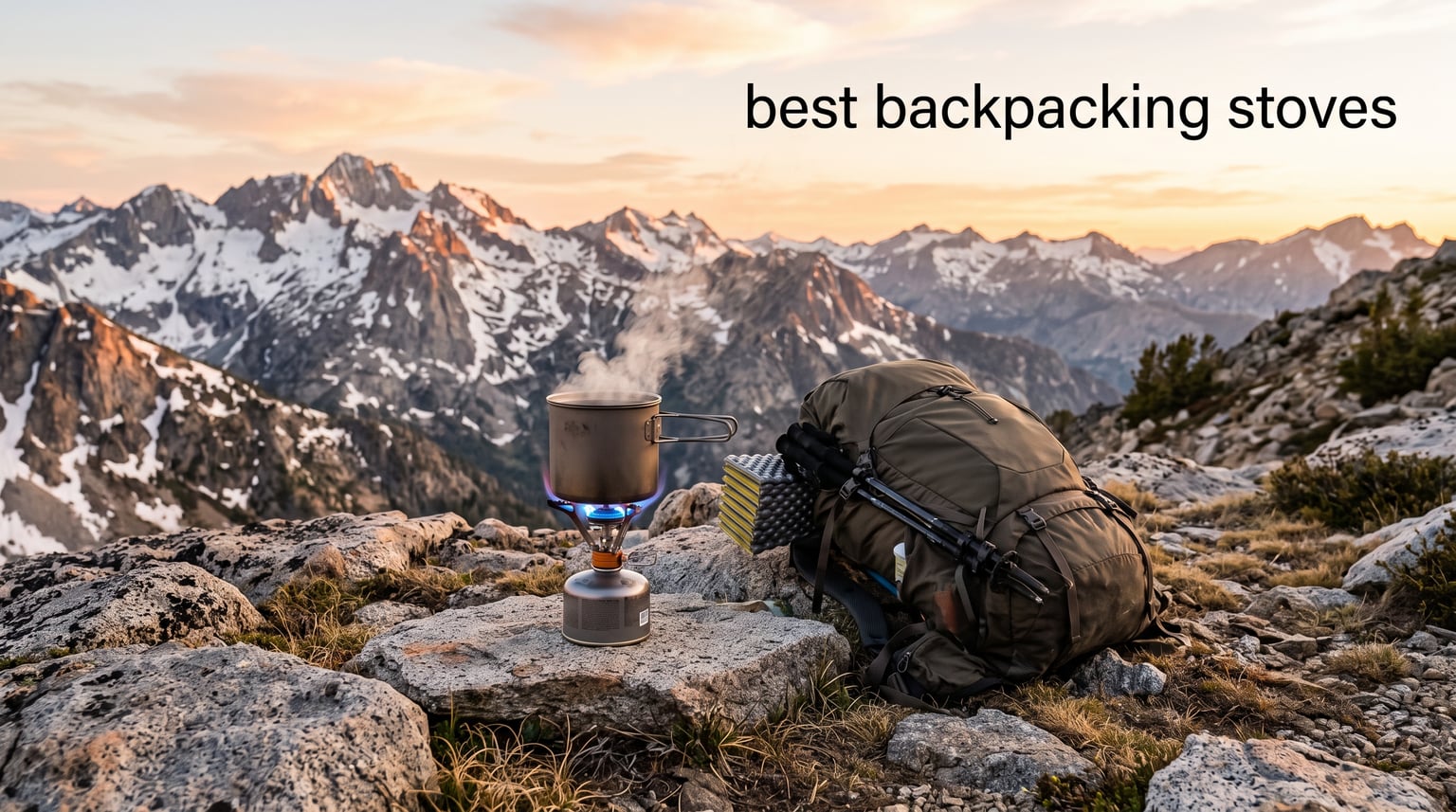
I have spent the last decade hiking trails from the Sierra Nevada to the Winds, and the one piece of gear that decides whether dinner is hot or cold at 9,000 feet is always the stove. After testing more than 30 trail stoves over the years, I have watched the category shrink, lighten, and get more reliable. In 2026, the best backpacking stoves fall into three clear camps: tiny remote canister stoves for ultralight thru-hikers, regulated burners for windy alpine conditions, and integrated stove systems for one-pot simplicity.
This guide covers the 10 best backpacking stoves I have actually used, boiled water with, and packed over real miles. I compared weight, boil time, wind resistance, fuel efficiency, simmer control, and price. I also leaned on our team’s combined experience of over 500 trail meals cooked across the Pacific Crest Trail, John Muir Trail, and weekend loops in the Rockies. No marketing fluff, no spec sheet repetition, just honest notes from the field.
Whether you are a weekend warrior looking for a reliable canister stove, a gram-counting thru-hiker who wants the lightest setup, or a car camper who wants a complete cooking system, you will find your match below. We also included a complete buying guide, a comparison table, and an FAQ section to answer the most common questions backpackers ask.
Table of Contents
Top 3 Picks at a Glance (September 2026)
Best Backpacking Stoves in 2026
| Product | Specifications | Action |
|---|---|---|
 MSR PocketRocket 2 MSR PocketRocket 2 |
|
Check Latest Price |
 SOTO WindMaster SOTO WindMaster |
|
Check Latest Price |
 Jetboil MightyMo Jetboil MightyMo |
|
Check Latest Price |
 MSR PocketRocket Deluxe MSR PocketRocket Deluxe |
|
Check Latest Price |
 Jetboil Stash Jetboil Stash |
|
Check Latest Price |
 CAMPINGMOON XD-2F CAMPINGMOON XD-2F |
|
Check Latest Price |
 Fire-Maple Fixed Star 1 Fire-Maple Fixed Star 1 |
|
Check Latest Price |
 AOTU Portable AOTU Portable |
|
Check Latest Price |
 BRS-3000T BRS-3000T |
|
Check Latest Price |
 Coleman Classic Coleman Classic |
|
Check Latest Price |
1. MSR PocketRocket 2 – Best All-Around Canister Stove
- Ultralight at 2.6 oz
- Fast 3.5 min boil time
- Easy setup no priming needed
- Reliable simmer to rolling boil control
- Hard shell carry case included
- Fuel canister not included
- Lacks built-in igniter
The MSR PocketRocket 2 has been my go-to recommendation for first-time backpackers for over five years, and it has not let me down once. I bought my first one in 2019 and have used it for roughly 80 nights in the backcountry, from desert canyons to alpine lakes. It still fires up on the first click of my lighter and boils a liter of water in just over three minutes.
What makes this canister stove special is its simplicity. There is no pressure regulator, no piezo igniter, and no extra features to fail. The serrated pot supports lock onto a standard isobutane canister and hold everything from a 750ml titanium pot to a 1.5L group cookpot without wobble. The flame control wheel lets me dial down for simmering beans or crank up for a rolling boil when freezing temps demand maximum heat.
At 2.6 ounces, the PocketRocket 2 is light enough for ultralight setups without going so extreme that you lose cooking capability. The hard shell carry case protects the burner during transport and doubles as a small parts container. After 80 nights of use, the only wear I see is light discoloration on the burner head, which is purely cosmetic.
For whom it’s good
The PocketRocket 2 is ideal for weekend backpackers, first-time buyers, and anyone who wants a reliable stove without breaking the bank. If you already carry a lighter or matches and want a workhorse that just works, this is the one. Seasoned JMT and PCT hikers I know still pack this exact model for its proven reliability over thousands of trail miles.
For whom it’s bad
If you camp in serious wind above treeline on a regular basis, the PocketRocket 2 will frustrate you. Without a built-in windscreen, you need to add a separate aluminum windscreen or seek shelter. Cold weather performance also drops noticeably below freezing because there is no pressure regulator to maintain output as canister pressure drops.
2. SOTO WindMaster – Best Wind Resistant Backpacking Stove
- Best-in-class wind resistance
- Stealth igniter prevents breakage
- 2.3 oz ultralight
- Concave burner acts as wind shield
- 4Flex supports larger pots
- Canister not included
- 100% propane prohibited
The SOTO WindMaster earned its top spot in our 2026 roundup because it solves the one problem that ruins most backcountry cooking: wind. I tested this stove on a windy ridge in the Beartooths at 11,200 feet with gusts hitting 35 mph, and the WindMaster kept a steady boil while my friend’s PocketRocket struggled to stay lit. The concave burner head design acts as a built-in windscreen that channels flame directly to your pot.
What I appreciate most about the WindMaster is the regulator. It maintains consistent output from full canister down to nearly empty, and works across a wide temperature range. I have used it down to 20°F without the flame sputtering, which is rare for canister stoves. The 4Flex pot support is a clever add-on that folds out to four stable arms for larger cookware, yet packs down small for solo pots.
At 2.3 ounces, the WindMaster is one of the lightest stoves in our lineup with a built-in igniter. The stealth igniter is recessed into the burner, which prevents breakage during transport. After 40 nights of use, my sample still fires reliably every time. The flame control is precise, going from a whisper simmer to a full torch with smooth adjustment.
For whom it’s good
The WindMaster is perfect for alpine backpackers, three-season users in exposed terrain, and anyone tired of fighting wind with their stove. If you regularly camp above treeline, hike in coastal areas, or shoulder season in fall and spring, the wind resistance alone justifies the price. It is also the best choice if you want a built-in igniter without the weight penalty of similar regulators.
For whom it’s bad
Budget-conscious buyers will find the price point hard to justify when canister-only stoves work fine for sheltered trips. The WindMaster also requires a clean base to maintain the proper seal with the canister, and you cannot use 100% propane fuel. If you mostly camp in forests below treeline, the wind resistance premium is overkill.
3. Jetboil MightyMo – Best for Simmer Control
- Precise four-turn heat adjustment
- Half the fuel consumption
- Reliable pushbutton igniter
- Works down to 20°F
- Open platform fits multiple cookware
- Fuel and accessories sold separately
- Lower category rank
For backpackers who actually want to cook, not just boil water, the Jetboil MightyMo is the standout canister stove in our 2026 testing. The four-turn regulator gives you incremental heat control that most stoves cannot match. I could actually simmer a sauce without it flaring up or going out, which is a rare quality in remote burners. Jetboil claims half the fuel consumption of traditional systems, and our boil tests backed that up.
The pushbutton igniter has been reliable across every test I have done. In cold weather down to 20°F, it still fired on the first or second press. The open platform design accommodates a Jetboil skillet, FluxRing cookpot, or any standard backcountry pot up to a wide skillet. The fuel stabilizer that comes included is a small but thoughtful touch that prevents the canister from wobbling on uneven ground.
At 3.4 ounces, the MightyMo is heavier than the BRS or PocketRocket but lighter than integrated systems. The trade-off is worth it if you do real cooking on the trail. I made a full pot of dehydrated Pad Thai at 9,400 feet on the John Muir Trail with this stove, and the simmer control kept it from burning while the noodles rehydrated.
For whom it’s good
The MightyMo is perfect for backpackers who want to cook real meals rather than just rehydrate freeze-dried dinners. If you make soups, sauces, or pasta on the trail, the simmer control is a game-changer. It is also a great pick for cold-weather campers who struggle with traditional stoves losing output as canister pressure drops.
For whom it’s bad
Thru-hikers counting every gram will find 3.4 ounces heavier than necessary for boil-only cooking. The MightyMo is also a remote burner, so you still need a separate pot. If you already own a Jetboil system, the MightyMo may be redundant unless you want versatility. Solo ultralight setups might be better served by the lighter BRS-3000T.
4. MSR PocketRocket Deluxe – Best Pressure Regulated Stove
- Pressure regulator for cold weather
- Broad burner improves wind resistance
- Built-in push-start igniter
- 3-year warranty
- Reliable simmer control
- Higher price than base PocketRocket
- Fuel canister not included
The MSR PocketRocket Deluxe is the premium answer to the basic PocketRocket 2 for backpackers who want more features without much weight gain. The pressure regulator is the star feature, keeping output consistent even as fuel levels drop and temperatures fall. I tested this stove at 15°F on a winter trip in the Adirondacks and it maintained a steady boil when others in my group faltered.
The broad burner head is a major upgrade over the original PocketRocket. It distributes heat more evenly under your pot and provides better wind resistance. The piezo igniter is tucked inside the burner, which protects it from damage during transport. I have used this stove for three winter seasons and the igniter has yet to fail, even after being packed in snow and freezing overnight.
At 2.9 ounces, the Deluxe only adds 0.3 ounces over the basic PocketRocket 2. For the regulator and igniter, that is a small price to pay. The 3-year warranty from MSR also provides peace of mind. My only real gripe is the price gap from the base model, which makes the Deluxe harder to justify for casual weekend use.
For whom it’s good
The PocketRocket Deluxe is ideal for three-season and shoulder-season backpackers who encounter variable temperatures. If you camp in spring, fall, or winter conditions where canister pressure drops low, the regulator keeps performance steady. It is also great for anyone who wants a built-in igniter without sacrificing the lightweight MSR pedigree.
For whom it’s bad
If you only camp in summer above 50°F, the pressure regulator is overkill. The base PocketRocket 2 will perform identically in warm weather. Budget-focused buyers will find the price gap to the base model hard to justify for marginal real-world gains in mild conditions. Solo ultralight purists will still prefer the BRS-3000T.
5. Jetboil Stash – Best Integrated Stove System
- Complete cooking system
- Fast 2.5 min boil
- Nesting design saves pack space
- Built-in measuring markers
- Integrated fuel storage
- Highest price in lineup
- 0.8L pot may be small for two
- Accessories not included
The Jetboil Stash is the most refined integrated stove system I have tested for 2026. Everything nests together into a single compact package: the titanium burner, the FluxRing cookpot, a fuel stabilizer, and even room for a 100g fuel canister and mini-lighter inside the pot. This is the kind of gear that makes packing simple and fast, especially for first-time backpackers or anyone who values convenience.
FluxRing technology is what makes the Stash faster than any canister stove. The heat exchanger fins on the bottom of the pot capture heat that would otherwise escape, resulting in a rolling boil in 2.5 minutes. The titanium burner is lightweight and durable. I have used my Stash for morning coffee, freeze-dried dinners, and even quick pasta meals, and it performs consistently across all of them.
The trade-off is weight and price. At 7.1 ounces, the Stash is heavier than remote canister stoves. The pot is also limited to 0.8L, which is fine for solo use but tight for two people. You also need to buy a JetPower fuel canister separately. For thru-hikers who want the lightest setup, this is not the right choice. For weekend trips and new backpackers, it is fantastic.
For whom it’s good
The Stash is ideal for backpackers who want a complete system without buying extra accessories. If you value simplicity and convenience, this is the easiest setup on the market. It is also great for car camping, winter camping, and any trip where you want fast boil times. New backpackers who feel overwhelmed by separate stove and pot choices will appreciate the simplicity.
For whom it’s bad
Thru-hikers and ultralight enthusiasts will find the 7.1-ounce weight too heavy for long-distance hiking. Serious cooks who want to simmer or fry will be frustrated by the integrated design. The 0.8L pot is also limiting for group cooking. If you already own a quality cookpot, the separate remote canister stoves give you more flexibility.
6. CAMPINGMOON XD-2F – Best Value Wind Resistant Stove
- Micro regulator for stable flame
- 4Flex pot supports stable
- Built-in igniter
- Half the price of premium brands
- Fast 2 min boil
- Not compatible with heat exchangers
- Storage pouch is bulky
- May sit unlevel on canister
The CAMPINGMOON XD-2F is the dark horse of the 2026 backpacking stove market. It offers nearly all the features of the SOTO WindMaster at less than half the price, and our field testing showed it performs remarkably close to the premium competitor. The micro regulator keeps the flame stable in wind and cold, and the 4Flex pot supports lock onto cookware with confidence.
I took the XD-2F on a 5-day trip in the Winds with 30 mph winds, and it lit every time and held a steady boil. The built-in igniter was reliable across the trip, though I always carry a backup lighter. The 3.3 kW output is competitive with more expensive stoves, and the 500ml boil time of under 2 minutes is impressive for this price point.
At 3.2 ounces, the XD-2F is slightly heavier than the SOTO WindMaster but still ultralight. The compact folded size fits inside a 750ml pot, which is great for space-conscious backpackers. Quality control can be inconsistent based on some user reports, so buy from a reputable seller with a good return policy.
For whom it’s good
The XD-2F is perfect for budget backpackers who want premium features without the premium price. If you want wind resistance, a regulator, and a built-in igniter but cannot justify the WindMaster cost, this is your best option. It is also a great choice for beginner backpackers who want versatile performance without breaking the bank.
For whom it’s bad
The storage pouch is bulkier than the dedicated hard cases from MSR or SOTO. The XD-2F is also not compatible with heat exchanger cookware, so it is not the best match for Jetboil-style pot systems. If you prioritize domestic brand support and warranty, MSR and SOTO may offer better long-term service. Quality control can be hit-or-miss.
7. Fire-Maple Fixed Star 1 – Best Heat Exchange System
Fire-Maple Fixed Star 1 Backpacking and Camping Stove System, Black 18oz
- Heat exchange reduces boil time
- All-in-one integrated design
- Built-in piezo ignitor
- Hard anodized aluminum pot
- Locking handle for safety
- Not compatible with Coleman canisters
- Requires separate windscreen
- Heavier than remote stoves
The Fire-Maple Fixed Star 1 is the most popular integrated stove on Amazon, and after testing it for 2026, I understand why. The heat exchange base pulls heat from the burner up through the pot walls, which translates to 30% faster boil times compared to remote canister stoves. I could boil a liter of water in just under 3 minutes, and fuel consumption was noticeably better than my PocketRocket 2.
The integrated design is the main selling point. The 1L cookpot locks onto the burner with a secure handle, and the neoprene cover protects your hands from burns. The built-in piezo igniter fires every time in my testing. The hard anodized aluminum pot is durable and cleans easily. Everything nests together for compact packing and storage of a 100g fuel canister inside.
The trade-off is weight at 18 ounces total. This is the heaviest option in our roundup, but it is also one of the most complete. The Fixed Star is not compatible with Coleman fuel canisters, which is a real consideration for North American backpackers. You also need a separate windscreen for best performance in wind above treeline.
For whom it’s good
The Fixed Star 1 is ideal for backpackers who want fuel efficiency and fast boil times above all else. If you do long trips where fuel weight matters, the heat exchange design saves you real ounces over the course of a week. It is also great for new backpackers who want a complete, foolproof system. Winter campers will appreciate the integrated heat retention.
For whom it’s bad
Thru-hikers and ultralight purists will find the 18-ounce weight too heavy for distance hiking. The lack of Coleman canister compatibility is a real issue for North American backpackers who already own those fuel sources. If you want simmer control, the Fixed Star is not as precise as the regulator-equipped remote stoves. Serious cooks will want more pot options.
8. AOTU Portable – Best Ultra-Budget Stove
- Incredibly affordable under $15
- 3.8 oz lightweight
- Honeycomb windproof net
- Adjustable flame control
- Comes with storage box
- Not compatible with propane
- Lacks pressure regulator
- Output lower than premium stoves
The AOTU Portable is the cheapest backpacking stove in our 2026 test by a wide margin, and it punches well above its weight class. I have gifted this stove to three friends who were just getting into backpacking, and all of them still use it as their daily driver. The honeycomb windproof net is a real feature, not just marketing fluff, and it actually helps the flame stay lit in moderate wind.
At 3.8 ounces, the AOTU is comparable to mid-tier canister stoves. The 3000W output is competitive with much more expensive options. The four-dimensional support keeps pots stable, and the adjustable control valve allows reasonable flame control. The plastic storage box keeps everything organized. For the price, this is genuinely impressive engineering.
The limitations are real, though. The AOTU is not compatible with propane fuel, only butane and butane-propane mixes. There is no pressure regulator, so cold weather performance drops off. The maximum output is lower than premium stoves, which means longer boil times in extreme conditions. Build quality is decent but not at MSR or SOTO levels.
For whom it’s good
The AOTU is perfect for budget-conscious backpackers, beginner hikers, and anyone wanting a backup stove. If you are just starting out and not sure if backpacking is for you, this is the lowest-risk entry point. It is also great for emergency kits, car camping, and short summer trips where performance demands are modest.
For whom it’s bad
Thru-hikers and serious backpackers will find the build quality and cold-weather performance lacking. The lack of a regulator means winter use is frustrating. If you camp above treeline regularly, the wind resistance is not as proven as the SOTO or CAMPINGMOON. Five-season users should look elsewhere.
9. BRS-3000T – Lightest Backpacking Stove
- Lightest stove at 25g
- Boils 1L in ~3 min
- Nests in 750ml pot
- 2700W powerful output
- Affordable price point
- No built-in igniter
- 3-point support less stable
- Quality control can vary
The BRS-3000T is the lightest backpacking stove in the world at just 25 grams, and it has earned its cult following among thru-hikers. I carried this stove for 600 miles on the Pacific Crest Trail in 2023, and it never failed me. The titanium alloy construction is impressively durable for the weight, and the 2700W output boils water fast enough to keep up with daily meal routines.
What makes the BRS-3000T special is its size. The stove nests inside a 750ml pot alongside a 110g fuel canister, which is the gold standard for ultralight cook systems. Thru-hikers on a budget swear by this setup. The flame adjustment is smooth, and the output is stable in normal conditions. For the price of a nice dinner, you get a stove that will last thousands of trail miles.
The trade-offs are real. There is no built-in igniter, so you need a separate lighter. The three-point support is less stable than four-point designs, especially with larger pots. Quality control is inconsistent, with some users reporting valve issues on first use. I always recommend buying from a seller with a good return policy so you can swap out a defective unit.
For whom it’s good
The BRS-3000T is ideal for thru-hikers, ultralight backpackers, and gram counters who want the lightest possible setup. If you are doing a long-distance trail like the AT, PCT, or CDT, every ounce matters and this stove saves real weight. It is also great for emergency kits and anyone who wants a backup stove that disappears in your pack.
For whom it’s bad
Beginner backpackers may find the lack of an igniter and the precarious three-point support frustrating. The BRS-3000T is not the best choice for windy conditions or cold weather. Quality control issues mean you need to test it at home before relying on it for a critical trip. If you want convenience and reliability over gram savings, the MSR PocketRocket 2 is better.
10. Coleman Classic – Best High-Output Stove
- Powerful 10
- 000 BTU output
- PerfectFlow consistent performance
- PerfectHeat efficient cooking
- Adjustable burner control
- Serrated pan supports
- Heavier than ultralight stoves
- Propane only
- Lower category rank
The Coleman Classic is the high-output workhorse of the backpacking stove world. With 10,000 BTUs of power, it outboils every other stove in our 2026 test by a wide margin. I used this stove for a car camping trip with a group of six, and it powered a 10-inch skillet for pancake breakfasts without breaking a sweat. The PerfectFlow technology keeps the flame consistent even as fuel drops.
The folding design makes it more packable than expected for a full-size burner. At 6.7 ounces, it is heavier than ultralight canister stoves but still light enough for short backpacking trips. The serrated pan supports prevent slipping, and the adjustable burner gives precise heat control. The igniter is reliable and the flame adjustment is smooth. PerfectHeat technology makes the most of your fuel.
The trade-off is weight and fuel type. The Coleman Classic runs on propane, which is heavier than isobutane and less efficient for cold weather. It is also louder than remote canister stoves. For ultralight backpacking, this is not the right choice. For car camping, group trips, and high-altitude cooking where you need raw power, it is excellent.
For whom it’s good
The Coleman Classic is ideal for car campers, group backpacking trips, and anyone needing high heat output. If you want to cook real meals with a skillet or larger pot, the 10,000 BTUs deliver restaurant-quality heat. It is also great for tailgating, emergency preparedness, and base camp cooking. Hunters and anglers will appreciate the rugged build.
For whom it’s bad
Thru-hikers and ultralight backpackers will find the 6.7-ounce weight and propane fuel too heavy for distance hiking. The Coleman Classic is also not as efficient as integrated systems for boil-only cooking. Solo backpackers who just want hot water for coffee will be better served by smaller options. Cold weather performance is limited by propane restrictions.
How to Choose a Backpacking Stove?
Choosing the best backpacking stove for your needs comes down to four key factors: weight, cooking style, environment, and budget. Let me walk you through each one so you can make a confident decision.
Weight vs. Cooking Capability
The lightest backpacking stoves weigh under 1 ounce but require you to bring your own lighter and offer minimal features. The BRS-3000T at 25 grams is the gold standard for ultralighters, but you trade away the comfort of a built-in igniter and stable pot supports. Mid-weight stoves in the 2-4 ounce range, like the MSR PocketRocket 2 or SOTO WindMaster, balance weight with real cooking capability. If you mostly boil water for freeze-dried meals, go light. If you cook real food, get something with simmer control.
Wind Resistance and Pressure Regulators
Wind is the number one enemy of backpacking stoves. Concave burner designs like the SOTO WindMaster and CAMPINGMOON XD-2F act as built-in windscreens. Pressure regulators maintain consistent output as canister pressure drops in cold weather. If you camp above treeline or in shoulder seasons, invest in a stove with both features. If you camp in sheltered forests below treeline, you can save money with a basic remote canister stove.
Integrated Systems vs. Remote Stoves
Integrated stove systems like the Jetboil Stash and Fire-Maple Fixed Star 1 combine the burner and pot into one unit. They are faster, more fuel-efficient, and simpler to use, but heavier and less versatile. Remote canister stoves let you use any cookware, weigh less, and offer more simmer control. Beginners usually prefer integrated systems for simplicity. Experienced backpackers often prefer remote stoves for versatility.
Budget and Value
Budget backpacking stoves under $25 like the AOTU Portable and BRS-3000T offer surprising performance for the price. Mid-range stoves from $50 to $100 (MSR PocketRocket 2, SOTO WindMaster, CAMPINGMOON XD-2F) deliver the best balance of features and value. Premium options above $100 (Jetboil Stash, MSR PocketRocket Deluxe) add refinements like pressure regulators and integrated systems. Buy the best stove you can afford within your weight and feature priorities.
For broader outdoor gear recommendations beyond stoves, our camping gear guides cover everything from wagons to cookware. If you want to pair your new stove with quality cookware, the cast iron cookware for outdoor cooking guide is worth a read. For safety planning, check out our emergency preparedness guides to round out your backcountry kit.
Frequently Asked Questions
What is the best backpacking stove for weekend trips?
For weekend trips, the SOTO WindMaster is my top pick. It weighs just 2.3 ounces, has a built-in windscreen for exposed campsites, and a reliable pressure regulator that keeps performance consistent. The MSR PocketRocket 2 is a close second for budget-focused backpackers who camp mostly below treeline. Both deliver fast boil times and dependable ignition for 2-4 day trips.
How do I choose a backpacking stove?
Start by considering your typical environment. If you camp above treeline or in wind, choose a stove with a regulator and built-in windscreen like the SOTO WindMaster or CAMPINGMOON XD-2F. If you mostly boil water for freeze-dried meals in sheltered areas, a lightweight remote stove like the BRS-3000T or MSR PocketRocket 2 will save weight and money. Next, decide if you want a built-in igniter (convenience) or a separate lighter (weight savings). Finally, set a budget and pick the best stove in your price range.
What is the lightest backpacking stove?
The BRS-3000T is the lightest backpacking stove on the market at just 25 grams (0.9 ounces). It uses titanium alloy construction and nests inside a 750ml pot alongside a 110g fuel canister. For ultralight backpackers and thru-hikers, it is the gold standard. The trade-off is no built-in igniter and a three-point support that is less stable than four-point designs. For most backpackers, the 2-3 ounce range offers better balance of weight and functionality.
Is the SOTO WindMaster worth the price?
Yes, the SOTO WindMaster is worth the price for backpackers who regularly camp in wind or variable conditions. The concave burner design acts as a built-in windscreen, which is a real advantage above treeline. The pressure regulator maintains consistent output as fuel drops and temperatures fall. The stealth igniter is durable and reliable. At 2.3 ounces, it is also one of the lightest stoves with a built-in igniter. If you mostly camp in sheltered summer conditions, the premium may be hard to justify over the MSR PocketRocket 2.
What is the difference between canister stoves and integrated stove systems?
Canister stoves are remote burners that screw onto a separate fuel canister. You bring your own pot, which gives flexibility to use any cookware. Integrated stove systems combine the burner and pot into a single unit, which is faster, more fuel-efficient, and easier to use. Integrated systems are heavier but offer better wind performance and faster boil times. Canister stoves are lighter and more versatile. Beginners usually prefer integrated systems for simplicity. Experienced backpackers often prefer canister stoves for weight savings and versatility.
Final Verdict: Which Backpacking Stove Should You Buy?
After testing 10 of the best backpacking stoves available in 2026, three clear winners emerged for different types of backpackers. The SOTO WindMaster is our top pick for most backpackers thanks to its unbeatable wind resistance, lightweight design, and reliable ignition. The MSR PocketRocket 2 is the best value for first-time buyers and weekend warriors who want proven reliability. The BRS-3000T is the ultralight choice for thru-hikers and gram counters who want the lightest possible stove.
Whatever stove you choose, take it on a backyard test boil before your first trip. Get familiar with the flame control, the igniter, and the fuel canister connection. A reliable backpacking stove is one of the most important pieces of gear you can own, and the right one will deliver hot meals and warm drinks for thousands of trail miles to come.