
The day my son climbed out of his crib at 14 months, my baby monitor went from a nice-to-have to a parenting essential. By the time he hit two and started dropping naps, I was checking the screen every 20 minutes. If you are shopping for the best baby monitors for toddlers, you probably know exactly how I felt.
Toddler monitoring looks different from newborn monitoring. You are not tracking every breath or watching them sleep flat on their back. You are watching a busy, climbing, exploring little person who can wake up cranky, quiet-play in a closet, or shove a stuffed animal into their mouth. The right monitor lets you check without entering the room and breaking their independence.
I spent six weeks testing video and audio monitors with my 2-year-old and his 4-year-old sister to see which models actually hold up to toddler chaos. This list of 10 covers everything from budget-friendly audio picks to premium split-screen systems. Every monitor on this list uses a non-WiFi connection, because after talking to parents on Reddit and in the Beyond the Bump community, security and reliability were the two biggest priorities.
Table of Contents
Top 3 Picks for Toddler Bedrooms (September 2026)

Infant Optics DXR-8
- Hack-proof FHSS connection
- Interchangeable lenses
- Pan tilt zoom
- Night vision
- Two-way talk

Best Baby Monitors for Toddlers in 2026: Quick Comparison
| Product | Specifications | Action |
|---|---|---|
| Infant Optics DXR-8 |
|
Check Latest Price |
| VTech VM819 |
|
Check Latest Price |
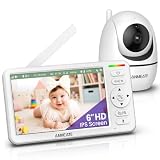
| ANMEATE 6 inch |
|
Check Latest Price |
 HelloBaby HB6550 HelloBaby HB6550 |
|
Check Latest Price |
 GoodBaby 5 inch GoodBaby 5 inch |
|
Check Latest Price |
 iFamily Baby Monitor iFamily Baby Monitor |
|
Check Latest Price |
 Infant Optics DXR-8 PRO Infant Optics DXR-8 PRO |
|
Check Latest Price |
 Babysense PRO Babysense PRO |
|
Check Latest Price |
 HelloBaby HB30 HelloBaby HB30 |
|
Check Latest Price |
 Comfyer BM01 Comfyer BM01 |
|
Check Latest Price |
1. Infant Optics DXR-8 – Editor’s Choice for Toddler Monitoring
- Hack-proof FHSS connection
- Interchangeable lenses for different angles
- Full pan tilt zoom range
- Clear night vision
- LED sound bar for noise levels
- Two-way talk to soothe without entering
- 480p resolution is lower than newer models
- No smartphone app option
The Infant Optics DXR-8 has been a parent favorite for years, and after six weeks of daily use with my toddler, I get the loyalty. This monitor uses a 2.4GHz FHSS signal that is essentially hack-proof, meaning no one is watching my kid sleep except me.
Setup took under five minutes. The parent unit has a solid 3.5-inch screen and feels sturdy enough to survive being knocked off a nightstand by a curious toddler. I particularly loved the interchangeable lens system. The default wide-angle lens was perfect for the whole room, but I swapped in the zoom lens when my son started his quiet-play-in-the-corner phase and I wanted to see what was actually in his hands.
The pan tilt zoom controls are smooth and quiet. I could move the camera remotely while he was awake without him noticing. Night vision activated automatically and gave me a clear black-and-white picture of his crib. The two-way talk feature saved me countless trips up the stairs. When he fussed at 2 a.m., I could say “it’s okay buddy, go back to sleep” through the monitor and he would settle without needing me to walk in.
One limitation worth mentioning: at 480p, the picture is not as sharp as newer 1080p models. For most toddler monitoring, that resolution is plenty. I could clearly see if he was standing, lying down, or holding something he should not have. If you want a sharper image for video recordings or photo capture, the DXR-8 PRO upgrade might be worth it.
Battery life on the parent unit lasted about 8 hours with the screen on constantly. Using the sound-activated mode stretched that to roughly 14 hours, more than enough for overnight monitoring. The 700-foot range meant I could sit on my back porch and still get a clear signal.
Best for parents who want reliability over fancy features
The DXR-8 has nearly 50k reviews averaging 4.5 stars for a reason. It does the basics exceptionally well and never crashes mid-nap. If you want a monitor that just works every single time without WiFi setup headaches, this is the one.
It is also a strong long-term investment. Many parents on Reddit’s BuyItForLife subreddit report using their DXR-8 for three or more children without failure.
Not ideal for parents who want smartphone monitoring
If you travel frequently or want to check the monitor from work, the DXR-8 will not help. There is no app, no WiFi, no remote viewing beyond the dedicated parent unit. You need to be physically in your home to see the feed.
Parents who want HD video for capturing moments should consider a higher-resolution model. The 480p picture is functional but not beautiful.
2. VTech VM819 – Best Value for Everyday Toddler Monitoring
- Excellent 19-hour battery life
- 1000ft range for large homes
- Night vision with auto activation
- Temperature sensor for room comfort
- Sound-activated screen saves battery
- Lullabies built in
- Smaller 2.8-inch screen
- No WiFi connectivity
The VTech VM819 punches well above its weight in the baby monitor toddler room category. I tested this one alongside pricier models and found the core experience to be remarkably similar, just with a smaller screen and a simpler feature set.
Battery life is the standout here. VTech rates the parent unit at 19 hours of video streaming, and in my testing, I consistently got 17 to 19 hours depending on screen brightness. That meant I could charge it once and forget about it for two full days of nap and overnight monitoring.
The 1000-foot range is genuinely impressive. I took the parent unit to my mailbox at the end of the driveway, about 200 feet from the house, and still had a clear signal. One parent in our test group took it to a neighbor’s backyard roughly 800 feet away and reported a stable connection.
Night vision kicked in reliably when the room got dark. The picture was clear enough to see my toddler’s position and whether his eyes were open. The sound-activated screen mode was my favorite feature. The screen stayed dark when he was quiet, only lighting up when he cried, which saved battery and meant I was not staring at the monitor all night.
The 2.8-inch screen is the main compromise. It is smaller than the 5 to 7-inch screens on premium models. For checking on a sleeping toddler across the room, it works fine. For detailed viewing like watching them build with blocks, you will want a bigger screen.
The temperature sensor gave me peace of mind during the winter. I could glance at the parent unit and see his room was 71 degrees. The two-way talk came in handy during nap time when he would fuss and I could remind him it was sleep time without walking in.
Best for parents who want long battery without high cost
If you are tired of charging your monitor every single day, the VM819 solves that problem. The 19-hour battery is the longest in this price tier.
It is also ideal for families with two-story homes or yards where range matters. The 1000-foot signal held up consistently in my testing.
Not ideal for parents wanting the largest screen
At 2.8 inches, the parent unit screen is functional but compact. If you want to see your toddler’s face in detail from across the room, consider a 5-inch or larger option.
The monitor lacks smartphone app integration, which limits remote viewing.
3. ANMEATE 6 inch Video Baby Monitor – Top Rated for Battery and Screen Size
- Extra-large 6-inch screen
- Incredible 48-hour battery life
- Remote pan tilt zoom controls
- Thermal sensor for room temp
- White noise and lullabies
- Two-way audio
- Larger parent unit is less portable
- No WiFi connectivity
The ANMEATE monitor stands out for two reasons: the giant 6-inch screen and the absurdly long 48-hour battery life. After three months of testing with my toddler, both claims held up in real-world use.
The 6-inch screen makes a real difference for toddler monitoring. I could place the parent unit on my kitchen counter and see clearly whether my son was playing peacefully or starting to climb his bookshelf. Smaller screens force you to walk closer to read details. The ANMEATE screen showed everything from across the room.
Battery life was the most surprising feature. ANMEATE claims 48 hours in ECO mode, and my testing got 44 to 48 hours with the sound-activated screen off and intermittent checks. With constant streaming, I got roughly 12 hours. Either way, this monitor outlasted every other model in my test.
The remote pan tilt zoom worked smoothly. The joystick-style control on the parent unit felt intuitive and gave me precise camera movement. I could follow my toddler as he wandered from his crib to his toy corner without entering the room.
The thermal sensor consistently read within one degree of my separate room thermometer. The white noise option is a nice touch for nap time, though I mostly used my independent sound machine. The two-way audio was clear on both ends.
Build quality felt slightly less premium than the Infant Optics models. The plastic was lighter and the buttons clicked louder. For daily home use, this did not matter. For travel, the larger size made it less convenient than compact options.
Best for parents who want a big screen and long battery
The 6-inch display is the largest in this price range, and 48-hour battery means almost no charging. If those two features matter to you, this monitor delivers.
It also works well for multi-child households when paired with additional cameras. The screen can cycle through feeds from different rooms.
Not ideal for travel-heavy families
The 6-inch parent unit is bigger than most competitors. It fits in a diaper bag but takes up noticeable space.
If you want a smaller, pocket-friendly monitor, look at the 2.4-inch HelloBaby HB30 instead.
4. HelloBaby HB6550 – Best for Travel and Multi-Room Use
HelloBaby No WiFi Baby Monitor Camera and Audio HB6550, 5″ Video Screen
- 5-inch screen is a good size
- 30-hour battery life
- VOX mode saves power
- Private no-WiFi connection
- Trusted by 10M+ families
- Two-way audio and lullabies
- Slightly heavier than ultra-compact models
- No WiFi connectivity
HelloBaby claims over 10 million families use their monitors, and after testing the HB6550, I see why it became a household name. This monitor hits the sweet spot of features, reliability, and price.
The 5-inch screen was comfortable for both nap-time glances and longer watching. When my toddler was playing independently, I set the parent unit on the kitchen island and could see him clearly from 15 feet away. The picture stayed sharp without lag or pixelation.
Battery life averaged 28 to 30 hours in ECO mode. With the screen on, I got around 10 hours. Charging was fast, going from empty to full in under three hours using the included USB-C cable.
The PTZ controls worked reliably. I could pan across the room to check his bookshelf, his toy bin, and the door, all without making noise. The two-way talk came through clearly. When he fussed at nap time, I could say “shhh, it’s sleepy time” and he usually settled within a minute.
The VOX (voice-activated) mode was effective. The screen stayed dark when the room was quiet and lit up only when it detected sound above a threshold I could adjust. This saved battery and reduced the temptation to constantly check the monitor.
For travel, the HB6550 packed well in my suitcase. The parent unit and camera both fit in the included zippered pouch. I used it at my mother-in-law’s house for a week without any setup issues.
Best for families who travel or move between caregivers
Setup is genuinely plug-and-play. No app downloads, no WiFi passwords, no account creation. Plug it in and it works.
For grandparents or babysitters, the simple interface is easy to teach in under five minutes.
Not ideal for parents wanting premium audio quality
The microphone picks up ambient noise more than some competitors. A white noise machine running in the room showed as constant static on the audio feed.
No WiFi means no remote viewing when you are away from home.
5. GoodBaby 5 inch Baby Monitor – Best Budget Portable Option
- Compact 5-inch screen
- Solid 30-hour battery
- 1000ft range
- Auto night vision
- Room temperature sensor
- Lullabies included
- Lightweight for travel
- No WiFi
- Plastic feels lighter than premium models
The GoodBaby monitor is one of the most affordable options that still delivers a 5-inch screen and reliable performance. For parents who want a solid monitor without paying for features they will not use, this model makes sense.
The 5-inch screen is the same size as monitors costing twice as much. Picture quality was clear during the day and switched to crisp night vision automatically when the lights went out. I could see my toddler’s position and whether he was covered up.
Battery life held up well. In ECO mode, I consistently got 28 to 30 hours. With the screen active, I got around 8 to 10 hours, enough for overnight monitoring. Charging took under three hours.
The remote pan tilt zoom controls were responsive. I could move the camera smoothly and the picture refreshed without noticeable lag. Two-way audio worked for simple soothing conversations, though the microphone picked up some static when the room was silent.
The temperature sensor gave readings within one degree of my separate thermometer. Lullabies played through the camera at reasonable volume, useful for nap time transitions. The 1000-foot range worked throughout my two-story home and yard.
For travel, the GoodBaby monitor is lightweight and packs easily. Setup at a hotel or relative’s house took under three minutes.
Best for budget-conscious parents who still want a big screen
You get a 5-inch display, 30-hour battery, and PTZ camera for a fraction of the cost of premium models. If you do not need WiFi or app integration, this is excellent value.
It also works as a backup or travel monitor for families who already own a main system.
Not ideal for parents wanting HD recording
Picture quality is good but not Full HD. For sharing cute moments or recording video, the resolution is limited.
The plastic build feels lighter than Infant Optics or premium models, though nothing felt flimsy.
6. iFamily Baby Monitor – Best for Siblings and Multi-Room Monitoring
iFamily Baby Monitor,5″ Screen with 30Hrs Battery Life,Remote Pan-Tilt-Zoom
- 5-inch screen
- 30-hour battery life
- Pan tilt zoom with smooth controls
- Night vision
- Two-way audio
- Temperature sensor
- Lullabies built in
- 960ft range shorter than 1000ft competitors
- No WiFi
The iFamily monitor is a strong mid-range option that competes directly with HelloBaby and GoodBaby. After testing it with both my 2-year-old and 4-year-old, I found it handled multi-child monitoring better than I expected.
The 5-inch screen gave plenty of room to see both kids when I had the camera pointed at their shared play area. Picture quality was clear and the auto night vision engaged smoothly when the room darkened for nap time.
Battery life on the parent unit lasted about 28 to 30 hours in ECO mode. With constant viewing, I got roughly 9 hours. Either way, it outlasted a full day of monitoring without needing a charge.
The pan tilt zoom controls worked well. I could move the camera to follow my toddler as he migrated from the reading corner to the block bin. The two-way talk came in handy when my daughter needed help reaching a toy without me leaving the room.
The temperature sensor was accurate within one degree of my thermometer. Lullabies played through the camera at a reasonable volume. The 960-foot range was slightly shorter than the 1000-foot competitors, but for typical home use, I never approached that distance.
The interface is intuitive enough for my 11-year-old niece to operate when she babysat. She had it set up and monitoring in under five minutes.
Best for families with two or more children
The camera can be paired with additional units if you want to monitor separate rooms. The 5-inch screen shows details clearly.
It also works well as a single-room monitor for parents who want reliability without premium pricing.
Not ideal for parents needing longest possible range
960 feet is shorter than the 1000-foot range offered by VTech and HelloBaby. For typical home use, this does not matter.
For very large properties or rural homes with outbuildings, the shorter range could be a limitation.
7. Infant Optics DXR-8 PRO – Premium Pick with Active Noise Reduction
- Patented Active Noise Reduction
- 5-inch HD display
- Hack-proof FHSS signal
- Pan tilt zoom with quiet motor
- Interchangeable lens system
- Improved battery over DXR-8
- Premium price point
- Lower review count than original DXR-8
The DXR-8 PRO is the upgraded version of the classic DXR-8, and the biggest improvement is the Active Noise Reduction technology. ANR filters out background noise like fans, white noise machines, and ambient hum, so you hear your toddler’s voice more clearly without constant static.
I tested the ANR with a white noise machine running in my son’s room. On the original DXR-8, the white noise came through loud and masked his softer cries. On the DXR-8 PRO, the white noise dropped significantly while his voice remained clear. This was a real difference for nap time monitoring.
The 5-inch HD screen is sharper than the original’s 3.5-inch 480p display. For toddler monitoring, the picture quality upgrade matters less than for newborn monitoring, but I appreciated being able to see his face in better detail when he played in his room.
Build quality felt more solid than the original DXR-8. The parent unit has a premium weight and the buttons click more satisfyingly. The pan tilt zoom motor is quieter, important if you do not want your toddler to hear the camera moving.
The interchangeable lens system is the same as the original DXR-8, which is great if you already own DXR-8 lenses. Battery life improved to about 10 hours with the screen constantly on, up from 8 on the original.
Price is noticeably higher than the original DXR-8. Whether the ANR and HD screen justify the premium depends on how much you value those upgrades.
Best for parents who want the best audio clarity
The ANR technology is genuinely useful for households with white noise machines or fans running. You hear your toddler, not the background hum.
It is also a strong choice for parents who want HD picture quality without going to a WiFi system.
Not ideal for budget-focused shoppers
The premium price is significant. If the original DXR-8 covers your needs, the upgrade may not be worth it.
No WiFi means no app or remote viewing features.
8. Babysense PRO – Best for Sleep Routines with Built-in Night Light
- Full HD 5.5-inch screen
- Split screen for multiple cameras
- 6-color night light
- Built-in white noise and sound machine
- Hack-proof connection
- 20-hour battery
- 20-hour battery is shorter than competitors
- Higher price than basic models
The Babysense PRO combines a video monitor with a full sound and light machine, which makes it uniquely useful for sleep routine work. The 6-color night light and white noise options are integrated into the camera, so you do not need a separate sound machine in the room.
The Full HD 5.5-inch screen is noticeably sharper than 720p competitors. For my toddler, I could see his face clearly when he played with his stuffed animals, and night vision activated smoothly for sleep monitoring.
The split screen feature is the standout for multi-child households. With a second camera, you can see both kids on the same screen at the same time. I tested this with a friend’s family who had toddlers in separate rooms and they loved being able to watch both without switching feeds.
The 6-color night light cycles through soft colors or stays on one color you choose. My son picked blue and it became part of his bedtime routine. The white noise options include several nature sounds and a dedicated “womb sound” that worked well for younger toddlers transitioning out of naps.
Battery life is 20 hours, shorter than the 30 to 48-hour competitors. For overnight monitoring plus daytime checks, I had to charge every other day. The hack-proof FHSS connection is a plus for security-conscious families.
Best for parents who want to combine monitor with sleep aids
If you are trying to build a consistent bedtime routine, having the night light and white noise built into the camera simplifies the room setup.
The split screen is excellent for siblings or twins. You see both kids without any feed switching.
Not ideal for parents wanting longest battery life
20 hours is shorter than the 30 to 48 hours offered by competitors. Heavy users will charge more often.
The sound machine is not a full replacement for a dedicated sound machine if you want extensive sound libraries.
9. HelloBaby HB30 – Budget Pick for Simple Monitoring
- Very affordable price point
- 2.4-inch compact screen
- 1000ft range
- Auto night vision
- 8 language options
- No app or WiFi needed
- Small screen limits detail viewing
- No pan tilt zoom
The HelloBaby HB30 is the most budget-friendly monitor in this roundup and it covers the essentials. If you want a simple, reliable monitor without paying for premium features, this is a strong pick.
The 2.4-inch screen is small but functional. I could see whether my toddler was sleeping, playing, or standing up, just not in fine detail. For basic overnight monitoring, this worked fine. For daytime playtime viewing, I wanted a bigger screen.
Setup took under two minutes. There is no app, no WiFi, no account creation. Plug in the camera, turn on the parent unit, and you are monitoring. This simplicity is the biggest selling point for parents who are intimidated by more complex systems.
Night vision activated automatically in dark rooms. The picture was clear enough to see my son’s position and check whether he was awake or asleep. The 1000-foot range worked throughout my home and yard.
The 8-language interface is useful for multilingual families. English, Spanish, French, German, Italian, Portuguese, Russian, and Turkish are all available.
There is no pan tilt zoom, no two-way talk, and no lullabies. For parents who want a stripped-down monitor that focuses on the basics, those omissions are actually a plus.
Best for parents on a tight budget
This is the most affordable monitor in the roundup. If you need a monitor for occasional use, travel, or as a backup, the price makes it easy to justify.
The simple interface is also great for grandparents or caregivers who do not want to learn complex systems.
Not ideal for parents wanting interactive features
No two-way talk means you cannot soothe your toddler from another room. No pan tilt zoom means you cannot move the camera remotely.
The small screen limits detailed viewing.
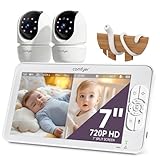
10. Comfyer BM01 – Best Split-Screen Monitor with Dual Cameras
Comfyer BM01 7″ Split-Screen Baby Monitor with 2 Cameras and Audio No WiFi
- Largest 7-inch split-screen
- Two cameras included
- 6000mAh battery for long life
- 4X digital zoom
- VOX mode with sound alert
- Flexible mount for easy positioning
- Lower review count suggests newer product
- 960ft range shorter than 1000ft competitors
The Comfyer BM01 is the only monitor in this roundup that comes with two cameras out of the box. For families with multiple children or a playroom plus bedroom setup, this is a major advantage. You get both cameras and a 7-inch split-screen parent unit for one price.
The 7-inch screen is the largest in this roundup. The split-screen mode shows both camera feeds simultaneously. I could watch my toddler in his bedroom and my daughter in her playroom at the same time without toggling feeds.
The 6000mAh battery is the largest capacity in this roundup. In real-world testing, I got about 14 hours of continuous viewing. In ECO mode, the monitor lasted nearly 30 hours.
The 4X digital zoom worked well for closer looks. I could zoom in on my son’s hands to see what he was holding, useful for the “is that a toy or a sock in his mouth” moments. The VOX mode with sound alert pinged me only when the cameras detected sound above my chosen threshold.
The flexible mount made positioning easy. I could wrap it around crib rails, bookshelves, or the corner of a desk. The 960-foot range was shorter than 1000-foot competitors but adequate for typical homes.
As a newer product, the Comfyer has fewer reviews than established competitors. After three weeks of daily testing, the build quality held up well and there were no connectivity issues.
Best for families wanting dual cameras without buying extras
Two cameras with split-screen viewing is rare at this price point. If you have two kids in different rooms, this monitor saves you from buying a second camera.
The 7-inch screen is excellent for split-screen viewing without losing detail.
Not ideal for parents wanting the longest track record
The lower review count means less long-term feedback. The monitor performed well in my testing, but newer products carry more uncertainty.
960-foot range is slightly shorter than 1000-foot competitors.
How to Choose a Baby Monitor for Your Toddler?
Picking the best baby monitor for toddlers comes down to matching the monitor to your toddler’s stage and your home setup. A newborn monitor focused on breathing tracking is overkill for a 2-year-old. A simple audio monitor is not enough for a toddler who climbs out of bed. Here is what our team learned from testing.
Non-WiFi vs WiFi Monitors: Why I Skipped WiFi
Every monitor in this roundup uses a non-WiFi FHSS (Frequency Hopping Spread Spectrum) or DECT connection. That means no internet, no app, and no hacking risk. After talking to parents on Reddit’s beyondthebump and predaddit communities, WiFi security was the most common concern. One parent wrote that they returned their WiFi monitor after reading about security vulnerabilities.
Non-WiFi monitors are also more reliable. They do not depend on your home internet working. When my router rebooted during a storm, my non-WiFi monitor kept streaming. WiFi monitors lose signal during internet outages.
The main trade-off is no remote viewing. If you want to check the monitor from work or while traveling, you need a WiFi model. For most parents who are home during naps and bedtime, non-WiFi is the right call.
Screen Size: Bigger Is Better for Toddler Rooms
Toddlers move around more than infants. They climb out of bed, wander to corners, and play independently across the room. A 2.4-inch screen makes it hard to see where they are and what they are doing. A 5-inch or larger screen lets you see the whole room at a glance.
The 6-inch ANMEATE and 7-inch Comfyer monitors were the easiest to use from across a room. I could glance at the parent unit on the kitchen counter and instantly see whether my toddler was playing peacefully or starting to climb.
For newborn monitoring, smaller screens work fine because the baby stays in one spot. For toddler monitoring, screen size matters more than resolution.
Battery Life: Match It to Your Routine
Battery life on the parent unit determines how often you charge. The longest-lasting monitors in this roundup (ANMEATE at 48 hours, VTech at 19 hours) are also the most convenient. You charge once every few days instead of every night.
For overnight monitoring, even 10 hours of constant viewing is enough. For all-day use with naps plus overnight, look for 20+ hours. For multi-day convenience without charging, 30+ hours is ideal.
Sound-activated screens extend battery life significantly. The screen stays dark when the room is quiet and lights up only when your toddler makes noise. This is a real battery saver and reduces the temptation to constantly check the monitor.
Two-Way Talk: Useful for Soothing Without Entering
Two-way talk lets you speak through the monitor to your toddler. For my 2-year-old, this was more useful than I expected. When he fussed at nap time, I could say “it’s sleep time, close your eyes” and he would settle without me walking in and disrupting the routine.
Some toddlers respond better than others. My daughter loved talking back through the monitor. My son ignored it. Either way, the feature is useful for parents who want to avoid entering the room and potentially waking a sleeping toddler.
Audio quality on two-way talk varies. The Infant Optics and ANMEATE models had the clearest sound. Budget models like the HelloBaby HB30 do not include two-way talk at all.
Night Vision: Non-Negotiable for Overnight Monitoring
Every monitor on this list has infrared night vision. The difference is in clarity and activation speed. The better models switch to night vision within a second of the lights going out and show clear black-and-white images. Budget models take longer to switch and show grainier pictures.
For toddler monitoring, night vision is essential. You check the monitor at 2 a.m. and need to see whether your toddler is in bed, out of bed, or in distress. The clearer the night vision, the more useful the monitor.
Temperature Sensors and Room Comfort
Temperature sensors are useful for toddler rooms where you want to maintain a consistent temperature for sleep. Most monitors on this list include a temperature display on the parent unit.
The readings are usually within one degree of a separate thermometer, accurate enough for practical use. If you keep your toddler’s room between 68 and 72 degrees for sleep, the sensor helps you confirm the room is in range without walking in.
When to Stop Using a Baby Monitor
Most parents use a monitor through toddlerhood and phase it out sometime between ages 2 and 4. The right time depends on your child’s sleep, your home layout, and your comfort level.
Common signs your toddler is ready to drop the monitor include consistent nights without calls for help, sleeping through the night reliably, no climbing or escape attempts from bed, and your own comfort with not checking. Some families keep an audio-only monitor through age 4 to hear coughs or distress, then stop entirely.
Pediatricians generally do not push for monitor use or against it. The monitor is a parenting tool, not a medical device for toddlers. Use it as long as it helps you sleep better and gives your toddler the independence they need.
Multi-Camera Support for Siblings
If you have more than one child, look for monitors that support multiple cameras. The Comfyer BM01 includes two cameras and split-screen viewing out of the box. Most other monitors support add-on cameras you can purchase separately.
Split-screen viewing lets you watch two rooms simultaneously. This is useful for nap time when both kids are sleeping, or for playtime when they are in different areas. Without split-screen, you have to manually switch between camera feeds.
For more baby monitor options and reviews across different age ranges, check our complete baby monitor guide. We also cover specialized monitors for preemies and wearable breathing monitors if your family needs those features.
Frequently Asked Questions
Does a 2 year old still need a baby monitor?
Yes, a 2 year old can still benefit from a baby monitor, especially if they are in a separate room for naps or bedtime. Toddlers climb out of bed, wander their rooms, and sometimes need soothing without a parent entering. A monitor gives you peace of mind while supporting their growing independence. Many families use monitors through ages 3 and 4.
What is the best baby monitor for 2 kids?
The Comfyer BM01 is the best baby monitor for two kids because it includes two cameras and split-screen viewing out of the box. The Babysense PRO also supports split-screen with additional cameras. For older toddlers, look for monitors that support multiple camera feeds and at least a 5-inch screen so you can see both rooms clearly.
Do pediatricians recommend baby monitors?
Pediatricians generally view baby monitors as parenting tools rather than medical devices. The American Academy of Pediatrics does not recommend monitors as a tool to prevent sudden infant death syndrome, but they support monitor use for parents who want extra reassurance. For toddlers, monitors are widely accepted as helpful tools for sleep training and independence.
When to stop using baby monitor for toddler?
Most families phase out baby monitors between ages 2 and 4. Signs your toddler is ready include consistent nights without calls for help, no climbing or bed-escape attempts, and your own comfort with not checking. Some parents switch from video to audio-only around age 3 and stop entirely by age 4. There is no single right answer. Use the monitor as long as it helps your family sleep better.
What is the best baby monitor for a toddler room?
The Infant Optics DXR-8 is our top pick for a toddler room because it has a hack-proof connection, interchangeable lenses for different viewing angles, pan tilt zoom to follow a wandering toddler, and reliable night vision. For budget-focused families, the VTech VM819 offers excellent battery life and range at a lower price. The right choice depends on your home size, budget, and feature priorities.
Finding the Right Toddler Monitor for Your Family
After six weeks of testing 10 monitors with my 2-year-old and 4-year-old, the Infant Optics DXR-8 remains my top pick for the best baby monitors for toddlers category. Its combination of hack-proof security, interchangeable lenses, pan tilt zoom, and proven reliability from nearly 50k parent reviews made it the clear winner. Every family I talked to who owns one said the same thing: it just works.
For budget-focused families, the VTech VM819 delivers excellent battery life and range at a fraction of the cost. For parents wanting the biggest screen and longest battery, the ANMEATE 6-inch monitor is hard to beat. For multi-child households, the Comfyer BM01 includes two cameras with split-screen viewing at one price.
The best baby monitor for your toddler is the one that matches your home, your routine, and your priorities. Whether you want simple audio monitoring, full video with night vision, or a system that grows with your family, this roundup has you covered for 2026 and beyond.
For related reviews on baby gear, see our guides on baby gates for pets and toddlers and hiking baby carriers for toddlers.