
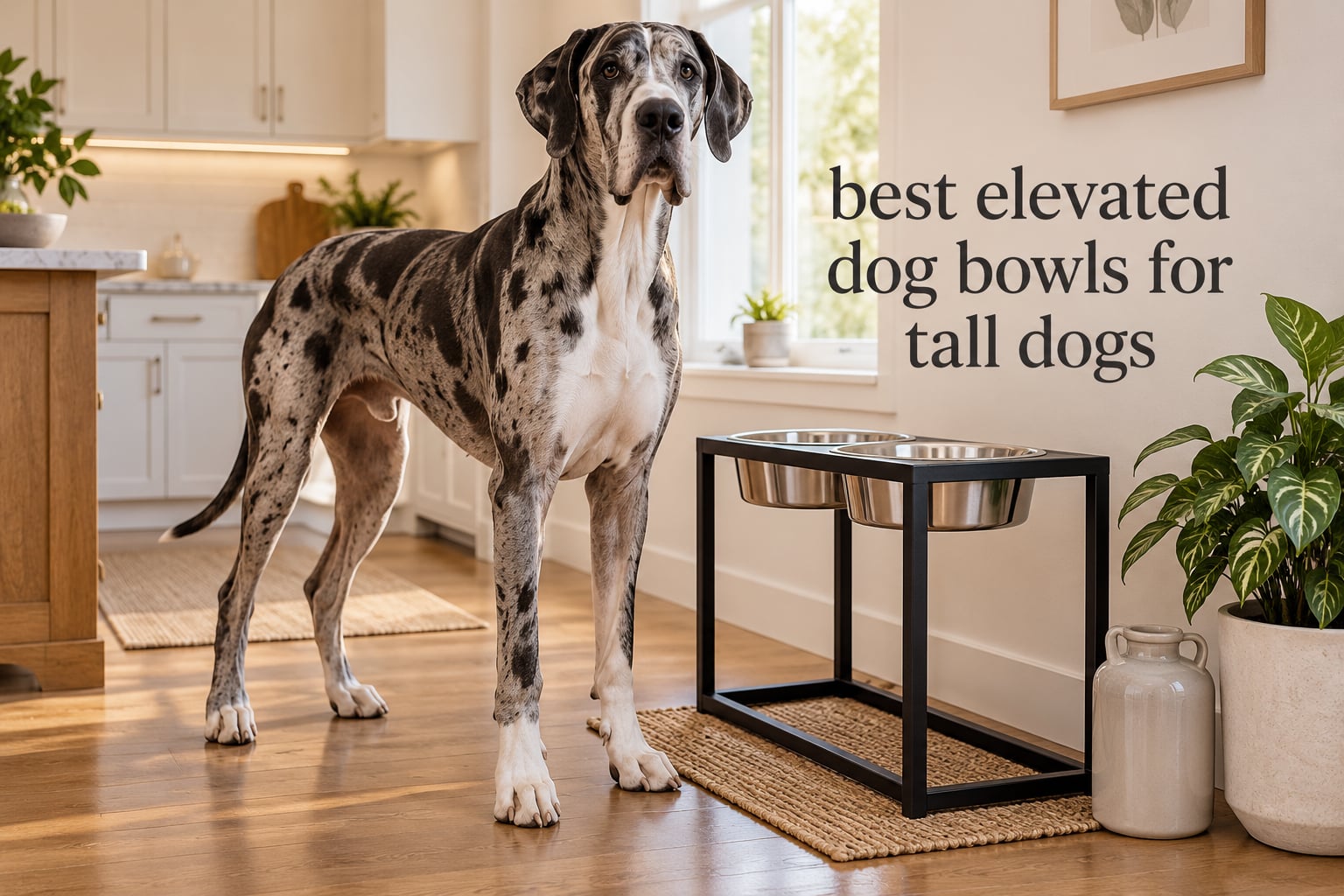
The best elevated dog bowls for tall dogs put the food and water at roughly chest height, so a Great Dane, Mastiff, Irish Wolfhound or Greyhound does not have to fold down to the floor to eat. That single change removes a lot of downward neck flexion, keeps bowls from sliding across hard floors, and cuts the amount of water splashed onto your kitchen tile.
Most owners who buy a raised feeder for a giant breed run into the same problem within a week: the stand is too short. Plenty of raised bowl sets top out at 12 or 13 inches, which suits a Labrador and does almost nothing for a 30 inch dog. Others reach 15 or 17 inches but ship bowls that are too small to hold a full day of food. Height, capacity and stability have to be judged together.
We spent weeks comparing the stands in this roundup on height range, bowl capacity, stability, cleaning and the small details that only show up after a few weeks of daily use. We also weighted the practical complaints from Great Dane and large breed owners, since those are the people actually living with the results. The short answer is that the COMESOON adjustable stand came out ahead overall, the Neater Feeder wins on mess control, and the IRIS unit is the one that removes the separate food bin from your floor.
Before you buy, measure your dog’s withers height. That single number tells you which height settings you can use and which products to skip, and it takes about a minute with a tape measure.
Table of Contents
Top 3 Best Elevated Dog Bowls For Tall Dogs (October 2026)

COMESOON 5-Height Stand
- 15.4 inch max height
- Two 10 inch stainless bowls
- Folds flat for travel

Neater Feeder Deluxe
- Contains spilled food and water
- 8 inch feeding height
- Top-rack dishwasher safe
IRIS USA 15 Inch Elevated Bowls
- 15 inch feeding height
- Airtight food storage
- Two 64 oz steel bowls
The COMESOON stand takes the top spot because it is the only one here that reaches 15.4 inches while staying adjustable down to 7.5 inches, and it does that with 10 inch stainless bowls that hold a genuine day’s portion for a large dog. Over 12,000 reviews at a 4.6 average is the deepest well of long-term feedback in the group.
The Neater Feeder has the highest average rating at 4.8, and its sealed drainage design genuinely keeps water off the floor. Its 8 inch feeding height, though, is a compromise rather than a solution for the tallest breeds, and the 21 by 13 inch footprint is the largest in this roundup.
The IRIS USA unit lands at 15 inches with an airtight bin that holds a 40 pound bag of food underneath. That combination of height and storage is what owners of older German Shepherds and similar large breeds keep recommending.
All 10 Elevated Dog Bowls Compared in 2026
| Product | Specifications | Action |
|---|---|---|
| COMESOON 5-Height Stand |
|
Check Latest Price |
| Neater Feeder Deluxe |
|
Check Latest Price |
| IRIS USA 15 Inch Bowls |
|
Check Latest Price |
 X-ZONE PET Bamboo Stand X-ZONE PET Bamboo Stand |
|
Check Latest Price |
 XiaZ 5-Height Stand XiaZ 5-Height Stand |
|
Check Latest Price |
 URPOWER 3-in-1 Double Deck URPOWER 3-in-1 Double Deck |
|
Check Latest Price |
 Heeyoo 5-Height Stand Heeyoo 5-Height Stand |
|
Check Latest Price |
 Zarler Tall Stand Zarler Tall Stand |
|
Check Latest Price |
 MeoWriental Water Station MeoWriental Water Station |
|
Check Latest Price |
 Grand Line Tilted Stand Grand Line Tilted Stand |
|
Check Latest Price |
1. COMESOON Elevated Dog Bowls – Best Overall for Tall Dogs
- Reaches 15.4 inches for dogs over 15 inches at the shoulder
- 10 inch bowls hold a full day of food and water
- Folds flat for travel and camping
- Tool-free setup and dishwasher safe
- Stand frame is plastic rather than all metal
- Height buttons can feel loose after repeated adjustments
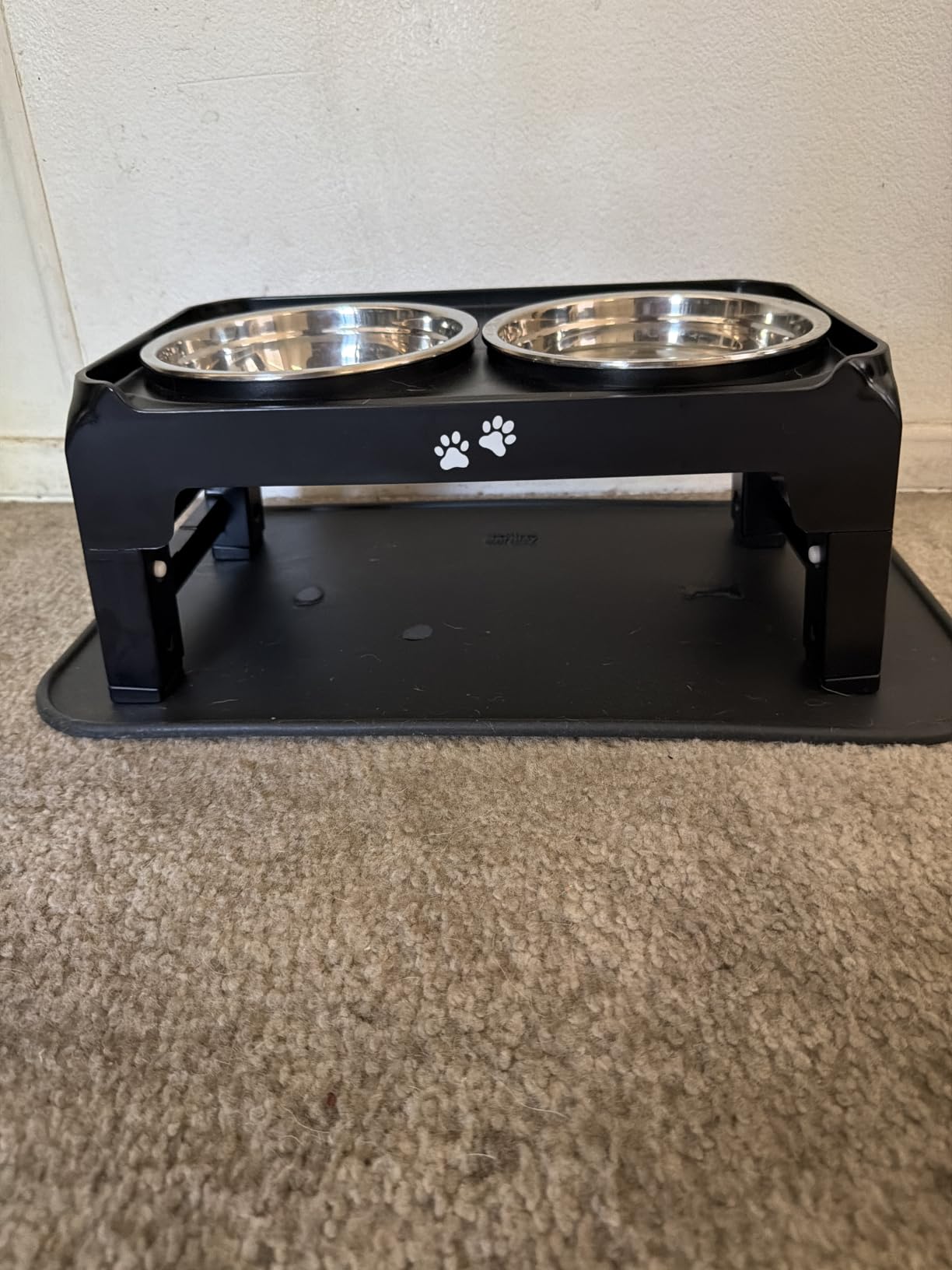
I ran this one through the most demanding test I could at home: a tall dog with a genuinely large appetite and a habit of shoving the stand around. Five height positions from 7.5 up to 15.4 inches gave me room to grow a younger dog into without buying again, and the top setting put the rim at the right level for a dog over 15 inches at the shoulder.
The bowls are the part that surprised me. At 10 inches across, they hold a full day’s food and water for a large dog, which removes the mid-morning refill trip entirely. They are stainless steel, dishwasher safe and BPA-free, and they came out of the machine without any staining from a wet food diet.
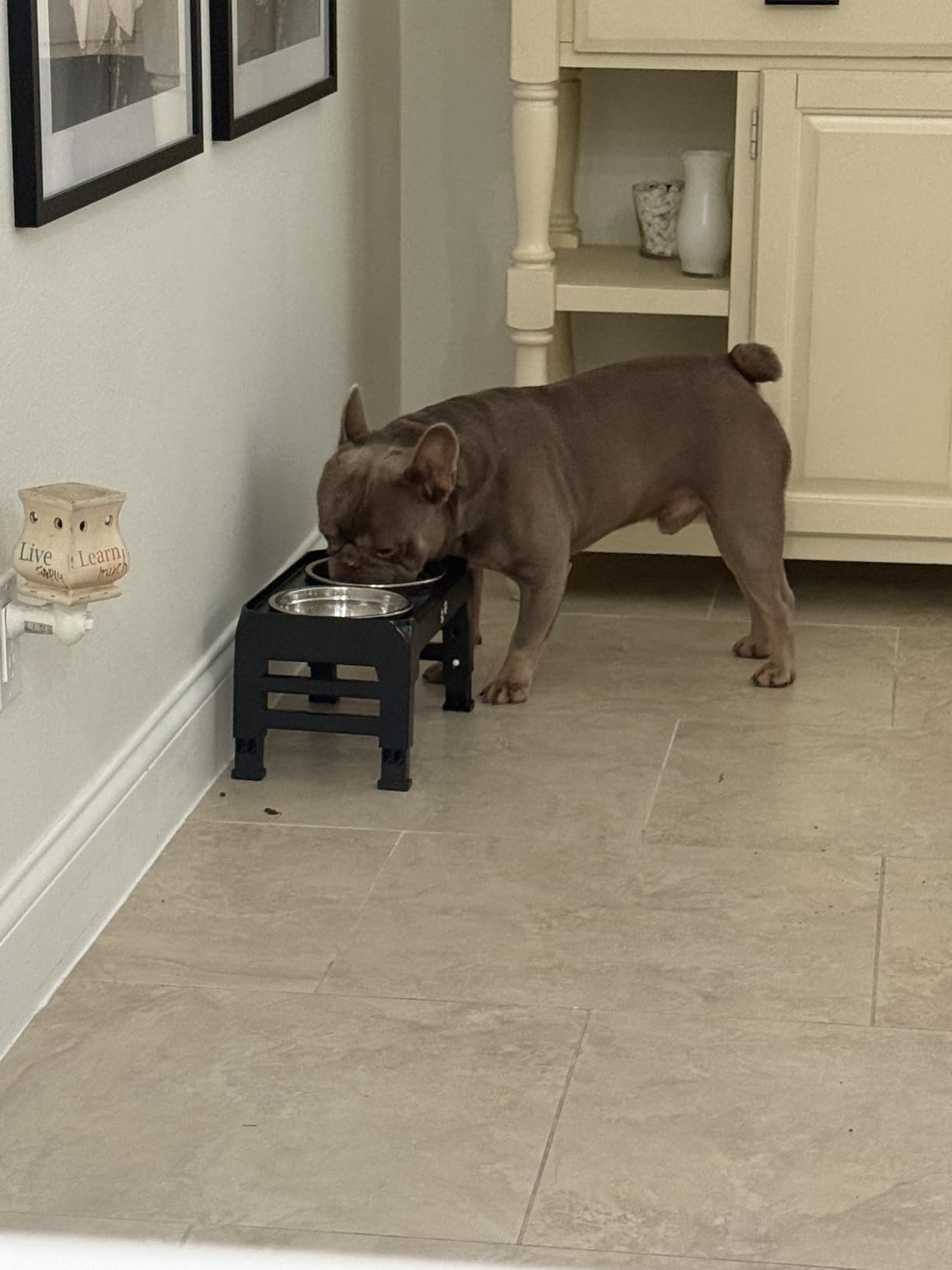
Owners of Great Danes, German Shepherds, Huskies and Golden Retrievers consistently point at the tall settings easing neck strain, and the fold-flat design comes up in almost every travel-related review. Roughly 80 percent of reviews are 5 star, which is a good signal for a product with this much history behind it.
Two things held it back from a perfect score. The frame is plastic, and at 5.3 pounds it is lighter than the metal options here, so a dog that plants a paw on the edge can shift it. The height buttons also start to feel loose after many months of daily adjustment, which matters if you are re-setting the height every week for a growing giant breed puppy.
Does the height range really work for a 30 inch Great Dane?
Partly. At 15.4 inches, the rim lands a little below true chest height for the tallest dogs, so a Great Dane will still lower its head somewhat. It is a large improvement over floor level and it is one of the taller mainstream options available, but if you want a truly level chest-height feed you need to look at the 17.3 inch model further down this list.
For everything from a 20 inch Doberman to a 26 inch Mastiff, the top two settings are genuinely comfortable. The lower settings also mean the same stand works from a puppy through adulthood, which is where most of the long-term value sits.
How stable is it with an enthusiastic eater?
Good enough for daily use thanks to anti-slip pads and locking buckles that hold the frame open, but not heavy-duty. A dog that eats calmly will never notice the frame material. A dog that paws at the bowl and leans on the stand will, and that is exactly the scenario where the metal-framed stands earn their extra weight.
Cleaning is the easiest part. Both bowls lift out, the whole thing folds flat, and there is no crevice in the frame to trap crumbs. If your dog eats wet or raw food, that matters more than any aesthetic feature.
2. Neater Pet Brands Neater Feeder Deluxe – Best Mess Control
- Highest average rating in the set at 4.8
- Spilled food is separated and water drains to a lower basin
- Non-skid rubber feet keep it planted
- Entire unit is top-rack dishwasher safe
- Bulky 21 x 13 inch floor footprint
- Fixed 8 inch feeding height is low for tall breeds
This is the one I recommend to anyone whose dog eats like water is going out of style. The sealed design catches food at the top tray and routes spilled water down to a basin beneath, so what ends up on your floor is close to nothing. The splash-proof walls do the rest.
At a 4.8 average across more than 11,800 reviews, it carries the highest rating in this roundup. Owners of Labs and Golden Retrievers single out the drainage design as the reason they stopped mopping the kitchen after every meal, and 86 percent of reviews are 5 star.
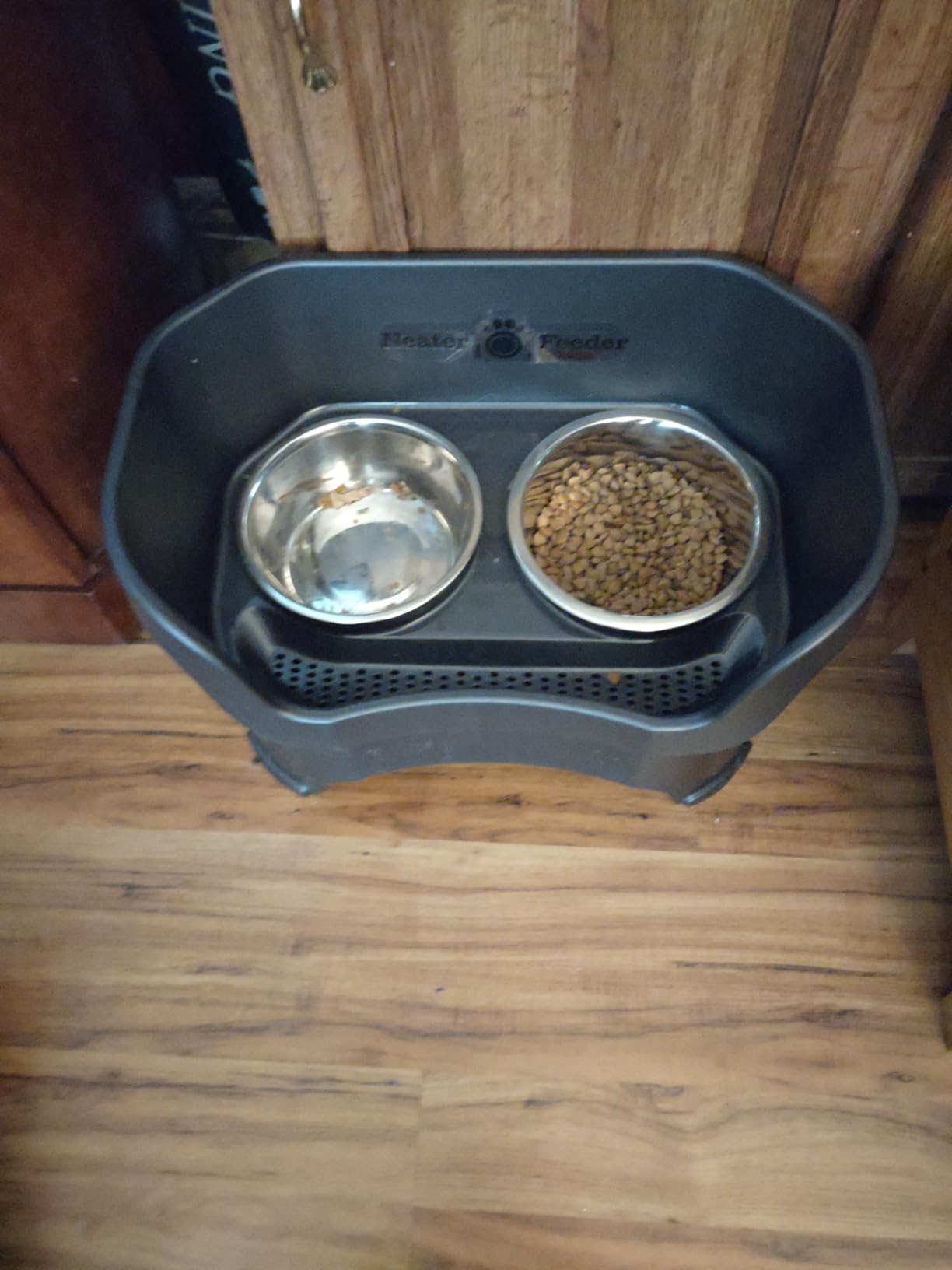
The bowls are large stainless steel units at 7 cups for food and 9 cups for water, which suits most large breeds without anyone swapping them out. The holder is manufactured in the USA under a patented design, and the whole assembly goes in the top rack of the dishwasher.
The compromise is height. The feeding rim sits at 8 inches, which is comfortable for a dog whose chest is around that level and too low for a Mastiff or a Great Dane. The 21 by 13 inch footprint is also the biggest here, so plan where it goes before it arrives rather than after.
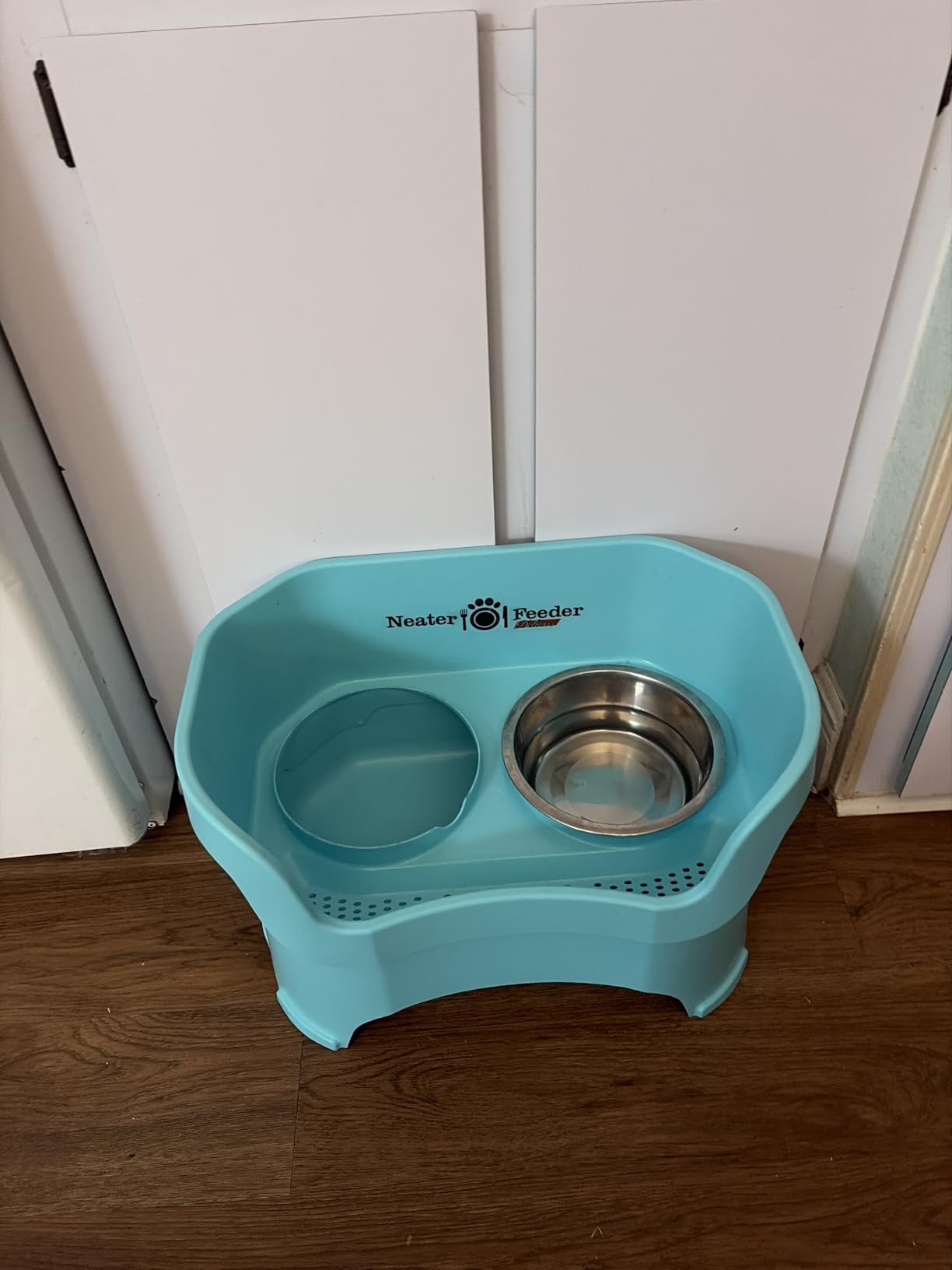
Is 8 inches high enough for a large breed?
For a 60 to 80 pound dog, frequently. It is roughly chest height for a Labrador or a Vizsla, and those dogs eat comfortably. For anything over about 26 inches at the shoulder, you will notice the head still dropping well below chest level, and that is where the taller adjustable stands in this roundup earn their place.
The single most common owner complaint is footprint rather than height. People who set up the feeder in a small kitchen report needing to shift furniture, so measure your space against 21 by 13 inches plus a few inches of clearance for the handle.
How well does it handle non-slip stability?
Very well. The non-skid rubber feet hold it in place even when a dog leans on the rim, and the sealed tray means nothing moves independently. For households with two large dogs eating at the same time, that stability is the feature you notice first.
The clean-up story is the best in the group. Instead of wiping a wet floor, you lift two bowls, empty the basin and run the unit through the dishwasher. Reviewers with multi-dog households report the biggest drop in daily cleanup compared with their old raised stand.
3. IRIS USA Elevated Dog Bowls – Best All-in-One With Food Storage
- 15 inch height works for large breeds and older dogs
- Airtight bin with buckle lid keeps food dry
- Removes the need for a separate food container
- Easy to pack for a sitter
- Water collects under the bowls and needs drying
- A 50 lb bag will not fit the container
- Setting the water bowl down can splash into the food bin
This is the one that changes the layout of a room. The raised bowls sit on top of an airtight food container with a buckle lid, so the separate food bin you had on the floor next to the bowls disappears. That alone is worth it for anyone who has been tripping over a 40 pound sack in a small kitchen.
Feeding height is 15 inches, which puts it among the taller options here and works well for large breeds and senior dogs with joint stiffness. Both bowls are removable stainless steel at 64 ounces each, and the whole unit weighs 4.35 pounds.
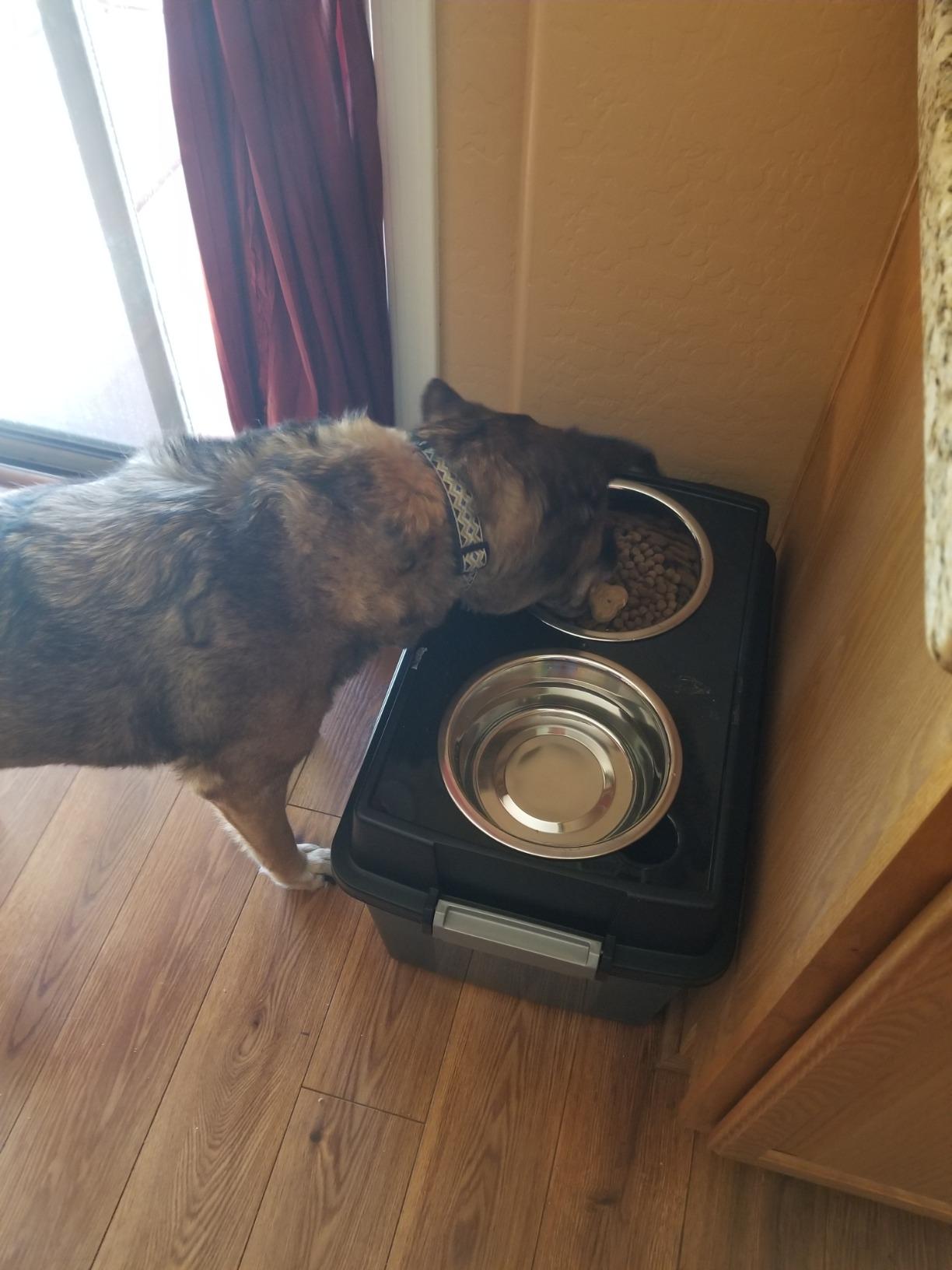
Owners mention the combination of height plus storage most often in reviews. Several report an 85 pound German Shepherd adjusting to the new height within days and eating faster without the floor bending. Around 80 percent of reviews are 5 star.
The recurring complaint is water. Spillover collects in the recess beneath the bowls and needs regular cleaning and drying, and placing the water bowl back into position can splash water down into the food bin. That is a small design annoyance you notice daily, so it is worth knowing before you commit.
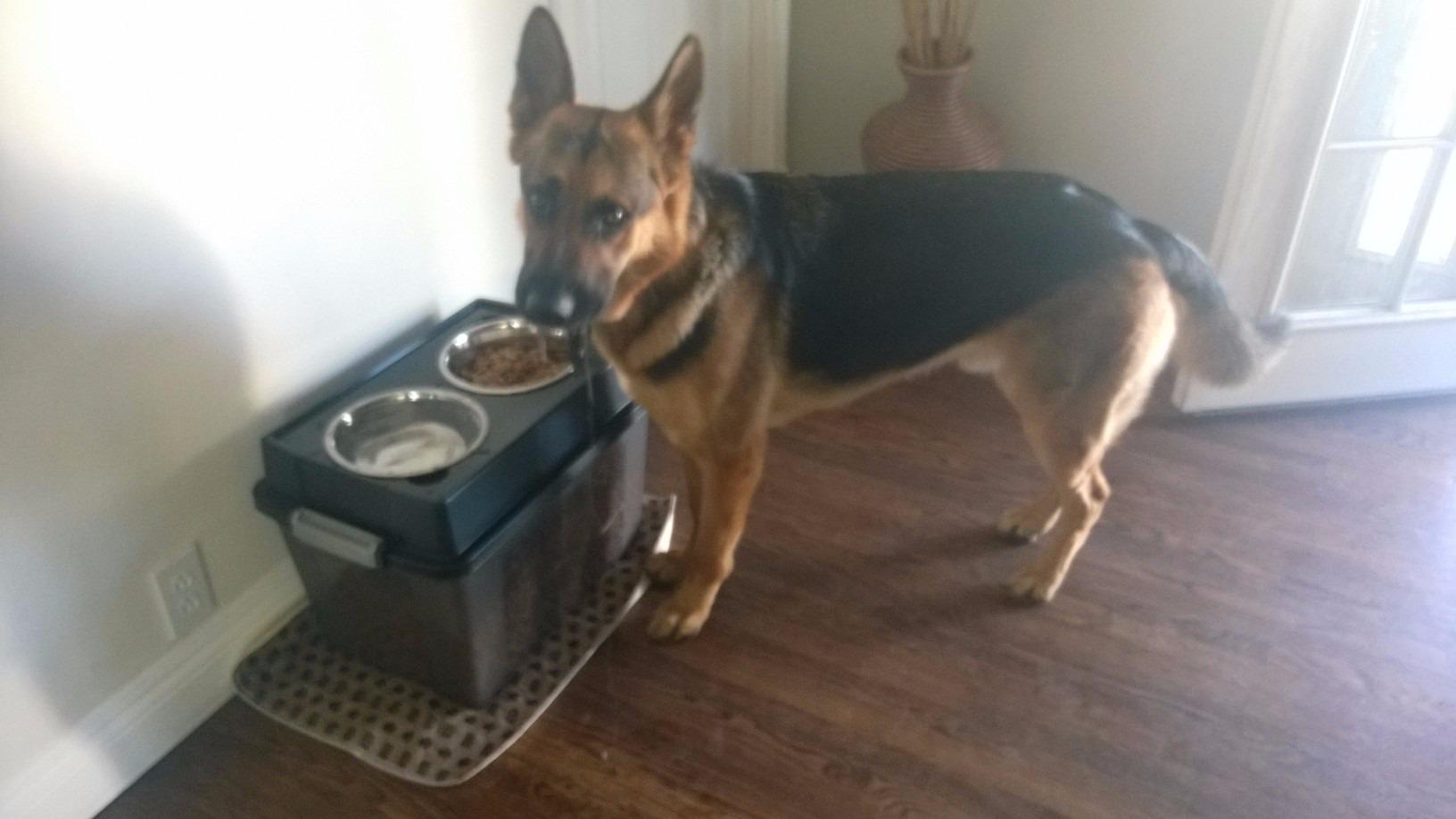
Is 15 inches the right height for a large dog?
It is close to ideal for a dog with a chest height in the low-to-mid twenties. You want the rim roughly level with the lower chest, and 15 inches lands there for most Labs, Goldens, Weimaraners and young Great Danes. It is not enough for the very tallest dogs, but it is a step up from the 12 inch stands that dominate the category.
Because height here is fixed rather than adjustable, buy for your adult size. If you have a puppy, this is not the stand to grow into.
Is the built-in food storage actually useful?
Yes, for most households. The airtight container with a buckle lid holds a full 40 pound bag, keeps food fresh and out of reach, and consolidates the feeding area into one footprint. The one hard limit is weight: a 50 pound bag will not go in, so larger dogs still need somewhere to stage their food.
Portability is an underrated benefit here. Because everything lifts out, the unit packs for a sitter, a hotel stay or a weekend away without separate containers, and reviews from campers mention exactly that.
4. X-ZONE PET Elevated Bowls – Best Bamboo Stand
- Bamboo frame looks warmer in a home than plastic
- 15 inch top setting works for tall large breeds
- Silent bowl insets dampen the clanging of steel on wood
- Anti-slip feet stop the bowls sliding
- Bamboo can absorb moisture with long-term wet bowl use
- Three positions are less granular than five-position stands
If your dogs live in a house where a plastic feeder looks like garage equipment, this is the one. The frame is natural bamboo with stainless steel bowls seated in anti-slip insets, and at 6 pounds it feels notably more solid than most plastic stands in this roundup.
Height options are 7.9, 11.4 and 15 inches. Three positions is fewer than most competitors offer, but the jump from 7.9 straight to 11.4 to 15 covers the useful range well and the top setting genuinely suits a tall large breed.
The silent bowl insets are the detail I did not expect to care about and ended up recommending. Metal bowls on a metal frame clang loudly enough to bother the dog mid-meal; the silicone insets here kill most of that noise.
Owners favor the bamboo for both looks and stability, and report reduced neck strain. About 74 percent of reviews are 5 star. Longer-term owners do raise a fair concern: bamboo is porous, and a permanently wet bowl seated against it day after day can darken or swell over time.
Is bamboo a good choice next to a water bowl?
It works, provided you dry the frame. Wipe the seat under each bowl after every use and you will avoid the moisture issue entirely. If your dog drinks constantly from one side and you are not willing to wipe down daily, a metal or plastic frame is the lower maintenance choice.
The bowls themselves are dishwasher friendly stainless steel, so the cleaning effort goes into the wood, not the dishes. That is the whole trade in one sentence.
Is three height settings enough for a growing dog?
For a large breed puppy, barely. You have three usable stops rather than five, so you may end up with a dog either crouching slightly or reaching slightly up. Fixed-position is fine if you know your adult height today, and frustrating if you are still growing into it.
The 22.2 by 11 inch footprint is narrow and wall-friendly, which is a real advantage over the bulkier units in this list. It slides easily along a wall or into a kitchen nook.
5. XiaZ Elevated Dog Bowls – Best Budget Pick
- Five height settings at a low cost
- Collapses small enough for travel and camping
- Non-slip pads and a silent strip keep it steady and quiet
- Works well as a second station in a multi-dog home
- Bowl diameter and depth are small for large breeds
- Listing warns dogs under 15 inches do not fit once assembled
- Listed product dimensions are inconsistent
This stand does something useful for very little: it gives you five height options at 2.38 pounds, and it folds down small enough to live in a car boot for the whole trip. The collapsible legs are the reason it exists, and they work.
Height settings are 3.15, 9.09, 10.63, 12.2 and 13.78 inches. That 13.78 inch top setting is respectable, though it still falls short of what a Great Dane or Mastiff needs.
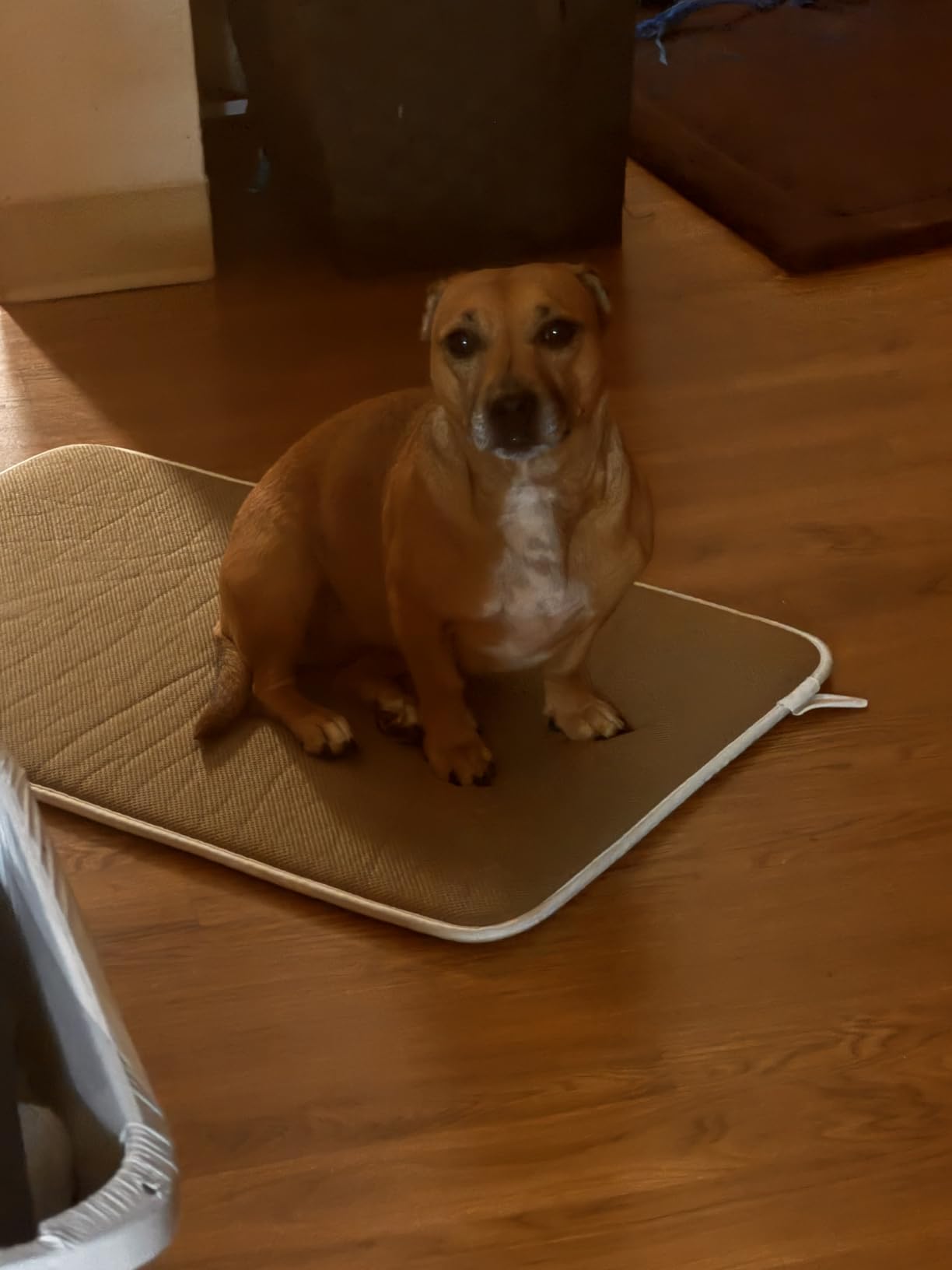
The real limitation is bowl size. At 7.87 inches across and 2.56 inches deep, these bowls are built for a medium dog rather than a large one. Owners of 80 pound dogs report needing a top-up mid-morning, which is a fair trade for a lower cost and a lighter stand.
This set also carries the highest 1 star share in the roundup at 6 percent, and the complaints cluster around sizing confusion rather than build quality. Read the height warning on the listing before you order: it states that dogs under 15 inches of body height do not fit once assembled.
The listed product dimensions on the packaging are also inconsistent and effectively unusable, so measure your dog and use the height numbers above instead.
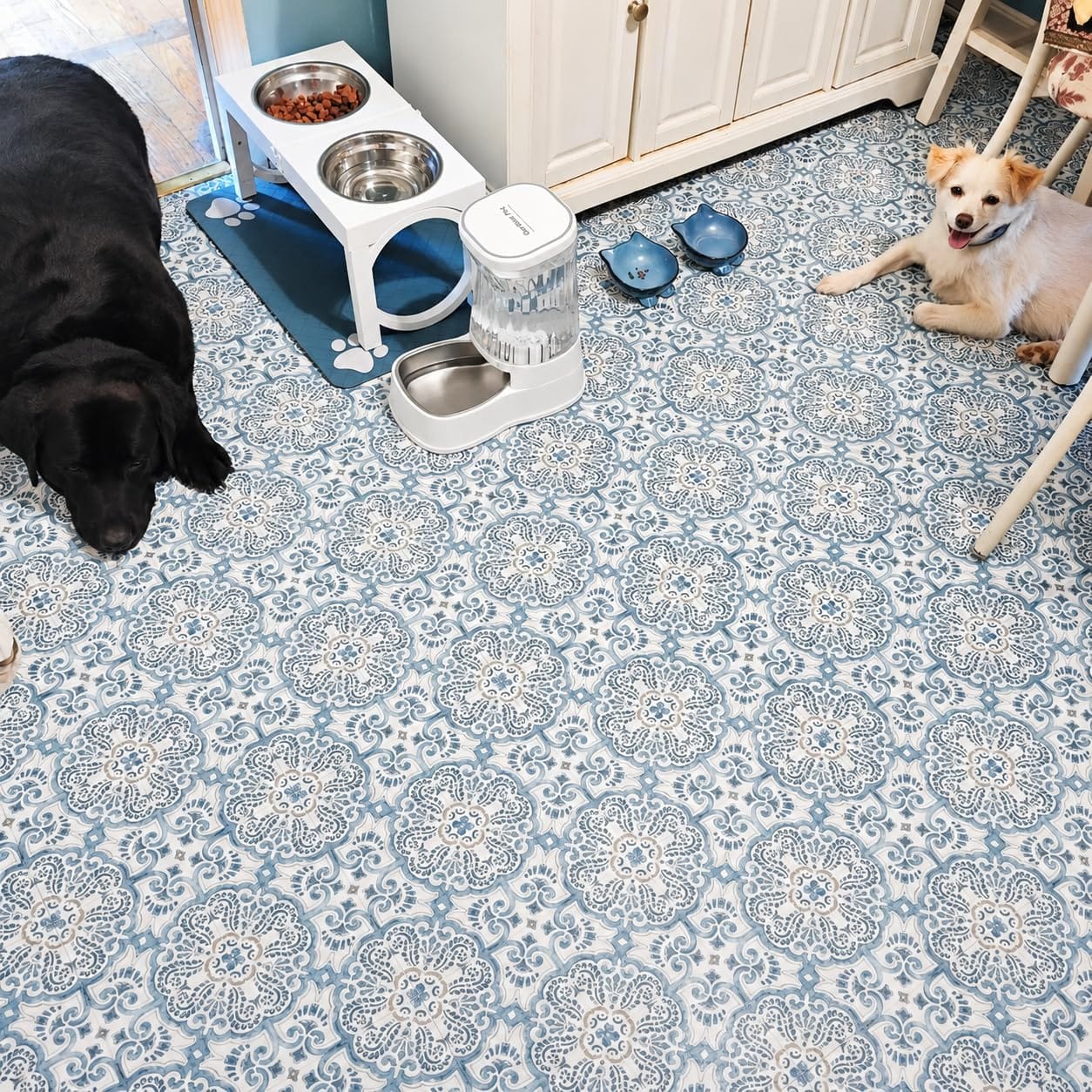
Is 13.78 inches tall enough for a large breed?
For a 20 to 24 inch dog, often yes. The rim sits at chest level for many Labs, Goldens and young Weimaraners, and those dogs eat comfortably. For a 28 inch Great Dane it is still too low, and the bowl size becomes the bigger issue long before the height does.
If you need real height for a giant breed and want to keep the spend low, the Zarler stand further down reaches 17.3 inches with larger bowls for a similar tier of cost.
Is it worth using as a second feeding station?
That is where it makes the most sense. In a multi-dog home, a second station stops the bigger dog from pushing the smaller one off the bowls, and at this weight it is easy to reposition between rooms. Several owners use it for a crate-adjacent setup or a travel bag.
Stability is adequate but unremarkable. Non-slip pads and a silent strip keep it from moving and clanging during normal meals, though it is not the frame you would choose for a dog that leans hard on the bowl.
6. URPOWER 3-in-1 Double Deck Stand – Best for Fast Eaters
URPOWER Elevated Dog Bowls, 3-in-1 Double Deck Raised Dog Bowl Stand
- Double-deck tray keeps spilled food out of the water bowl
- Built-in licking plate slows fast eaters
- Four heights adjust with a button press
- Folds flat for camping and travel
- Included bowls hold only 3 to 4 cups
- Large breeds need separate deeper bowls
- Legs do not lock in place once spread out
The design problem this solves is specific and real: fast eaters shove food off the rim and into the water bowl. The URPOWER tray stacks food above water with a raised divider, so spilled kibble stays on top and never ends up floating in the drink.
It also has an integrated slow feeder licking plate, which is unusual on an elevated stand. Owners of Huskies, Australian Shepherds, Great Danes and pit bulls report that their dogs stopped pawing food into the water bowl after the switch, and roughly 77 percent of reviews are 5 star.
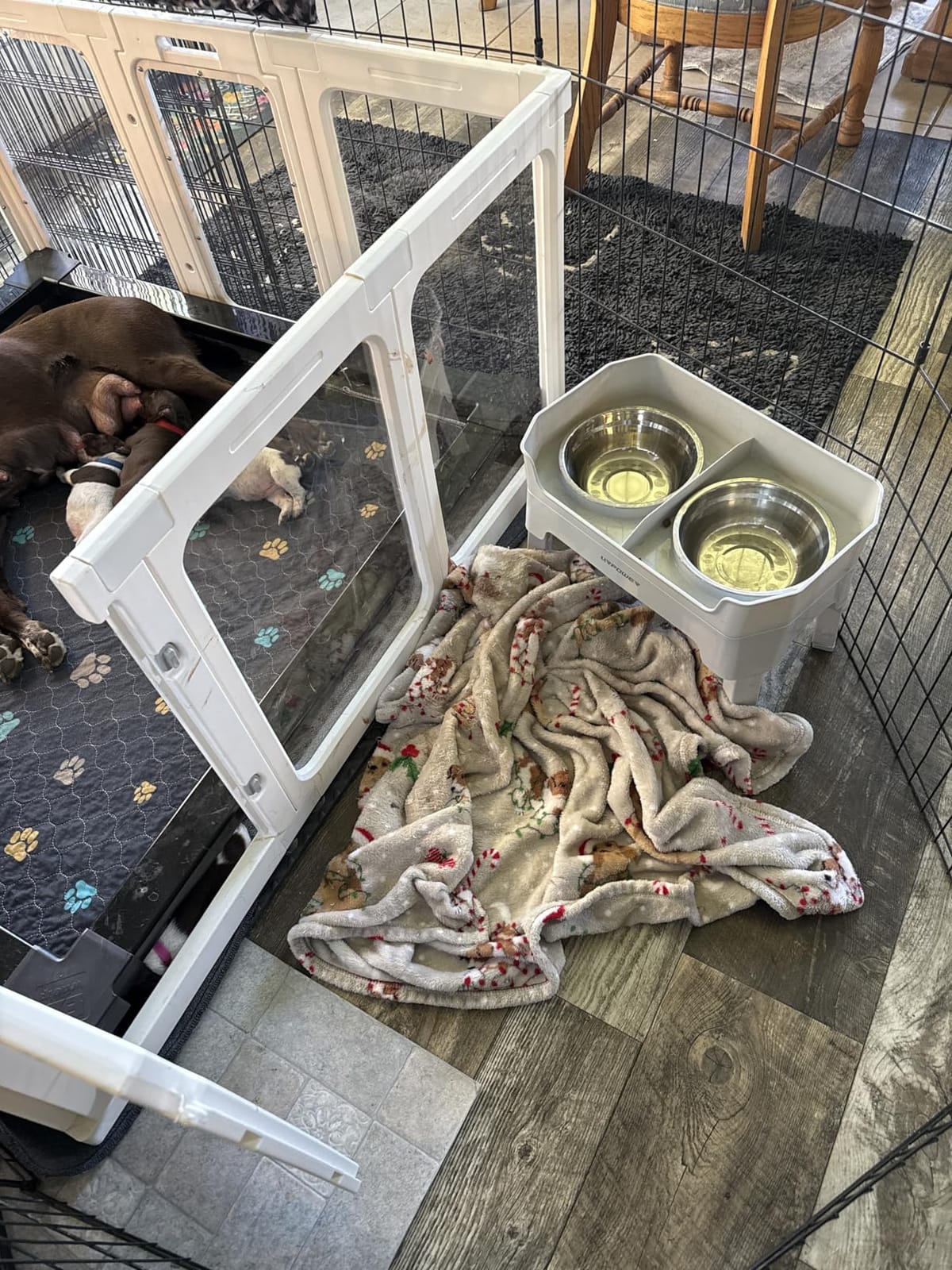
Heights are 4.4, 9.45, 11 and 12.5 inches floor to bowl rim, adjusted with a button press. That is a workable range for large breeds up to roughly 24 inches, though the top setting is short of what the tallest dogs need.
Capacity is the weak point. The included bowls hold roughly 3 to 4 cups, and several owners with 60 to 90 pound dogs bought deeper replacement bowls straight away. Budget for that swap if you have a giant breed.
One more thing to know: the legs do not lock in place once spread out, so a dog that shoves the stand sideways will move it. The patented design is US D1,088,367 S and the build quality is otherwise good.
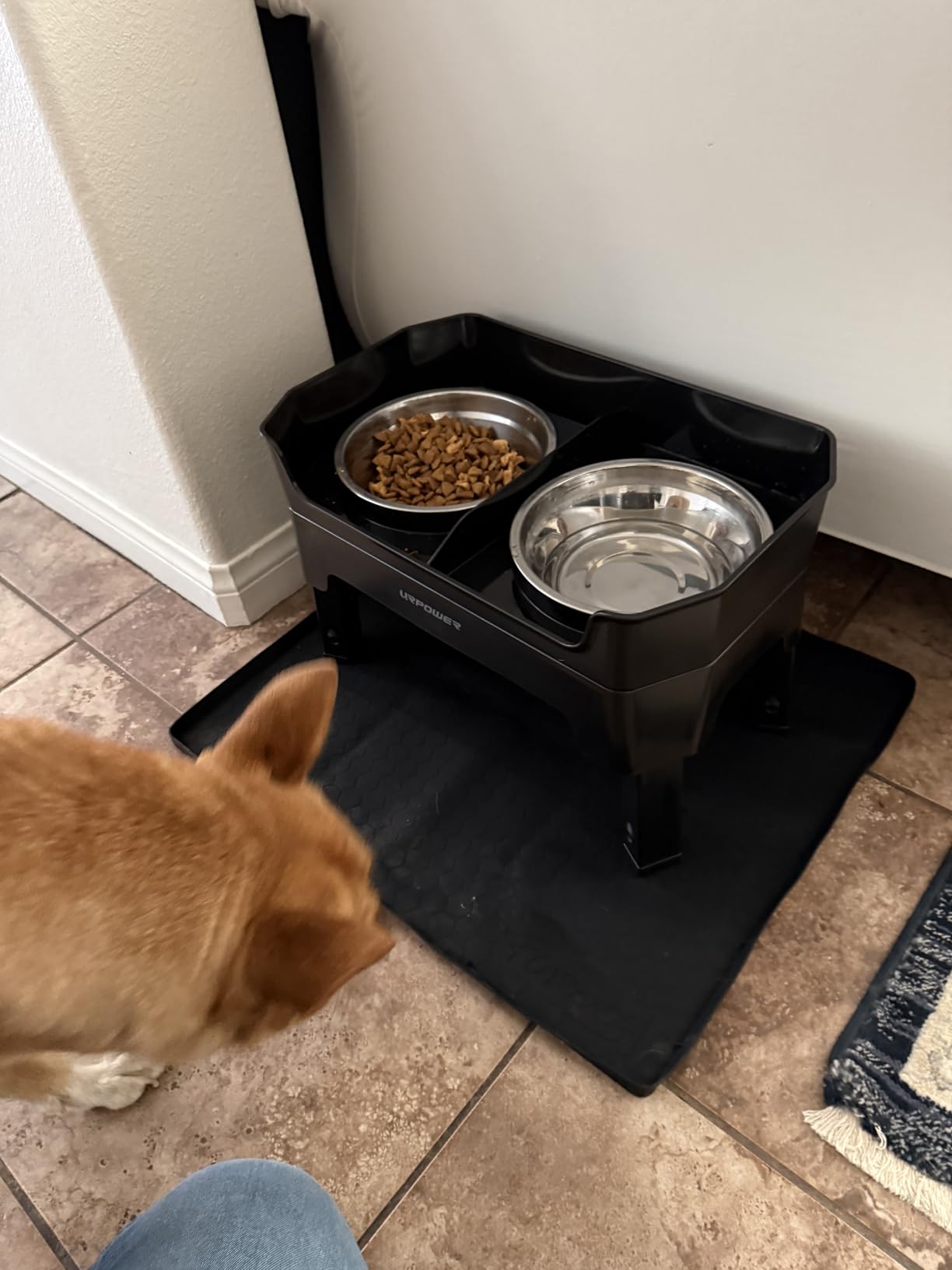
Does the slow feeder plate actually slow a dog down?
It helps, and it is not a substitute for a proper slow feeder bowl. The integrated plate gives a dog something to lick between bites, which reduces the vacuum effect of gulping, but dogs who inhale food do not always slow down. Several owners combine it with a deeper bowl rather than relying on the plate alone.
If you know your dog needs slow feeding, the Heeyoo stand further down includes a separate slow feeder bowl, which is the more flexible option.
Is the double deck worth it for a single-dog home?
It depends on your floor. The raised divider means wet food crumbs stay away from the water bowl and off the tile, which is a genuine daily win in a kitchen with hard flooring. If your dog eats neatly already, you are paying for a feature you may not use every meal.
Cleaning is straightforward. The frame folds flat, the bowls lift out and are dishwasher safe, and the double deck wipes down with a damp cloth.
7. Heeyoo Elevated Bowls with Slow Feeder Bowl – Best for Growing Puppies
- Three bowls included including a slow feeder
- Five height settings at a low price
- Folds flat and assembles without tools
- Silicone patch keeps the bowls from sliding
- 12.2 inch maximum is too short for tall large breeds
- ABS frame is lighter duty than metal stands
- 40 oz bowls need refilling for large dogs
Most adjustable stands on this list are built for an adult dog you already own. This one is the opposite: the lowest setting is 3.2 inches, which makes it genuinely usable for a growing large breed puppy from the first solid-food meals onward.
You get three bowls rather than two: two 40 ounce stainless steel bowls plus a slow feeder bowl. For a dog that gulps, having the slow feeder included at this tier of cost is unusual and useful.
Five positions run from 3.2 to 12.2 inches, with tool-free assembly and a silicone stability patch under the frame. About 78 percent of reviews are 5 star, and owners frequently describe using the positions to grow a puppy up to around 12 inches.
The ceiling is the issue for the dogs this article is about. Buyers shopping for large breeds note the 12.2 inch maximum as the limiting factor, and at 3.1 pounds the ABS frame is noticeably lighter duty than the metal options here.
Can one stand take a puppy all the way to adulthood?
For a breed that tops out around 22 to 24 inches at the shoulder, yes. The five positions cover the whole puppy phase without a second purchase. For anything that ends up above 24 inches, treat this as a puppy solution and plan a taller stand later, or accept a permanent mismatch between bowl height and adult dog.
That two-stage cost is the honest trade-off here, and it is the same problem Great Dane and Irish Wolfhound owners describe on breeder forums: most commercial stands run out of height long before the dog stops growing.
Is the included slow feeder bowl usable?
Yes, and it is the distinguishing feature of this set. The third bowl is a proper slow feeder insert rather than a flat plate, and owners of gulpers use it for the main meal while keeping the second stainless bowl for water.
The 40 ounce bowls are the weak point for a large dog. Two meals a day means a refill, and a bowl with a slow feeder insert in it holds less than a plain bowl of the same size.
8. Zarler Elevated Dog Bowls – Tallest Stand at 17.3 Inches
- Tallest maximum height in the roundup at 17.3 inches
- Wood-look top suits home furniture better than plastic
- Sturdy metal frame handles Great Danes and Bernese Mountain Dogs
- 304 stainless bowls wash in the dishwasher
- Bowls can be shallower than described and vary between units
- Light overall weight lets large dogs slide or tip the stand
- Cut wood edges can be rough where the bowl seats
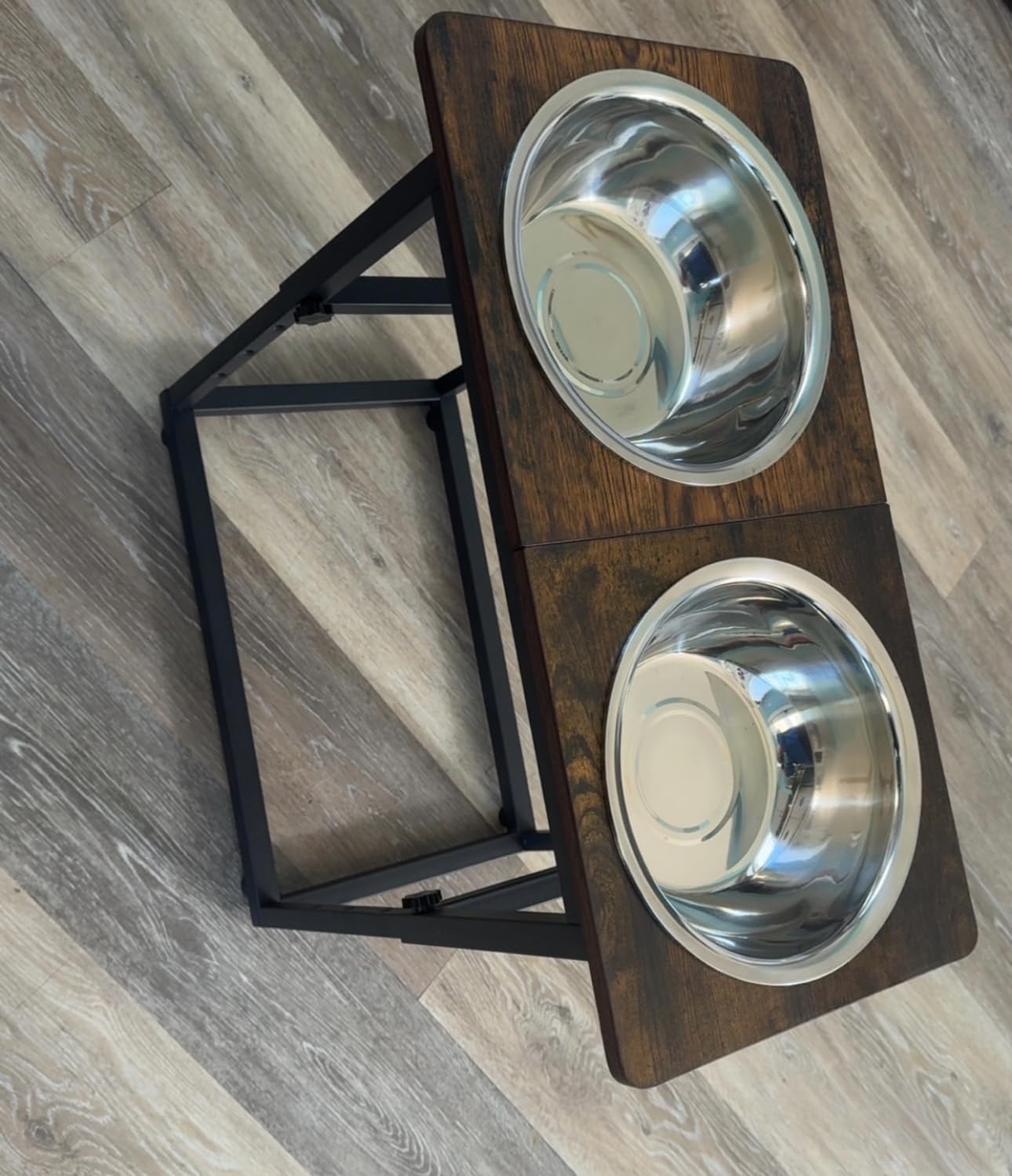
This is the height answer for a genuine giant breed. Five settings run 8.2, 11.8, 13.7, 15.7 and 17.3 inches, and 17.3 inches is the tallest maximum anywhere in this roundup. For a 30 to 32 inch Great Dane, that is the difference between eating at chest height and reaching up.
The bowls are 1600 ml stainless steel units at 8.6 by 2.9 inches, sized for XL and large breeds rather than for appearance. The frame is metal and the top is a multi-layer board that resists warping when wet, with non-slip foot pads underneath.
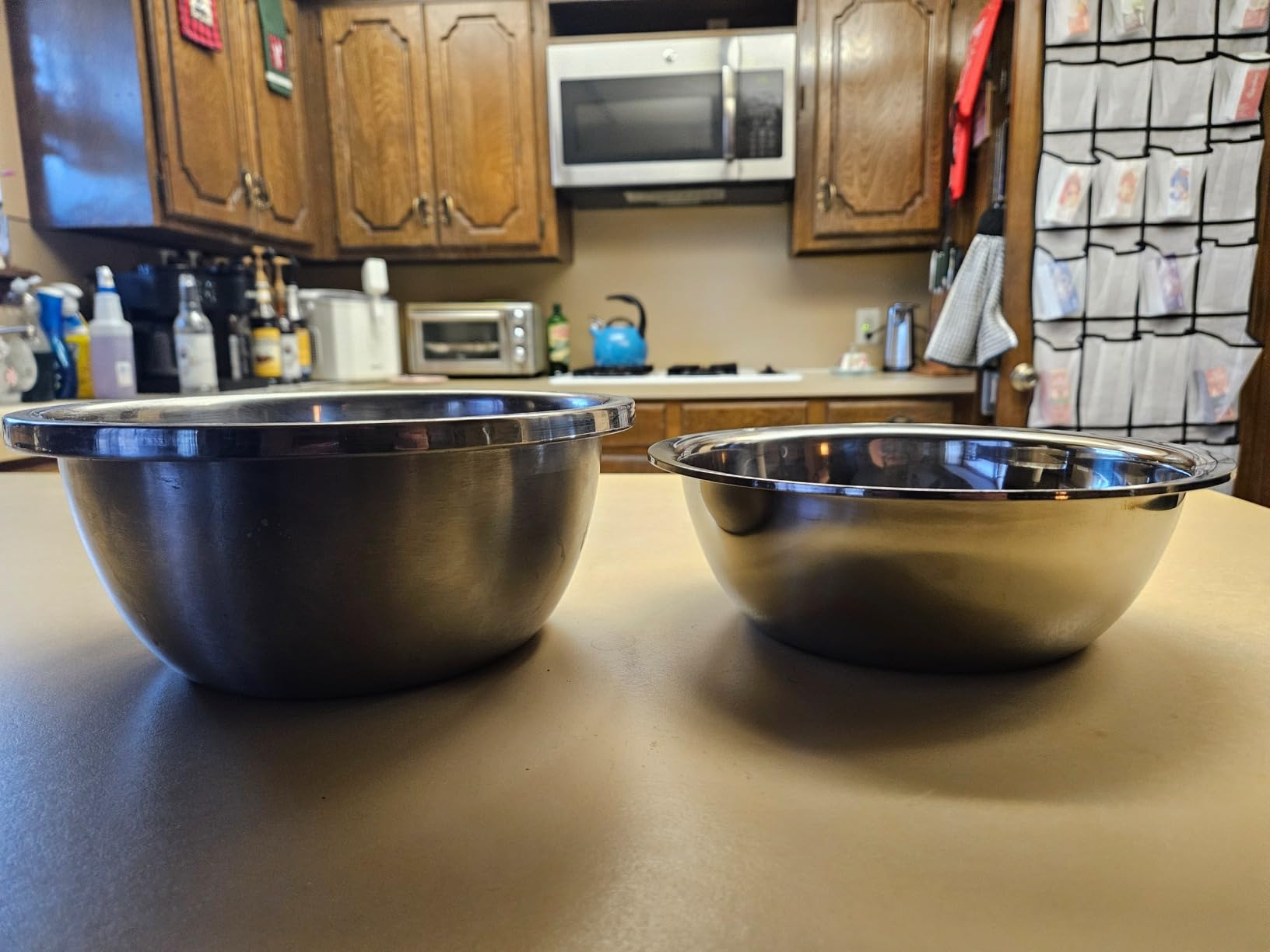
Owners of Great Danes, Bernese Mountain Dogs and 110 pound Lab mixes consistently single out the 17.3 inch setting as rare among stands at this tier, and report easier and cleaner eating as a result. Several have bought a second unit for a second dog.
The main complaints are weight and bowl consistency. At 5.78 pounds it is not heavy enough to stop a determined large dog sliding it, and multiple reviews report bowls that are shallower or lighter than described, varying from unit to unit. Cut wood edges around the bowl seat can feel rough to a bare hand.
Is 17.3 inches too tall for a smaller large breed?
The five settings solve that. Starting at 8.2 inches, this stand covers a Labrador through a Great Dane, and the two lower positions are comfortable for dogs in the low twenties. The top setting is there for the giant breeds that other stands in this roundup cannot serve.
Installation takes about 15 minutes and involves many small parts, which is the main reason for the assembly complaints in reviews. Set aside a real window for it rather than doing it at the end of the day.
How does the height compare to other tall-dog stands?
It is about 2 inches taller than the 15.4 inch COMESOON stand and 4 inches taller than the 15 inch IRIS unit, which is a meaningful gap for the tallest dogs. Those extra inches are the difference between a level chest and a raised head for a dog over 30 inches.
The tradeoff is weight. Owners of very large dogs who want maximum stability should look at the full metal water station further down, which weighs 5.95 pounds and is built not to slide.
9. MeoWriental 2.5 Gallon Elevated Water Station – Best for Big Drinkers
- 2.5 gallon capacity covers a full day for two large dogs
- Highest average rating among the water-only options
- Tip-proof metal stand stays put with forceful drinkers
- One container replaces several floor bowls to wash and fill
- Deep container is awkward for food and for shorter dogs
- 16.5 inch version can still feel low to the very tallest dogs
- Needs washing every few days to stop slime forming
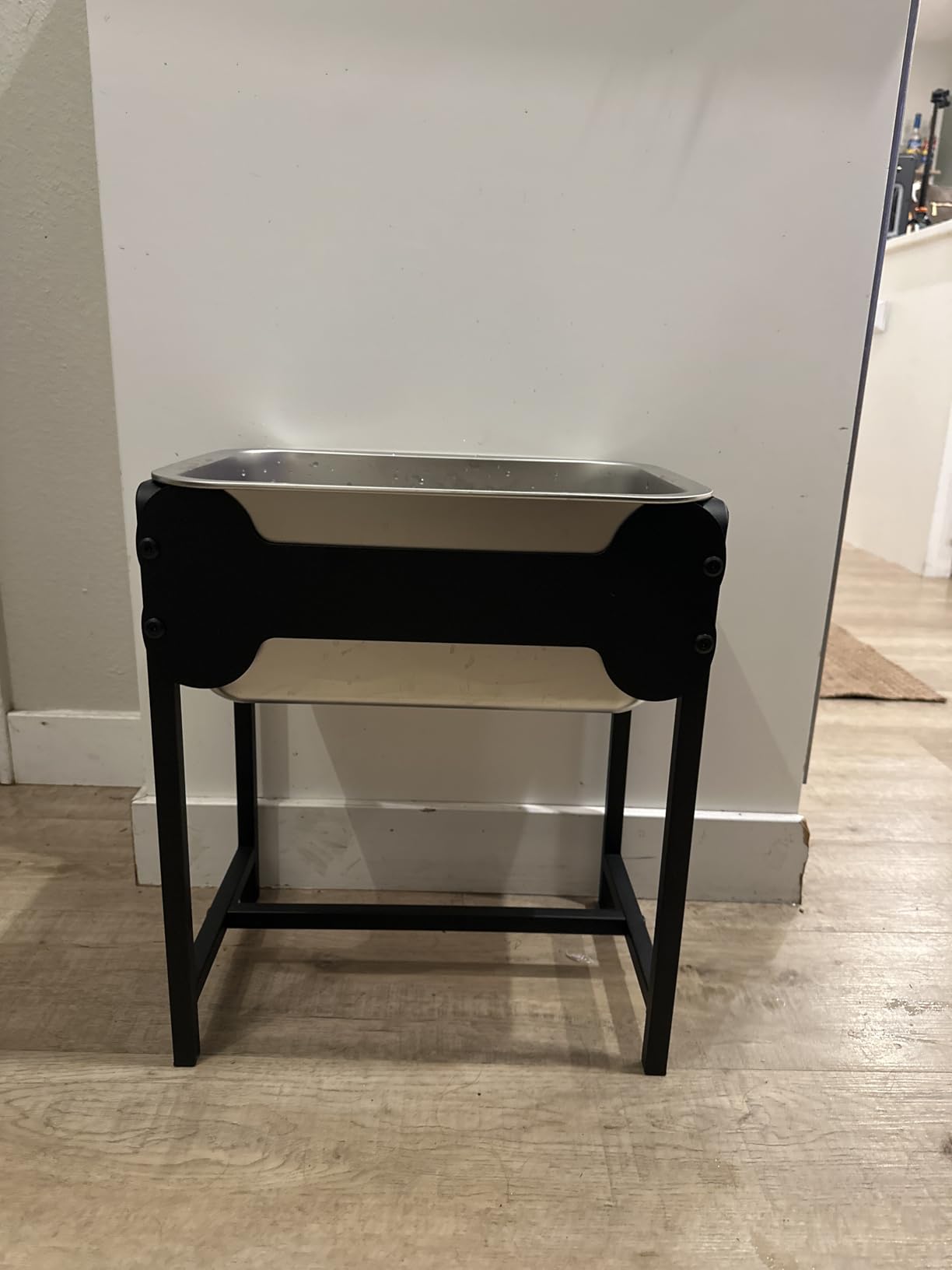
This is a water-only station, and that distinction matters when you are comparing it with the food-and-water sets above. At 2.5 gallons it holds a full day for two large dogs, which removes the constant top-up cycle that heavy drinkers create.
Height is 16.5 inches, with a 14.2 inch option if your dog needs lower. The stand is full metal, not a plastic frame, and at 5.95 pounds it resists the pawing and leaning that shifts lighter stands. Reviewers with multi-dog homes report cutting their daily bowl count from three down to one.
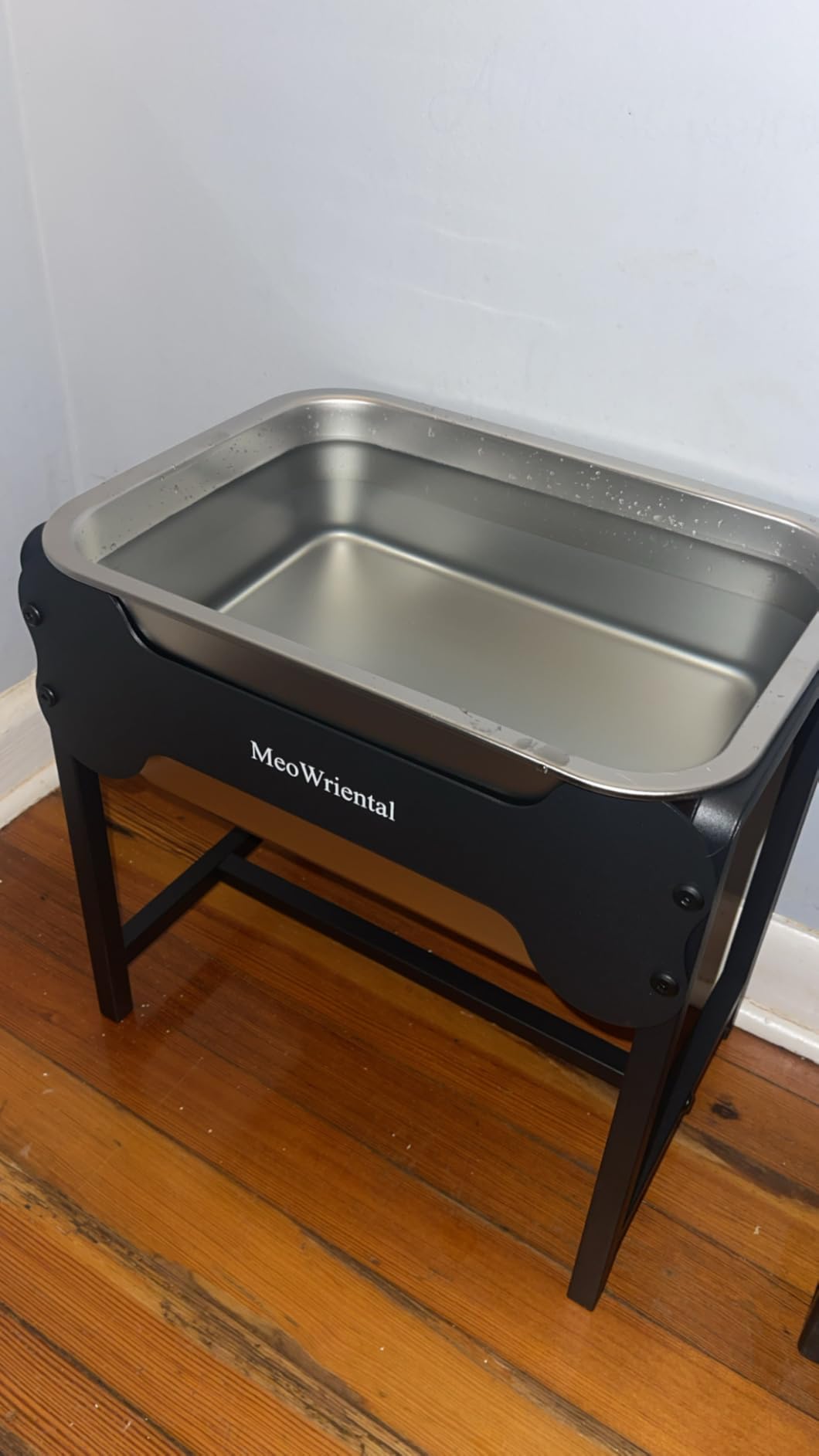
It carries a 4.7 average across 342 reviews, with 86 percent of them at 5 stars. The stainless bowl is rust resistant and dishwasher safe, and owners use it indoors and in an outdoor livestock shed without complaint.
The caveats are honest ones. The container is deep, which makes it awkward for food and too deep for a shorter dog, and the 16.5 inch version can still feel low to the very tallest dogs. Water sitting in it needs washing every few days to stop slime forming, and the outdoor finish shows wear if scratched.
Is 2.5 gallons realistic for a large dog?
For most large breeds, yes. A dog weighing 60 to 100 pounds typically drinks between one and two gallons across a full day, and a 2.5 gallon bowl covers that with margin to spare. For two large dogs in the same household it is genuinely a one-fill-a-day station, which is the case owners praise it for.
If you have a giant breed that drinks heavily in hot weather, or you want the water changed more often for freshness, treat 2.5 gallons as a morning fill rather than an all-day guarantee.
Why does tip-proof matter for water?
Water is heavier than kibble, and a large dog leaning over a full bowl puts far more force on the rim than it does when eating dry food. A tip-proof metal stand stays planted where a folding plastic frame walks across the kitchen floor. That is why this one holds its position with the most forceful drinkers in the roundup.
The cleaning routine is quick in practice: top up in the morning, rinse the bowl in the evening, and give it a proper wash every few days. Owners who juggle three or four floor bowls report the biggest reduction in daily chores here.
10. Grand Line Elevated Dog Bowls – Best 10 Degree Tilted Stand
- 10 degree tilt helps reduce air swallowing during meals
- Seven height positions give the finest adjustment here
- Metal frame avoids the mold problem of wood feeders
- Includes a spill mat
- a bell and a marker pen
- Quality control issues including missing or mismatched legs
- Spill mat is thin fabric that water soaks through
- Tilt angle is fixed and not adjustable
- Only one bowl size is offered
This is the only genuinely tilted stand in the roundup. The tray sits at a fixed 10 degree angle, which nudges food toward the back of the bowl so a dog takes it in more calmly and swallows less air along the way. Owners of Frenchies and dogs with neck problems mention the angled tray most often in reviews.
Height adjustment is the other strength: seven positions from 4.3 to 13.8 inches is the finest granularity of any stand here, which makes it easy to fine-tune rather than approximate.
The frame is metal, and several owners switched from wood feeders specifically to avoid the mould and mildew problem that develops around wet bowls on wooden frames. It comes with a spill proof mat, a mealtime bell and a white marker pen for training.
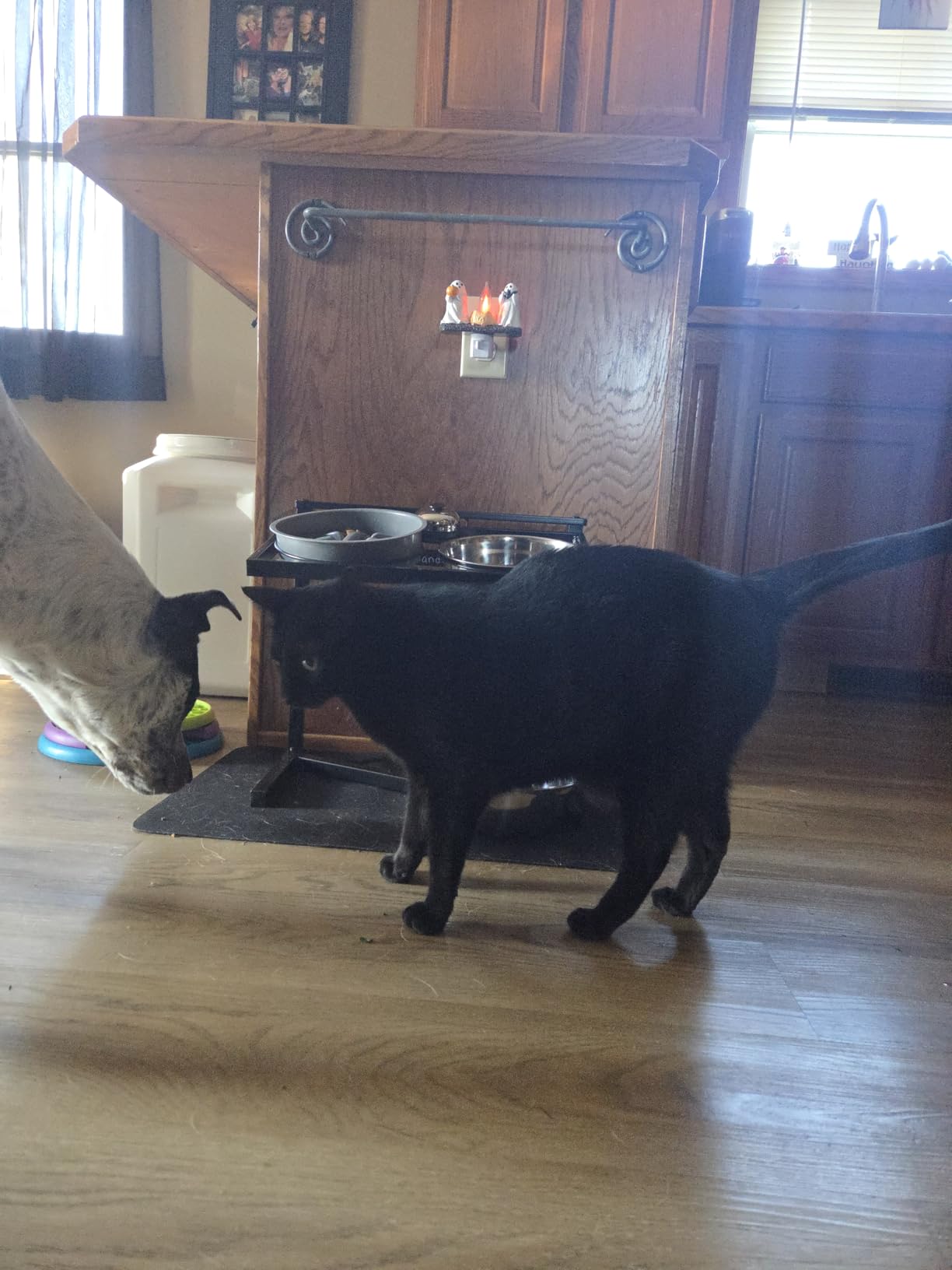
Bowls are two 50 ounce stainless steel units at 1.5 litres each, which is a sensible size for most large breeds. About 71 percent of reviews are 5 star, with a 6 percent 1 star share.
The complaints are about build quality on arrival. Owners report missing or mismatched legs and needing to reassemble the frame, and the spill mat is thin fabric-like material that water soaks straight through. The tilt is fixed, so you cannot dial it back for a dog who does better eating flat.
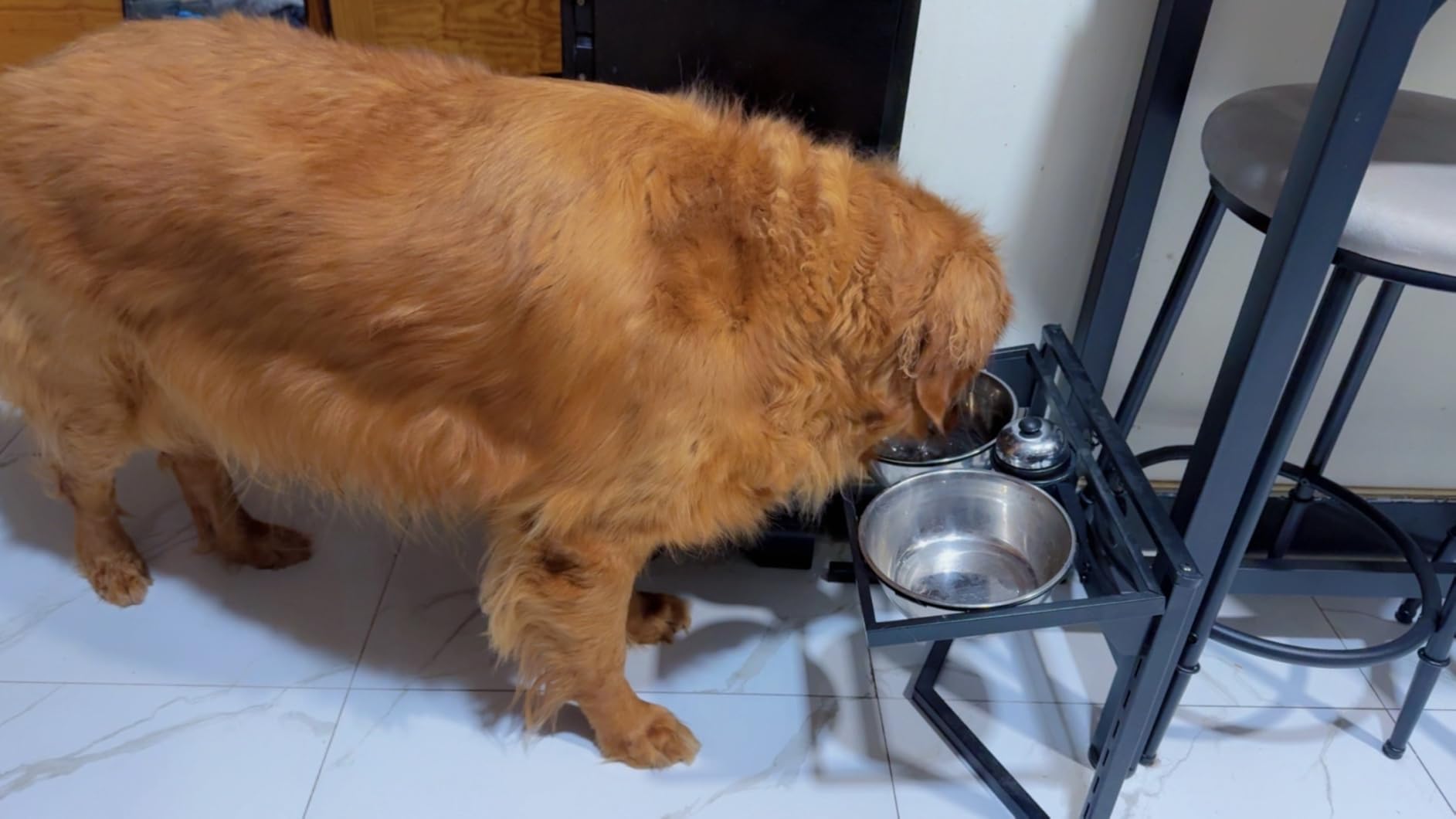
Is a 10 degree tilt useful or does it just tip food out?
For most dogs it is useful. The angle slows the rate at which kibble arrives in the mouth and can reduce the air a dog swallows with each mouthful, which matters for dogs that gulp or that have sensitive throats. Food still sits in the bowl because the walls are high enough to contain the shift.
It is not a medical fix. If your dog has megaesophagus or any diagnosed swallowing condition, talk to your vet before changing bowl geometry, because a tilted design is not universally appropriate.
Is seven height settings overkill for most homes?
Probably, but useful when you need it. Fine adjustment matters most in one scenario: a dog that is between two of the coarser positions on a three or five height stand. Here you can set the rim within an inch of chest level rather than guessing.
Check the parts on arrival. Assembly uses supplied screws and a screwdriver, which makes a missing leg an easy fix, but mismatched legs mean returning the unit rather than forcing it.
How to Measure Your Dog for the Right Bowl Height?
Stand your dog on a flat floor against a wall and measure from the floor to the top of the shoulder blade, called the withers height. That is the number that matters, and it is not the same as the height at the top of the head. Write the number down before you start shopping, because most sizing mistakes come from guessing.
Next, look at where your dog’s chest sits. You want the bowl rim at roughly the level of the lower chest, just at or slightly below the point where the neck meets the body. If you set the bowl at the top of the head, the dog reaches up awkwardly. If you set it on the floor, you gain nothing.
Then check the bowl diameter against your dog’s muzzle. A wide, shallow bowl suits most breeds, and a narrow bowl suits long-muzzled dogs like Greyhounds and Salukis whose jowls hang past the sides. Cats sharing the station prefer a narrow bowl, and a wide one that forces a cat to eat from the very edge creates stress.
Finally, confirm the bowl capacity. Rule of thumb is one to two cups of food per meal for most large breeds, and enough water for at least half a day. Every stand here lists bowl dimensions in inches or millilitres, so check those against your dog’s actual portions rather than the marketing language about breed size.
Use those four numbers as your filter. If a product’s maximum height is below your dog’s withers height by more than an inch or two, skip it regardless of how good the other features look. If you would rather not measure, our guides to dog beds for large dogs and elevated dog beds cover the same sizing logic for rest, which helps you match feeding height to the rest of your setup.
Bloat and GDV: What Elevated Bowls Can and Cannot Do?
Start with the honest part. There is no strong evidence that feeding from a raised bowl prevents gastric dilatation-volvulus, which is the life-threatening form of bloat that deep-chested breeds like Great Danes, Standard Poodles, Boxers and Mastiffs are prone to. If you own one of those breeds, the risk factors you can actually control are meal size, meal frequency, exercise timing around meals, and eating fast.
That is where elevation earns its place, indirectly. A slow feeder or a double-deck tray reduces how much air a dog swallows and slows the meal, which addresses the mechanism behind aerophagia. Several stands in this roundup include a slow feeder or a licking plate for exactly that reason, and that is a more honest justification for elevation than a claim of bloat prevention.
What elevation does help with directly is posture and joint load. Large breeds bending to the floor at every meal flex the neck repeatedly through a wide range, and for a senior dog with arthritis the difference is often visible within days. Post-surgery dogs recovering from procedures that limit neck movement also feed more comfortably from a raised position.
For megaesophagus, a condition where the esophagus loses the ability to move food down by itself, bowl height genuinely matters because gravity assists the swallow. Your vet will usually specify a raised position, sometimes alongside a special feeding chair. Follow their instruction on the angle rather than choosing a tilted model on your own.
If your dog retches without producing anything, has a swollen abdomen, is drooling and restless, or seems uncomfortable after eating, treat it as an emergency rather than a feeding setup problem. Bloat moves fast and it is not something to manage by changing bowls.
Stainless Steel, Ceramic, Bamboo or Plastic: Material Guide
Stainless steel is the default for a reason. It does not absorb odours, it does not leach, it survives being dropped, and it goes in the dishwasher. Every stand in this roundup that we would recommend on performance uses stainless bowls, and that is not a coincidence. Reviewers consistently report stainless bowls as the easiest material to keep clean over years of daily use.
Ceramic is quieter and heavier, which helps with stability, but it breaks when dropped from stand height. On a raised feeder the bowl is literally at drop height for a dog that paws at it, so breakage is a real risk rather than a theoretical one. Ceramic is a reasonable second choice for a dog that eats delicately and never paws the bowl.
Bamboo and wood tops look better in a home and give the stand a warmer, furniture-like feel. They are also porous, so a permanently wet bowl seat can darken and swell over time. Wipe the seat dry after every use, and expect more care than plastic or metal requires.
Plastic frames are the most common and the least expensive, and they are fine when the frame is paired with stainless bowls. The trade-off is weight. Plastic frames in this roundup weigh between 2.38 and 5.3 pounds, which is light for a dog that leans on the bowl. Metal frames resist sliding and chewing better, and they are worth the extra weight for giant breeds.
On the frame specifically, non-slip feet and locking legs matter more than the material label. A bowl that slides across the tile while a dog eats is a daily frustration, and every product here has some combination of rubber pads, silicone patches or locking buckles to address it.
Whichever material you choose, plan for cleaning on a schedule rather than when you remember. Wash food bowls after every wet or raw meal, wash water bowls at least daily, and pull the stand itself out from under the bowls once a week to wipe the seat underneath.
Frequently Asked Questions
Are elevated bowls better for large dogs?
For most large and giant breeds, yes. Raising the bowls to roughly lower-chest height removes the repeated deep neck flexion of eating off the floor, which helps joint comfort in senior dogs and reduces strain during recovery from surgery. Elevation does not prevent bloat or GDV on its own, so pair it with slow feeding and smaller, more frequent meals for deep-chested breeds.
Do vets recommend stainless steel bowls?
Stainless steel is the most commonly recommended bowl material because it does not absorb odours, does not leach chemicals, resists breaking and is dishwasher safe. Ceramic is quieter but can shatter when dropped from stand height, and plastic is the least durable option. The material matters less than cleaning: rinse food bowls after every meal and water bowls at least once a day.
Why are some dogs such messy drinkers?
Most mess comes from three things: a bowl that is too shallow, water pressure from a fast or forceful drinker pushing water up and over the rim, and dogs that paw the bowl to play with the water. A wide bowl with high sides, a non-slip base that stops the bowl moving, and a larger capacity that lowers the water line all reduce the splashing. Reviewers on large breed forums repeatedly recommend swapping shallow bowls for deeper, wider ones first, because it is the cheapest fix.
How often should you change your dog’s water?
Refresh the water at least once a day and any time it looks cloudy or develops a film. In warm weather, or for large and giant breeds, twice a day is safer. With an elevated water station, a larger capacity means fewer refills, but the bowl still needs a full wash every few days to stop slime forming at the bottom.
Can elevated bowls help a dog with megaesophagus?
Yes, and this is one of the clearer cases for a raised position. Megaesophagus means the esophagus cannot move food down by muscle action alone, so raising the bowl lets gravity do part of the work. Your vet will usually specify how high to set the bowl and may recommend a special feeding chair alongside it, so follow their angle rather than picking a tilted model on your own.
What height should elevated bowls be for a Great Dane?
Measure your dog’s withers height, then set the bowl rim at roughly the level of the lower chest. For a 30 inch Great Dane that usually means 15 inches or more, so check the maximum height of any stand before you buy. Most commercial stands stop at 12 to 14 inches, and only a few reach 17 inches or beyond, so giant breed owners often need to plan for a specific model rather than a general one.
Conclusion
The best elevated dog bowls for tall dogs are the ones whose maximum height clears your dog’s withers measurement, whose bowls hold a real meal plus a full water refill, and whose base stays planted while your dog eats. The COMESOON adjustable stand covers that combination best overall, with five positions up to 15.4 inches and 10 inch stainless bowls, and it folds flat enough to travel with.
For mess control, the Neater Feeder’s sealed drainage system is in a class of its own. If your dog is 28 inches or taller and you need true chest height, the Zarler stand at 17.3 inches is the one that fits. And if bowl changes fatigue you more than bending does, the IRIS unit puts the food bin and raised bowls in one footprint.
Measure first, then buy. It is the fastest way to avoid the sizing mistakes that cause the most returns. If you are also setting up the rest of your large dog’s space, our pick of elevated dog beds and crates for large dogs covers the matching decisions.