
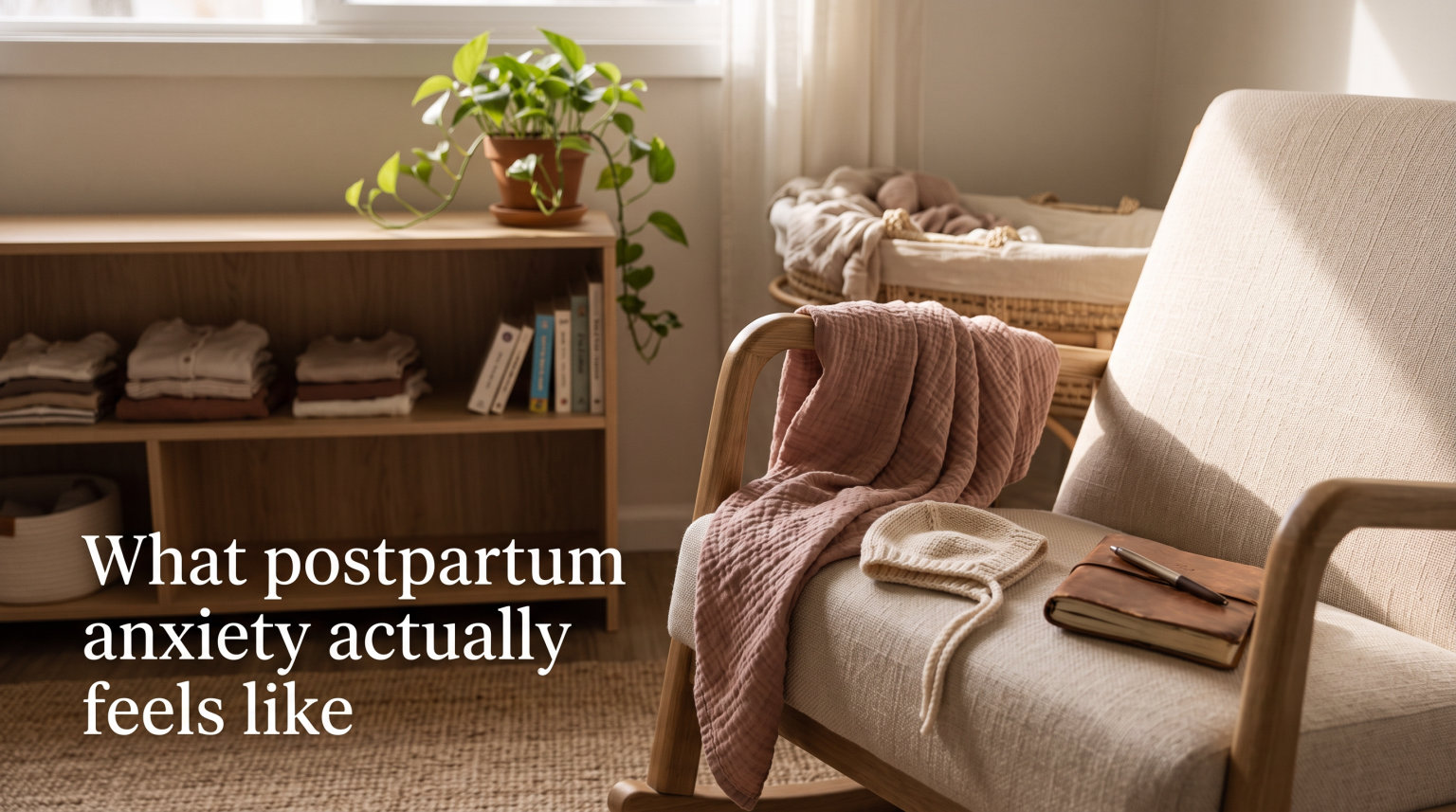
It’s 3 AM. Your baby is finally sleeping, nestled in the bassinet, breathing soft and slow. You should be sleeping too. Your body is exhausted, every cell begging for rest, but your heart pounds like a drum against your ribs. You stare at the ceiling, your mind racing through a thousand catastrophic scenarios. What if the blanket is too close to her face? What if she stops breathing? You already checked twice. You will check again.
This is what postpartum anxiety actually feels like. It is a persistent state of hypervigilance that hijacks your nervous system, transforms everyday moments into potential emergencies, and leaves you trapped between bone-deep exhaustion and frantic alertness. Unlike the “baby blues” that fade within two weeks, postpartum anxiety lingers, intensifies, and convinces you that constant worry equals good motherhood.
Postpartum anxiety affects up to 20% of new mothers, though experts believe the actual number is higher because many women suffer in silence. If you are reading this at midnight while the world sleeps, wondering if what you are experiencing is normal, you are not alone. You are not broken. And what you are feeling has a name.
Table of Contents
The Physical Experience of Postpartum Anxiety
Your body becomes a battleground. The physical symptoms of postpartum anxiety are not subtle whispers; they are alarms blaring through your system at all hours. Understanding these sensations helps distinguish between normal new-mother fatigue and anxiety that requires support.
Your Heart Knows Something Your Mind Cannot Explain
Many women describe a racing heart that feels like it might crack open their chest. One mother told me her heart beat so fast and hard she could see her shirt moving with each thump. This is your fight-or-flight response stuck in the “on” position. Your body perceives threats everywhere, pumping adrenaline and cortisol even when you are sitting quietly with a sleeping baby.
Chest tightness accompanies the racing heart. It feels like an iron band squeezing your ribs, making it hard to take a full breath. Some women mistake this for heart problems, rushing to the emergency room only to be told their hearts are fine. The sensation is real, but its source is anxiety, not cardiac failure.
Tired But Wired: The Insomnia That Breaks You
The cruel paradox of postpartum anxiety is wanting sleep desperately while being completely unable to achieve it. This is the “tired but wired” phenomenon that mothers on Reddit describe with devastating accuracy. Your body is asleep, but your mind races wide awake.
You finally get the baby down after forty minutes of rocking. You crawl into bed, close your eyes, and wait for oblivion. Instead, your brain launches into a worry spiral. Did you hear a noise? Is the baby too warm? Too cold? Should you check? You check. The baby sleeps peacefully. You return to bed. The cycle repeats until morning light filters through the curtains and you have not slept at all.
The Body Keeps Score
Postpartum anxiety manifests throughout your body in ways that seem unrelated to your mind. Tension headaches grip your temples like a vice. Your jaw aches from constant clenching. Dizziness strikes when you stand too quickly. Your stomach churns with persistent nausea or flip-flops with anxiety.
Some women experience hair falling out in clumps, not just from normal postpartum hormonal shifts but from the internalized stress their bodies cannot process. Others develop chronic muscle tension in their neck and shoulders, creating knots that massage therapists comment on with concern. Your body is screaming what your voice cannot articulate.
The Emotional Weight: What Postpartum Anxiety Feels Like
The emotional experience of postpartum anxiety defies simple description. Mothers reach for metaphors that capture the suffocating weight of it. Drowning. Trapped. Torn in half. These are not dramatic flourishes; they are the most accurate words available for an experience that exists outside normal emotional vocabulary.
The Drowning Sensation
Many women describe feeling like they are drowning in their own bodies. Author Jessica Friedmann wrote about “drowning in my own body” after her son’s birth, capturing a sensation familiar to countless mothers. You are submerged beneath an invisible weight, unable to surface for air, watching normal life continue above the waterline while you struggle below.
This drowning feeling comes with profound isolation. You might be surrounded by family, holding your baby, outwardly appearing to manage motherhood, while internally you are suffocating. The disconnect between your external presentation and internal experience creates a loneliness that compounds the anxiety itself.
The Invisible Cage
Feeling trapped is perhaps the most common emotional thread in postpartum anxiety narratives. You love your baby. You wanted this baby. Yet you feel imprisoned by the constant demands, the relentless worry, the sense that you can never relax or let your guard down. One mother described it as “being torn in half,” pulled between the person she was before and the mother she has become, with no space for her authentic self to exist.
The trapped feeling intensifies when well-meaning people tell you to “enjoy every moment.” You are not enjoying anything. You are surviving. You are white-knuckling through each day, counting hours until bedtime, then dreading the night anxiety that will prevent sleep. The guilt about not “enjoying” motherhood becomes its own crushing weight.
Postpartum Rage: The Fight Response
Anxiety is not always quivering fear. Sometimes it is white-hot anger that erupts without warning. Postpartum rage is the fight response of an overstimulated nervous system, and it carries devastating shame. You snap at your partner for breathing too loud. You scream at the dog for barking. You have intrusive thoughts of shaking the baby when they will not stop crying, then collapse in guilt and horror at having those thoughts at all.
This rage is a lesser-known symptom of postpartum anxiety, but it affects many mothers. The anger serves a biological purpose: it mobilizes energy when your system perceives threat. But in the context of new motherhood, it creates profound shame. You are supposed to be gentle, patient, endlessly nurturing. Instead you feel like a powder keg with a dangerously short fuse.
Dissociation and Zoning Out
At the opposite end of the spectrum from rage is dissociation: the freeze response of a overwhelmed nervous system. You might find yourself staring at the wall, unable to move or think, while your baby cries in the next room. Time becomes slippery. You lose chunks of hours with no memory of what you did. You feel disconnected from your body, watching yourself perform motherhood from a distance, as if observing a stranger.
Dissociation serves as protection when your system is overloaded, but it creates terror of its own. Mothers worry they are “losing their mind” or developing something more serious than anxiety. Recognizing dissociation as a common anxiety symptom, rather than psychosis or failure, helps reduce the fear that accompanies it.
Intrusive Thoughts and Mental Patterns
The mental component of postpartum anxiety often causes the most distress. Intrusive thoughts are unwanted, disturbing mental images or ideas that pop into your mind without invitation. They are the secret shame that keeps mothers from seeking help, because they fear these thoughts reveal something terrible about their character or sanity.
What Intrusive Thoughts Actually Look Like
Intrusive thoughts take many forms. You might imagine dropping the baby down the stairs. You might see mental images of car accidents every time you drive. You might worry constantly that your baby will stop breathing, checking their chest rise and fall dozens of times per hour. These thoughts are ego-dystonic, meaning they are foreign to your true values and desires. They horrify you precisely because you love your baby so deeply.
The critical distinction is this: intrusive thoughts are anxiety symptoms, not indicators of danger or desire. Mothers with intrusive thoughts about harming their babies are the least likely to act on them because they are so distressed by the thoughts themselves. The fear of the thoughts creates a feedback loop: the more you try not to think them, the more they appear.
The Checking Spiral
Compulsive checking behaviors develop as attempts to neutralize anxiety, but they ultimately reinforce it. You check that the baby is breathing. You check again. You check the stove is off, the door is locked, the bottle temperature is perfect. Each check provides momentary relief, then the doubt creeps back in. Did you really look closely enough? Maybe you should check one more time.
Phantom cries represent another manifestation of this hypervigilance. You hear your baby crying, rush to check, and find them sleeping peacefully. This happens repeatedly, especially at night. Your brain is so primed to detect distress that it generates false signals, keeping you in a constant state of alert.
Dr. Google Becomes Your Worst Enemy
Postpartum anxiety often manifests as compulsive researching. You Google every sneeze, every rash, every slightly unusual breathing pattern. You fall down rabbit holes of rare diseases and worst-case scenarios. One mother described searching “can babies die from hiccups” at 2 AM, fully aware it was irrational but unable to stop herself.
This compulsive googling is an attempt to gain control over uncertainty. If you can just find the right information, you can prevent all harm. But the internet rewards anxiety with terrifying possibilities, creating a self-perpetuating cycle of worry and research that never resolves.
Why This Happens: The Hormone and Biology Connection
Understanding the biological mechanisms behind postpartum anxiety helps dismantle the shame that so many mothers carry. This is not a character flaw or a failure of motherhood. It is a neurobiological event triggered by one of the most dramatic hormonal shifts a human body can experience.
The Hormone Cliff
During pregnancy, progesterone and estrogen levels climb to heights you will never experience again. These hormones have calming, mood-stabilizing effects. Then, within hours of delivery, they plummet. The progesterone drop alone is equivalent to going from 100 to 0 in terms of your brain’s access to natural anti-anxiety chemicals.
Simultaneously, oxytocin floods your system to facilitate bonding and milk production, but oxytocin also activates brain regions associated with anxiety and defensive behaviors. Your brain chemistry is literally being rewired while you are also sleep-deprived, healing from birth, and learning to care for a completely dependent human.
Your Brain on High Alert
Evolutionarily, hypervigilance serves a purpose. A mother who constantly scans for threats is more likely to keep her infant safe from predators. But in modern life, without actual predators, this vigilance becomes maladaptive. Your amygdala, the brain’s threat detection center, becomes hypersensitive. It sounds alarms for every creak, every slightly different breathing pattern, every imagined danger.
Combined with chronic sleep deprivation, which impairs the prefrontal cortex (responsible for rational thinking and emotional regulation), you have a perfect storm for anxiety. Your brain cannot distinguish between real threats and normal variations. Everything feels urgent. Everything feels dangerous.
Postpartum Anxiety vs Postpartum Depression
Postpartum anxiety and postpartum depression are both perinatal mood and anxiety disorders (PMADs), but they feel different and require slightly different treatment approaches. Understanding the distinction helps you seek appropriate help and validates your specific experience.
Postpartum depression typically manifests as sadness, emptiness, loss of interest in activities, difficulty bonding with the baby, and feelings of worthlessness. You might feel numb, disconnected, or like you are going through the motions without real emotion.
Postpartum anxiety, by contrast, is characterized by excessive worry, racing thoughts, physical tension, and hypervigilance. You are not numb; you are overstimulated. You are not disconnected; you are hyper-connected in a fearful way. Many women experience both conditions simultaneously, but it is entirely possible to have postpartum anxiety without depression.
The distinction matters because some standard depression screenings miss anxiety symptoms. You can score low on depression scales while experiencing severe anxiety that impacts your functioning just as significantly. If you feel constantly worried, tense, and unable to relax but do not feel sad or hopeless, you may have postpartum anxiety without depression.
When to Seek Help for Postpartum Anxiety
Every new mother worries. Every new mother loses sleep. How do you know when normal new-mother experiences cross into territory that requires professional support? Here are clear indicators that it is time to reach out.
Red Flags That Cannot Be Ignored
Seek immediate help if you have thoughts of harming yourself or your baby. If intrusive thoughts become persistent urges, if you feel you cannot trust yourself around your baby, or if you experience hallucinations or delusions, contact a healthcare provider immediately or go to the emergency room. These symptoms require urgent intervention.
Beyond crisis situations, consider seeking help if your anxiety lasts longer than two weeks without improvement. If worry consumes most of your day, if you cannot sleep even when opportunity presents, if physical symptoms interfere with basic functioning, professional support can help.
How to Start the Conversation
Many mothers avoid seeking help because they fear judgment or worry their baby will be taken away. These fears are understandable but largely unfounded. Healthcare providers who specialize in maternal mental health understand postpartum anxiety. They know that intrusive thoughts are symptoms, not dangers. They want to help you, not punish you.
To start the conversation, be specific about your symptoms. “I am constantly worried, I cannot sleep even when the baby sleeps, my heart races all day, and I am having intrusive thoughts that scare me.” Write your symptoms down beforehand if you worry you will forget or minimize them in the appointment.
Treatment Options and Recovery
Postpartum anxiety is highly treatable. You do not have to white-knuckle through it hoping time will heal what biology has disrupted. Multiple effective treatment options exist, and most women experience significant improvement within weeks of starting treatment.
Therapy That Works
Cognitive Behavioral Therapy (CBT) is the gold standard for treating postpartum anxiety. CBT helps you identify thought patterns that fuel anxiety, challenge catastrophic thinking, and develop coping strategies for physical symptoms. Many therapists offer telehealth appointments, making treatment accessible even with a newborn.
Other effective therapy modalities include Acceptance and Commitment Therapy (ACT), which teaches you to coexist with anxiety without fighting it, and Interpersonal Therapy (IPT), which addresses relationship changes and role transitions. Group therapy specifically for postpartum anxiety provides normalization and peer support that individual therapy cannot replicate.
Medication Safety During Breastfeeding
Many women avoid medication because they fear it will harm their baby through breast milk. This fear is largely unfounded. Most SSRIs (selective serotonin reuptake inhibitors) used to treat anxiety are compatible with breastfeeding. Medications like sertraline (Zoloft) and paroxetine (Paxil) have extensive safety data and minimal transfer into breast milk.
A reproductive psychiatrist or knowledgeable OB-GYN can discuss options that balance your mental health needs with breastfeeding goals. Untreated maternal anxiety also affects babies through elevated cortisol levels and impaired bonding, so treating your anxiety benefits your baby as much as medication concerns might worry you.
Self-Care Strategies That Actually Help
While professional help is often necessary, self-care strategies complement treatment and provide immediate relief. Deep breathing exercises activate the parasympathetic nervous system, countering the fight-or-flight response. Even five slow breaths can reduce heart rate and physical tension.
Exercise, even gentle walks with the stroller, burns off excess adrenaline and improves mood. Mindfulness practices help you observe anxious thoughts without engaging them. Limiting caffeine and sugar reduces physical anxiety triggers. Asking for specific help, rather than general offers of support, ensures you actually get assistance with laundry, meals, or baby care.
One mother shared that she forced herself to shower and put on real clothes every day, even when she did not leave the house. The ritual signaled to her brain that she was a functioning adult, not just a milk-producing machine. Small acts of self-care accumulate into meaningful mental health support.
Resources and Immediate Help
You do not have to navigate this alone. Multiple organizations exist specifically to support mothers experiencing perinatal mood and anxiety disorders. These resources provide immediate help, connection to local providers, and validation that what you are experiencing is real and treatable.
National Resources
Postpartum Support International (PSI) operates a helpline at 1-800-944-4773. They provide referrals to local coordinators who can connect you with therapists, support groups, and psychiatrists specializing in maternal mental health. PSI also offers weekly online support groups specifically for postpartum anxiety.
The National Maternal Mental Health Hotline provides 24/7, free, confidential support at 1-833-TLC-MAMA (1-833-852-6262). Trained counselors understand perinatal mood disorders and can provide immediate coping strategies and resource connections.
For crisis situations, the Suicide and Crisis Lifeline is available 24/7 by calling or texting 988. You can also text HOME to 741741 to reach the Crisis Text Line for free, confidential support.
Finding Local Help
Many communities offer postpartum support groups through hospitals, birthing centers, or mental health clinics. Ask your OB-GYN, pediatrician, or lactation consultant for local referrals. Online communities like the Postpartum Support International Facebook groups provide peer support when in-person groups are not accessible.
When seeking a therapist, look for someone who specializes in perinatal mental health. The PSI website maintains a directory of trained providers. If local options are limited, telehealth expands access to specialized care regardless of geography.
Frequently Asked Questions About Postpartum Anxiety
When does anxiety peak postpartum?
Postpartum anxiety typically peaks between 3 weeks and 3 months after delivery, though symptoms can begin immediately or emerge much later. Some women experience peak anxiety around the 3-month mark when the initial flood of support often diminishes and the reality of long-term caregiving sets in. Every woman is different, and anxiety can fluctuate throughout the first year.
What are the physical symptoms of postpartum anxiety?
Physical symptoms include racing heart, chest tightness, difficulty breathing, insomnia despite exhaustion, tension headaches, dizziness, upset stomach, muscle tension, and changes in appetite. Many women also experience hair loss and chronic jaw clenching. These symptoms result from an overactive fight-or-flight response.
What are postpartum anxiety thoughts?
Postpartum anxiety thoughts include excessive worry about the baby’s safety, catastrophic what-if scenarios, intrusive mental images of harm coming to the baby, compulsive thoughts about checking on the baby, and rumination about your own adequacy as a mother. These thoughts are ego-dystonic, meaning they horrify you and do not reflect your true desires.
How long does PPA last?
Without treatment, postpartum anxiety can persist for months or even years. With appropriate treatment including therapy, support, and sometimes medication, most women experience significant improvement within 6 to 12 weeks. Early intervention leads to faster recovery. Postpartum anxiety is highly treatable, and you do not need to suffer indefinitely.
Do pregnancy hormones make anxiety worse?
Yes, the dramatic drop in progesterone and estrogen after delivery creates a biological environment primed for anxiety. Progesterone has natural calming effects, and its sudden absence removes a chemical buffer against stress. Combined with sleep deprivation and the psychological adjustment to motherhood, these hormonal changes create the perfect conditions for anxiety to develop.
You Are Not Alone in This
If you recognize yourself in these descriptions, please know this: you are not broken. You are not failing. You are experiencing a common, treatable medical condition that affects up to 20% of new mothers. The fact that you are reading this article, searching for understanding, proves that you care deeply about your baby and your own wellbeing.
Postpartum anxiety is not a life sentence. With support, treatment, and time, the drowning sensation subsides. The racing heart slows. The intrusive thoughts lose their power. You will not always feel this way. The mother you want to be, the one who can breathe and rest and enjoy her baby, is still there beneath the anxiety.
What postpartum anxiety actually feels like is overwhelming, terrifying, and isolating. But it is also temporary and treatable. Reach out to a healthcare provider, call one of the support lines listed above, tell a trusted friend what you are experiencing. You do not have to carry this alone. Help exists, recovery happens, and you deserve to feel better. What postpartum anxiety actually feels like is real, but so is healing.