
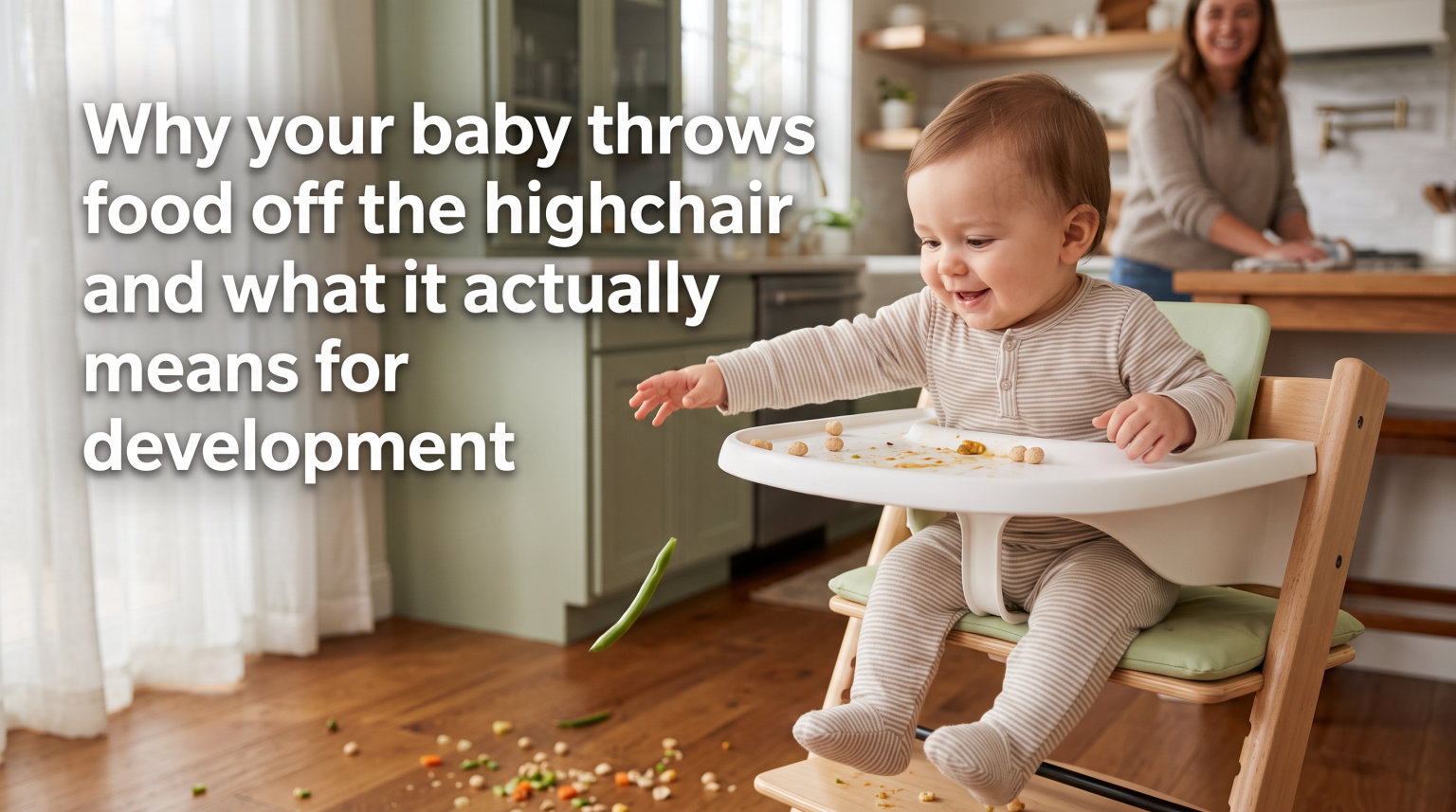
You sit down for dinner, place a few pieces of steamed broccoli on your baby’s high chair tray, and within seconds those green florets are on the floor. Your baby grins. You sigh. This scene repeats three times a day, every day, and you’re starting to wonder if your little one is deliberately trying to test your patience. Before you start dreading every meal, here’s what you need to know: when your baby throws food off the highchair, it’s not misbehavior. It’s a powerful developmental milestone that signals healthy brain growth, motor skill advancement, and emerging communication abilities.
Our team spoke with pediatric occupational therapists, child development specialists, and hundreds of parents navigating this exact phase. The consensus is clear: food throwing is developmentally appropriate behavior that typically begins around 6 to 8 months, peaks between 12 and 18 months, and gradually declines by age 2 to 2.5 years. Understanding why your baby throws food transforms mealtime from a battleground into an opportunity for connection and growth.
Table of Contents
Why Your Baby Throws Food: The Developmental Science
Babies don’t throw food to annoy you. They throw food because their developing brains are hardwired to explore, test, and learn from their environment. From a developmental psychology perspective, this behavior serves multiple crucial functions in your baby’s cognitive and physical growth. Let’s break down exactly what’s happening in that busy little brain.
Cause and Effect Learning: Your Baby is a Little Scientist
Dr. Sarah Berger, a developmental psychologist who studies infant cognition, describes babies as “little scientists” constantly running experiments. When your baby drops a piece of banana over the high chair edge, they’re testing a fundamental concept: what happens when I let go? The food falls. It makes a sound. It changes shape. Mom or Dad reacts. Every throw is a data point in their understanding of physics.
This cause and effect learning builds neural pathways that will later support complex reasoning, problem-solving, and scientific thinking. The behavior connects to object permanence development, your baby learning that objects continue to exist even when out of sight. When food disappears over the tray edge, your baby is learning about gravity, trajectory, and consequence. These early physics lessons form the foundation for spatial reasoning skills they’ll use for decades.
The repetition can feel maddening as a parent, but neurologically, your baby needs multiple trials to solidify these connections. Each throw reinforces the pattern in their brain: release leads to fall, which leads to outcome. This is exactly how early learning works, through repeated exploration and observation.
Fine Motor Skills in Development
Grasping food requires coordination between finger muscles, palm control, and wrist stabilization. Releasing food at the right moment demands even more sophisticated motor planning. When your baby picks up a slippery pea or a crumbly cracker, they’re exercising developing fine motor skills that took months to build and will take more months to perfect.
The ability to open the hand and drop an object is called voluntary release, and it’s a significant motor milestone that emerges around 8 to 12 months. Before this development, babies struggle to let go of objects intentionally. The emergence of food throwing often signals that your baby has achieved this new level of hand control. They’re practicing their newfound ability, much like you might practice a new dance move or typing technique.
Oral motor skills develop alongside hand skills during this period. Your baby is learning to coordinate chewing, swallowing, and breathing while simultaneously managing food manipulation. Sometimes throwing occurs when the oral demands feel overwhelming, your baby’s way of managing sensory input and motor complexity.
Sensory Processing and Food Exploration
Food is a sensory experience long before it becomes nutrition. The squish of cooked sweet potato between fingers, the cold temperature of yogurt, the rough texture of toast crusts, all provide tactile information that helps your baby understand their world. Throwing food is sometimes an extension of this sensory exploration, testing how different textures respond to impact.
Proprioception, your baby’s sense of where their body is in space, develops through these interactions. When food leaves their hand and travels through space, they receive feedback about force, distance, and direction. Occupational therapists note that this proprioceptive input is valuable for overall sensory integration and body awareness.
Some babies are more sensitive to tactile input than others. If your baby frequently throws certain textures while accepting others, they may be showing you which sensory experiences feel comfortable versus overwhelming. This selective throwing provides clues about their unique sensory processing profile.
Growing Autonomy and Independence
Around the first birthday, babies enter a developmental stage marked by increasing independence and self-determination. They want to make choices, control their environment, and assert their preferences. Food throwing becomes one of the few ways they can exercise autonomy within the constraints of a high chair. It’s a declaration: I decide what happens to this food.
This autonomy development is especially pronounced in baby-led weaning approaches, where babies control their own feeding from the start. The throwing behavior aligns with the philosophy of child-directed eating, even when the outcomes feel messy to parents. Understanding this connection helps frame the behavior as developmentally congruent rather than oppositional.
Your baby’s drive for independence is healthy and necessary. The throwing phase, frustrating as it is, represents important psychological growth toward selfhood and agency. Each toss is a tiny assertion of personhood in a world where most decisions are made for them.
Communication Before Words
Long before they can say “all done” or “no more,” babies communicate through action. Food throwing often signals a specific message: I’m finished eating. I’m bored with this meal. I’m not hungry right now. Learning to read these pre-verbal communications helps you respond appropriately and reduces the behavior over time.
Appetite fluctuates significantly in the second year of life. Growth slows from the rapid pace of infancy, and babies need fewer calories per pound. A baby who happily ate a full cup of food yesterday might genuinely need only a few bites today. Throwing can indicate satiety when babies lack the vocabulary to express fullness.
Sometimes throwing signals overwhelm rather than completion. Too many food options, too much happening in the environment, or too much sensory input can trigger a throwing response. Your baby might be saying this feels like too much right now through their actions.
Seeking Connection and Response
Babies are social beings who crave interaction and attention. When you react to thrown food with surprise, sound, or movement, your baby receives exactly what they wanted: your focused attention. The behavior becomes a game not because they enjoy the mess, but because they enjoy the connection that follows.
Developmental experts call this connection-seeking behavior. Your baby has learned that throwing food reliably produces a parental response. Even negative reactions count as connection in a baby’s social calculus. Understanding this motivation helps you redirect the behavior toward more appropriate connection strategies.
Mealtime represents a significant portion of your baby’s daily social interaction. If they feel disconnected or overlooked during this family time, throwing becomes a tool to re-center themselves in your attention. The behavior is essentially asking: notice me, engage with me, I’m here.
When Food Throwing Starts, Peaks, and Ends: An Age-by-Age Guide
Understanding the typical timeline helps set realistic expectations and reduces parental anxiety. While every child develops at their own pace, food throwing follows a fairly predictable pattern across the first two years of life. Knowing where your baby falls on this timeline can help you respond with appropriate strategies.
6 to 8 months: The behavior typically emerges as babies gain the motor control to grasp and release. At this stage, throwing is purely exploratory. Your baby is testing cause and effect without any social awareness of the behavior’s impact. The throws are often accidental at first, then become intentional as they discover the consistent result.
9 to 12 months: Intentional throwing increases as motor skills and cognitive understanding improve. Your baby is now deliberately experimenting with the physics of falling food. This period often coincides with the beginning of self-feeding, making the behavior particularly prominent during the transition to finger foods.
12 to 18 months: This is typically the peak period for food throwing. Motor skills, cognitive curiosity, autonomy drives, and social awareness all converge during this developmental window. Parents often report the “windscreen wiper” motion at this age, where babies sweep entire trays clear in one dramatic motion. Forum discussions consistently identify this period as the most challenging for mealtime mess.
18 to 24 months: Gradual improvement begins as language skills develop and impulse control strengthens. Your toddler can now communicate “all done” verbally or with signs, reducing the need to throw to signal completion. However, testing boundaries remains common, and throwing may persist during periods of fatigue or overwhelm.
24 to 30 months: By age 2 to 2.5 years, most children have largely outgrown regular food throwing. They possess the language, motor control, and social understanding to keep food on the table. Occasional incidents still occur, especially when tired or upset, but the phase has essentially ended for most families.
What to Do in the Moment When Your Baby Throws Food
Your immediate response shapes whether the behavior continues or fades. The goal is to remain calm, minimize emotional reactions, and teach appropriate alternatives without creating a power struggle. Here’s a step-by-step protocol based on pediatric feeding therapy principles.
The 90-90-90 Rule for High Chair Positioning
Before addressing the throwing behavior itself, check your baby’s physical setup. The 90-90-90 rule refers to the angles at your baby’s hips, knees, and ankles when properly positioned in a high chair. Each joint should form approximately a 90-degree angle, creating stable, supported seating that promotes calm, focused eating.
Foot support is critical and often overlooked. When a baby’s feet dangle unsupported, they seek sensory input through movement, which can manifest as kicking, squirming, and yes, throwing. A stable footrest gives your baby grounding and reduces the restless energy that contributes to food tossing. Check that your baby’s high chair or booster seat provides adequate foot support at their current height.
Positioning affects not just behavior but safety and digestion too. A baby slumped backward or sliding forward cannot focus on eating tasks. Taking five minutes to adjust the high chair settings, add a footrest if needed, or place a box under dangling feet can dramatically improve mealtime behavior. Many parents on parenting forums report that adding foot support reduced their baby’s throwing by half.
Your Immediate Response Strategy
Step 1: Pause and breathe. Your emotional reaction teaches your baby whether throwing is an effective attention-getting strategy. A calm, neutral response removes the reward of your dramatic reaction.
Step 2: Assess the message. Is your baby full? Bored? Overwhelmed? Sometimes the appropriate response is ending the meal rather than managing the throwing. If your baby has eaten reasonably and is now throwing everything, they may be signaling completion.
Step 3: Implement natural consequences. When food goes on the floor, the meal is over or the food is gone. You don’t need to lecture or punish, simply follow through with the logical outcome. Food on the floor means food is done for this meal. Consistency matters more than severity.
Step 4: Redirect once. If throwing seems exploratory rather than communicative, offer one replacement. Place food back on the tray with a simple “food stays on the tray.” If throwing continues, proceed to ending the meal calmly.
Step 5: Clean up without commentary. Make the mess disappear without turning cleanup into a theatrical event. The less attention the behavior receives, the less rewarding it becomes.
The No-Thank-You Bowl Technique
Teaching appropriate food rejection reduces throwing by giving your baby an acceptable alternative. Place a small bowl or section of the tray designated as the “no thank you” or “all done” spot. Demonstrate moving unwanted food there instead of throwing it down. This gives your baby a way to exercise choice and autonomy within acceptable boundaries.
For babies not yet using words, pair the bowl with a simple sign or phrase. Say “no thank you” as you demonstrate moving food to the designated spot. Over time, your baby will associate the phrase and action, eventually using it independently. This approach validates their right to dislike certain foods while teaching respectful expression of that preference.
The technique also helps you read your baby’s signals more accurately. If the no-thank-you bowl fills up quickly, your baby may genuinely not like the food offered. If they continue throwing after using the bowl appropriately, the behavior may be about play or attention rather than food rejection.
How to Minimize Food Throwing: Prevention Strategies That Work
Prevention reduces the need for constant response management. These strategies address common triggers and set your baby up for mealtime success before the first bite lands on the tray.
Serve smaller portions. A tray overloaded with food invites sweeping gestures. Offer two to three pieces of food at a time, refilling as your baby eats successfully. This reduces overwhelm and makes throwing less appealing as a tray-clearing strategy.
Choose appropriate food sizes and textures. Foods that are too slippery, too crumbly, or too challenging to grasp lead to frustration and throwing. Opt for stick shapes about the size of your finger for easy grasping. Avoid perfectly round items that roll away immediately.
Time meals strategically. A hungry baby is often a throwing baby, but so is an overly hungry baby who feels frantic. Offer meals when your baby is alert and moderately hungry, not ravenous or exhausted. Watch for hunger cues and try to begin meals before your baby becomes overly hungry.
Minimize distractions. TVs, tablets, and toys at the table divert attention from eating and create a overstimulating environment. A calm, consistent mealtime setting helps your baby focus on the task at hand. Keep the table clear except for the current meal.
Involve your baby in cleanup. As your baby approaches toddlerhood, hand them a cloth or involve them in picking up dropped food. This teaches responsibility without shame and turns the natural consequence into a learning opportunity. Even young babies can participate in wiping the tray or placing items in the compost.
Model the behavior you want. Your baby watches everything you do. Demonstrate keeping food on your plate, using utensils appropriately, and treating mealtime as an enjoyable social occasion. Family meals where your baby sees older siblings or parents eating calmly provide powerful modeling.
When Food Throwing Might Signal Something More: Red Flags to Know
While throwing is typically normal, certain patterns warrant professional attention. Occupational therapists and feeding specialists can assess whether underlying sensory or motor issues contribute to the behavior. Trust your instincts if something feels beyond typical development.
Persistent gagging or choking: If throwing accompanies frequent gagging, vomiting, or apparent difficulty managing food textures, consult a feeding therapist. These signs may indicate oral motor delays or sensory processing challenges affecting safe eating.
Extreme texture refusal: A baby who throws every wet or textured food while only accepting dry crunchy items may have sensory sensitivities requiring support. Some sensory defensiveness is normal, but extreme selectivity affects nutrition and warrants evaluation.
Behavior beyond age 3: While occasional throwing happens with overtired toddlers, regular food throwing persisting past age 3 suggests the behavior has become a habit or power struggle rather than developmental exploration. A child psychologist or behavioral specialist can help address entrenched patterns.
Associated developmental concerns: If throwing accompanies delays in other areas, communication, social engagement, motor skills, discuss your concerns with your pediatrician. Food throwing alone is rarely a concern, but combined with other delays, it may be part of a larger picture.
Most babies who throw food are developing exactly as they should. But you know your child best. If your gut tells you something else is happening, seeking an occupational therapy evaluation brings peace of mind and early support if needed.
Frequently Asked Questions About Babies Throwing Food
What to do when baby throws food off highchair?
Stay calm and neutral to avoid reinforcing the behavior as a game. Check if your baby is signaling fullness and end the meal if so. Implement natural consequences by calmly removing food or ending the meal without lecture. Offer a no-thank-you bowl as an appropriate alternative for rejecting food. Ensure your high chair has proper foot support following the 90-90-90 rule.
What is the 90-90-90 rule for high chairs?
The 90-90-90 rule refers to proper positioning where your baby’s hips, knees, and ankles each form approximately a 90-degree angle when seated. This positioning provides stability, promotes better digestion, and reduces restless behavior including food throwing. Foot support is essential; dangling feet create discomfort that can contribute to mealtime misbehavior.
Is it normal for a 2 year old to throw food on the floor?
Occasional food throwing at age 2 is still within the normal range, though the behavior typically declines significantly between 18 and 24 months. By age 2, most toddlers have developed language skills to communicate needs verbally rather than through throwing. Frequent or intense throwing at this age may indicate the behavior has become a habit or attention-seeking pattern rather than developmental exploration.
How long does the throwing phase last?
The food throwing phase typically begins around 6 to 8 months when babies develop grasp and release skills, peaks between 12 and 18 months, and gradually declines by 24 to 30 months. Most children have largely outgrown regular food throwing by age 2.5, though occasional incidents may still occur when toddlers are tired, overwhelmed, or testing boundaries.
When your baby throws food off the highchair, they’re not being naughty, disrespectful, or manipulative. They’re being a baby, exploring their world, developing crucial skills, and communicating in the only ways available to them. This phase will pass. Your calm, consistent response shapes not just the behavior, but your baby’s relationship with food and family meals for years to come. Trust the process, protect your floors with a good splat mat, and remember that every thrown pea represents learning in action.