
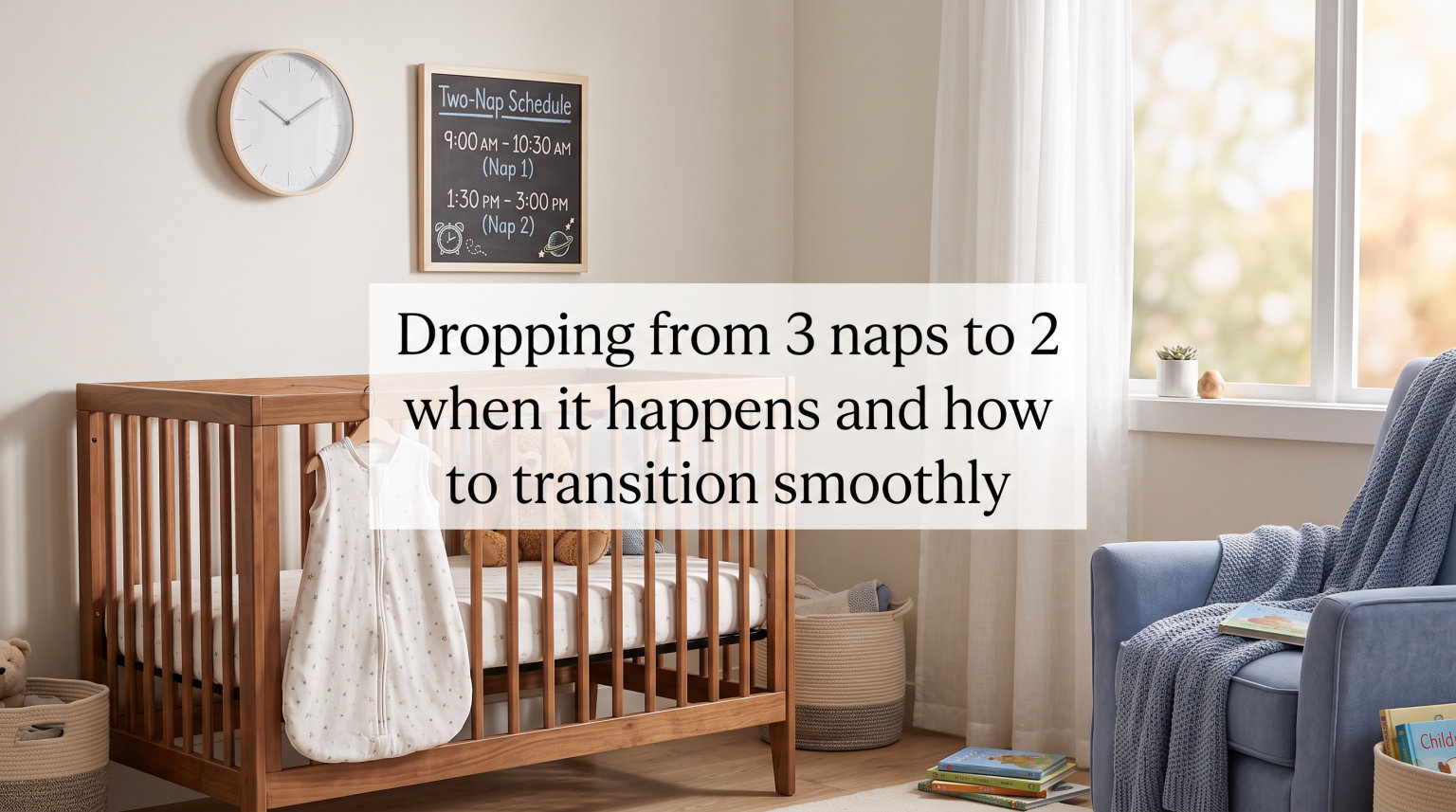
I remember staring at the clock at 6:45 PM, wondering how my baby would ever make it to bedtime. We had just started dropping from 3 naps to 2, and that last stretch of the day felt impossible. If you are reading this while holding a cranky 7-month-old who just refused their third nap, I have been exactly where you are.
The 3 to 2 nap transition is one of those parenting milestones that sounds simple until you are living it. This guide walks you through when it happens, how to know your baby is ready, and exactly how to make the switch without losing your sanity. By the end, you will have a clear plan for those longer wake windows and early bedtimes that make this transition work.
I have helped hundreds of families navigate sleep changes, and I can tell you this: the transition goes much smoother when you wait until your baby is truly ready. Rushing it usually backfires with overtiredness and night wakings. Let us figure out if now is the right time for your little one.
Table of Contents
Quick Facts: The 3-to-2 Nap Transition
Here is what you need to know at a glance:
- Typical age: 6.5 to 8 months (some as early as 6, others closer to 9)
- Which nap disappears: The third nap (catnap) gets dropped
- New wake windows: 2.5-3 hours / 3-3.5 hours / 3.5-4 hours
- Transition duration: 2-6 weeks for full adjustment
- Key strategy: Early bedtime (6:00-6:30 PM) is essential
- Warning: Doing this too early (before 6 months) usually causes more problems
When Do Babies Drop to 2 Naps?
Most babies are ready to drop from 3 naps to 2 between 6.5 and 8 months of age. The sweet spot for many families is around 7 to 7.5 months. However, every baby develops on their own timeline.
Some babies show readiness as early as 6 months. These early transitioners usually have higher sleep needs or have already consolidated their naps well. On the flip side, some babies do not fully settle into a two-nap schedule until closer to 9 months. That is completely normal too.
I have noticed from parent reports that the median age for completing this transition successfully is about 8 months. This does not mean you should wait until 8 months to try. It means many babies start the process around 7 months but need several weeks to fully adjust.
This transition often coincides with the 8-month sleep regression, which can make timing tricky. If your baby is showing signs of readiness and is at least 6.5 months old, it is usually better to proceed rather than try to preserve three naps through the regression. The developmental changes happening at this age make the shift inevitable.
Signs Your Baby Is Ready to Drop the Third Nap
Watch for these clear signals that your baby is ready for the transition:
- Consistent nap resistance. Your baby takes 20 minutes or longer to fall asleep for the third nap, or simply refuses it outright most days.
- Third nap pushes bedtime too late. If that last catnap ends after 5:00 PM, bedtime gets pushed past 8:00 PM, which can affect night sleep quality.
- Early morning wakings appear. Suddenly your baby is waking at 5:30 AM instead of 6:30 AM. This often signals the schedule needs adjusting.
- The second nap is lengthening. When the midday nap starts stretching to 1.5-2 hours, your baby is naturally consolidating sleep.
- Age is appropriate. Your baby is at least 6.5 months old, preferably 7+ months, with the other signs present.
A few days of nap fighting do not mean it is time to transition. I look for a pattern lasting at least 5-7 days. Random bad nap days happen to every baby. What you want to see is a consistent message from your baby that they are ready for longer stretches of awake time.
Signs Your Baby Is NOT Ready to Transition Yet
Here are indicators that you should wait:
- Your baby is under 6 months old
- Nap resistance is occasional, not consistent
- Your baby still sleeps well with three naps and falls asleep easily
- Longer wake windows make your baby overtired quickly
- Your baby is currently teething, sick, or recovering from travel
- Recent disruptions like starting daycare or moving homes
Trying to transition during illness or major life changes usually creates extra stress. Wait until things settle down. The third nap is your friend until your baby clearly outgrows it.
Which Nap Gets Dropped?
The third nap (also called the catnap) is the one that disappears. This is typically a short 30-45 minute nap that happens in the late afternoon, usually around 4:30-5:30 PM.
A catnap serves as a bridge to get your baby to bedtime without becoming overtired. It prevents the dreaded 5:00 PM meltdown. But once your baby can handle longer wake windows and builds enough sleep pressure, that bridge becomes unnecessary.
Your morning and midday naps remain. In fact, these naps often lengthen once the catnap is dropped. Many parents are surprised to see their baby start taking two solid 1.5-hour naps after the transition, when before they had three shorter naps.
The catnap is a developmental stepping stone, not a permanent fixture. Babies start with 4-5 naps as newborns, drop to 3 naps around 4-5 months, then consolidate down to 2 naps in that 6-8 month window. Eventually they will drop to one nap around 14-18 months.
Wake Windows for the 2-Nap Schedule
Wake windows are the periods of awake time between sleep periods. They are the secret to making this transition work. Here is how they change:
| Schedule | First Window | Second Window | Third Window |
|---|---|---|---|
| 3-Nap Schedule | 2-2.5 hours | 2.5 hours | 2-2.5 hours |
| 2-Nap Schedule | 2.5-3 hours | 3-3.5 hours | 3.5-4 hours |
The key concept here is sleep pressure. Your baby needs enough awake time to build up the biological drive to sleep. Without adequate sleep pressure, they will take short naps or resist sleep entirely. The transition works by gradually extending these windows so more pressure builds before each sleep period.
At this age, sleepy cues become less reliable. Your baby might still yawn or rub their eyes, but those signals come later in the window. By the time you see them, your baby might actually be overtired. I recommend watching the clock more than the cues during this transition.
How to Transition from 3 Naps to 2: Step-by-Step
Here is the process that works for most families:
Step 1: Extend the First Wake Window
Start by pushing the first wake window 15 minutes longer. If your baby was waking at 6:30 AM and napping at 8:30 AM, move that first nap to 8:45 AM. Do this for 2-3 days before making further changes.
Step 2: Extend the Second Wake Window
Once the first window is stable, add 15 minutes to the second wake window. This creates a natural drift where the third nap slot gets pushed later and later until it essentially disappears into bedtime.
Step 3: Skip the Third Nap When Resistance Appears
On days when your baby clearly refuses the third nap, do not force it. Instead, move bedtime earlier by 30-60 minutes. A 6:00-6:30 PM bedtime is completely appropriate during the transition.
Step 4: Commit to Early Bedtime
This is non-negotiable. Without the catnap, your baby loses 30-45 minutes of daytime sleep. They need to make that up at night, and the only way is an earlier bedtime. Aim for 6:00-6:30 PM during the adjustment period.
Step 5: Stay Consistent for 5-7 Days
Once you commit to the two-nap schedule, stick with it for at least a week. Bouncing back and forth between 2 and 3 naps confuses your baby’s body clock and makes the transition take longer.
Step 6: Allow 2-6 Weeks for Full Adjustment
Be patient. Some babies adjust in 2-3 weeks. Others need 4-6 weeks. Inconsistent days where you need a “rescue” third nap are normal during this period. That does not mean you failed.
Strategies for Extending Wake Windows
Keeping a baby awake longer requires active engagement. Here are proven strategies:
- Get outside. Fresh air and natural light help regulate the circadian rhythm and keep babies alert.
- Rotate activities every 15-20 minutes. Move from floor play to high chair time to outdoor stroller walks.
- Increase social interaction. Face-to-face play, singing, and talking keep the brain engaged.
- Offer new experiences. A change of scenery, even just moving to a different room, helps maintain alertness.
- Avoid screens. TV and tablets can actually make babies drowsy or create overstimulation that leads to meltdowns.
I often tell parents to think of this as “active awake time” rather than just keeping baby awake. A bored baby will seem tired when they are actually just understimulated.
Why Early Bedtime Is Essential During the Transition
If there is one mistake I see parents make repeatedly, it is pushing bedtime too late during the 3-to-2 nap transition. They worry their baby will wake up at 5:00 AM if they go to bed at 6:00 PM. The opposite is usually true.
Without that third nap, your baby is missing 30-45 minutes of sleep. An overtired baby produces stress hormones like cortisol that actually make it harder to stay asleep. The result is often night wakings or early morning wakings, not sleeping in.
A 6:00-6:30 PM bedtime allows your baby to get the 11-12 hours of night sleep they need. Many parents report their baby actually sleeps better and wakes later when bedtime moves earlier during this transition. It sounds counterintuitive, but sleep begets sleep.
One Reddit parent shared: “Early bedtime was the game-changer for us. Once we committed to 6:00 PM bedtime during the transition, everything else fell into place.” I have heard this same story dozens of times.
Sample Schedules: Before and After
Here is what the schedules look like side by side:
| Time | 3-Nap Schedule (6-7 months) | 2-Nap Schedule (7-8 months) |
|---|---|---|
| 6:30 AM | Wake up | Wake up |
| 8:45 AM | Nap 1 (1-1.5 hours) | Nap 1 (1-1.5 hours) |
| 12:00 PM | Nap 2 (1-1.5 hours) | Nap 2 (1.5-2 hours) |
| 3:30 PM | Nap 3 (30-45 min catnap) | Awake time |
| 5:30 PM | Wake from catnap | Begin bedtime routine |
| 7:30 PM | Bedtime | Asleep by 7:00 PM |
Notice how the 2-nap schedule moves bedtime earlier by 30-60 minutes. This compensates for the lost catnap. During the actual transition period, you might need to push bedtime even earlier to 6:00-6:30 PM.
These times are flexible. The wake windows matter more than clock times. If your baby wakes at 7:00 AM instead of 6:30 AM, simply shift everything 30 minutes later.
How Long Does the 3-to-2 Nap Transition Take?
The transition from 3 naps to 2 typically takes 2-6 weeks for full adjustment. Most babies need at least 3-4 weeks to fully settle into the new rhythm.
During this period, expect inconsistency. Some days your baby might take two solid naps. Other days they might need a “rescue” third nap if the second nap was short or early. That is completely normal and does not mean the transition is failing.
I often tell parents to think of it as a gradual shift, not a flip of a switch. Your baby is learning to build more sleep pressure and consolidate sleep into longer stretches. That takes time.
One parent on Reddit shared: “It took us three tries before the transition stuck. The first two times, we went back to three naps after a week because our baby just seemed too tired. The third time, at 7.5 months, it worked.” Do not be discouraged if you need to reset and try again.
Navigating the Transition with Daycare
Daycare adds a layer of complexity that many guides ignore. Daycare schedules often do not align perfectly with home routines, especially during nap transitions.
Here are strategies that work:
- Communicate with your daycare provider. Let them know you are transitioning and ask for their support in following wake windows.
- Be flexible on weekends. If daycare still offers three naps, allow that third nap on weekends to prevent sleep debt from building up.
- Consider timing. If your baby is starting daycare soon, you might delay the transition until they have settled into the new environment.
- Use early bedtime aggressively. If daycare naps were short, move bedtime earlier to compensate.
Many parents report their baby actually does better with the transition at daycare because the group environment provides stimulation that keeps them awake longer. The peer influence and structured activities help extend wake windows naturally.
Common Challenges and How to Handle Them
Here are the most frequent issues parents face and how to solve them:
Challenge 1: Baby refuses the third nap but cannot handle the long wake window to bedtime.
This is the classic transition dilemma. The solution is early bedtime. A 6:00-6:30 PM bedtime prevents overtiredness even when the last stretch feels long. You can also try a stroller walk or car ride for the third nap on particularly tough days.
Challenge 2: Naps get shorter during the transition.
This is normal. Sleep is consolidating, which sometimes means temporary disruption. Stick with the schedule for at least a week before adjusting. Often naps lengthen once the transition settles.
Challenge 3: Early morning wakings increase.
Usually this means bedtime is too late or wake windows need tweaking. Try moving bedtime 30 minutes earlier first. If that does not help after a week, check if you are asking for too much awake time during the day.
Challenge 4: It is hard to keep baby awake until bedtime.
Change the scenery frequently. Go outside, take a bath, call a grandparent for entertainment, offer a snack in the high chair. Active engagement is key during that last window.
Challenge 5: Inconsistent days with a mix of 2 and 3 nap days.
This is normal during the 2-6 week transition period. Do not stress about perfection. Aim for mostly 2-nap days with occasional 3-nap days when needed. Consistency will come with time.
When to Go Back to 3 Naps (Reverse the Transition)
Sometimes the transition attempt fails. Here is when to consider reverting:
- Your baby shows constant signs of overtiredness after 5-7 days of trying
- Significant sleep loss has occurred (multiple hours per day)
- Your baby seems irritable and not themselves
- Night sleep has significantly deteriorated
There is no shame in trying again later. Go back to three naps for 2-3 weeks, then reassess. Many parents need multiple attempts before the transition sticks permanently.
Frequently Asked Questions
Is the transition from 3 to 2 naps hard?
The transition from 3 to 2 naps is usually smoother than the 4-to-3 or 2-to-1 transitions. Most babies adjust within 2-6 weeks. The key is waiting until your baby is truly ready (showing consistent signs for 5-7 days) and committing to early bedtime during the adjustment period.
When to drop a nap from 3 to 2?
Most babies are ready to drop from 3 naps to 2 between 6.5 and 8 months of age. Signs of readiness include consistently fighting the third nap, early morning wakings appearing, and the second nap lengthening. Wait until your baby is at least 6 months old before attempting the transition.
How do I transition to two naps smoothly?
To transition smoothly, extend wake windows gradually by 15 minutes every 2-3 days. Skip the third nap when your baby shows resistance and move bedtime 30-60 minutes earlier. Stay consistent for at least a week, and expect the full adjustment to take 2-6 weeks. Focus on active awake time to help your baby stay alert longer.
Can I drop to 2 naps at 5 months?
Dropping to 2 naps at 5 months is usually too early for most babies. At this age, wake windows of 3-4 hours are often too long and lead to overtiredness, which causes night wakings and early morning wakings. Wait until your baby is at least 6 months old, preferably 6.5-7 months, unless your pediatrician advises otherwise.
Which nap gets dropped during the 3 to 2 nap transition?
The third nap, also called the catnap, gets dropped during this transition. This is the short 30-45 minute nap that typically occurs in the late afternoon. The morning and midday naps remain and often lengthen once the catnap is eliminated.
How long does the 3 to 2 nap transition take?
The 3 to 2 nap transition typically takes 2-6 weeks for full adjustment. Some babies settle in within 2-3 weeks, while others need up to 6 weeks. Expect inconsistent days during this period, with a mix of 2-nap and occasional 3-nap days. Multiple attempts may be needed before the transition sticks permanently.
Should wake windows be the same every day during the transition?
Wake windows should stay relatively consistent during the transition, but flexibility is important. If your baby takes a short second nap, you might need a slightly earlier bedtime that day. Use the wake windows as guidelines rather than rigid rules, adjusting based on how your baby responds.
Conclusion
Dropping from 3 naps to 2 is a significant milestone that marks your baby’s growing ability to stay awake longer and consolidate sleep. Most babies are ready between 6.5 and 8 months, though individual timing varies.
Remember these key takeaways: wait for consistent signs of readiness, extend wake windows gradually, commit to early bedtime during the adjustment, and be patient with the 2-6 week transition period. Every baby is different, and it is okay if your little one needs multiple attempts before the change sticks.
Trust your instincts as a parent. You know your baby better than any schedule or guide. If something feels off, it is always okay to pause and try again later. The transition will happen when your baby is truly ready. You have got this.