
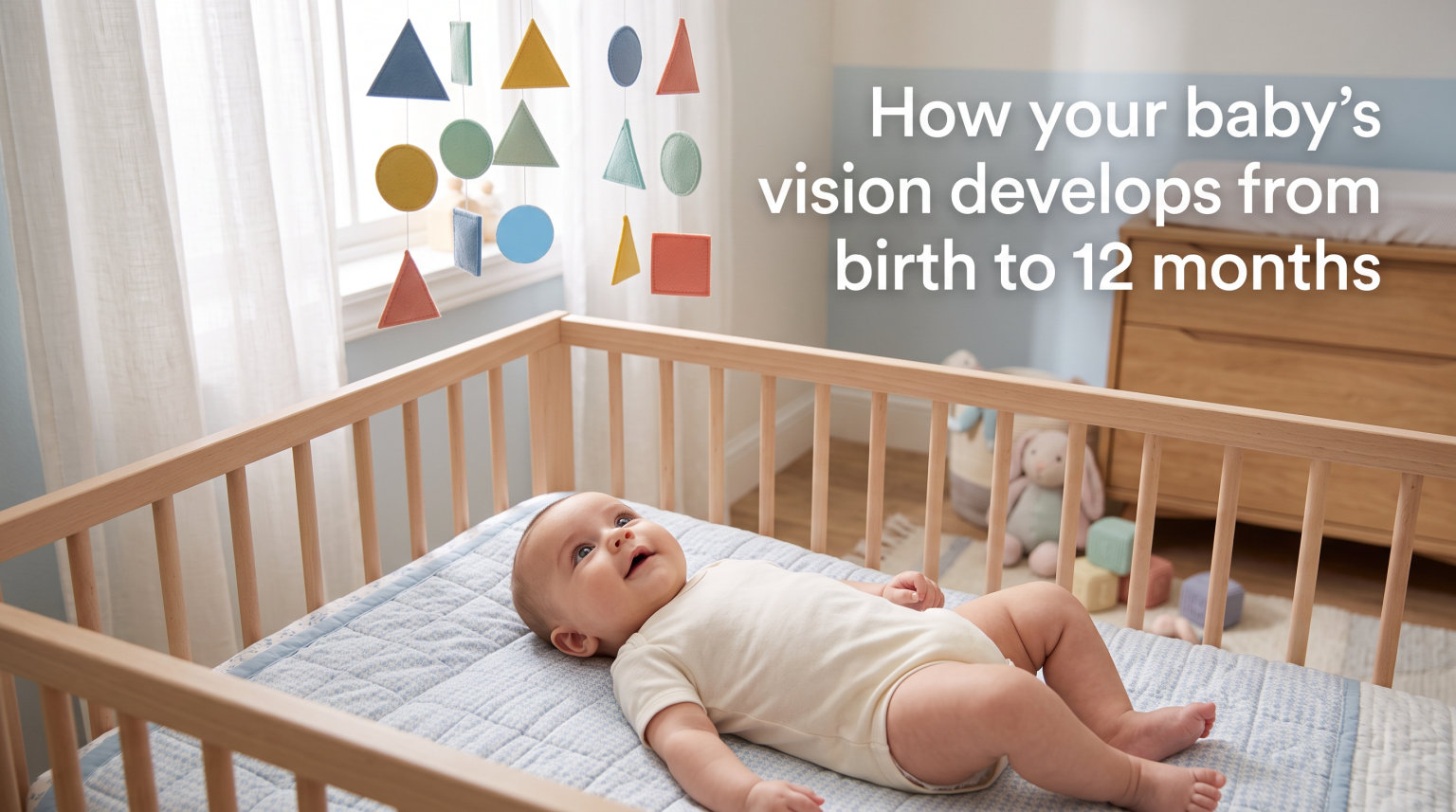
I remember holding my newborn daughter and wondering if she could actually see me looking back at her. Her eyes seemed to drift and wander, sometimes crossing in ways that made me worry. Understanding how your baby’s vision develops from birth to 12 months can ease those concerns and help you support their growth at every stage.
A baby’s vision reaches near-adult levels by 12 months of age, though the journey begins with surprisingly limited sight. Newborns see the world very differently than we do, and their visual system undergoes remarkable changes during the first year of life. This guide walks you through each developmental stage so you know what to expect and how to help.
Table of Contents
How Your Baby’s Vision Develops From Birth to 12 Months: A Complete Timeline
Baby vision development follows a predictable pattern from blurry, high-contrast perception at birth to full color vision, depth perception, and eye-hand coordination by the first birthday. Each phase builds on the previous one, with major milestones occurring at roughly 2-month intervals. Understanding these stages helps you provide appropriate stimulation and recognize when something might need professional attention.
Birth to 2 Months: The Blurry Beginning
Newborns can see from birth, but their vision is quite different from adult sight. At 2 days old, your baby can see you when you hold them at the right distance, though the image appears blurry and lacks fine detail. Their clearest vision extends only 8 to 15 inches, which happens to be the perfect distance between a nursing baby’s eyes and their mother’s face.
During these early weeks, babies see mostly in shades of gray and high-contrast patterns. Black-and-white images register more clearly than pastels or subtle color variations. Their peripheral vision is actually better than their central vision at this stage, which explains why newborns sometimes seem to look past you rather than directly at you.
Eye crossing is completely normal during the first two months. Your baby’s eye muscles are still learning to coordinate, and occasional wandering or crossing eyes do not indicate a problem. Only if the eyes remain constantly crossed or one eye never aligns should you mention it to your pediatrician.
You may notice your newborn seems startled by bright lights or prefers dimmer environments. This sensitivity occurs because their pupils cannot yet constrict and dilate efficiently to regulate light intake. Soft, indirect lighting creates the most comfortable visual environment for these early weeks.
2 to 4 Months: Focusing and Tracking
Between 2 and 4 months, your baby’s eyes begin working together as a team, creating more unified images and improving depth perception foundations. This is when baby tracking objects becomes consistent, following moving toys or faces across their field of view with smooth, coordinated eye movements.
Color vision infants development accelerates during this period. While newborns could only distinguish between light and dark, 2-month-olds begin perceiving color, starting with reds and greens. By 3 to 4 months, most babies can see the full spectrum of colors, though not with the same saturation adults perceive.
Focusing ability improves dramatically during this stage. Your baby can now lock onto objects at varying distances and maintain clear focus for longer periods. This explains why you may suddenly notice your infant studying your face with apparent recognition around the 6 to 8 week mark.
Hand eye coordination baby development begins here too. Around 3 months, babies start swiping at objects within reach, though accuracy remains limited. These early attempts lay the groundwork for the precise reaching and grasping that emerges in the coming months.
5 to 8 Months: Depth Perception and Visual Integration
By 5 months, infant vision milestones include fully developed color vision and emerging depth perception. Your baby can now distinguish between near and far objects with increasing accuracy, judging distances well enough to reach for and grasp toys successfully. This newfound ability transforms playtime as babies become more intentional about grabbing and exploring objects.
Depth perception baby capabilities expand rapidly between 5 and 7 months. Babies begin understanding spatial relationships, recognizing that objects continue to exist even when partially hidden. This cognitive-visual connection supports the endless games of peek-a-boo that delight this age group.
Visual acuity sharpens significantly during this period. Where a 3-month-old might see objects as somewhat blurry, 6-month-olds achieve much clearer vision at all distances. They can now recognize familiar faces across a room and notice small details like facial expressions and household objects.
The 3-6-9 rule sometimes referenced by parents refers to approximate developmental windows, though vision development varies individually. Around 3 months brings better focusing, 6 months brings depth perception and color maturity, and 9 months brings the visual coordination needed for crawling and mobility.
9 to 12 Months: Visual Mastery and Mobility Support
By 9 months, your baby approaches adult-level vision clarity and coordination. What a 12 month old baby sees includes near and distant objects with impressive detail, moving targets tracked smoothly, and full color perception across the spectrum. Their visual system now supports complex motor activities like crawling, cruising furniture, and eventually walking.
Eye-hand coordination reaches new heights during these final months. Babies can accurately judge distances to pick up small objects between thumb and forefinger, stack blocks with precision, and turn pages in board books. These fine motor skills depend entirely on the visual development that preceded them.
Memory and visual recognition strengthen considerably. Your baby recognizes familiar people from across rooms, identifies favorite objects by sight, and anticipates events based on visual cues. This cognitive-visual integration supports language development as babies connect spoken words with the objects they see.
Depth perception baby abilities fully mature during this stage, enabling safe navigation of spaces and obstacles. Babies judge distances accurately enough to avoid bumping into furniture while cruising and eventually take their first steps with reasonable confidence in what their eyes tell them about the environment.
Warning Signs of Vision Problems to Watch For
While most babies develop vision normally, certain warning signs warrant professional evaluation. Contact your pediatrician or a pediatric ophthalmologist if you notice any of the following:
- Eyes that remain constantly crossed or turned after 4 months of age
- One eye that consistently turns inward or outward
- White or grayish appearance in the pupil (should appear black)
- Excessive tearing or crustiness not related to infection
- Extreme sensitivity to light that causes distress
- No visual tracking of objects by 3 months
- No interest in faces or visual stimuli by 2 months
- Drooping eyelids that block vision
Premature babies may follow slightly different timelines and require earlier screening. If your baby was born before 37 weeks gestation, discuss vision monitoring with your pediatrician, as premature infants have higher risks for certain eye conditions.
The American Optometric Association recommends a first infant eye exam between 6 and 12 months of age. Many participating providers offer this exam free through the InfantSEE program, making early screening accessible regardless of insurance or income.
Activities to Support Your Baby’s Vision Development
You can actively support your baby’s visual growth through age-appropriate activities that stimulate and challenge their developing system. Here are specific suggestions organized by developmental stage:
Birth to 2 months: Hold your face 8 to 12 inches from your baby during feeding and interaction. Use black-and-white pattern cards or books with high-contrast images. Move slowly across their field of vision so they can practice tracking without becoming overwhelmed.
2 to 4 months: Introduce colorful toys and mobiles with varied hues. Play tracking games by slowly moving toys from side to side and up and down. Use unbreakable mirrors so babies can observe their own facial movements and expressions.
5 to 8 months: Place toys at varying distances to encourage depth perception practice. Play peek-a-boo to reinforce object permanence concepts. Offer stacking toys and blocks that require visual judgment to manipulate successfully.
9 to 12 months: Read picture books together, naming objects and pointing to images. Create safe crawling environments with varied textures and visual elements. Take walks outside where babies can observe moving objects, natural scenery, and changing light conditions.
Throughout all stages, limit screen time entirely for babies under 18 months as recommended by the American Academy of Pediatrics. Real-world visual experiences provide far richer developmental benefits than any digital content.
Understanding How Babies Actually See the World
Many parents wonder what the world looks like through their baby’s eyes. Visual simulations suggest newborns experience something like a blurry, low-resolution photograph with most colors washed out to gray. Faces appear as light blobs with dark areas where eyes and mouth create contrast.
By 3 months, the world begins gaining color and clarity, similar to a slightly out-of-focus color photo. Faces become recognizable, and environmental details emerge. By 6 months, vision approximates a clear, well-saturated image with good depth perception, though fine details still lack full adult sharpness.
This gradual sharpening explains why babies seem increasingly engaged with their surroundings as they develop. What appeared as disinterest in early weeks often reflects visual limitations rather than personality. As vision improves, babies respond more enthusiastically to faces, toys, and environmental stimuli.
Frequently Asked Questions About Baby Vision Development
At what age is a baby’s vision fully developed?
A baby’s vision reaches near-adult levels by 12 months of age, though fine refinements continue through early childhood. By their first birthday, babies can see clearly at various distances, track moving objects smoothly, perceive full color, and judge depth accurately. Full visual maturity typically completes between ages 3 and 5 years.
What is the 3 6 9 rule for babies?
The 3 6 9 rule refers to approximate vision development milestones. Around 3 months, babies achieve better focusing and begin tracking objects. At 6 months, full color vision emerges along with developing depth perception. By 9 months, visual coordination supports mobility activities like crawling and pulling to stand. Individual development varies, so some babies reach these milestones slightly earlier or later.
Can my baby see me at 2 days old?
Yes, your baby can see you at 2 days old when you hold them at the proper distance. Newborns see clearest at 8 to 15 inches, which matches the distance between a nursing baby’s eyes and their parent’s face. While the image appears blurry and lacks color, your baby can distinguish your face from others and prefers looking at human faces over other objects.
What can a 12 month old baby see?
By 12 months, babies see with near-adult clarity and can focus on objects both near and far. They perceive full color, track moving targets smoothly, and judge distances accurately for walking and reaching. A one-year-old recognizes familiar faces across rooms, notices small details, and uses vision to navigate environments and avoid obstacles while cruising or taking first steps.
Conclusion: Celebrating Your Baby’s Visual Journey
Understanding how your baby’s vision develops from birth to 12 months transforms those early months from a mystery into a fascinating journey you can actively support. From the blurry, high-contrast world of newborns to the visually rich environment experienced by one-year-olds, each stage brings new capabilities worth celebrating.
Remember that infant vision milestones provide guidelines, not rigid rules. Some babies track objects confidently at 6 weeks while others need 10 weeks to master the skill. Both timelines fall within the normal range. Trust your instincts about your baby’s development, and do not hesitate to seek professional guidance if something concerns you.
Schedule that first eye exam between 6 and 12 months to ensure your baby’s visual system develops properly. The simple screening provides peace of mind and catches any issues early when intervention works best. Enjoy watching your little one discover their visual world, one clear image at a time.