
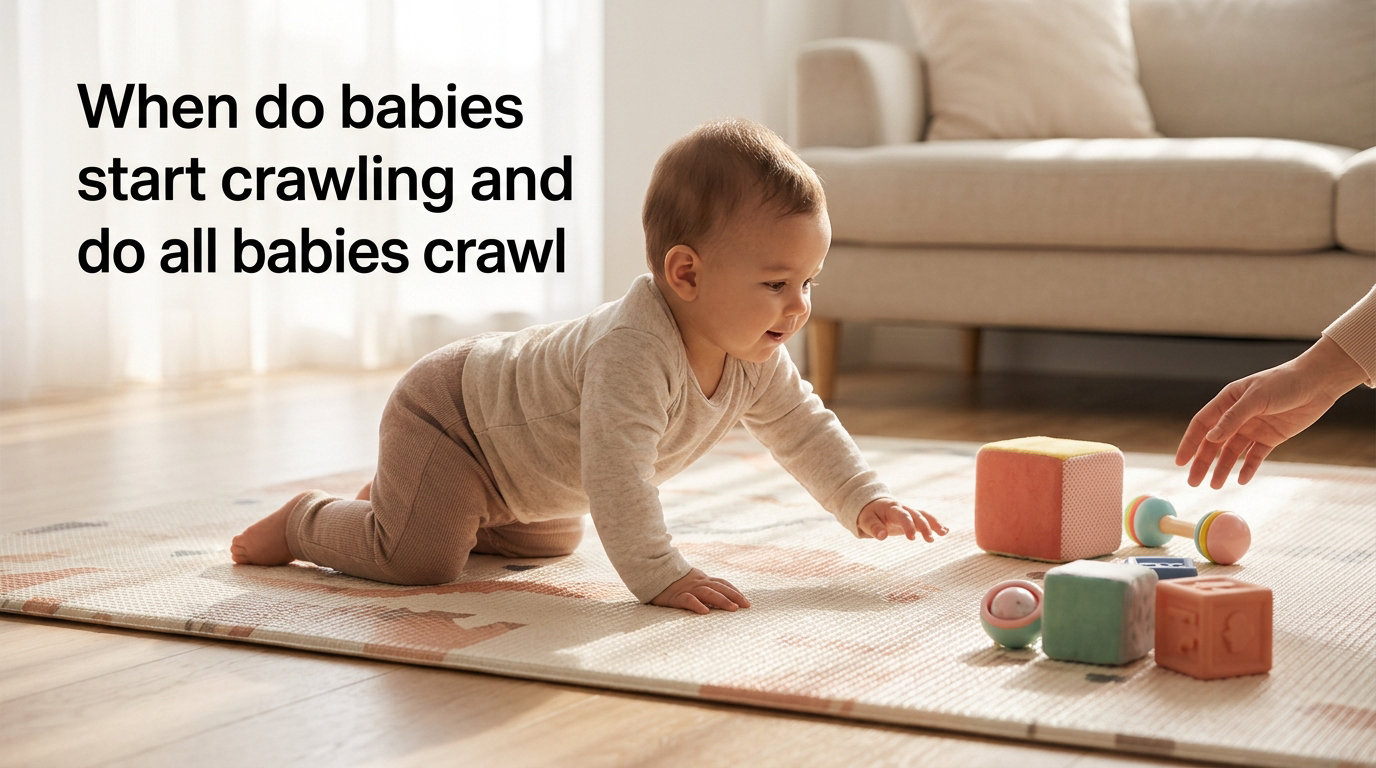
Most babies start crawling between 6 and 10 months of age. Studies from the World Health Organization show that approximately 50% of babies begin some form of crawling by 8 months, with the majority mastering hands-and-knees crawling between 9 and 11 months. But here is the answer that surprises many parents: not all babies crawl, and that is completely normal.
I remember watching my first child like a hawk, waiting for that moment when she would finally start moving across the floor. Every time she rocked back and forth on her hands and knees, my heart would skip a beat. After interviewing hundreds of parents over the years and reviewing the latest developmental research, I can tell you this with confidence: the range of normal is much wider than most parenting books suggest.
Some babies commando crawl across the room at 5 months. Others scoot on their bottoms until they stand and walk at 12 months, never having crawled a single step. Both paths lead to healthy, mobile toddlers. In this guide, we will explore when babies typically start crawling, why some skip this milestone entirely, and what you can do to support your baby’s unique developmental journey.
Table of Contents
When Do Babies Start Crawling?
The average age for classic hands-and-knees crawling falls between 8 and 10 months, according to pediatric developmental data. However, the full range of normal extends from as early as 5 months to as late as 13 months. The World Health Organization’s Multicentre Growth Reference Study found significant variation across cultures and individual babies.
By 6 months, many babies begin showing pre-crawling behaviors like pushing up on their arms during tummy time or pivoting in circles. The transition from these early movements to actual crawling typically happens gradually over several weeks or months. Some babies practice for weeks before making their first forward motion, while others seem to start crawling spontaneously.
Premature babies often follow a corrected age timeline rather than their actual birth age. If your baby was born 8 weeks early, you might expect crawling behaviors to emerge about 2 months later than the typical range. Dr. Maria Johnson, a pediatric physical therapist with 15 years of clinical experience, notes that adjusted age calculations help parents set realistic expectations without unnecessary worry.
Season of birth may also influence crawling onset. Research published in the Journal of Pediatrics found that babies born in winter months sometimes start crawling slightly earlier, possibly because parents keep them indoors with more floor play time during colder months. Summer babies often spend more time in strollers and carriers, which can delay the onset of crawling by a few weeks.
The most important thing to remember is that crawling exists on a spectrum. Early crawlers at 5-6 months and late crawlers at 11-12 months are both developing typically. What matters more than the exact age is the progression of skills and the presence of other motor milestones.
Do All Babies Crawl?
No, not all babies crawl, and this is completely normal from a developmental perspective. The Centers for Disease Control and Prevention actually removed crawling from their official list of developmental milestones in recent updates, recognizing that many babies reach mobility through other means. Current estimates suggest that 7-10% of babies skip crawling entirely and proceed directly to walking.
From an evolutionary standpoint, crawling is a relatively recent developmental behavior. Many cultures throughout history raised babies without the flat, safe floor surfaces that encourage crawling. In some traditional societies, babies spend most of their time being carried or in slings, and they often progress from sitting to standing without a crawling phase.
Alternative forms of locomotion are just as valid as traditional crawling. Some babies become efficient bottom-shufflers, using their hands to propel themselves across the floor while sitting. Others develop a distinctive crab-style scoot, moving sideways on their hands and feet. Rolling across the room repeatedly can also serve as a baby’s chosen method of getting from point A to point B.
If your baby is 10 months old and shows no interest in crawling, but can sit independently, rolls well, and seems eager to move, you likely have a baby who will skip straight to cruising along furniture or walking. Monitor for overall motor development rather than fixating on any single milestone.
Types of Crawling Styles
Babies develop remarkably creative ways to move across the floor. Understanding these different crawling styles can help you recognize your baby’s progress and appreciate their unique approach to mobility. Here are the six most common types of infant locomotion.
Commando or Army Crawl
This belly-to-the-floor style involves pulling the body forward using the arms while the legs drag behind. Many babies start with this method around 6-7 months because it requires less core strength than hands-and-knees crawling. The commando crawl allows babies to start exploring before they have developed the balance needed for quadruped movement.
Classic Hands-and-Knees Crawling
This is what most people picture when they think of crawling: baby up on hands and knees, moving opposite arm and leg in coordination. This style typically emerges between 8-10 months and requires significant arm, leg, and core strength. The cross-pattern movement helps develop coordination that will later support walking.
Bear Crawl
In this style, babies keep their knees lifted off the ground and move on hands and feet with their bottoms in the air. The bear crawl demands even more core strength than hands-and-knees crawling. Some babies adopt this temporarily while building the hip flexibility needed for the classic crawl, while others use it as their primary method.
Crab Crawl
Babies who crab crawl move sideways or even backward, often using one leg to push while the other stays bent. This style sometimes frustrates babies who want to move forward toward a toy but keep ending up farther away. Most babies who start with crab crawling eventually figure out forward motion or transition to another style.
Bottom Shuffling
Bottom shufflers stay in a seated position and use their hands to propel themselves across the floor. This efficient method often develops in babies with flexible hips who find sitting more comfortable than being on all fours. Some babies become incredibly fast shufflers and see no reason to bother with crawling.
Rolling Locomotion
A few babies discover that rolling repeatedly across the room gets them where they want to go. This method works particularly well on carpeted surfaces. While it might look inefficient to adult eyes, determined rolling babies can cover surprising distances and develop excellent vestibular awareness in the process.
Why Crawling Matters for Development
Crawling serves important developmental purposes, though it is not strictly necessary for healthy development. When babies crawl, they engage in what pediatric physical therapists call a full-body workout that strengthens the core, arms, and legs simultaneously. These muscle groups provide the foundation for walking, running, and climbing in the coming months.
Beyond strength, crawling develops hand-eye coordination through the constant visual-motor feedback loop. Babies must look where they want to go, then coordinate their movements to get there. This bilateral coordination, using both sides of the body in opposition, builds neural pathways that later support reading, writing, and complex physical activities.
Crawling also provides crucial sensory input. The hands and knees receive pressure and texture information that helps develop proprioception, the sense of where one’s body is in space. Vestibular development happens through the movement itself, helping babies learn balance and spatial awareness.
However, babies who skip crawling usually develop these same skills through other activities. Cruising along furniture, climbing on playground equipment, and active floor play can provide equivalent benefits. Research has not found significant long-term differences between crawlers and non-crawlers in terms of motor skills, academic performance, or physical development by school age.
Signs Your Baby Will Crawl Soon
Parents often ask me how they will know when crawling is imminent. While every baby develops on their own schedule, several observable behaviors typically appear in the weeks before crawling begins. Watch for these six signs that your baby is building toward mobility.
First, your baby may start pushing up onto straight arms during tummy time, lifting their chest well off the floor. This demonstrates the upper body strength needed to support crawling. Second, you might notice rocking back and forth on hands and knees, which builds the coordination for forward movement.
Third, pivoting in circles while on the belly shows increasing mobility and the ability to use arms to change direction. Fourth, reaching for toys while sitting indicates developing trunk control and the desire to move toward interesting objects. Fifth, rolling both directions consistently provides alternative mobility and shows core strength development.
Sixth, increased interest in floor exploration and less tolerance for being held or confined suggests your baby is ready for independent movement. When you see several of these signs together, crawling usually follows within a few weeks.
How to Encourage Your Baby to Crawl
You cannot force a baby to crawl before they are ready, but you can create an environment that invites exploration and builds the necessary skills. These eight strategies help encourage crawling development without pressure or stress for either parent or baby.
1. Prioritize tummy time. Start from birth with short sessions on the belly and gradually increase duration as your baby grows stronger. By 4-6 months, aim for 30-60 minutes total per day, broken into manageable sessions. Use toys, mirrors, or your face as motivation for your baby to lift their head and push up.
2. Get down on the floor. Babies learn by watching and interacting with you. Lie on your stomach facing your baby during tummy time. Your presence and engagement often extend how long they will happily stay on their belly, building strength through play.
3. Use toy motivation. Place favorite toys just out of reach during tummy time. The desire to grab that interesting object encourages babies to stretch, pivot, and eventually move forward. Gradually increase the distance as your baby gains confidence.
4. Create obstacle courses. Once your baby shows pre-crawling movements, set up soft obstacles like rolled towels or cushions to crawl over. This adds challenge and fun to floor play while developing problem-solving skills and varied movement patterns.
5. Limit time in containers. Bouncers, walkers, swings, and extended time in car seats reduce opportunities for active floor play. The more time babies spend in devices that hold them upright or restrict movement, the less time they have to develop the strength and coordination needed for crawling.
6. Try mirror play. Many babies love looking at their own reflection. Place an unbreakable mirror on the floor during tummy time. The fascinating face looking back can motivate longer, more active sessions.
7. Use play tunnels. Once your baby is commando crawling or showing interest in forward movement, a soft play tunnel can encourage extended crawling. The enclosed space often motivates babies to keep moving forward to emerge on the other side.
8. Model crawling. Yes, really get down and crawl around your living room. Babies learn through imitation, and watching a parent move on hands and knees can spark both interest and understanding of how to coordinate limbs for crawling.
Babyproofing for Crawlers
Once your baby starts moving, your home becomes an entirely different environment full of fascinating dangers. Start babyproofing before your baby crawls so the space is ready when they are. Focus on these essential safety measures.
Install outlet covers on all accessible electrical outlets. Babies love to stick fingers into these fascinating holes. Secure furniture that could tip, including bookshelves, dressers, and televisions, using wall anchors and straps. Cabinet locks prevent access to cleaning supplies, medications, and other hazardous materials.
Get down on your hands and knees and view your home from a crawler’s perspective. You will notice small objects, cords, pet food, and other hazards you never saw from standing height. Pick up coins, batteries, small toys, and anything that could fit through a toilet paper tube, as these pose choking risks.
Install stair gates at the top and bottom of any stairs. Even if your baby is not crawling yet, they will be before you know it, and stairs pose serious fall risks for new crawlers. Cover sharp furniture corners with soft bumpers, and secure loose rugs that could slide under crawling hands and knees.
When to Consult a Pediatrician
While the range of normal for crawling is wide, certain signs warrant professional evaluation. Trust your instincts as a parent. If something feels off about your baby’s movement or development, schedule an appointment with your pediatrician. Here are specific red flags to watch for.
Contact your pediatrician if your baby shows no interest in mobility by 12 months, meaning they do not crawl, scoot, shuffle, roll purposefully, or attempt to pull to stand. While some babies are simply late bloomers, lack of any movement attempts by this age deserves assessment.
Asymmetrical movement patterns also require evaluation. If your baby consistently drags one side, favors one arm or leg, or seems unable to use both sides equally, this could indicate neurological or muscular issues. Stiff, rigid movements or extreme floppiness and difficulty bearing weight on arms or legs are also concerning.
Loss of previously acquired skills represents a serious red flag. If your baby could roll or sit but has stopped doing so, seek immediate evaluation. Additionally, if your baby cannot sit independently by 9 months or shows no weight-bearing through their legs when held upright, discuss these concerns with your healthcare provider.
Remember that developmental assessments are not pass-or-fail tests. They are opportunities to ensure your baby receives any needed support early, when interventions are most effective. Most babies who receive early intervention services show excellent progress and catch up to their peers.
Frequently Asked Questions
What is the average age for babies to start crawling?
Most babies start crawling between 6 and 10 months of age. The average for hands-and-knees crawling is around 8.3 months according to WHO data. Approximately 50% of babies begin some form of crawling by 8 months, with the majority mastering classic crawling between 9 and 11 months. However, the full normal range extends from 5 months to 13 months.
Do all babies crawl by 10 months?
No, not all babies crawl by 10 months. Many babies have not started crawling at this age and are still developing typically. Some babies start as late as 12-13 months, while others skip crawling entirely and progress directly to walking. The CDC removed crawling from their official milestone list because it is not a universal developmental requirement.
Is crawling at 4 months early?
Crawling at 4 months is considered early but not concerning. Some babies develop the necessary strength and coordination earlier than average. Early crawling is typically the commando or army crawl style, where babies pull themselves forward on their bellies. As long as your baby is developing other skills appropriately and shows no signs of stiffness or neurological issues, early mobility is simply an individual variation.
Can babies crawl at 3 months?
True hands-and-knees crawling at 3 months is extremely rare and would warrant pediatric evaluation. However, some 3-month-old babies may show early pre-crawling behaviors like pushing up on their arms during tummy time or attempting to propel themselves forward. These early movements are different from coordinated crawling and represent normal strength development. If you observe what appears to be purposeful crawling at 3 months, consult your pediatrician to rule out any underlying concerns.
What is the 3 6 9 rule for babies?
The 3-6-9 rule refers to common gross motor milestone timeframes. By 3 months, babies typically hold their head steady when upright and push up on arms during tummy time. By 6 months, most babies sit with support and roll in both directions. By 9 months, many babies sit independently, crawl or scoot, and pull to stand. Remember that these are general guidelines, and healthy babies may reach these milestones weeks or even months earlier or later.
Can a baby roll over at 2 months?
Rolling from tummy to back can occur as early as 2 months in some babies, though 3-4 months is more typical. This early rolling is often accidental, happening when babies push up strongly on their arms and the momentum tips them over. Back-to-tummy rolling typically develops later, around 5-6 months. Early rolling does not predict early crawling or guarantee advanced development, it simply reflects your baby’s individual strength and temperament.
What is the hardest month for a baby?
Many parents find months 4-6 and 8-10 particularly challenging. Months 4-6 often bring the 4-month sleep regression, increased fussiness, and the transition out of the newborn phase. Months 8-10 frequently coincide with separation anxiety peaks, sleep disruptions from crawling practice, and the need for constant supervision as babies become mobile. However, every baby and family experience is different, and what feels hardest depends on your specific situation and support system.
Is it normal for babies to skip crawling?
Yes, it is completely normal for babies to skip crawling. An estimated 7-10% of babies never crawl and instead progress directly from sitting to cruising furniture to walking. The CDC officially removed crawling from the required milestone list, recognizing that alternative locomotion methods like bottom shuffling, scooting, or rolling are equally valid. Babies who skip crawling typically develop normally in all other areas and show no long-term differences from their crawling peers.
Conclusion
When do babies start crawling? Most begin between 6 and 10 months, though the normal range spans from 5 to 13 months. Do all babies crawl? No, and that is perfectly fine. Your baby might commando crawl at 6 months, hands-and-knees crawl at 9 months, bottom shuffle until walking, or skip crawling entirely. All of these paths lead to healthy mobility.
The most valuable thing you can do as a parent is provide plenty of floor play time, respond to your baby’s cues, and trust your instincts. If your baby is progressing, happy, and developing other skills, their crawling timeline is likely just right for them. And if you have concerns, your pediatrician is there to help.
After years of talking with parents about developmental milestones, I have learned that the babies who cause the most worry often surprise us by developing beautifully on their own schedules. Your baby is not behind. They are not missing a deadline. They are growing, learning, and moving through the world in their own perfect way.