
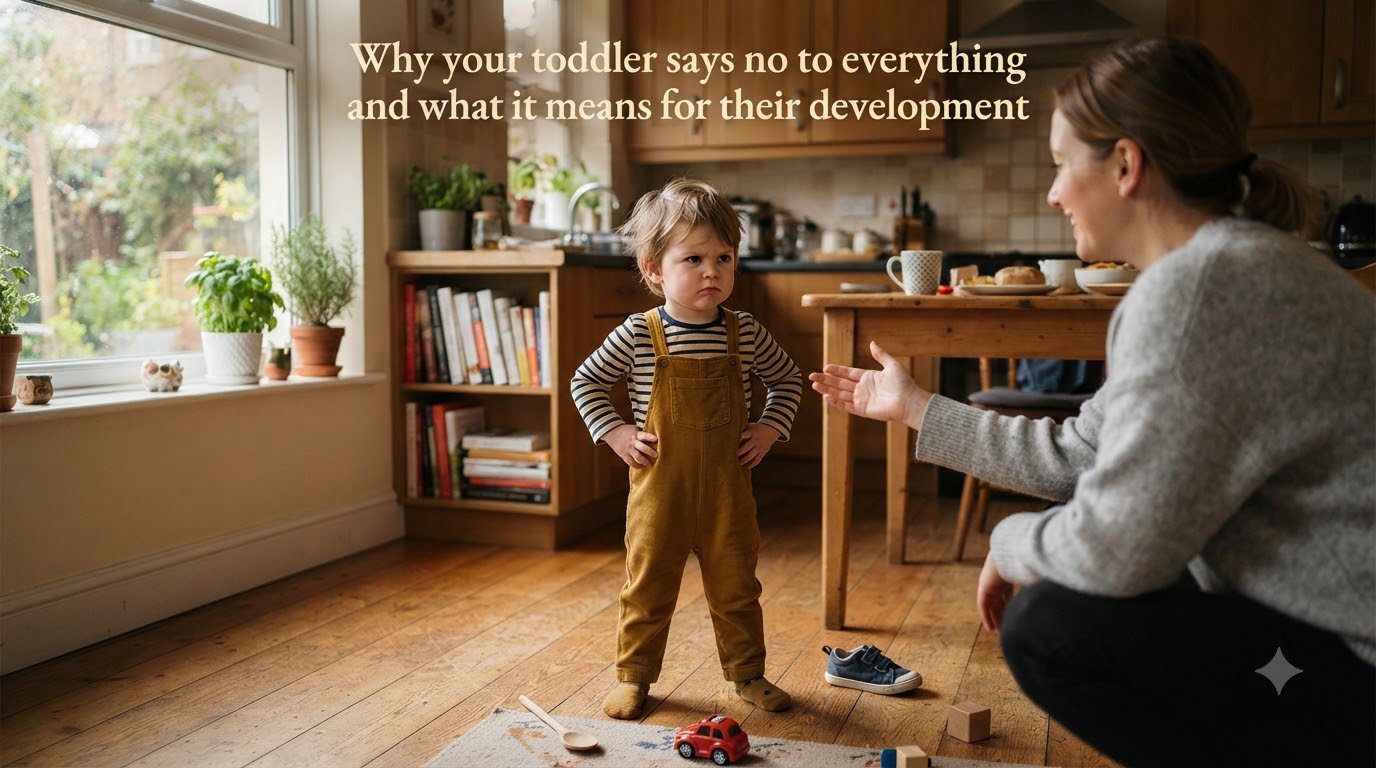
You ask your toddler if they want a banana. They say no. You hand them the banana anyway. They sign “more.” You offer milk. They shake their head, then ask for milk in their cup. By 9 a.m., you have been told “no” forty-three times.
If this sounds like your morning, take a breath. Your toddler says no to everything because their brain is doing exactly what it should be doing between 18 and 36 months. This phase is normal, temporary, and one of the most important stages of early child development.
In this guide, I’ll walk you through what’s actually happening inside your toddler’s head, why the word “no” is a sign of healthy growth, and what you can do when it feels like every request turns into a power struggle. I’ve pulled from developmental research, conversations with parents in our community, and years of working with families through this exact season.
Table of Contents
Why Toddlers Say No to Everything: The Developmental Explanation
Toddlers say no to everything because they are practicing two skills at once: language and independence. Between roughly 18 and 36 months, your child’s vocabulary explodes, and the word “no” is one of the most powerful tools in their new kit.
When a toddler says no, they are not being rude or manipulative. They are discovering that they have a voice that can shape the world around them. Until recently, they were a baby who went along with whatever happened. Now they realize that the word “no” can stop a parent in their tracks, change a plan, or open a negotiation. That is intoxicating for a tiny person.
Three things are happening at the same time:
- Your toddler is developing a sense of self as separate from you.
- They are testing cause and effect: what happens when I say this word?
- They are learning that they have preferences, and those preferences matter.
This is also the window where speech development in toddlers accelerates, which means even shy kids suddenly find their words. “No” is often the first word they own completely.
The Brain Science Behind Toddler Defiance
To understand why your toddler can’t just “go with the flow,” it helps to know what’s happening neurologically. Your toddler’s brain is under construction, and the part that handles flexibility, impulse control, and emotional regulation is one of the last to finish.
The frontal lobe, located behind the forehead, is responsible for executive function. This is the part that lets an adult pause, think, and choose a calm response instead of reacting. In toddlers, this area is still forming neural connections at a rapid pace. It will not be fully developed until their mid-twenties.
Dr. Dan Siegel describes this with his “flipping the lid” model. When a toddler is tired, hungry, or overwhelmed, their lower brain (the emotional, reactive part) takes over. Their upper brain (the thinking, regulating part) goes offline. Saying “no” pushed them into that lower brain. They literally cannot access flexible thinking in that moment.
This is why a toddler who happily put on their shoes at home melts down when asked to do it at the park. Same request, different state. Capacity matters more than willingness.
What Your Toddler Is Really Telling You
When your toddler shouts “no” at the swing they begged to go on, they are not being dishonest. They are telling you something important: I need to feel in control of something today.
Tiny humans live in a world where almost everything is decided for them. They cannot drive, dress themselves easily, or reach the cup they want. Saying “no” gives them a sense of agency. It is one of the only verbs they own.
Parents often notice their toddler says no even to things they clearly want. A bowl of blueberries is refused, then cried for five minutes later. This is not confusion. This is the toddler wanting to be the one who decides, not the one who is offered to.
What looks like defiance is really a draft of self-advocacy. Your toddler is learning to have a preference and voice it. That same skill, refined over years, becomes the adult who can say no to a job that is not right, leave a relationship that harms them, or stand up for a friend.
Why Saying No Now Builds Confidence Later
I want to reframe something our culture gets wrong. We call this the “terrible twos,” but many child development researchers now call it the “tremendous twos.” The defiance you are seeing is the foundation of healthy independence.
A toddler who practices saying no is rehearsing for a lifetime of knowing their own mind. They are learning where they end and another person begins. They are practicing the boundary-setting that protects them as teenagers and adults.
Consider the toddler who never says no. They may grow into a child who goes along with peers who pressure them, an adult who struggles to leave toxic workplaces, or a person who cannot identify what they actually want. Saying no early, in a safe relationship with you, is a rehearsal for saying no later in situations that matter.
This does not mean every “no” should be respected. Toddlers still need clear boundaries for safety and health. But the impulse itself is something to welcome, not fear.
Practical Strategies for Parents in the Moment
Knowing the “why” helps, but you still need tools for breakfast. Here are the strategies that have worked for families I work with, plus sample scripts you can use today.
1. Offer Two Real Choices
“Do you want the red cup or the blue cup?” Both options are yours to approve. Your toddler gets the feeling of control. You avoid the meltdown. This is one of the most useful tools during potty training and beyond.
2. Get Down on Their Level
Kneel so your eyes meet theirs. Use a calm, low voice. Eye contact plus physical proximity communicates safety, which helps their upper brain come back online.
3. Name What They Are Feeling
“You really wanted to keep playing. It is hard to stop.” Naming the emotion does not give in to it. It teaches your toddler that feelings are real and survivable.
4. Give Them a Job
“Can you carry the diaper to the changing table?” Toddlers love contributing. Turning a demand into a mission sidesteps resistance. You can also try sensory activities for toddlers to channel their need for control into productive play.
5. Use “When, Then” Statements
“When we put on shoes, then we can read a book.” This respects their autonomy while keeping the routine.
6. Keep Your Voice Steady
Yelling triggers their lower brain. A calm voice invites their upper brain to engage. You do not have to be perfectly calm. You just have to be mostly calm.
7. Build in Predictable Routines
Tantrums often spike when toddlers feel out of control. Predictable meal, nap, and bedtime routines reduce the overall volume of “no” responses because the day feels safe.
For more on how structure supports child development, see our piece on why boredom is actually good for kids.
What Is Co-Regulation and Why It Works
Co-regulation is the practice of staying calm yourself in order to help your child calm down. It sounds simple, but it is a powerful teaching tool.
Tiny humans cannot regulate their emotions alone. Their nervous systems borrow from the adults around them. If you match their panic, they escalate. If you offer a steady presence, they eventually borrow your steadiness.
Co-regulation does not mean ignoring the behavior or letting them run the show. It means lowering your voice, slowing your breath, and staying connected even while holding the limit. “I hear you. You are so upset. I am right here. We are leaving the park now.”
This is also where your own self-care comes in. A parent who is running on four hours of sleep and no support will struggle to offer co-regulation. Building your own reserves, asking for help, and taking breaks when you can, is part of the work.
When to Talk to Your Pediatrician
Most toddlers go through an intense “no” phase, and it does not mean anything is wrong. However, there are a few situations worth flagging at your next well-child visit.
Talk to your pediatrician if your toddler:
- Does not respond to their own name by 12 months.
- Has lost words or skills they once had.
- Shows no interest in connecting with you or other caregivers.
- Has very limited eye contact or repeated, unusual movements.
- Says no to nearly everything for more than a few months with no break, even in low-stress settings.
It is also worth asking if your toddler is in a developmental phase of typical defiance or if something else, like sensory overload, anxiety, or a developmental difference, might be contributing. A good pediatrician will listen without alarm and help you sort it out.
Remember: every child develops on their own timeline. Most toddlers who say no to everything are simply doing the work of becoming themselves.
Frequently Asked Questions
Is it normal for a 2 year old to say no to everything?
Yes. Saying no constantly between 18 and 36 months is a normal part of toddler development tied to language growth, independence, and testing cause and effect. Most children move through this phase by age 3 to 4.
Why does my toddler say no even to things they want?
Toddlers often refuse things they want because the act of refusing gives them a feeling of control. It is not confusion or dishonesty. They are practicing the skill of having preferences and voicing them.
How long does the toddler no phase last?
The most intense phase usually peaks between 2 and 3 years old and eases by age 4. Some children move through it faster, some slower. Consistent, calm responses help it pass more smoothly.
How do I handle my toddler saying no without yelling?
Get on their level, use a calm voice, name their feeling, offer two acceptable choices, and use when-then statements. Co-regulation, where you stay calm so they can borrow your calm, works better than matching their intensity.
Does saying no a lot mean my toddler is smart?
Saying no reflects strong language development, self-awareness, and a desire for independence, all signs of healthy cognitive growth. It does not diagnose intelligence on its own, but it does show your child is actively learning how to think and decide.
When should I worry about my toddler saying no?
Talk to your pediatrician if your child has lost skills they once had, shows little interest in connecting with you, has very limited eye contact, or if the refusal extends for many months with no break even in calm settings.
Final Thoughts on the ‘No’ Phase
If your toddler says no to everything, you are not failing. You are parenting a child who is actively building the neural pathways for independence, language, and self-advocacy. This is hard, exhausting, occasionally mortifying in the grocery store work. It is also a sign that you have raised a small person who knows they have a voice.
The next time you hear “no” for the hundredth time today, try this: pause, get down on their level, and remind yourself that they are practicing something they will need their whole life. Then offer two choices, breathe, and know that this phase is doing its work. If you are looking for developmental gifts that support this stage, our guide has age-appropriate recommendations.
Your toddler will not always say no to everything. One day, slowly, they will start saying yes to more, and you will find you miss the fierce little negotiator who insisted on wearing rain boots in July. For now, hold the boundary, hold your nerve, and trust the process.