
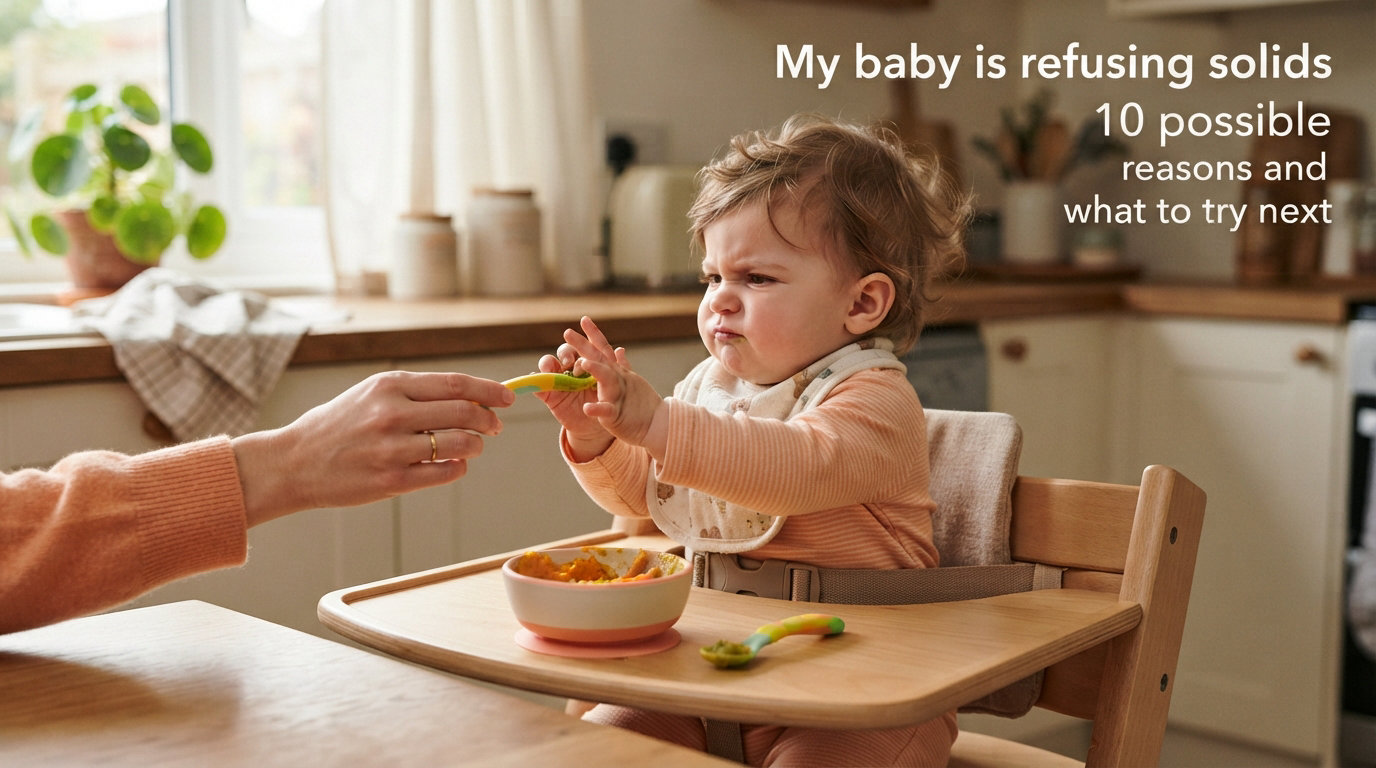
Nothing prepares you for the frustration of offering your baby a carefully prepared meal only to have them turn their head, clamp their mouth shut, or burst into tears. If your baby is refusing solids, you are not alone. This is one of the most common concerns I hear from parents, and it can trigger real worry about whether your baby is getting enough nutrition.
Baby refusing solids is incredibly common, especially between 6 and 12 months. Most of the time, food refusal is temporary and resolves with patience and the right approach. I have worked with hundreds of families navigating this phase, and I want to share what actually works.
In this guide, you will learn the 10 most common reasons babies refuse solids and exactly what to try for each situation. We will cover age-specific guidance and when food refusal truly warrants professional help. By the end, you will have a clear roadmap for moving forward with confidence.
Table of Contents
What Does Baby Refusing Solids Mean?
Baby refusing solids means your infant shows resistance or disinterest in eating food other than breast milk or formula. This can look like turning away from the spoon, spitting out food, crying at mealtimes, or simply not opening their mouth.
Food refusal differs from normal pickiness. Brief hesitation with new foods is expected. Persistent refusal across multiple foods or mealtimes indicates something worth addressing. Understanding the difference helps you respond appropriately without unnecessary stress.
Quick Checklist: Is Your Baby Ready for Solids?
Before diving into the reasons for food refusal, let’s confirm your baby is actually developmentally ready for solids. Starting too early is a leading cause of refusal.
Your baby is likely ready for solids when they show these signs:
They can sit upright with minimal support and hold their head steady
They have lost the tongue thrust reflex (pushing food out with tongue)
They show interest in food by reaching for or watching you eat
They can pick up objects and bring them to their mouth
They are at least 4-6 months old, ideally closer to 6 months
They open their mouth when food approaches (even if just exploring)
If your baby is under 4 months or showing the tongue thrust reflex consistently, their body is literally not ready to handle solids. This is not a behavior issue; it is biology. Waiting a few weeks can make all the difference.
My Baby Is Refusing Solids: 10 Possible Reasons and What to Try Next
Here are the 10 most common reasons babies refuse solids, starting with the developmental factors and moving through environmental and behavioral causes. Each reason includes practical solutions you can try today.
Reason 1: Baby Is Not Developmentally Ready
The tongue thrust reflex and extrusion reflex are protective mechanisms that push foreign objects out of your baby’s mouth. These reflexes usually diminish around 4-6 months but can persist longer in some babies. If these reflexes are still strong, your baby will automatically push food out, appearing to refuse it.
What to try: Check for tongue thrust by gently touching your baby’s lip with a clean finger. If their tongue pushes forward automatically, wait 1-2 weeks and try again. Focus on readiness signs like sitting independently and reaching for food rather than age alone.
Patience is your best tool here. Forcing food before your baby is ready can create negative associations that make future feeding harder. Trust their developmental timeline.
Reason 2: Baby Is Not Hungry Enough
Many babies refuse solids simply because they are not hungry. If milk feeds are too close to solid food attempts, your baby may have no appetite left. This is especially common for breastfed babies who nurse on demand.
What to try: Space milk feeds and solid meals by at least 1-2 hours. Offer solids when your baby shows hunger cues like increased alertness, rooting, or reaching for food. For most babies, mid-morning (about an hour after the first milk feed) works well.
Remember that under 12 months, milk should remain the primary nutrition source. Solids are for exploration and learning at this stage, not replacing milk calories.
Reason 3: Baby Is Too Tired to Eat
Timing matters enormously. A tired baby cannot focus on learning a new skill like eating solids. If your baby is rubbing their eyes, becoming fussy, or showing other tiredness signs, mealtimes will likely fail.
What to try: Schedule solid food attempts about an hour after your baby wakes up from a nap. Avoid feeding right before naps or bedtime when tiredness peaks. Watch your baby’s wake windows and plan accordingly.
Most 6-month-olds need about 2 hours of awake time before getting tired. By 9-12 months, this stretches to 3-4 hours. Align meals with these natural energy patterns.
Reason 4: Baby Is Teething or Feeling Unwell
Teething pain, ear infections, colds, and general illness are common culprits behind sudden food refusal. A sore mouth or throat makes eating uncomfortable. Many parents report their baby was eating fine, then suddenly refused solids during a teething episode.
What to try: Offer softer, cooler foods during teething periods. Cold purees, yogurt, or chilled fruit can feel soothing. If illness is present, focus on hydration and milk feeds rather than pushing solids. Return to normal feeding attempts once your baby feels better.
Sudden refusal after previously eating well is one of the strongest indicators that teething or illness is the cause. This type of refusal usually resolves within a few days to a week.
Reason 5: Baby Is Experiencing Gas or Constipation
Digestive discomfort can make your baby associate eating with pain. Constipation is particularly common when starting solids as your baby’s GI tract adjusts to processing new foods. A backed-up baby will not want to add more food to the problem.
What to try: Include fiber-rich foods like prunes, pears, and vegetables in your rotation. Ensure adequate hydration through milk feeds and small sips of water (appropriate for age). If constipation persists, talk to your pediatrician about safe remedies.
Pay attention to your baby’s bowel movement patterns. A comfortable digestive system supports better eating behaviors and reduces food refusal linked to discomfort.
Reason 6: Baby Is Too Distracted
Modern life brings constant stimulation. TVs, phones, siblings running around, pets, and noisy environments can overwhelm a baby trying to focus on eating. Some babies are more sensitive to distraction than others.
What to try: Create a calm eating environment. Turn off screens, reduce background noise, and minimize activity around the highchair. Face your baby toward a neutral wall or away from busy areas. Some families find early morning meals work best before the household gets busy.
Your attention is the most interesting thing to your baby. Engage with them during meals rather than multitasking. This connection often encourages better eating.
Reason 7: Texture Aversions or Sensory Issues
Some babies are naturally more sensitive to textures than others. They may gag on lumpy purees, refuse wet or slimy foods, or only accept very smooth textures. This is often called sensory processing sensitivity and is usually temporary.
What to try: Start with textures your baby accepts and gradually introduce variations. If purees are rejected, try thicker consistencies or move to soft finger foods. Some babies prefer the control of self-feeding over being spoon-fed.
Repeated gentle exposure is key. Research shows babies may need 10-15 exposures to a new texture before accepting it. Do not give up after the first few rejections.
Reason 8: Highchair Positioning Is Uncomfortable
Poor positioning makes swallowing difficult and unsafe. The “90-90-90 rule” is the gold standard: hips at 90 degrees, knees at 90 degrees, and ankles at 90 degrees. Many highchairs do not support this positioning, especially for younger babies.
What to try: Add a footrest if your baby’s legs dangle. Use rolled towels for side support if your baby slumps. Ensure the tray is at chest height, not up near the face. A well-positioned baby can focus on eating rather than balancing.
Test your baby’s highchair positioning by checking if they can easily reach and pick up food. If they are straining or struggling to maintain posture, adjust the chair before pushing more food.
Reason 9: Baby Feels Too Much Pressure
Pressure feeding backfires. When parents push, coax, or become visibly stressed about eating, babies pick up on this anxiety. They may refuse food as a response to the tension or as a way to exert control.
What to try: Adopt the Division of Responsibility feeding approach (explained in detail below). Your job is to offer food; your baby’s job is to decide whether and how much to eat. Remove emotional investment from whether they take a bite. Stay neutral and calm.
If mealtimes have become stressful, take a break for a few days and return with a fresh, pressure-free approach. Sometimes a reset is exactly what both parent and baby need.
Reason 10: Baby Wants More Control Over Feeding
Many babies resist being spoon-fed because they want to feed themselves. This developmental drive for independence is healthy and should be encouraged when safe. Some babies show immediate preference for self-feeding approaches.
What to try: Offer safe finger foods your baby can pick up independently. Soft cooked vegetables, ripe fruit pieces, and well-cooked pasta are good starters. Let your baby explore at their own pace, even if most food ends up on the floor initially.
The exploration phase is learning. Mess is part of the process. Your baby is developing motor skills, understanding cause and effect, and building confidence with food.
Age-Specific Guidance: What to Expect at Different Stages
Food refusal looks different at various ages. Understanding what is typical for your baby’s developmental stage can reduce anxiety and help you set realistic expectations.
6 Months Old: The Beginning
At 6 months, minimal solid intake is completely normal. Many babies take only a few bites or simply play with food during the first month. Milk should remain the primary nutrition source. Focus on exposure and exploration rather than consumption.
What to try: Offer solids once daily, about an hour after a milk feed. Keep sessions short, 10-15 minutes max. If your baby shows no interest, try again in a week or two. Every baby develops on their own timeline.
7-9 Months Old: Building Interest
By 7-9 months, most babies show increased interest in food. They may want to touch, smash, and experiment with textures. Some will begin accepting more volume, though milk remains essential. This is a common age for texture-related refusal as babies encounter lumpier foods.
What to try: Increase to 2-3 solid meals daily. Offer a mix of purees and finger foods. Watch for the pincer grasp developing around 8-9 months, which enables picking up small pieces. Gradually increase texture complexity.
9-12 Months Old: Skill Development
Between 9-12 months, babies typically become more intentional eaters. They understand that food relieves hunger and may show preferences. Self-feeding skills improve. Food refusal at this stage often relates to teething, independence-seeking, or becoming more selective.
What to try: Offer 3 meals plus snacks. Encourage self-feeding with appropriate finger foods. Continue offering rejected foods alongside accepted ones. Model eating the same foods yourself.
12 Months and Up: Toddler Patterns
After 12 months, toddlers often become more selective. This is developmentally normal and does not mean you did anything wrong. Growth slows, appetite fluctuates, and independence peaks. Some days your toddler will eat everything; other days, hardly anything.
What to try: Continue offering varied foods without pressure. Avoid becoming a short-order cook. Trust your toddler’s hunger cues. By 12 months, most babies can eat what the family eats with appropriate modifications.
Understanding the Division of Responsibility in Feeding
The Division of Responsibility, developed by feeding expert Ellyn Satter, is the single most helpful framework for addressing baby refusing solids. It clarifies roles and eliminates the power struggles that often develop around feeding.
Here is how it works: As the parent, you are responsible for what food is offered, when it is offered, and where it is offered. Your baby is responsible for whether they eat and how much they eat. No arguing, negotiating, or forcing.
This approach removes pressure from both sides. You do your job by providing nutritious options at regular intervals. Your baby does their job by listening to their body. Some meals they will eat more; some less. Both are acceptable.
When parents violate this division by pressuring, bribing, or restricting, babies often respond with increased refusal. Food becomes a battleground rather than nourishment. Returning to these defined roles typically resolves refusal within days or weeks.
Trust that your baby will not starve themselves. When offered regular, balanced meals and snacks, children naturally regulate their intake over time. Your confidence in this process helps your baby develop a healthy relationship with food.
When to Worry and Seek Professional Help
Most food refusal is temporary and resolves with the strategies above. However, certain situations warrant professional evaluation. Knowing these red flags helps you distinguish normal phases from concerning patterns.
Contact your pediatrician or a feeding specialist if you observe any of the following: your baby loses weight or fails to gain weight appropriately; your baby gags, vomits, or shows extreme distress with most foods; refusal persists beyond 2-3 weeks despite trying multiple strategies; your baby shows signs of dehydration; or your gut tells you something is not right.
Pediatric feeding therapists, including occupational therapists and speech-language pathologists, specialize in evaluating eating difficulties. They can assess oral motor skills, sensory processing, and swallowing safety. Early intervention is highly effective.
If your baby has been refusing solids for several months and is approaching 12 months with minimal intake, seek professional guidance sooner rather than later. While many babies catch up naturally, targeted support can prevent prolonged struggles.
Remember that seeking help is a strength, not a failure. Feeding challenges are complex and often multifactorial. Professional support provides clarity and a structured plan forward.
Frequently Asked Questions
What to do if baby refuses solid food?
If your baby refuses solids, start by checking their developmental readiness and hunger levels. Ensure they are not too tired or full from milk feeds. Try different textures, reduce distractions, and eliminate pressure at mealtimes. Offer food when they are alert and calm. If refusal persists beyond a few weeks, consult your pediatrician.
What is the 3 6 9 rule for babies?
The 3 6 9 rule refers to timing expectations for solid food introduction. Around 3 months, babies show curiosity about food but are not ready. By 6 months, most babies meet developmental milestones for starting solids. At 9 months, many babies eat 3 meals daily with increasing texture variety. Remember these are guidelines, not strict requirements.
Why is my 10 month old suddenly refusing solids?
Sudden food refusal at 10 months is most commonly caused by teething, illness, or a developmental leap. Your baby may also be asserting independence or reacting to changes in routine. Check for signs of discomfort, offer softer foods during painful teething periods, and maintain calm, pressure-free mealtimes. This phase typically passes within days to a week.
Is it normal for an 8 month old to not eat solids?
Yes, it is normal for an 8-month-old to eat minimal solids. Many babies at this age are still learning and exploring. Milk should remain the primary nutrition source until 12 months. Focus on exposure rather than consumption. If your baby shows interest but struggles with textures, try different consistencies or allow more self-feeding opportunities.
Is 7 months too late for solids?
No, 7 months is not too late for solids. While many babies start around 6 months, starting at 7 months is perfectly fine if your baby was not developmentally ready earlier. Some babies, particularly breastfed infants, show minimal interest until closer to 8-9 months. Follow your baby’s readiness cues rather than arbitrary timelines.
Can a 7 month old skip solids for a day?
Yes, a 7-month-old can absolutely skip solids for a day without any harm. Under 12 months, breast milk or formula provides complete nutrition. Solids are supplementary for practice and exploration. If your baby is teething, sick, or simply not interested, focus on milk feeds and try solids again the next day. No need to worry about occasional skipped meals.
FAQs
Baby refusing solids is one of the most stressful challenges parents face, but it is also one of the most common. The vast majority of babies move through this phase and develop healthy eating patterns with time and patience.
Remember the key principles: check developmental readiness, time meals appropriately, eliminate pressure, create a calm environment, and trust your baby’s hunger cues. Most food refusal resolves when parents shift from trying to get their baby to eat to simply offering food without attachment to the outcome.
Your baby will not starve themselves. They are learning a complex skill during a period of rapid development. Some bumps along the way are completely normal. With the strategies in this guide, you have everything you need to navigate this phase with confidence and reduce stress for both you and your baby.
If concerns persist beyond the timelines discussed here, professional support is available and effective. Trust your instincts, but also trust the process. Feeding challenges, while difficult in the moment, are usually temporary phases that pass with patience and the right approach.