
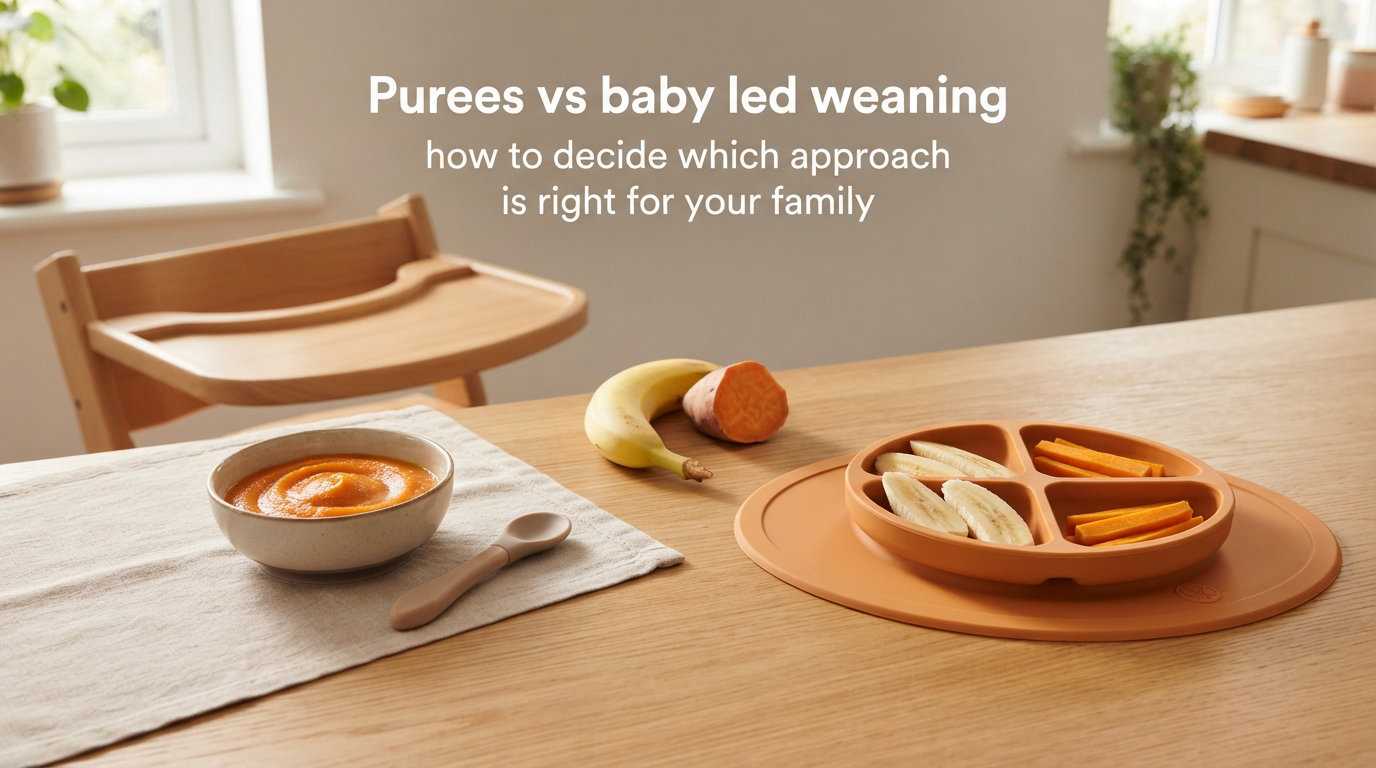
If you’re staring at jars of organic sweet potato puree while your friend posts photos of her six-month-old gnawing on a lamb chop, you’re not alone. The purees vs baby led weaning debate has become one of the most confusing decisions new parents face when starting solids.
Our team has worked with hundreds of families navigating this choice. After years of conversations with pediatricians, dietitians, and fellow parents, one truth keeps emerging: both methods can raise healthy, happy eaters. The “best” approach isn’t the one trending on Instagram. It’s the one that works safely for your baby, your family dynamics, and your comfort level.
In this guide, we’ll walk through everything you need to make a confident decision. You’ll learn what each method actually involves, the honest pros and cons of both, how to tell if your baby is truly ready, and a practical framework for choosing what’s right for your unique family situation.
Table of Contents
What Are Purees vs Baby-Led Weaning?
Before weighing the options, it helps to understand exactly what each feeding approach entails. Both are valid methods of complementary feeding, which simply means adding solid foods to your baby’s existing milk or formula intake.
Traditional Spoon-Fed Purees
The purees method is what most of us picture when we think of starting solids. You prepare smooth, mashed foods and spoon-feed them to your baby. Textures gradually progress from completely smooth to slightly chunky, eventually reaching soft table foods around 9 months of age.
This approach has been the standard recommendation for decades. You’ll find shelves of store-bought purees at every grocery store, and many parents enjoy making their own batches to freeze. The method gives you precise control over portions and ensures your baby consumes specific amounts of food.
Baby-Led Weaning (BLW)
Baby-led weaning flips the script entirely. Instead of spoon-feeding smooth purees, you offer your baby soft, finger-sized pieces of appropriate family foods from the very first bite. Your baby controls what goes into their mouth, how much they eat, and the pace of their meal.
Babies grasp the food, explore it, and self-feed at their own pace. Proponents emphasize that this approach honors a baby’s natural appetite regulation and builds independence from day one of solids introduction.
The Combination Approach
Here’s what many articles miss: you don’t have to choose just one method. The combination approach mixes both feeding styles, offering your baby finger foods for self-feeding alongside purees at different meals or even within the same meal.
In our experience, this flexible approach works beautifully for many families. You might do BLW at home where you can manage the mess, while daycare handles purees more easily. Or you might offer oatmeal for breakfast and soft roasted vegetables for dinner. The flexibility can reduce stress while still exposing your baby to a variety of textures and feeding experiences.
At-a-Glance Comparison
| Factor | Traditional Purees | Baby-Led Weaning |
|---|---|---|
| Age to start | 4-6 months (earlier if showing readiness) | 6 months (must sit independently) |
| Food texture | Smooth, gradually progressing | Soft finger foods from the start |
| Who controls feeding | Parent or caregiver | Baby self-feeds |
| Mess level | Moderate | Significant |
| Time commitment | Prep + dedicated feeding time | Baby eats at family pace |
| Cost | Store-bought or homemade options | Uses family food, less waste later |
| Best for | Parents wanting control, earlier starters | Families wanting shared meals, independence |
Baby-Led Weaning: Pros and Cons
Baby-led weaning has gained significant popularity over the past decade, and for good reason. But like any parenting choice, it comes with trade-offs. Let us break down what we’ve observed working with families who choose this path.
The Benefits of Baby-Led Weaning
Promotes independence and self-regulation. From their very first exposure to food, babies learn to recognize their own hunger and fullness cues. They decide when to start eating, how much to consume, and when to stop. Research suggests this early autonomy may help prevent overeating later in childhood.
Develops fine motor skills and hand-eye coordination. Picking up small pieces of food, bringing them to the mouth, and manipulating different textures builds essential motor skills. The oral motor development from managing varied textures may also support speech development.
Exposes babies to diverse textures and flavors early. Instead of weeks or months of only smooth foods, BLW babies encounter soft, chewy, slippery, and crumbly textures right away. This early exposure may reduce picky eating behaviors later. Studies have shown that babies who experience more texture variety in their first year accept a wider range of foods as toddlers.
Simplifies family mealtimes. Your baby eats modified versions of what you’re eating, at the same time you’re eating it. No separate cooking, no sitting at the table long after you’ve finished while you spoon-feed. Family meals become genuinely shared experiences.
May reduce food waste long-term. While early BLW involves some waste as babies explore, they typically transition to family foods more quickly. You’re not buying specialized baby food for months on end.
The Challenges of Baby-Led Weaning
Significant mess. This is the reality check every BLW parent needs. Food will be dropped, thrown, smeared into hair, and ground into the high chair. You’ll need a good cleanup routine and possibly a drop cloth under the high chair. Some parents find the mess anxiety-inducing.
Gagging can look alarming. Gagging is a normal, protective reflex that helps babies learn to manage food. It’s actually a sign the system is working. However, it looks dramatic and can trigger parental anxiety about choking. Understanding the difference between gagging and choking is essential before starting BLW.
Harder to track nutritional intake. When babies self-feed, you can’t measure exactly how much they’ve consumed. This causes stress for some parents, especially if their baby seems to play with food more than eat it. Iron intake is a particular concern, as babies need iron-rich foods daily and some struggle to consume enough through self-feeding alone.
Not always practical for all families. If you rely heavily on childcare, travel frequently, or have limited time for family meals, BLW can be challenging. Not all daycare providers are comfortable with or allowed to do BLW. Some families simply don’t eat the types of foods suitable for early BLW due to dietary restrictions or cultural preferences.
Requires more vigilance during meals. While choking risk is low when following safety guidelines, you need to stay present and attentive during BLW meals. Multi-tasking while your baby eats becomes more difficult.
Traditional Purees: Pros and Cons
The traditional purees method has been the standard approach for generations of parents. Modern research and practice have refined it, but the core concept remains: smooth foods introduced gradually, with parents or caregivers controlling the feeding process.
The Benefits of Traditional Purees
Precise portion control and tracking. You know exactly how much your baby has eaten. For parents of babies with growth concerns, those born prematurely, or babies with specific nutritional needs, this visibility provides peace of mind. Tracking iron and nutrient intake is straightforward when you measure each serving.
Can start slightly earlier. Babies can begin smooth purees around 4-6 months, sometimes earlier than the 6-month guideline often cited for BLW. If your baby shows signs of readiness before sitting independently, purees may be the appropriate first step.
Familiar texture progression. The gradual move from smooth to lumpy to soft pieces follows a clear developmental path. Many parents appreciate this structured approach. You know when to advance textures based on clear milestones.
Less messy initially. A spoon goes directly from jar or bowl to baby’s mouth. While some mess is inevitable with any feeding method, the early weeks of purees involve considerably less food on the floor, walls, and baby’s face compared to BLW.
Convenient for on-the-go and childcare. Pre-packaged purees make feeding away from home simple. Most childcare providers are experienced with and equipped for spoon-feeding. The logistics of purees fit easily into varied family schedules.
Can be made baby-led too. Here’s a nuance often missed: purees can be offered in a baby-led way. Pre-load a spoon and hand it to your baby, or offer a bowl of thick oatmeal for them to scoop with their hands. This maintains self-feeding principles while using smooth textures.
The Challenges of Traditional Purees
Delayed exposure to varied textures. If parents stick with smooth purees too long, babies may develop texture aversions. The window for optimal texture acceptance is roughly 6-10 months. Missing this window can contribute to picky eating.
Time-intensive preparation or cost. Making your own purees requires steaming, blending, and storing batches. Buying pre-made options adds up financially. Either way, there’s a significant time or money investment in the early months.
Less independence for baby. When parents control the spoon, babies have fewer opportunities to practice self-regulation. Some babies may become passive eaters who don’t recognize their own fullness cues as readily.
Separation from family meals. If you’re spoon-feeding while the rest of the family eats, mealtimes become fragmented. Babies miss the social modeling that happens when everyone eats together.
Transition period required. Eventually, every baby must move to table foods. The transition from purees to finger foods requires intentional effort and can be challenging for some babies. This transition typically happens around 8-9 months regardless of starting method.
The Combination Approach: Doing Both
After helping countless families navigate starting solids, we’ve noticed something: many parents naturally drift toward a middle path. They offer purees at breakfast and finger foods at dinner. They let daycare do spoon-feeding while doing BLW at home on weekends. This combination approach isn’t a compromise or a failure to commit. It’s often the most practical, flexible solution.
Why Families Choose Combination Feeding
Flexibility for different situations. Real life rarely fits neatly into one method. You might love BLW at home but your childcare provider prefers purees. Your baby might devour purees when teething but prefer finger foods on good days. Combination feeding adapts to your reality.
Best of both worlds. You get the texture exposure and independence benefits of BLW alongside the control and convenience of purees. Babies learn multiple feeding skills simultaneously: using utensils, self-feeding with hands, and accepting varied textures.
Reduces parental anxiety. If you’re worried about nutrition intake, offering some measured purees can ease those concerns while still giving your baby self-feeding opportunities. If the mess of full BLW overwhelms you, doing it at some meals but not all creates balance.
Respects baby’s preferences. Some babies strongly prefer one method over another, and their preferences may shift day to day. Combination feeding lets you follow your baby’s lead rather than forcing adherence to a philosophy.
Practical Tips for Combination Feeding
If you decide to combine methods, here are strategies that work well:
Offer both at the same meal. Start with some finger foods for self-feeding, then offer a puree at the end. Or offer pre-loaded spoons of puree alongside soft finger foods on the tray. This gives your baby choices and experiences both textures.
Assign methods to different meals. Breakfast might be oatmeal and pureed fruit you help with, while dinner is soft roasted vegetables your baby feeds themselves. This creates routine while still offering variety.
Use purees as dips. Thick purees can be dipping sauces for soft finger foods. Hummus, yogurt, and mashed avocado make excellent dips that combine both feeding styles in one bite.
Communicate with caregivers. If you’re combining approaches across home and childcare, make sure everyone knows what your baby is eating and how. Clear communication prevents confusion and keeps your baby’s feeding experience consistent.
Signs Your Baby Is Ready for Solids
Before choosing a method, you need to know if your baby is actually ready to start solids. Most babies reach this milestone around 6 months, but individual readiness varies. Starting too early can frustrate both you and your baby. Starting too late misses a window of developmental readiness.
The Six Signs of Readiness
Look for these developmental milestones before introducing solid foods:
1. Can sit with minimal support. Your baby needs trunk strength to sit upright safely while eating. For BLW specifically, independent sitting is important so they can lean forward and spit out food if needed. For purees, sitting with support is acceptable.
2. Has good head and neck control. Your baby should hold their head steady and upright without wobbling. This control is essential for safe swallowing.
3. Has lost the tongue-thrust reflex. This reflex causes babies to automatically push foreign objects out of their mouths. When you touch a spoon to their lips, they should open their mouth rather than pushing their tongue forward to reject it.
4. Shows interest in food. Your baby watches you eat, reaches for your food, or opens their mouth when food is nearby. This social interest in eating indicates cognitive readiness.
5. Can bring objects to their mouth. The ability to grasp toys or objects and get them to their mouth demonstrates the coordination needed for self-feeding.
6. Has approximately doubled birth weight. Most babies are ready for solids when they reach about 13 pounds or double their birth weight, whichever comes first.
Readiness Differences by Method
While all babies should show these signs before starting solids, the specific readiness requirements differ slightly between methods:
For traditional purees, babies can start as early as 4 months if showing readiness. They need less developed motor skills because you’re controlling the spoon. Strong head control and loss of tongue-thrust reflex are most important.
For baby-led weaning, most experts recommend waiting until 6 months. BLW requires the ability to sit independently (not just with support), well-developed hand-eye coordination for grasping food, and stronger oral motor skills to manage solid pieces safely.
If your baby shows readiness signs before 6 months, purees may be the appropriate starting point. You can always transition to more self-feeding approaches as their skills develop.
How to Decide Which Approach Is Right for Your Family
Information about both methods is helpful, but many parents tell us they still feel stuck. They need a decision framework, not just facts. After working with hundreds of families, we’ve developed a practical approach to help you choose confidently.
Step 1: Check Your Baby’s Readiness
Review the six signs of readiness above. If your baby meets all criteria and is at least 6 months old, either method is developmentally appropriate. If they’re between 4-6 months and showing some signs, purees might be the better starting point with BLW elements added as they develop.
Step 2: Assess Your Comfort Level
Be honest with yourself. Does the idea of your baby gagging on food terrify you? Traditional purees might reduce that anxiety. Does spoon-feeding feel unnatural or time-consuming? BLW might suit you better. Your comfort matters because babies pick up on parental stress during mealtimes.
Consider your own eating habits too. If your family regularly eats whole, unprocessed foods, BLW fits naturally. If you rely on convenience foods or your diet is limited, purees might be easier to manage initially.
Step 3: Evaluate Your Logistics
Your daily reality shapes which method works best. Ask yourself:
Who will feed the baby most often? If it’s a grandparent or daycare provider who prefers traditional feeding, purees create less friction.
What’s your childcare situation? Many daycare centers are equipped for purees but unfamiliar with or restricted from doing BLW.
Do you eat regular family meals? BLW works best when babies can join existing mealtimes.
How do you handle mess? If a food-splattered baby triggers serious anxiety, purees might be better for your mental health.
Step 4: Consider Your Baby’s Temperament
Some babies strongly indicate their preferences. A baby who grabs the spoon and fusses when fed might thrive with BLW. A baby who prefers being fed and shows less interest in self-feeding might do better with purees initially. Watch your baby’s cues during early feeding attempts.
Step 5: Remember You Can Change Course
This is the most important step. Your decision isn’t permanent. Many families start with one method and switch. Others combine approaches from the beginning. Some start with purees for a few weeks, then transition to more finger foods. The flexibility to adapt is more important than the initial choice.
Switching or Combining Methods
One of the biggest misconceptions about starting solids is that you must commit to one method. In reality, flexibility serves most families better than rigid adherence to a philosophy. Whether you want to switch methods entirely or combine both approaches, here’s how to make transitions smooth.
Transitioning from Purees to Baby-Led Weaning
If you started with purees but want to move toward more self-feeding, the transition can happen gradually. Begin by offering one finger food per meal alongside familiar purees. Soft steamed vegetables, ripe banana pieces, or scrambled eggs work well as starter finger foods.
Let your baby explore the finger food at their own pace while still offering the puree. Over time, you can reduce the purees and increase finger foods as your baby gains confidence. Most babies naturally progress to primarily finger foods by 9 months regardless of how they started.
By 9-10 months, purees should become complementary rather than primary, with soft table foods making up most of the diet. This timeline applies whether you started with BLW or purees.
Adding Purees to a BLW Approach
If you started with BLW but want to incorporate some purees, offer them in a baby-led way. Pre-load spoons with thick purees and let your baby bring the spoon to their own mouth. Offer bowls of thick oatmeal or mashed foods that babies can scoop with their hands.
This maintains the self-feeding, independence-focused approach of BLW while adding the convenience and nutrition tracking that purees offer. Many BLW families naturally include yogurt, applesauce, and other spoon foods using this method.
Navigating Different Approaches at Home and Daycare
This is one of the most common practical challenges parents face. If your childcare provider only does purees but you prefer BLW at home, your baby will adapt to both. Babies are remarkably flexible.
Communicate clearly with your childcare provider about what foods you’re sending and how you’d like them offered. Send appropriate finger foods if your provider is willing to do BLW. If not, focus on BLW during evenings and weekends when you’re together.
Similarly, if grandparents care for your baby and prefer traditional feeding methods, work with them rather than against them. The relationship and your baby’s nourishment matter more than method consistency.
Safety Considerations for Both Methods
Regardless of which feeding approach you choose, certain safety guidelines apply universally. Understanding these basics will help you feed your baby confidently.
Choking Prevention Basics
Choking risk is a concern for all parents starting solids, regardless of method. The good news: research shows no increased choking risk with baby-led weaning when safety guidelines are followed compared to traditional feeding.
Always supervise your baby during eating. Never leave a baby alone with food. Ensure your baby is sitting upright, not reclined. Avoid high-risk choking foods including whole grapes, whole nuts, popcorn, hard raw vegetables, and chunks of meat or cheese.
Cut foods appropriately: round foods like grapes and cherry tomatoes should be quartered, sausages should be sliced lengthwise, and hard foods should be cooked until soft for early eaters.
Understanding Gagging vs Choking
This distinction is crucial for all feeding methods. Gagging is a normal, protective reflex that sounds and looks dramatic but resolves quickly. When gagging, babies make noise, their eyes may water, and they cough or retch. This is the body working correctly to move food forward.
Choking is silent. A choking baby cannot cry, cough, or make sound because their airway is blocked. They may turn blue around the lips. This requires immediate intervention.
Most parents find gagging alarming at first, but it becomes less stressful with experience. Stay calm, don’t panic, and let your baby work through it. Panicking or reaching into their mouth can actually make the situation worse.
Allergen Introduction
Current guidelines recommend introducing common allergens early and often, around 6 months. This includes peanut, egg, dairy, wheat, soy, sesame, fish, and shellfish. Early introduction actually reduces allergy risk.
Introduce one allergen at a time, in small amounts, during a time when you can monitor your baby for at least two hours. Watch for hives, vomiting, or difficulty breathing. Once a food is successfully introduced, continue offering it regularly to maintain tolerance.
Frequently Asked Questions
Is it better to do baby-led weaning or purees?
Neither method is definitively better. Research shows both baby-led weaning and purees can result in healthy, happy eaters when done responsively. Baby-led weaning emphasizes independence and texture exposure, while purees offer more control over intake. The best method is the one that works safely for your family’s lifestyle and your comfort level.
Why do pediatricians not recommend baby-led weaning?
Most pediatricians do support baby-led weaning when done safely. Some may initially recommend purees due to concerns about choking risk, iron intake tracking, or difficulty monitoring how much baby eats. However, research shows BLW is safe when parents follow guidelines. If your pediatrician has concerns, discuss them together and share current evidence.
Do purees count as baby-led weaning?
Purees can be part of baby-led weaning if the baby self-feeds them. Pre-loading a spoon with puree and letting your baby bring it to their own mouth keeps the feeding baby-led. Traditional spoon-feeding by a caregiver differs from this self-feeding approach. The key principle is baby control, not food texture.
When to switch from purees to BLW?
You can switch from purees to baby-led weaning at any time. Start by offering soft finger foods alongside familiar purees. Let your baby explore self-feeding with pre-loaded spoons. Gradually increase finger foods as your baby gains confidence. By 9 months, all babies should progress to primarily soft table foods regardless of which method they started with.
What’s better: baby-led weaning or purees?
Neither approach is inherently better. The research shows no significant long-term differences in health outcomes between properly executed baby-led weaning and traditional purees. Both can support healthy growth, appropriate weight gain, and positive relationships with food when done responsively. The better choice depends on your baby’s readiness, your family’s situation, and what feels right for you.
Can you mix baby-led weaning and purees?
Yes, absolutely. Many families successfully combine baby-led weaning and purees. You might offer finger foods at one meal and purees at another, or offer both at the same meal. This flexible approach works well for families and babies. Many parents find combination feeding the most practical solution.
How can I get my baby to progress from purees?
To help your baby progress from smooth purees, gradually increase texture by mashing instead of pureeing, then move to soft lumps. Offer soft finger foods alongside purees so your baby can practice self-feeding. Let them play with textures even if they don’t eat much. By 8-9 months, most babies should handle soft table foods regardless of how they started.
When to stop pureeing baby food?
Most babies are ready to move away from smooth purees by 8-9 months of age. By this point, they typically have the oral motor skills to handle soft, mashed, or finely chopped table foods. Continue progressing textures until your baby eats modified versions of family meals by around 12 months. There’s no need for specialized baby foods beyond the first year.
Purees vs Baby-Led Weaning: Trust Your Family’s Path
After reading through all the information, research, and practical considerations, here’s what we want you to remember: you are the expert on your baby. The purees vs baby led weaning decision matters less than the love, attention, and responsiveness you bring to mealtimes.
Both methods can nurture healthy eaters. Both have valid benefits and real challenges. The families who struggle most are often the ones who feel pressured to follow a specific philosophy rigidly, even when it doesn’t fit their reality.
Here’s your permission slip: choose what feels right today, knowing you can change your approach tomorrow. Start with purees and transition to finger foods when it feels natural. Begin with BLW and add some spoon-fed purees when convenient. Combine both approaches from day one. Your baby will adapt to your family’s needs.
The most important factors aren’t which method you choose. They’re ensuring your baby is developmentally ready, supervising meals attentively, offering a variety of nutritious foods, and responding to your baby’s hunger and fullness cues. Do those things, and your baby will thrive regardless of whether their first food came from a spoon or their own chubby fist.
Starting solids is a milestone to celebrate, not stress over. Trust yourself, trust your baby, and enjoy this messy, wonderful phase of discovery together.