
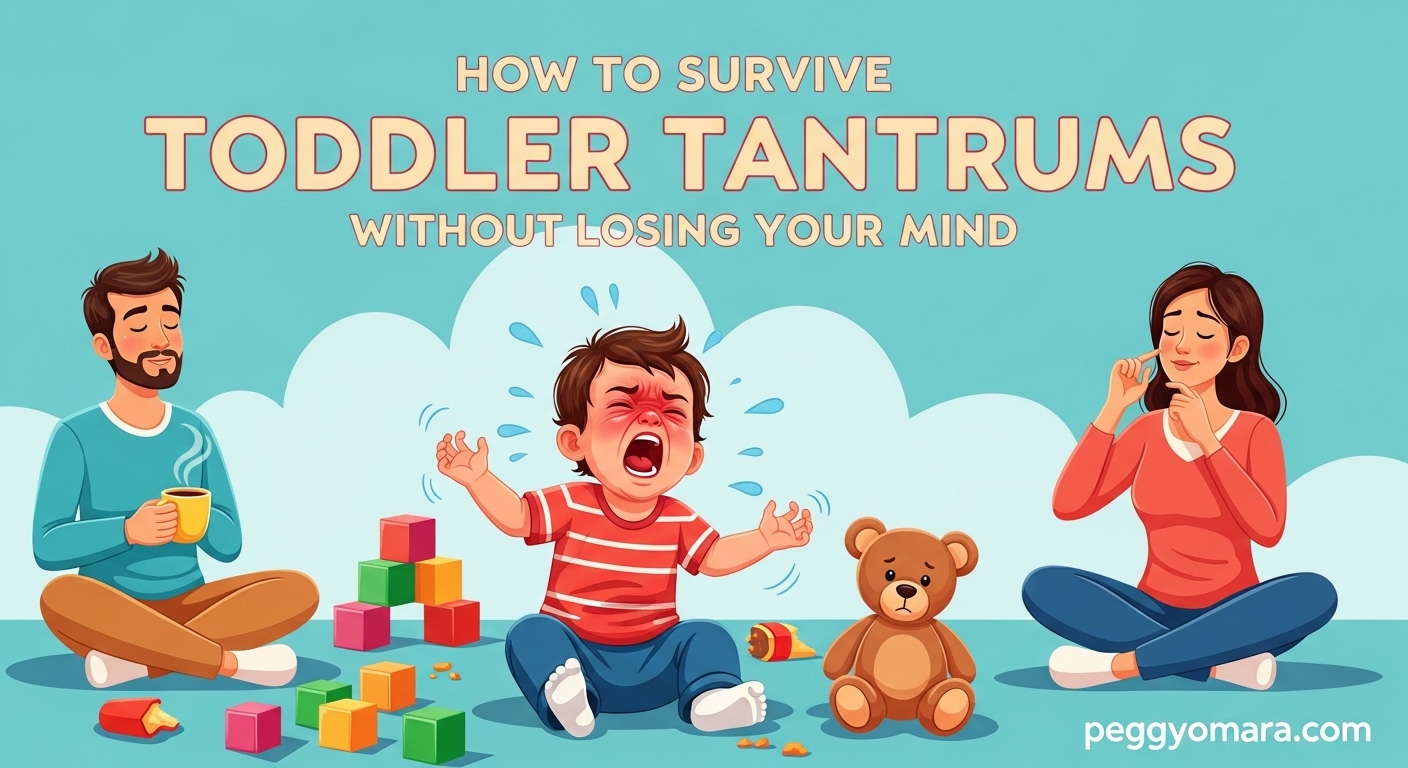
You’re standing in the checkout line at the grocery store. Your two-year-old wanted the blue box of cereal, but you handed them the red one instead. Within seconds, they’re on the floor, kicking, screaming, tears streaming down their face. The line behind you shuffles impatiently. You feel your face flush, your heart race, and that familiar voice in your head whispers: You’re failing at this.
I’ve been there. Every parent has. And here’s what I wish someone had told me sooner: Tantrums aren’t about defiance. They’re about development. Your child isn’t giving you a hard time. They’re having a hard time.
Learning how to survive toddler tantrums without losing your mind isn’t about finding magic tricks to stop them. It’s about understanding what’s happening in your child’s brain, shifting your perspective, and having a plan for the heat of the moment. This guide will give you science-backed strategies, exact scripts you can use when words fail you, and the reassurance that you—and your child—are absolutely normal.
Table of Contents
Quick Tips: How to Handle a Tantrum in the Moment in 2026?
Before we dive deeper, here are the essentials you can use right now:
- Check yourself first. Take three deep breaths. You cannot pour from an empty cup.
- Get on their level. Kneel down to make eye contact. Towering over them feels threatening to a dysregulated nervous system.
- Use fewer words. During a meltdown, language processing shuts down. Keep it simple: “You’re upset. I’m here.”
- Offer connection, not correction. This isn’t the time for teaching. It’s the time for co-regulation.
- Ensure safety. Move them to a safe spot if they’re hitting, throwing, or at risk of injury.
- Don’t take it personally. Their storm isn’t about you. It’s about their overwhelmed brain.
- Wait it out. You can’t rush a tantrum. Your calm presence is the anchor they need.
- Validate without fixing. “You really wanted that toy” works better than “Stop crying, it’s just a toy.”
- Take care of basics later. Check for hunger, fatigue, or overstimulation once they’re calm.
- Repair if needed. If you yelled or lost your cool, apologize once everyone is calm. It models accountability.
Why Toddler Tantrums Happen? (It’s Not What You Think)
Tantrums look like manipulation. They sound like defiance. But underneath the screaming is something much simpler: a developing brain that doesn’t have the tools to handle big emotions yet.
The Brain Science Every Parent Needs to Know
Your toddler’s prefrontal cortex—the part of the brain responsible for rational thinking, impulse control, and emotional regulation—isn’t fully developed. In fact, it won’t be mature until their mid-twenties. Right now, it’s under construction.
Meanwhile, their amygdala—the brain’s alarm system—is fully online and hyperactive. When something triggers big feelings (the wrong cup, the broken cracker, the sibling who touched their toy), the amygdala sounds the alarm. Stress hormones flood their system. Their nervous system enters fight-or-flight mode.
Here’s the critical part: once that stress response activates, the prefrontal cortex goes offline. Your child literally cannot think clearly, cannot access words effectively, and cannot calm themselves down. They’re not choosing to lose control. They’re experiencing nervous system dysregulation.
What Co-Regulation Means (And Why It Matters)
Co-regulation is the process where a child’s nervous system borrows the calm of a regulated adult. When you stay steady during their storm, your regulated breathing, calm voice, and grounded presence literally help their nervous system return to baseline.
Think of it like this: you’re the anchor in their emotional hurricane. The ship (your child) is being tossed around, but the anchor (you) stays firm. Eventually, the storm passes and the ship finds stillness again. Without the anchor, the ship just keeps drifting.
This is why yelling, punishing, or walking away in anger often makes tantrums worse. Your dysregulation feeds theirs. But when you stay calm—not perfectly calm, just calm enough—you become the safe harbor they need.
Are Tantrums Normal?
Absolutely. Research shows that tantrums are a universal developmental milestone, typically emerging around ages 2-3 and gradually declining by age 4-5. Studies from the National Institute of Health indicate that over 85% of children experience regular tantrums during the toddler years.
Tantrums are communication. When your toddler screams because you cut their sandwich into squares instead of triangles, they’re not being ridiculous. They’re expressing frustration with a world they can’t control, using the only tools they have.
The intensity and frequency vary by temperament. Some children have big, explosive reactions. Others have shorter, quieter meltdowns. Both are normal. What’s important is how we respond, not whether our child has them at all.
The Mindset Shifts That Change Everything
Parenting is about 80% mindset and 20% strategies. When you change how you think about tantrums, everything else falls into place. Here are the six mindset shifts that transformed my approach:
Shift 1: It’s Not About You
Your child’s tantrum feels personal. It happens in public. It seems designed to embarrass you. But it isn’t. A tantrum is your child’s internal experience spilling outward. They aren’t trying to manipulate you. They’re trying to cope with feelings too big for their small body.
When I stopped viewing tantrums as attacks on my parenting and started seeing them as cries for help, my entire response changed. I stopped feeling defensive. I stopped worrying about what others thought. I could just show up for my child.
Shift 2: Small Body, Big Feelings
Imagine experiencing rage, grief, and overwhelm without the vocabulary to name it, the experience to know it passes, or the skills to self-soothe. That’s your toddler’s reality. Their feelings are as real and intense as ours. They just have fewer tools to manage them.
Dr. Becky Kennedy, clinical psychologist and founder of Good Inside, says: “Tantrums aren’t bad behavior. They’re the result of a child’s brain being overwhelmed. Our job isn’t to stop the tantrum. It’s to stay connected through it.”
When you remember that your child is doing the best they can with what they have, compassion replaces frustration.
Shift 3: Trust the Process
Tantrums feel endless in the moment. The screaming, the kicking, the tears that just won’t stop. But they always end. Always. Your child cannot maintain that level of dysregulation indefinitely. Eventually, their nervous system will exhaust itself and return to baseline.
Your job isn’t to stop the tantrum faster. It’s to ensure your child doesn’t feel alone while it’s happening. Trust that the storm will pass. It always does. And each time you stay steady through it, you’re building their emotional resilience.
Shift 4: Tantrums Are a Healthy Release
This one surprised me. Tantrums aren’t just normal—they’re healthy. When children cry, scream, and release big emotions, they’re processing stress hormones and completing stress cycles. A child who tantrums and is supported through it actually experiences emotional healing.
Suppressing emotions (“stop crying,” “don’t be a baby”) teaches children to stuff their feelings down. Those feelings don’t disappear. They get stored in the body and often resurface as anxiety, aggression, or physical symptoms later.
A supported tantrum—one where the child feels safe to express and has a calm adult nearby—is emotionally productive. You’re not failing when your child melts down. You’re giving them space to process.
Shift 5: This Is an Opportunity to Connect
It sounds crazy, but tantrums are bonding opportunities. When you stay calm during your child’s worst moment, you send a powerful message: I love you even when you’re falling apart. I can handle your big feelings. You’re safe with me.
This builds secure attachment. It teaches your child that emotions aren’t dangerous and that they don’t have to manage them alone. These lessons stay with them for life.
Shift 6: Prepare Your Mind
Expect tantrums. Not because your child is difficult, but because they’re a toddler. When you go into the day braced for the possibility of meltdowns, you’re less blindsided when they happen. You have a plan. You’re resourced.
I used to think a day without tantrums meant I was succeeding. Now I know that tantrums are just part of the package. Expecting them doesn’t mean accepting poor behavior. It means being realistic about development.
What to Do in the Middle of a Tantrum?
Knowing the theory is one thing. Being in the trenches with a screaming toddler is another. Here’s exactly what to do when the storm hits:
Step 1: Pause and Breathe (10 seconds)
Before you react, take three deep breaths. Ground yourself. Feel your feet on the floor. This brief pause interrupts your own stress response and gives you access to your prefrontal cortex—the part of your brain that makes good parenting decisions.
Your child is in fight-or-flight. If you join them there, nobody can steer the ship. Your calm is their lifeline.
Step 2: Assess Safety
If your child is hitting, kicking, throwing, or at risk of injury, prioritize physical safety. Move them to a safe space if needed. Hold them gently but firmly if they’re a danger to themselves or others. Don’t worry about being gentle in this moment—be safe.
Some children need physical containment when dysregulated. Others need space. Know your child. Safety always comes first.
Step 3: Get On Their Level
Kneel or sit so you’re at eye level with your child. Towering over them can feel threatening to a nervous system that’s already on high alert. Being on their level is non-threatening and communicates that you’re with them, not against them.
Maintain a relaxed posture. Open body language. Soft facial expression. Even if they’re screaming, your calm presence sends signals of safety.
Step 4: Use Minimal Words
During a tantrum, your child’s language centers are largely offline. Long explanations, reasoning, or questions won’t process. Keep your words simple and few:
- “You’re upset.”
- “I’m here.”
- “You wanted the blue cup.”
- “This is hard.”
Resist the urge to lecture, explain, or negotiate. Those require a brain that isn’t currently available. Your words are emotional life rafts, not teaching moments.
Step 5: Offer Connection (Without Forcing It)
Some children want physical comfort during tantrums. They want to be held, rocked, or touched. Others push away and need space while still needing your presence. Follow your child’s lead.
If they want comfort, offer it. If they push away, stay nearby but don’t force contact. Say: “I’m right here when you’re ready.” Your physical presence—even at a distance—is still co-regulation.
Remember: you’re not trying to stop the tantrum. You’re trying to stay connected through it.
Step 6: Wait It Out
This is the hardest part. Tantrums are uncomfortable. They’re loud. They activate every stress response in our adult bodies. But trying to rush a tantrum to conclusion usually prolongs it.
Your calm, steady presence is doing more than you know. Even if it looks like you’re doing nothing, you’re actually doing the most important thing: providing an anchor for your child’s nervous system.
Trust the timeline. The tantrum will end. And when it does, your child will know you stayed.
Handling Public Tantrums
Public tantrums add the pressure of judgment to an already stressful situation. Here’s how to handle them:
First, let go of the shame. Tantrums in public don’t mean you’re a bad parent. They mean you have a normal toddler. Most people either understand or aren’t paying as much attention as you think.
Second, if possible, move to a quieter space. A restroom, your car, or a corner of the store can provide privacy for both of you. Sometimes removing the stimulation of a public space helps the tantrum resolve faster.
Third, ignore the onlookers. Make eye contact with your child, not the judgmental stranger. Your energy goes where your attention goes. Give it to your child.
Finally, remember that the rules don’t change just because you’re in public. Your child still needs your calm presence. They still can’t process lectures. They still need to complete their emotional process.
Scripts: What to Say When Emotions Run High?
When your child is mid-meltdown, finding the right words feels impossible. Here are specific scripts that work, organized by age and situation:
For Ages 18 Months to 2 Years
At this age, language is limited. Keep it extremely simple:
- “You’re mad. I’m here.”
- “You wanted that. You’re sad.”
- “This is hard. I love you.”
- “You can cry. I’m staying.”
- “Big feelings. Safe mama/dada.”
For Ages 3 to 4 Years
Slightly more language processing is available, but still keep it brief:
- “You really wanted that toy. It’s hard when we can’t have what we want.”
- “Your body feels out of control right now. I’m here to help.”
- “You can be as mad as you need to be. I can handle your feelings.”
- “When you’re ready, I’m here for a hug.”
- “This feeling is big, but it won’t last forever.”
For Ages 4 to 5 Years
More complex language and beginning emotional awareness:
- “Your amygdala is sounding the alarm. Let’s breathe together to help your brain feel safe.”
- “I see you’re having big feelings. I’m not going anywhere.”
- “It’s okay to be upset. Everyone feels this way sometimes.”
- “You wanted things to go differently. That’s frustrating.”
- “When you’re ready, we can talk about what happened.”
What NOT to Say
Avoid these phrases—they disconnect, invalidate, or escalate:
- “Stop crying.” (Invalidates feelings)
- “You’re fine.” (Denies their experience)
- “Don’t be a baby.” (Shaming)
- “If you don’t stop, we’re leaving.” (Threats don’t regulate nervous systems)
- “You’re making me mad.” (Makes your emotions their responsibility)
- “Big boys/girls don’t cry.” (Creates toxic emotional suppression)
- “Why are you crying over nothing?” (Minimizes valid emotions)
The “Name It to Tame It” Approach
Dr. Dan Siegel coined this phrase to describe how labeling emotions helps the brain process them. When you name what your child is feeling—”You’re frustrated,” “You’re disappointed,” “You’re angry”—you engage their prefrontal cortex and begin calming the amygdala.
Even if they can’t respond verbally, your narration helps. “You wanted the red cup. I gave you the blue cup. You’re angry.” This simple validation can shorten tantrum duration and intensity.
Preventing Tantrums Before They Start
While you can’t prevent all tantrums (and shouldn’t try—you want your child to practice processing emotions), you can reduce unnecessary ones by understanding triggers:
The HALT Check
Most preventable tantrums come from four states: Hungry, Angry, Lonely, Tired. Before challenging activities (errands, transitions, social events), check these basics:
Hungry: Keep snacks available. Toddlers have small stomachs and fast metabolisms. A hungry toddler is a dysregulated toddler.
Angry: Look for accumulated frustrations. Has your child been told “no” repeatedly? Have they had opportunities for autonomy and control?
Lonely: Has your child had positive attention from you today? Sometimes tantrums are bids for connection. Ten minutes of focused play can prevent an hour of meltdowns.
Tired: Watch sleep cues. An overtired toddler has zero emotional reserves. Prioritize rest.
Manage Transitions
Transitions are tantrum hotspots. Moving from play to cleanup, home to car, awake to asleep—these shifts require flexibility that toddlers don’t have.
Use warnings: “Five more minutes, then we clean up.” Use timers: “When the bell rings, it’s time for your bath.” Use rituals: “We always wave goodbye to the park before we leave.”
Give limited choices: “Do you want to walk to the car or be carried?” This creates a sense of agency.
Don’t Skip Connection Time
Children who feel deeply connected to their parents tantrum less intensely. This isn’t about permissiveness. It’s about emotional fuel. A child’s connection tank needs regular refilling.
Special time—ten to fifteen minutes of child-directed play without screens, phones, or interruptions—builds the security that prevents meltdowns. You’re not coddling. You’re investing in emotional stability.
Part of helping children develop emotional independence is allowing them the space to process their feelings while knowing you’re nearby if needed.
Reduce Overstimulation
Some tantrums are simply sensory overload. Bright lights, loud noises, crowded spaces, too many activities—these overwhelm a developing nervous system.
Know your child’s limits. Some toddlers can handle the mall. Others can’t. Some can do three errands. Others max out at one. Respect their capacity, even when it’s inconvenient.
After the Storm: Recovery and Repair
The tantrum ends. Your child is calm. Now what?
Reconnect First
After the nervous system returns to baseline, your child may feel vulnerable. They just lost control of themselves in front of the person they trust most. They need reassurance that your love is unconditional.
Physical reconnection—a hug, snuggle, or holding hands—tells them the relationship is intact. Don’t rush to analyze what happened. Just be together.
Simple Naming (Optional)
Once everyone is calm, you can briefly name what happened: “You were really upset about leaving the park. That was hard.” Keep it neutral and brief. No lectures.
When You Lost Your Cool
Sometimes you yell. Sometimes you walk away angry. Sometimes you say things you regret. You’re human. The good news: repair is powerful.
Once you’re calm, apologize simply: “I yelled earlier. I’m sorry. I was frustrated, but that’s not how I want to speak to you. I love you even when we’re both having big feelings.”
Apologizing doesn’t undermine your authority. It models accountability and teaches that mistakes can be fixed. It also gives your child permission to be imperfect too.
After-School Meltdowns
Many children hold it together all day at school or daycare, then melt down the moment they see you. This is called restraint collapse. You’re their safe place, so they finally let go.
Don’t take it personally. Don’t punish it. Create a landing zone: quiet time, snack, connection before homework or chores. They need to decompress before they can function.
When to Worry About Tantrums
Most tantrums are normal. Some patterns warrant professional input. Here’s how to tell the difference:
Normal Tantrum Characteristics
- Last 2-15 minutes on average
- Happen less frequently as children develop language
- Peak between ages 2-3, declining by age 4-5
- Child responds to comfort or calming strategies
- Child returns to baseline and resumes normal activity
- No intentional harm to self or others
Red Flags to Discuss with a Professional
- Tantrums increase in frequency or intensity after age 4
- Episodes last longer than 20-30 minutes regularly
- Child causes intentional self-harm (head banging, scratching)
- Child is frequently aggressive toward others
- Tantrums occur many times daily with no clear triggers
- Child cannot be calmed by any strategy or presence
- Developmental regression in other areas
- Extreme rigidity that interferes with daily functioning
If you’re concerned, talk to your pediatrician. Early intervention helps. Trust your gut. You know your child better than anyone.
When Tantrums Should Stop
By age 4, most children have developed enough language and self-regulation to express needs verbally rather than through meltdowns. If tantrums are still frequent and intense beyond this age, it may indicate underlying challenges worth exploring.
That said, older children—and adults—still have meltdowns sometimes. The goal isn’t zero emotional outbursts. It’s developmentally appropriate expression with increasing skills for self-regulation.
Frequently Asked Questions
How to stop uncontrollable toddler tantrums?
At what age should toddler tantrums stop?
How to snap a child out of a tantrum?
How to deal with toddler tantrums with gentle parenting?
Should I ignore my toddler’s tantrum?
How long should tantrums last?
Why does my toddler cry over everything?
Is it okay to walk away from a tantrum?
Final Thoughts: You’re Doing Better Than You Think
If you’re reading this, you’re already a thoughtful parent. The very fact that you want to understand tantrums instead of just surviving them says everything about your commitment to your child.
Learning how to survive toddler tantrums without losing your mind isn’t about perfection. It’s about showing up, staying present, and trusting the process—even when it’s messy. Some days you’ll nail it. Other days you’ll yell and have to repair. Both are part of parenting.
Remember: your child’s tantrums aren’t evidence of your failure. They’re evidence of normal development happening in real time. You’re not raising a problem child. You’re raising a human who is learning to feel, process, and eventually regulate big emotions.
And here’s the secret they don’t tell you: this season is shorter than it feels. The tantrums will fade. The screaming will stop. One day you’ll look at your child—now older, calmer, more capable—and realize they learned emotional resilience because you stayed steady through the storms.
You’re not alone in this. Every parent has stood where you’re standing. Every parent has wondered if they’re enough. You are. Keep going.