
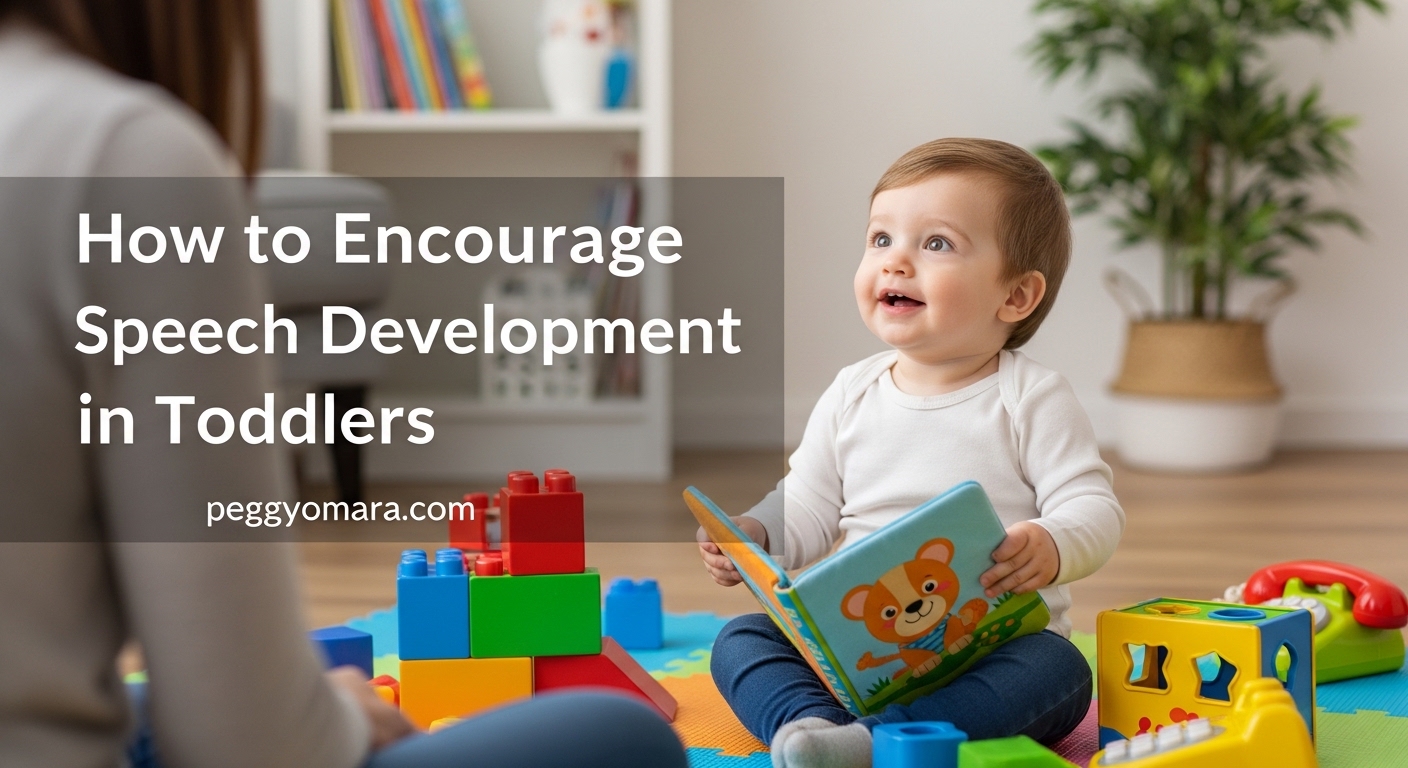
Every parent waits for those first words with a mix of excitement and nervousness. When my daughter was 18 months old, she had a vocabulary of just five words. I remember watching other toddlers her age chatter away while she pointed and grunted to get what she wanted. The worry crept in quietly at first, then louder each day. If you are here because you are wondering how to encourage speech development in toddlers, I want you to know something important: you are not alone, and there is so much you can do to help.
The good news is that most children develop language at their own pace, and the strategies in this guide have been recommended by speech-language pathologists for decades. These techniques work whether your toddler is a late talker or simply needs a little extra encouragement to use their words. By the end of this article, you will have a toolbox of proven methods to support your child’s language development at home.
Table of Contents
Understanding Speech Milestones: What to Expect and When
Before diving into strategies, it helps to understand what normal development looks like. Children develop language in two main areas: receptive language (what they understand) and expressive language (what they can say). Most toddlers understand far more than they can express, which is completely normal.
Here are the typical milestones speech-language pathologists look for:
By 12 months: Most babies say one or two words with meaning (like “mama” or “dada” directed at the right person). They should respond to their name, understand simple instructions like “no,” and use gestures like pointing or waving.
By 18 months: Toddlers typically have a vocabulary of 10 to 20 words. They can follow simple one-step directions and point to body parts when asked. This is often when the language explosion begins for many children.
By 24 months: Most two-year-olds use 50 or more words and start combining two words together (“more milk,” “go car”). They follow two-step instructions and seem to understand most of what you say to them.
Remember that these are guidelines, not strict rules. Some perfectly typical children have fewer words at 18 months and then catch up rapidly by age two. The range of normal development is wider than many parents realize.
How to Encourage Speech Development in Toddlers: 10 Proven Strategies
Supporting your toddler’s language growth does not require special toys or expensive programs. The most effective techniques happen naturally during your daily routines. Here are ten evidence-based strategies that speech-language pathologists recommend for encouraging toddler speech development.
1. Narrate Your Daily Activities
Self-talk and parallel talk are powerful tools for building vocabulary. Self-talk means describing what you are doing as you do it. When you are making breakfast, say: “I am pouring the cereal. Now I am adding milk. The milk is cold.” Parallel talk means describing what your child is doing: “You are stacking the blocks. The red block is on top. It is getting tall.”
This constant exposure to language helps toddlers learn new words in context. They hear sentence structure, descriptive words, and action words all woven into familiar routines. Do not worry about sounding silly. Your child is absorbing every word, even when they do not respond outwardly.
Aim to narrate during everyday moments: diaper changes, bath time, getting dressed, and meal preparation. These predictable routines give your toddler repeated exposure to the same vocabulary, which strengthens learning.
2. Master the Wait Time Technique
One of the most effective yet underused strategies is simply waiting. After you ask a question or make a comment, count silently to five or even ten seconds before speaking again. This gives your toddler time to process what you said and form a response.
Many parents, myself included, tend to fill every silence. We repeat ourselves, rephrase the question, or answer for our child. But those pauses are where the magic happens. Your toddler needs time to think of the word, remember how to say it, and then actually produce the sound.
Practice this during reading time. Point to a picture and say, “What is that?” Then wait. Count to ten in your head. Watch your child’s face. They are working hard in that silence. If they do not respond after ten seconds, you can provide the answer: “That is a dog. Dog.”
3. Use Parentese, Not Baby Talk
There is an important difference between parentese and baby talk. Parentese is the singsong, higher-pitched voice adults naturally use with babies. It has elongated vowels, exaggerated facial expressions, and clear articulation. Research shows parentese actually helps language development because it draws attention to speech sounds and keeps babies engaged.
Baby talk, on the other hand, uses made-up words or incorrect pronunciations (“wuv” for love, “baba” for bottle). While occasional baby talk is harmless, relying on it too much can confuse children who are learning correct word forms.
Use your parentese voice to emphasize key words. Slow down slightly and raise your pitch when introducing new vocabulary. “Look at the BIIIG ball. It is so BIG. Can you say ball?” This natural modification helps toddlers tune in to the sounds that matter.
4. Read Together Every Single Day
Reading to your toddler is one of the most impactful activities for language development. Books expose children to vocabulary they do not encounter in everyday conversation: words like “giraffe,” “mountain,” or “astronaut.” They also teach narrative structure and print awareness.
Do not just read the words on the page. Make reading interactive. Point to pictures and name them. Ask simple questions: “Where is the dog?” “What is the baby doing?” Let your child turn the pages, even if it means skipping ahead. The goal is engagement, not perfect completion.
Board books with simple pictures and rhyming text work well for young toddlers. As they get older, introduce books with repetitive phrases they can chime in on. “Brown Bear, Brown Bear” and “The Very Hungry Caterpillar” are classics for a reason. The predictable patterns help toddlers anticipate and participate.
5. Incorporate Gestures and Sign Language
Many parents worry that teaching signs will delay spoken language. The opposite is true. Gestures and sign language actually support speech development by giving children a way to communicate before their mouths can form words. Research consistently shows that signing babies often speak sooner and have larger vocabularies.
Start with functional signs that reduce frustration: “more,” “all done,” “help,” “milk,” and “eat.” Use the sign every time you say the word, and reward any attempt your child makes to use it. When they sign “more,” respond immediately: “More! You want more crackers. Here are more crackers.”
Encourage pointing and waving as well. Point to objects and name them. Wave hello and goodbye during social interactions. These gestures are precursors to language and show that your child understands the back-and-forth of communication.
6. Create Communication Temptations
Communication temptations are situations you set up that encourage your child to communicate. The key is creating a scenario where your toddler wants or needs something, then waiting for them to attempt communication before providing it.
Here are some effective examples. Put their favorite snack in a clear container they cannot open. Place a desired toy on a high shelf. Give them juice in a closed cup without a straw. Blow bubbles, then close the container and wait. Start a familiar song or game, then pause expectantly.
When your child points, grunts, or makes any attempt to communicate, respond immediately. If they just reach, you can model the word: “Open. You want me to open it. Say open.” Then open it. The goal is motivating them to use their words by making communication necessary and rewarding.
7. Expand and Recast What They Say
When your toddler does speak, you can build their skills by expanding and recasting. Expanding means adding one or two words to what they said. If they say “dog,” you respond: “Yes, big dog.” If they say “more juice,” you say: “More juice please.”
Recasting means repeating what they said with correct grammar. If your toddler says, “He goed outside,” you respond: “Yes, he went outside.” You are not correcting them directly, which can discourage attempts. Instead, you are modeling the correct form naturally.
Both techniques accept and validate your child’s communication while gently pushing their skills forward. Use them consistently throughout the day. When your child points and says “car,” expand with: “Yes, red car. The car is fast.” Every expansion is a mini language lesson.
8. Use Labeled Praise for Communication Attempts
Labeled praise means being specific about what you are praising. Instead of just saying “good job,” say “Good job using your words” or “I love how you asked for help.” This reinforces exactly what you want to see more of.
Any communication attempt deserves recognition. If your toddler points and makes a sound, respond: “I see you pointing. You want the ball. Good telling me.” If they attempt a word but mispronounce it, praise the effort: “Great trying! You said banana.”
Avoid pressure or forcing words. If your child gets frustrated when you ask them to say something, back off. Keep the focus on positive, encouraging interactions. The goal is making communication feel successful and enjoyable, not stressful.
9. Sing Songs and Nursery Rhymes
Music and rhythm make language easier to remember. The repetitive patterns in nursery rhymes help children predict what comes next. The melodic nature of songs keeps them engaged longer than regular speech. Songs like “Wheels on the Bus,” “Old MacDonald,” and “If You Are Happy and You Know It” are language-building goldmines.
Leave out the last word of familiar songs to encourage participation. Sing “Twinkle twinkle little” and wait. Your toddler may surprise you by filling in “star.” This cloze technique builds anticipation and gives them a chance to contribute.
Action songs that combine movement with words are especially valuable. Clapping, stomping, and pointing while singing engages multiple senses and strengthens memory. Do not worry about your singing voice. Your toddler loves your voice more than any professional singer.
10. Limit Screen Time and Prioritize Face-to-Face Interaction
The American Academy of Pediatrics recommends no screen time (except video chatting) for children under 18 months, and limited high-quality programming for children 18 to 24 months. There is a reason for this: language learning happens best through responsive, back-and-forth interaction.
Video chatting with grandparents is different from passive screen watching. Your child sees a real person responding to them in real time. Educational videos, even high-quality ones, cannot replace the responsive interaction that happens during play and conversation with you.
If you do use screens occasionally, watch together and talk about what you see. Make it interactive by asking questions and connecting the content to real life. But prioritize play, reading, and conversation as your main activities. Those human connections are where language truly grows.
When to Seek Professional Help
While most toddlers develop language at their own pace, some situations warrant professional evaluation. Knowing the red flags helps you advocate for your child if needed. Trust your instincts. You know your child better than anyone.
Contact your pediatrician or a speech-language pathologist if you notice any of these warning signs by 18 months: your child does not respond to their name consistently, makes no gestures like pointing or waving, shows limited interest in social interaction, or does not follow simple instructions.
By age two, seek evaluation if your child uses fewer than 50 words, has not started combining two words together, does not imitate words or sounds, or shows frustration when trying to communicate. Regression is also a red flag. If your child previously said words and then stops using them, talk to your doctor.
Early intervention services are available in every state for children with developmental delays. These services are often free or low-cost and can make a tremendous difference. A speech-language pathologist can evaluate your child and provide targeted therapy if needed. The earlier support begins, the better the outcomes tend to be.
It is worth noting that speech delays can have many causes. Hearing problems, oral-motor issues, developmental differences, and environmental factors can all play a role. A professional evaluation helps identify the specific needs of your child. Speech delay alone does not indicate autism, though it can be one piece of a larger picture. Only a comprehensive evaluation can determine what is going on.
Frequently Asked Questions
Is it normal for a 2.5 year old not to talk?
Some 2.5 year olds are late talkers and still within the range of normal development. By 30 months, most children use 50 or more words and combine them into phrases. If your child understands language well, follows directions, and communicates nonverbally, they may just need more time. However, if they have fewer than 50 words or are not combining words by 30 months, consult your pediatrician about a speech evaluation.
What is the 80 20 rule for toddlers?
The 80 20 rule in speech therapy suggests that parents should speak 80 percent of the time about what the child is currently focused on or interested in, and only 20 percent about redirecting or correcting. Following your child’s lead keeps them engaged and motivated to communicate. When you talk about what they are looking at or playing with, they are more likely to absorb the language and respond.
What are 5 reasons for delayed speech in children?
Five common reasons include: 1) Hearing impairment or frequent ear infections affecting sound processing; 2) Oral-motor problems making speech production difficult; 3) Developmental disorders like autism spectrum disorder; 4) Environmental factors including limited language exposure or high screen time; 5) Family history of speech or language delays. Many late talkers have no identifiable cause and simply develop at their own pace.
What does apraxia look like in a 2 year old?
Childhood apraxia of speech (CAS) involves difficulty planning and coordinating the movements needed for speech. Signs in a two-year-old include inconsistent errors (saying the same word differently each time), difficulty imitating simple sounds, limited consonant and vowel sounds, and visible struggle or groping movements when trying to speak. They may understand language well but have trouble producing words clearly. A speech-language pathologist can diagnose CAS.
At what age should a parent worry about speech delay?
Parents should monitor development continuously, but key evaluation points are 18 months and 24 months. By 18 months, children should have at least a few meaningful words and use gestures. By 24 months, they should have 50 or more words and combine two words together. If your child is not meeting these milestones, or if you notice regression, loss of skills, or lack of social engagement at any age, consult your pediatrician.
What is the red flag for speech delay?
Major red flags include: no words by 18 months, fewer than 50 words by age two, no two-word combinations by age two, loss of previously acquired speech or language skills, lack of social smiling or eye contact, not responding to name by 12 months, and absence of gestures like pointing or waving by 12 months. Any regression in skills is also an immediate red flag requiring evaluation.
Can a 2 year old have speech delay and not be autistic?
Yes, absolutely. Many children with speech delays are not autistic. Speech delay can result from hearing issues, oral-motor difficulties, developmental language disorder, bilingual learning, or simply being a late talker. Autism involves social communication challenges beyond just speech, such as limited eye contact, reduced social interest, repetitive behaviors, and difficulty with back-and-forth interaction. Only a qualified professional can diagnose autism. Many late talkers catch up completely with early support.
Conclusion: Your Role in Your Toddler’s Language Journey
Learning how to encourage speech development in toddlers gives you practical tools to support your child during these critical early years. The strategies in this guide work because they are grounded in how young brains actually learn language: through responsive interaction, meaningful context, and positive experiences. You do not need to be perfect. You just need to be present and engaged.
Start with one or two techniques that feel natural to you. Narrate your morning routine. Practice wait time during snack time. Read that favorite book one more time with enthusiasm. Every conversation, every song, every shared moment of attention builds your child’s language foundation.
Remember that children develop on their own timelines. Some toddlers are chatterboxes at 18 months. Others store up language silently and then speak in full sentences at age two. Both patterns can be completely healthy. Your job is not to force words but to create an environment where words want to emerge. If you have concerns, trust your instincts and seek guidance. Early support can make all the difference.