
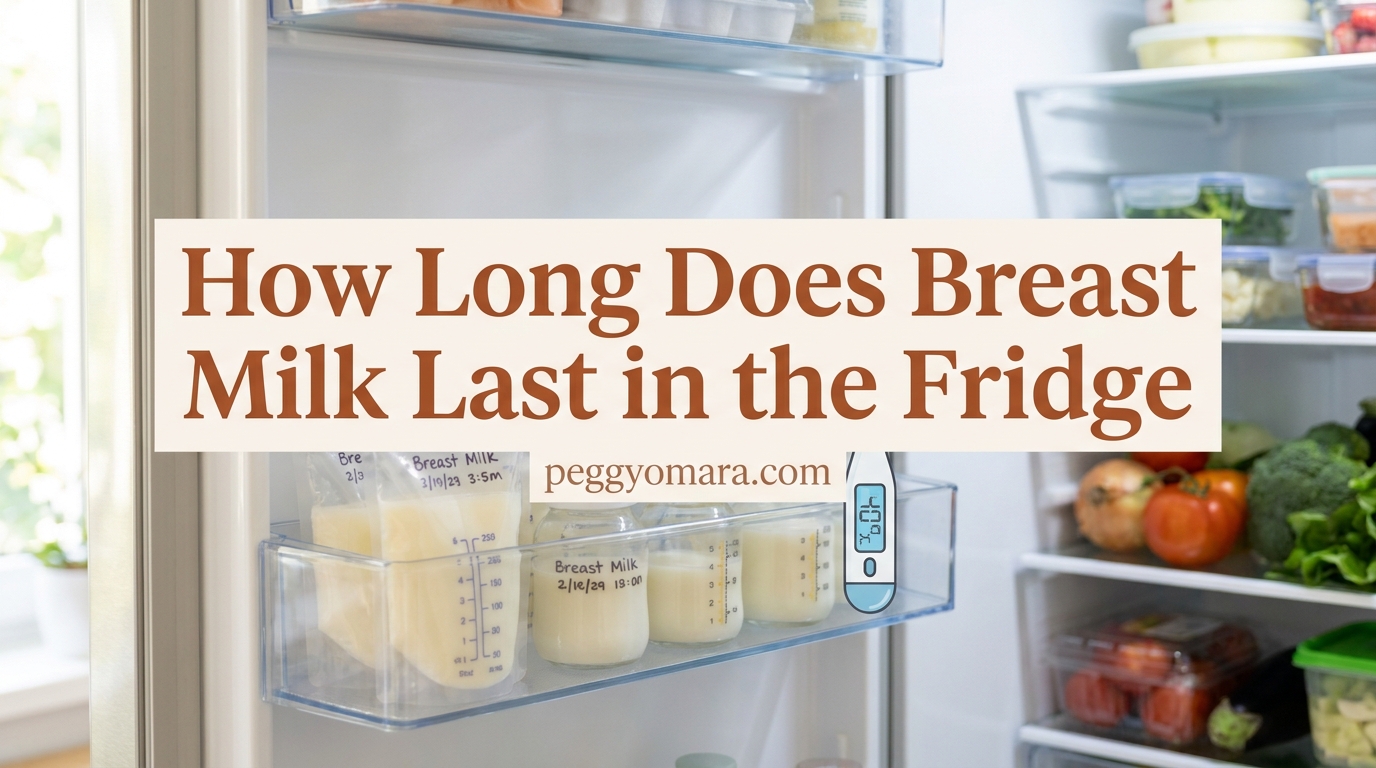
How long does breast milk last in the fridge? Freshly expressed breast milk can be safely stored in the back of your refrigerator at 39°F or 4°C for up to 4 days. If you follow excellent hygiene during pumping, some recent studies suggest it may remain safe for up to 6 to 8 days, though the conservative 4-day guideline remains the medical standard recommended by the CDC and American Academy of Pediatrics.
Understanding proper breast milk storage is essential for every parent who pumps. Whether you are returning to work, building a freezer stash, or simply need flexibility for nighttime feedings, knowing exactly how long your liquid gold remains safe helps you avoid waste while ensuring your baby receives the full nutritional benefits. Our breastfeeding resources offer additional guidance for your nursing journey.
In this comprehensive guide, you will learn the exact storage timeframes for every scenario, the simple mnemonics doctors recommend for remembering guidelines, how to choose the right containers, and what to do in special situations like power outages or workplace pumping.
Table of Contents
Quick Storage Summary (2026)
For parents who need answers fast, here are the official CDC and AAP storage timeframes:
- Room Temperature (77°F/25°C or cooler): Up to 4 hours
- Refrigerator (39°F/4°C): Up to 4 days (6-8 days under clean conditions)
- Freezer (0°F/-18°C): Up to 6 months optimal, 12 months acceptable
- Insulated Cooler (with ice packs): Up to 24 hours
These timeframes assume you are storing expressed breast milk in clean, BPA-free containers with tight-fitting lids. The countdown begins from the moment you finish pumping, not from when you place the milk in storage.
The Rule of 4s: Your Simple Storage Memory Aid
The American Academy of Pediatrics promotes an easy-to-remember guideline called the Rule of 4s. This mnemonic helps sleep-deprived parents recall the key storage timeframes without consulting charts at 3 AM.
The Rule of 4s states: 4 hours at room temperature, 4 days in the refrigerator, and 4 months in the freezer. Some lactation consultants modify this to 6-6-6 for extra conservative safety, while others use 3-3-3 for premature or medically fragile infants.
Understanding the 4-4-4, 6-6-6, and 3-3-3 Rules
Medical organizations provide different recommendations based on the populations they serve. Understanding these variations helps you choose the right guideline for your situation.
The 4-4-4 rule represents the AAP standard for healthy, full-term babies: 4 hours room temperature, 4 days refrigerator, 4 months freezer. This balances safety with practicality for most families.
The 6-6-6 rule, sometimes recommended by lactation consultants, extends timeframes to 6 hours at room temperature, 6 days in the refrigerator, and 6 months in the freezer. Recent 2026 research supports the 6-day refrigerator timeframe for milk pumped under clean conditions.
The 3-3-3 rule applies to premature infants, babies with compromised immune systems, or hospital NICU settings. These conservative timeframes minimize any infection risk for vulnerable babies: 3 hours room temperature, 3 days refrigerator, 3 months freezer.
Complete Storage Guidelines Comparison (2026)
Store your breast milk according to where you plan to keep it. Each storage method has specific temperature requirements and timeframes to maintain safety and nutritional quality.
| Storage Location | Temperature | Maximum Duration | Best Practices |
|---|---|---|---|
| Room Temperature | 77°F / 25°C or below | 4 hours | Covered, away from heat sources |
| Refrigerator | 39°F / 4°C | 4 days (up to 8 days) | Back of fridge, not door |
| Freezer (separate door) | 0°F / -18°C | 6 months optimal, 12 max | Store in back, away from door |
| Deep Freezer | 0°F / -18°C or below | 12 months optimal | Most stable long-term option |
| Insulated Cooler | With ice packs | 24 hours | For travel or workplace storage |
| Thawed (in fridge) | 39°F / 4°C | 24 hours | Do not refreeze |
| Warmed (after warming) | Serve immediately | 2 hours maximum | Discard what baby does not finish |
This comparison table reflects current CDC guidelines as of 2026. Always use the oldest stored milk first to maintain rotation and minimize waste. When storing in the refrigerator, place containers in the coldest area, typically the back of the main compartment away from the door.
Choosing the Right Storage Containers
The containers you select for storing breast milk matter for both safety and convenience. Your options include hard plastic bottles, glass containers, and disposable milk storage bags.
Hard Plastic Bottles
Hard plastic bottles designed specifically for breast milk storage work well for short-term refrigerator storage. Choose BPA-free containers with tight-fitting lids to prevent spills and contamination. Look for recycling codes 1, 2, or 5, and avoid containers marked with recycling number 7, which may contain BPA.
These bottles stack neatly in the refrigerator and work seamlessly with most breast pumps. You can pump directly into them, reducing transfer steps and potential contamination. They are reusable, making them an environmentally friendly choice for families storing milk regularly.
Glass Containers
Food-grade glass containers, including mason jars and dedicated breast milk glass bottles, offer the most inert storage surface. Glass does not absorb odors or leach chemicals, and it withstands repeated sterilization better than plastic.
Many parents prefer 4-ounce or 8-ounce mason jars for refrigerator storage. Glass containers last indefinitely with proper care, reducing long-term costs and environmental impact. The main drawbacks are weight, breakage risk, and the space they occupy in your refrigerator.
Milk Storage Bags
Disposable milk storage bags work best for freezer storage where their flat, compact shape maximizes space efficiency. Most bags hold 6 to 8 ounces and feature double-zipper seals to prevent leaks.
These bags are not ideal for refrigerator storage because they cannot stand upright on shelves and may develop small leaks if handled frequently. Save your bags for building your freezer stash, and use bottles or jars for milk you plan to use within a few days.
Proper Refrigerator Storage Techniques
Where and how you place breast milk in your refrigerator affects how long it stays fresh. Temperature consistency matters more than most parents realize.
Location Matters
Always store breast milk in the back of the refrigerator main compartment, not the door. The door experiences the most temperature fluctuation from opening and closing. The back of the main shelf maintains the most consistent cold temperature.
Keep milk away from raw meats, eggs, and strong-smelling foods. While sealed containers protect against contamination, odors can potentially affect milk taste. Designate a specific shelf or bin for breast milk to prevent accidental displacement.
Monitor Your Temperature
Use an appliance thermometer to verify your refrigerator maintains 39°F or 4°C or below. Home refrigerator dials are often inaccurate, and even a few degrees warmer significantly reduces safe storage time. Check the temperature weekly, especially during summer months.
If your refrigerator cannot maintain this temperature consistently, treat the 4-day guideline as a maximum rather than a target. When in doubt, freeze milk within 24 to 48 hours of pumping to preserve it safely.
Label Everything
Label each container with the date and, if needed for daycare, your baby’s name. Use waterproof labels or masking tape with permanent marker. Standard paper labels dissolve and become unreadable with condensation.
Store milk in small batches of 2 to 4 ounces, the amount most babies consume in one feeding. This minimizes waste since you must discard any milk your baby does not finish within 2 hours of warming. Multiple small containers also thaw faster than one large block.
Combining Fresh and Stored Milk
Many parents wonder if they can add freshly pumped milk to a container already holding refrigerated milk from an earlier session. You can, but temperature matters.
Cool freshly expressed breast milk in the refrigerator for at least 30 to 60 minutes before combining it with already chilled milk. Never add warm milk directly to cold milk, as this raises the temperature of the stored milk and can encourage bacterial growth.
Once combined, the entire container carries the date of the oldest milk. Track this date for storage time calculations. Some parents use the pitcher method, collecting all day’s milk in one large container, then portioning it into individual bottles at the end of the day.
Thawing and Warming Breast Milk
Proper thawing preserves the nutritional and immunological properties of your breast milk. Rushing the process damages beneficial components.
Safe Thawing Methods
The safest method thaws frozen breast milk overnight in the refrigerator. Place the frozen container on a plate to catch any condensation, and allow 12 to 24 hours for complete thawing depending on volume.
For faster thawing, hold the container under cool running water, gradually increasing to lukewarm. Never use hot water, as this creates hot spots and destroys nutrients. Do not thaw at room temperature or in warm water baths, which allow bacterial growth in the outer layers while the center remains frozen.
Warming Instructions
Warm refrigerated or thawed milk by placing the container in a bowl of warm water for a few minutes. Swirl gently to mix the fat, which naturally separates during storage. Test the temperature by dripping a few drops on your inner wrist; it should feel lukewarm, not hot.
Never microwave breast milk. Microwaves create dangerous hot spots that can burn your baby’s mouth and destroy valuable antibodies and nutrients. The uneven heating also damages the milk’s protective properties.
Use thawed breast milk within 24 hours of complete thawing. Count this timeframe from when the last ice crystals disappear, not from when you moved it to the refrigerator. Never refreeze thawed milk, even if your baby did not drink it.
Understanding Lipase and Milk Changes
Many parents panic when thawed breast milk smells or tastes different from fresh milk. This change often indicates lipase activity, not spoilage.
What Is Lipase?
Lipase is a natural enzyme in breast milk that breaks down fats so your baby can digest them. Some parents produce higher lipase levels than others. When milk sits in storage, this enzyme continues working, creating a soapy or metallic smell and taste.
This milk remains completely safe and nutritious for your baby. Most infants drink it without issue. However, some babies refuse bottles with high lipase milk due to the taste change.
Managing High Lipase Milk
If your baby rejects high lipase milk, you can inactivate the enzyme by scalding the milk before storage. Heat freshly pumped milk in a saucepan until small bubbles form around the edges, about 180°F or 82°C, then cool quickly and refrigerate or freeze.
Scalding destroys some immune factors, so only do this if necessary. Test a small batch of your stored milk after 24 hours to check for lipase activity before building a large freezer stash.
Vitamin C Degradation
Breast milk contains less vitamin C after storage, even under ideal refrigeration. Fresh milk contains optimal levels of all nutrients. While stored milk remains nutritionally superior to formula, using fresh milk when possible and rotating your freezer stash ensures your baby receives the full spectrum of benefits.
Workplace Storage Rights and Practical Tips
Returning to work presents unique breast milk storage challenges. Understanding your legal rights and practical options ensures a smooth transition.
Your Legal Rights
The federal Break Time for Nursing Mothers law requires employers to provide reasonable break time and a private, non-bathroom space for pumping for up to one year after your baby’s birth. Employers with fewer than 50 employees may be exempt if compliance would cause undue hardship.
This law does not require employers to provide refrigeration specifically for breast milk. However, many workplaces accommodate employee requests to store milk in break room refrigerators. When this is not possible, insulated cooler bags with ice packs maintain safe temperatures for up to 24 hours.
Practical Workplace Storage
Store your pumped milk in a sealed container or cooler bag in a workplace refrigerator, clearly labeled with your name and the date. If using a shared refrigerator, place milk in a sealed bag or container to prevent accidental spills or contamination.
Communicate with your employer about your pumping schedule and storage needs before returning to work. Most supervisors accommodate reasonable requests when approached professionally. Document any denials of your legal pumping rights, as you may file a complaint with the Department of Labor if necessary.
Emergency and Special Situations
Power outages, travel, and natural disasters create unique challenges for breast milk storage. Planning ahead protects your supply.
Power Outage Guidance
During a power outage, keep your freezer closed. A full freezer maintains safe temperatures for approximately 48 hours if unopened, while a half-full freezer stays cold for about 24 hours. Add dry ice or block ice if the outage will last longer.
If your frozen milk develops ice crystals and feels cold to the touch after power restoration, you can safely refreeze it. If it has completely thawed and sits at room temperature for more than 2 hours, discard it. When in doubt, smell and taste the milk; truly spoiled milk smells distinctly sour, not just different.
Travel Storage Tips
When traveling, store breast milk in an insulated cooler bag with frozen ice packs. This keeps milk safe for up to 24 hours. TSA allows breast milk in quantities greater than 3.4 ounces in carry-on bags, and you do not need to store it in quart-sized bags. Declare your milk at security; agents may screen it separately.
Hotel mini-refrigerators often cannot maintain safe temperatures for breast milk. Check the temperature with a thermometer before storing milk overnight. If the mini-fridge runs too warm, use the hotel’s main refrigerator or keep milk in your cooler with fresh ice.
NICU and Preemie Considerations
Parents of premature infants or babies in the NICU often follow stricter 3-3-3 guidelines: 3 hours at room temperature, 3 days in the refrigerator, 3 months in the freezer. These vulnerable infants have less developed immune systems, justifying the conservative approach.
Hospital NICUs may have additional requirements, including specific container types or sterilization procedures. Follow your medical team’s guidance exactly for these special situations.
Frequently Asked Questions
What is the 4 4 4 rule for breast milk?
The 4-4-4 rule is a memory aid recommended by the American Academy of Pediatrics: 4 hours at room temperature, 4 days in the refrigerator, and 4 months in the freezer. This guideline applies to healthy, full-term infants and represents a conservative approach to breast milk storage safety.
What is the 6 6 6 rule for breast milk?
The 6-6-6 rule extends storage timeframes to 6 hours at room temperature, 6 days in the refrigerator, and 6 months in the freezer. Some lactation consultants recommend this guideline, and recent research supports the 6-day refrigerator timeframe for milk pumped under clean conditions. However, the CDC and AAP still officially recommend the more conservative 4-day guideline.
What is the 3 3 3 rule for breast milk?
The 3-3-3 rule applies to premature infants, babies with compromised immune systems, or hospital NICU settings. This conservative guideline recommends storing breast milk no longer than 3 hours at room temperature, 3 days in the refrigerator, and 3 months in the freezer to minimize any infection risk for vulnerable babies.
Can I freeze breast milk after 4 days in the fridge?
Yes, you can freeze breast milk that has been refrigerated for up to 4 days. The CDC confirms this is safe. However, freeze milk as soon as possible for best quality. Milk that sits in the refrigerator for several days before freezing may have slightly reduced vitamin C levels and antioxidant properties compared to milk frozen immediately after pumping.
How can I tell if breast milk has gone bad?
Spoiled breast milk smells distinctly sour, similar to spoiled cow’s milk, and may have visible clumps that do not dissolve when swirled. A soapy or metallic smell alone does not indicate spoilage; this typically results from normal lipase enzyme activity. If you are unsure, taste the milk. Truly bad milk tastes sour and unpleasant.
Can I reheat breast milk twice?
No, you should not reheat breast milk more than once. Once warmed to body temperature, use the milk within 2 hours and discard any leftovers. Repeated warming creates opportunities for bacterial growth and degrades the milk’s nutritional and immunological properties. Store milk in small 2-4 ounce portions to minimize waste.
Can I store breast milk in bottles with nipples attached?
No, do not store breast milk in bottles with nipples attached. Store milk in clean containers with solid, tight-fitting lids. Nipples do not seal properly and can leak or become contaminated. Only attach nipples when you are ready to feed your baby, and discard any milk left in the bottle 2 hours after your baby starts drinking.
How long does breast milk last after warming?
Once warmed, breast milk lasts up to 2 hours at room temperature. After 2 hours, discard any unused milk regardless of whether your baby drank from the bottle. This timeframe starts when you finish warming the milk, not when you begin feeding. Never re-warm or re-refrigerate milk that has been warmed.
Conclusion
How long does breast milk last in the fridge? The standard answer remains 4 days at 39°F or 4°C, though research suggests up to 6 to 8 days may be safe under excellent hygiene conditions. Use the Rule of 4s as your baseline memory aid: 4 hours at room temperature, 4 days refrigerated, 4 months frozen.
Store your milk in the back of the refrigerator in BPA-free containers with tight lids, label everything with dates, and always use the oldest milk first. Understanding lipase activity prevents unnecessary panic about normal milk changes, while knowing your workplace rights ensures you can continue providing breast milk after returning to work.
With proper storage techniques, you can confidently build a milk supply that keeps your baby nourished and thriving throughout your caring for your newborn journey. When in doubt, consult a lactation consultant or your pediatrician for personalized guidance based on your baby’s specific health needs.