
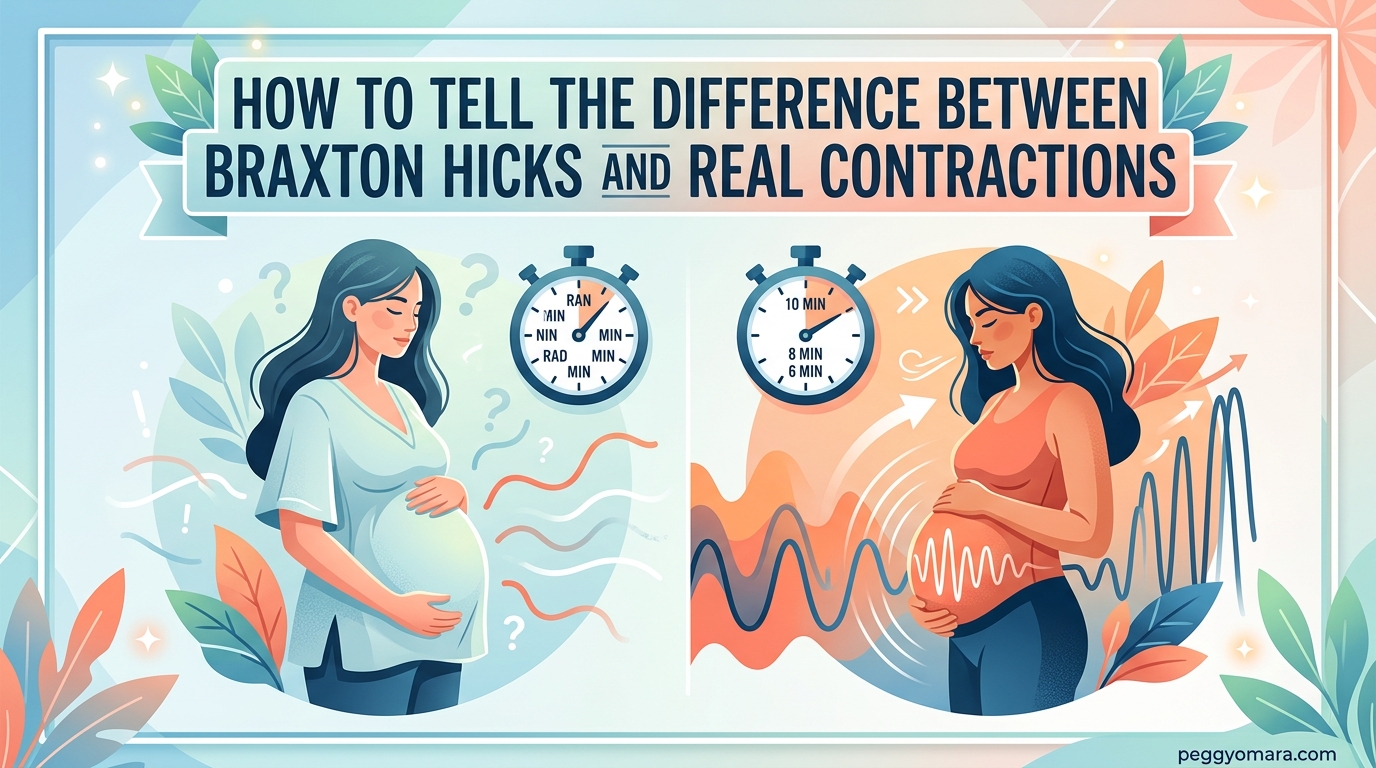
Your belly tightens. You pause mid-step, hand instinctively reaching for your bump. Is this it? Or is your body just practicing? Learning how to tell the difference between Braxton Hicks and real contractions is one of the most common concerns for pregnant women, especially as you enter the final weeks.
During my three pregnancies, I remember that mix of anticipation and uncertainty. Each tightening made me wonder if labor was starting. After speaking with countless mothers and healthcare providers over the years at our pregnancy and birth resources, I have gathered the clearest guidance to help you distinguish between these two types of contractions.
This guide will walk you through the specific differences using four simple factors: timing, intensity, location, and whether movement brings relief. By the end, you will know exactly what to watch for and when to make that call to your doctor or midwife.
Table of Contents
What Are Braxton Hicks Contractions?
Braxton Hicks contractions are often called practice contractions or false labor. Your uterus has been working throughout pregnancy, but now it is rehearsing for the main event. These sporadic tightenings are your body’s way of preparing the uterine muscles for true labor and delivery.
Dr. John Braxton Hicks first identified these contractions in 1872. Before his observations, many women were sent home from hospitals thinking they were in labor when they were not. His work helped doctors and mothers understand that not all contractions signal imminent birth.
These practice contractions can begin as early as the second trimester, though they become more noticeable and frequent during the third trimester. Some women feel them strongly. Others barely notice them. Both experiences are completely normal.
How to Tell the Difference Between Braxton Hicks and Real Contractions in 2026?
The key to distinguishing Braxton Hicks from real labor lies in four main factors. Medical professionals use these same criteria when assessing whether you are experiencing false labor or true labor.
| Factor | Braxton Hicks (False Labor) | Real Contractions (True Labor) |
|---|---|---|
| Timing | Irregular, unpredictable intervals. No consistent pattern. | Regular, rhythmic intervals that get progressively closer together. |
| Intensity | Usually mild, does not increase over time. May weaken. | Steadily increases in strength. Each contraction stronger than the last. |
| Location | Primarily felt in the front of the abdomen. Localized tight band. | Starts in lower back, radiates forward and around the abdomen. |
| Relief | Often stops with movement, position change, hydration, or rest. | Continues regardless of position change, walking, or hydration. |
| Cervical Change | Does not cause cervical dilation or effacement. | Results in progressive cervical dilation and effacement. |
The Timing Pattern Makes the Difference
Real contractions follow a coordinated pattern. They start at the top of your uterus and move downward in waves. Braxton Hicks contractions are not coordinated. They may feel random and do not build in a predictable way.
Think of true labor contractions like waves approaching the shore. They roll in with steady rhythm, each one closer than the last. Braxton Hicks are more like splashes that come and go without a pattern.
Where You Feel the Sensation
Braxton Hicks typically feel like a tightening band across the front of your belly. Your abdomen may become hard to the touch, like pressing on your forehead. Real contractions often begin as a dull ache in your lower back or hips before wrapping around to the front.
When I was in labor with my first child, I distinctly remember the back pressure that gradually intensified and moved forward. That radiating pattern was nothing like the isolated front-tightening I had experienced for weeks during Braxton Hicks.
What Do Contractions Feel Like?
Every woman describes contractions differently. However, there are common threads in how women experience both types of uterine activity.
How Braxton Hicks Feel
Most women describe Braxton Hicks as a sudden tightening or hardening of the abdomen. Your belly may feel like a basketball under your shirt. These sensations are usually painless, though some women report mild discomfort similar to menstrual cramps.
The tightening typically lasts between 30 seconds and two minutes. Then your belly softens and returns to normal. You might have several in an hour, or go days between episodes.
How Real Labor Contractions Feel
Early labor contractions often feel like stronger menstrual cramps combined with lower back pain. As labor progresses, the intensity increases. The peak of each contraction becomes more pronounced, and the resting period between contractions feels shorter even if the actual time has not changed much.
Many women report a pressure sensation in their pelvis or rectum as the baby descends. This is a sign that true labor is progressing and your body is working to bring your baby down and out.
Do not believe anyone who tells you that you will just know when contractions are real. Many women, especially first-time mothers, have genuine difficulty distinguishing early labor from strong Braxton Hicks. Trust the timing pattern more than your pain tolerance.
Common Causes and Triggers of Braxton Hicks
Understanding what triggers these practice contractions can help you manage them and potentially reduce their frequency if they are bothering you.
Dehydration Is the Most Common Trigger
Your uterus is a muscle. Like any muscle, it contracts more when dehydrated. In hot weather or after exercise, Braxton Hicks often increase simply because your body needs fluids. Drinking a large glass of water can sometimes stop a cluster of practice contractions within 20 to 30 minutes.
Physical Activity and Your Bladder
A full bladder puts pressure on the uterus and can trigger tightenings. Sexual activity can also stimulate Braxton Hicks, as can fetal movement. Active babies often prompt a contraction response from the uterus.
Overexertion is another common trigger. A long walk, carrying groceries, or even a stressful day at work can bring on a wave of practice contractions. Your uterus responds to your overall physical state.
How to Relieve Braxton Hicks Contractions
Since Braxton Hicks do not signal true labor, you can often stop them with simple measures. If these techniques work, you are likely experiencing false labor. If the contractions continue regardless, it may be time to time them more carefully.
Drink water first. Fill a large glass and sip it over 15 minutes. Empty your bladder completely. Sometimes just standing up from the toilet can stop the tightening.
Change your position or activity level. If you have been walking, sit or lie down on your left side. If you have been resting, take a gentle walk. Movement often helps your uterus relax.
Try a warm bath or shower. The warmth relaxes muscles throughout your body, including your uterus. Practice slow, deep breathing. Inhale through your nose for four counts, exhale through your mouth for six counts.
The 5-1-1 Rule: When to Go to the Hospital
The 5-1-1 rule is a widely accepted guideline for knowing when to head to your birthing location. This applies particularly to first-time mothers, which I will address separately below.
The 5-1-1 Rule Explained
Go to the hospital when your contractions are:
- 5 minutes apart or less
- 1 minute long each (from start to finish)
- 1 hour of this consistent pattern
Some providers use a 4-1-1 variation: contractions 4 minutes apart, lasting 1 minute, for 1 hour. Ask your doctor or midwife which guideline they prefer.
If this is not your first baby, your provider may want you to come in earlier. Subsequent labors often progress faster, and the 5-1-1 rule may bring you to the hospital too late for any comfort measures you want to use.
Start timing your contractions as soon as you suspect they might be real. Use a simple app, a watch, or ask your partner to track them. Note when each contraction starts, when it peaks, when it ends, and how long until the next one begins.
When to Call Your Doctor or Midwife
Here is the most important truth: it is always okay to call your healthcare provider. You will never be bothering them by asking about contractions. They would rather answer your questions than have you worry alone or arrive at the hospital unnecessarily.
Call immediately if your water breaks, regardless of whether you are having contractions. Note the color, odor, and approximate amount. Clear fluid is normal. Green, brown, or foul-smelling fluid needs immediate attention.
Contact your provider if you notice vaginal bleeding that is more than light spotting. A small amount of blood-tinged mucus may be your mucus plug or bloody show, which is normal in late pregnancy. Heavy bleeding is not.
Report decreased fetal movement. If your baby is moving less than usual, call right away. Also call if you experience regular contractions before 37 weeks gestation, as this could signal preterm labor.
Special Guidance for First-Time Moms
If this is your first pregnancy, you have a special set of considerations. First labors typically last longer than subsequent ones, but they also tend to start more subtly. The slow buildup can make it harder to recognize when true labor has begun.
Consider calling your provider at the first sign of possible labor. Many obstetricians and midwives prefer that first-time mothers come in earlier so they can assess you in person. You will not be seen as an inconvenience. You will be seen as a mother doing her best to bring her baby safely into the world.
Ask your partner or support person to help with timing contractions. During a contraction, it can be difficult to focus on a clock. Having someone else track the pattern frees you to focus on breathing and comfort measures.
Be aware of prodromal labor, sometimes called false labor that feels real. This pattern of contractions can last hours or even days, starting and stopping without progressing. It is exhausting and emotionally difficult. Rest when you can, and remember that your body is still doing important work even if it is not yet active labor.
After your baby arrives, you may want guidance on healing and returning to normal activities. You can find helpful information in our article about postpartum recovery.
Frequently Asked Questions
How to know real contractions vs Braxton Hicks?
The best way to tell the difference is by tracking timing, intensity, and relief. Real contractions follow a regular pattern that gets progressively closer together and stronger. They start in your lower back and radiate forward. Changing positions or drinking water does not stop them. Braxton Hicks are irregular, felt mostly in the front, and usually stop with movement or hydration.
What are three signs of false labor?
Three signs of false labor are: 1) Irregular timing with no consistent pattern between contractions, 2) Discomfort that stays primarily in the front of your abdomen without back pain, and 3) Contractions that stop or lessen when you change positions, walk, drink water, or rest.
How do contractions feel when they first start?
When contractions first start, they often feel like stronger menstrual cramps combined with a dull ache in your lower back. Early labor contractions are usually mild enough that you can talk through them. They gradually increase in intensity and become more rhythmic as labor progresses.
What is the 5 1 1 rule for Braxton Hicks?
The 5-1-1 rule is actually used for real contractions, not Braxton Hicks. It indicates when to go to the hospital: contractions that are 5 minutes apart, lasting 1 minute each, for at least 1 hour. If you are following this rule, you are likely in true labor rather than experiencing Braxton Hicks.
Do Braxton Hicks feel like actual contractions?
Braxton Hicks can feel similar to mild early labor contractions, which is why they cause confusion. Both involve uterine tightening. However, real contractions become progressively stronger, more regular, and do not go away with movement. The intensity and pattern separate true labor from practice contractions.
Are real contractions more painful than Braxton Hicks?
Generally yes, real contractions are more intense than Braxton Hicks and become increasingly painful as labor progresses. However, pain tolerance varies widely among women, so pain level alone is not the best indicator. Focus instead on the pattern, timing, and whether the contractions continue regardless of rest or position changes.
Can doctors tell the difference between Braxton Hicks and real contractions?
Yes, doctors and midwives can tell the difference through physical examination and monitoring. They check for cervical changes, which only occur with true labor. They can also use a tocodynamometer to measure contraction patterns. If you are unsure, contacting your provider is the best way to get an accurate assessment.
What are five signs of false labor?
Five signs of false labor are: 1) Contractions are irregular with no predictable pattern, 2) Pain stays in the front of your belly without wrapping to your back, 3) Discomfort decreases with walking, rest, or hydration, 4) Contractions do not get progressively stronger or closer together, and 5) There is no cervical change when examined by a healthcare provider.
Trust Your Instincts and Know When to Ask for Help
Learning how to tell the difference between Braxton Hicks and real contractions takes practice and patience. Remember the four key factors: timing, intensity, location, and relief. Real contractions follow a rhythmic pattern that grows stronger, start in your back and radiate forward, and continue regardless of what you do.
Braxton Hicks are irregular, felt mainly in the front, and often stop when you move, hydrate, or rest. Both are normal parts of pregnancy. Neither is wrong or something to fear.
If you are ever uncertain, trust your instincts and call your healthcare provider. No question is too small when it comes to the safety of you and your baby. You know your body better than anyone, and that intuition is one of the most valuable tools you have as you prepare for birth.
Your baby will come. Your body knows what to do. And now you have the knowledge to recognize the signs when that moment truly arrives.