
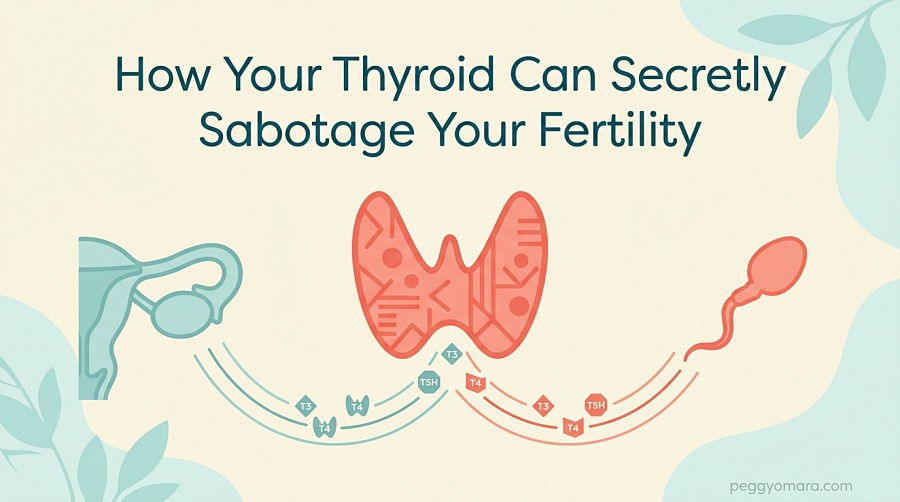
You’re tracking ovulation, eating clean, taking prenatals — and still no positive test. Here’s what almost no one mentions: a butterfly-shaped gland in your neck, weighing less than an ounce, may be quietly running the show.
Quick answer: Your thyroid produces hormones (T3 and T4) that directly regulate ovulation, menstrual cycles, sperm production, and early pregnancy. When it’s underactive (hypothyroidism) or overactive (hyperthyroidism) — even mildly — it disrupts prolactin, GnRH, and the entire reproductive hormone cascade, causing anovulation, luteal phase defects, miscarriage, and male infertility. Roughly one in three women with subfertility has an underlying thyroid issue, and many never get tested.
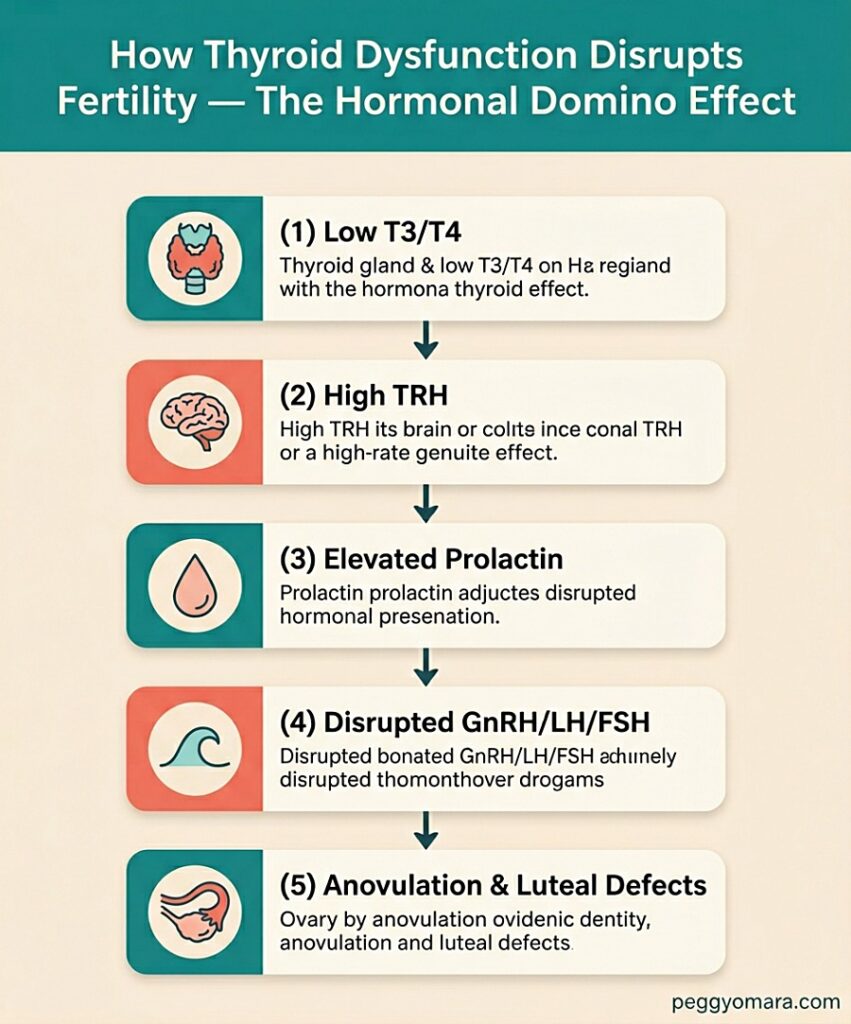
Table of Contents
Why Your Thyroid Has More Power Over Fertility Than You Think
The thyroid isn’t just about metabolism and energy. Thyroid hormone receptors sit directly on your ovaries, oocytes, endometrium, and testes. When thyroid signaling falters, every part of the reproductive machinery feels it.
According to a 2022 NIH-published narrative review on thyroid function in male and female infertility, thyroid dysfunction is one of the most common — and most overlooked — endocrine causes of infertility in both sexes.
The Hormonal Domino Effect
Here’s the chain reaction most doctors won’t walk you through:
- Low T3/T4 signals the hypothalamus to crank out more TRH (thyrotropin-releasing hormone).
- TRH boosts TSH — but it also boosts prolactin.
- About 46% of infertile women with hypothyroidism have elevated prolactin (hyperprolactinemia).
- High prolactin suppresses GnRH, the master switch for LH and FSH.
- Without proper LH/FSH pulses → no ovulation, short luteal phase, or anovulatory cycles.
That’s how a sluggish thyroid silently shuts down conception — without a single “thyroid symptom” you’d recognize.
Hypothyroidism: The Most Common Culprit
Hypothyroidism affects 4–5% of the population, and Hashimoto’s thyroiditis is the #1 cause. The Mayo Clinic’s expert overview of hypothyroidism and infertility notes the link is well-documented but often missed because symptoms overlap with “just being tired.”
Hypothyroidism’s fertility damage includes:
- Anovulatory cycles (no egg released)
- Heavy, prolonged, or irregular periods from estrogen breakthrough bleeding
- Short luteal phase → fertilized eggs can’t implant
- Higher miscarriage risk (especially first trimester)
- Elevated TPO antibodies linked to early pregnancy loss
Hyperthyroidism: The Overlooked Saboteur
Overactive thyroid (often from Graves’ disease) is rarer but equally damaging. Excess thyroid hormone causes:
- Scanty, infrequent periods or amenorrhea
- Increased spontaneous miscarriage risk
- Higher Thyroid Binding Globulin, which alters estrogen metabolism
- Reduced ovum quality during IVF stimulation
Subclinical Hypothyroidism: The Silent Form
This is where it gets sneaky. Subclinical hypothyroidism means TSH is mildly elevated but T4 is “normal.” Standard labs miss it. Yet meta-analyses confirm it’s strongly associated with miscarriage, preterm delivery, and reduced IVF success — and levothyroxine treatment can fix it. One study showed treated women had a 35% pregnancy rate vs 26% on placebo, with miscarriage dropping from 13% to 9%.
The Magic Number: TSH Under 2.5
Most labs flag TSH as “normal” up to 4.5 or 5.5 mIU/L. For fertility, that’s too loose. The British Thyroid Foundation’s pregnancy and fertility guidance and the American Society for Reproductive Medicine recommend TSH below 2.5 mIU/L when trying to conceive, and below 3.0 in the second/third trimesters.
Thyroid Antibodies: The Hidden Miscarriage Risk
Even with a perfect TSH, anti-TPO antibodies above 121 IU/mL correlate strongly with early miscarriage. Thyroid autoimmunity (TAI) is thought to affect ovarian tissue directly and signal a broader immune dysregulation hostile to embryo implantation. Anyone with recurrent loss or unexplained infertility should ask for a full thyroid panel including TPO and TgAb antibodies — not just TSH.
Men Aren’t Off the Hook
Thyroid disease damages male fertility too:
- Hyperthyroidism → abnormal sperm motility, reduced semen volume
- Hypothyroidism → abnormal sperm morphology, low libido, erectile dysfunction
- Both → reduced sperm density and DNA integrity
If you’ve been told it’s “unexplained male factor,” request a TSH and free T4 before assuming.
Symptoms You Shouldn’t Ignore
| Hypothyroidism | Hyperthyroidism |
|---|---|
| Fatigue, weight gain | Restlessness, weight loss |
| Cold intolerance | Heat intolerance |
| Heavy/irregular periods | Light/missed periods |
| Hair thinning, dry skin | Tremors, racing heart |
| Constipation, depression | Diarrhea, anxiety |
| Brain fog | Insomnia |
What to Test — The Complete Fertility Thyroid Panel
Don’t accept just a TSH. Ask for:
- TSH (target <2.5 mIU/L preconception)
- Free T4 and Free T3
- Anti-TPO and anti-thyroglobulin antibodies
- Reverse T3 (optional, for conversion issues)
- Prolactin
- Thyroid ultrasound if antibodies positive or nodules suspected
Treatment: What Actually Works
For hypothyroidism: Levothyroxine is standard. Once pregnant, the dose typically rises 20–30% to meet increased demand. Retest TSH every 4–6 weeks.
For hyperthyroidism: Methimazole or propylthiouracil. Methimazole is generally avoided in the first trimester due to congenital risks.
For thyroid autoimmunity: Levothyroxine plus selenium (200 mcg/day in some studies), addressing gut health, and reducing inflammatory triggers like gluten in sensitive individuals.
Lifestyle Levers That Move the Needle
Medication isn’t the whole picture. To support thyroid and fertility together:
- Iodine (150 mcg/day, more if pregnant) — but don’t megadose
- Selenium (Brazil nuts, sardines) — supports T4→T3 conversion
- Iron and ferritin — low iron tanks thyroid function
- Vitamin D above 40 ng/mL
- Stress management — cortisol blocks T4→T3 conversion
- Sleep — 7–9 hours protects HPO axis
For a deeper dive into the broader fertility picture beyond thyroid, this guide on evidence-based ways to boost fertility naturally pairs well with thyroid optimization.
Common Mistakes That Delay Pregnancy
- Accepting “your TSH is normal” at 3.8 without questioning
- Skipping antibody testing despite recurrent loss
- Not retesting after starting levothyroxine
- Ignoring the male partner’s thyroid
- Stopping thyroid meds the moment you see two pink lines (your dose needs to increase, not stop)
Pro Tips From the Research
Optimize before, not during. Couples with one or both partners showing thyroid dysfunction have measurably better IVF outcomes when TSH is normalized before stimulation begins, not mid-cycle.
TPO antibodies = closer monitoring. Even if euthyroid, antibody-positive women benefit from earlier and more frequent thyroid checks throughout pregnancy.
When to See a Specialist
If you’re under 35 and have tried conceiving for 12 months, or over 35 and tried for 6 months, get evaluated. Two or more miscarriages also warrant a workup. Thyroid testing should be part of that first visit — not an afterthought. For more on timing, see this guide on how long you should try before seeing a fertility specialist.
FAQs
Can thyroid problems cause infertility even with normal periods?
Yes. Subclinical hypothyroidism and elevated TPO antibodies can impair egg quality, implantation, and early pregnancy without disrupting your visible cycle.
What TSH level is best for getting pregnant?
Below 2.5 mIU/L preconception, per ASRM and major endocrine societies — even though most labs flag “normal” up to 4.5–5.5.
Does Hashimoto’s mean I can’t get pregnant?
No. Most women with well-managed Hashimoto’s conceive and carry healthy pregnancies. The key is keeping TSH optimized and monitoring antibodies.
Can hyperthyroidism cause miscarriage?
Yes. Untreated hyperthyroidism — especially Graves’ — significantly raises miscarriage and preterm birth risk. Treatment normalizes outcomes for most.
How long after starting levothyroxine can I try to conceive?
Most doctors recommend waiting until TSH is stable below 2.5 — usually 6–8 weeks after dose adjustment, confirmed by repeat labs.
Should my partner get his thyroid tested too?
Absolutely. Thyroid dysfunction in men damages sperm motility, morphology, and libido. It’s a 5-minute blood draw worth doing.
Can I have a thyroid problem with no symptoms?
Yes — that’s exactly why it’s missed. Subclinical and antibody-driven dysfunction often show no obvious signs until fertility becomes the symptom.
Bookmark this page if you’re on a conception journey — and bring this checklist to your next appointment. Your thyroid may be small, but ignoring it is the most expensive mistake in fertility care.