
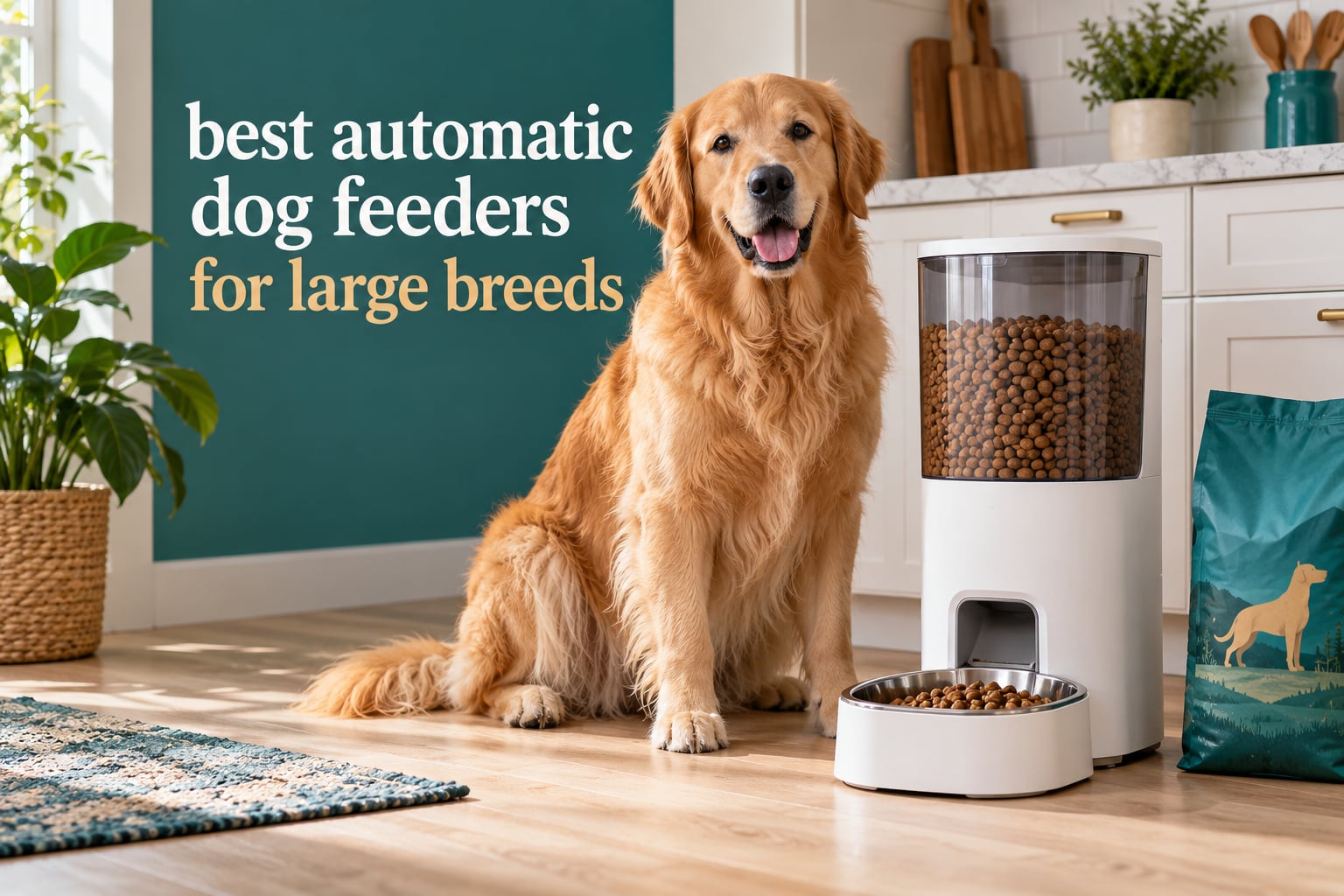
The Yakry 12L/50-Cup automatic feeder is the best automatic dog feeder for large breeds overall, because it pairs a 12-litre hopper built for kibble up to 20mm with app scheduling, a 1080P camera and more owner feedback than any other unit in this group. If you want a sealed hopper instead of an app, the Dokoo 15L is the runner-up. And if your dog is on prescription kibble, size the hopper to the ration rather than to the marketing.
Large-breed kibble is physically larger than what most feeders are designed around. Pieces of 15mm to 23mm simply will not move through a narrow chute, and a shallow bowl that suits a 20-pound dog forces a 90-pound dog to eat off the floor or tip the whole machine over.
That is why capacity alone is a poor filter. We measured every feeder here against a real daily ration, checked the bowl a large dog’s muzzle actually fits into, and read the failure reports rather than the feature lists. If you want a broader look at feeders across sizes, our automatic dog feeder roundup covers the smaller categories too.
Table of Contents
Top 3 Automatic Dog Feeders for Large Breeds in 2026
Yakry 12L/50-Cup Feeder
- 12L / 50-cup hopper
- Kibble up to 20mm
- 1080P camera with night vision
- Dual-band WiFi app

UTCG 12L/50-Cup Feeder
- 12L / 50-cup hopper
- Kibble up to 18mm
- Silicone stirring paddle
- Wall-mount kit included

MOLLY and Cody 14L Silo Feeder
- 14L / 60-cup hopper
- Anti-blockage channel
- 6 meals with 1-60 portions
- 4xAA battery backup
Quick Overview: All 8 Feeders Side by Side
The spec table below covers every feeder in this guide, with hopper size in litres and cups, the largest kibble each unit handles, and the practical details that decide whether it suits a large dog.
| Product | Specifications | Action |
|---|---|---|
| Yakry 12L/50-Cup Feeder with Camera |
|
Check Latest Price |
| UTCG 12L/50-Cup Feeder |
|
Check Latest Price |
| MOLLY and Cody 14L Silo Feeder |
|
Check Latest Price |
 Dokoo 15L Vacuum-Sealed Feeder Dokoo 15L Vacuum-Sealed Feeder |
|
Check Latest Price |
 DOGNESS 11L Cordless Feeder DOGNESS 11L Cordless Feeder |
|
Check Latest Price |
 Nityers 15L/63-Cup Feeder Nityers 15L/63-Cup Feeder |
|
Check Latest Price |
 Gwozn 15L Camera Feeder Gwozn 15L Camera Feeder |
|
Check Latest Price |
 Nityers 15L Camera Feeder Nityers 15L Camera Feeder |
|
Check Latest Price |
How We Picked These Feeders
Five criteria shaped the ranking. First, hopper capacity measured against a real daily ration, not a headline litre count, since a 10L hopper that refills every four days is a different product from a 15L hopper that holds a full bag.
Second, bowl size in cups, because the most common complaint we found on r/dogs was not hopper capacity at all. Owners were disappointed that feeders advertised for large breeds came with bowls too small for a 1 to 1.25-cup serving, forcing the dog to eat off the floor.
Third, the maximum kibble diameter in millimetres, checked against what large-breed food actually contains. Fourth, whether the feeder keeps its schedule when the Wi-Fi drops or the power cuts out. Fifth, we read the negative reviews closely, because the real failure modes are what you live with at 7am.
1. Yakry 12L/50-Cup Feeder With Camera – Best Overall Pick
Automatic Dog Feeder Large Breed: 12L/50 Cup Capacity for Kibble up to 20mm
- Large 12L hopper cuts refills for big dogs
- Camera and night vision praised as clear day and night
- Scheduling and portion control work once calibrated
- Removable stainless steel bowl
- Customer service reported as patient and helpful
- Companion app can be glitchy and drops Wi-Fi connections
- Several app features sit behind a paid subscription
- Large kibble can occasionally jam the dispenser
- Feed button volume is loud with no adjustment
This is the feeder I come back to for most large-dog households. The 12-litre hopper holds 50 cups, and at roughly two cups per feeding that is a comfortable multi-day window rather than a twice-daily chore. It weighs 5.85 pounds and stands 8.2 by 14 by 19 inches, so it fits against a wall without dominating a kitchen.
Its camera and two-way audio are genuinely useful for owners who work long days. Night vision is clear enough to confirm a dog came to the bowl at 2am, and Smart Life app control over dual-band 5GHz and 2.4GHz Wi-Fi means it will pair on either band, which is the difference between working and not working on a crowded 2.4GHz network.
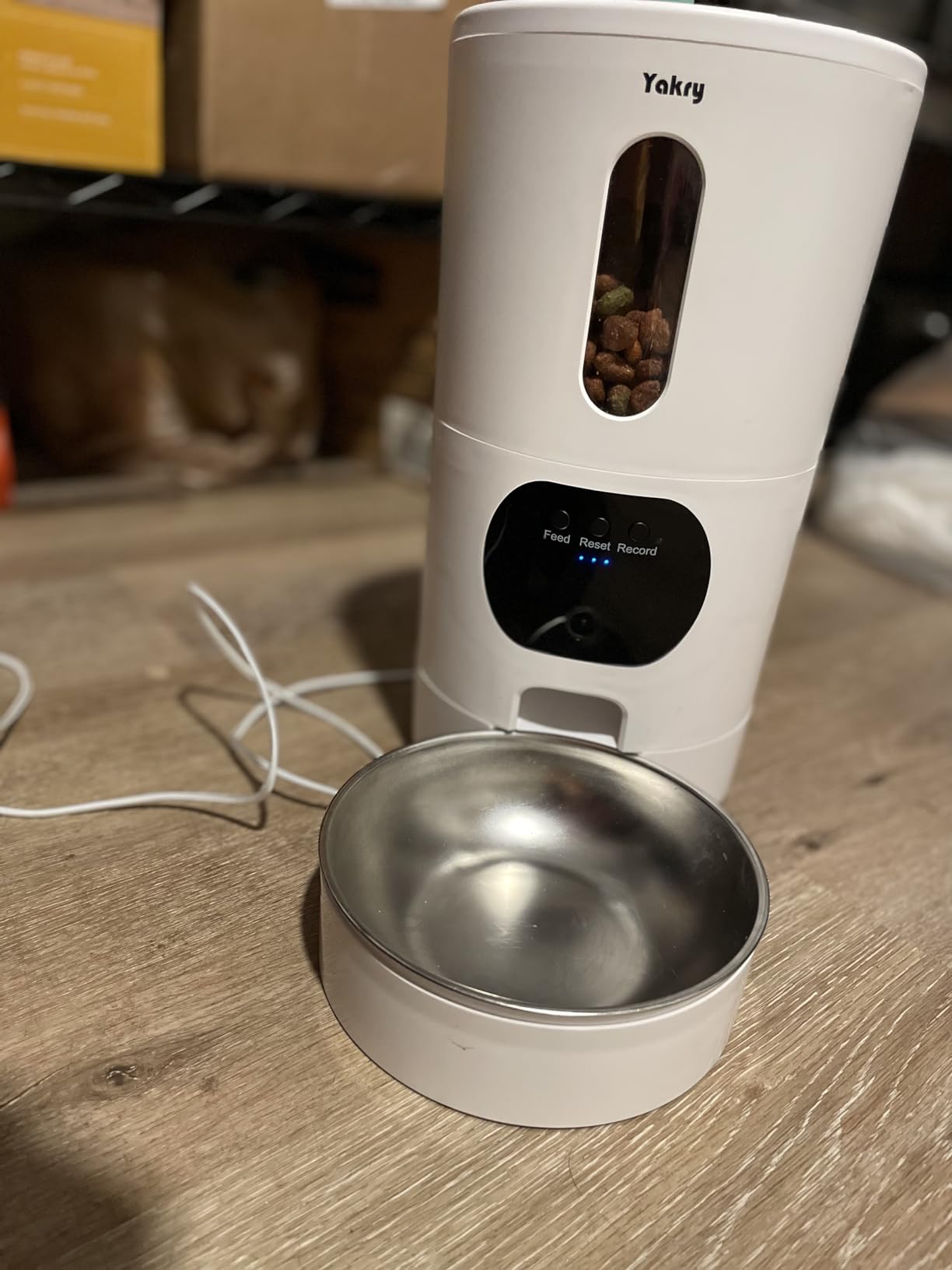
Up to 15 meals per day with 1 to 20 portions each gives you room to split a ration into smaller servings. The airtight lid with a desiccant bag keeps kibble dry, and the removable stainless steel bowl goes straight into a dishwasher.
The honest weakness is software. Owners report a disorganised companion app, dropped connections, and features that sit behind an extra paid subscription. Calibration matters too, because portion counts drift from real cup counts until you weigh the kibble yourself.
How it handles a 90-pound dog’s daily ration
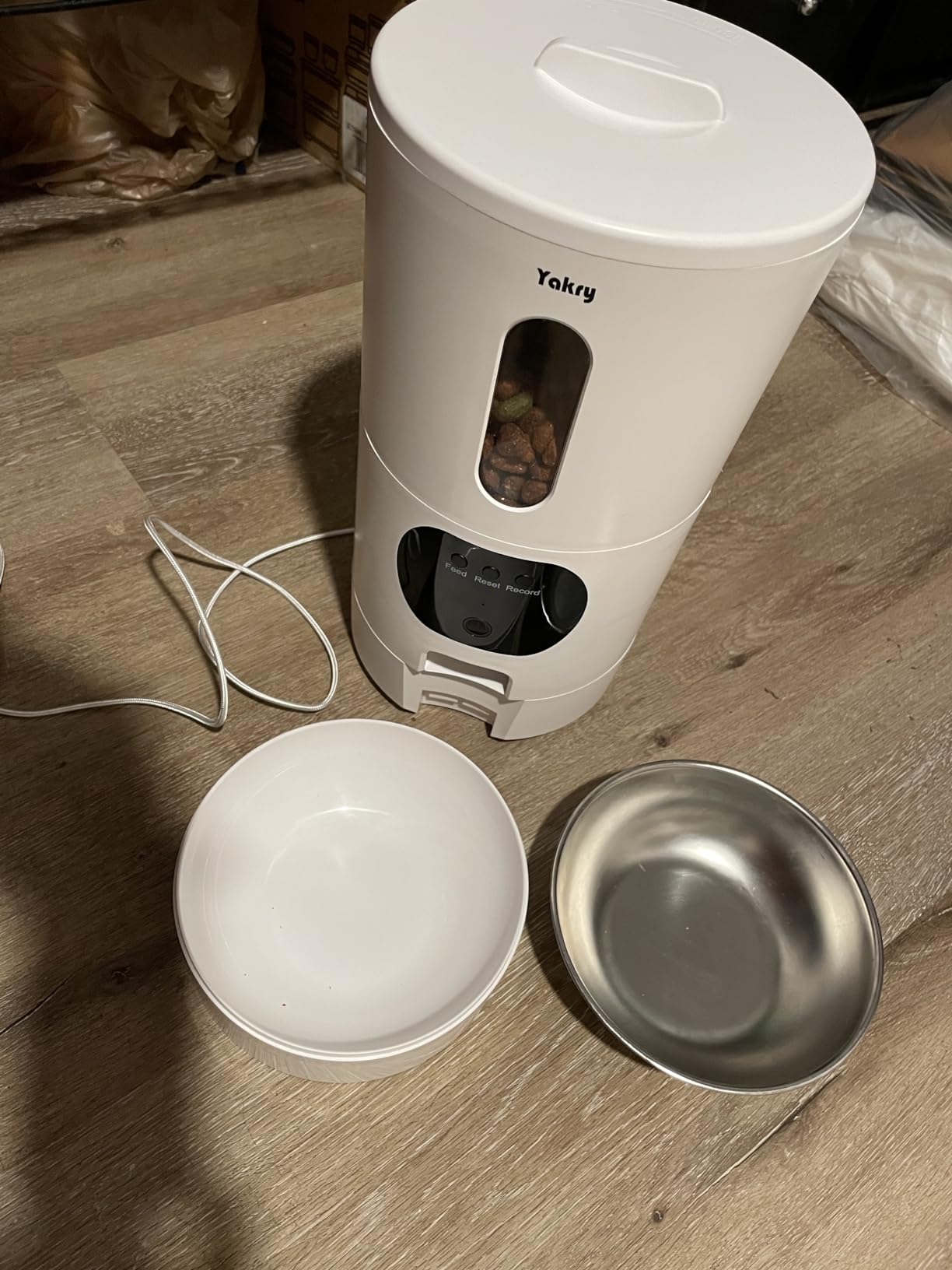
For a dog eating about 4 cups across two feedings, this hopper carries roughly 12 days of food. That is a meaningful difference from 4L and 6L units marketed to large breeds, which need topping up every day or two.
The removable stainless bowl is wide enough for a large muzzle, and the anti-jam path is rated for kibble up to 20mm, which covers most large-breed formulas. Pieces at the very top of that range can still catch, so keep the chute clear of dust.
Where the app will annoy you
If your household has unreliable Wi-Fi or you travel often, this is the wrong unit. The manual feed button has no volume adjustment and is loud enough that a dog can learn to trigger meals on its own, which undermines portion control entirely.
The camera points at the pet rather than down at the bowl, so it cannot tell you whether food actually landed. For feeding records you would need a model with a downward-tilting camera.
2. UTCG 12L Feeder – Best With a Wall-Mount Kit
Large Breed Automatic Dog Feeder: 12L/50 Cups for 20-Days Food
- 12L hopper holds 10 or more days of food
- Wide outlet and silicone paddle handle large kibble
- Camera and two-way audio work smoothly
- Wall-mount kit included for strong pets
- Runs on batteries so it works while camping
- Occasional jamming even within the stated kibble size
- Does not dispense very large single portions of 3-4 cups
- Food tray is smaller than ideal for slow eaters
- Unit is light for its size and can tip if pushed
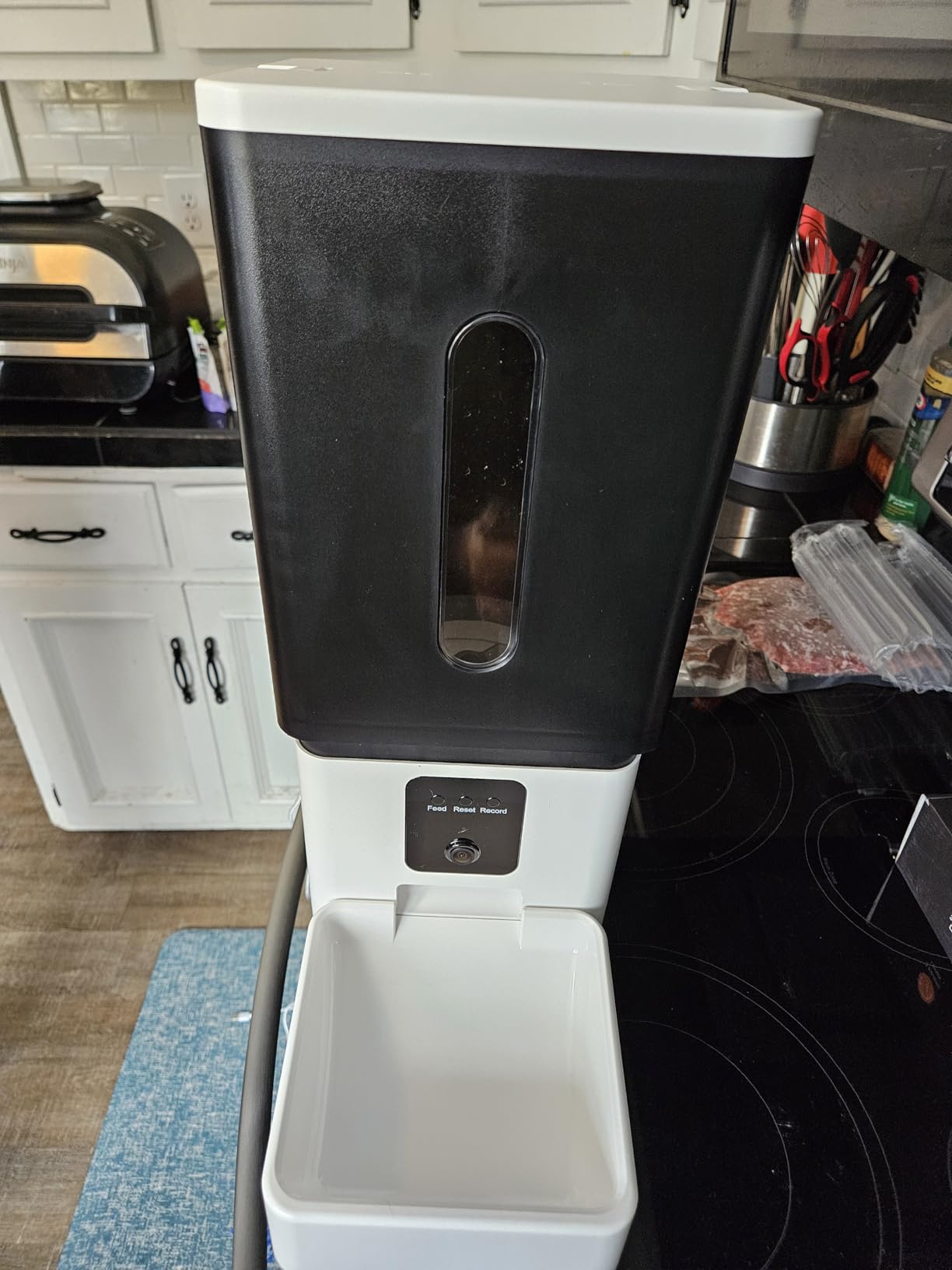
This is the only feeder in the group that ships with a wall-mount kit, and that single detail changes the equation for a dog who pushes, paws or leans on units. Owners of powerful dogs in r/Rottweiler threads describe exactly this problem, and strapping or mounting the feeder removes it.
Dispensing runs on a wide food outlet with a silicone stirring paddle, which is the mechanical answer to the clog complaints that dominate forums. Portions come out at 10g per portion, and the hopper lid uses a secure lock so a determined cat cannot fish kibble out of the top.
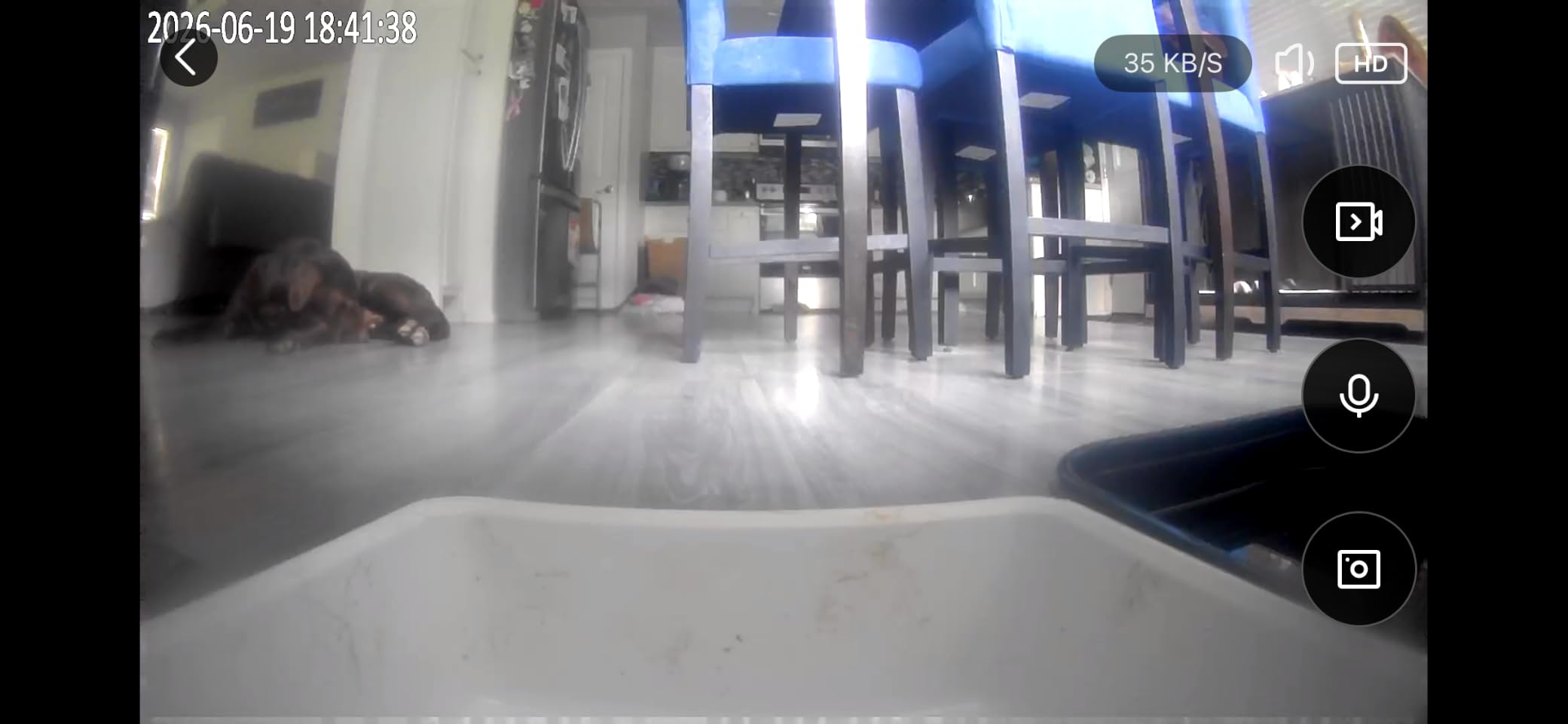
App scheduling supports up to 15 meals per day, and the 1080P camera with night vision and two-way audio sits in the same housing. The removable BPA-free hopper and bowl clean easily, and an SD card option is available if you want local recording instead of the cloud.
Two limits matter for large breeds. The 18mm kibble ceiling is narrower than the 22mm and 23mm units here, and the tray is shallow enough that owners of slow eaters report their dog pushing food out of it.
Why the mounting kit is the deciding feature
At 5.8 pounds, this housing is light for its hopper size, and reviewers say it can tip if a large dog pushes it. Mounted on a wall or strapped high, the tipping concern disappears entirely, and so does the risk of a paw reaching into the outlet.
The dual-power setup is the other reliability win here. It runs on mains power with battery backup, and owners mention using it while camping, which is unusual for an app-dependent feeder.
Where the portions fall short
The biggest reported gap is single-portion size. If your dog’s ration is 3 to 4 cups at one sitting, you need multiple dispenses per meal, and a slow-feeding dog will outrun the tray while the second round is still coming.
Jams still happen occasionally even with kibble inside the stated 18mm range, and the camera does not angle down to check the bowl. Treat it as a presence check rather than a feeding confirmation.
3. MOLLY and Cody 14L Silo Feeder – Best Premium Build
- 14L capacity holds several weeks of food
- Sturdy build quality and easy assembly
- Scheduling and portion adjustment work reliably
- Stainless steel bowl is hygienic and easy to wash
- Battery backup keeps meals on schedule during outages
- Handles the largest kibble pieces less smoothly than medium kibble
- Low-food indication can trigger while food is still present
- The food chute can be pulled off and chewed
- No wall-mount option and the cord can loosen with use
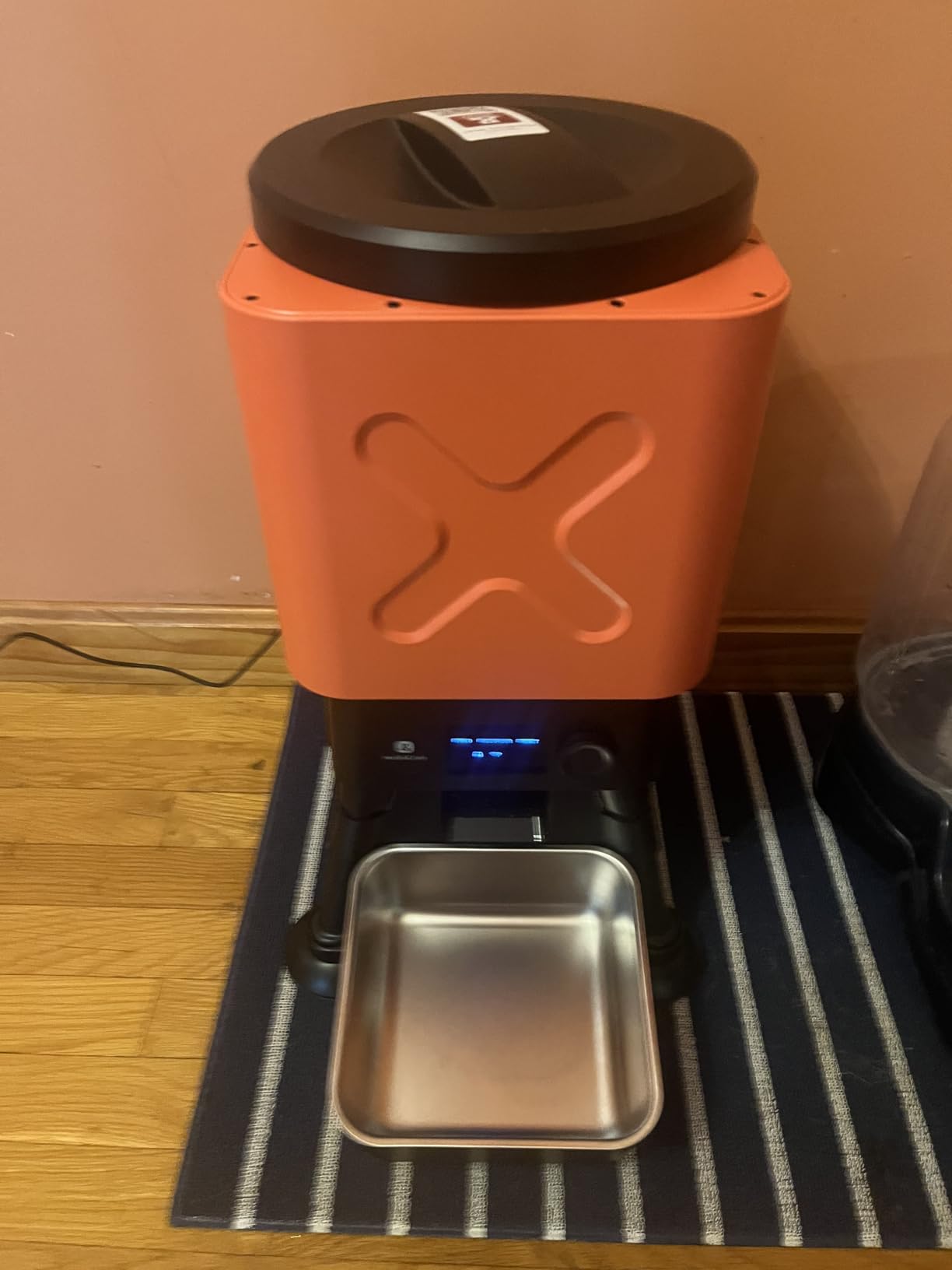
At 8.85 pounds this is one of the heavier feeders in the group, and owners consistently single out build quality and simple assembly. The silo-style hopper keeps food off the ground, and the raised design does not look like a plastic box in the middle of a kitchen, which matters more than most spec sheets admit.
Portion control is the standout. Between 1 and 60 portions per meal across 6 meals a day is the widest single-meal range of any feeder here, and that flexibility matters when a large dog’s ration is 4 cups or more at once.
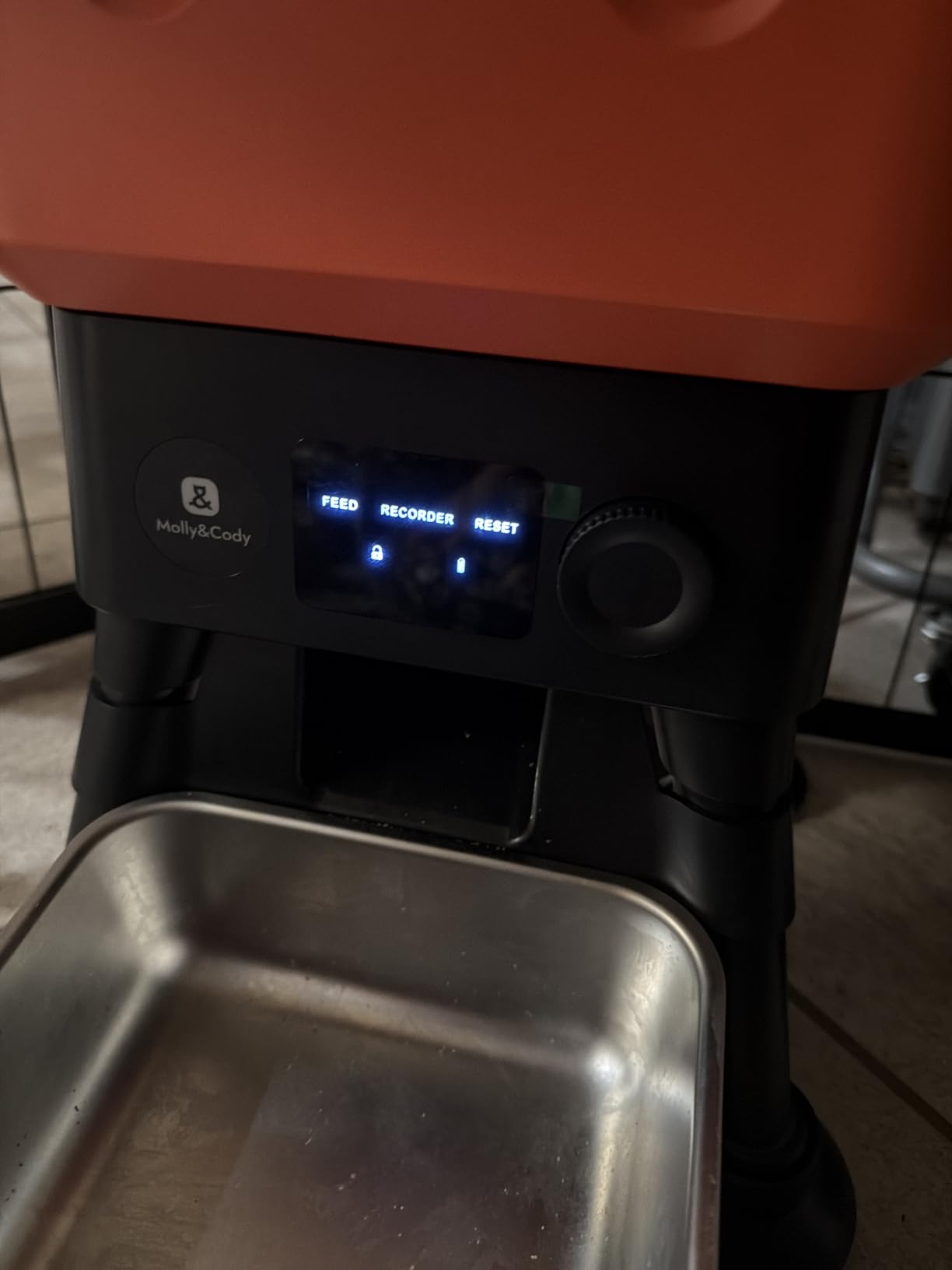
The 14-litre hopper holds 60 cups, so on a four-cup daily ration a refill comes around every two weeks. Battery backup uses four AA cells, and the manufacturer claims up to 84 days on battery, which matters if you lose power in a storm.
A 10-second personal voice message plays at mealtime, which some dogs respond to strongly. The stainless steel bowl is easy to wash.
What a heavy build solves for a strong dog
Weight is the feature. A dog leaning on a hopper to get at the food is far less likely to shift an 8.85-pound unit than a 5-pound one, and the elevated silo profile puts the outlet above paw height.
The anti-blockage motor and channel design keeps large kibble moving, though reviewers note the biggest pieces move less smoothly than medium kibble. If your dog eats 23mm pieces, this is not the one to pair with.
Watch-outs before you commit
The chute can be removed and chewed by a determined dog if it is not secured, so check the fixings after the first week. There is no wall-mount option here, which leaves the tipping question open.
The low-food indicator can trigger while food is still present, so treat the alert as a prompt to look rather than a fact. The unit is also bulky at 12.59 by 11.42 by 11.42 inches, and setup is easier on constant mains power.
4. Dokoo 15L Vacuum-Sealed Feeder – Best for Bag-Length Refill Intervals
- 15L hopper holds a full bag of kibble
- Dispenses large dog-sized kibble without clogging
- Elevated bowl suits large breeds and reduces neck strain
- No app dependency with on-device programming
- Stainless steel bowl is easy to clean
- No phone app or camera so no remote scheduling
- Vacuum seal stopped holding on some units after a few weeks
- Empty indicator does not work and the lid hides food
- On-device setup is not always intuitive
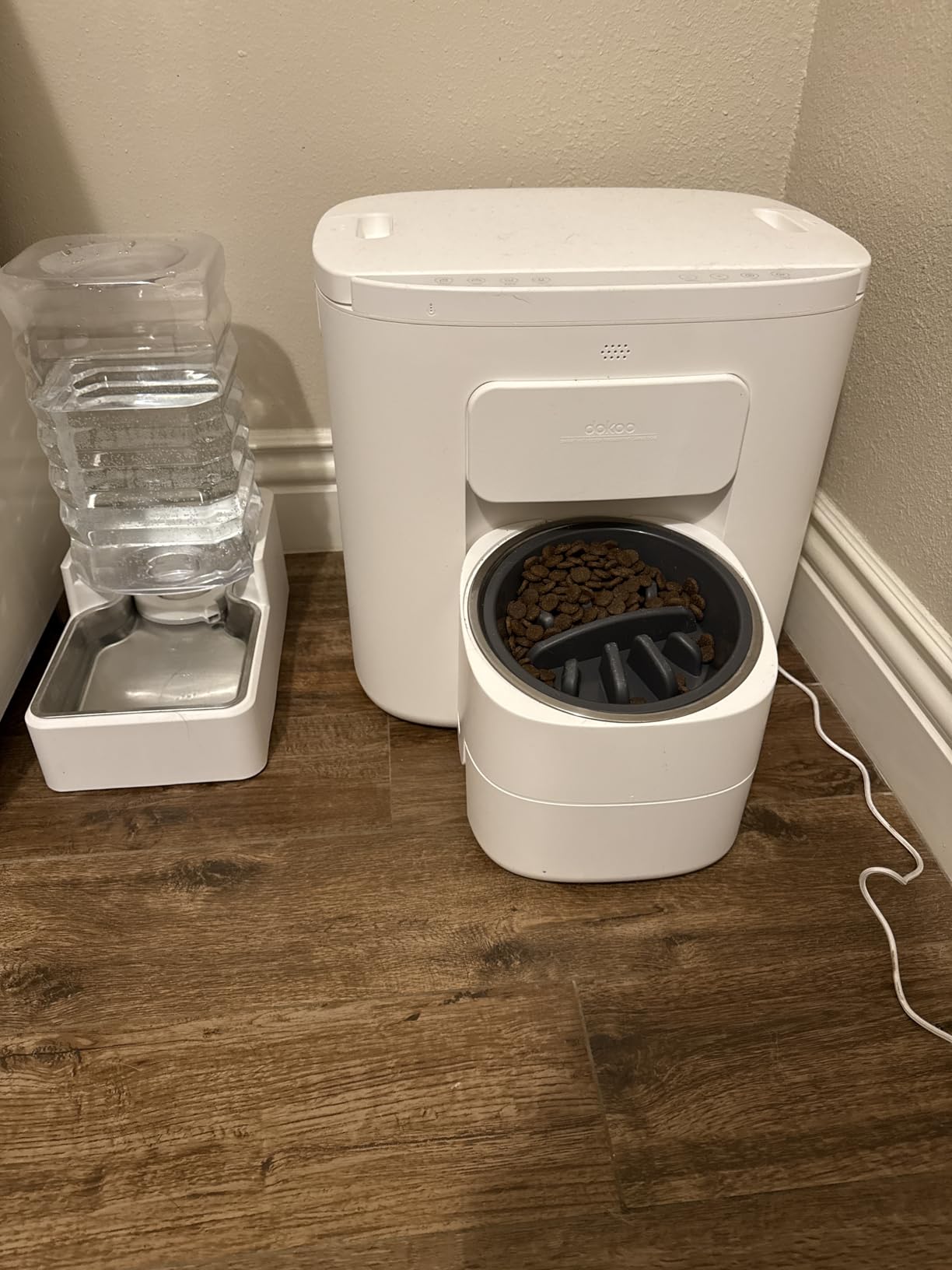
This is the feeder I trust most when the house has no reliable Wi-Fi. There is no app, no cloud account and no camera, so there is nothing to fail when the router reboots. You set six meals a day on the device and it runs.
The vacuum-sealed hopper reseals itself after each meal, and at 15 litres it holds 63 cups, close to a full bag of kibble for a large dog. At 19.84 pounds it is the heaviest unit here, and the adjustable elevated bowl stands the dog at a comfortable height.
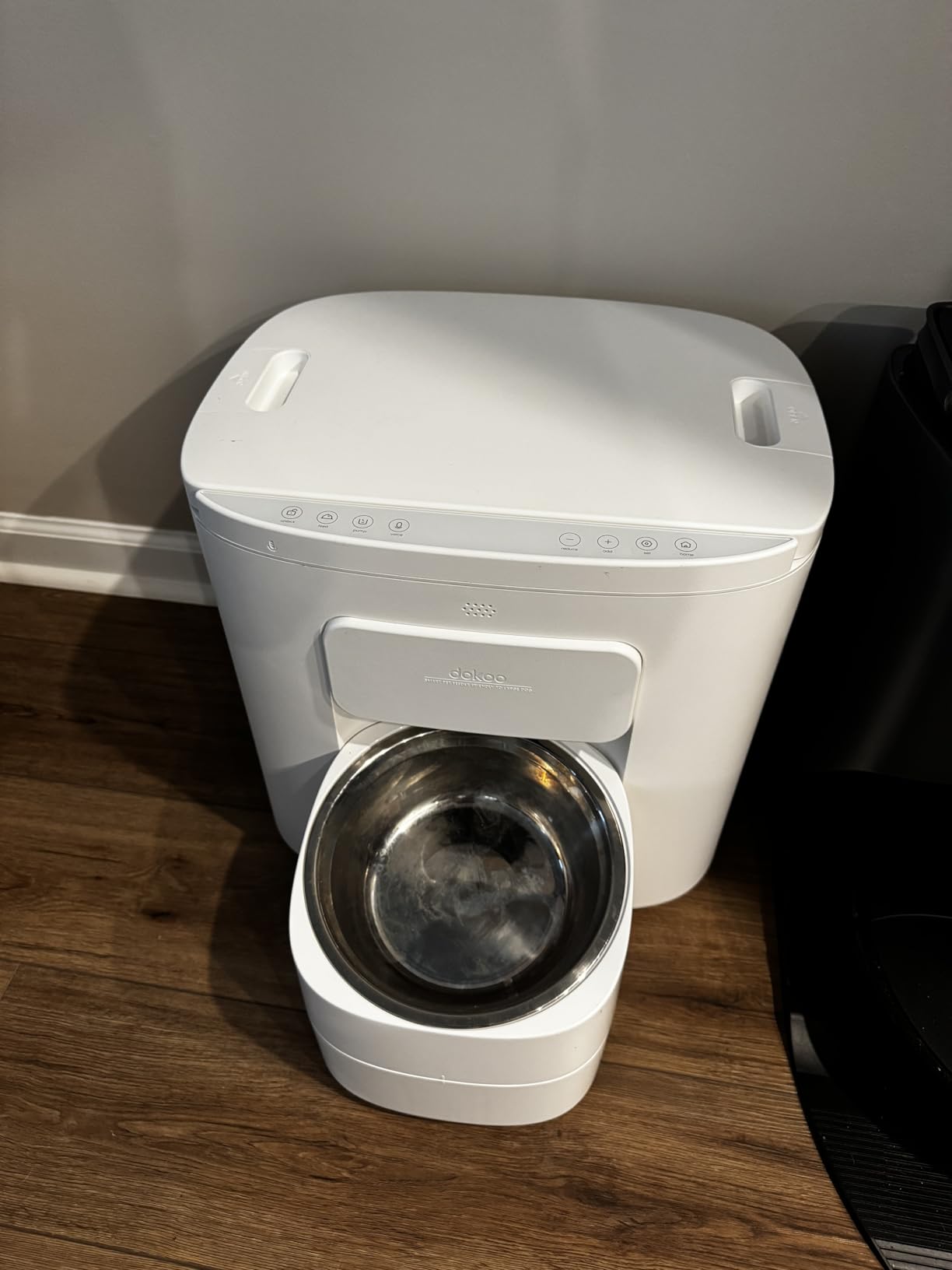
Dispensing uses a vertical wheel-style rotor rather than a flat impeller, and the anti-jam path is rated for 2-22mm kibble. Portions adjust from 1 to 20 per meal, and a 10-second voice recorder adds a familiar cue at feeding time.
Power runs from a 5V DC wall adapter with four D-cell batteries as backup, and the unit carries a 1-year warranty. BPA-free food-grade materials throughout, and no assembly is required.
Why offline reliability changes the decision
Owners who switched away from app-based feeders describe it as the reason they came back to a device that just works. r/Petlibro threads are full of people leaving a brand over reliability, and a feeder with nothing to pair, log in to or update is the simplest answer.
For deep-chested breeds this is also the safest pick in the group, because the adjustable bowl height takes the strain off the neck without needing a separate stand. Owners of Rottweilers and similar dogs in r/RhodesianRidgebacks ask the raised-feeder question constantly, and this unit answers it directly.
Where it falls down
A few owners report the vacuum seal stopped holding after a couple of weeks, so test the seal with a week of food rather than trusting it from day one. The empty indicator does not work and the steel lid hides what is left.
There is no camera and no remote dispensing, which rules it out for anyone who needs to confirm a feed from work. The 24-hour clock display is also easy to enter incorrectly, so check it before you leave.
5. DOGNESS 11L Cordless Feeder – Best for Going Off-Grid
- 11L hopper covers close to two weeks of food
- Cordless rechargeable battery avoids disposable batteries
- Quick button setup with no app or WiFi needed
- Triple-seal keeps kibble dry and fresh
- Reliable over multi-year use with rare jams
- Clock resets after a power interruption and needs a manual reset
- Attached bowl can be too small for a large single portion
- Portion size steps are approximate and vary with kibble
- Melamine bowl rather than stainless steel
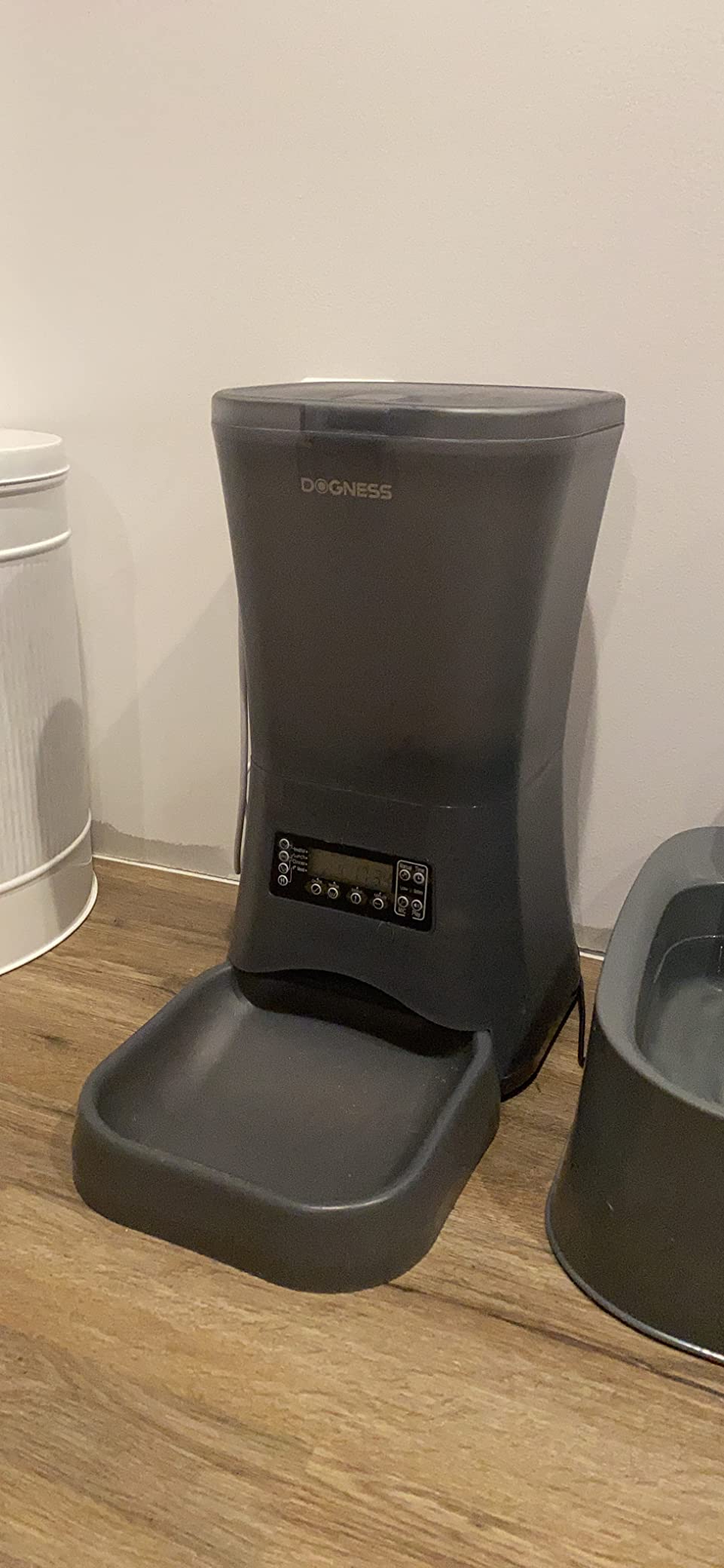
The cordless design is the reason to look at this one. A built-in rechargeable battery gives 60 to 80 days of backup with no disposable cells, and the included battery means there is nothing extra to buy before you can use it away from a socket.
Programming happens on the device itself with buttons, so there is no app and no internet requirement. Up to 9 meals a day with 20 servings each, and each serving measures roughly 1/6 cup, which gives fine-grained control for splitting a large ration.
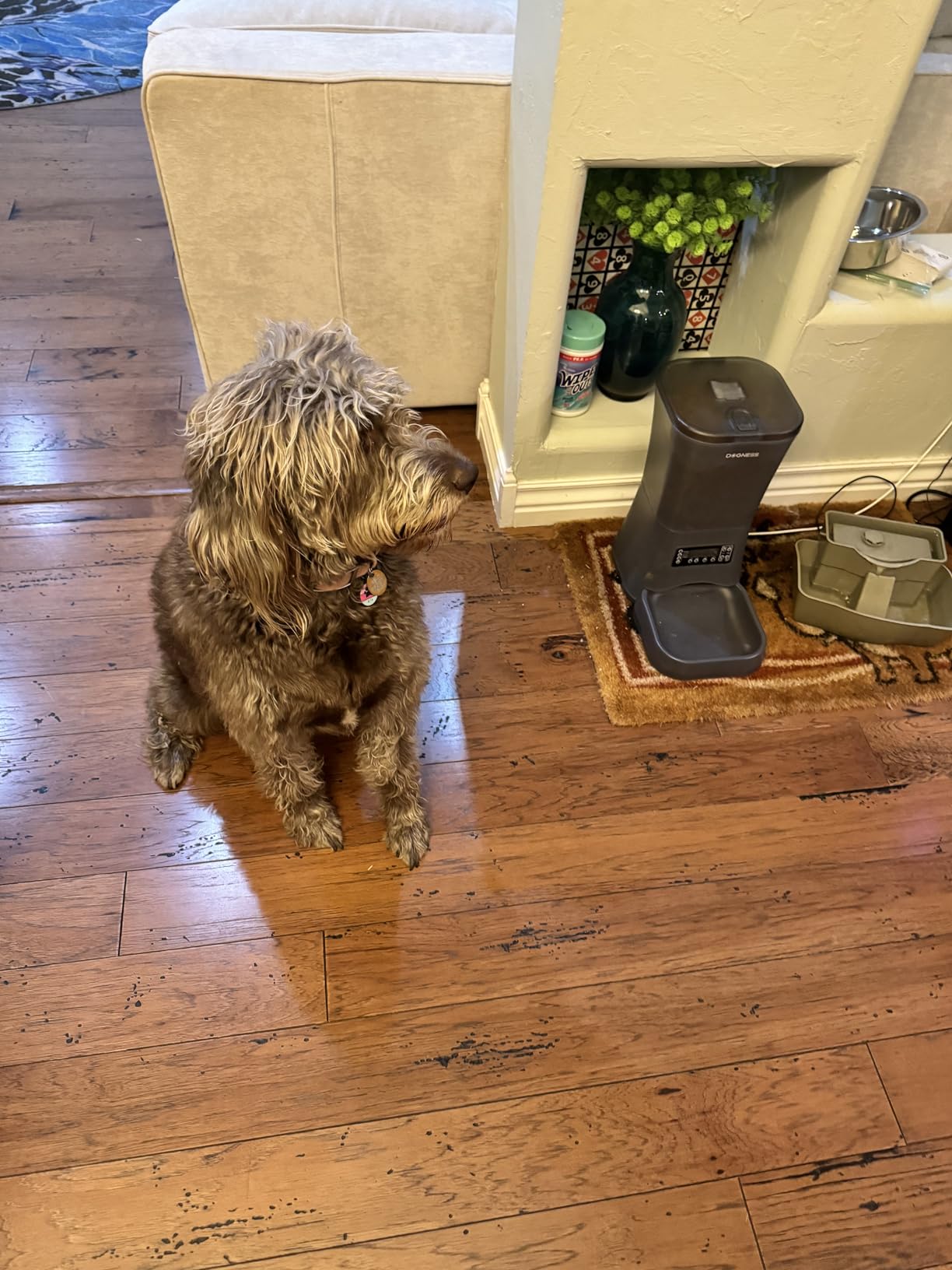
The triple-seal system combines a silicone seal, an auto-close dispenser and a desiccant pack, and the transparent hopper lets you see the level without opening the lid. The hopper and bowls disassemble easily for cleaning, which reduces the kibble-scattering cleanup that owners complain about elsewhere.
The dual-rotor dispensing channel with a wider outlet is the anti-jam mechanism, and it is rated for dry pellets up to 18mm. At 9 pounds it is heavy enough to stay put for most dogs.
Where cordless actually earns its keep
There is no power lead to run, so it works in a kennel, a covered patio or a camping setup. For anyone feeding a dog through a power cut, the battery claim matters more than any camera feature on any other unit here.
Long-term owners report multi-year reliability with rare jams, which is a stronger durability signal than first impressions. No Wi-Fi also means no subscription, no account and nothing to update.
What to watch after a power cut
The clock resets after a power interruption and needs manual resetting, so if you lose power overnight you must reprogram the schedule before you leave for work. That single behaviour is the main reason this is not our top pick.
The attached bowl can be too small for a large single daily portion, and owners report backups when several cups land at once. The bowls are melamine rather than stainless steel, so expect to replace them eventually.
6. Nityers 15L/63-Cup Feeder – Best for 23mm Kibble and Raised Bowls
- 15L hopper holds close to a full 20 lb bag of kibble
- Wide channel and motor move 23mm kibble without clogging
- Two stand heights suit a large or senior dog
- Locking lid stops a cat fishing food out
- Everything snaps apart for cleaning without spilling
- Bowl sits loosely in its holder and shifts as the dog eats
- Display turns off when running on battery power only
- No app or camera so no remote control
- One owner reported the unit failed to power on twice
Two things set this feeder apart. The 2-23mm kibble range matches the widest tolerance for big pieces in the group, and the 15-litre hopper holds roughly 18 to 20 pounds of food, close to a full bag, so on a four-cup daily ration you are topping up about every two weeks.
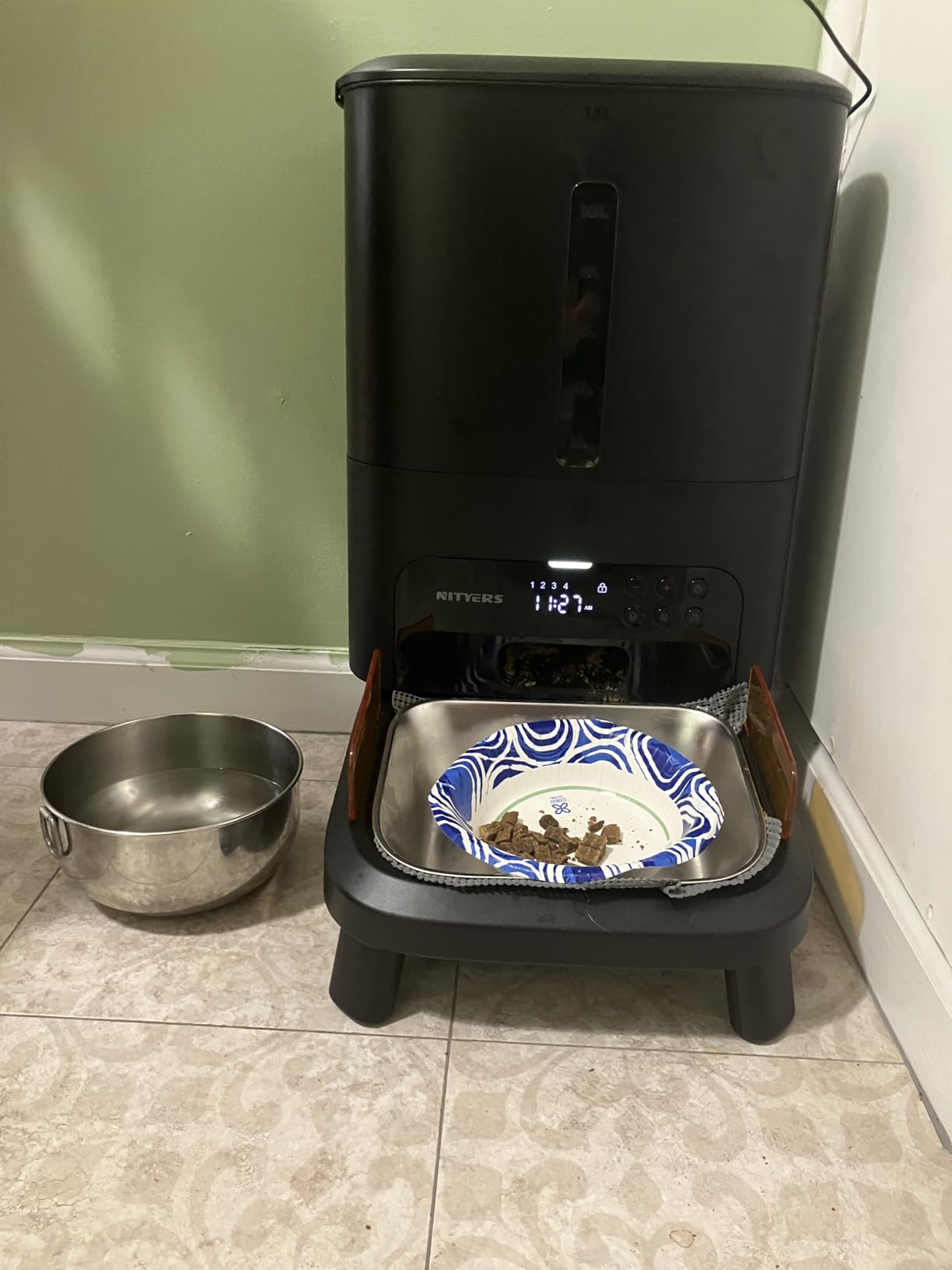
The bowl is the piece most large-breed owners care about, and at 9.84 inches with side rails and an internal incline, it is one of the few bowls here that comfortably fits a full 1.25-cup serving without the dog pushing food over the edge.
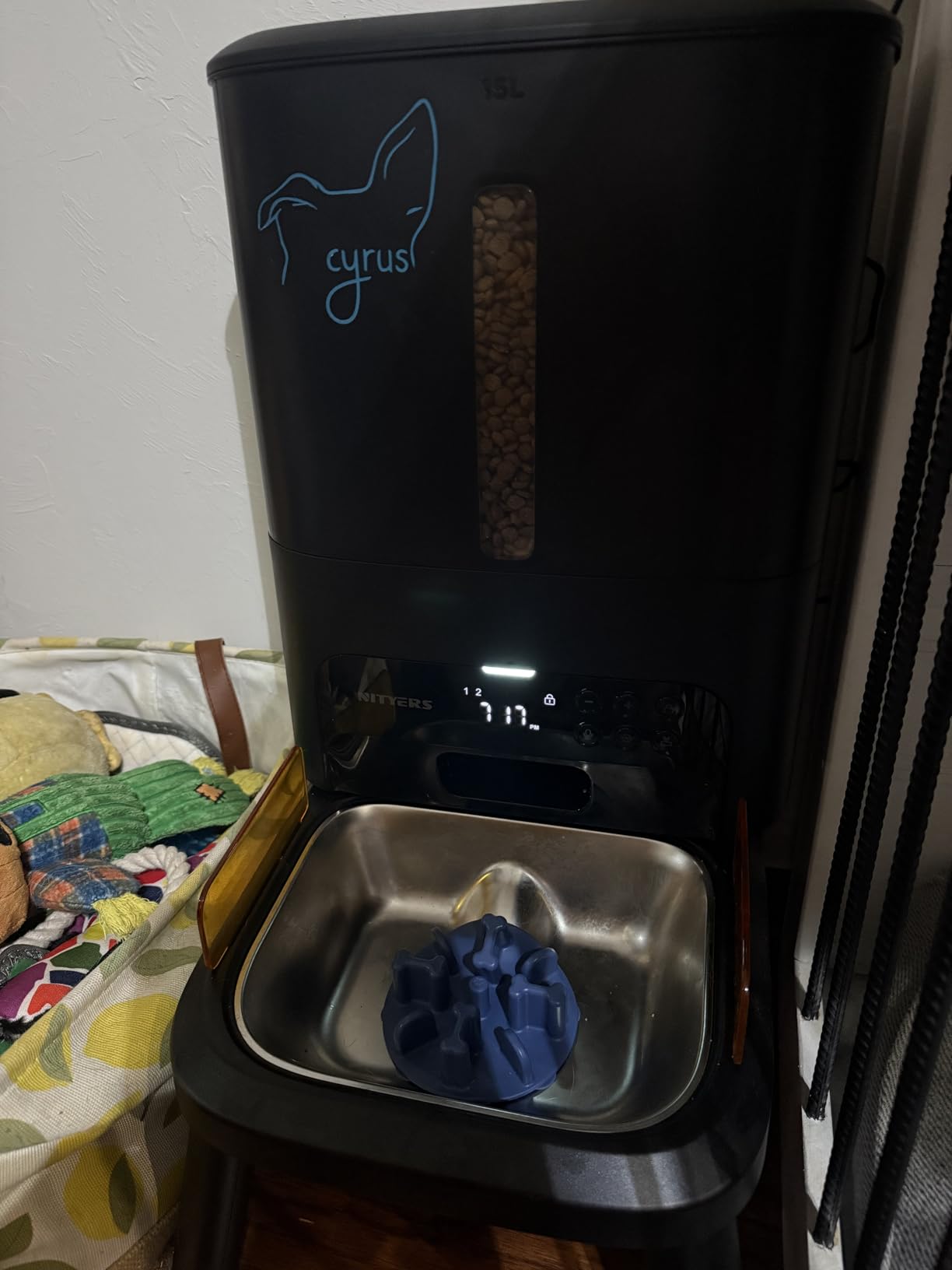
Two stand heights attach with tool-free twist-lock fittings, so you can run it low for a puppy or high for an adult or senior. The spring-lock silicone-sealed lid includes a desiccant compartment, and the Freshness Lock keeps kibble dry between meals.
Programming is on-device with a clear display, and there is no Wi-Fi or app dependency. Power comes from a DC adapter with eight AA batteries as backup, and the lid, hopper, rotor, bowl and tray all come apart for cleaning.
How to size the bowl before you buy
Bowl size is the mistake that shows up most often on r/dogs, where owners say advertised large-breed bowls look small once a real muzzle is in front of them. Measure the amount your dog eats in one sitting and check the bowl holds it with room to spare.
The bowl here is deep as well as wide, and one owner notes it may need a slow-feeder insert. If your dog gulps, that is worth budgeting for rather than discovering later.
Durability and control trade-offs
Portion sizes are consistent and the timer is accurate, which matters most for weight management. The counterpoint is that there is no app, so you cannot confirm a feed or dispense remotely from anywhere.
The bowl sits loosely in its holder and shifts as the dog eats, and the display switches off on battery power alone, so you check the schedule rather than reading it from across the room. One owner reported two power-on failures within two months, which is a small number but worth a warranty check.
7. Gwozn 15L Camera Feeder – Best for Multi-Feeder Households
Gwozn Automatic Dog Feeder Large Breed: 15L/63-Cup Capacity for 23mm Kibble
- 15L capacity reduces refills to every couple of weeks
- Wide outlet handles large kibble and freeze-dried pieces
- App supports multi-camera view of many feeders
- Camera quality is better than expected at this tier
- Battery backup keeps the schedule running during outages
- Front feed button cannot be disabled so a dog can trigger meals
- Cloud video features need a paid subscription
- Tuya and Smart Life apps criticized by some users
- Plastic dispenser fins jammed a few times
- Mediocre speaker for voice playback
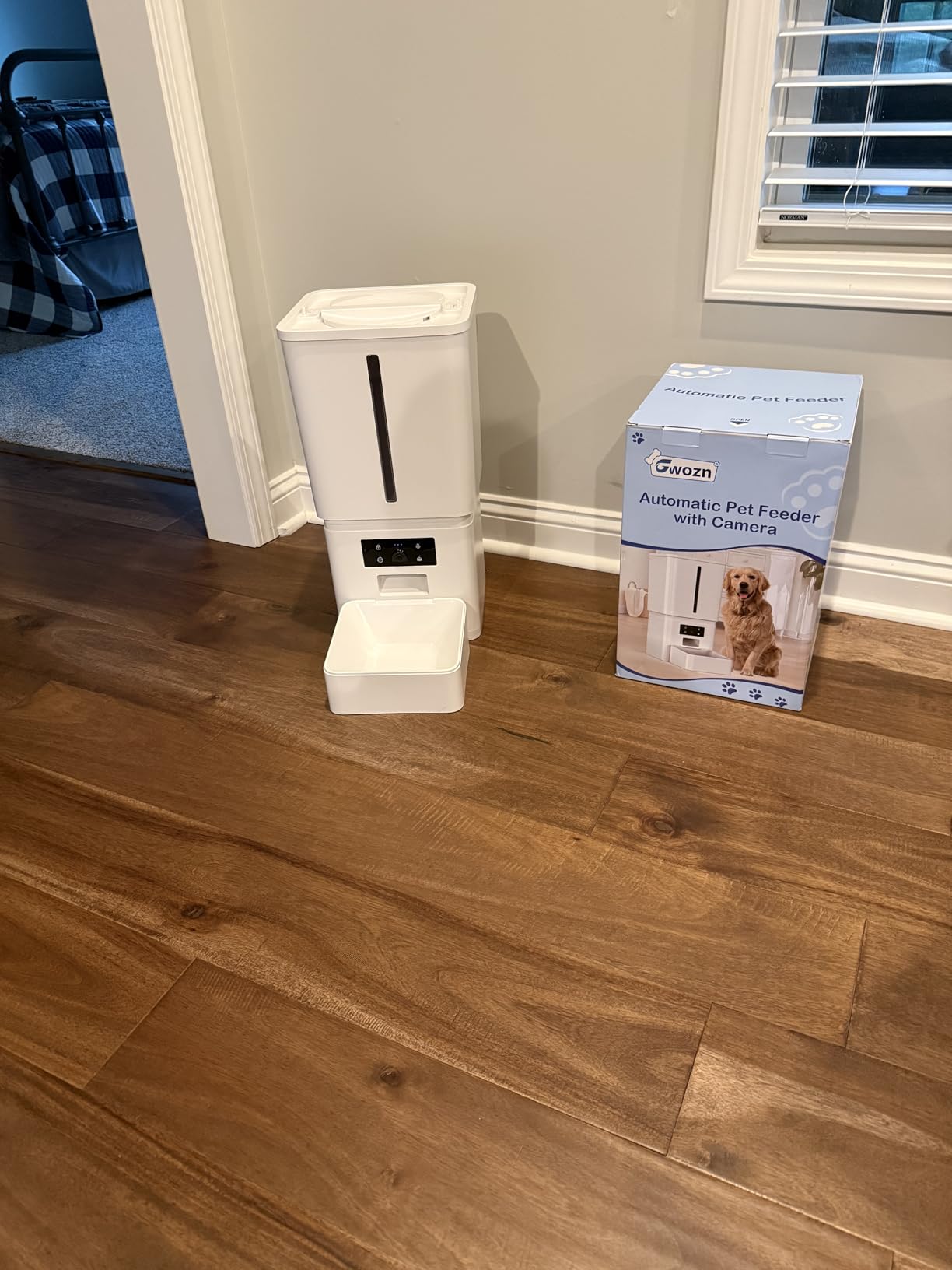
The reason this one appears here is multi-feeder management. Owners running several units at once like that the app adds devices quickly and shows many feeders in one view, which is the main draw for a kennel or multi-dog setup.
Capacity is 15 litres, or 63 cups, rated for up to 23mm kibble and freeze-dried pieces. Owners running topper-style diets specifically praise the wide dispensing outlet and food path.
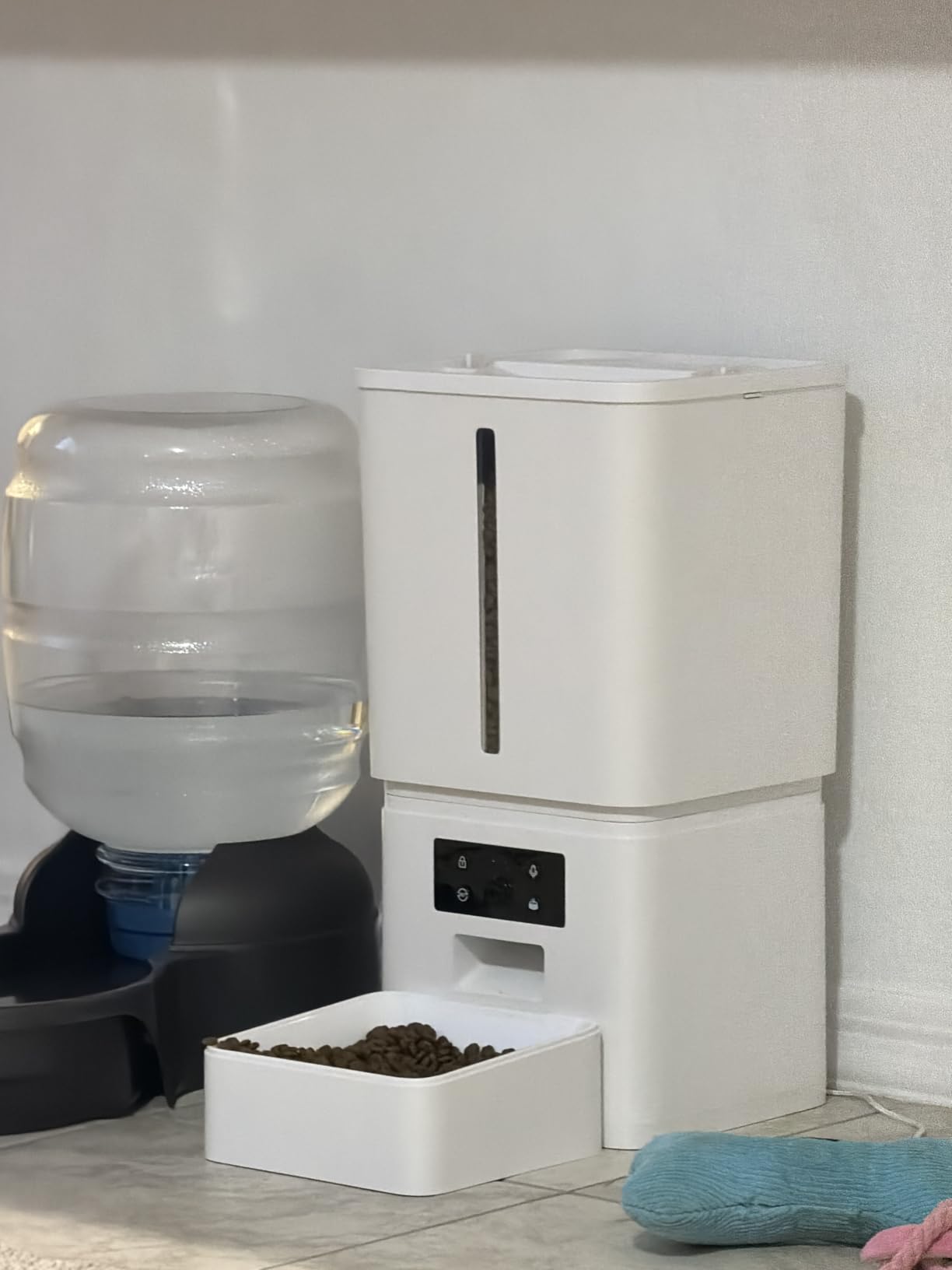
The camera is 1080P with night vision, AI motion detection and two-way audio, and a microSD card slot gives you local recording without a subscription. Dual-band 2.4GHz and 5GHz Wi-Fi pairing is standard here, which helps on crowded networks.
Up to 15 meals a day with 1 to 20 portions each, a sealed lid with a desiccant holder, and a fully removable tank, bowl, lid and dispensing rotor. A 2-year warranty is the longest in this group.
When multi-unit control matters
If you are feeding two large dogs in separate rooms, or running feeders for a dog and a cat, a single app view of all of them is the feature that removes daily walking around the house. That is where this unit earns its place.
The 23mm kibble rating and freeze-dried support widen the food options compared with the 18mm units here, which matters if you mix toppers into the kibble.
The button problem worth fixing first
The front feed button cannot be disabled, so a dog can trigger its own meal. Combined with an always-on manual feed, that quietly breaks portion control, and it is the single most important setting to check before you trust the schedule.
Cloud video needs a paid subscription that the listing does not mention up front, some users dislike the Tuya and Smart Life apps, and a ranch user running many units reported plastic dispenser fins jamming. The speaker is mediocre for voice playback.
8. Nityers 15L Camera Feeder – Best for Remote Check-Ins
- Handles large kibble that jammed cheaper feeders
- 15L capacity holds a 30 lb bag of food
- Elevated stand keeps the bowl at a comfortable height
- Feeding records in the app confirm the dog was fed
- Camera and two-way audio work well for remote check-ins
- One owner reported constant Wi-Fi disconnects that were hard to fix
- Camera tilts up and down but cannot pan side to side
- Cloud storage may require a subscription
- Camera is black and white rather than colour
- Manual feed button cannot be locked out
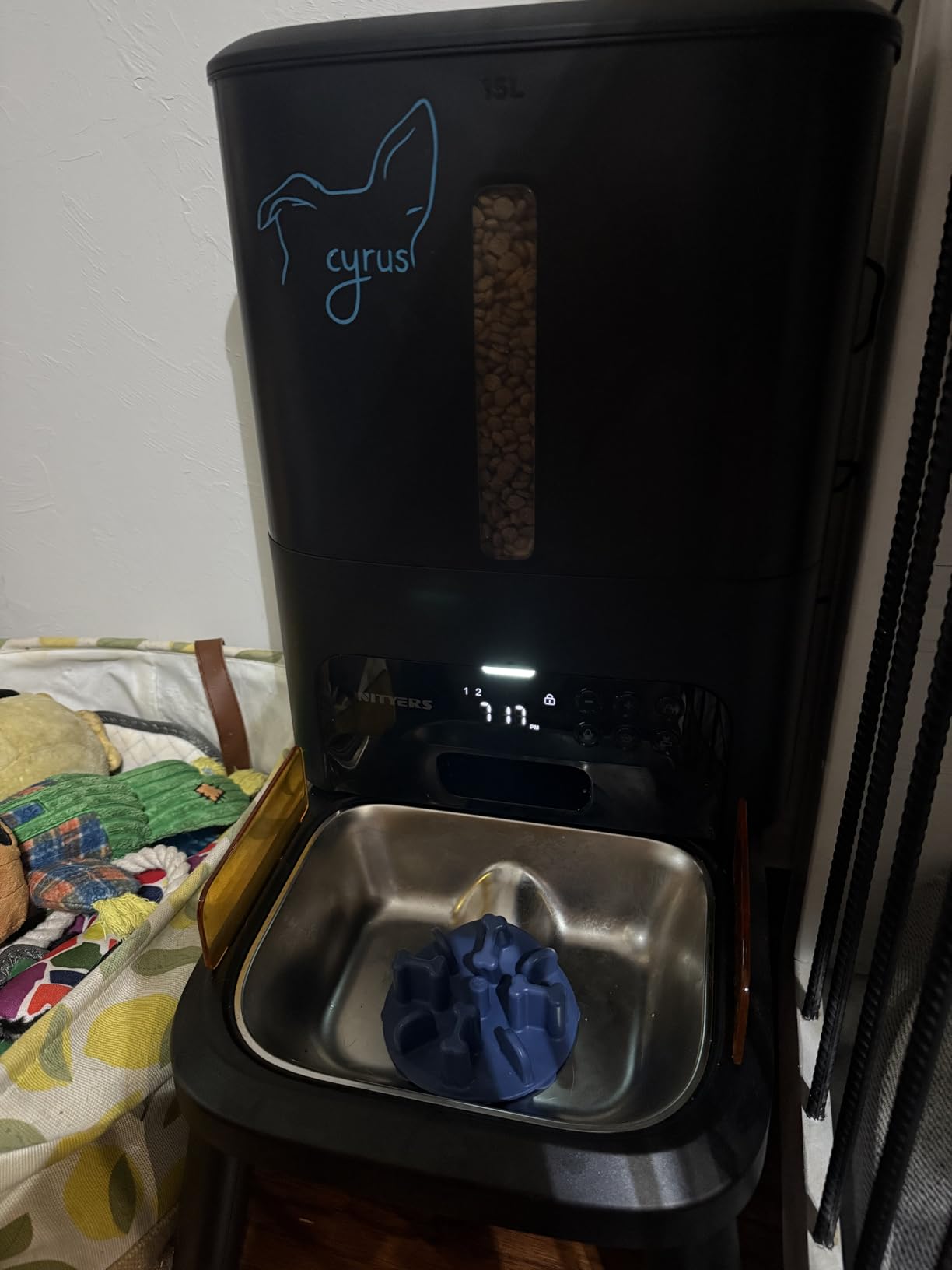
This is the camera-equipped sibling of the raised-stand feeder above, and it inherits the same 2-23mm kibble tolerance, two stand heights and 9.84-inch stainless bowl with removable side rails. What it adds is the ability to confirm a feed from anywhere.
The camera tilts from 10 degrees up to 70 degrees down, which is the difference between seeing your dog and seeing the bowl. AI motion detection and a feeding record history in the app let you check whether the dispense actually happened rather than trusting the schedule.
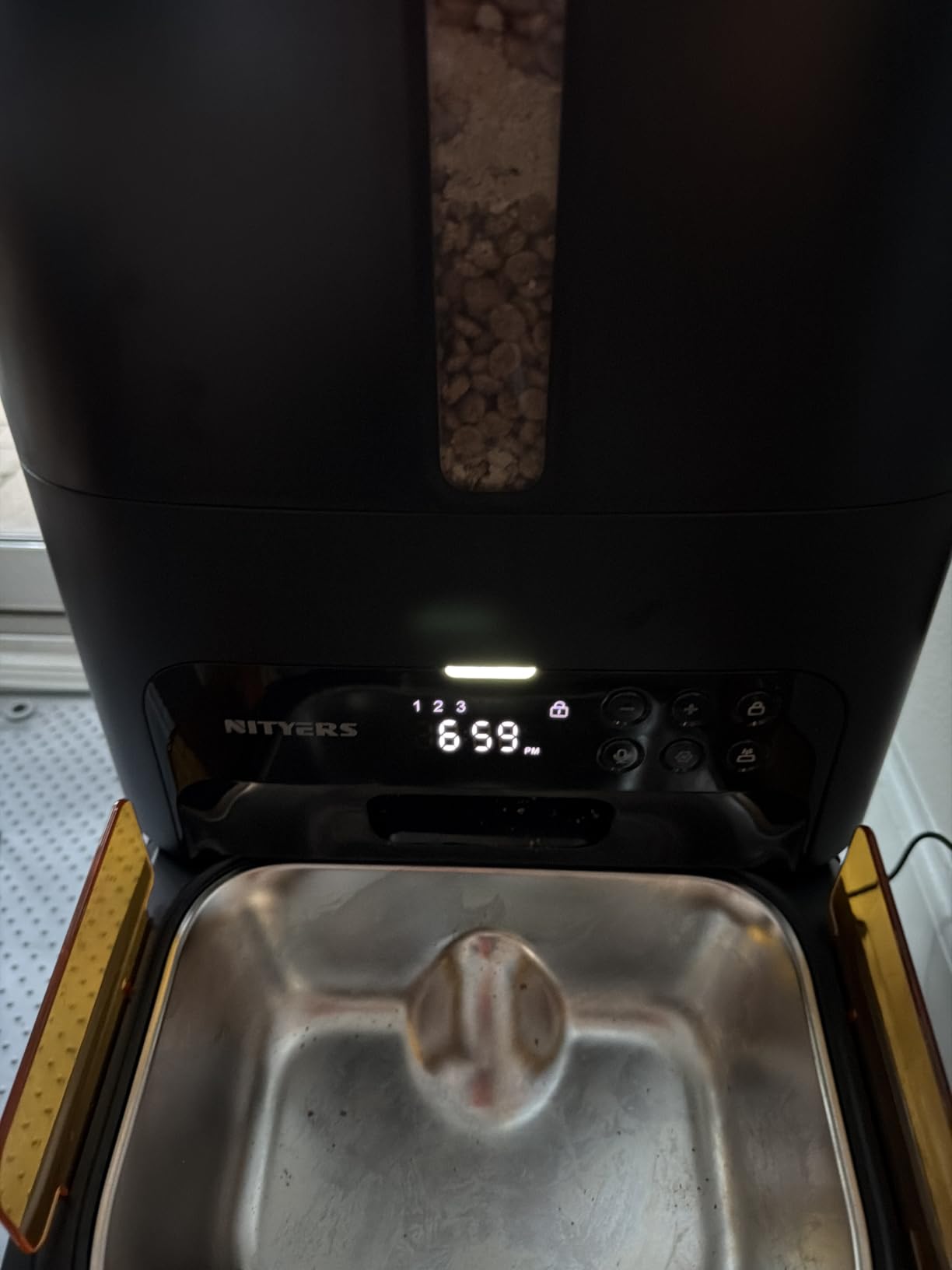
Portion control is unusually flexible at up to 99 portions of 1/8 cup per meal across 15 meals a day, and the 15-litre hopper fits a 30-pound bag of food, so on a four-cup ration a refill comes around roughly every two weeks.
Dual-band 5GHz and 2.4GHz Wi-Fi, two-way audio with microphone and speaker, twist-lock stand fasteners, and DC power with eight AA batteries for backup complete the feature set.
Why a tilting camera changes remote checking
A camera aimed at the pet tells you nothing about the food. One that tilts down toward the tray lets you confirm a portion landed, which is the difference between peace of mind and refreshing the app and hoping.
Feeding records fill the gap when you cannot watch live. Combined with two-way audio, you can speak to a dog that has separation anxiety while you are still at work.
Limitations worth knowing
The camera does not pan side to side and the picture is black and white rather than colour, so it is a feeding check rather than a proper pet camera. Cloud storage may need a subscription, and a microSD card is not included.
One owner reported constant Wi-Fi disconnects that were hard to fix, which is a reminder to test the connection in the room the feeder will live in. Portion size needs a test run, and the manual feed button cannot be locked out.
What to Look for in an Automatic Feeder for a Large Dog?
Hopper capacity and days of food
Size the hopper to the ration, not to the litre count. A dog eating roughly 4 cups a day needs that much capacity for every day you are away, so a 12-litre hopper holding 50 cups covers about 12 days and a 15-litre hopper holding 63 cups covers about two weeks. Those day counts assume the full stated capacity, so treat any longer claim as marketing unless the maths works.
Below roughly 6 litres you are refilling daily, which defeats much of the purpose. If you travel for work regularly, step up to 14L or 15L so you can leave for several days without topping up.
Bowl size in cups, not inches on the box
This is the number most roundups skip. Owners on r/dogs describe feeders labelled for large breeds whose bowls will not hold 1 to 1.25 cups, which is roughly what a 70 to 110 pound dog eats at a sitting.
Check the bowl against the dog’s muzzle and serving size, and look for side rails or an internal incline so food does not get shoved out. A wide stainless bowl beats a narrow melamine one at the same capacity.
Kibble size and anti-clog design
Large-breed kibble runs roughly 15mm to 23mm. Anything rated below 18mm will struggle with big pieces, and anything rated above 20mm handles the widest range. Look for a wide dispensing outlet, a silicone stirring paddle or a rotor-style wheel, and a chute you can reach to clear dust.
Kibble dust and broken fragments are the leading cause of jams, so a feeder with a fully removable rotor and chute saves you time every week.
How to test portion accuracy in ten minutes?
Never trust a feeder’s portion setting on day one. Dispense one portion into a measuring cup and weigh the kibble, then repeat it three times and compare. If the three runs differ by more than about 10 percent, the setting is unreliable for prescription diets.
Then run the same test with a different kibble shape, because portion size shifts with density. Recheck after a month, since portion drift over weeks is one of the most commonly reported problems in owner reviews.
Power backup and offline reliability
Every feeder here runs on mains power with battery backup, ranging from three D cells to eight AA cells, plus one cordless unit with a built-in rechargeable battery. Check whether the schedule survives a power cut, because some models lose the clock and need manual resetting.
For homes with patchy Wi-Fi, on-device programming beats an app. If you want remote control, test the connection in the room where the feeder will sit before you commit. Our automatic pet feeder guide covers more connectivity options.
Elevated bowls and bloat in deep-chested breeds
Rottweilers, Ridgebacks, German Shepherds, Great Danes and Boxers carry a higher bloat risk, and owners on r/RhodesianRidgebacks report being warned against raised feeders before asking what other large-dog owners actually use.
The evidence is mixed rather than settled, so treat elevation as one factor alongside feeding speed and meal size. A raised bowl plus slow-feed behaviour slows gulping, and splitting a large ration into two meals is a bigger lever than bowl height alone.
What automatic feeders cannot do
Every unit here handles dry kibble only. Wet, canned and refrigerated food needs a chilled unit, which none of these are. Owners on r/Petlibro are actively searching for that gap and none of the feeders here fill it.
They also do not replace water, exercise or company, and they do not stop a food-guarding dog from guarding a bowl. For two large dogs in one household, two feeders in separate rooms beat one dual-bowl unit, which rarely holds enough for two full rations.
Cleaning and pests
Owners report ants finding their way into an open hopper and kibble scattering across the floor. A sealed lid with a desiccant pack blocks both, and removable bowls and rotors make the weekly clean bearable. If your dog spends hours outdoors, our large dog kennel guide covers where feeding stations usually work best, and our crate guide covers covered feeding setups.
Frequently Asked Questions
What is the most reliable automatic pet feeder for large dogs?
Reliability comes down to three things: does it keep its schedule after a power cut, does the chute stay clear with large kibble, and does the app matter or not. Feeders programmed on the device with no app have nothing to fail, so they are the most reliable for most households. Feeder models with backup batteries keep dispensing during an outage. The most common reported failures are portion drift, clock resets after a power interruption, and jams from kibble dust.
Do vets recommend automatic feeders for large breeds?
Veterinarians generally recommend scheduled portion feeding over free feeding for large breeds, because free feeding makes weight control difficult and large dogs tend to eat more than they need. Automatic feeders support this by delivering a measured portion at set times rather than refilling a bowl. Most vets still prefer that you feed at least one meal at home, since the feeder handles routine meals and portion control rather than the whole diet.
Is there an automatic dog feeder that can handle large kibble sizes?
Yes. You need a feeder rated for at least 20mm kibble, and several here handle 22mm or 23mm pieces, which covers most large-breed formulas. Look for a wide dispensing outlet, a silicone stirring paddle or a rotor-style wheel, and a fully removable chute so you can clear dust and broken fragments. Anything rated below 18mm will struggle with the biggest pieces in a large-breed bag.
What are the disadvantages of using an automatic pet feeder?
The main drawbacks are portion drift over weeks, meaning the dispensing amount no longer matches the label, and dependence on power or Wi-Fi when an app is involved. Most units handle dry kibble only, not wet or refrigerated food. A feeder also removes the interaction of a mealtime, which matters for dogs with separation anxiety. Portions need calibrating with a scale before you trust them for a prescription diet.
What size automatic feeder does a large dog need?
A dog over roughly 50 pounds eating about 4 cups a day needs a hopper of 12 litres or more, so you can go two or three days without refilling. A 15-litre hopper covers close to three days or fits most of a large bag. Bowl size matters just as much, since you need a bowl that holds at least 1.25 cups with side rails, and a base heavy enough or mounted high so the dog cannot tip it.
Which Automatic Dog Feeder Should You Buy?
The Yakry 12L/50-Cup feeder is the pick for most households, with a hopper sized for a real large-breed ration, kibble tolerance to 20mm and more owner feedback behind it than anything else here. If your dog pushes at units, the UTCG 12L with its wall-mount kit solves that problem outright. If your Wi-Fi is unreliable, the Dokoo 15L runs without an app and keeps its schedule.
Two dogs in one home should get two feeders in separate rooms rather than one dual-bowl unit, and any deep-chested breed benefits from the adjustable raised stands on the Nityers pair. Check every feeder with the ten-minute scale test before you leave your dog alone with it, and give the best automatic dog feeders for large breeds a full week of supervised meals before trusting the schedule.