
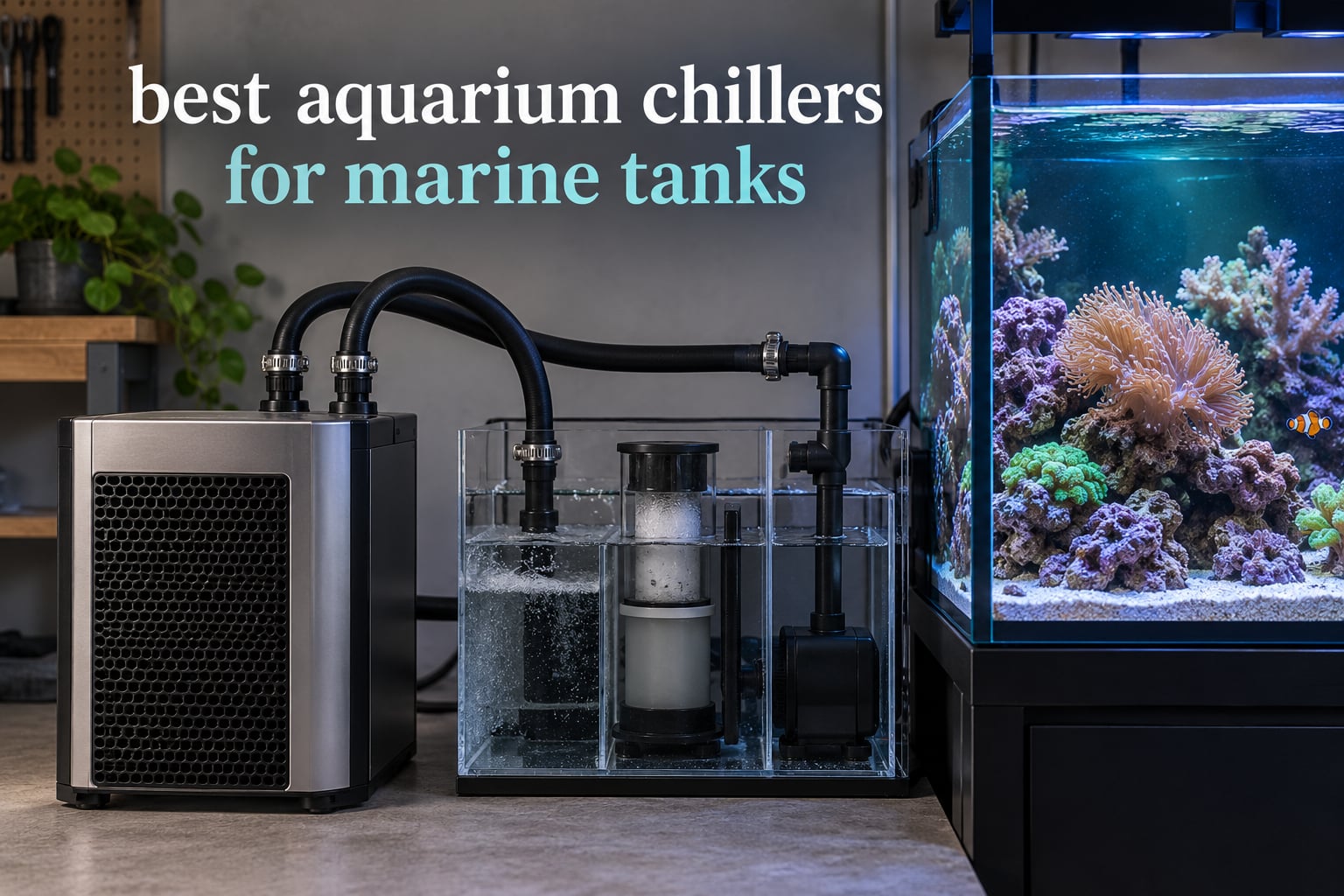
Summer heat is the single most common reason a reef tank comes under stress, and the gear that solves it is a chiller. If you have spent any time in the hobby forums, you already know the pattern: a warm room, a shallow display, a couple of metal halides, and coral that starts bleaching by the second week of July. My pick this year for the best aquarium chillers for marine tanks is the BAOSHISHAN 1/3 HP 79-gallon unit, because it pulls more heat out of a given footprint than anything else in this lineup and ships with a full plumbing kit.
I went through nine compressor chillers built for reef duty, read the review histories on each, and lined up the numbers that actually decide whether a marine tank survives August: cooling capacity against real system volume, whether the heat exchanger is titanium, how loud the compressor is at 3 a.m., and whether the controller can be trusted without constant calibration. Every unit below is rated for salt water, so nothing freshwater-only sneaks into the list.
Along the way I have drawn on the sizing debates that run constantly on Reef Central and r/Aquariums, where the consensus is consistent: total your water, add your heat load, then size up one tier rather than run a small compressor flat out all summer. If you are also shopping for cold-water gear, our picks for the best cold plunge chillers cover a similar compressor design in a different housing.
Table of Contents
What Is an Aquarium Chiller?
An aquarium chiller is a thermostatically controlled cooling unit, usually a small refrigeration compressor working through a titanium heat exchanger, that recirculates tank or sump water and pulls it down to a set temperature. Unlike a fan, which only moves air across the surface, a chiller actively removes heat from the water, so a marine reef can hold within a degree of its target all summer.
The cycle is simple. A probe reads the water temperature, the controller switches the compressor on when the reading exceeds the setpoint, and a pump pushes water across the cold exchanger where refrigerant absorbs the heat. The cooled water goes back into the sump or tank, and the heat it picked up is dumped out the back of the unit into the room.
That last part matters. Every chiller is an air conditioner for your sump room whether you planned for it or not, which is why reef keepers sometimes position a unit near the room doorway on purpose. If you also run other cooling hardware, our best lab chillers guide covers the same compressor physics at a different scale.
Top 3 Best Aquarium Chillers For Marine Tanks (October 2026)
BAOSHISHAN 1/3 HP 79 Gal
- 1/3 HP compressor rated to 79 gallons
- Pure titanium evaporator for saltwater
- Drops water 8-15F below ambient
- Full pump and plumbing kit included

Active Aqua 0.25 HP 92 Gal
- 0.25 HP compressor for 40-92 gallons
- Pure titanium evaporator
- Boost function for fast pull-down
- Digital temperature control
Poafamx 1/3 HP 80 Gal
- 1/3 HP compressor for 40-80 gallons
- Titanium evaporator for fresh or salt
- Under 45 dB operation
- Complete hose and pump kit
All 9 Marine Chillers Compared in 2026
| Product | Specifications | Action |
|---|---|---|
| BAOSHISHAN 1/3 HP 79 Gal |
|
Check Latest Price |
| Active Aqua 0.25 HP 40-92 Gal |
|
Check Latest Price |
| Poafamx 1/3 HP 40-80 Gal |
|
Check Latest Price |
 Fitnet 1/3 HP 79 Gal Touch Screen Fitnet 1/3 HP 79 Gal Touch Screen |
|
Check Latest Price |
 JBJ Arctica 1/10 HP Titanium JBJ Arctica 1/10 HP Titanium |
|
Check Latest Price |
 VEVOR 1/10 HP 52 Gal VEVOR 1/10 HP 52 Gal |
|
Check Latest Price |
 Dreamtrue 1/10 HP 42 Gal Dreamtrue 1/10 HP 42 Gal |
|
Check Latest Price |
 MLJHFC 1/10 HP 42 Gal MLJHFC 1/10 HP 42 Gal |
|
Check Latest Price |
 Poafamx 1/13 HP 26 Gal Poafamx 1/13 HP 26 Gal |
|
Check Latest Price |
1. BAOSHISHAN 1/3 HP 79-Gallon Chiller: Best Overall for Marine Tanks
BAOSHISHAN 1/3 HP Aquarium Chiller Up to 79 Gal, Drops Down 8-15F 110V
- Pure titanium evaporator resists saltwater corrosion
- Holds setpoint accurately and quietly
- Complete kit with stainless shaft pump and tubing
- Many owners report multi-year continuous operation
- On-screen messages in Chinese characters and Celsius display
- Weak instructions
- factory thermostat needs calibration
- Included 3/8 inch fittings restrict flow
This is the unit I keep coming back to for mid-size marine systems. The cooling figure is honest: a 1/3 HP compressor rated to 79 gallons, pulling water 8 to 15 degrees below ambient, with 63 gallons named as the realistic peak-summer figure. That gap between the headline number and the recommended number is the most credible thing in the whole listing, and it is exactly the honesty you want when you are sizing against a 40-gallon sump in an 82 degree room.
The heat exchanger is a pure titanium evaporator inside a stainless steel housing, which is the saltwater standard. At 45 to 50 dB at one meter it is quieter than a small mini-fridge, and the included stainless shaft pump, tubing and hose clamps mean you are not making a second hardware run before the unit will run at all. The 39.1 pound weight is real, so plan the cabinet shelf for it rather than a light duty stand.
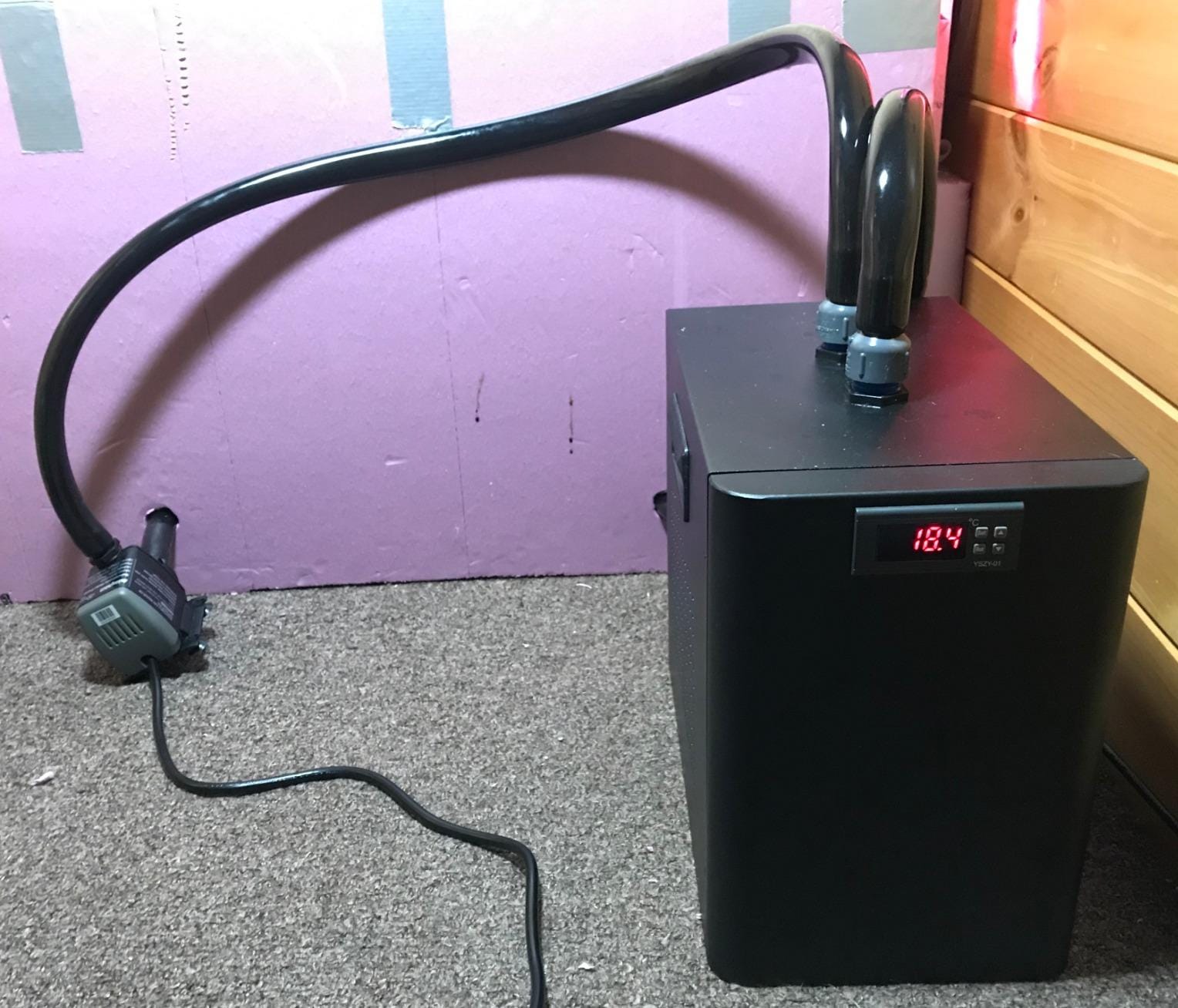
What gives me pause is documentation rather than performance. The control screen runs in Chinese characters with a Celsius display, the manual is widely described as poor or missing, and the factory thermostat needs calibration through the F1 and F2 settings before it will read true against your own probes. None of that is a dealbreaker if you plan for it, but it is an afternoon of work on day one.
Two other practical notes from the review history. The bundled 3/8 inch fittings and pump restrict flow enough that several owners upgraded to 1/2 inch, and the pump is powerful enough to stir sand in a shallow display, which matters a lot if you keep small fish or a mandarin. A small cluster of one and two star reports describes units that stopped chilling after 7 to 12 months, so the warranty conversation is worth having before you install rather than after.
Why this one works in a reef sump?
Two independent high speed fans with enlarged side vents move heat out continuously, which is what allows it to run for days without the compressor cycling itself into a short-stroked death. The unit asks for 6 inches of clearance on the sides for airflow, and that ventilation is the difference between a chiller that lasts five summers and one that does not.
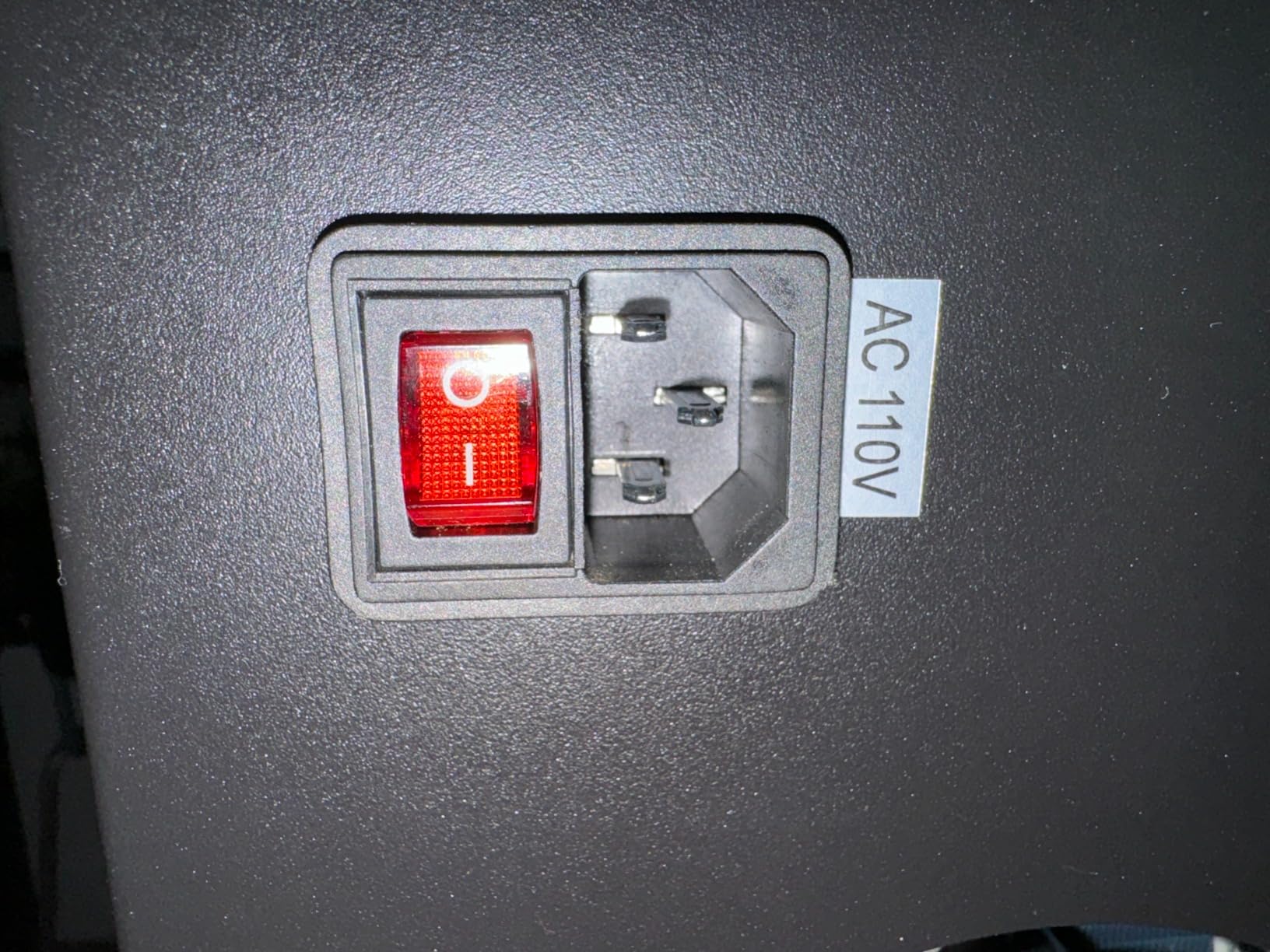
An internal battery retains the set temperature across power interruptions, so a brief outage during a storm does not leave the compressor off and the tank climbing all night. For anyone running an SPS dominant reef where a two degree swing triggers a bleach event, that memory function is more valuable than any headline capacity number.
Where it will disappoint you?
The calibration requirement is real and it is not optional on a fresh unit. If you skip it and trust the built-in reading, you can be off by several degrees and spend a whole summer fighting a thermostat that was never wrong, just uncalibrated.
It also runs hot into the room, so in a small fish room in summer you are adding the heat load back into the space. Plan ventilation or position it near an exterior wall rather than tucking it into a closed cabinet.
2. Active Aqua 0.25 HP 40-92 Gallon Chiller: Best for Large Marine Systems
Active Aqua Hydroponic Water Chiller, 0.25 HP, Pure Titanium, 40-92 Gallon
- Titanium evaporator rated for salt and fresh water
- Highest capacity range in this lineup at 40-92 gallons
- Boost function speeds up initial pull-down
- Digital interface for precise setpoint control
- Pump and hoses sold separately
- Highest cost relative to cooling capacity
- 17 percent of reviews are 1-star
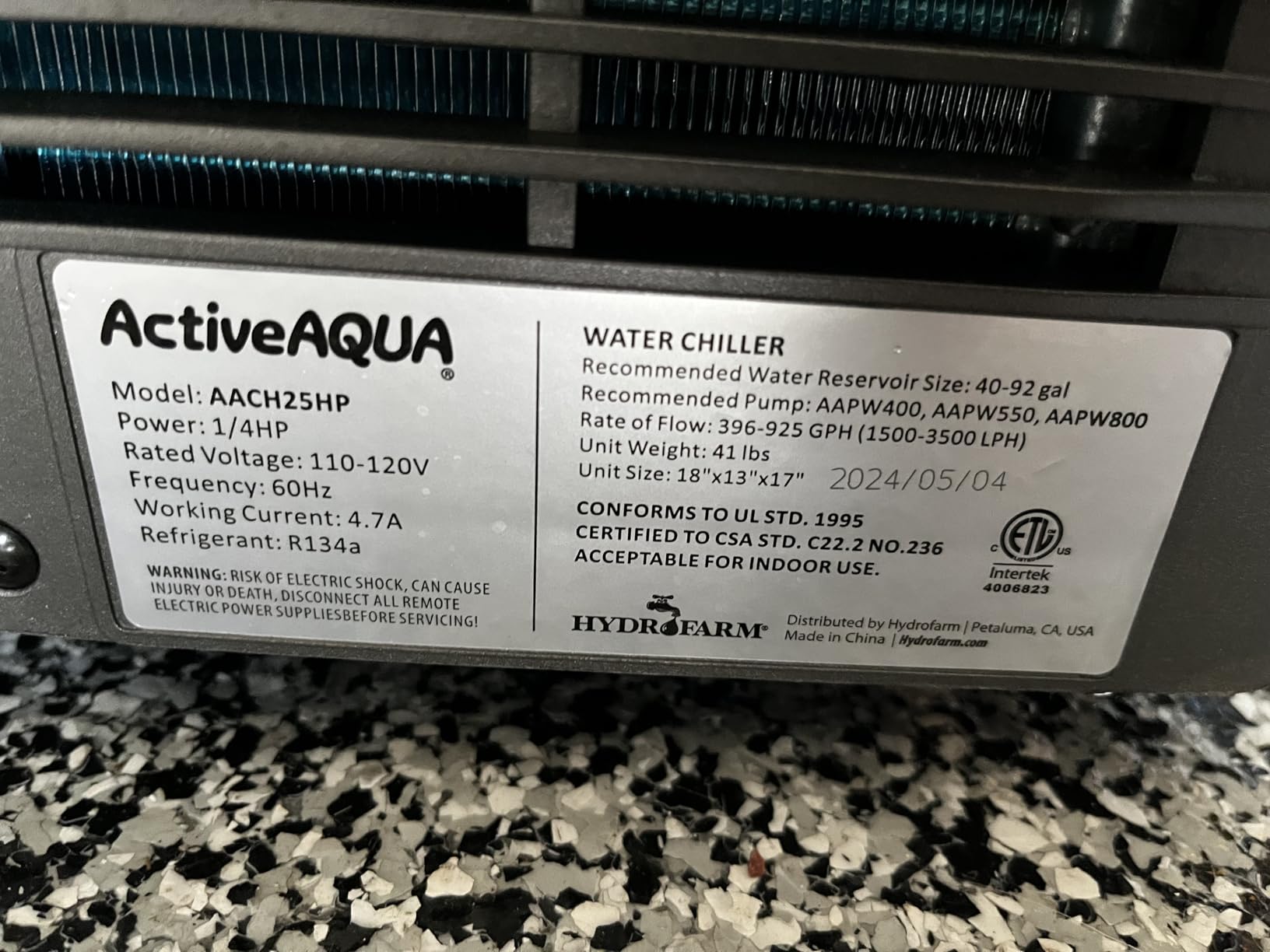
When your system runs 90 gallons plus or you have a deep sump and a refugium, capacity is the constraint that matters, and this is the unit with the widest rated range in the group. A 0.25 HP compressor covering 40 to 92 gallons, with an anti-corrosive pure titanium evaporator that the manufacturer rates for both fresh and salt water, gives you more headroom per inch of cabinet than the 1/3 HP units here.
The Boost function is genuinely useful on a new install. Rather than waiting out a slow ramp-down, you force maximum output until the water reaches setpoint and then hand it back to the controller. The digital interface gives finer setpoint control than a mechanical dial, and at 44.9 pounds the 19 by 14 by 19 inch body needs a proper shelf.
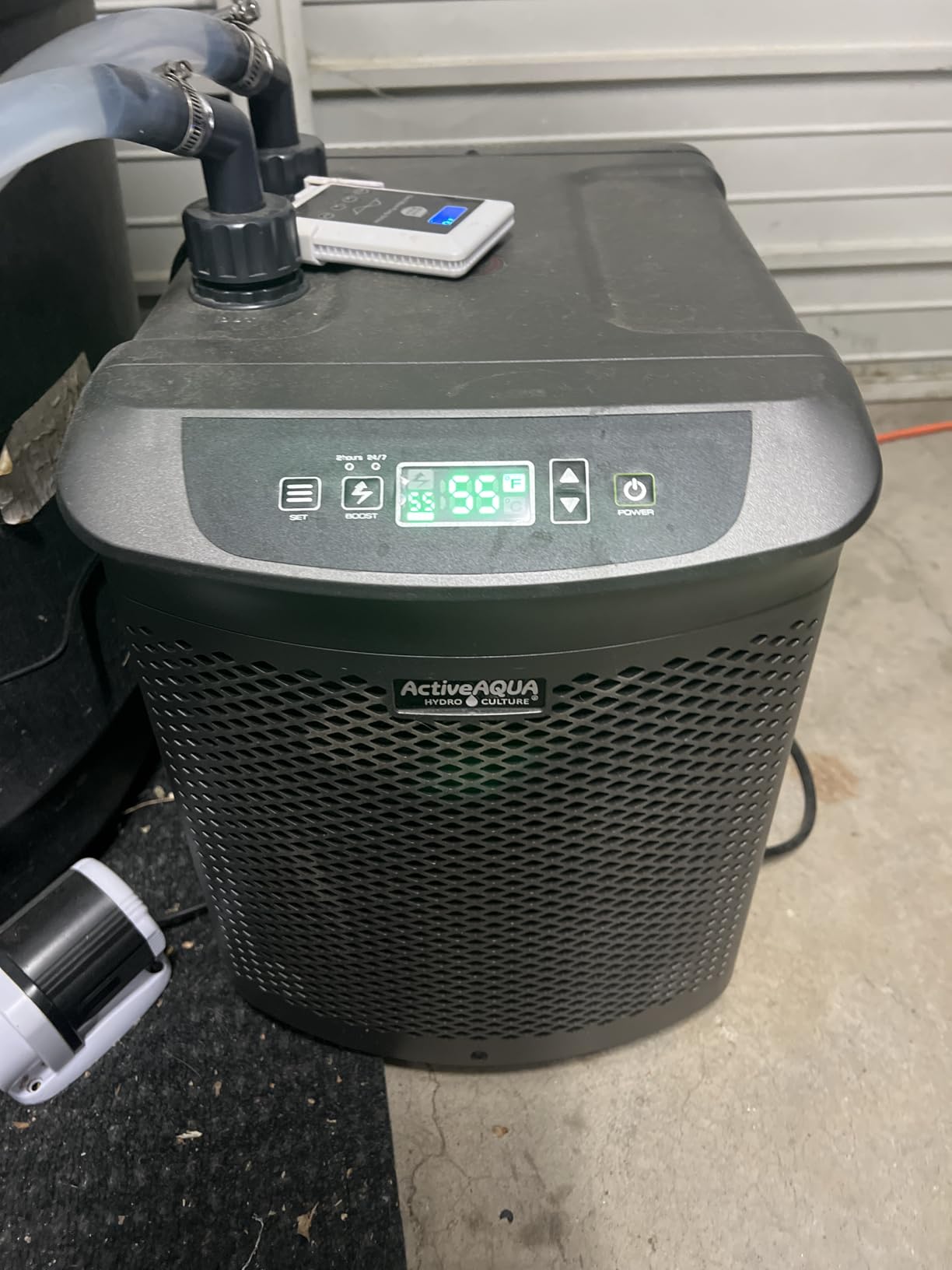
The catch is on the invoice before the install. Pump and hoses are not included, and the unit is designed around AAPW400, AAPW550 or AAPW800 pumps, so you are buying a matched circulation pump and plumbing whether you planned for it or not. Add that to the fact that this is the most expensive unit per BTU in the lineup, and it becomes a capacity decision rather than a value decision.
The 351 reviews split cleanly between hydroponics and reef owners. Praise concentrates on the titanium evaporator and the cooling range, while 17 percent of reviews are one star, the second highest share in the group, mostly describing units that stopped holding setpoint after extended use. That is a durability signal worth weighing, especially for a system that will run continuously for months.
What to check before you commit?
Confirm your sump has the space. At 19 by 14 by 19 inches this is not a shelf unit, and reef keepers who try to squeeze it into an undersized cabinet end up restricting the airflow it needs, which undoes the efficiency you are paying for.
Also confirm the pump pairing. Because the circulation pump is external, the flow rate through the titanium exchanger is whatever you connect. Too little flow and the exchanger cannot pull enough heat, which reads as a chiller that underperforms its rating even when nothing is broken.
Where it will disappoint you?
The all-in cost is the biggest drawback. Once you add a matched pump, hoses and fittings, you are well past the other options here for cooling you could get from a 1/3 HP unit with the plumbing already in the box.
The one star share is also worth noting against a long service life. A chiller that fails in its second summer means a tank without cooling at the worst possible time, so the alarm output on your controller matters more here than on a cheaper unit.
3. Poafamx 1/3 HP 40-80 Gallon Chiller: Best Value Compressor Unit
- Titanium evaporator gives saltwater compatibility
- Complete kit with pump hose connectors and clamps
- Quiet enough for a bedroom or office
- Multiple owners report leak-free 24/7 running
- Several owners report compressor failures between 8 and 12 months
- Factory thermostat reads several degrees off and needs calibration
- Bundled pump is weak at roughly 158 GPH
This is the one I recommend to people who want a real compressor chiller with titanium hardware without paying the premium-brand figure. A 1/3 HP compressor rated to 40 to 80 gallons, cooling up to 10C below room temperature, with a corrosion-resistant titanium evaporator that handles salt or fresh water. The operating range is 65 to 80F, which covers an SPS target and leaves margin above it.
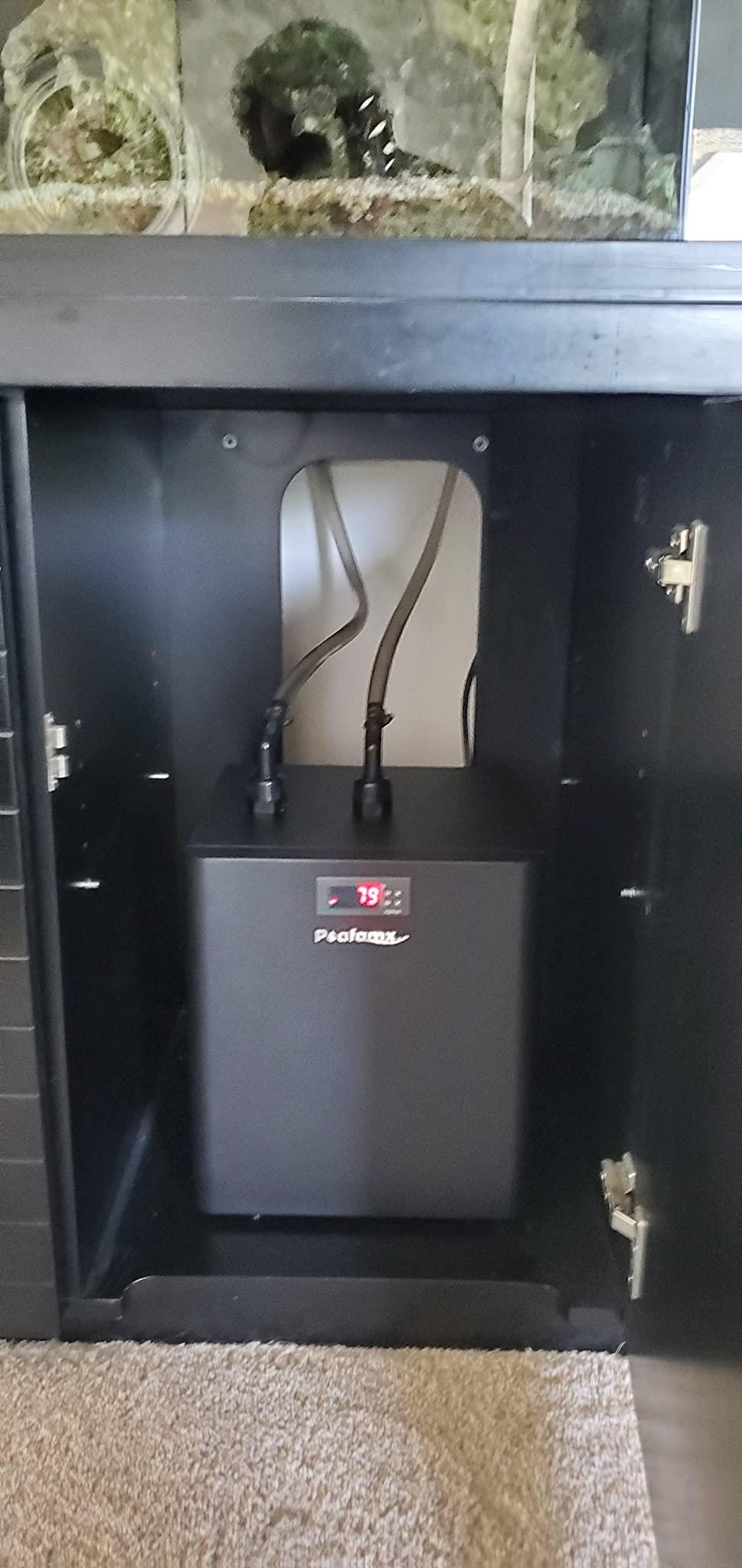
It runs under 45 dB and uses R290 refrigerant with zero ozone depletion potential, and the box includes the chiller, a pump, hose, connectors and clamps. At 37 pounds and 12.6 by 12.6 by 7.28 inches it is also the flattest unit here, which makes it easier to slide under a cabinet stand than the taller compressors.
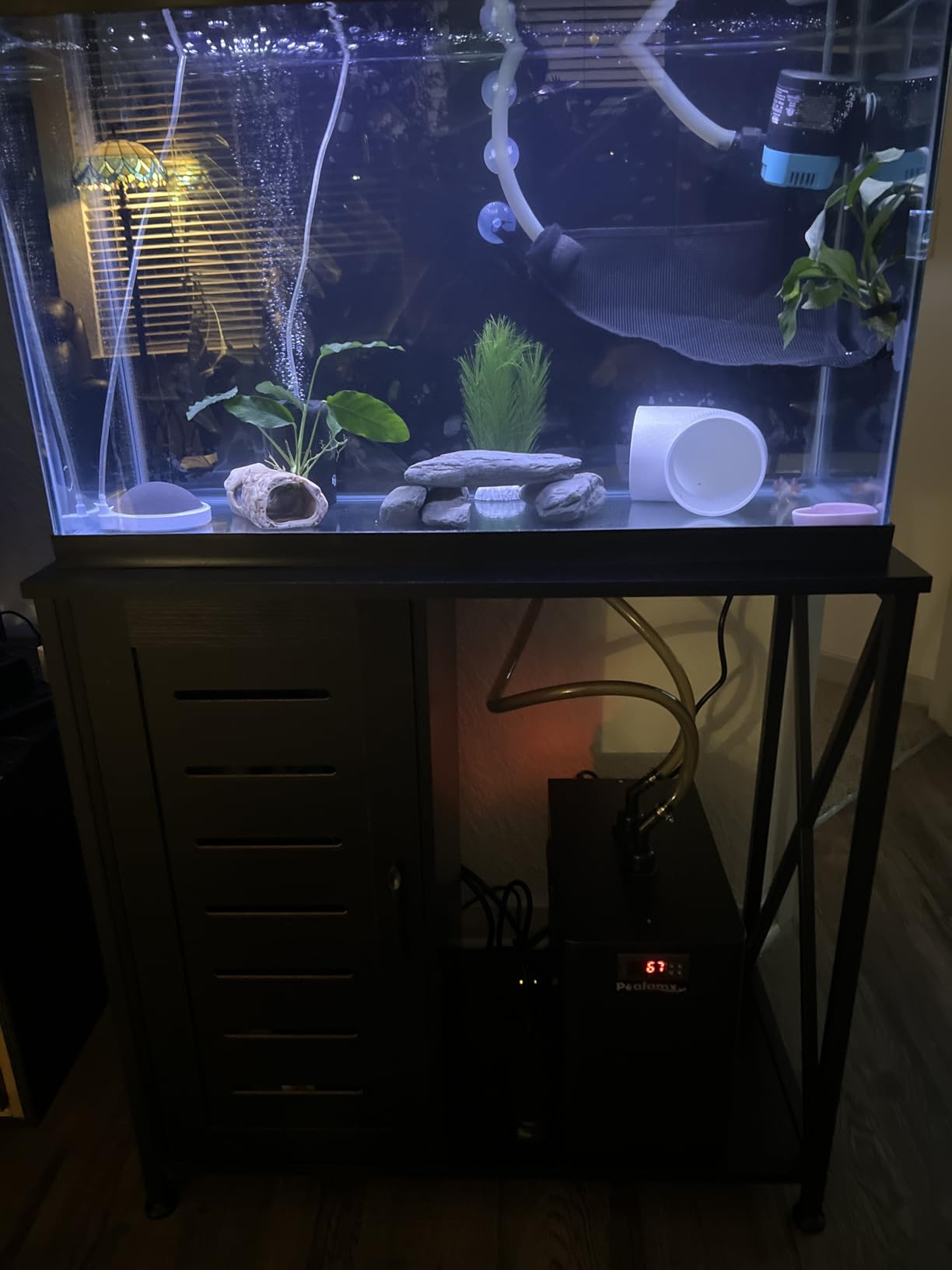
The durability history is the part you should read twice. A recurring cluster of one star reviews describes units that stopped chilling between 8 and 12 months, and one reviewer documented burnt internal wiring along with a fire risk at the power switch after nine months of use. That is a small but real safety signal, and it argues for keeping the unit on a circuit you can trip at the wall rather than an unattended extension lead.
The factory thermostat also reads several degrees off and needs calibration, and the included pump is weak at roughly 158 GPH, so many owners upgrade it. Owners who get past the first year report quiet, leak-free operation and stable temperatures, which is why the rating holds at 4 stars across 218 reviews.
Why it earns the value tag?
Everything you need to run it arrives in the box, and the titanium evaporator means you are not buying a freshwater unit and hoping. For a mixed reef in the 40 to 80 gallon range, that combination is hard to beat at this tier.
It is also the flattest chassis in the group, which matters more than it sounds. Vertical clearance under a stand is the constraint that forces people to compromise on capacity, and a 7.28 inch tall body changes what you can fit behind a cabinet.
Where it will disappoint you?
The compressor longevity is the honest weakness. Buyers who need a unit to sit unattended through a full summer of 90 degree days should weigh the failure reports more heavily than the rating, and should not be shy about adding a temperature alarm on their controller.
The 158 GPH pump is also below what a large sump wants, so on a 40 gallon sump you will likely end up replacing it. Budget for that in the first month rather than treating it as a surprise.
4. Fitnet 1/3 HP 79-Gallon Touch Screen Chiller: Top Rated for Setpoint Control
- Highest average rating among 79 gallon units
- Touch screen memory restores setpoint after power cycles
- Calibration function lets you match setpoint to a probe
- Owners report holding a 125 gallon system stable
- Printed instructions conflict with the listing
- No filter included
- One owner reported a power-inlet fault within three months
On raw consistency of owner feedback, this is the strongest-rated 79 gallon compressor in the group at 4.4 stars, with the smallest share of one star reviews. The 1/3 HP compressor is paired with an intelligent digital touch screen that has a memory function, meaning it restores your set temperature after a power cycle instead of coming back at a default reading.
That memory matters more than it sounds on a reef. Most chiller failures during a heat event trace back to a power interruption that reset the controller to a setting nobody chose, and this one simply comes back where you left it. The temperature range is 68 to 79F, R290 refrigerant, and the heat exchange side uses a corrosion-resistant pure titanium pump rated for salt water.
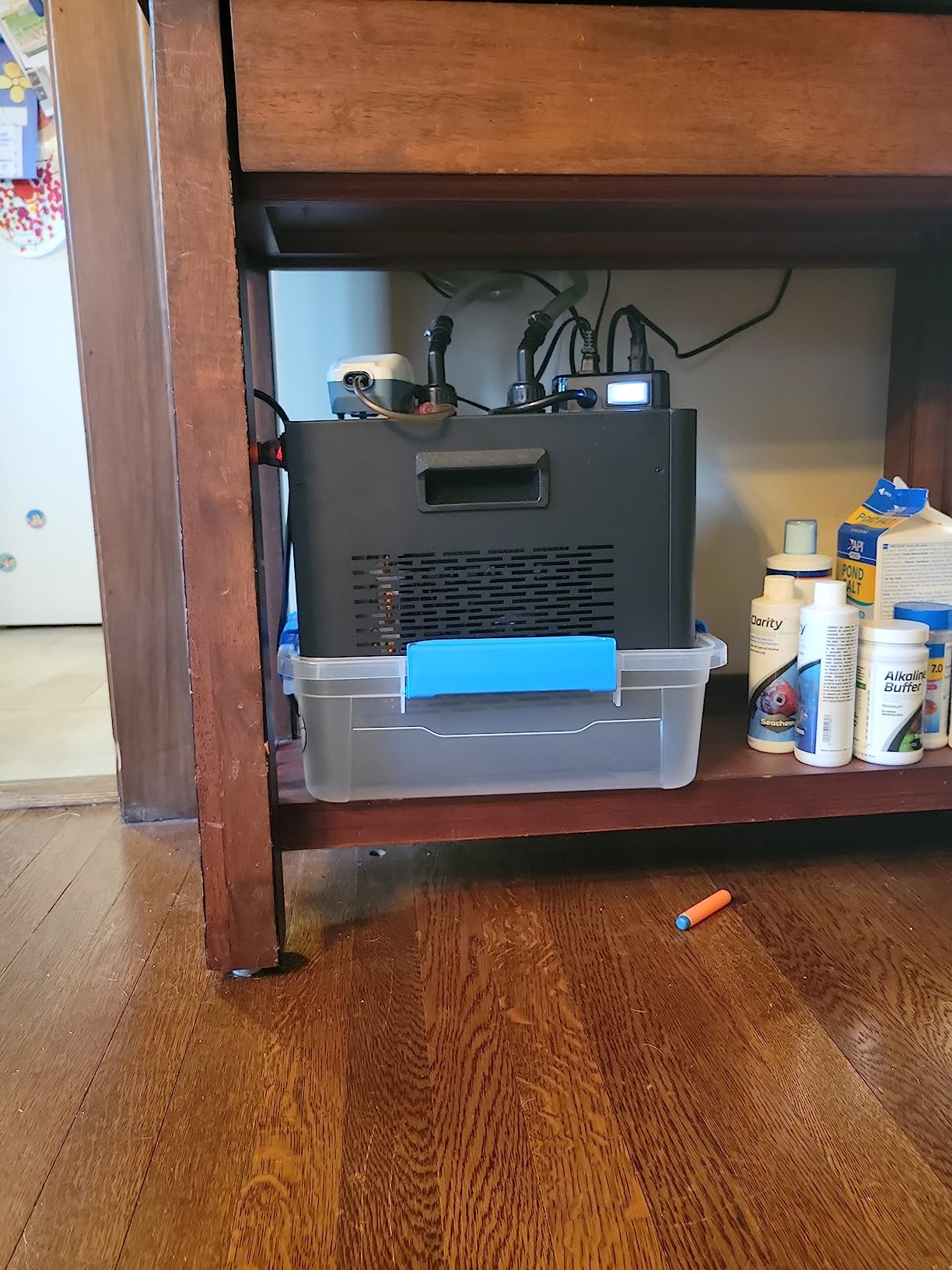
Two cooling fans and a set of ventilation holes handle heat dissipation, and the unit wants 6 inches of clearance. There is also a programmable temperature difference and a calibration function, which is how you match the on-screen reading to an independent probe and stop guessing.
The friction is documentation. Printed instructions conflict with the listing and several owners needed support emails to resolve setup, and the F1 temperature difference setting is easy to misconfigure, which can leave the compressor sitting idle while the display looks perfectly normal. One owner also documented a short at the power inlet that vibration triggered, and there is no filter included with the pump, pipe and connectors.
What this one is genuinely good at?
Setpoint control is the headline. If you run a controller that alarms off an independent probe, you want the chiller reading to agree with it, and the calibration function here gets you there without a fight.
It is also the newest design in the lineup, so the cooling efficiency and the memory behaviour reflect current hardware rather than a platform from a decade ago.
Where it will disappoint you?
The setup path is rougher than the spec sheet suggests. Budget time and patience for the F1 configuration step, and read the listing page rather than the paper manual, because owners report the two contradicting each other.
At 112 reviews it is the second thinnest evidence base here. Owners running cold water and ice-plunge setups report sustained low temperatures, but there is not yet a multi-year durability record to lean on.
5. JBJ Arctica 1/10 HP Titanium Chiller: Best for Quiet Reef Rooms
- Consistently described as near-silent
- quieter than a wall air conditioner
- Holds setpoint within 0.1 degrees once calibrated
- Pure titanium construction is the reef durability benchmark
- One owner reports six years of continuous service
- Highest cost in the lineup by a wide margin
- Pump and plumbing hardware not included
- Requires calibration before it holds temperature accurately
- Discharges heat into the room
This is the name reef hobbyists reach for first, and on Reef Central the recurring argument about it is not whether it works but whether the titanium platform justifies the cost against alternatives like the Teco SeaChill. The answer for saltwater is usually yes. The Arctica titanium platform has been the corrosion-resistance benchmark for reef chillers for a long time, and the 1/10 HP version is the entry point into it.
What owners consistently describe is near-silent running, quieter than a wall air conditioner, and setpoint holding within 0.1 degrees of external gauges once calibrated. At 4.1 stars across 47 reviews with 74 percent five star, the rating is high for a small review base, and one owner reports six years of continuous service on theirs.
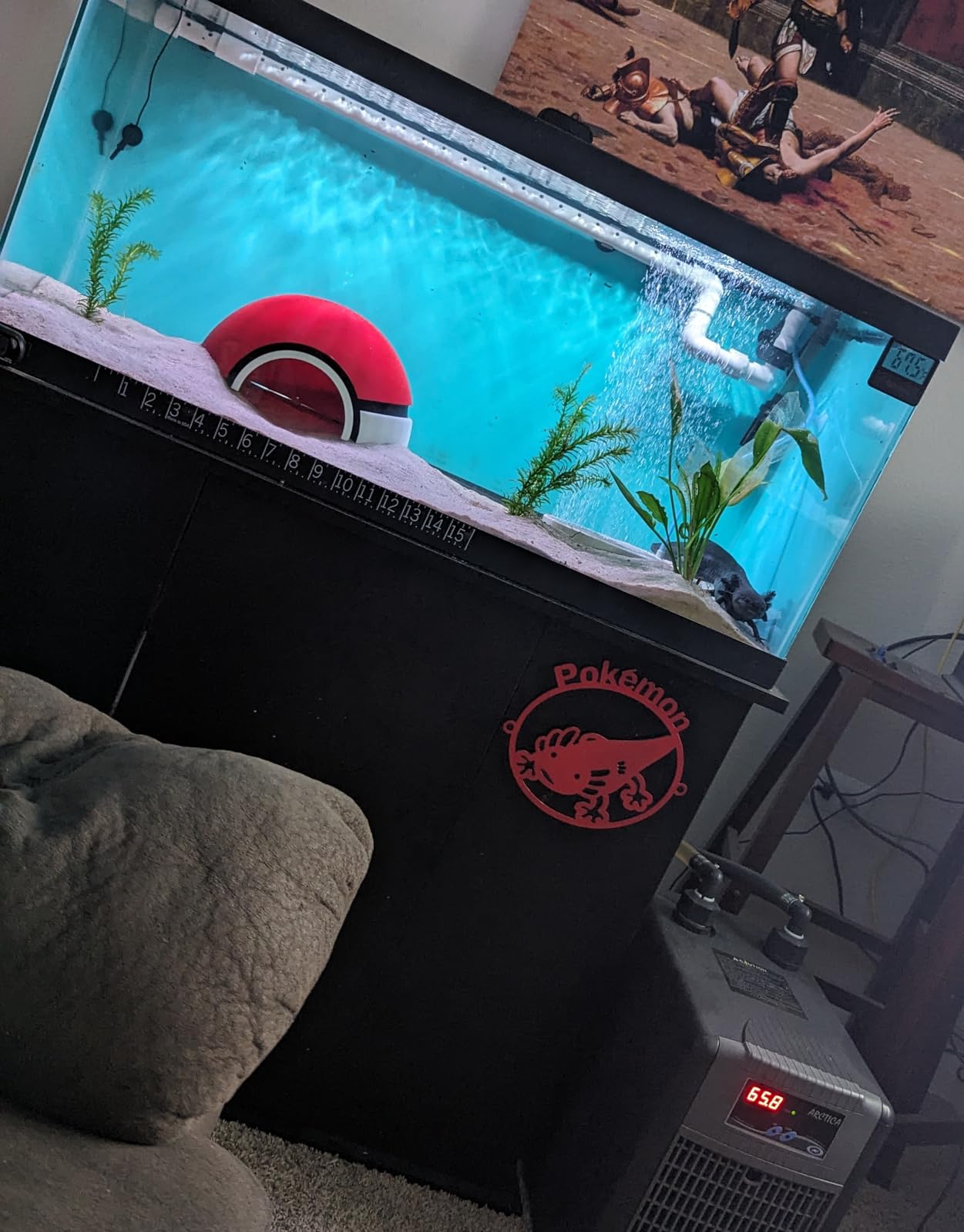
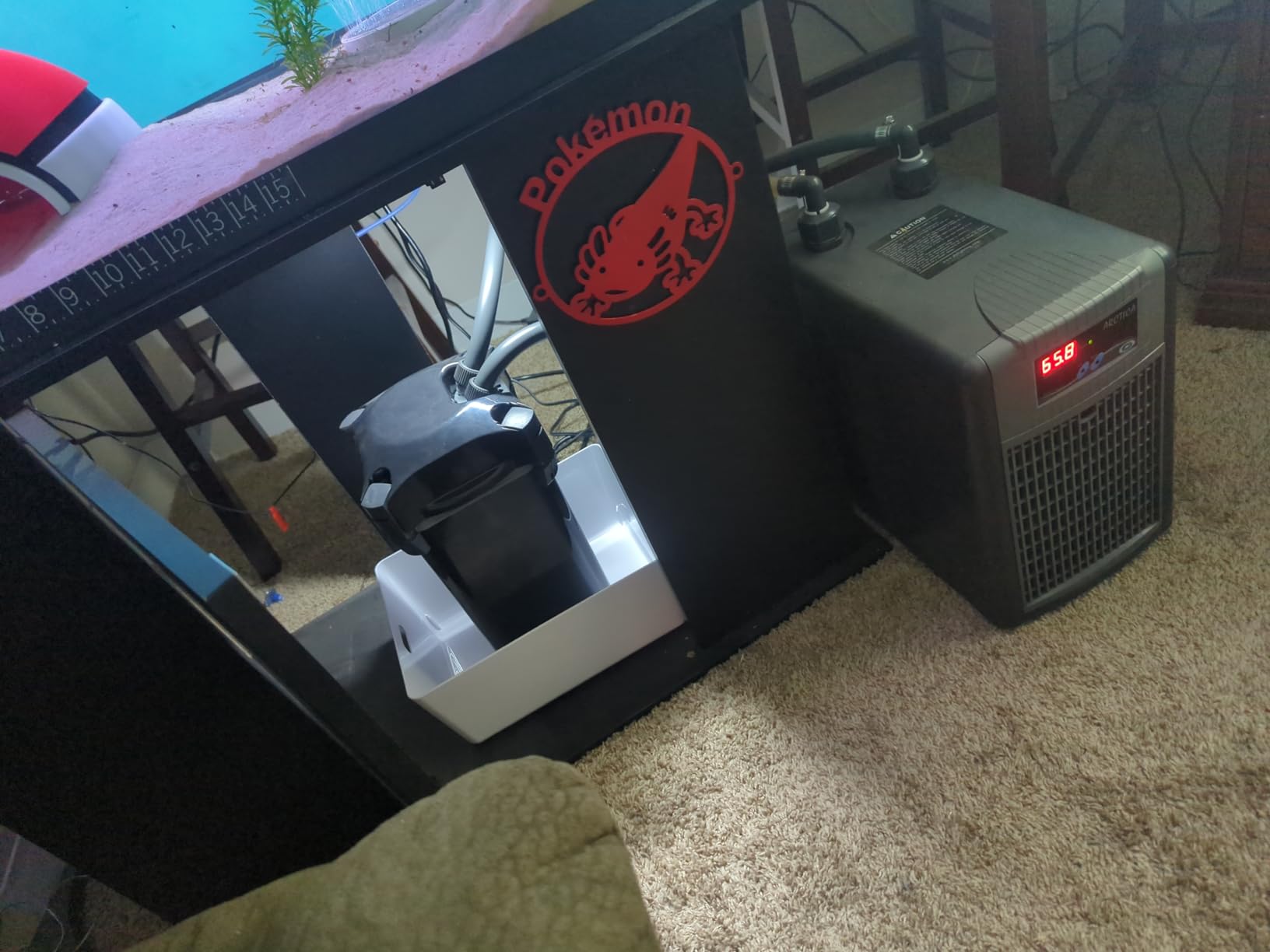
The design is straightforward. A 1/10 HP compressor, an ozone-friendly R-134A charge, a highly efficient condenser built to draw less energy, and corrosion-resistant titanium heat transfer surfaces. It comes in 1/10, 1/5 and 1/3 HP versions, so the same platform covers a nano cabinet and a large sump if you would rather not mix platforms.
Two things to know before you commit. The pump and plumbing hardware are not included, and adjustable flow regulation is your responsibility, so the total build is bigger than the headline figure. The unit also needs calibration out of the box before it will hold temperature accurately, which trips up people expecting a plug-and-play install.
Why reef keepers keep recommending it?
The titanium construction is the point. In salt water, the heat exchanger is the component that fails first on cheaper units, and a titanium surface removes that failure mode from the equation for the working life of the machine.
It is also the quietest option here by owner report, which matters when the chiller lives in a room you sit in. The condenser design is built for efficiency, so the compressor is not working as hard to hold setpoint, which is part of why it is quiet.
Where it will disappoint you?
Cost is the honest objection. It is the most expensive unit in this lineup by a wide margin, and once you add a pump and fittings the gap widens further, so it is a value conversation only for someone who prioritises titanium and silence over spending less.
Two one star reviews report units that stopped cooling after a few weeks, and every unit vents heat into the room, which can warm the space it is cooling. If you are counting on it as a free-riding room cooler, budget for the room rather than the tank.
6. VEVOR 1/10 HP 52-Gallon Chiller: Best for High Flow Through a Sump
VEVOR Aquarium Chiller 52Gal 1/10HP Quiet Cooler with Titanium Evaporator
- Titanium evaporator at the entry price point
- Highest stated flow rate in the group at 1200 L/H
- Very quiet operation similar to a refrigerator
- Complete fittings kit with pump clamps and hoses
- Bundled submersible pump becomes noisy and vibrates the tank
- One marine owner reported disrupted skimmer foam
- No adjustable buffer band so it short-cycles
- Displayed temperature can read several degrees off
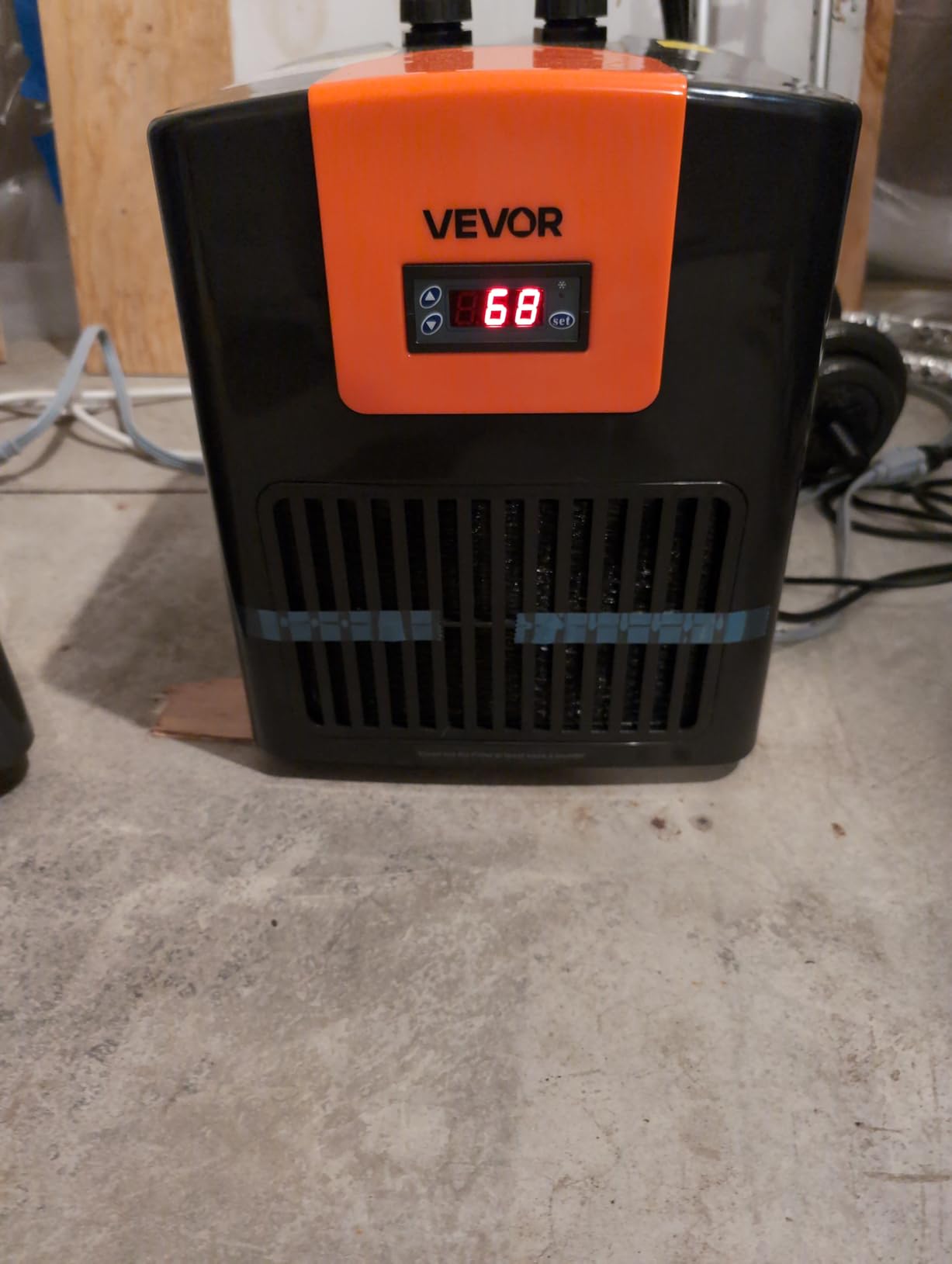
Flow rate is the underrated spec on a reef install, and this unit leads the group at 1200 L/H circulation on a 1/10 HP compressor. That matters when your return line is short and wide, because the exchanger only pulls heat as fast as water moves across it. A titanium evaporator rated for fresh and salt water, R290 refrigerant, and a stated 65 to 80F range cover the tropical reef targets comfortably.
At 30.9 pounds and 12.4 by 11.81 by 15.59 inches it is one of the lighter and smaller compressors here, and the fittings kit is unusually complete: hose clamps, pipe connection nuts, connectors, O-rings, an SP-2500 pump, PVC hoses, a manual and a suction cup. You can have it circulating the same afternoon it arrives.
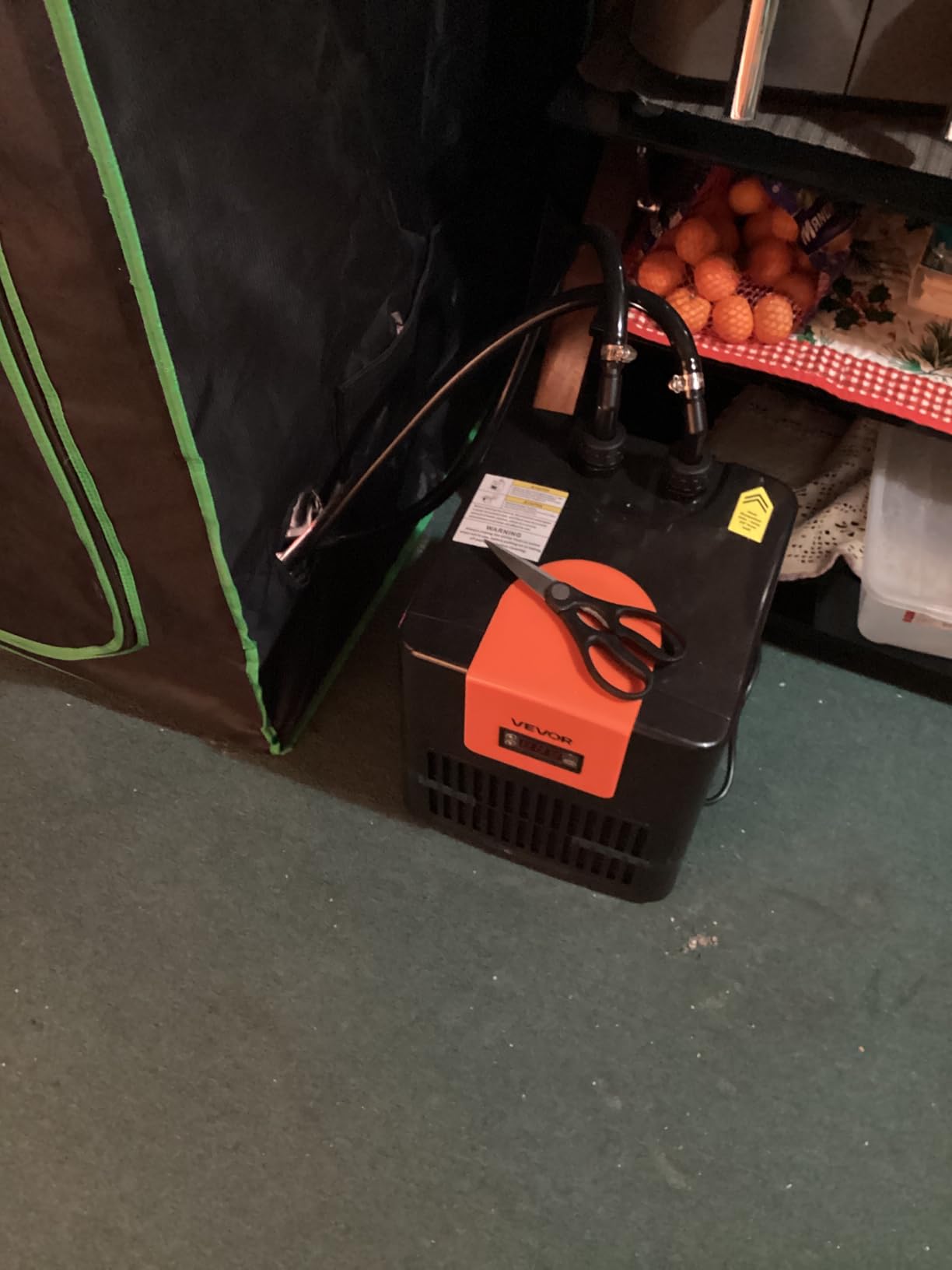
The repeated complaint is the bundled submersible pump. Several owners report it becoming noisy and vibrating the tank badly enough to replace it, and one German-language review from a reef keeper specifically describes the unit disrupting protein skimmer foam, which is a marine-only problem you will not see in a freshwater thread.
There is also no adjustable buffer band, so the compressor short-cycles more than you would like, and the displayed temperature can read several degrees off from a real probe. It is a young listing with 31 reviews concentrated in recent months, and one unit arrived with a defective pump that took days of support contact to resolve.
Why the flow figure matters on a sump?
A 52 gallon rating with 1200 L/H gives you a lot of water movement per pass, which is what keeps a large sump mixed and pulls the whole volume toward setpoint instead of only cooling the water directly above the exchanger.
It is a good fit for a return line positioned above the sump where you can use a higher diameter hose. If your plumbing is already plumbed for 3/4 inch, this unit will take full advantage of the flow rating.
Where it will disappoint you?
Plan on replacing the submersible pump. That is the single most common fix owners describe, and if you are running it in a display with sand and small fish, the vibration and noise from a marginal pump is not something you want to live with through summer.
The clearance requirement is also 24 inches, the largest in the group, so it needs a genuinely open cabinet space with air moving around it rather than a tight shelf. Short cycling without an adjustable buffer also means more compressor starts, which shortens service life.
7. Dreamtrue 1/10 HP 42-Gallon Chiller: Most Versatile for Small Marine Tanks
- Quietest stated noise level in the group at 30-40 dB
- LED touch display makes setpoint straightforward
- Bundled pump hose cable and remote control
- Lowest entry tier while still rated for salt water
- 42 gallon capacity limits it to small and nano reef systems
- Thin review base of 34 ratings limits reliability evidence
If your marine system is a 30 gallon nano with a small sump and you want a real compressor rather than a fan, this is the cheapest credible entry point. A 1/10 HP compressor rated to 42 gallons, reducing temperature 5 to 15F below ambient, rated for both fresh and salt water, and shipping with a water pump, hose, cable, remote control and manual.
The stated noise level of roughly 30 to 40 dB is the lowest figure in the group, and the remote control is a nice touch on a unit that lives under a stand. The upgraded LED display with touch screen controls makes setting a temperature straightforward without pulling the unit out of the cabinet.
It also comes in a 79 gallon variant if you outgrow the 42 gallon body, which means you can stay on the same platform and the same control interface. That continuity is more useful than it sounds when you are adding a sump and needing more capacity in year two.
The honest limitation is the evidence. With 34 ratings there is very little long-term durability data, and at 63 percent five star and 12 percent one star, the sample is too small to draw conclusions about compressor life. Owners rate the quiet operation and the touch interface highly, and it holds temperature within its stated range, but treat the long-term picture as unproven rather than settled.
Where this size actually fits?
A 42 gallon ceiling suits a 20 to 30 gallon nano reef with a modest sump, especially one with low-wattage lighting running in a shaded room. In those conditions a fan would often do the job, and a chiller is only necessary if your room runs warm for long stretches.
The 8.7 by 15.7 by 11 inch footprint is narrow, which makes it one of the easier units to fit behind a small stand where a square compressor will not go.
Where it will disappoint you?
It is capacity-limited by design. Once you add a 20 gallon refugium, an SPS dominant coral colony, or a metal halide, the total system volume passes the point where this unit can keep up, and you will be chasing temperature on the hottest afternoons.
Thin long-term data is the other issue. If the tank is full of expensive livestock, buy the chiller you can keep for a decade rather than the one you will be diagnosing at the start of your second summer.
8. MLJHFC 1/10 HP 42-Gallon Chiller: Best for Compact Setups
MLJHFC 42Gal Aquarium Chiller 1/10HP 160L Quiet Compressor Cooler
- Titanium evaporator at the entry price point
- Quiet compressor barely audible across a room
- Holds temperature within about one degree of setpoint
- Plugs straight into a US wall outlet with no wiring
- Only a 20-rating review base so long-term durability is unproven
- Included fans slightly louder than expected
- Casing is plastic despite the listed stainless steel material type
This has the highest average rating in the group at 4.9, with 88 percent five star and no one or three star ratings at all. It is also the sample size to keep in mind: 20 reviews, all recent. So the honest framing is promising rather than proven, and I would not build a heavy SPS system around a rating that thin.
The hardware underneath is sound for a 42 gallon system. A 1/10 HP compressor with a corrosion-resistant titanium evaporator rated for salt water and chemical resistance, a low-noise compressor with dual silent fans, and a 64 to 79F range that covers reef targets with margin. Owners report holding within about a degree of setpoint and a compressor that is barely audible across a room.
Two practical details stand out. It plugs straight into a US wall outlet, so there is no wiring work, and hose clamps and connectors are included. The listed weight is 5.3 pounds, which is dramatically lighter than every other unit here and means you can actually lift it into a high cabinet shelf on your own.
The listed dimensions of 13.4 by 7.9 by 12.6 inches make it one of the more compact bodies in the lineup, and the specification calls for 6 inches of clearance for heat dissipation. One useful note for hot stretches: keep water at about 80 percent of tank capacity, since a partially filled sump cools faster.
Why the rating is so high?
Owners report consistent cooling of small reef and cold-water tanks with quiet, stable operation and no leaks on first setup. Solid packing quality also gets mentioned often, which matters more than it sounds given how many reef owners open a shipment to find a cracked housing.
The titanium evaporator at this tier is unusual, and it means you are not trading away saltwater compatibility to save money, which is the most common compromise in cheap chillers.
Where it will disappoint you?
Twenty reviews is the whole evidence base, and every one of them is recent, so nothing here tells you what happens in year three. If you want the highest rating in the group to mean something, pair it with an independent temperature alarm on your controller.
The included fans are slightly louder than expected for a unit that advertises 30 to 40 dB, and the casing is plastic even though the listing material field says stainless steel. At 5.3 pounds the housing also feels less substantial than the 30-plus pound compressors it is competing with.
9. Poafamx 1/13 HP 26-Gallon Chiller: Best for Nano Marine Tanks
Poafamx Aquarium Chiller 26gal, 1/13 HP Small Water Chiller for Axolotl
- Titanium evaporator makes it salt safe at a nano tank price
- Whisper quiet compressor
- Included 210 GPH pump gives reliable circulation
- Cools quickly from 27C to 19C
- Roughly 20 percent of ratings are 1-star
- Intake and outlet ports are not labeled
- Initial temperature setting described as complicated
- One unit overheated and shut down after about 10 seconds
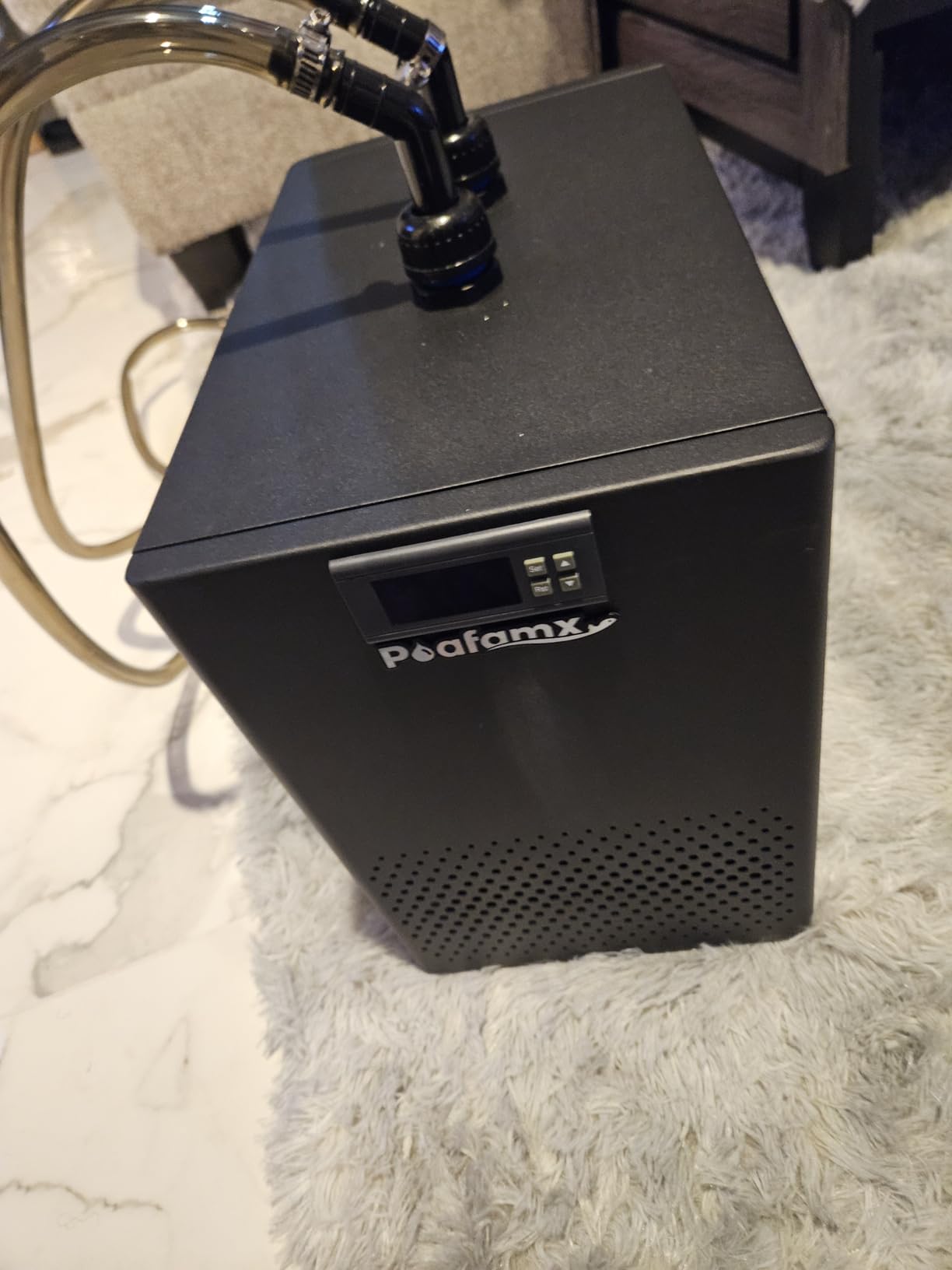
This is the smallest compressor chiller here, built for 20 to 30 gallon aquariums, and it is the option I point people toward when a nano reef sits in a warm room and a fan is not cutting it. A 1/13 HP compressor with a corrosion-resistant titanium evaporator rated for fresh and salt water, a 65 to 80F range, and an included 210 GPH pump that owners describe as reliable for circulation.
The cooling speed is the standout. One owner reports dropping 27C to 19C within minutes, which is a useful margin in a small system where a few degrees matters fast. Several others report three years of continuous operation, and the compressor is quiet enough to sit in a bedroom or living room.
It is also the most polarised unit in the group. Seventy-one percent of ratings are five star against 20 percent that are one star, the highest one star share here, and the negative reviews describe units that failed within a year. One compressor overheated and shut down after about 10 seconds with a condenser fan shorting out, which points at a manufacturing variance rather than a design limit.
Two setup details will cost you time if you skip them. The intake and outlet ports are not labeled, so plumbing setup is guesswork until you trace the circuit, and the initial temperature setting is described as complicated. It also ejects a large volume of hot air into the room, which matters a lot when the tank is 30 gallons in a small room.
What it does well in a nano reef?
Fast pull-down matters more in a small system than the headline capacity does. A nano has almost thermal mass, so a unit that drops 8 degrees in minutes buys you back the coral that would otherwise be sitting in a slow warm drift all afternoon.
The titanium evaporator is the thing that makes this a marine unit rather than a freshwater unit with a marine-compatible label, and the included pump means a first install is one box, not two.
Where it will disappoint you?
The failure rate is the honest concern, and with a 1-year warranty there is not much recourse if the compressor gives up in your first August. In a nano with a small livestock population that is a calculated risk; in a display full of corals it is not.
The unlabeled ports and complicated initial setup also mean you should budget an hour with a diagram before you start, and the hot exhaust will warm a small room noticeably, which can feed right back into the heat load you are trying to control.
How Big a Chiller Does Your Reef Actually Need?
Nearly every sizing mistake I see comes from counting display gallons and ignoring everything else. A reef system is display plus sump plus refugium plus return-shoal reservoir, and the chiller has to hold all of it. Work through it in this order.
Add up total system volume. Display, sump, refugium and any Swagelok reservoir. A 150 gallon display with a 40 gallon sump and a 20 gallon refugium is 210 gallons of water to cool, not 150.
Add up your heat load. Lighting is the biggest contributor, and metal halide and high-wattage LED fixtures put far more heat into the water than low-wattage reef LEDs. Pumps, heaters and a room that sits at 82F or above all add to it.
Set your target temperature. SPS-dominant reefs want 76 to 77F, LPS and mixed reefs 77 to 79F, soft corals and nano tanks sit comfortably at 78 to 80F, and cold-water marine species want 55 to 62F. Colder targets need a chiller that can hold a bigger differential from ambient.
Match capacity to total volume, then size up. Treat the manufacturer gallon rating as a peak-summer ceiling, not a daily average. A 79 gallon unit listing typically names 63 gallons as the real summer number, and that is the figure to plan around.
Size up one tier for a hot room. Hobbyists on r/Aquariums consistently recommend this. A compressor running flat out all summer short-strokes far sooner than one with headroom, and the cost gap between adjacent sizes is small next to replacing a chiller in year three.
Check the flow rate against your plumbing. A unit rated for 1200 L/H in a narrow-bore return line is not delivering its rated flow, and no amount of capacity makes up for water moving too slowly across the titanium exchanger.
As a worked example, a 150 gallon display with a 40 gallon sump, metal halide lighting, in a room that hits 82F in July, has 190 gallons of water and a heavy lighting load. That combination sits comfortably in the 79 gallon class with headroom, or the 92 gallon class if you intend to add a refugium next year. If you are also planning a marine electronics controller to handle alarms, our best marine electronics picks cover the probe and controller side.
Compressor, Thermoelectric or Fan: Which Technology Fits a Marine Tank?
Compressor chillers, which is everything on this list, use refrigerant to move heat out of the water. They are the only category here that can pull a tank down 10 to 20 degrees below room temperature and hold it, which makes them the only real answer for SPS corals, cold-water marine species, or a room that regularly sits in the upper 80s.
Thermoelectric units use a Peltier module instead of refrigerant. They are quiet, inexpensive, and they work best in small volumes where the temperature differential is modest, but they add heat to the room rather than moving it outside, so in a warm room they are working against themselves. For a marine tank they are a marginal choice.
Fan chillers move air across the water surface and evaporate it. They are cheap and genuinely adequate in specific cases: a nano reef under 20 gallons in an air-conditioned room, or a small system where the room temperature is already close to your target. A fan is not adequate for anything SPS, anything cold-water marine, or any system where a summer afternoon will outrun the evaporation rate. Most people end up buying the fan first and the compressor chiller two summers later.
Whichever you pick, a chiller also works as a room conditioner. Positioning the unit where its exhaust air can escape through a doorway, or near an exterior wall in a fish room, gives you a free secondary benefit that many reefers rely on deliberately. If the exhaust has nowhere to go in a closed cabinet, expect the capacity you paid for to be eaten by poor airflow.
How to Hook Up an Aquarium Chiller in a Sump?
Inline is the standard reef install, and it is the one I recommend for anything with a sump. Follow these steps in order.
Shut off the pump and unplug the chiller. Confirm the sump is drained enough to work safely, and place towels under the plumbing before you cut anything.
Choose the return or the supply side. Putting the chiller on the return side feeds already-warm water past the skimmer and the chiller first, which protects the equipment. Putting it on the supply side chills the water before it reaches the display and the skimmer, and many reefers prefer that for nutrient control.
Match the hose diameter to the unit. Several models in this lineup ship with 3/8 inch fittings, and a 3/8 inch chiller line in a 40 gallon sump is a real restriction. Upgrading to 1/2 inch is the single most common modification owners report making.
Mount the chiller with intake and outlet ends aligned vertically so any air pocket rises out of the exchanger, and leave the manufacturer clearance on every side. Clearance requirements range from 6 inches to 24 inches depending on the model.
Prime the pump fully before the first run. Running a titanium exchanger dry damages it, and most units in this group include a pump that needs to be filled and seated before startup.
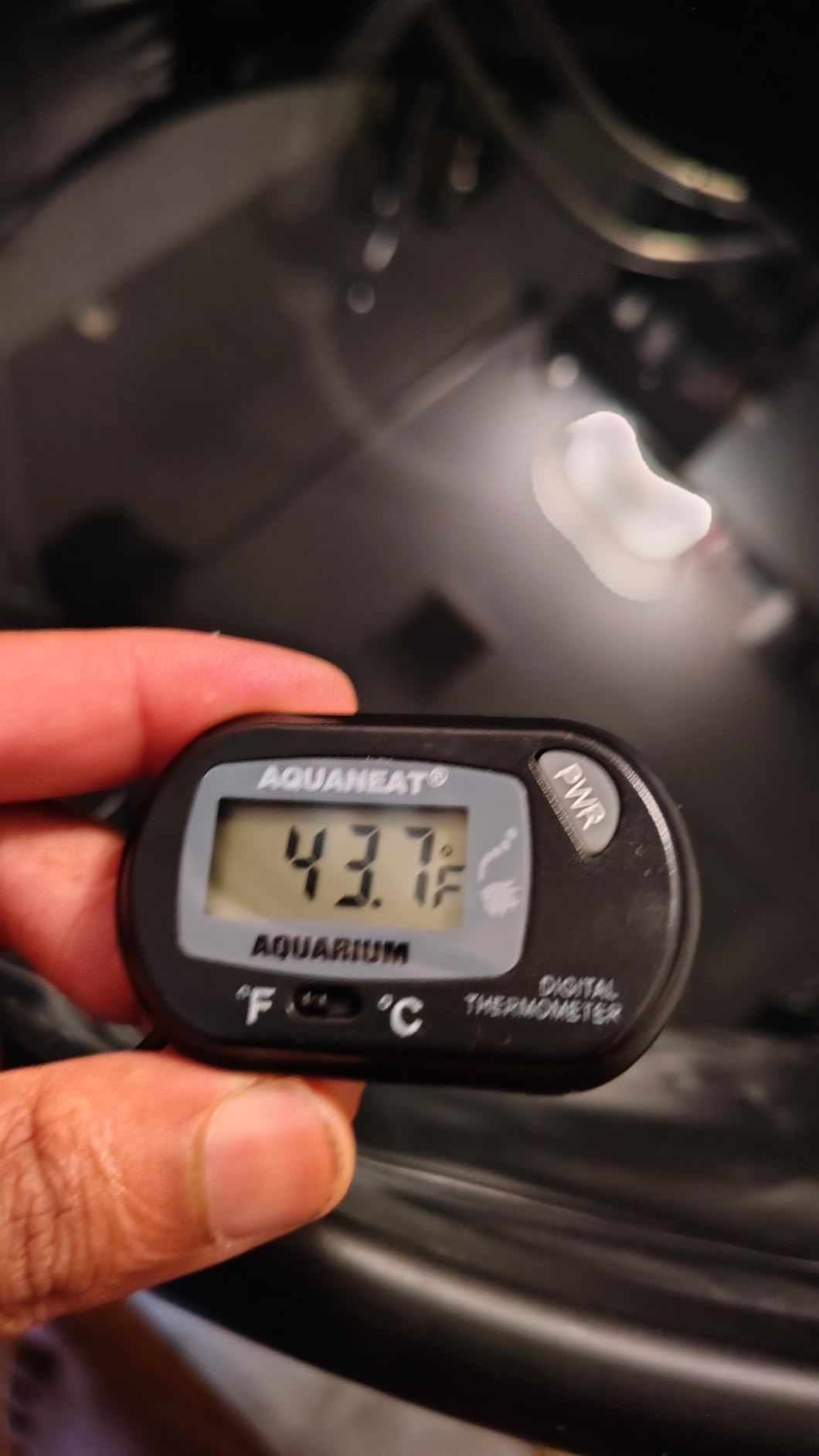
Calibrate the controller against an independent probe before you trust it. Several units here ship with a factory thermostat that reads a few degrees off, and the difference between the built-in reading and your controller is the thing that causes alarm fatigue.
Wire a high temperature alarm to your controller. Most reef controllers accept a chiller probe or a probe relay, and an alarm that fires on your phone is worth more than a chiller that quietly stopped holding setpoint in July.
Confirm the circuit can carry it. A chiller plus high-wattage reef lighting can approach the limit of a standard outlet, and the failure reports we read include burnt wiring and a power-inlet fault, so use a circuit you can trip at the wall.
If your tank has no sump, a drop-in unit sits in the display, and an external reservoir loop runs a closed loop through a container beside the stand. External loops scale to large systems but cost more in plumbing and monitoring, so they suit 300 gallon-plus displays where a single inline unit cannot keep up. All three approaches work; inline in a sump is simply the most efficient for the heat load.
Saltwater Maintenance: Condenser Rinses, Corrosion Watch and Heatwave Planning
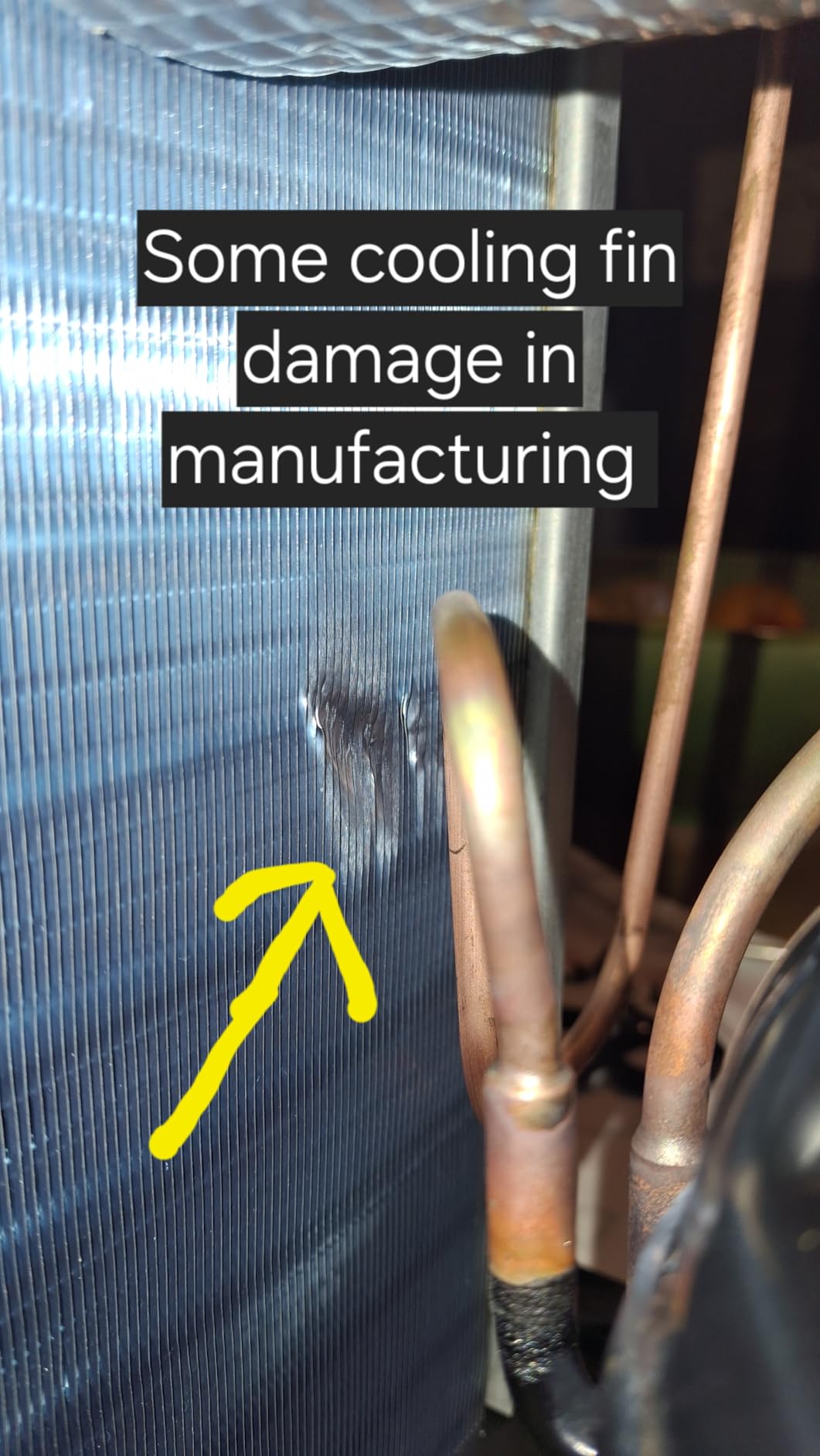
Salt is the reason titanium matters, but the exchanger is not the only place salt attacks. Rinse the condenser fins every few months, more often in a room where you run a humidifier or a wet fish room, because a finned condenser that is loaded with salt residue pushes the compressor harder and shortens its life.
Rinse the unit with fresh water before you store it for the winter or move it. Corrosion most often starts on fittings, hose clamps and the pump housing, so inspect those points specifically for pitting rather than only looking at the titanium surface. If you are buying a used chiller, listen to the compressor start, watch whether the controller responds immediately, and look closely at the exchanger for pitting.
Condensation is normal around an inline chiller in a sump-heavy system, because the cold tube surfaces collect moisture out of the warm room air. Keep the run long enough to drip into the sump, and expect a small puddle inside a closed cabinet. If you see heavy dripping, check that the sump has an adequate water line and that the room is not being cooled by the unit faster than the air can hold the moisture.
For heatwave planning, the sequence that saves livestock is simple. Have the controller alarm before the temperature climbs, not after. Keep frozen water bottles in the freezer for a manual top-off on the display, keep the room ventilation clear, and treat a power outage as a coolant failure rather than a plumbing event. Reefer groups consistently report heat-swing stress on acans and similar livestock after an air conditioning or power failure, and that stress shows up days later, not the afternoon of the event.
Finally, know what a failure looks like. A chiller that never drops the temperature is usually a control or power problem, and a chiller that chills for a few hours then stops is usually a condenser airflow or refrigerant problem. Clean fins, confirm clearance, then look at the controller before you start shopping for a replacement. If you also need a way to move temperature-sensitive specimens, our best marine coolers covers transport rather than installed cooling.
Frequently Asked Questions
What is an aquarium chiller?
An aquarium chiller is a thermostatically controlled cooling unit, usually a small refrigeration compressor working through a titanium heat exchanger, that recirculates tank or sump water and pulls it down to a set temperature. A probe senses the water temperature and switches the compressor on, a pump moves water across the cold exchanger, and refrigerant absorbs the heat. Unlike a fan, a chiller actively removes heat, so a reef can hold within a degree of its target.
What is the best chiller for an aquarium?
For a marine reef in the 40 to 80 gallon range, the best chiller is the BAOSHISHAN 1/3 HP 79-gallon unit. It combines a pure titanium evaporator, a 1/3 HP compressor rated to 79 gallons, a stainless shaft pump and a full tubing kit, and it holds setpoint at 45 to 50 dB. For systems above 90 gallons, the Active Aqua 0.25 HP 40-92 gallon unit offers the widest capacity range.
Which brand of chiller is best?
Brand matters less than the heat exchanger material and the service behind it. Reef hobbyists most often recommend the JBJ Arctica titanium platform, which has long been the corrosion-resistance benchmark for reef duty. Among the value tier, the titanium-equipped units from BAOSHISHAN, Poafamx and VEVOR give saltwater compatibility without the premium cost. What matters more is matching capacity to your total system volume.
How do I hook up an aquarium chiller?
Turn off the sump pump, cut into the return or supply line, and plumb the chiller in series with hose sized to match the unit fittings. Mount it with intake and outlet ends aligned vertically so air rises out, leave the manufacturer clearance on all sides, and prime the pump fully so the titanium exchanger never runs dry. Calibrate the controller against an independent probe and wire a high temperature alarm before the first hot week.
Which aquarium chiller is the quietest?
Quietness depends on where the noise comes from. Compressor noise is lowest on the JBJ Arctica, which owners describe as quieter than a wall air conditioner, and on the Fitnet unit with its memory-equipped controller. Stated compressor figures are lowest on the Dreamtrue and MLJHFC 42-gallon units at roughly 30 to 40 dB. A bundled submersible pump is often louder than the compressor itself, and replacing it is the first fix owners make.
Can I use a freshwater chiller in saltwater?
Only if the heat exchanger is titanium or another saltwater-rated material. Every chiller in this roundup has a titanium evaporator rated for fresh and salt water, which is the single specification to check before any unit goes near a reef. The titanium surface resists the corrosion that eats through aluminum and copper exchangers, which is why it is the standard for reef duty and why cheaper units fail there first.
The Verdict: Best Aquarium Chillers for Marine Tanks in 2026
After working through nine titanium-equipped compressor chillers, the BAOSHISHAN 1/3 HP 79-gallon unit remains my pick as the best aquarium chillers for marine tanks choice for most reef keepers. It has the largest review base in the group, honest capacity figures that name a real summer ceiling rather than a marketing one, a pure titanium evaporator, and the only kit in this price tier that arrives complete enough to plumb the same day it is delivered.
For systems above 90 gallons, step up to the Active Aqua 0.25 HP 40-92 gallon unit and budget separately for a matched pump. For quiet reef rooms, the JBJ Arctica 1/10 HP titanium platform is the benchmark the rest of the list is measured against. For a nano under 30 gallons, either of the 42-gallon titanium units will carry a small system comfortably.
Whatever you choose, total your water before you choose your capacity, calibrate the controller against a real probe in the first week, and wire an alarm to your controller before the first heat wave. Those three steps prevent more reef losses than the chiller brand ever will. Check the latest listing for whichever unit fits your system volume, and get it running a month before the weather turns.