
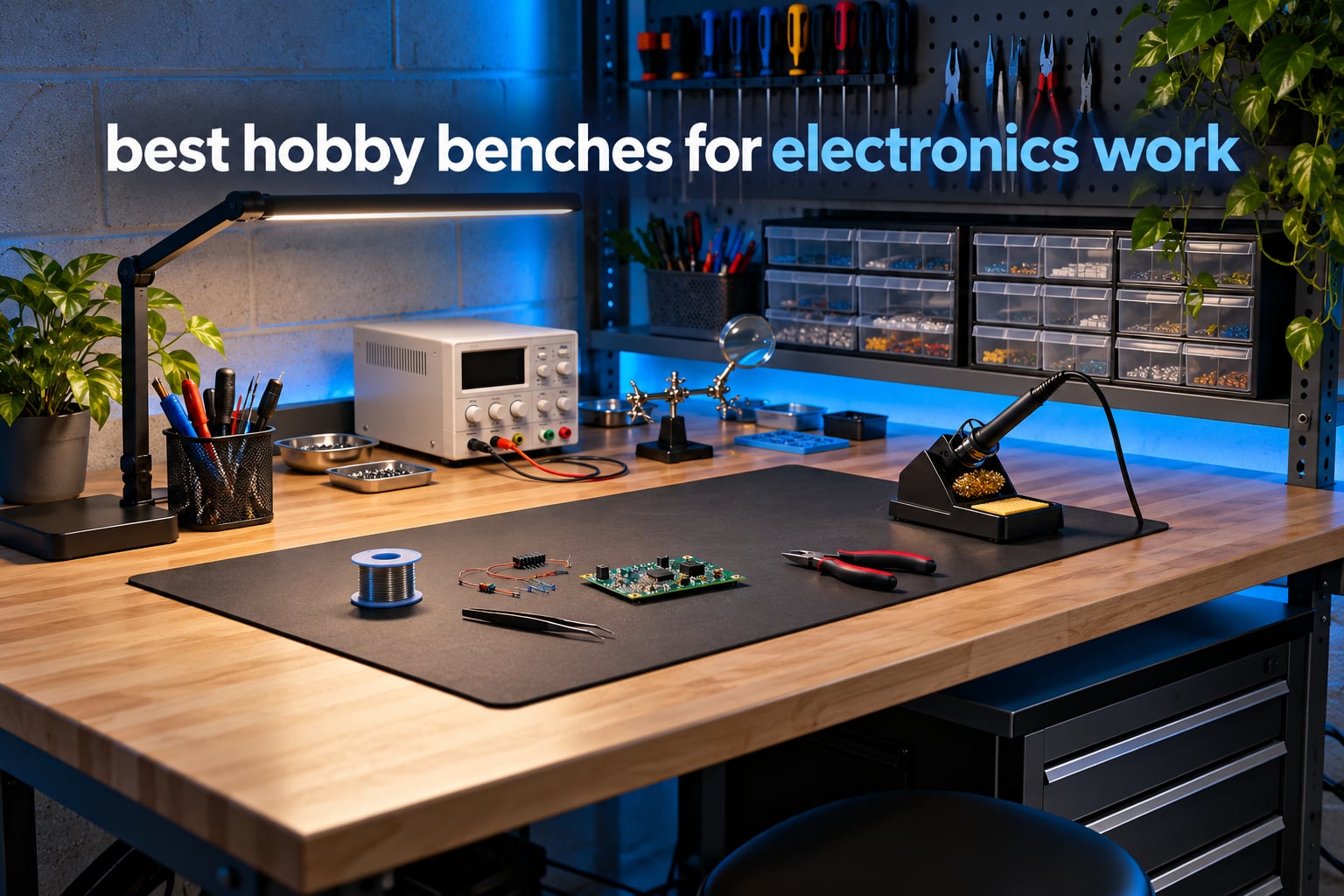
The dining table was never going to last. Most hobbyists start soldering on a kitchen table or a corner of a shared desk, and for a few months that works fine. Then the bench power supply arrives, followed by a hot air station, a microscope, a monitor on an arm, and suddenly there is no clear surface left to actually work on.
That is when a purpose-built bench starts earning its place. The best hobby benches for electronics work are not industrial ESD stations. They are sturdy, well-sized frames with a solid top, somewhere to plug in tools, and enough rigidity that a heavy instrument sitting on one corner does not make the whole thing wobble while you have a hot iron in your hand.
We compared 12 benches across this roundup, weighing the things that actually decide whether a bench is pleasant to work at: surface depth, frame stiffness, height range, whether there is a way to ground an anti-static mat, and what happens to the top after a year of soldering iron contact. We stuck to the hobby tier, the segment where these benches actually live for most people, and we flag where the professional ESD tier starts.
If you are still choosing tools rather than furniture, our beginner electronics starter kits guide covers the kit side, and our marine electronics picks is a good read if electronics is tied to a hobby you already have.
Table of Contents
What Is an Electronics Workbench?
An electronics workbench is a rigid, correctly sized work surface built to hold the tools of electronics work: a soldering or hot air station, a bench power supply, an anti-static mat with a ground cord, parts storage and task lighting, mounted on a level frame that does not flex when you lean on it.
It works by giving you three things at the same time. A surface stiff enough that joints stay sound while you work, a place where static charge has somewhere to drain instead of jumping into a component, and enough organised space that every tool has a home within arm’s reach.
Hobbyists, students and beginners doing soldering, PCB rework, laptop and phone repair, breadboarding or radio restoration all benefit. You do not need a certified production bench. You do need a bench that does not flex, does not scorch, and gives you room to push instruments back out of the way.
Top 3 Picks for Best Hobby Electronics Benches in 2026

WORKPRO 48 Inch Adjustable Bench
- 2000 lb steel frame
- Solid rubberwood top
- 5 height positions
- Built-in power strip

CAMMOO 48 Inch Bench with Pegboard
- Dual pegboards
- 6 tool-free heights
- 2000 lb capacity
- ETL power strip
WEN 48 Inch Bench with Light
- Three 13-amp outlets
- Overhead light
- Two drawers and shelves
- Pegboard
All 12 Hobby Electronics Benches Compared (October 2026)
| Product | Specifications | Action |
|---|---|---|
| WORKPRO 48 Inch Adjustable Workbench |
|
Check Latest Price |
| CAMMOO 48 Inch Adjustable Workbench |
|
Check Latest Price |
| WEN 48 Inch Workbench with Power and Light |
|
Check Latest Price |
 VEVOR 48 x 20 Inch Adjustable Workbench VEVOR 48 x 20 Inch Adjustable Workbench |
|
Check Latest Price |
 CAMMOO 48 x 24 Inch Workbench with Storage CAMMOO 48 x 24 Inch Workbench with Storage |
|
Check Latest Price |
 VEVOR 60 x 24 Inch Workbench on Wheels VEVOR 60 x 24 Inch Workbench on Wheels |
|
Check Latest Price |
 GVGBUK 48 Inch Adjustable Workbench on Wheels GVGBUK 48 Inch Adjustable Workbench on Wheels |
|
Check Latest Price |
 Maemttes 60 Inch Solid Wood Workbench Maemttes 60 Inch Solid Wood Workbench |
|
Check Latest Price |
 OLBRUS 48 Inch Adjustable Workbench with Wheels OLBRUS 48 Inch Adjustable Workbench with Wheels |
|
Check Latest Price |
 Eltean 48 Inch Workbench with Lockable Cabinet Eltean 48 Inch Workbench with Lockable Cabinet |
|
Check Latest Price |
 Hak 48 Inch Workbench with Pegboard and LED Hak 48 Inch Workbench with Pegboard and LED |
|
Check Latest Price |
 Topass Pegboard Workbench with Casters Topass Pegboard Workbench with Casters |
|
Check Latest Price |
1. WORKPRO 48 Inch Adjustable Workbench Is the Stiffest All-Round Pick
- Genuinely stiff 1.3 mm steel frame under a 2000 lb rating
- Solid FSC-certified rubberwood top that shrugs off soldering iron contact
- Five height positions let you sit or stand
- ETL-certified power strip with 4 AC outlets and 2 USB-A ports
- Quick tool-light assembly with a video guide
- Only 20.4 inches deep so instruments cannot be pushed well back
- No casters so it is awkward to reposition
- No pegboard or integrated storage for small tools
This is the bench I keep coming back to. The frame is 1.3 mm steel, and after weeks of leaning on it with a microscope arm clamped to the edge, it stayed put. Nothing about it felt thin for the money.
The rubberwood top is the detail that matters most for electronics. It is a solid 1-3/16 inch board rather than a veneer over particle board, which means a resting iron leaves a mark instead of lifting the laminate. Owners working with hot air stations report the same thing.
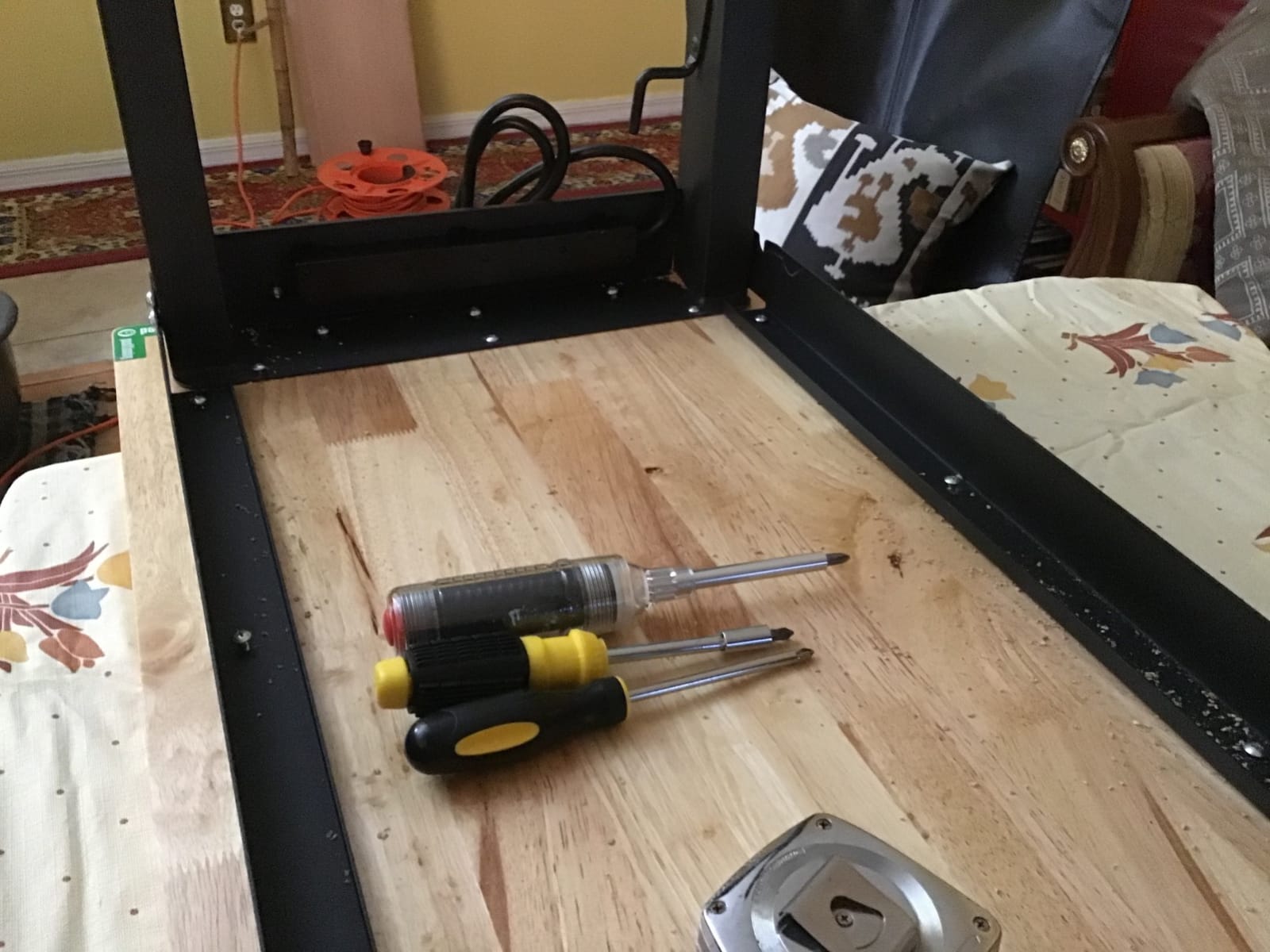
Five height positions between 31.5 and 39.4 inches cover both seated and standing work. The adjustment is per-leg rather than a single crank, so you set each corner once and it stays. Set-up takes about ten minutes and the instructions are clear enough that you do not need a video you cannot pause.
The one compromise is depth. At 20.4 inches, a power supply, a scope and a soldering iron all live on the same plane, and there is no room to slide a hot tool back out of your working area. Plan your layout before you commit, and keep the iron in its stand on the far edge.
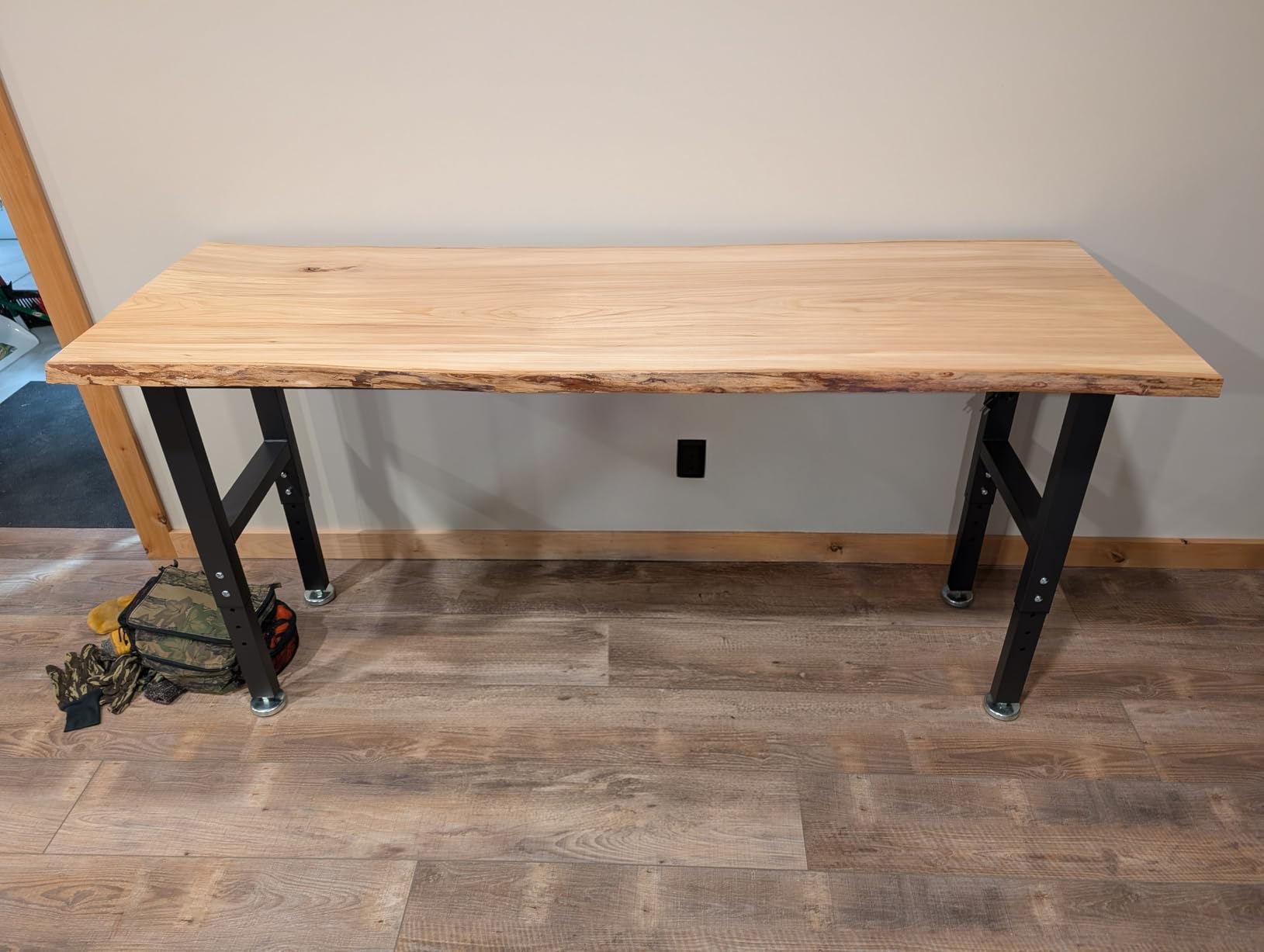
How it holds up with a microscope and a hot air station
Both of those tools are heavy and both want to be at the same spot on the bench. On this frame the top does not flex between them, and the four AC outlets plus two USB-A ports mean the bench power supply and the hot air station never fight over a wall socket.
Reviewers are split on the missing storage. There is no pegboard and no drawer, so small parts need a separate bin or wall rail. That is a genuine gap, and it is why we put the CAMMOO 48 x 24 a few places down.
Where it will frustrate you
There are no wheels. At this size and weight, moving it across a room is a two-person job, so the position you assemble it in is the position it lives. In a basement or garage corner, decide that corner before you start.
The narrow top is the real limit. If your work involves opening a laptop or spreading out a board with a microscope, 20 inches of depth becomes the constraint you notice first, not the load rating.
2. CAMMOO 48 Inch Adjustable Workbench Has the Highest Rating and the Best Pegboards
- Highest rated bench in this roundup at 4.8 across 696 reviews
- Dual-sided pegboards with six included hooks for tools at hand
- Six tool-free height settings from 28.5 to 39 inches
- Adjustable glides level the bench on uneven basement floors
- ETL power strip with 4 AC outlets and 2 USB ports
- Wood screws are hard to start by hand so plan on an electric screwdriver
- Short pre-drilled holes can strip if you use a drill
- Occasional warped or split rubberwood tops
- Fewer rigid cross members than the WORKPRO frame
This bench scored 4.8 across 696 reviews, the highest rating in the group, and the reason is consistency rather than any single feature. Owners keep pointing at the same thing: a stiff, level frame and a smooth rubberwood top that works in a garage, a craft room or a sewing space.
For electronics work, the dual pegboards are the reason to pick it over a similarly priced frame. Pliers, side cutters, tweezers and a spool of solder all get a hook instead of a shelf, which keeps the top clear. Six tool-free height settings from 28.5 to 39 inches cover sitting low or standing up.
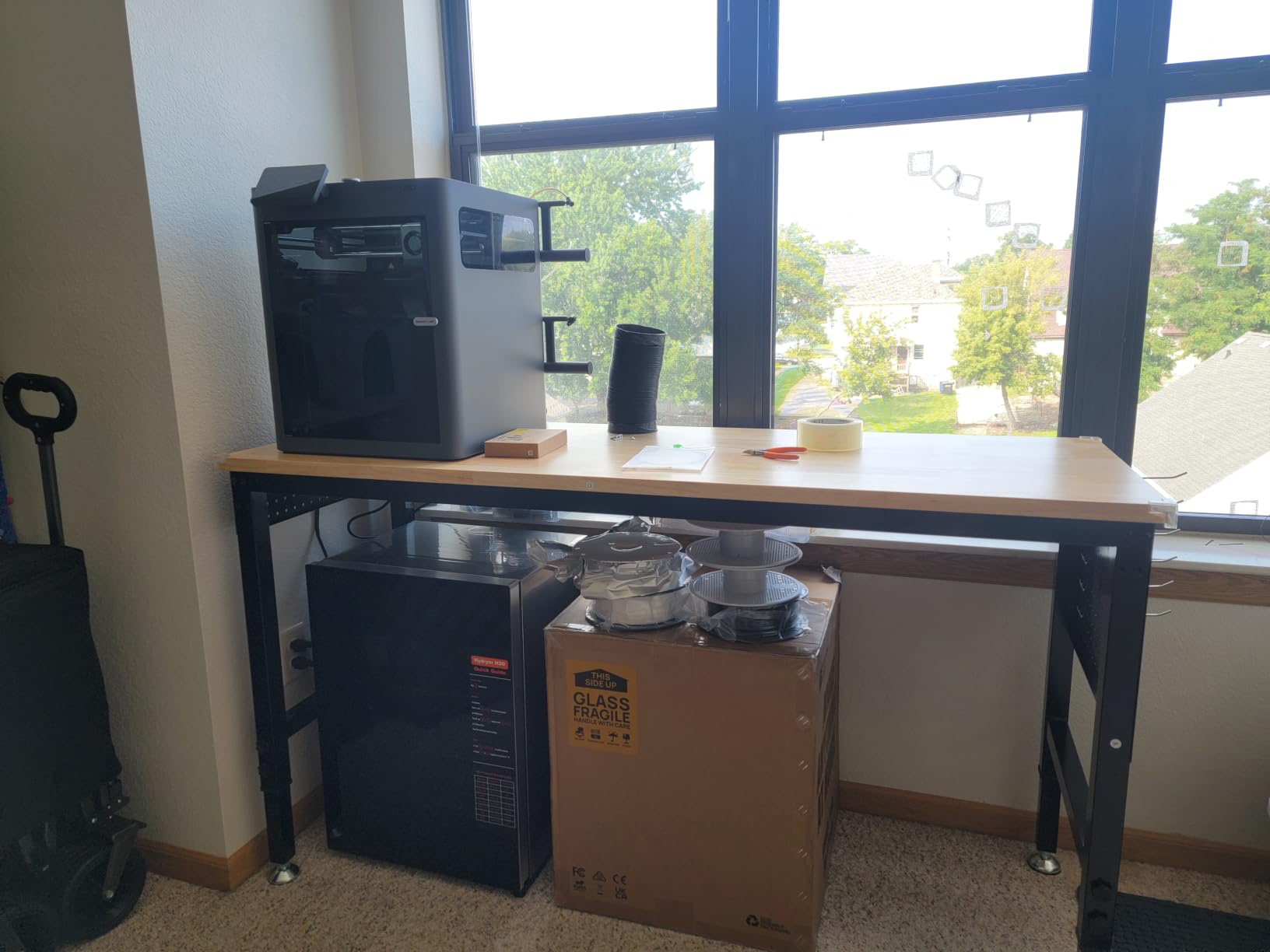
The adjustable glides matter more than they sound. Basement and garage floors are never level, and a bench that rocks every time you push a screwdriver into a joint is a bench you will start resenting. Owners in uneven rooms say the glides are the difference between usable and annoying.
Assembly is the one real friction point. The wood screws are hard to start by hand, and the short pre-drilled holes strip if you drive them with a drill. An electric screwdriver on low torque is the right tool here, not a drill.
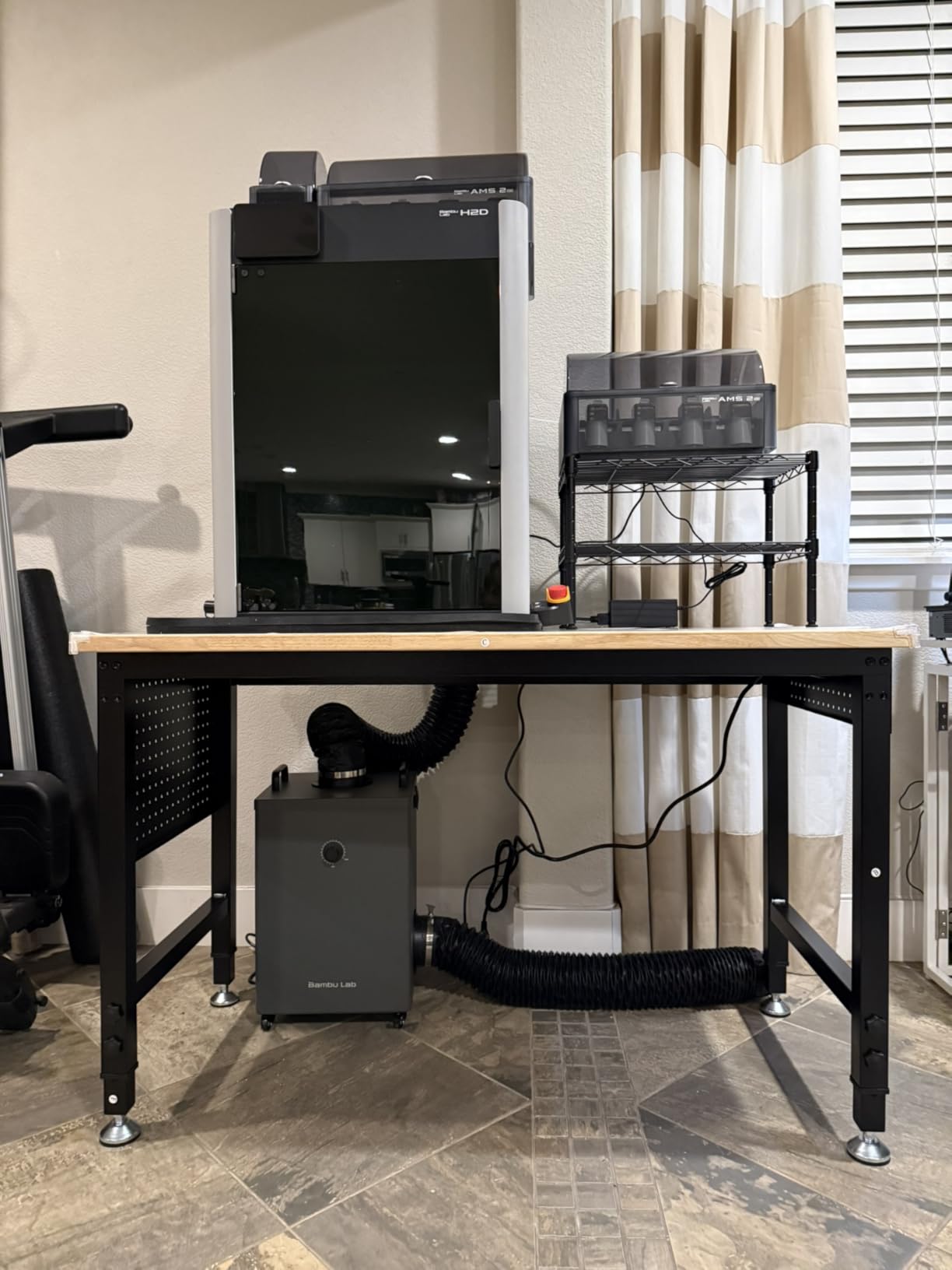
Why hobbyists rate it highest
The rubberwood top is sanded smooth and takes repeated heat without the surface layer breaking up. Combined with the fact that the whole thing is tool-free to adjust, it is the bench people describe as the one that finally made the hobby easier to organise.
Reviewers also note the brand resolves damaged tops with replacement parts rather than refunds, which matters when a warped board arrives in the box.
Where it will frustrate you
It sits at 23.62 inches deep, better than the 20-inch frames but still not a full 24. If you want a bench where you can push a supply back and still have arm’s reach, look at the 48 x 24 model further down.
Several owners add their own lower cross beam for extra rigidity, which tells you the frame is good rather than perfect. On a bench this size, that is a fair trade.
3. WEN 48 Inch Workbench Is the One With Power Outlets and a Light Built In
WEN WB4723T 48-Inch Workbench with Power Outlets and Light, Black
- Most reviewed bench in this roundup with 2924 reviews at 4.1
- Power outlets and an overhead light are integrated rather than added later
- Two wide drawers plus upper and lower shelves for organisation
- Thick enamel-coated surface does not flex
- Finished look suits a garage or a craft room
- 220 lb surface rating is light duty rather than heavy duty
- Assembly is long and fiddly with roughly 100 small fasteners
- Instructions are vague about part orientation
- Pegboard material is thin and can stretch under a heavy battery
- Some arrive with chipped shelves or a broken drawer track
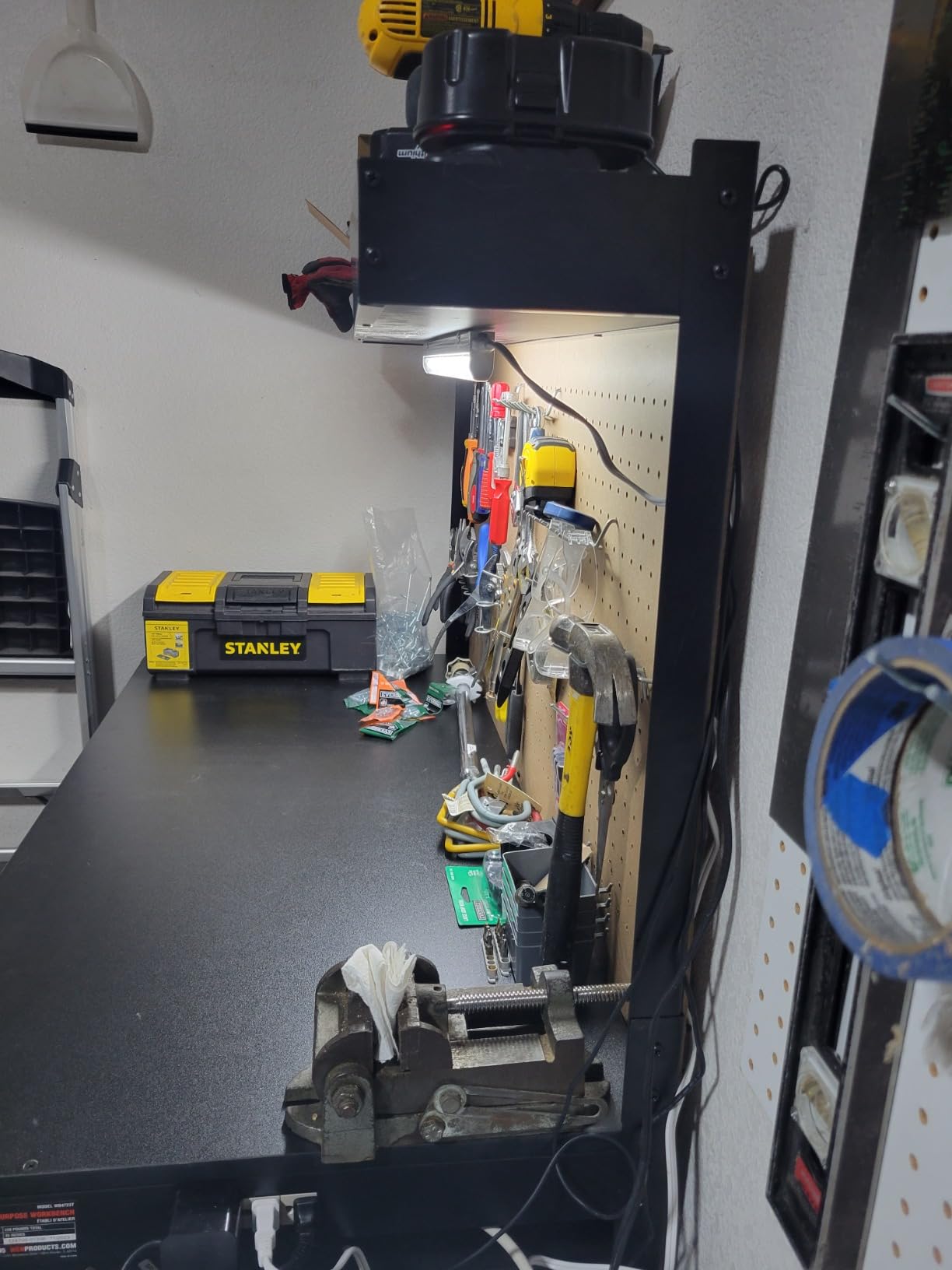
Out of everything we looked at, this is the only bench where you plug in and start work. Three 13-amp outlets sit in the frame and a light hangs over the work area, so there is no separate power strip to route and no lamp clamp fighting the side rails.
That integration is the whole pitch, and it is genuinely useful when you are inspecting hairline solder joints under a magnifier. Reviewers on this bench talk about lighting more than they talk about weight capacity.
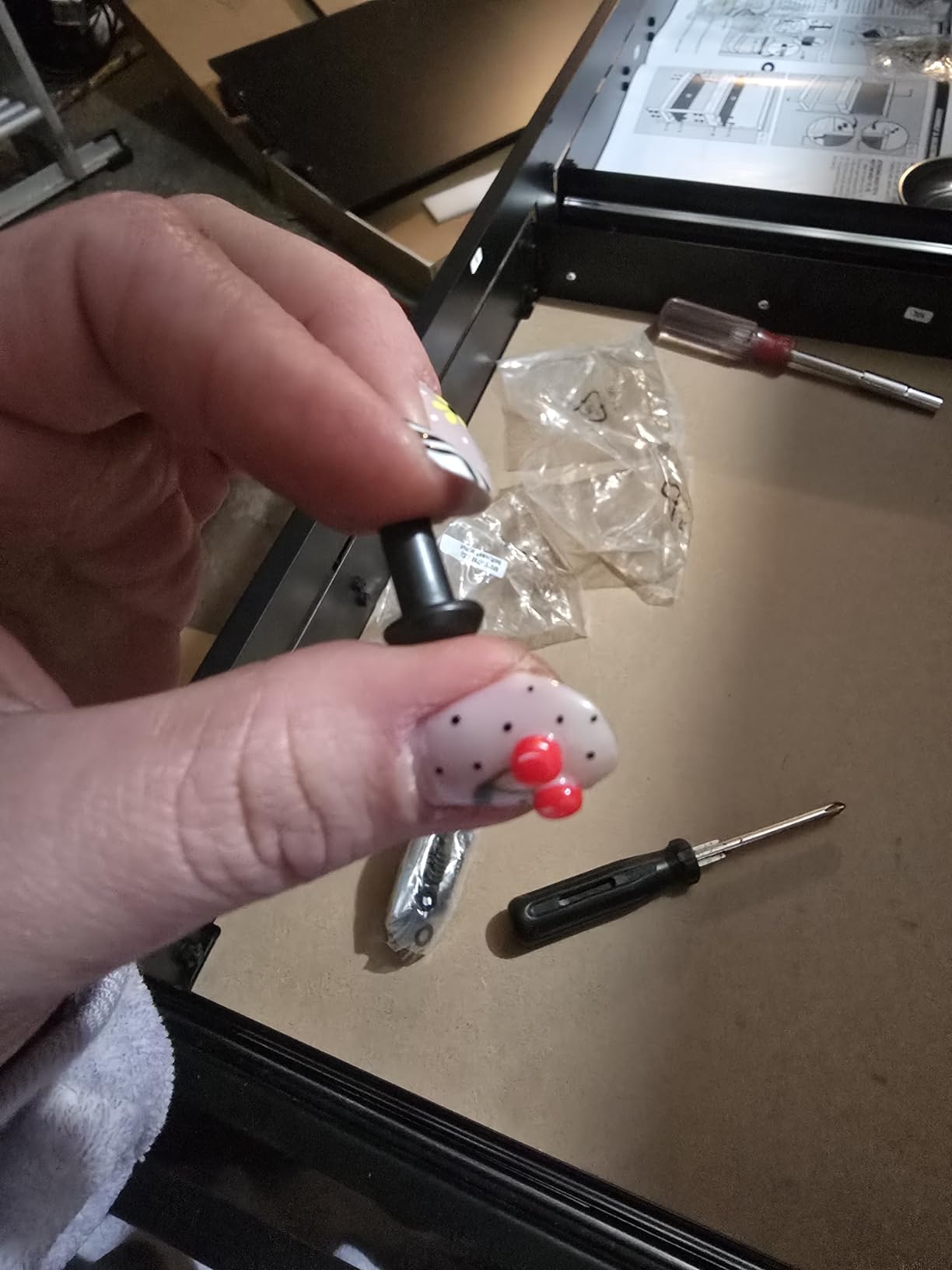
Storage is better than most. Two wide drawers plus upper and lower shelves and a pegboard give small parts and hand tools a real home, which is more than most of the lighter frames in this roundup manage.
Be clear-eyed about the 220 pound rating though. Owners point out that this is light duty. It is fine for soldering irons, a supply and parts bins. It is not the bench to put a lathe or a large 3D printer on.
Assembly is the sticking point. Roughly 100 small bolts, nuts and washers, and the diagrams are vague about which way parts face, so budget a couple of hours and lay the hardware out sorted before you start.
Is the low rating a reason to skip it?
At 4.1 across 2924 reviews it has the largest sample of any bench here, and the complaints cluster in one place: assembly. Once built, owners describe it as solid, with a thick enamel surface that does not wobble when you push on it.
If you are comfortable with a long build, the payoff is that the outlets and the light are part of the frame. If you are not, budget an afternoon.
Where it will frustrate you
The enamel-coated surface is a working surface, not a delicate one, but it is thin compared with the solid rubberwood and oak tops elsewhere in this list. Heavy instruments pressing in one corner will feel it more than they would on a thicker board.
The pegboard is thin enough that a heavy cordless battery can stretch it. Small hooks are fine. Do not hang a drill on it.
4. VEVOR 48 x 20 Inch Adjustable Workbench Is the Best Value Entry Point
- Entry point into the 2000 lb class without moving up a tier
- Eleven height levels from 28.5 to 38.3 inches with rubber levelling feet
- Built-in 4 AC outlets 2 USB ports and a 9.8 foot cord
- Oak top resists cracking and deformation
- Four adjustable feet level it on uneven floors
- Frame screws loosen with use and need periodic retightening
- Holes sometimes do not align across units
- No wrench included even though one is required
- Tops arrive scuffed or with splinted edges
- Thickness varies between sizes so the rating feels inflated on smaller tops
This is the shortest route to a bench that will not flex. The 2000 pound rating sits on a 48 by 20 inch oak surface over a steel frame, and for soldering, breadboarding and light repair work that is more than enough.
Eleven height levels is the widest range in the roundup, running from 28.5 to 38.3 inches. The four levelling feet take out the rock that most cheap frames have.
Owners like it for 3D-printer and craft-table duty as much as electronics, and the 4 AC outlets plus 2 USB ports with a 9.8 foot cord mean the supply and a laptop can both live on the bench. Some variants of this listing include casters and pegboard panels.
Two honest notes from reviews. The frame bolts loosen with use and need tightening every so often, and the 48 inch version of this bench is only about 20 inches deep, so the capacity number flatters the usable surface.
How it behaves under a real repair load
An oscilloscope, a bench supply and a hot air station will not shift the frame. Reviewers who work on 3D printers alongside electronics report the levelling feet and the height range as the features they notice daily.
The 9.8 foot cord is long enough to reach a wall outlet without an extension lead trailing across the floor, which keeps the under-bench area clear.
Where it will frustrate you
Retightening bolts is a recurring note, and it matters more when a heavy instrument is clamped to the corner. Check the frame bolts after the first few sessions rather than assuming they stay put.
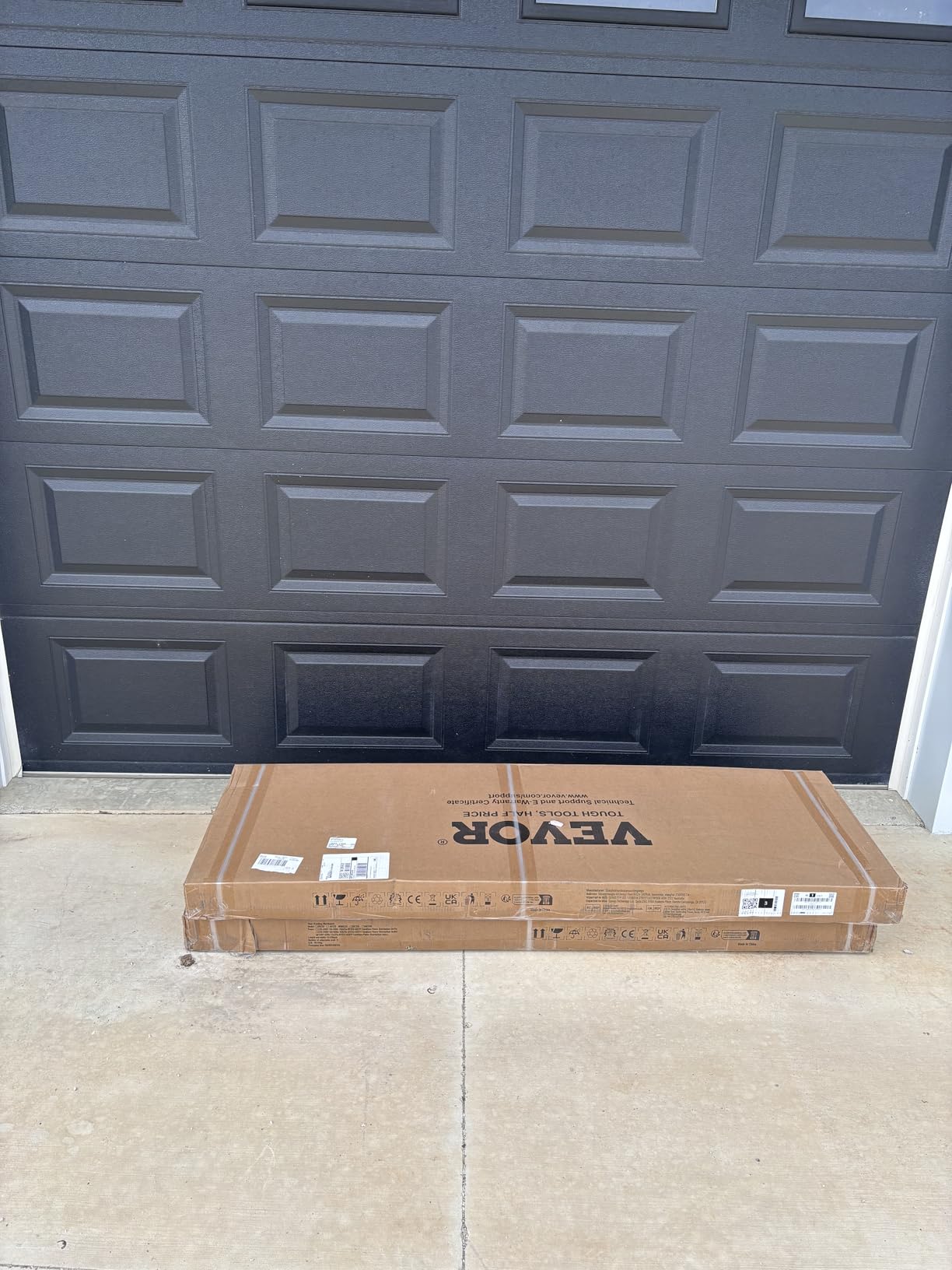
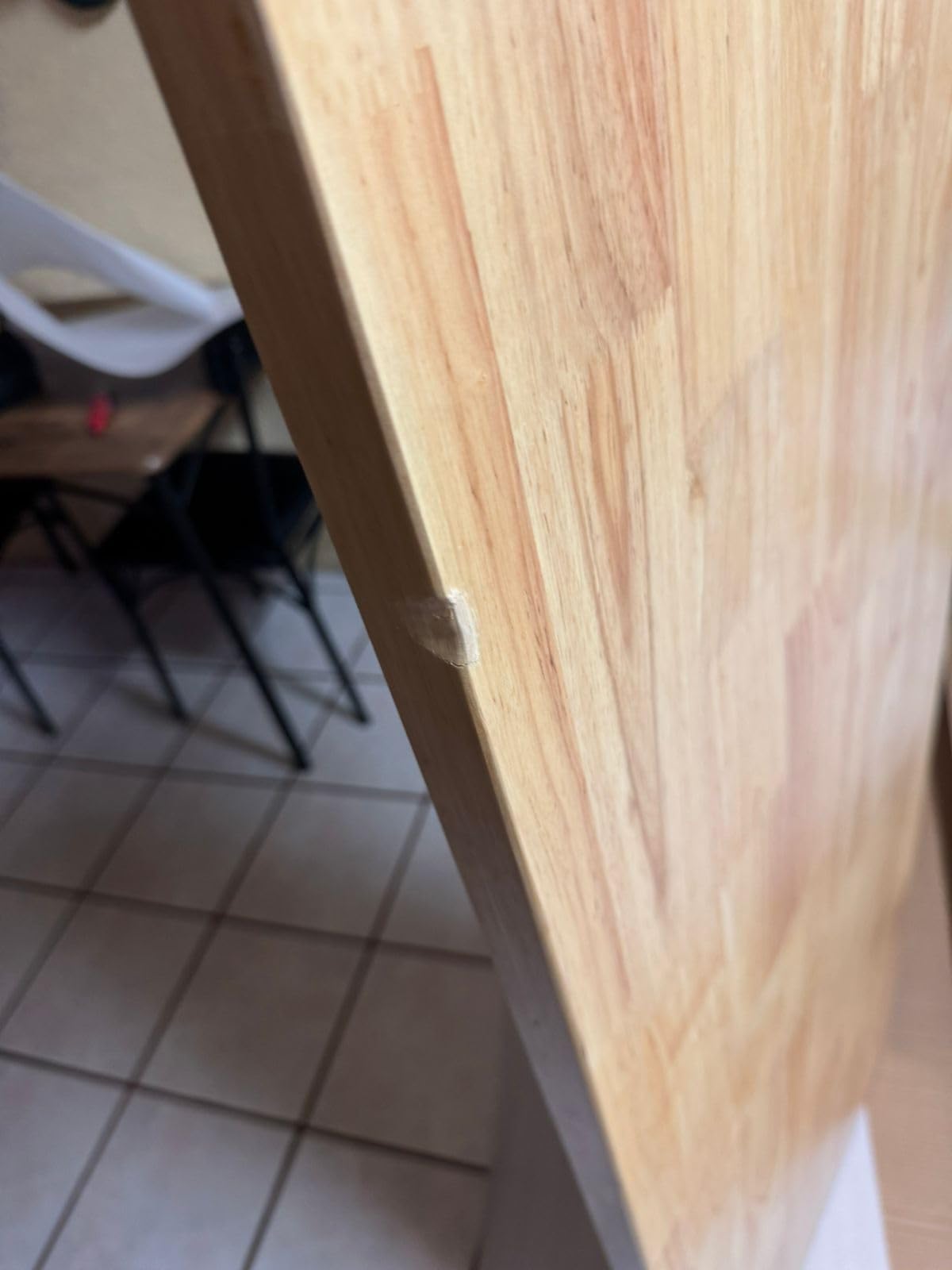
Quality control is inconsistent. Owners report holes that do not line up and tops arriving scuffed, so check the parts list before you start and keep the packaging in case something needs replacing.
5. CAMMOO 48 x 24 Inch Workbench Solves the Depth and Storage Problem
CAMMOO 48×24 Inch Garage Work Bench with Storage, Pegboard & Power Strip
- 24 inches of depth so instruments can be pushed back out of the working area
- Ten tool-free height levels with 1.34 inch increments
- Under-shelf mounts to any leg hole for flexible storage height
- No-drill metal pegboard that moves with the bench
- ETL power strip with 4 AC outlets and 2 USB-A ports
- Thin-gauge steel feels more medium duty than the 2000 lb claim
- Pegboard eats about an inch of the 24 inch top
- Included LED strip is weak with a short USB cable
- Only three or four pegboard hooks included
- A real wrench is needed to torque the bolts
Depth is the feature nobody mentions until they run out of it. At 24 inches this bench gives you roughly 23 inches of usable surface once the pegboard is accounted for, and that is enough to keep a supply, a scope and a soldering station in separate zones.
The adjustable under-shelf is the sleeper feature. It mounts to any leg hole, so you can decide shelf height after the bench is built rather than before. Owners building a bench for parts bins and spare boards use it for exactly that.
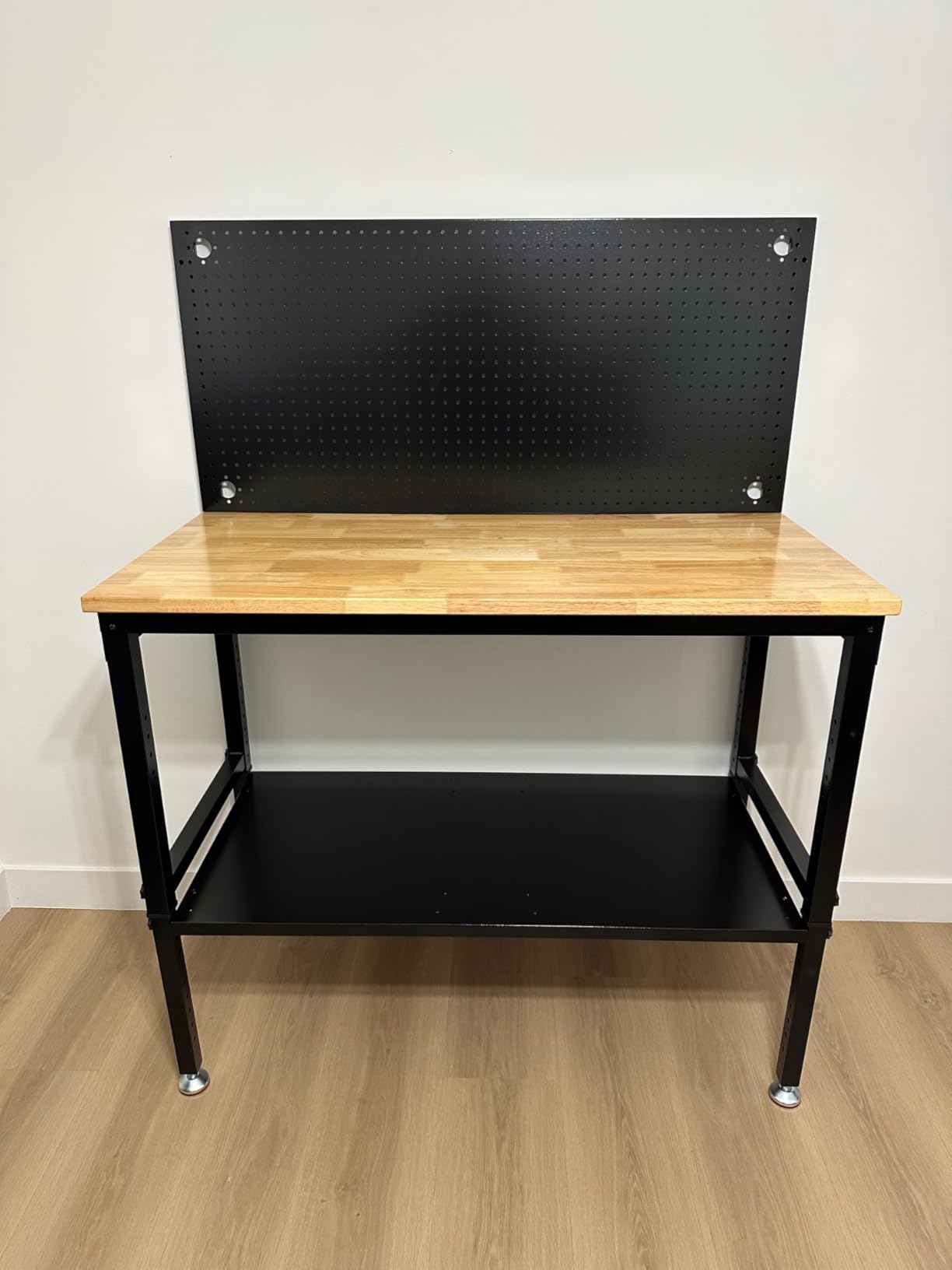
Ten tool-free height levels at 1.34 inch increments is the smoothest adjustment range here, and the pegboard needs no wall mounting, which is what makes this bench work in a rented space or a room you cannot drill into.
Assembly takes under two hours according to owners, and the detailed instructions plus the included video are among the better ones in this group.
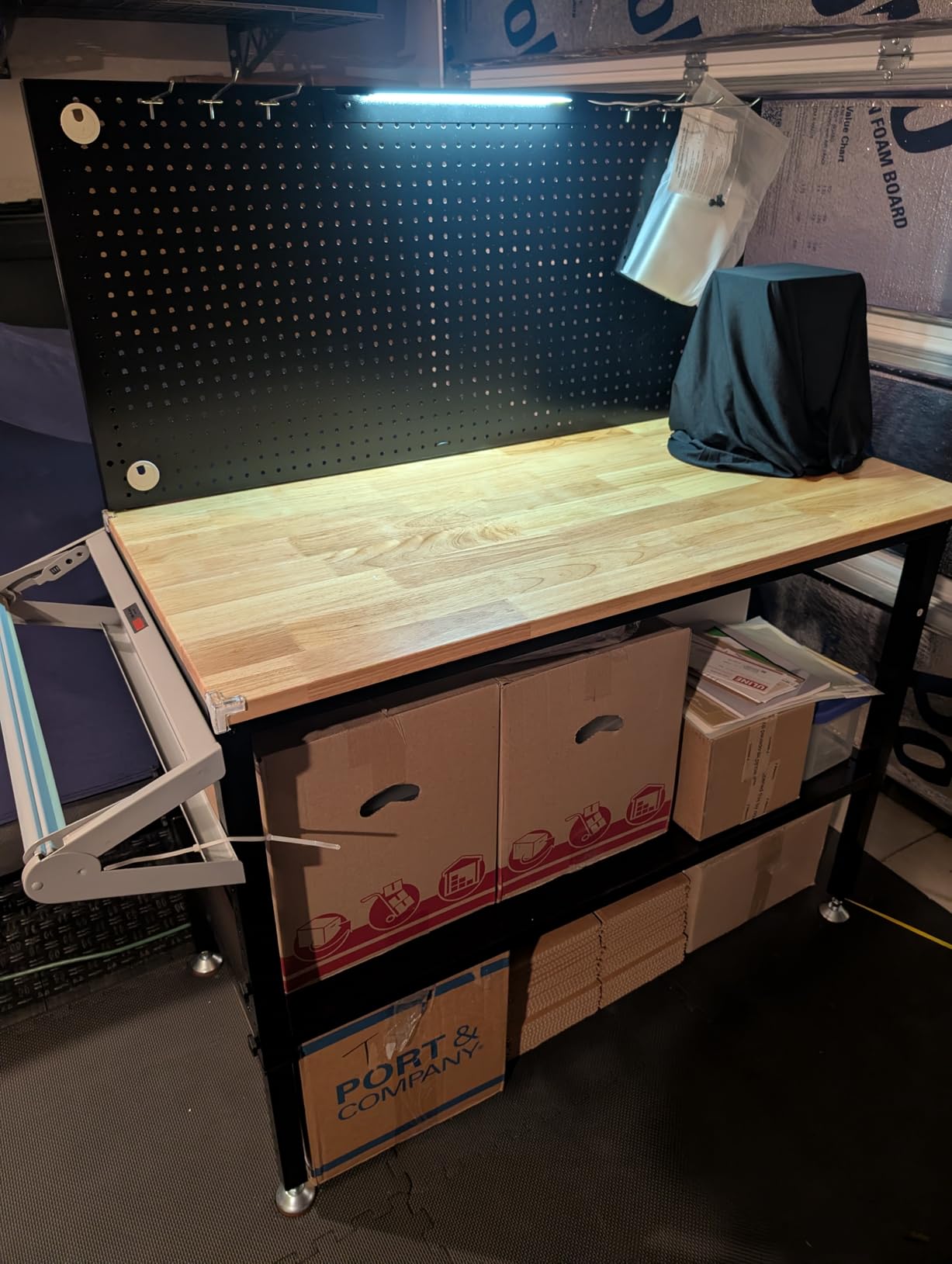
What the 24 inches of depth changes in practice
With a narrower top, a hot air station ends up next to your board and your wrist. With 24 inches you can push the hot tools to the back, keep the mat in the middle, and put the microscope where you can reach it without leaning across anything hot.
That is also why we consider depth one of the two decisions that matter most, alongside frame stiffness.
Where it will frustrate you
Owners consistently call the steel thin-gauge relative to the advertised 2000 pound capacity. If you plan to clamp a heavy instrument, check the top and frame before you buy rather than after.
The included LED strip is dim and its USB cable is short, and only a few hooks come in the box. Treat both as starting points you will replace.
6. VEVOR 60 x 24 Inch Workbench on Wheels Is the One That Follows the Project
- Largest surface in the set at 60 x 24 inches
- Four 2.5 inch swivel casters with brakes so one person can move it
- Stated capacity is described as realistic rather than inflated
- Seven height positions from 29 to 41 inches
- Integrated 4 outlet 2 USB power station with a 10 foot cord
- Side rails sit low enough to block a desk lamp clamp
- Printed brand logo on the top cannot be removed
- Tops can arrive with a dented edge from thin packaging
- Narrower than typical at 20 inches deep on the 48 inch variant
- Rigidity is far better with leg bolts spread across the top and bottom holes
When the work moves, a bench on casters saves you from rebuilding a setup twice. This one has four 2.5 inch swivel casters with brakes, so you can roll it across a garage to the car or the outbuilding and lock it where you want it.
The 60 by 24 inch oak top is the largest surface in this roundup. That is enough room for a 3D printer, a supply and a work mat side by side, which is the combination many hobbyists end up wanting.
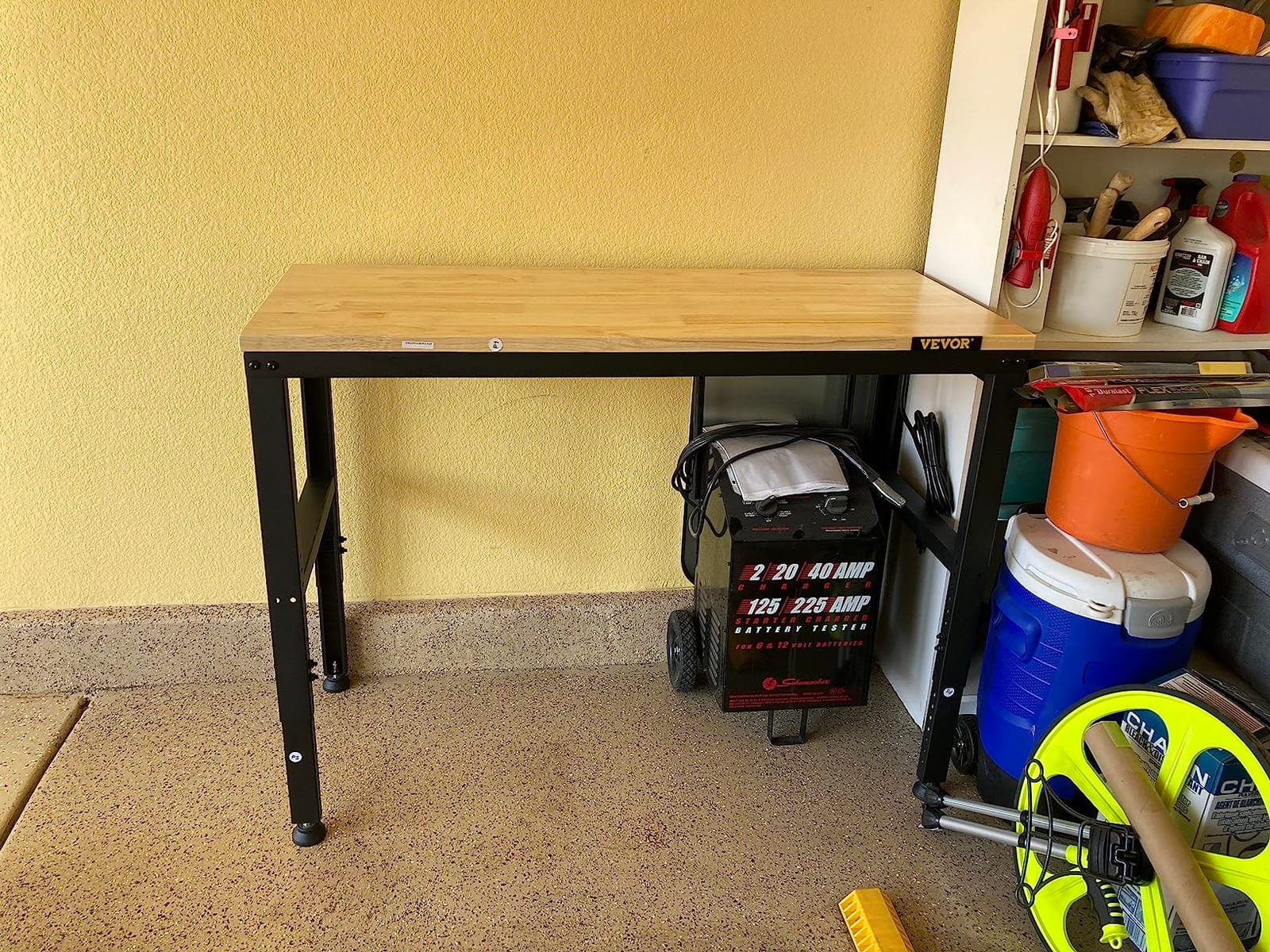
Reviewers consistently describe the capacity as honest, which is not something they say about every 2000 pound bench. A tip that comes up more than once: use the topmost and lowermost leg holes rather than adjacent ones and the frame gets noticeably stiffer.
Some variants include a hidden drawer rated at 33 pounds, which is sized for hand tools rather than anything heavy.
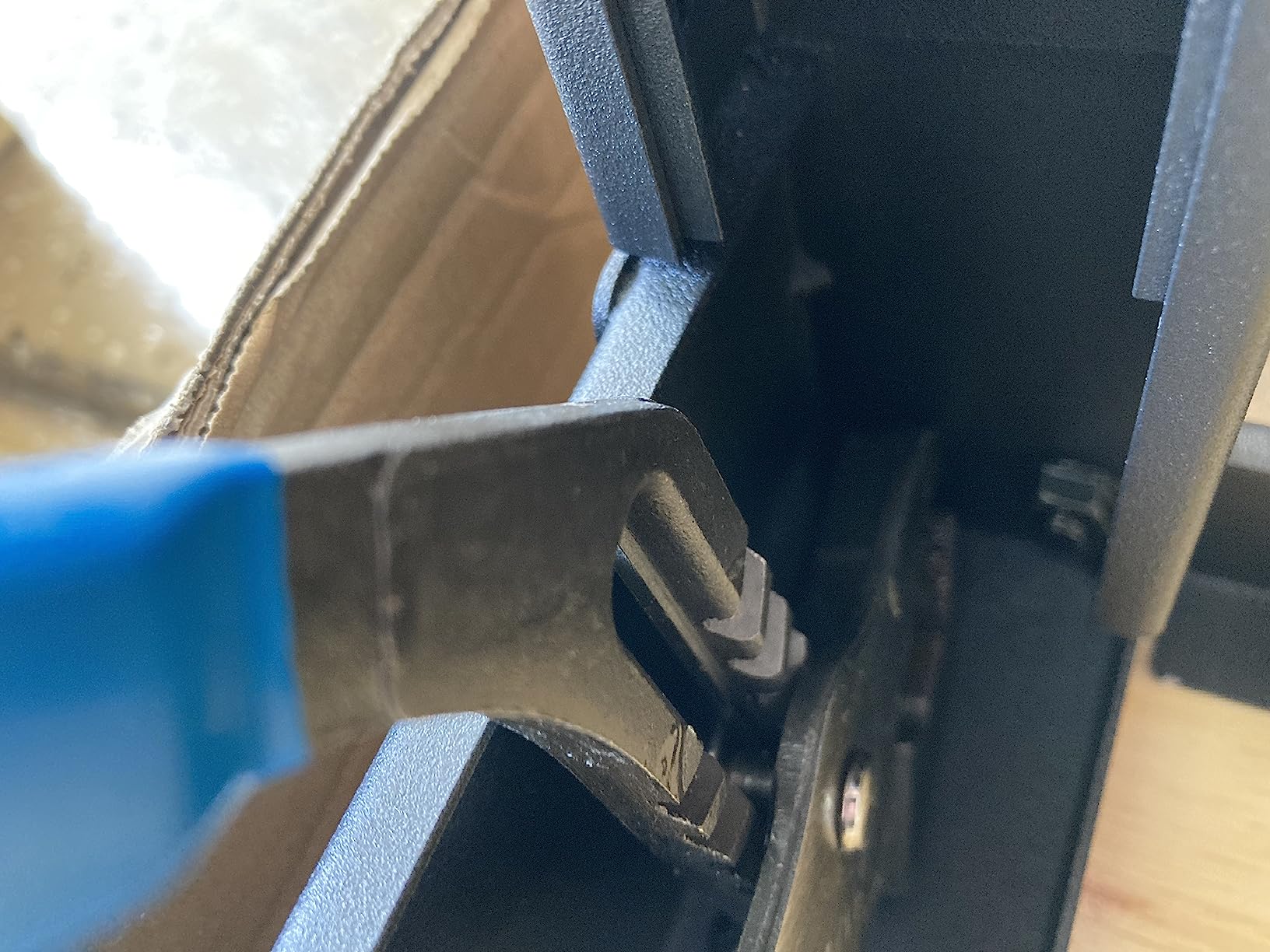
How it handles instruments on the move
Rolling a loaded bench is where cheap casters fail. These are 2.5 inch swivel casters with brakes, and owners moving the bench between the bench and the outboard describe it as easy for one person to handle even loaded.
Lock the casters before you start a precision job. A bench that can drift under a magnifying arm is a bench that produces cold joints.
Where it will frustrate you
The side rails sit low enough that a desk lamp clamp will not attach, so if you plan on clamp lighting you need a separate arm. The printed logo on the top cannot be removed either, which matters only if you are fussy about appearance.
On the 48 inch version of this bench, depth drops to about 20 inches. Check the size you are actually ordering.
7. GVGBUK 48 Inch Adjustable Workbench on Wheels Sits Lowest for Seated Work
GVGBUK 48″ Adjustable Workbench, Work Table with Wheels and Power Outlet
- Drops to 26.3 inches which is the lowest setting in this roundup
- Sealed rubberwood top is sanded smooth and wipes clean
- Locking casters let one person move it
- ETL-certified 4 outlet and 2 USB strip comes pre-assembled on the frame
- Quick build reported at 5 to 20 minutes with a simple wrench
- No under-frame cross piece so a cross brace would help with heavy loads
- Open underside means nothing prevents sag on a very heavy workpiece
- Small wheels and a glossy top that can feel slippery
- A perforated rail arrives under the top and must be relocated
- Legs can arrive in a silver tone rather than the colour shown
Seated bench work is where the 26.3 inch minimum height on this bench earns its place. Most adjustable frames bottom out around 28 to 29 inches, which is fine standing and cramped when you are sitting down for fine solder work.
The power strip arrives pre-wired onto the frame, and the casters mean you can pull the whole bench up to a chair. Owners who work seated on repair jobs describe that as the reason they bought it.
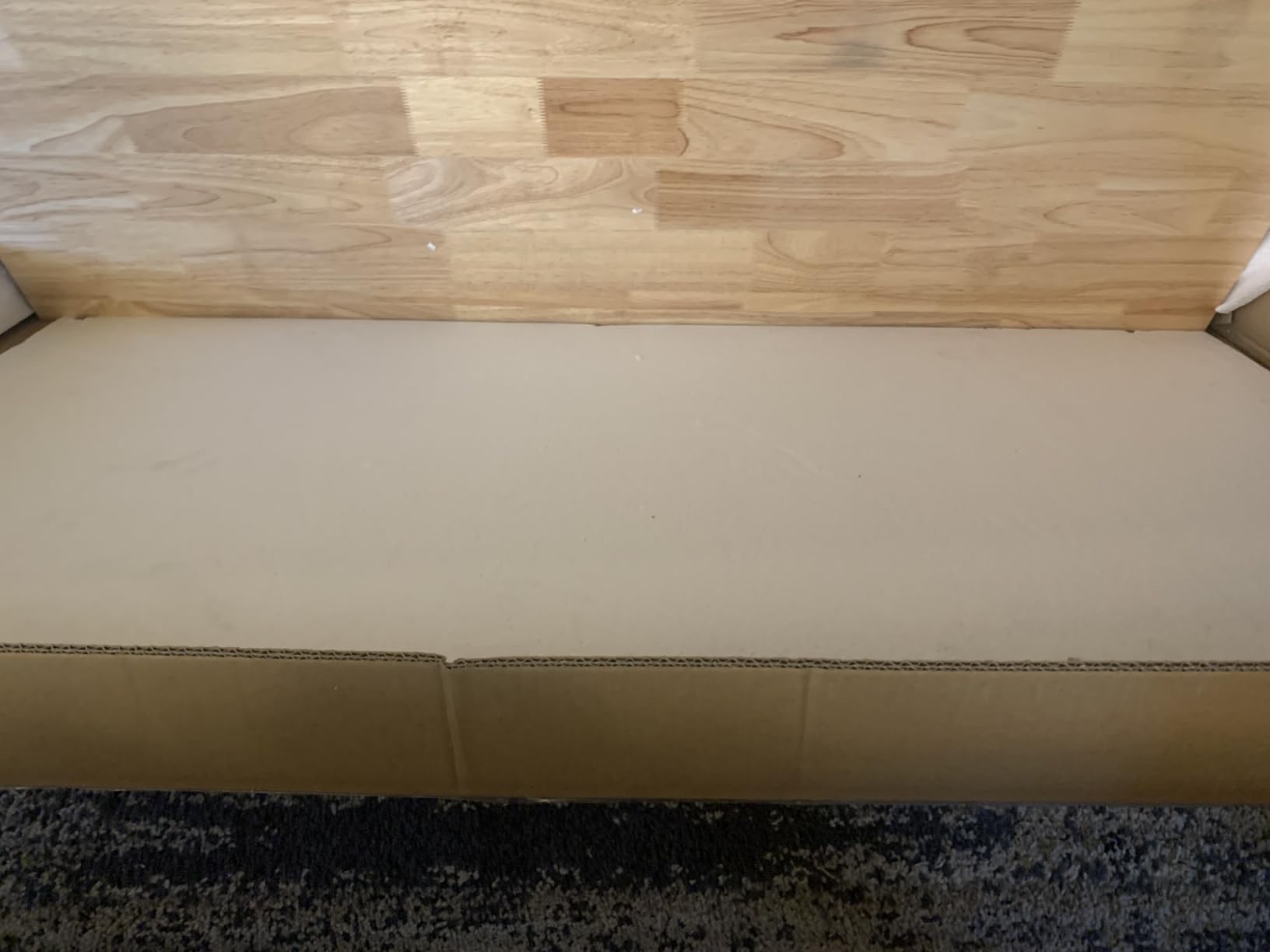
Reviewers also use this bench as a laser engraver stand, a router table base and a cutting table, and the varnished rubberwood top is smooth enough for all three. Assembly is quick by the standards of this group, reported anywhere from 5 to 20 minutes with a simple wrench.
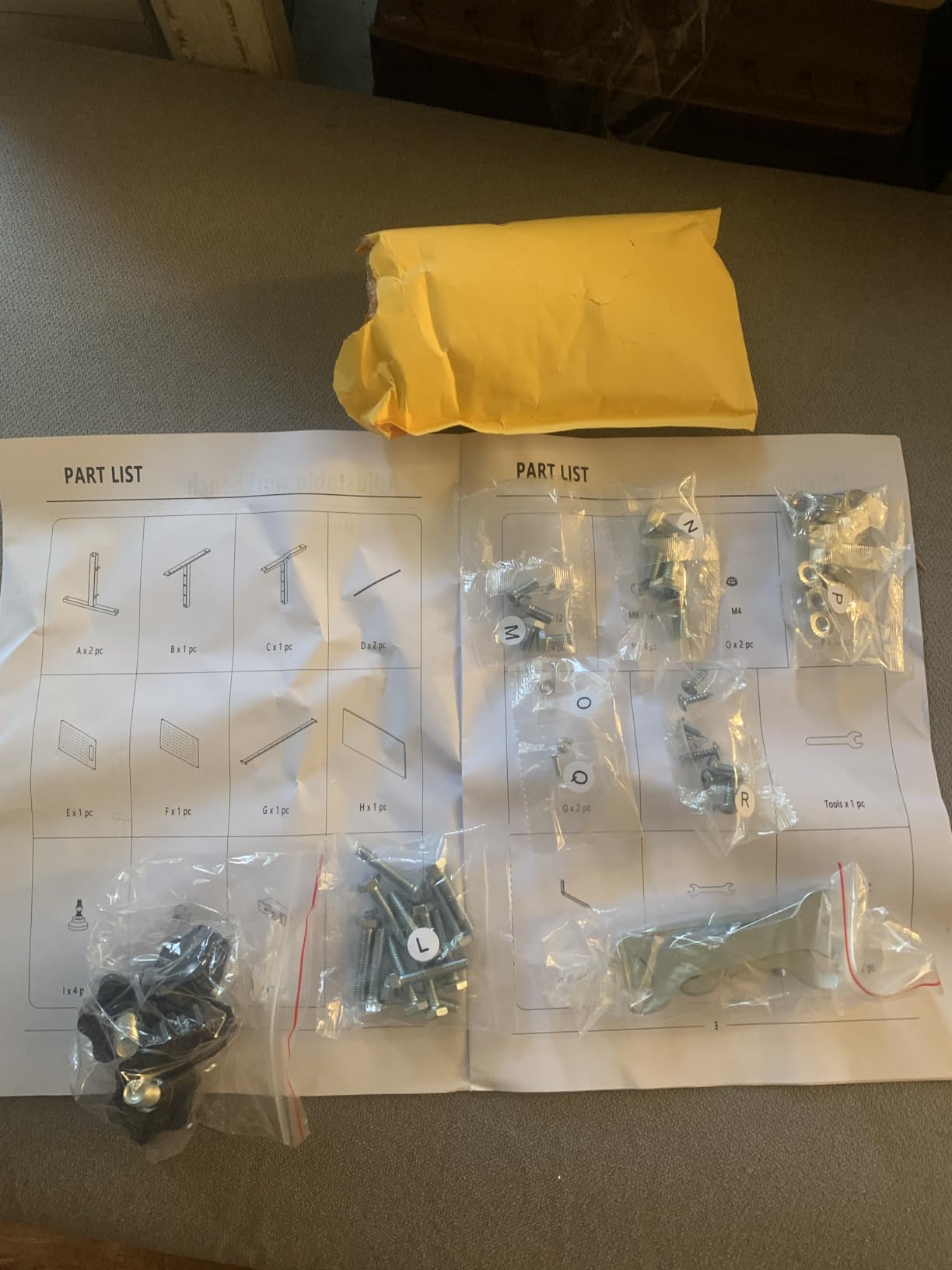
One assembly step catches people out: a perforated rail ships under the benchtop and has to be moved, and the guide does not mention it. You will find it.
Why seated height matters more than people expect
Working seated with a bench above elbow height forces you to hunch, and hunching is how you lose solder joints you thought were fine. Being able to drop the top to 26.3 inches and put a stool under it fixes a real ergonomic problem for repair work. If you are also choosing the seat itself, our piano bench picks cover the same seated-height logic.
The locking casters are part of that. Sitting down on a bench that can drift is its own problem, and these lock.
Where it will frustrate you
There is no cross piece under the frame, and the open underside means a very heavy workpiece can sag the middle. For electronics that is rarely an issue, but if you plan to add a large vice or a laser cutter, add a brace.
The top is varnished, so it looks smooth and can feel slippery when a board is wet with flux. The casters are also small, which is fine indoors and less pleasant on gravel or a sloped driveway.
8. Maemttes 60 Inch Solid Wood Workbench Handles a Big Top and Heavy Loads
60” Heavy-Duty Solid Wood Work Bench Work Table with Wheels, Adjustable Height Portable Workbench with Power Outlets, 3000 Lbs Capacity Workstation for Garage, Workshop
- Highest stated load rating in the group at 3000 lb
- Large 60 x 24 inch solid wood surface for assembly work
- Smooth-rolling casters let you move it without breaking workflow
- Built-in power outlet keeps tools plugged in at the station
- Adjustable height supports seated and standing work
- No pegboard or integrated storage for small tools
- Solid wood and a wide top make it heavy to reposition
- Smallest review count in the group at 283 with the highest one-star share
The 3000 pound rating is the highest stated figure in this roundup, and it sits on solid wood rather than a board product. For a hobbyist that is more headroom than most people need, but it is a genuinely thick top that shrugs off heat.
Sixty inches of width is the other draw. Owners who run 3D printing alongside electronics use the extra width to keep a printer on one side and a full repair setup on the other, which is a problem the 48 inch frames cannot solve.
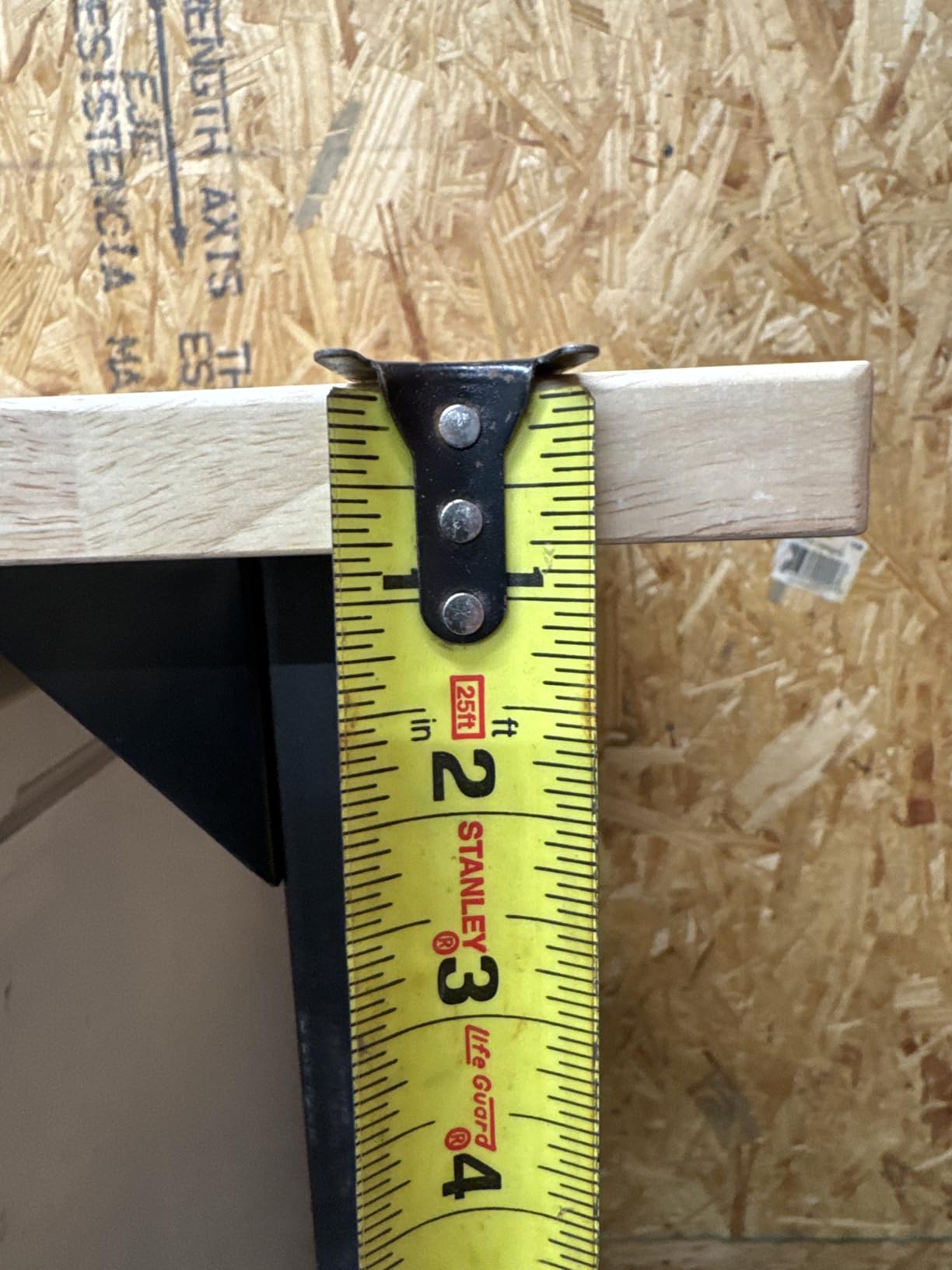
The casters and built-in outlet are what make a 60 inch top practical. Without them, a bench this wide is furniture you move once and never again. With them, you roll it against the wall when you need floor space.
Height is adjustable so it works for both seated and standing jobs, and the pedestal base keeps the footprint efficient for the width.
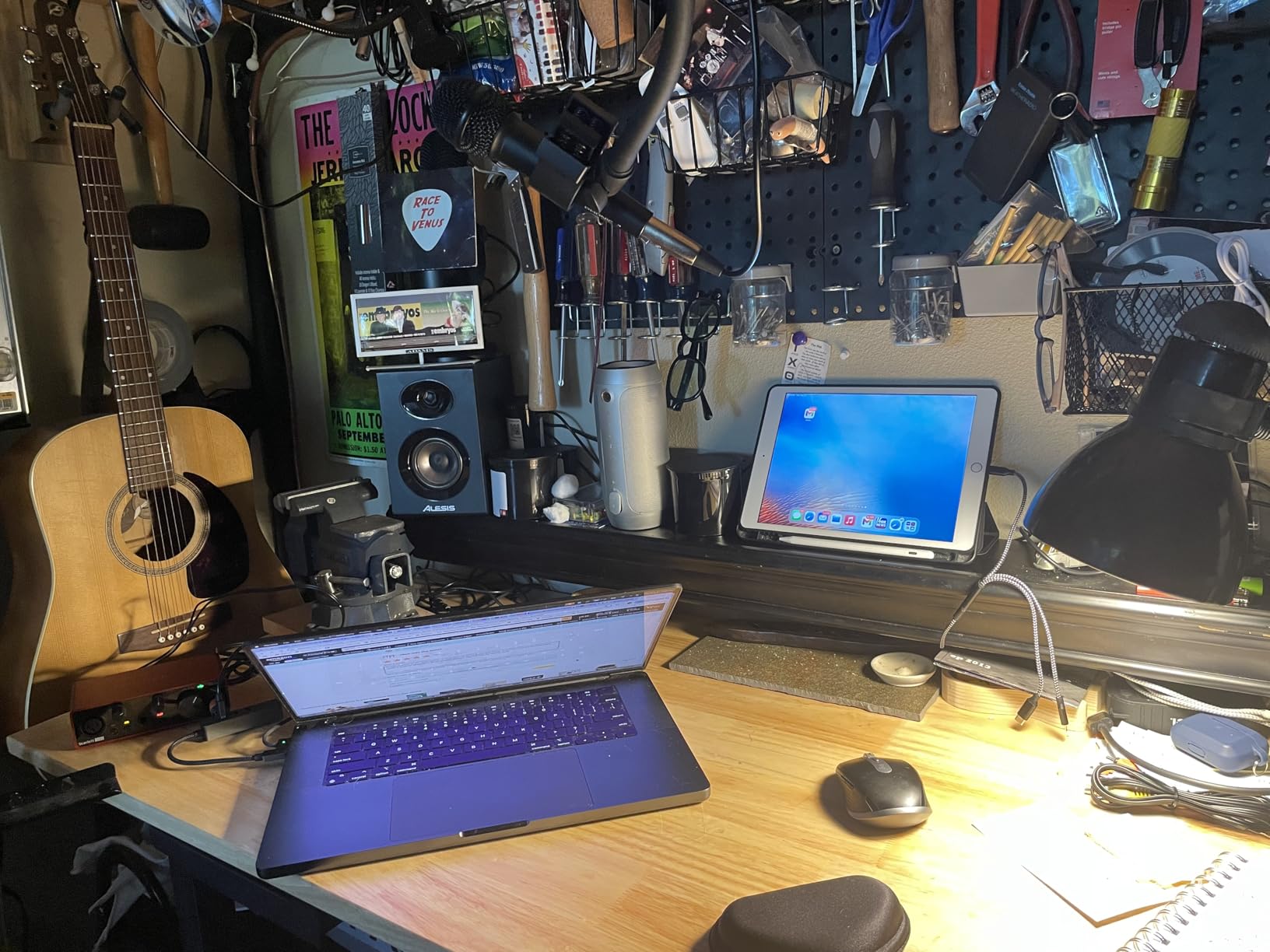
When a 60 inch top is the right call
Reach for a surface this wide if you are splitting tasks across a bench rather than focusing on one board. Two work zones side by side, a printer and a repair bench, or a test area and a soldering area, all benefit from the extra width.
Solid wood is also the better choice than veneer if you park a hot iron on the surface at the end of every session. The mark stays in the wood rather than in a surface layer.
Where it will frustrate you
There is no pegboard and no integrated storage, so parts and hand tools need a separate solution. At this width, that gap is more noticeable than on a 48 inch frame.
It is heavy. Solid wood plus a 60 inch top plus a pedestal base means moving it is a two-person job even with casters. Plan where it lives before you build.
9. OLBRUS 48 Inch Adjustable Workbench Doubles as a Standing Desk or Craft Table
OLBRUS 48″ Adjustable Workbench with Power Outlet and Wheels
- Six height levels from 26.3 to 35.8 inch covering seated and standing work
- Four universal lockable casters move it easily even when loaded
- ETL-certified 4 outlet and 2 USB-A strip built into the frame
- Rubberwood top has a polished surface that resists cracking and wipes clean
- 2000 lb capacity and quick assembly most buyers finish unaided
- Worktop is thinner than some buyers expected
- Height adjustment requires unloading and repositioning rather than a quick lever change
- Some units shipped with missing pre-drilled holes
- Frame can shake under heavy vibrating equipment
- Back plate holes may not align
Owners repurpose this bench far beyond electronics. Sewing tables, art and jewellery stations, guitar maintenance and standing desks all show up in reviews, and that is the clearest signal that it works as general-purpose furniture.
For electronics, the useful parts are the four lockable casters and the 26.3 inch minimum height. That combination lets you roll the bench next to a chair for seated work and then roll it against a wall when you are done, which is how a one-room hobby space stays livable.
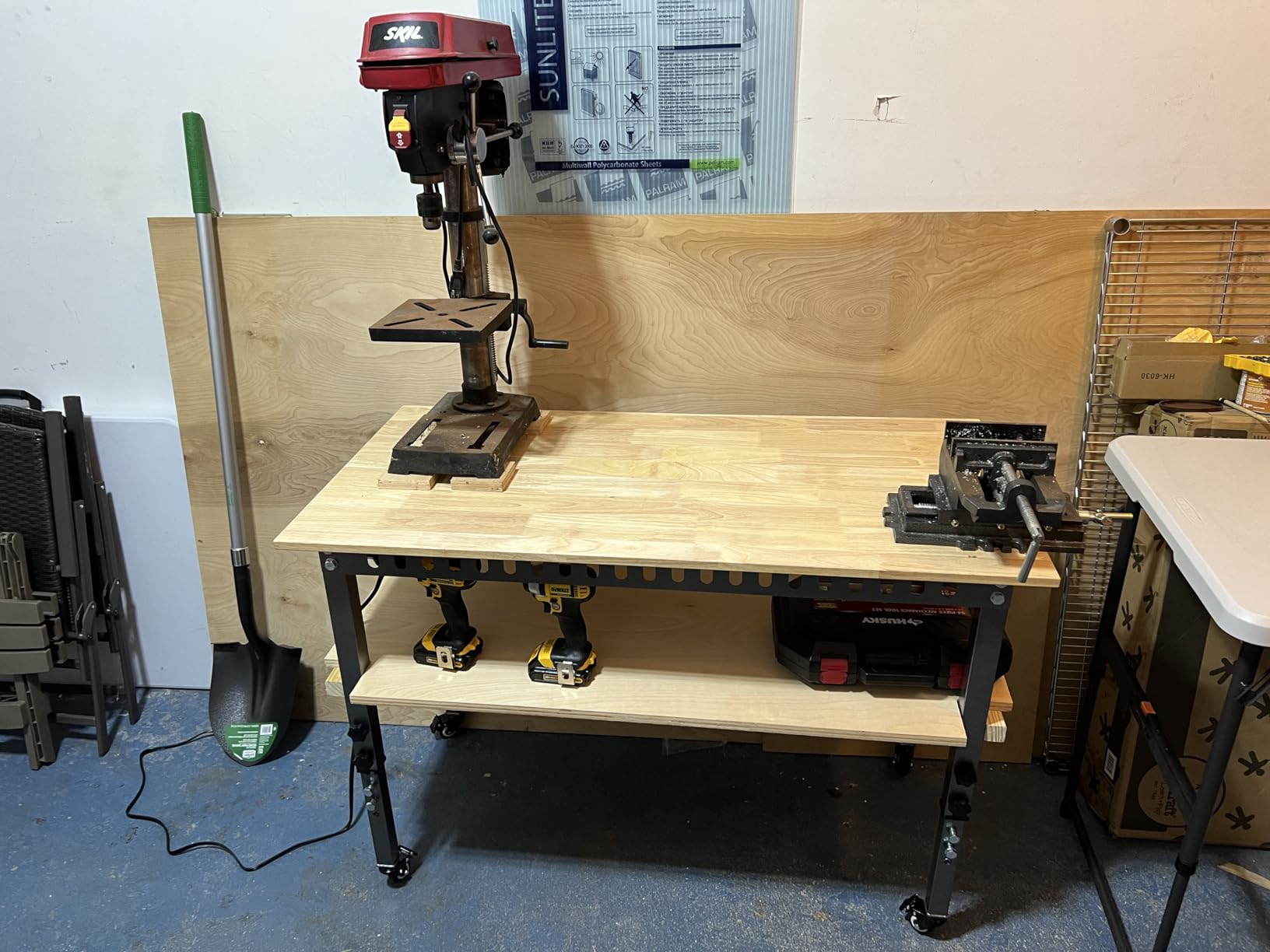
The ETL-certified strip with 4 AC outlets and 2 USB-A ports is fitted during manufacture, so there is no wiring for you to do. Assembly is straightforward enough that most buyers complete it without help.
The 2000 pound rating and the 48 by 23.6 inch surface give you plenty of room for a supply, a mat and a hot air station, provided you keep the vibrating equipment elsewhere.
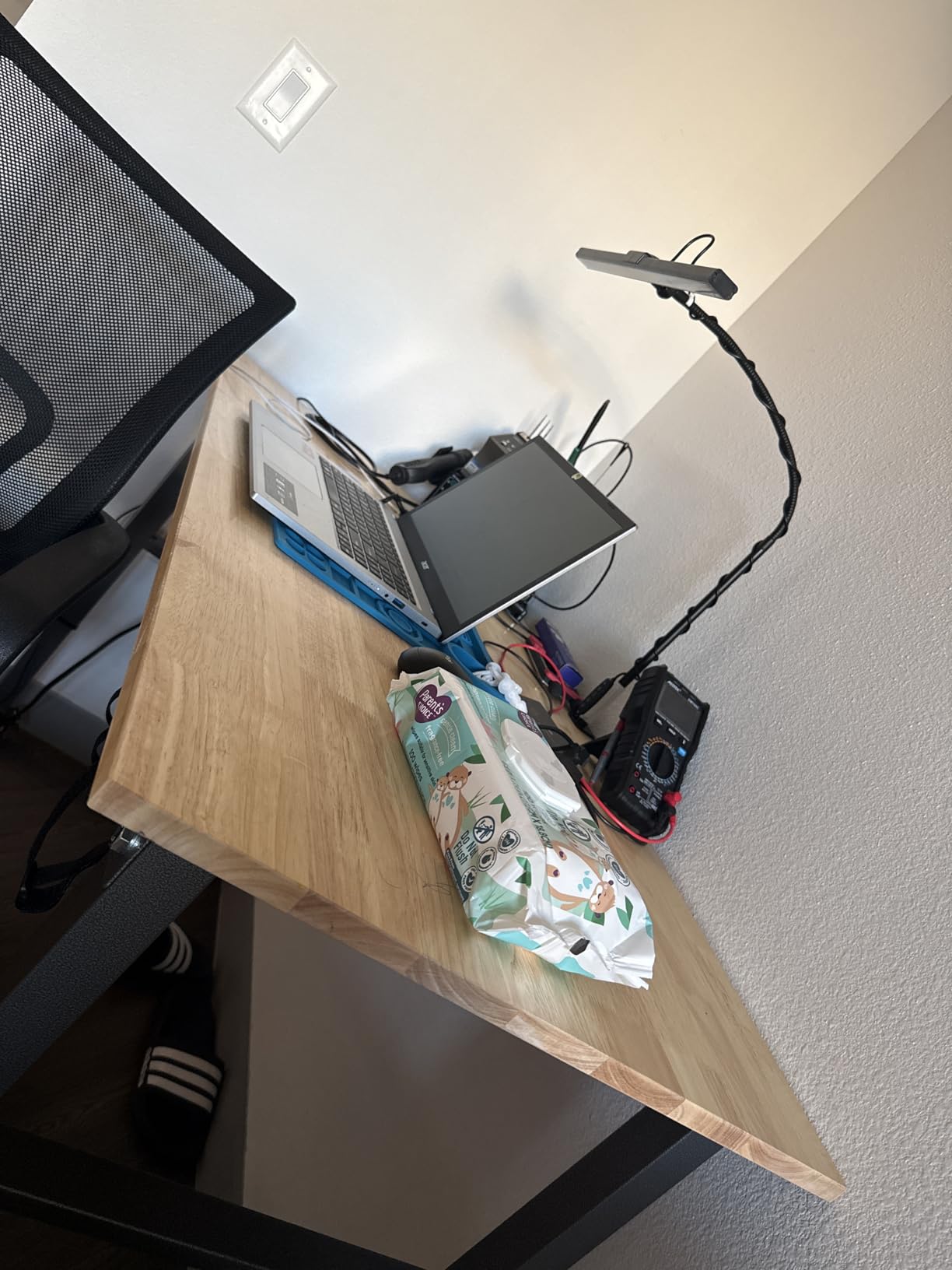
How it performs in a shared hobby room
If the electronics bench also has to be a craft table or a standing desk, this is the one to look at. The finish is clean enough to sit in a room rather than a garage, and the casters mean it moves in seconds rather than at the end of the year.
The polished rubberwood top wipes clean, which matters more than it sounds once you are working with flux residue and heat shrink.
Where it will frustrate you
The top is thinner than some buyers expected. It is fine for soldering and assembly but it is not a thick butcher block, so a heavy instrument pressed into one corner will move the surface more than the 2000 pound figure suggests.
Height changes are not a single-lever operation. You unload, reposition and relock rather than cranking through it, and the frame can shake under a vibrating tool such as a laser cutter. Put the cutter on a separate table.
10. Eltean 48 Inch Workbench Packs the Most Storage Into the Footprint
Eltean 48″ Workbench,Heavy Duty 2500 LBS Capacity Work Benches for Garage
- Two drawers a lockable cabinet with magnetic doors and lower open shelves
- Magentially mounted LED light with three colour temperatures and dimming
- No-drill pegboard with four rear holes for routing power
- Rubber mat surface protects tools and dampens noise
- Pre-drilled holes with instructions and an assembly video for a 30 to 45 minute build
- Top sags under a moderately heavy machine well short of the 2500 lb claim
- Drawer slides are flimsy and drawers can detach when pulled
- Heavier than 100 pounds and assembled upside down so two people are needed
- Few or no pegboard hooks included
If your problem is that the tools have outgrown the bench, this is the one. Two drawers, a lockable cabinet with magnetic doors, lower open shelves and a top tray put more organised storage into a 48 inch footprint than anything else in this roundup.
The magnetic LED light is the detail reviewers mention most. It has warm, neutral and cool settings with dimming, and it mounts magnetically rather than by a bracket that drifts. For inspecting a hairline joint, a cold white setting at low brightness is genuinely useful.
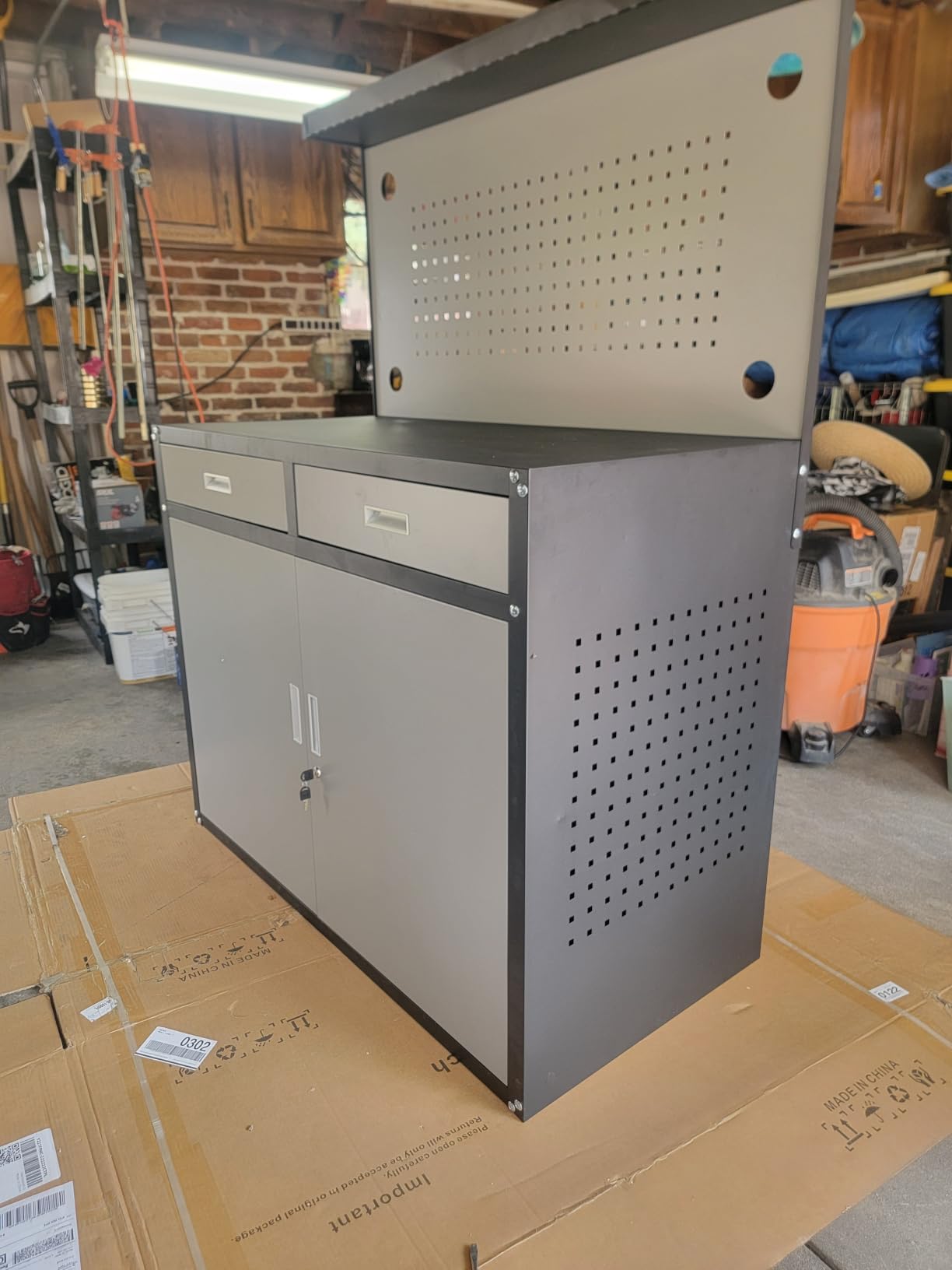
The rubber mat surface does two jobs. It protects the metal top from a hot iron and it dampens the noise of small parts bouncing around during rework. The four rear holes let you route the power supply to the strip.
Owners call it good value across several units, and the build is reported at 30 to 45 minutes with the included video.
Why storage density beats raw capacity for electronics
A 2500 pound rating is meaningless if every bin has to live on the top. This bench puts screws, jumpers, spare boards and consumables behind doors and in drawers, which is exactly what a growing hobby needs when the soldering is only half the activity.
The lockable cabinet also has a practical use: it keeps components and small tools out of sight in a shared room.
Where it will frustrate you
The 2500 pound claim is not met in practice. A reviewer reported the top sagging under an 87 pound lathe, which is well short of the rating. For electronics that is not a real concern, but do not plan to put a heavy machine on it.
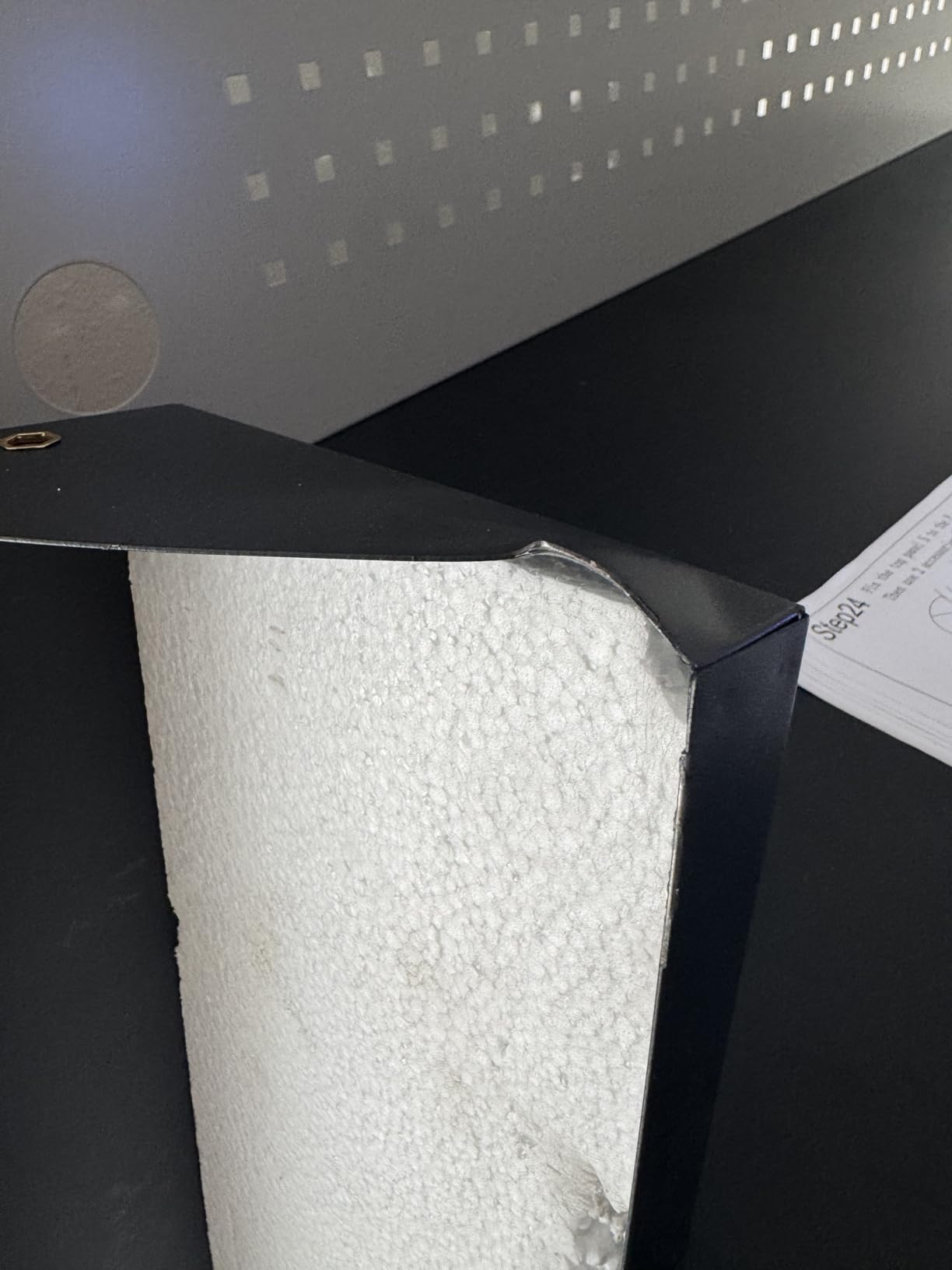
The drawers are the weak point. Slides are flimsy and drawers can detach when pulled, so treat them as light-parts storage. And at over 100 pounds, assembled upside down, you will want a second person to turn it over.
11. Hak 48 Inch Workbench Has Pegboards on Three Sides
- Only bench in this roundup with pegboard on three sides for 360 degree tool access
- Lockable cabinet plus two drawers for screws and small parts
- Magnetic LED strip runs 3000K to 6000K with brightness control
- 6 inch top extension keeps tools from sliding off the surface
- All-steel powder-coated frame with triangular bracing and a rubber mat top
- Sheet metal panels can be thin and sharp during assembly
- Drawers are bent sheet metal and wobble when pulled
- Some arrive with dented or bent parts
- Included LED strip is dimmer than expected
- Assembly takes several hours despite the 30 minute estimate
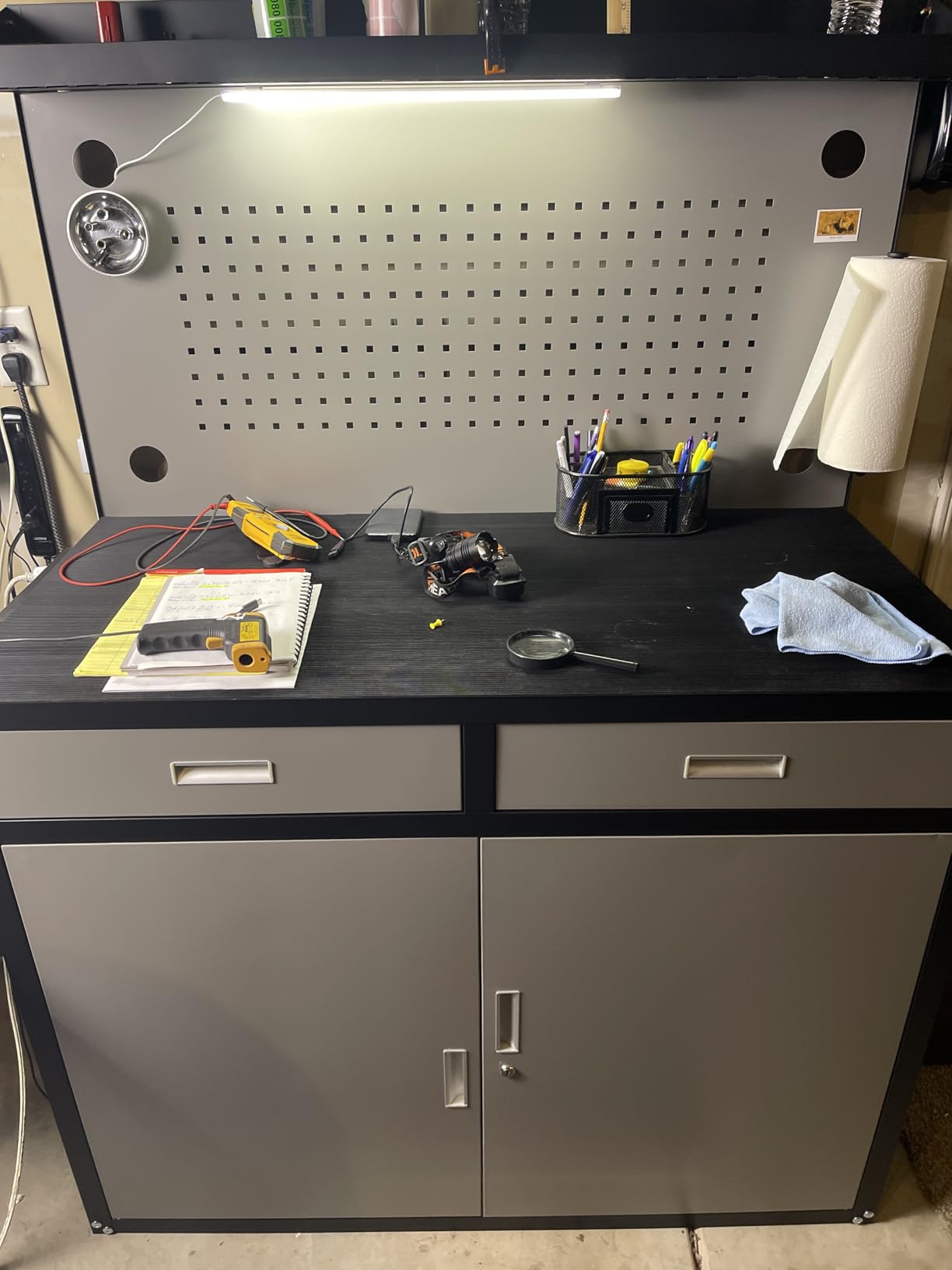
Three-sided pegboard is the reason to pick this bench. You can hang tools on the back and both ends, which on a 48 inch bench means roughly a third more hanging space than a single back panel gives you, without needing a wall to mount anything on.
That matters in a basement or a rented flat where you cannot drill. Tweezers, side cutters, probes, crimpers and a spool holder all get a home and stay visible.
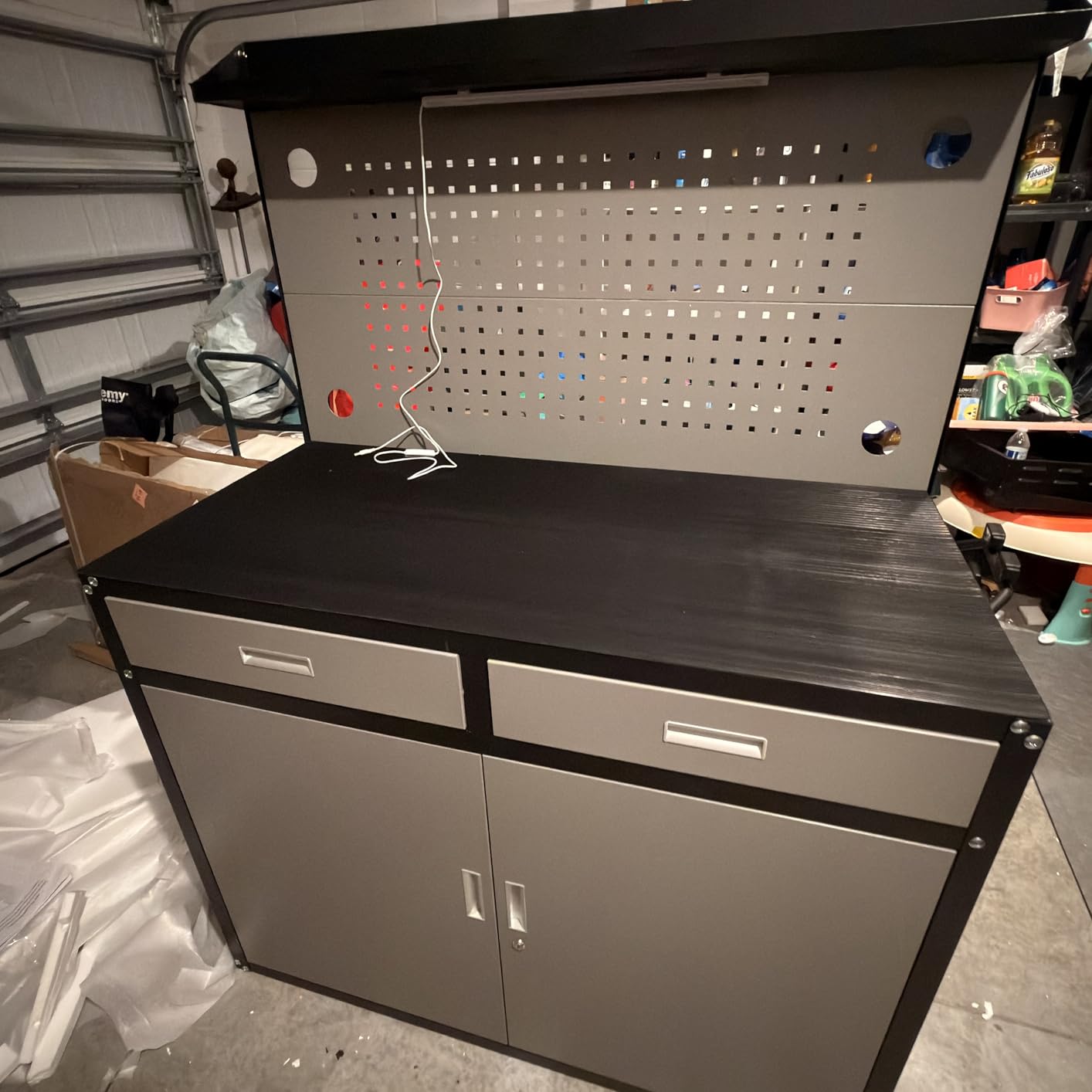
The magnetic LED strip runs from 3000K to 6000K with a non-glare design, so you can match the light temperature to what you are inspecting. Warm for general work, cool for checking a joint under magnification.
The 6 inch top extension table is a small idea with a real effect. It gives you somewhere to set a tray of parts or a board you have just finished, instead of balancing it on the edge of the bench.
What pegboard on three sides changes
Most hobby benches have one panel at the back, and within a year that panel is full. A third panel roughly doubles the number of tools you can hang at eye level, which directly reduces the clutter on your working surface.
Owners upgrading from a plain table call the combination of a lockable cabinet, pegboard and under-shelf drawers a big improvement in garage organisation.
Where it will frustrate you
Assembly is the honest weakness. Owners report several hours of work despite the stated 30 minute estimate, and the sheet metal panels are thin and sharp while you fit them. Wear gloves.
The drawers are bent sheet metal with minimal fasteners and can wobble when pulled, and the included LED strip is dimmer than the colour temperature range suggests. Plan on adding a proper task light later.
12. Topass Pegboard Workbench on Casters Is the Budget Pick
- Lowest cost bench in this roundup by a wide margin
- Tool-free clip assembly one person completes in about 20 minutes
- 2.2 mm double-layer steel legs rated at 100 lbs per shelf
- Shelf heights adjust to match what you store
- Pegboard and 3-tier dividers plus four lockable casters
- 34 inch width and 18 inch depth limit the usable work surface
- 200 lb total rating makes it more a storage station than a heavy-duty bench
- No integrated power outlets or lighting
- Stands 48 inches tall so it is not a seated work surface
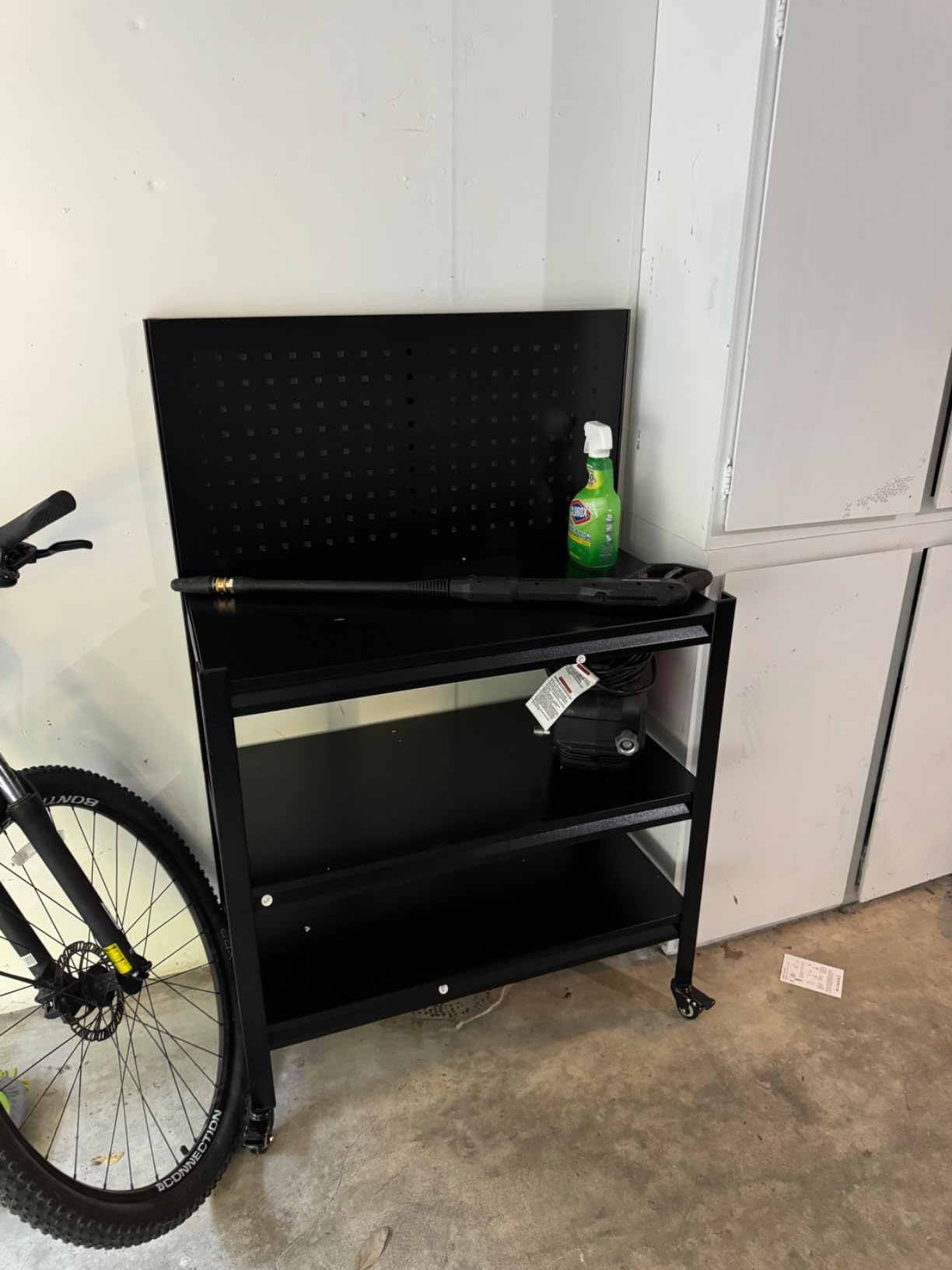
Treat this one as a mobile tool station rather than a soldering bench. At 34 by 18 inches with a 200 pound total rating, it will hold tools, bins and small machines on three shelves, and it rolls to wherever the project is.
What makes it worth including is the price and the assembly. Tool-free clip construction means one person can build it in about 20 minutes with no tools, which is rare in this category. The shelf heights adjust to match what you actually store.
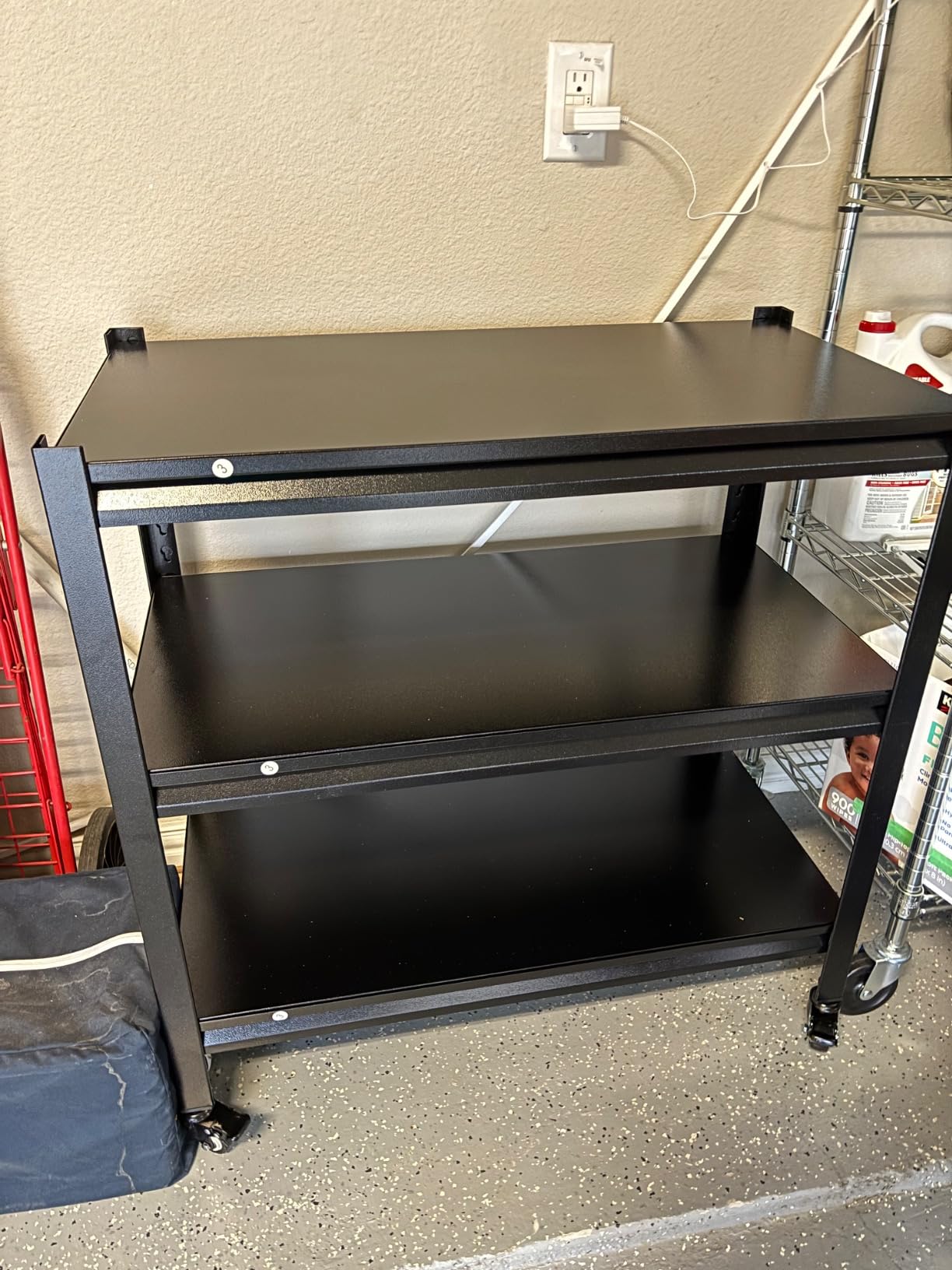
Owners use it as a parts trolley next to a bigger bench, with the pegboard and 3-tier dividers holding screws, connectors and small components. Four lockable casters mean it rolls across indoor and outdoor surfaces.
The 2.2 mm double-layer steel legs carry 100 pounds per shelf, so load is a per-shelf figure rather than a total figure. That is a different model from the 2000 pound ratings elsewhere in this roundup.
How it performs as a tool station
Park it beside your main bench as a rolling parts and consumables trolley. The 3-tier dividers suit small bins, and the pegboard takes hand tools that would otherwise sit loose on a shelf.
In a dorm room or a small apartment, the four lockable casters and the compact footprint are the whole appeal. You can store the entire thing against a wall when you are not using it.
Where it will frustrate you
It is not a soldering surface. It stands 48 inches tall, so it is a standing-height station rather than a seated bench, and there is no seated height option at all.
At 18 inches deep there is no room to push instruments back, and there are no power outlets or lighting built in, so a hot iron has to be plugged into a separate lead. It is light duty by design.
How to Choose an Electronics Workbench
Most buyers fixate on the load capacity because it is the biggest number on the listing. It is also the least useful number for electronics work. Here is the order of decisions that actually matters.
Surface depth, then width. Depth decides whether you can push a hot air station back out of your working area. 24 inches deep is the practical minimum for soldering, rework and inspection work, and 30 inches is better if you also run a 3D printer or a microscope on the same surface. Is 24 inches deep enough? Yes, for electronics. A 20 inch top is tight the moment a supply, a scope and a mat are all in use.
Frame rigidity, not frame rating. A 2000 pound figure describes a uniformly distributed load. A microscope arm or a vise applies a point load at one corner, and that is what makes a bench wobble. Look for steel frame thickness, cross members and reviews that mention rigidity after a few months rather than on day one.
Top material and heat tolerance. A solid rubberwood or oak top survives a resting soldering iron far better than a veneer over particle board. Laminate and melamine scorch, lift and hold flux residue in the seams. For daily iron contact, a solid wood or a full rubber mat is the safer choice.
How you will ground an anti-static mat. Check whether the frame is metal and whether there is a bonding point or a rear hole to run a ground cord to. A mat with no route to earth is decoration.
Height range and whether the change is tool-free. A minimum height near 26 inches lets you sit and work; a maximum near 39 inches lets you stand. Five to ten positions is enough. Check whether adjusting height means unloading the bench, because on some frames it does.
Power and lighting. Four AC outlets and a couple of USB ports in the frame saves you routing an extension lead across the floor. Integrated lighting helps with inspection work. Neither is essential if you plan to add a strip and a lamp later.
Storage and vertical space. Pegboard, drawers and an under-shelf decide whether the top stays clear after a year. A single back panel runs out quickly.
Mobility. If you work in more than one room, casters with brakes matter. If the bench is going to sit in a corner, a heavier fixed frame is more stable.
Expandability. Can you add a shelf, a second level or a monitor arm later? Hobbyists grow tools faster than they grow rooms.
Worktop Materials: Rubberwood, Oak, Steel and Laminate
Rubberwood and solid wood tops are the best compromise for hobby electronics work. They take heat without delaminating, they can be sanded back, and a solder splash wipes off rather than soaking in. The trade-off is weight and the need to keep an iron in its stand.
Oak tops, as on the two VEVOR benches here, are dense and resist cracking well. Owners note that tops arrive scuffed and can arrive with splinted edges, so check the surface before you build around it.
Steel tops, enamel-coated or powder-coated, are the easiest to clean and the worst to leave a hot iron on. Enamel coating marks permanently. They are the right choice when the bench is shared with woodworking, and the wrong one for a dedicated soldering surface.
Laminate and melamine over particle board are the cheapest and the most common failure point. Heat lifts the surface layer, moisture gets into the seam, and the top never feels solid again. If you buy one, put a full-coverage rubber mat on it and treat the iron stand as non-negotiable.
A rubber or silicone mat is the cheapest upgrade in this entire category. It protects whatever is underneath, adds a defined work zone, and gives your anti-static mat something to sit on. If your budget only covers one improvement, this is it.
ESD Explained: Where Hobbyists Can Cut Corners and Where They Cannot
Static damage is invisible. A part can test fine on the bench and fail a week later in someone else’s equipment, and you will never know the bench caused it. That is why the topic gets more attention from professionals than it does from hobbyists.
An anti-static mat is a mat that dissipates static charge slowly and evenly rather than letting it build and then jump. It is not a shield. To work properly it needs a ground cord running from the mat to a proper earth point, and a wrist strap if you are handling bare boards, CMOS parts or anything with a sensitive input stage.
Here is where hobbyists can cut corners. If you mostly solder through-hole joints on older boards, use resistive components, or work on a wooden table in a dry room, a dissipative mat on a solid wood or metal surface is genuinely enough. Most hobby damage comes from dry winter air, synthetic clothing and walking on a carpeted floor in socks, not from the table itself.
Here is where you cannot. If you handle bare PCBs with fine-pitch components, CMOS ICs, MEMS sensors, or any board with exposed inputs, you need a metal frame or a metal surface bonded to earth, a ground cord, and a wrist strap connected to the same point. A mat on an ungrounded wooden table gives you the appearance of protection and none of the mechanism.
Professional ESD benches start several times higher than anything in this roundup and add compliance testing, monitored grounding and resistance specifications. You do not need that to solder a resistor. You do need a real ground path to protect a board you cannot afford to replace.
A practical middle ground: buy a metal-framed bench from this list, add a dissipative mat with a ground cord, clip the cord to a bonding point or a screw on the frame, and keep a wrist strap in the drawer. That covers the vast majority of hobby electronics work.
What a Real Hobbyist Actually Puts on a Bench
Community setup threads make the space problem very clear. One well-known soldering setup thread describes cramming a DC power supply, a couple of soldering stations, hot tweezers, a hot air station, a keyboard, a work mat, a laptop on a stand, a microscope, board holders and a helping-hands plate onto a six-foot desk, and calling it cramped.
That is the realistic load-out, and it is a good checklist. In rough priority order:
A bench power supply and a multimeter, front and centre
A soldering iron station and a hot air rework station
A dissipative mat with a ground cord, sized to your working area
A helping-hands or board holder so both hands stay free
A magnifying lamp or microscope on an arm, if you work on fine joints
A parts bin rail or pegboard for consumables and small components
A monitor on an arm, or at least space to put a laptop on a stand
Counting that list, you can see why 18 inches of depth fails. Each item wants its own zone, and a hot tool parked at the edge is the one thing that should not happen.
For small spaces, a rolling bench earns its keep twice: it gives you a full setup when you need it and floor space when you do not. For anyone starting out, the sensible upgrade order is mat first, then a task light, then a shelf or pegboard, then a power strip if the bench does not have one built in.
Frequently Asked Questions
What is the best electronics workbench?
The best electronics workbench for a hobbyist is a rigid steel frame with a solid rubberwood or oak top at least 24 inches deep, integrated power outlets and enough height adjustment to work seated or standing. Among the 12 benches reviewed here, the WORKPRO 48 inch adjustable bench is the strongest all-round pick, and the CAMMOO 48 inch bench is the highest rated.
What is the best portable work bench?
The best portable work bench for electronics is one with locking swivel casters and a frame stiff enough to be locked in place while you work. The VEVOR 60 x 24 inch bench on wheels and the GVGBUK 48 inch bench both have braking casters and pre-wired power strips, so you can roll the whole setup to the job and back.
Are workbenches worth buying?
Yes, if you solder, rework boards or repair electronics regularly. A purpose-built bench gives you a surface that does not flex, a frame you can bond an anti-static mat to, integrated power, and somewhere for tools to live. Most hobbyists who start on a kitchen or dining table outgrow it within about a year. If you solder once a year, a good mat on a solid wood table is enough.
What equipment is needed for an electronic workbench?
A realistic hobby load-out is a bench power supply, a multimeter, a soldering iron station, a hot air rework station, a dissipative mat with a ground cord, a helping-hands or board holder, a magnifying lamp or microscope on an arm, a parts bin rail, and a monitor on an arm or a laptop on a stand. That list is why surface depth matters more than load rating.
What is the optimal depth for a workbench?
For electronics work, 24 inches deep is the practical optimum. It lets you push a hot air station and a power supply to the back of the surface and keep the middle clear for the board you are working on. 30 inches is better if you also run a 3D printer or microscope on the same bench, and 20 inches is tight once a supply, a scope and a mat are all in use.
Is 24 deep enough for a work bench?
Yes, 24 inches deep is enough for electronics work. It is deep enough to separate your hot tools from your working area and to push instruments back when you need reach. Add a few inches of pegboard or an overhang and you should plan for a 30 inch top if you also use magnification or a 3D printer.
Which workbench is the best?
It depends on the work. For an all-round electronics bench the WORKPRO 48 inch adjustable model is the pick, for the highest rating and best tool storage the CAMMOO 48 inch bench wins, for built-in power and lighting the WEN 48 inch bench is unmatched, for a rolling setup the VEVOR 60 x 24 inch bench, and for three-sided pegboard the Hak 48 inch bench.
Are anti-static mats safe for electronics?
Yes. An anti-static mat dissipates static charge slowly so it cannot build up and jump into a component. It is safe to work on and it does not interfere with soldering. A mat only protects parts if it is grounded, so pair it with a ground cord running to the bench frame or a proper earth point, and use a wrist strap for bare static-sensitive boards.
What is the best material for anti-static mats?
The best material for anti-static mats is a dissipative vinyl or rubber mat that is permanently conductive rather than a thin coating that wears off. Choose one with a stud or snap for a ground cord, a surface that resists solder flux and solder spatter, and a size that covers your whole working area rather than a small pad. Two-layer mats with a soft foam base are easier on your wrists.
What is an anti-static mat for computers?
An anti-static mat for computers is a grounding surface placed under a motherboard, laptop or expansion card during repair or upgrade work. It gives static charge a controlled path to earth instead of letting it discharge through a sensitive chip. Pair it with a wrist strap clipped to the same ground point, and use a solid work surface underneath rather than a thin mat on a carpeted floor.
The Bench Worth Building Your Hobby Around
If you want one bench and no second guessing, the WORKPRO 48 inch adjustable workbench is the pick. A real 2000 pound steel frame under a solid rubberwood top, five height settings, and a power strip with four AC outlets and two USB ports already fitted. It is the frame we would trust with a hot iron in one hand and a board in the other.
If you want the highest rating and the best tool organisation, the CAMMOO 48 inch bench with dual pegboards takes it. If you want the light and the outlets already in the frame, the WEN 48 inch bench is the one to look at, and you need a free afternoon for the assembly.
The decision that matters most is not the load rating. It is depth and stiffness. Get at least 24 inches of usable depth, choose a frame with steel legs and cross members, and put a solid rubber mat with a proper ground cord on top. Get those three right and the hobby takes care of itself.
Tell us what you ended up choosing, and check back as your tool collection grows. A bench that is right in 2026 is rarely right in three years.