
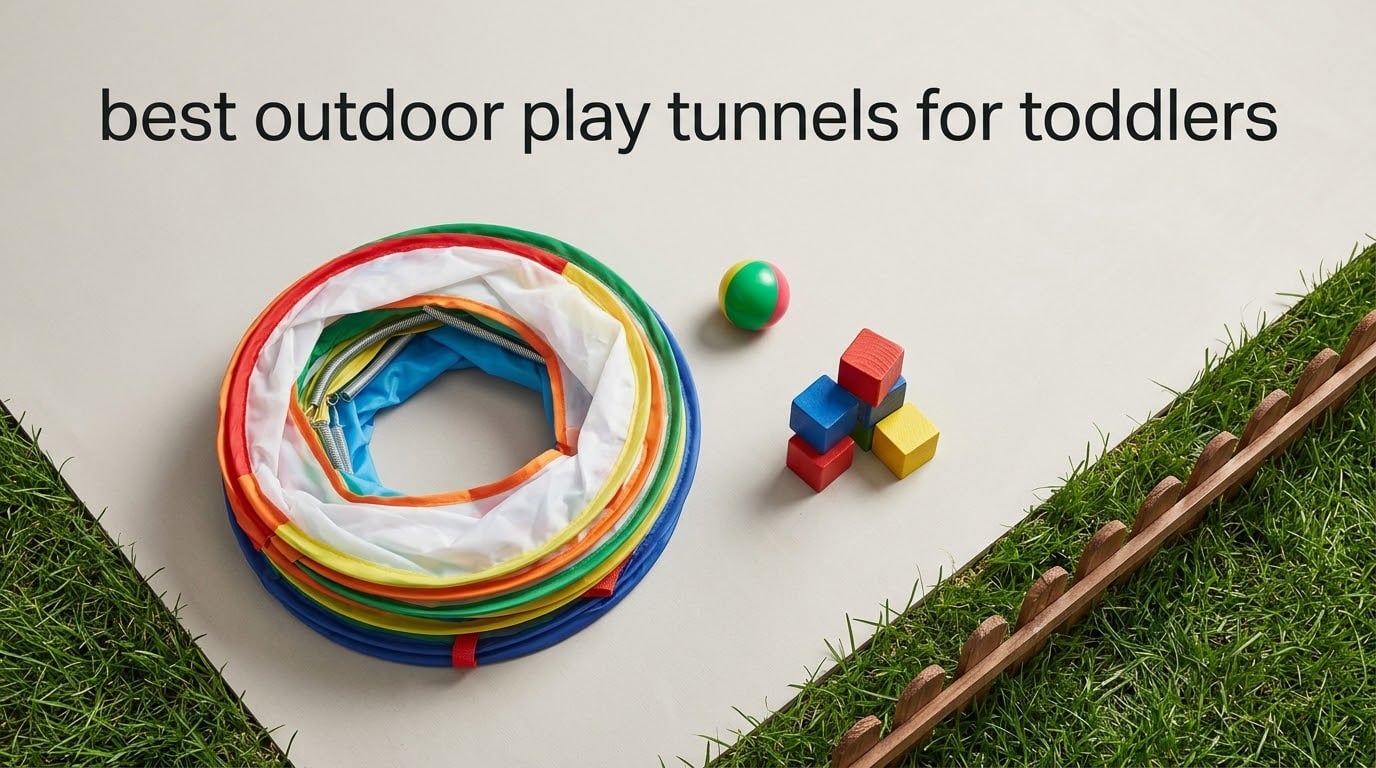
Yes, play tunnels are genuinely good for toddlers. Crawling through one builds core strength, coordination and body awareness, and it gives a toddler a screen-free way to burn energy in the garden. The catch is that most tunnels are sold for indoor use, and only some survive a full summer outdoors. We spent six weeks with ten of the best outdoor play tunnels for toddlers to see which ones hold their shape, which ones dry out properly, and which ones your child will still be crawling through in October.
A play tunnel is a collapsible tube of mesh and polyester held open by a spring steel or aluminium frame. It pops open in seconds, folds flat into a carry bag, and gives a toddler a hidey-hole, a racing lane, or the centrepiece of a homemade obstacle course. The models in this roundup run from short 47-inch tubes for babies to full 6-foot runs for a three-year-old who wants to sprint through at speed.
Before we get into the list, it helps to know what you are actually choosing between. If you are still assembling a full play area, start with our indoor play tent guide and add the tunnel as the crawling element. If the tunnel is the main event and you have hard patio slabs rather than grass, the diameter and floor padding matter far more than the colourway. We cover all of that in the buying guide near the end.
Table of Contents
Top 3 Picks: The Best Outdoor Play Tunnels for Toddlers in 2026

Moncoland Rainbow Tunnel
- ASTM certified
- 18.1 inch diameter
- 69 inch length
- Two-second pop-up

Melissa & Doug Giddy Buggy
- Padded caterpillar design
- Removable end panels
- Folds to 3 inches
- Water-resistant fabric
All 10 Outdoor Play Tunnels at a Glance (October 2026)
Diameter is the number most parents get wrong. A 17.5 inch tube is comfortable for a two-year-old and tight for a four-year-old, and no amount of encouraging will fix a cramped crawl. Length matters for running games, mesh matters for supervision, and frame material matters for whether the tunnel keeps its shape after a month of being shoved around.
| Product | Specifications | Action |
|---|---|---|
| Moncoland Rainbow Tunnel |
|
Check Latest Price |
| Hide N Side 6ft Tunnel |
|
Check Latest Price |
| Melissa & Doug Giddy Buggy |
|
Check Latest Price |
 Pacific Play Tents Fun Tube Pacific Play Tents Fun Tube |
|
Check Latest Price |
 Kiddey Two-Pack Tunnels Kiddey Two-Pack Tunnels |
|
Check Latest Price |
 PigPigPen Pop Up Tunnel PigPigPen Pop Up Tunnel |
|
Check Latest Price |
 Playz 21 Inch Rainbow Playz 21 Inch Rainbow |
|
Check Latest Price |
 SweHouse Colorful Tunnel SweHouse Colorful Tunnel |
|
Check Latest Price |
 Labeol 6 Foot Tunnel Labeol 6 Foot Tunnel |
|
Check Latest Price |
 Hoohtoot Mesh Tunnel Hoohtoot Mesh Tunnel |
|
Check Latest Price |
1. Moncoland Rainbow Tunnel: The Best All-Round Outdoor Play Tunnel for Toddlers
- Breathable mesh panels let a parent watch the child inside
- Highest rated in the set at 4.8 stars
- Two-second pop-up and flat fold
- Rainbow colour panels aid colour recognition
- Only tunnel in the set with ASTM certification listed
- First-time flat folding takes a few attempts
- One report of a lower quality item on a repeat order
This is the tunnel we ended up keeping out on the patio, and it is the one I recommend to anyone starting from scratch. The spec sheet lists an 18.1 inch diameter and a 69 inch length, which is the sweet spot for a toddler who can crawl but has not yet started charging through at a run. The frame is alloy steel on a spring mechanism, and at 1.4 pounds it is light enough for an adult to reposition without collapsing it.
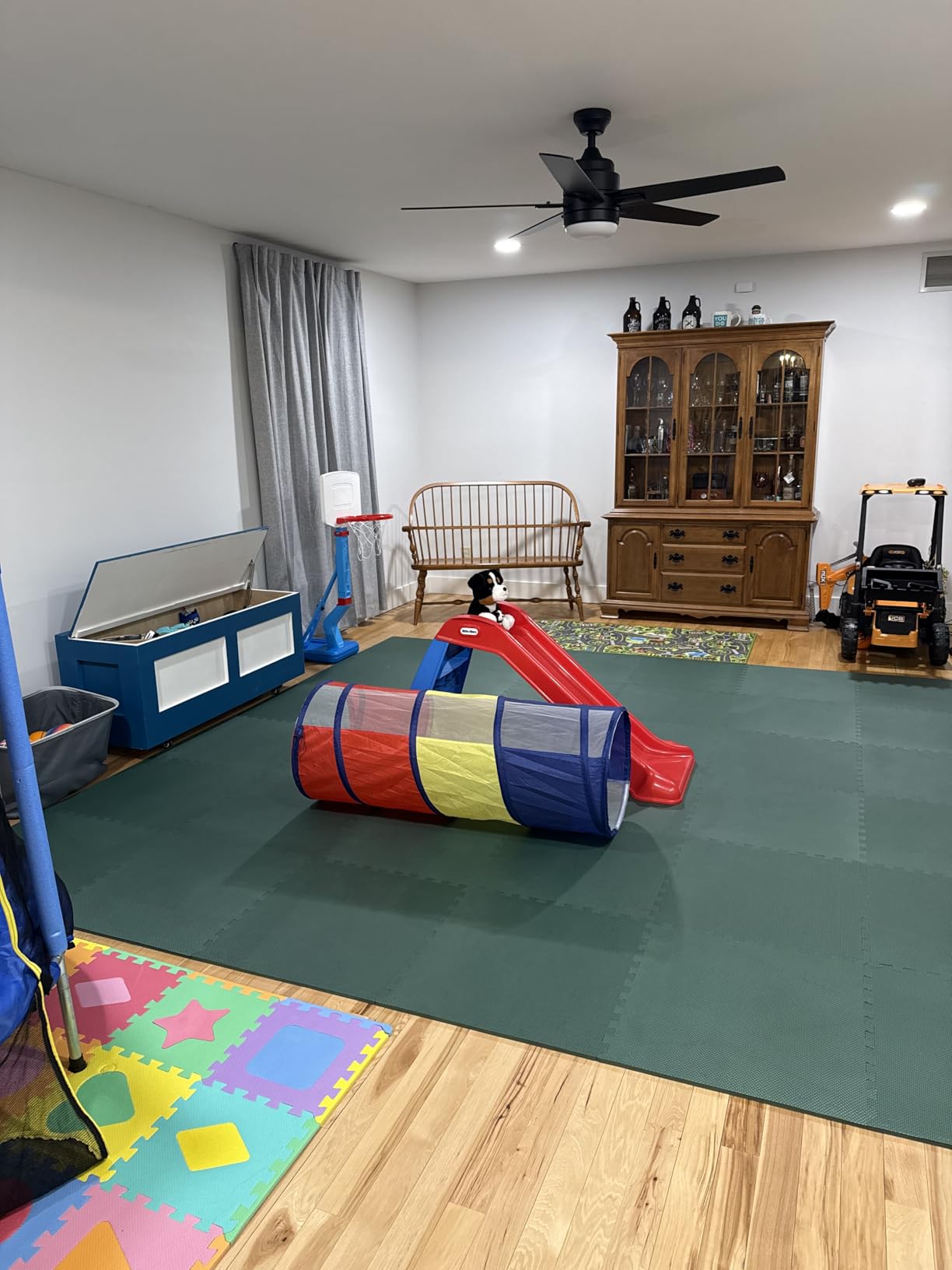
What separates it from the cheaper options is the mesh. You can see straight through to a child inside, which quietly solves the problem that stops a lot of toddlers entering a tunnel in the first place. Reviewers repeatedly mention that the mesh panels calm separation anxiety, and that children find the rainbow panels interesting enough to explore on their own. It is also the only tunnel in our set that lists ASTM certification, which matters if you are using it for supervised daycare play.
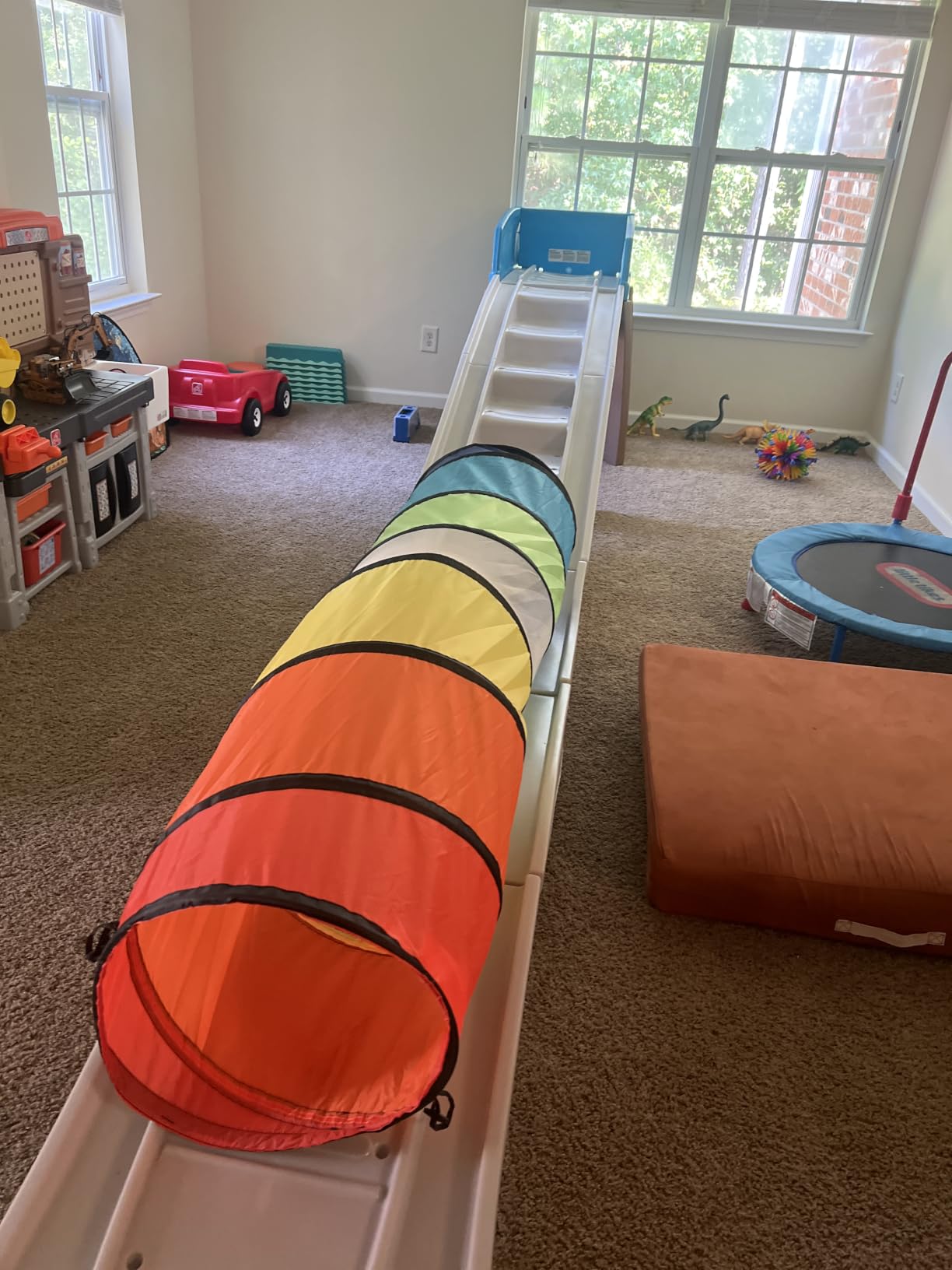
The pop-up is genuinely a two-second job. Push the frame together, let go, and the tunnel springs open into a full circle. Folding it back down takes a little more practice the first few times, and that is the single most common complaint in the reviews, but nobody reports the learning curve lasting beyond an afternoon.
On durability, owners describe close to a year of daily indoor and backyard use without snagging or tearing. The fabric has held its shape for us through several weeks of dragging it across patio slabs, and the ends have not stretched. One isolated review reports receiving a cheaper substitute item on a repeat order, so check the listing carefully when you order again.
Who this tunnel suits
This suits a parent with a mixed-age household who wants one tunnel that a two-year-old and a five-year-old can both use. The 18.1 inch diameter is comfortable for most preschoolers, and the visible mesh means you can cook, work, or sit on the patio while still keeping an eye on whoever is inside.
It is also a strong pick for a patio or a small garden, because it folds down to almost nothing between sessions. If your child is in the crawling stage, you can add a few soft play blocks inside to turn it into an obstacle rather than a tunnel. Several owners do exactly this.
Who this tunnel does not suit
If you want a run long enough to sprint through, look elsewhere. At 69 inches this is a crawl, not a sprint lane, and a four-year-old who likes to charge through at speed will want something in the six-foot range or longer.
It also is not a ball pit. Like most tunnels in this price bracket, no balls are included, and reviewers note that adding them is what turns the tunnel into a genuine obstacle course. If a ball pit is the main attraction, budget for that separately.
2. Hide N Side 6ft Tunnel: The Best Value Pick for Everyday Outdoor Play
- Most reviewed tunnel in the set at 5622 ratings
- Full 6 foot length in a light pop-up frame
- Pops up and folds flat in seconds
- Mesh side panel helps shy crawlers commit
- Roomy enough for most small pets too
- Light enough that a toddler can drag it
- End closure needs attention with infants under one year
- Children sometimes stand on it or swing from it
This is the tunnel that appears on the most wishlists we looked at, with 5622 ratings behind it, and the reason is simple: it is a full 6 feet long on a light frame. The spec is 18 inches in diameter by 72 inches long, built on an alloy steel frame with 190T soft polyester, and it weighs 1.3 pounds. That combination is the sweet spot for a backyard where the tunnel gets dragged around rather than carefully placed.
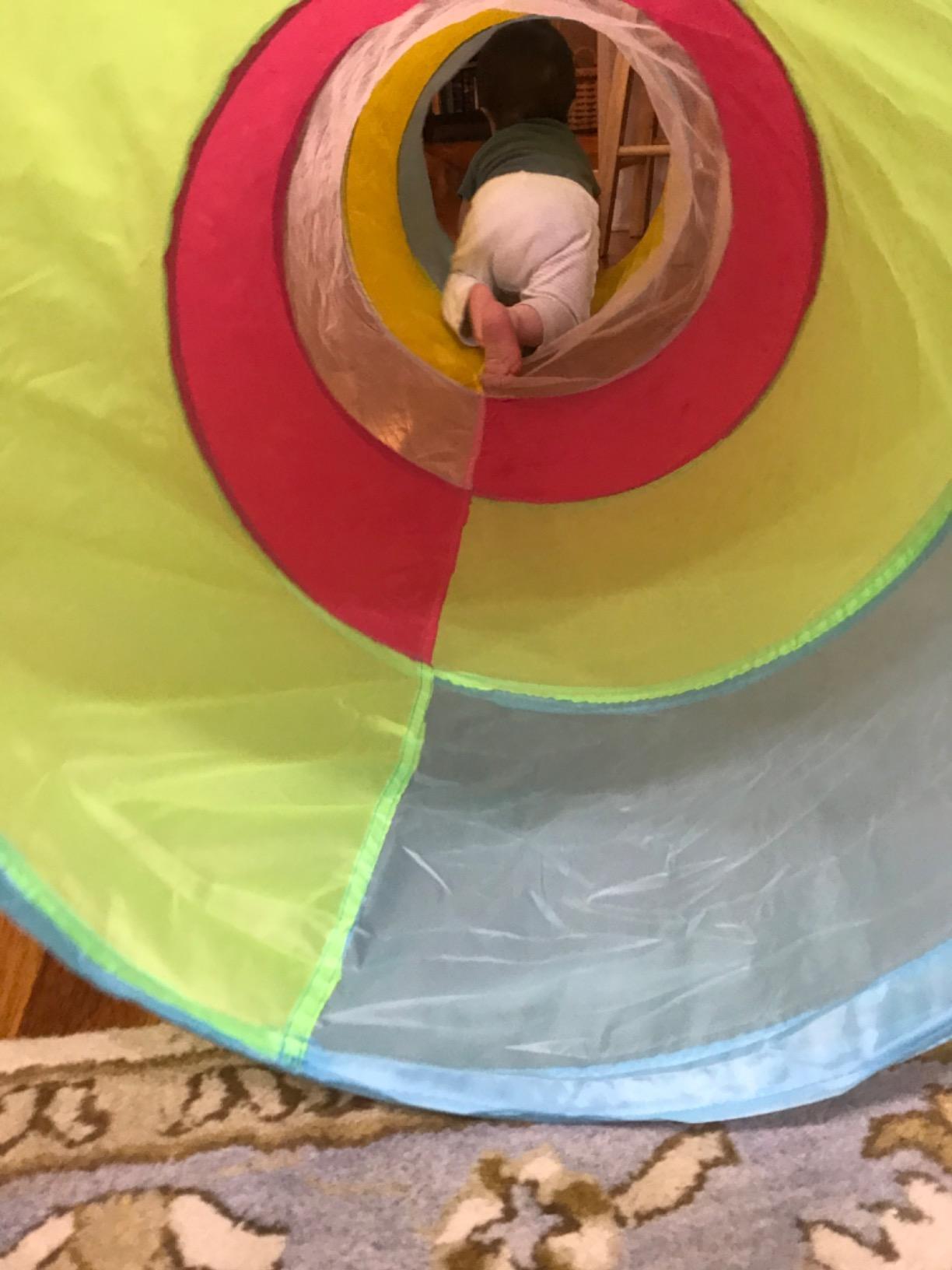
In practice, it does what a basic pop-up tunnel should. One hand pushes the frame together, you let go, and it is open. Folding it flat into the included storage pouch takes about the same effort in reverse. The mesh side panel is the part parents mention most warmly, because a child can see out and a parent can see in, which makes the first crawl far less of a negotiation.
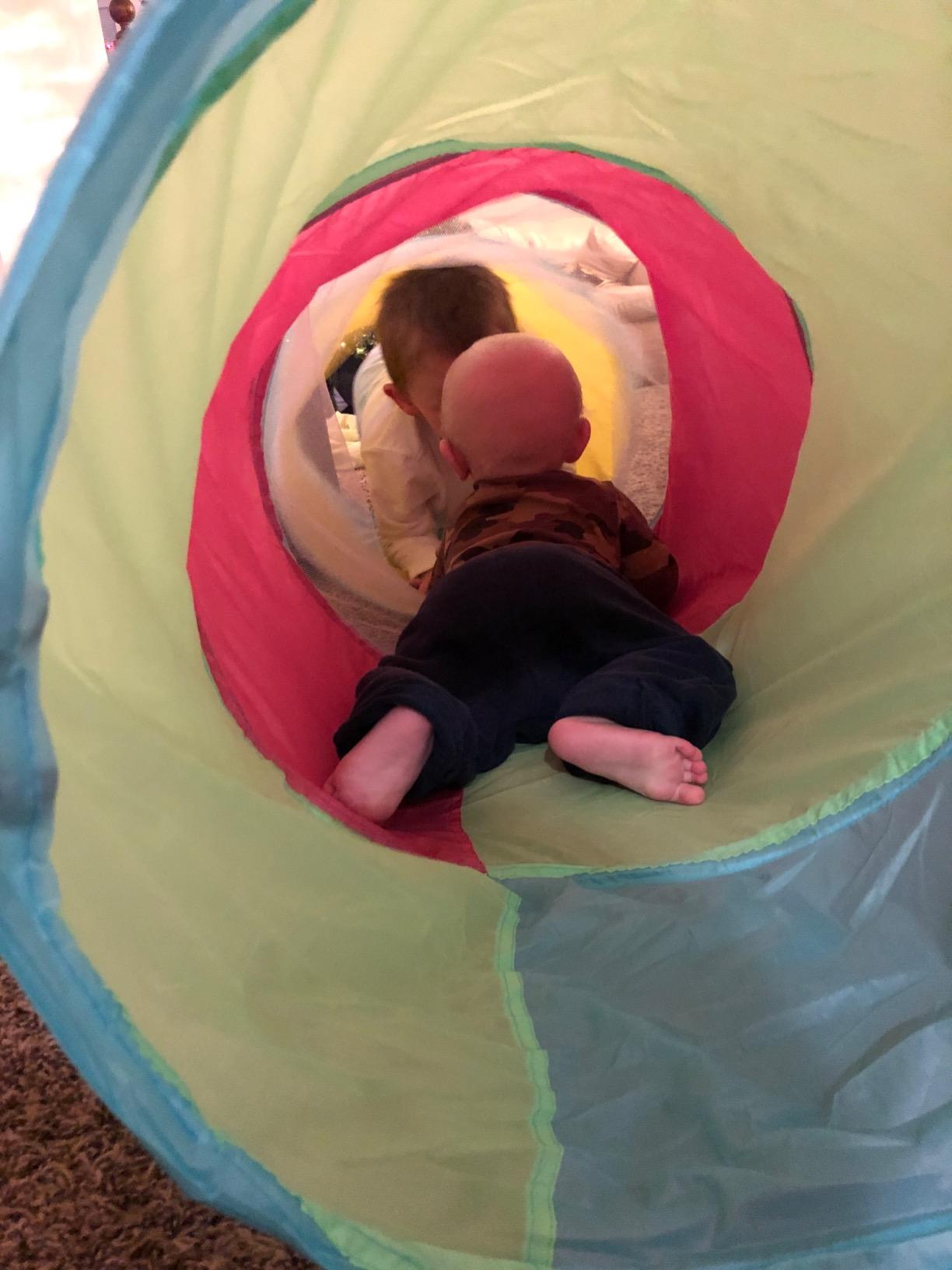
On durability, owners consistently single out the thick steel wiring as the reason it outlasts cheaper fabric-only tunnels. It has taken a beating in our own testing, including being dragged over concrete and used as a den for a determined four-year-old, and the shape has held. The polyester has picked up a little sand in the seams, which is normal and comes out with a brush.
The honest weakness is weight. At 1.3 pounds it is light enough that a toddler can shift or even drag the whole tunnel, and some children stand up inside it or swing from the hoops. That is a supervision issue rather than a defect, but it is worth knowing before you set it up in the middle of a patio.
Who this tunnel suits
This suits families who want one tunnel that covers crawling, hide and seek, freeze tag and racing without a multi-piece set. The 6 foot length is long enough for a three-year-old to crawl with purpose, and the 18 inch diameter is not intimidating for a beginner.
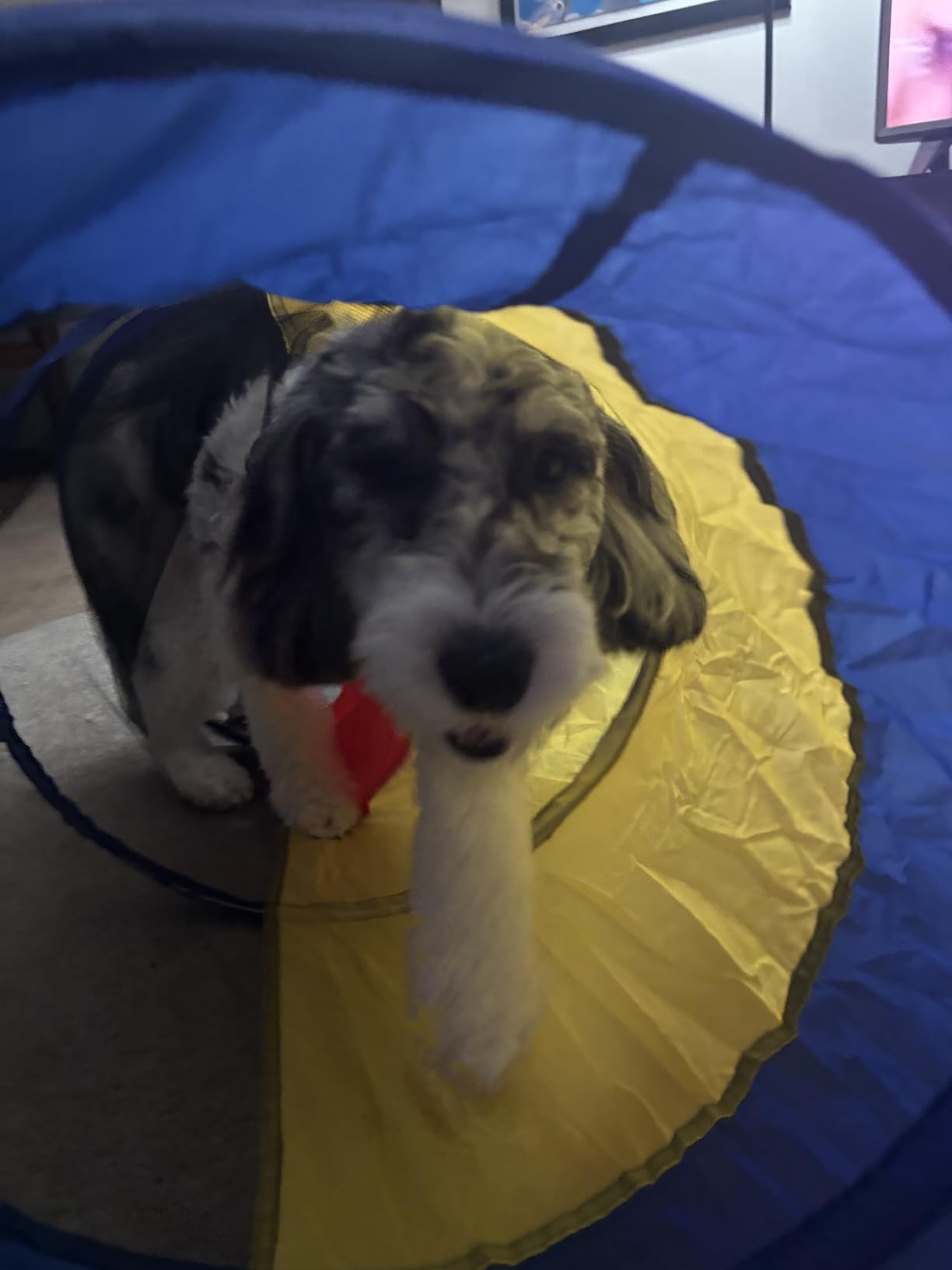
It is also a good fit if the tunnel will do double duty as a pet toy. Owners use it for dogs, and at 6 feet there is room for most small breeds to go through comfortably. If you are building an obstacle course, this is the piece you anchor the run around.
Who this tunnel does not suit
If you have a baby under one year, be careful with the loop-and-button closure on one end, which reviewers flag as needing attention with very young infants. Older crawlers are fine, but that closure is the part to check before you hand it over.
It is also not the sturdiest option if a dog is going to be chewing on it regularly, and the fabric will not stand up to being climbed on. Treat it as a crawl-through, not a climbing frame, and it will keep going for a long time.
3. Melissa & Doug Giddy Buggy Tunnel: The Best Premium Caterpillar Tunnel
Melissa & Doug Sunny Patch Giddy Buggy Crawl-Through Tunnel (E-Commerce Packaging)
- Noticeably sturdier build than cheaper pop-up tunnels
- Removable end panels babies can learn to push
- Cute striped caterpillar design with a face window
- Water-resistant easy-clean fabric that survives outdoors
- Folds flat with velcro and includes a storage bag
- Shortest length of the full-size tunnels at 57.5 inches
- Quickly outgrown as a child grows
- Lightly padded hoops can bump knees on hard surfaces
Among parents who compare tunnels side by side, this is consistently described as the sturdiest and best looking of the bunch, and several reviewers say so directly, comparing it favourably to cheaper models that rip or sag. The build difference is visible from the first pop: the wire hoops are slightly padded, the stitching is tighter, and at 3 pounds it is twice the weight of most of its competitors, which is what stops it from being shoved around by a toddler.
The design is the other selling point. It is a striped caterpillar with a see-through face window, and the two end panels are removable, so a baby can learn to push them open and crawl out on their own. That single feature turns it from a tube into a peek-a-boo toy, and it is the reason several parents use it from the crawling stage onward.
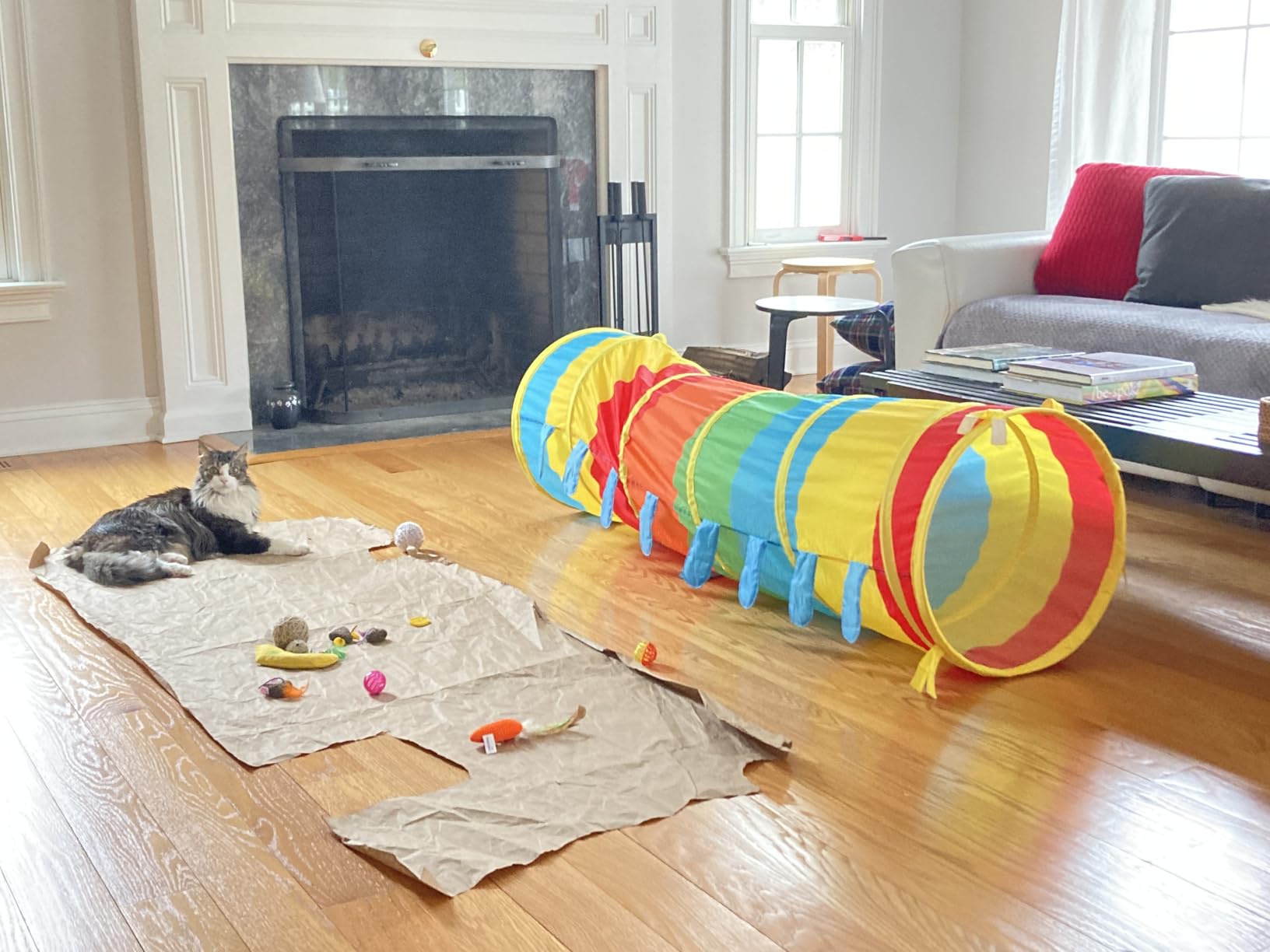
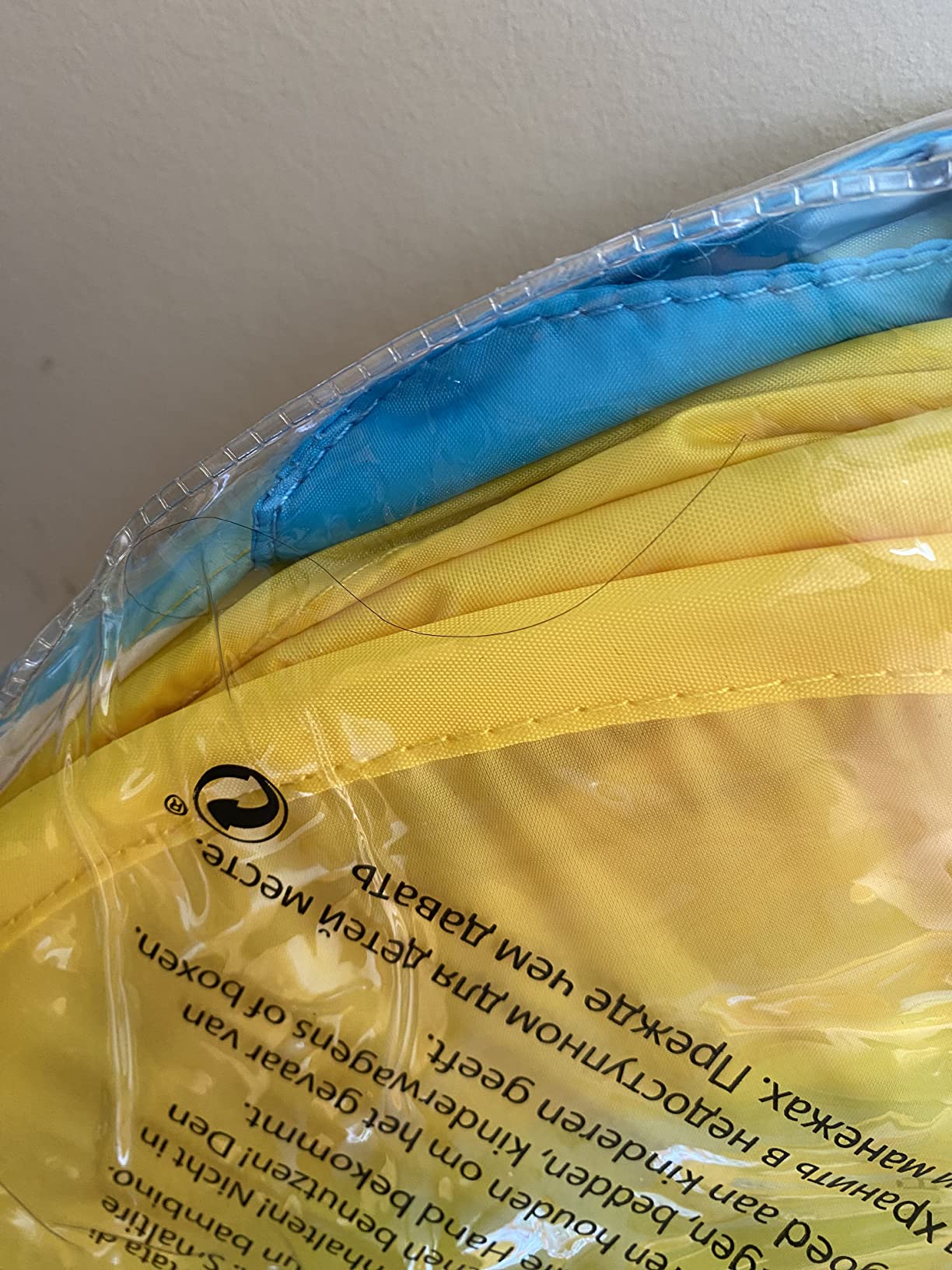
Outdoors, the water-resistant, easy-clean fabric is the part that matters most. We ran it through rain and sprinkler sessions and wiped it down afterwards, and the material came back looking new. The velcro flat fold is secure enough to slide into the storage bag without springing open, which matters if you are hauling it through a house to the garden.
Size is the trade-off. At 57.5 inches long and 18 inches in diameter, it is the shortest of the full-length tunnels here, and children do grow out of it faster than they do with a 6 foot model. It is also the most expensive tunnel in the set, which reflects the heavier frame and padded hoops rather than a marketing decision.
Who this tunnel suits
This suits parents who want a tunnel that looks like a toy rather than gym equipment, and who are happy to pay more for a build that survives a two-year-old hammering it every day. The caterpillar theme does a lot of work in imaginative play, and the removable end panels add a stage of difficulty you can increase as your child grows.
It is also the one we would pick for hard indoor flooring, because the padded hoops are kinder to knees than bare wire. For a playroom that doubles as a rainy-day destination, pair it with one of our foam play mat picks and you have a full soft-play corner.
Who this tunnel does not suit
It is not the pick for a child who wants to sprint. At 57.5 inches there is not enough runway for a fast four-year-old, and frustrated runners tend to climb on top of it instead, which is the one thing you do not want.
Very young babies can also find the moving end covers confusing until an adult removes them, and even lightly padded hoops can bump knees on concrete. If your play surface is stone rather than grass, put a mat under the entrance first.
4. Pacific Play Tents Fun Tube: The Best Tunnel for Connecting Multiple Units
Pacific Play Tents 20406 Kids The Fun Tube 6-Foot Crawl Play Tunnel, 6′ x 19″ Diameter, Blue/Black
- Tougher build than most pop-up tunnels
- No See-UM mesh gives a wide see-through view
- Interior padding around the spring steel hoops
- Velcro straps let tunnels connect end to end
- Wipes clean and collapses flat
- Mesh threads can fray where stitching meets the wire
- Velcro straps snag the mesh if handled roughly
- Hoop padding is thin on hard ground
This is the tunnel to buy if the plan is to build a run rather than own a single tube. The 6 foot length and 19 inch diameter make it the widest standard model here, and the hook-and-loop panels on both ends mean you can line up two, three, or more into a caterpillar run without taping anything together. Owners who bought multiple units report they are still going strong after three years.
The mesh is the differentiator. No See-UM mesh is semi-opaque rather than fully transparent, so a child inside feels hidden while a parent can still watch. Several owners mention that this is the first tunnel their shy child was willing to crawl into without an adult going in first, which is a real advantage in a household with separation anxiety.
At only 16 ounces, it is also the lightest tunnel in the set, and it collapses flat for storage. The fabric is 190T 70 denier polyester taffeta that wipes clean with a damp cloth and mild soap, and it carries a one-year manufacturer warranty against defects, which is longer than most of the budget models offer.
Who this tunnel suits
This suits anyone building a longer run, whether that is two tunnels in the garden or a full caterpillar course for a daycare play area. Because the diameter is 19 inches, it also handles an older or taller toddler better than the 17.5 and 18 inch models, and adults can squeeze through, which is useful if you are retrieving a child mid-crawl.
It pairs naturally with the matching cube from the same range, which clips to the same hook-and-loop panels. If you already own a pop-up tent and want a matching look, our play tent roundup has options in the same bright, screen-free style.
Who this tunnel does not suit
The most common complaint is longevity detail rather than play value: mesh threads beginning to fray where the stitching sits against the wire, and velcro straps catching the mesh if they are pulled roughly rather than peeled. Treat the connection points gently and both issues mostly stay away.
The hoop padding is thin, so on a hard patio the rings can feel rough under a knee. A grass surface or a mat under the entry fixes that. There is also a single report of a unit falling apart on first use, so inspect the seams and stitching the moment it arrives.
5. Kiddey Two-Pack Tunnels: The Best Set for Connecting a Longer Run
- Two tunnels in one pack for a longer obstacle course
- Velcro tabs give a true one-second pop-up
- Soft padded interior that is kind to knees
- Bright four-colour design
- Carry bag makes it portable to the park or a party
- Costs more per tunnel than the single variant
- Balls and obstacles are not included
If the plan is an obstacle course, this two-pack removes the maths. Each tunnel measures 72 inches long by 18.5 inches in diameter, so connected together you get a 12 foot run from a single pack, which is enough to build a proper crawl-through lane for a daycare, a birthday party, or a long garden obstacle course. Owners report connecting them or lining them up as parallel lanes for racing.
The Velcro-tab closure is a nicer mechanism than most. Rather than wrestling a drawstring or a button, you release the tabs and the spring steel frame extends on its own in about a second. Collapsing it back down is the same motion in reverse, and the zippered carry bag swallows both tunnels for trips to the park.
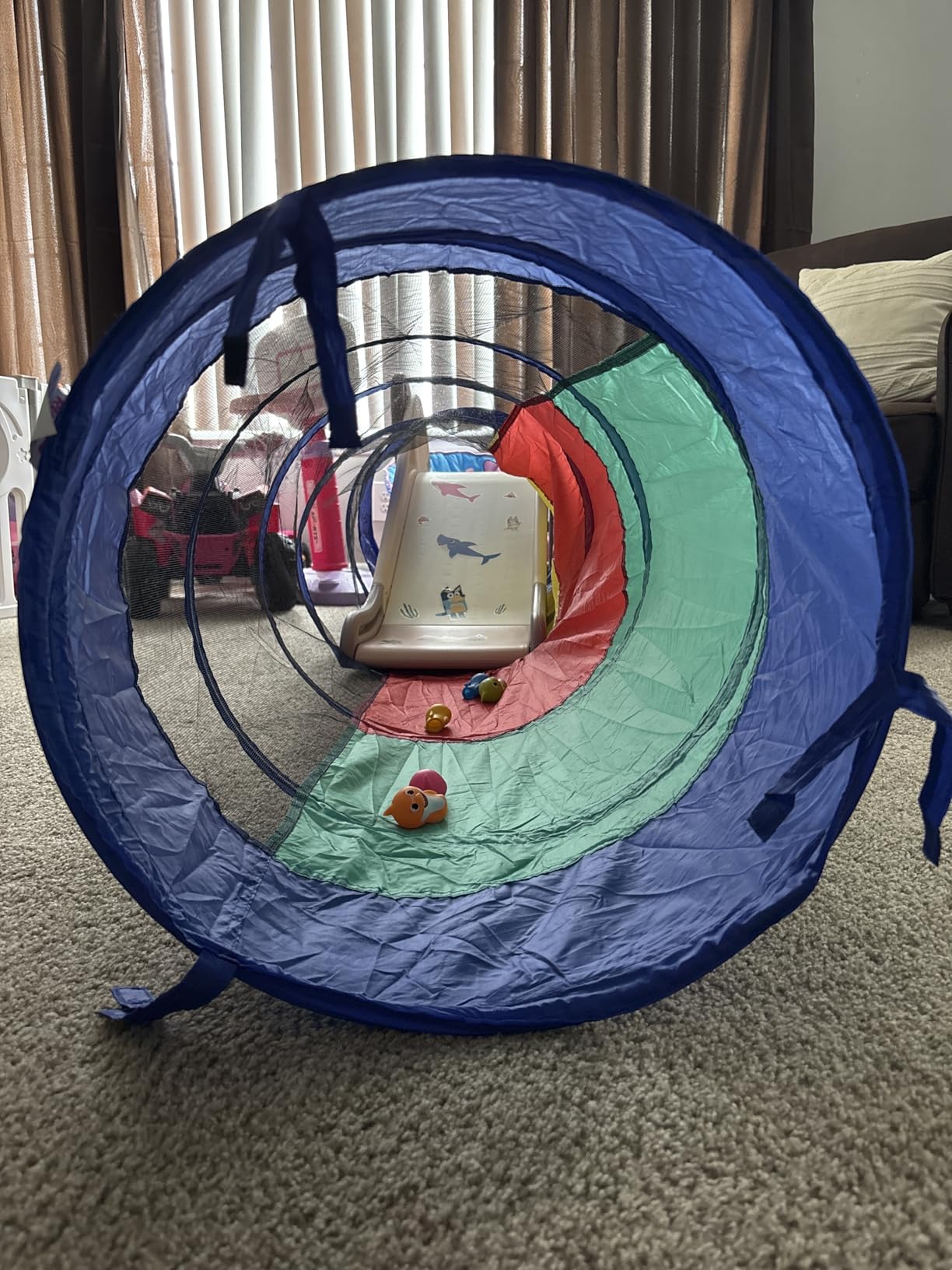
Inside, the floor is soft and padded, which is a real improvement on bare polyester when a toddler is on knees for twenty minutes at a stretch. The breathable mesh side gives airflow and a partial view, and the four-colour scheme is bright enough to pull a child toward it from across the garden.
The value calculation depends on how many tunnels you actually need. If you want one tube for one child, the single-tunnel variant works out cheaper per tunnel, and you end up ignoring the second unit. If you are building a run, this is the efficient buy.
Who this tunnel suits
This suits a family with two children, or one child and a friend, because parallel tunnels turn solo play into a race. It also suits anyone running a daycare or leading a preschool outdoor session, where a 12 foot crawl lane is more useful than two short tubes scattered on the lawn.
For a smaller patio, the carry bag is the deciding factor. Two folded tunnels fit in a cupboard, and the whole set can go to the park in one bag when the weather turns.
Who this tunnel does not suit
It is not the right choice for a single child who will only use one tube, because the per-tunnel cost is higher than buying the single variant. You would be paying for a second tunnel that stays folded in a cupboard.
Also note what is not in the box. No balls, no obstacles, no tent pieces, so if you are picturing a full obstacle course you are still sourcing the extras separately. The title of this listing makes the balls exclusion explicit, which is more honest than most.
6. PigPigPen Pop Up Tunnel: The Best Tunnel for Puppy Training and Light Play
PigPigPen Pop Up Play Tunnel Tent for Toddlers Babies or Dogs, Indoor & Outdoor Toys for Kids Backyard Playset. (Red,Yellow,Blue)
- Spring frame springs back into shape after being curved around corners
- Rounded corners and durable stitching
- Wipe-clean fabric
- Lightweight and folds flat
- Four-colour scheme appeals to toddlers and pets
- Thin kite-like fabric can let wire push through under animal play
- Smaller 17.5 inch diameter is snug for older toddlers
- Not a match for rough or chewing play
This one gets a mention for a reason no other tunnel here does: owners repeatedly use it for puppy training, laying it out in a garden and rewarding the dog for running the length of it. The 17.5 inch diameter and 67 inch length are close to a dog agility tunnel in proportion, and the fold-flat design means the training kit lives in a cupboard rather than taking up patio space all year.
For toddlers, the rounded corners and durable stitching are the useful details. There are no hard edges to catch a knee or a bare wire ends to snag a sleeve, and the polyester wipes clean with a damp cloth and mild soap after a session on wet grass. The four primary colours are bright and simple, which works well for a child who is drawn to bold shapes.
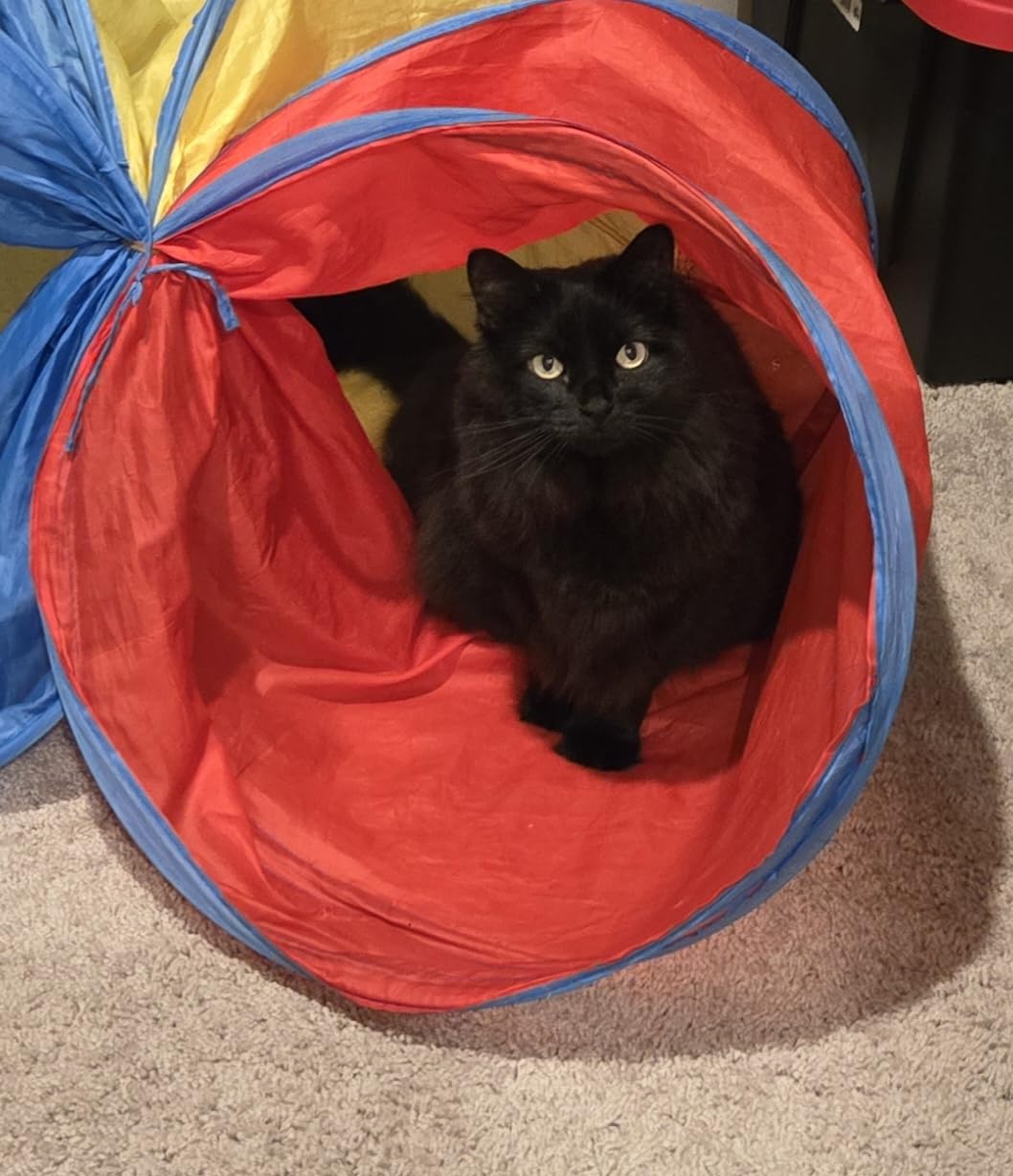
The one weakness that comes up in a small number of three-star reviews is the fabric. It is thinner and more kite-like than the 190T polyester on some competitors, and under heavy or animal play the wire hoops can begin to work through the sides. Under normal toddler use it has held up fine, so the practical question is whether a dog will be chewing on it.
There is also a pet behaviour note worth knowing. A tunnel rolled into a curved shape can put off a skittish animal, so if you are using it for a nervous dog, start with the tunnel fully extended and straight before curving it.
Who this tunnel suits
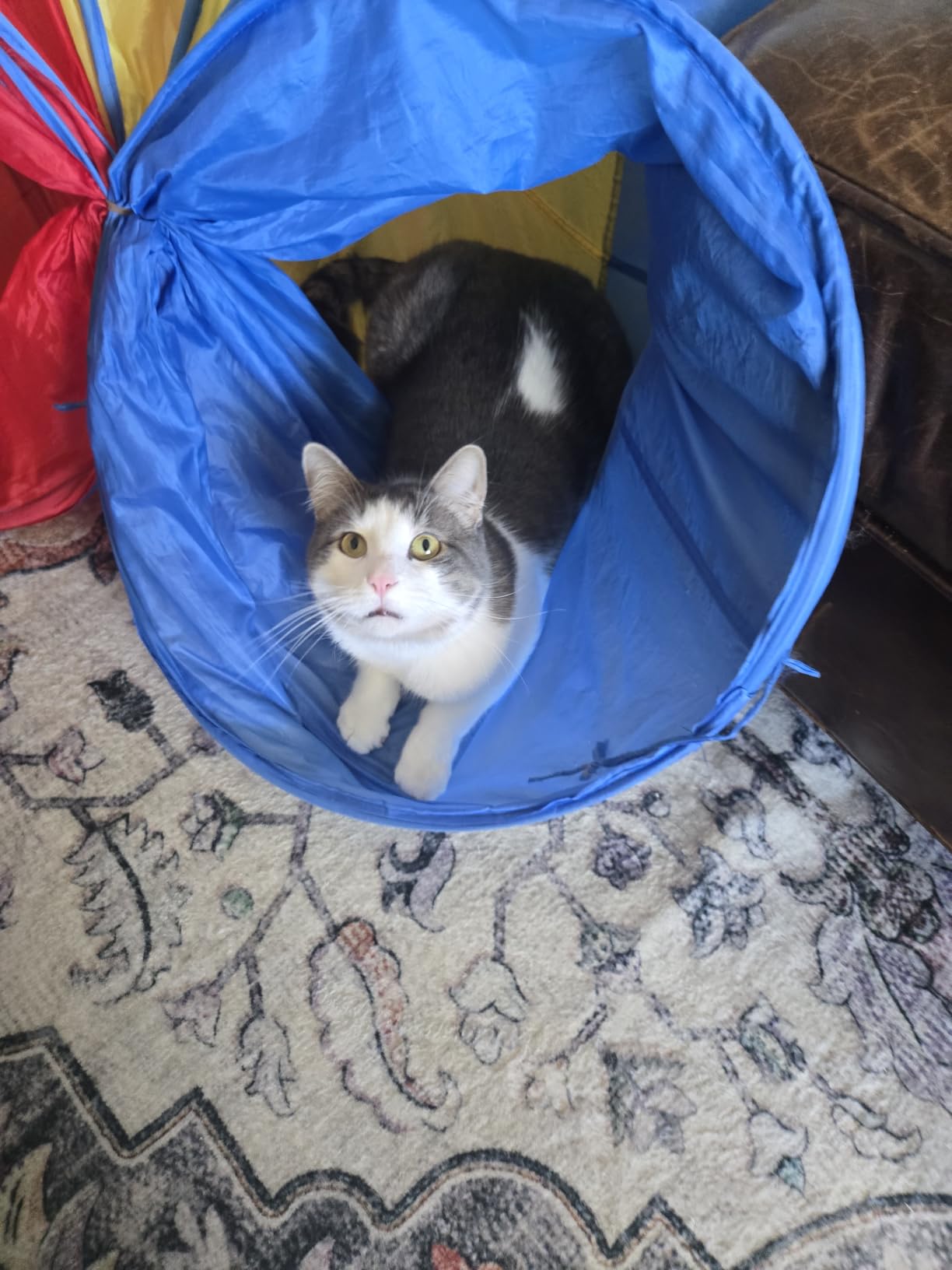
This suits a household where the tunnel is shared between a child and a puppy, and where the priority is lightness and portability rather than heavy-duty construction. The manufacturer lists it for 36 months to 10 years, and owners confirm children from around 17 months through the early teens get real use out of it.
It is a good fit for a rented garden or a flat too, since the whole tunnel folds flat and pops open the moment you want it. Nobody has to assemble anything, which also makes it useful for grandparent visits and playdates.
Who this tunnel does not suit
At 17.5 inches, this is one of the narrower tunnels in the set, and it is the number to check if your child is on the taller side for their age. A tall three-year-old may crawl through with a hunched back, and a hunching crawler usually stops enjoying the tunnel quickly.
It is also the wrong choice for a household where a dog will chew the fabric or dig at the seams. The frame can be pushed out of shape or through the material, and the spring does not recover as cleanly once that happens.
7. Playz 21 Inch Rainbow Tunnel: The Best Tunnel for Toddlers From 12 Months
Playz Kids Play Tunnel Toys for Toddlers 1-3, Large 21″ Rainbow Pop Up
- Widest tunnel in the set at 21 inches
- Tested for children as young as 12 months
- Unfolds in seconds and folds into a carry bag
- Breathable tear-resistant soft fabric
- Connects to tent and ball pit tunnels
- Less mesh than two-mesh-side models so visibility is reduced
- Aluminium hoops are lighter and less rigid than spring steel
The 21 inch diameter is the whole argument for this tunnel, and it is a significant one. Most of the category sits at 18 inches, which is fine for a two-year-old and uncomfortable for a four-year-old. At 21 inches, the same tunnel leaves real clearance above a crawling child’s shoulders, and owners specifically name this as the reason larger toddlers stopped complaining and started enjoying it.
Its manufacturer listing starts at 12 months, which makes it genuinely usable from the crawling stage rather than as a later purchase. At 71 inches long and 1.3 pounds, it is also longer than most of the set, so a crawling baby has a real runway rather than a short tube to shuffle through.
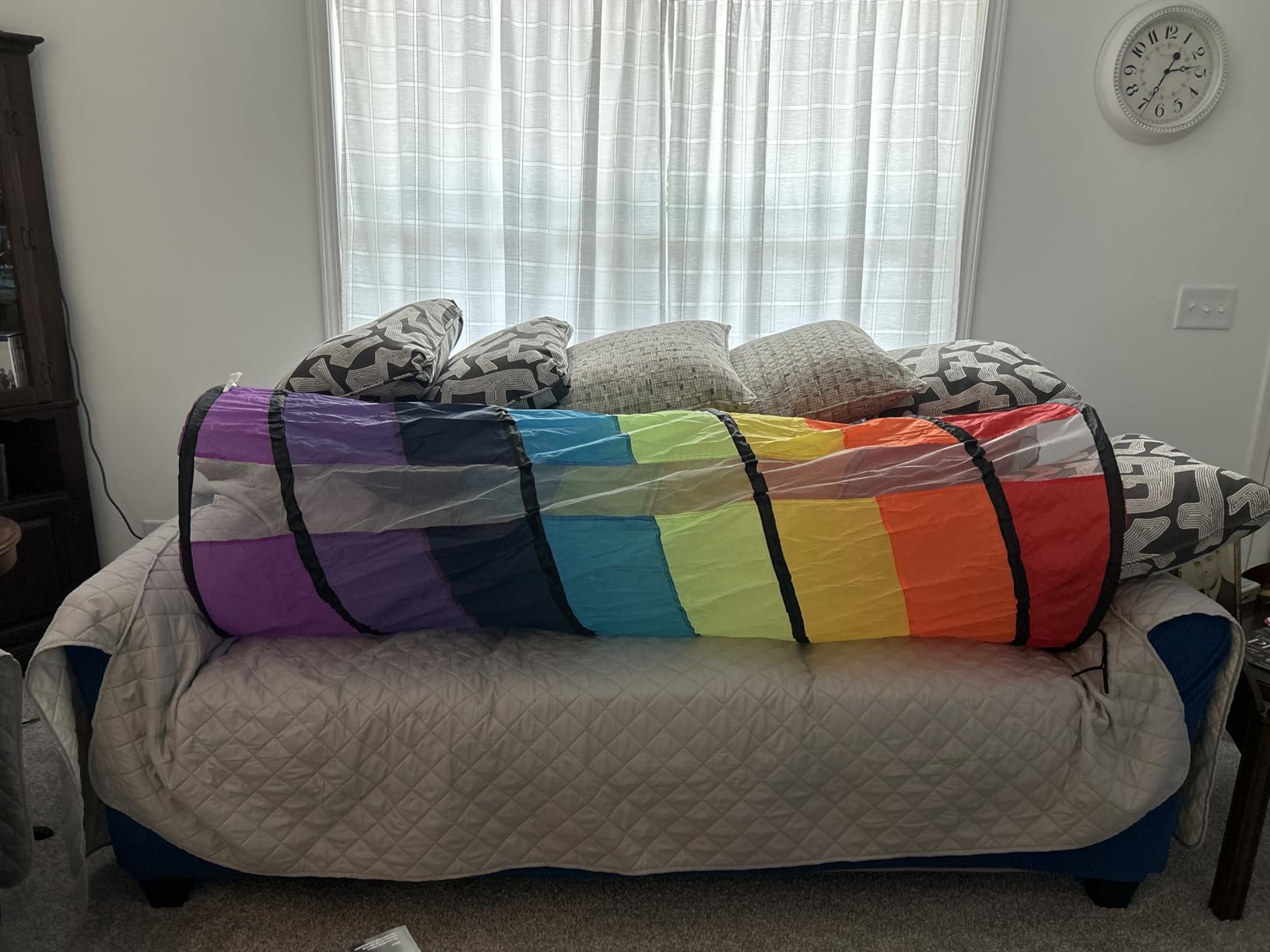
The pop-up mechanism is fast. Unfold and it holds its circle, fold it down and it fits into the carry bag, which owners who travel or attend playdates appreciate more than they expected to. Several parents connect it to a tent tunnel or a ball pit tunnel to extend the play space rather than owning a standalone run.
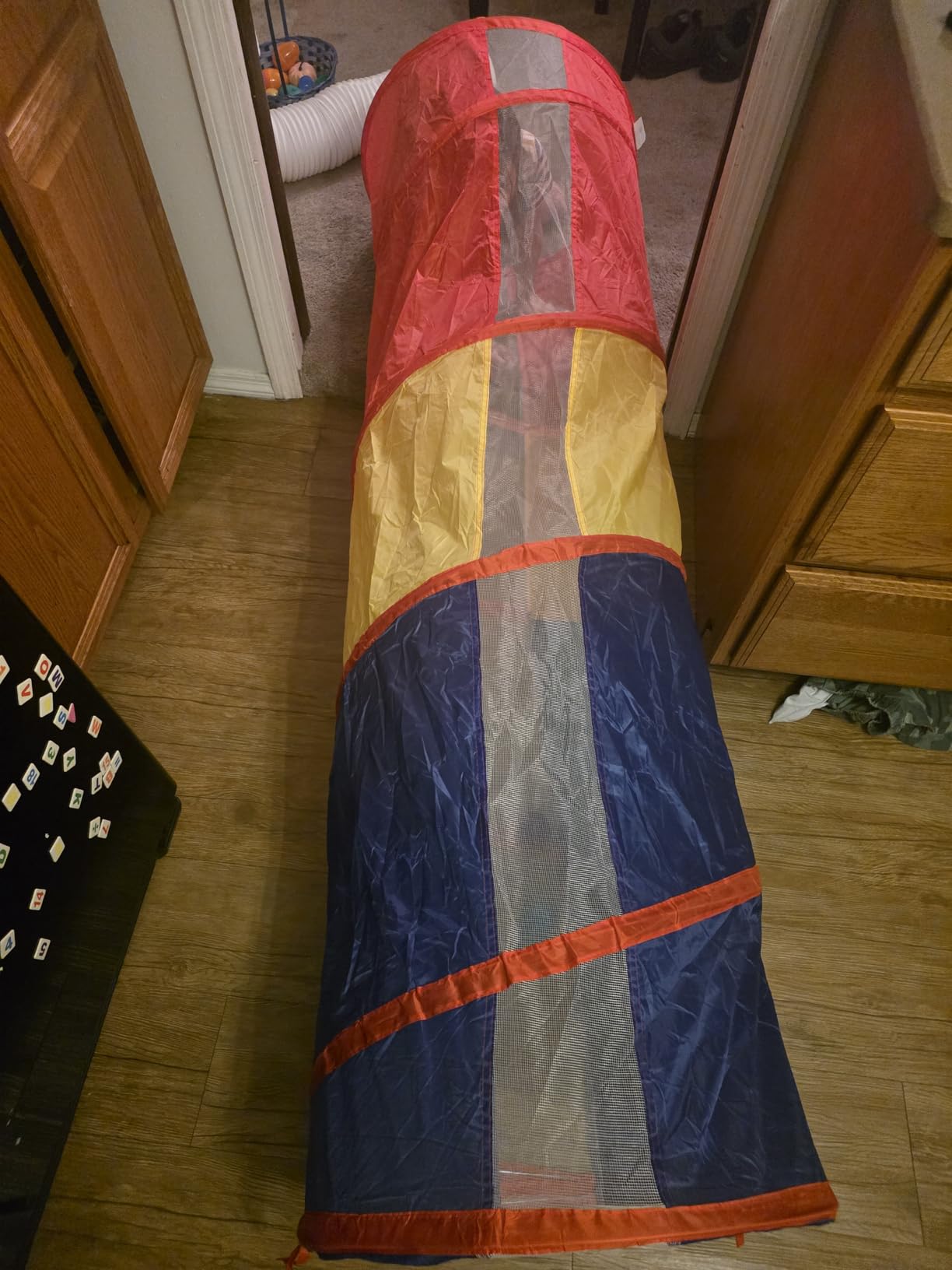
The trade-offs are the two things a wider tunnel has to give up. The fabric is soft and tear-resistant but has less mesh than the two-mesh-side models, so visibility into the tunnel is reduced. And the hoops are aluminium rather than hardened spring steel, which means they flex a little more when a child throws weight on them.
Who this tunnel suits
This suits a tall or older toddler who has already outgrown an 18 inch tunnel, and it is the model we would pick for a child about to start preschool. The extra diameter means less hunched crawling and more willingness to go in, which is the difference between a tunnel that gets used daily and one that ends up in the garage.
It also suits families who want one toy that works from the crawling stage through to three years, and who travel or go to playdates regularly enough to need the carry bag.
Who this tunnel does not suit
If your main concern is supervision, this is not the strongest option. With less mesh than the two-mesh-side competitors, a parent cannot see a child inside as clearly, and that matters most for younger babies playing near a pool, a gate, or a busy road.
The aluminium hoops are also a compromise if you expect heavy rough play. They are lighter and more portable than steel, but they hold a circle less rigidly once bent, so a child who treats the tunnel as a climbing frame rather than something to crawl through will flatten it faster.
8. SweHouse Colorful Crawling Tunnel: The Best Tunnel for Small Patios and Babies
- Two mesh sides make it a natural peek-a-boo prop
- Keeps a child visible while playing
- Twist-lock design opens and folds without tools
- Light enough to move between rooms or to the park
- Also marketed to cats
- dogs and other pets
- Shortest tunnel here at about 47 inches
- Plastic frame is less rigid than steel wire alternatives
- Only one colourway in this listing
Not every family has a lawn. For a balcony, a small patio, or a front step, footprint is the deciding factor, and at 47.24 inches this is the most compact tunnel in the roundup. That makes it the obvious first tunnel for a family on a tight budget who just wants something reliable for a baby to crawl through.
The two mesh sides are genuinely the best feature here. This is a tunnel you can see into from both directions, which turns it into a natural peek-a-boo prop. A child inside is visible the whole time, and because the sides are meshed rather than solid, air still circulates on a hot afternoon.
The twist-lock fold is simple and tool-free, and at such a small size the whole thing is light enough for an adult to carry from a bedroom to the garden in one hand. The listing also carries a 180 day manufacturer warranty, which is not universal in this category.
Who this tunnel suits
This suits a parent of a baby or young toddler who wants a first crawling tunnel, and whose outdoor space is a patio rather than a garden. The short length and generous mesh make it a comfortable introduction to crawling for a child who is still tentative about enclosed spaces.
It also works as a cat tunnel, and several owners use it that way, which is a bonus if you want one object doing double duty. For hard patio surfaces, the 18.11 inch diameter keeps the entrance low enough for a small child to duck into without a fight.
Who this tunnel does not suit
At roughly 47 inches, this is the shortest tunnel in the set, and that is a real limitation rather than a minor one. Older toddlers who want to run through, or who need a longer runway to build speed, will find it too short and may abandon it within a season.
The plastic frame is also less rigid than the steel wire on the other models, so a child leaning on a hoop deforms the circle more easily. If you want a tunnel that a boisterous four-year-old can throw themselves into, choose a steel-framed model instead.
9. Labeol 6 Foot Tunnel: The Best Budget Tunnel for Obstacle Courses
- Full 6 foot length in a light no-assembly frame
- Can be bent into multiple shapes for obstacle play
- Bright colours and mesh panels hold a child's attention
- Storage bag plus fold-down tie closure
- Children
- older siblings and small pets all use it
- Central netting tears more easily than the rest of the fabric
- Tie strings are short and awkward to fasten
- Fabric is thin so durability is moderate
A 6 foot tunnel that bends is more useful than it sounds. Because the alloy steel spring structure is flexible along its length, you can curve it into an L, an arch, or a loop, and owners use exactly that to build obstacle courses rather than straight lanes. Connected to play cubes, tents or a slide, a curved tunnel becomes a maze, which is a genuinely different kind of play from crawling in a line.
It has a 4.7 star average across 526 ratings, and the feedback clusters around three things: the instant pop-up, the bright colours with mesh panels, and how many children and pets use it. Parents report children from about one year old through the early teens crawling through it for hide and seek, and small dogs and cats claiming it as their own.
Who this tunnel suits
This suits a family building a multi-piece obstacle course, because the flexible frame is the point. If you already own a play cube or a small slide, this tunnel is the connector that turns separate pieces into a route a child can follow from start to finish. Our outdoor playhouse guide has similar large-format pieces if you are scaling up.
It is also a good second tunnel for a household that already owns a short one. A 47 inch tube and a 6 foot tunnel together give you two lengths of run without buying a two-pack.
Who this tunnel does not suit
The durability is moderate rather than heavy-duty, and reviewers are specific about where. The central netting tears more easily than the surrounding fabric, and the tie strings used to close the collapsed tunnel are short and awkward for an adult to tie, which is an irritation during pack-up rather than a defect.
If your child is at the age where they climb on everything, this is not the tunnel for them. Thin fabric and a light frame will not survive being stood on, and the shape takes longer to spring back into place afterwards.
10. Hoohtoot Mesh Tunnel: The Best Tunnel for Agility Drills and Long Play Sessions
Hoohtoot Kids Crawl Through Play Tunnel, Pop Up Baby Play Tunnel for Toddlers, Game Toy Play Tent for Girl or Dog Cat Pet Tunnel
- Breathable mesh walls give airflow and parent visibility
- Soft thick fabric that is comfortable for crawling and rolling
- Tool-free pop-up with a zippered carry bag
- Wipes clean with a damp cloth and mild soap
- Works as a dog agility tunnel or cat tunnel
- Short 47 inch length suits crawling rather than running games
- Only one colourway offered in this listing
This is a 47 inch tunnel with mesh on the walls, and for certain uses that combination is exactly right. Parents who use it for long indoor-outdoor sessions praise the airflow and the ability to keep an eye on a child inside for extended stretches without stopping the play. The soft, thick polyester is also described as the most comfortable of the short tunnels for rolling and crawling rather than only crawling.
It is a plain, well-executed pop-up with a soft, thick interior. No tools, no assembly, and a zippered carry bag for parties, parks and daycare. It wipes clean with a damp cloth and mild soap, which matters more outdoors than most parents expect, since the fabric picks up patio dust and damp grass quickly.
Who this tunnel suits
This suits a parent who wants mesh on every side for visibility and airflow, and who mainly needs a short crawl rather than a long run. At 18 inches in diameter it is a comfortable size for a two-year-old, and the soft floor fabric is kind to a beginner who is still building the coordination to crawl rather than sprint.
It is also a genuinely useful dog agility tunnel, and a cat tunnel, which makes it a two-for-one purchase for a household that wants to train a puppy in the garden while a toddler uses the same object.
Who this tunnel does not suit
At 47 inches it is one of the shorter options, so it is not the pick for running games or a child who wants a proper lane to race down. It also does not bend into a course the way a flexible steel frame does, so it is a straight lane rather than a maze element.
Only one colourway is offered in this listing, so if your child is particular about red versus blue, check the colour before you commit. And as always, no balls or accessories are included, so budget separately if you plan to fill it.
Leaving a Play Tunnel Outside: UV, Rain, Sand and Wind
Almost every tunnel in this roundup is made from polyester, and almost none of them are sold as garden equipment. That does not mean they cannot live outside, but it does mean the care routine matters. We kept several of these tunnels on the patio for six weeks through sun, rain and a lot of sand, and the difference between the ones that faded and the ones that did not came down to four things.
Sun. Polyester fades with sustained UV exposure, and it fades unevenly. The panels that face the sun directly bleach first, which is why colour tunnels that start bright often end up mottled after a summer. Positioning the tunnel so the most colourful panel faces north rather than south slows this down, and a garden that gets afternoon shade will preserve colour far better than an open patio.
Rain and moisture. A wet tunnel that is folded up while damp will smell within a day. The fix is simple and non-negotiable: bring it in, open it fully, and let it dry before folding. Every tunnel here wipes clean with a damp cloth and mild soap, and the water-resistant fabric on the caterpillar model is the easiest to bring back after a downpour. Do not put a damp tunnel back in its carry bag.
Sand and soil. This is the issue that comes up most often in parent complaints and the one almost nobody warns you about. Sand works into the seams and the mesh, and it abrades the fabric every time the tunnel is dragged. A stiff brush and a vacuum hose between the hoops does most of the work, and keeping the tunnel on a mat rather than directly on gravel prevents most of the problem in the first place.
Wind. A spring-frame tunnel is a sail. Even in a moderate breeze, a 6 foot tunnel can roll across a lawn or lift and flip, and the hoops can deform if the frame lands hard. Weighting the ends with a brick or a large stone works far better than most pegs, which pull out of soft ground. If you live somewhere genuinely windy, do not leave a tunnel out overnight.
On connecting units, only two approaches are reliable. Velcro or hook-and-loop end panels, as on the Pacific Play Tents Fun Tube, clip directly and repeatedly without tools. Soft Velcro tabs, as on the two-pack, do the same job. Mixing brands usually requires a bungee cord or a strip of hook-and-loop tape, which works but takes longer to assemble and is easier for a toddler to pull apart mid-game.
Between seasons, fold the tunnel flat, let it dry completely, and store it in its bag somewhere dry and rodent-free. Cotton mice have a strong interest in the foam in a carry bag, and a chewed tunnel seam is the most common end-of-year repair we hear about. If you need a soft surface underneath for indoor storage, our eco friendly play mat picks are a good pairing.
Tunnel Safety Rules for Toddlers
Play tunnels are simple objects, and the risks are simple enough to manage with five rules. None of them require anything beyond attention, which is why these toys remain a good buy despite the small print.
Keep the child in sight. Choose a tunnel with mesh panels if your child is under three, and position yourself so you can see into it from where you are sitting. A tunnel with solid ends removes your view of the whole child.
Check the pop-up frame before the first crawl. Spring steel hoops can pinch a small finger during the opening motion, and the wire ends can catch a sleeve. Do the opening yourself, every time, and never let a child under one operate it.
No climbing on top. Standing or jumping on a pop-up tunnel deforms the hoops and can make the tunnel collapse. The most common accident we hear about is a child falling off a tunnel they climbed rather than crawled through.
Put something soft underneath. Every tunnel here uses hoops or a floor panel that sits a few centimetres off the ground. On concrete or stone, a mat, a rug, or a grass patch makes a big difference to knees and heads.
Supervise pets separately. Several tunnels in this roundup are marketed to dogs and cats, and most dog owners also note chewing. A dog with a chewed tunnel is a pet hazard, not a toy.
One more practical note: the end closures on some budget models, including the loop-and-button design on the most-reviewed tunnel here, deserve a check before a baby under one year goes anywhere near them. For under-ones, the Playz model rated from 12 months or the removable-panel design on the caterpillar tunnel are the safer starting points.
How to Choose the Right Outdoor Play Tunnel
Four decisions account for almost all of the difference between a tunnel that gets used every day and one that ends up in a cupboard. Work through them in order and the choice makes itself.
1. Diameter first, length second. Most of the category sits between 17.5 and 19 inches, and one model runs to 21. For a two-year-old, 18 inches is comfortable. For a three- to four-year-old, 19 to 21 inches is the difference between a relaxed crawl and a hunched one. Length is a separate question: under 48 inches suits babies and peek-a-boo, 57 to 60 inches suits a crawling preschooler, and a full six feet is what you want for running games. Buying short and hoping a child will grow into it is the most common sizing mistake.
2. Frame material over fabric weight. Alloy steel and spring steel frames hold their circle under rough play and resist being reshaped by a child leaning on them. Aluminium frames are lighter and more portable but flex more, and plastic frames are the least rigid of the three. Polyester fabric thickness matters too, but frame is the part that determines whether the tunnel is still a circle in six months.
3. Check the age label against your child, not against the box. Most listings state 36 months to 10 years, which is a manufacturer default rather than a measurement. One model in this roundup is listed from 12 months, and the caterpillar tunnel with removable end panels works from the crawling stage because the covers come off. A label of 36 months and up is a reasonable signal that the mesh and floor are not designed for a baby who is still finding their hands and knees.
4. Decide on a price tier before you look at brands. Tunnels fall into three practical tiers. Budget pop-up tunnels are a single tube, usually in 190T polyester on a light steel frame, and they are entirely adequate for a backyard. Mid-range sets add mesh on both sides, a carry bag, and sometimes a second tunnel for a longer run. Daycare-grade caterpillar tunnels use heavier frames, padded hoops, hook-and-loop connection panels and a manufacturer warranty, and they are the right call for shared or institutional use where a tunnel takes more punishment per week than a home one ever will.
Two things buyers regularly miss. Ball pit balls are almost never included, and a tunnel full of balls is a completely different toy from an empty one, so treat that as a separate purchase. And tent-and-tunnel combinations sound economical but frequently end up with unused pieces, so buy the tunnel first and add a tent only if you have a specific obstacle-course plan.
For the best play tent to pair with a tunnel, the criteria are the same as the tunnel’s: a pop-up frame, mesh for visibility, and a floor that is easy to wipe. A tunnel plus a dome tent plus a cube gives you a full circuit, which is the shape most children play with longest.
On a budget, other good outdoor play items for toddlers fill out the same circuit. Hard-surface balance beams and stepping stones build the gross motor skills a tunnel does. A ball pit or a set of soft play blocks inside the tunnel turns a crawl into an obstacle. A foam pit or a mat underneath softens the landings. And a sprinkler or a tray of water nearby turns a sunny afternoon into a reason to keep crawling. Our play mat and playhouse guides cover the ground and structure elements in more detail.
For a small balcony or a rented flat, a compact tunnel under 48 inches with mesh on both sides is the most you should try to fit. Anything longer needs a lawn, and any tunnel on a first-floor balcony should be secured away from the railing.
Frequently Asked Questions
Are play tunnels good for toddlers?
Yes. Crawling through a play tunnel builds core strength, coordination and body awareness, and it gives toddlers a screen-free way to burn energy. Look for mesh panels so you can see inside, a frame stiff enough not to collapse when a child leans on it, and a diameter of at least 18 inches so a taller toddler is not crawling hunched.
What size play tunnel is best for toddlers?
For a two-year-old, a diameter of 18 inches and a length of 48 to 60 inches is comfortable. For a three- or four-year-old, look for 19 to 21 inches of diameter, and 6 feet of length if they want to run through it. Tunnels under 48 inches suit babies and peek-a-boo rather than running games.
What are some good outdoor play items for toddlers?
A play tunnel is the anchor piece, and it works best alongside hard-surface stepping stones or a balance beam for gross motor practice, a ball pit or soft blocks inside the tunnel to turn it into an obstacle course, and a foam mat underneath for soft landings. A small tent or play cube extends the run, and water nearby keeps play going on warm days.
What is the best play tent for toddlers?
The best play tent for a toddler is a pop-up design with mesh panels, a floor you can wipe clean, and a frame that folds flat into a bag. Pairing a tent with a matching tunnel turns two separate toys into a circuit a child can follow from start to finish, which is the format most children play with longest.
How do you keep a play tunnel clean outside?
Brush out sand with a stiff brush or a vacuum hose between the hoops, wipe the fabric with a damp cloth and mild soap, and let the tunnel dry completely before folding it up. Never store a damp tunnel in its carry bag, because trapped moisture causes a smell within a day. Keep it on a mat rather than gravel to reduce abrasion.
Final Verdict: The Best Outdoor Play Tunnels for Toddlers in 2026
After six weeks of patio testing, the Moncoland Rainbow Tunnel is the best outdoor play tunnel for toddlers in 2026. It carries the highest rating in the set, the 18.1 inch diameter and 69 inch length fit a crawling toddler through to a preschooler, the mesh panels let you supervise without hovering, and it is the only model here with ASTM certification listed. If you want a longer run, add the Hide N Side 6 foot tunnel as a second lane, and if you want something that looks like a toy rather than equipment, the caterpillar design is the one to buy.
Whatever you choose, put it on a soft surface, keep it in sight, and let it dry before you fold it. That habit alone will double the life of any tunnel in this guide.