
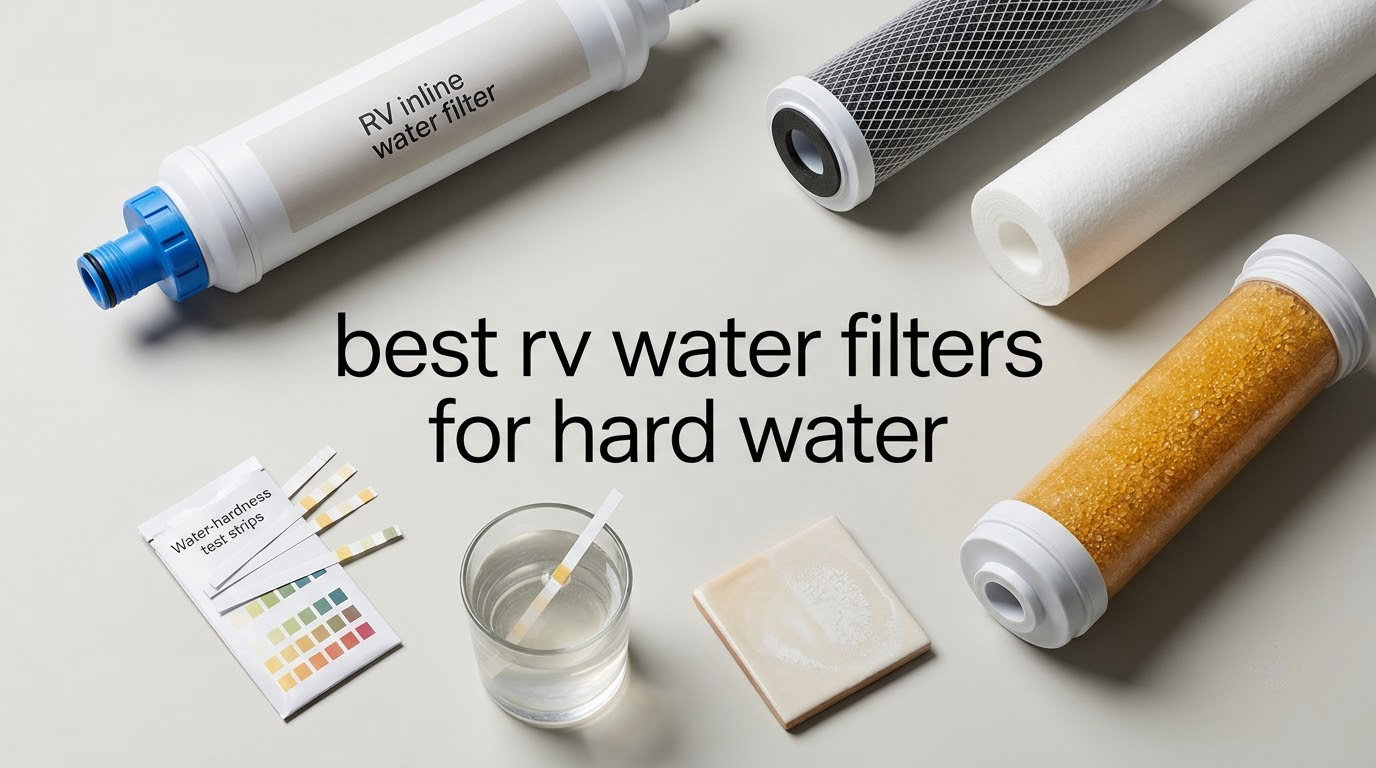
No water filter softens hard water. Filters strain out sand, rust and sediment and strip chlorine with carbon media, but the calcium and magnesium that cause scale are dissolved at the ion level, where only an ion-exchange softener can reach them. So the honest answer to the best rv water filters for hard water question is a two-part setup: a filter for what you can see and smell, and a softener for the minerals you cannot. We spent weeks comparing ten systems built for that job, and the picks below split cleanly into six softeners and four filters that earn a place in the chain.
Hard water is not an RV problem you can ignore. Mineral scale lines the inside of your water heater, clogs faucet aerators, and leaves the white spotting and mineral rings on shower glass that owners describe over and over in RV forums. One owner in Arizona told us two inline filters alone left the water visibly hard, and that only a softener cleared the glass door. Another, travelling Texas hill country, measured 450 ppm at a full-timer’s well and found portable gear undersized for it.
We built this guide around published specifications and owner reports, not marketing copy. Every pick below states its grain capacity, micron rating or stage count, flow rate, and what it genuinely does not fix. If you want a broader look first, our general guide to RV water filters covers chlorine, bacteria and boondocking sources in more detail. This one is narrower on purpose: water that is hard.
Table of Contents
Filter or Softener: What Each One Actually Removes
A filter works by catching things. A sediment stage physically strains out sand, silt, rust flakes and dirt at a stated micron rating, and a carbon block adsorbs chlorine, VOCs and offensive tastes onto its surface area. Both are mechanical or chemical processes, and both are size-based or molecule-based. Neither one touches dissolved calcium and magnesium, because those ions are already fully dissolved and far smaller than any pore a filter can strain.
A softener works by exchanging. Ion-exchange resin is charged with sodium ions; as hard water passes through, the resin trades sodium for calcium and magnesium and holds the hardness on its beads until a regeneration cycle flushes it out with table salt. That is the only mechanism among the products in this guide that reduces hardness, and it is why every softener below carries a grain capacity rating and every filter below does not.
Two more distinctions save a lot of money. First, hardness and iron are different problems. Ferrous iron is a particle that a sediment or catalytic stage can catch, while hardness needs resin. Owners who buy a standard softener for an iron-heavy well often see orange staining persist, and one forum answer put it plainly: the media has to match the contaminant. Second, a rotten-egg sulfur smell is not hardness at all. Several owners who assumed their softener would clear it were corrected by people who use it: that odor needs a catalytic carbon stage.
Reverse osmosis sits in a different category again. It rejects a wide range of dissolved solids including hardness, but forum owners consistently note it consumes three to four gallons of input water for every gallon produced, which is why it stays a drinking-water option in most RVs rather than a whole-coach solution. If your real problem is taste at the kitchen tap, our under sink filter picks make more sense than anything on this list.
Top 3 Picks for Hard Water Setups (October 2026)
These three cover the three most common camper situations: full-time living, filtering the water that reaches your softener, and a complete ready-to-hook-up kit.

On The Go Double Standard 16,000 Grain
- 16000 grain capacity
- Up to 1600 gallons
- Regenerates in under 30 minutes
- No electricity or tools
Beech Lane Dual RV Water Filter
- 5 micron sediment stage
- 0.5 micron carbon block
- Lead-free brass fittings
- Lifetime warranty
PRO+AQUA 16,000 Grain Softener
- Pre-filter included
- Regeneration kit and brine hose
- Quick-connect fittings
- 2000 gallon capacity
All 10 Best RV Water Filters for Hard Water in 2026
Every entry below is in the same order as the reviews that follow. Softeners reduce hardness; filters clean water but leave hardness in place.
| Product | Specifications | Action |
|---|---|---|
| On The Go Double Standard 16,000 Grain Portable Softener |
|
Check Latest Price |
 NPGLOBAL 16,000 Grain Portable Softener NPGLOBAL 16,000 Grain Portable Softener |
|
Check Latest Price |
| PRO+AQUA 16,000 Grain Portable Softener with Pre-Filter |
|
Check Latest Price |
 RVGUARD 16,000 Grain Portable Softener RVGUARD 16,000 Grain Portable Softener |
|
Check Latest Price |
 VEVOR 16,000 Grain Portable Softener VEVOR 16,000 Grain Portable Softener |
|
Check Latest Price |
 H and G Lifstyles Portable Water Softener 5A H and G Lifstyles Portable Water Softener 5A |
|
Check Latest Price |
 Nasibey External RV Dual Water Filter Nasibey External RV Dual Water Filter |
|
Check Latest Price |
| Beech Lane External RV Dual Water Filter |
|
Check Latest Price |
 FS-TFC Garden Hose Sediment and Scale Filter FS-TFC Garden Hose Sediment and Scale Filter |
|
Check Latest Price |
 AQUA CREST Hard Water Rinse Filter AQUA CREST Hard Water Rinse Filter |
|
Check Latest Price |
1. On The Go Double Standard 16,000 Grain – Best Portable Softener for Full-Time Living
OTG4-DBLSOFT-Portable 16,000 Grain RV Water Softener (NOT made in China, assembled by U.S. Workers in Indiana)
- Test strips drop extreme readings from 10-11 gpg to 1-2
- Compact footprint fits a storage bay or dock locker
- Regenerates with two boxes of ordinary table salt
- No electricity and no tools needed
- Movable base keeps it level on uneven ground
- Blue fiberglass tank sits crooked in the black base
- Plastic fittings rather than brass at this tier
- Needs somewhere to discharge flush water during regeneration
This is the softener that comes up more than any other in the RV forum threads we read, and the reasons are all in the specifications. It carries 16,000 grains of capacity and delivers up to 1,600 gallons or roughly 40 days of soft water per regeneration, which lines up well with a two-person rig on a mix of campground and boondocking water. Regeneration takes under 30 minutes with two boxes of common table salt and needs neither power nor tools.
The Double Standard designation matters: it produces about twice the soft water per regeneration of the standard single-tank version, which is why we treat it as the reference point when sizing anything else. The tank measures 22 inches tall by 9.5 inches in diameter and weighs 32 pounds, and the removable base keeps it stable on gravel rather than level concrete.
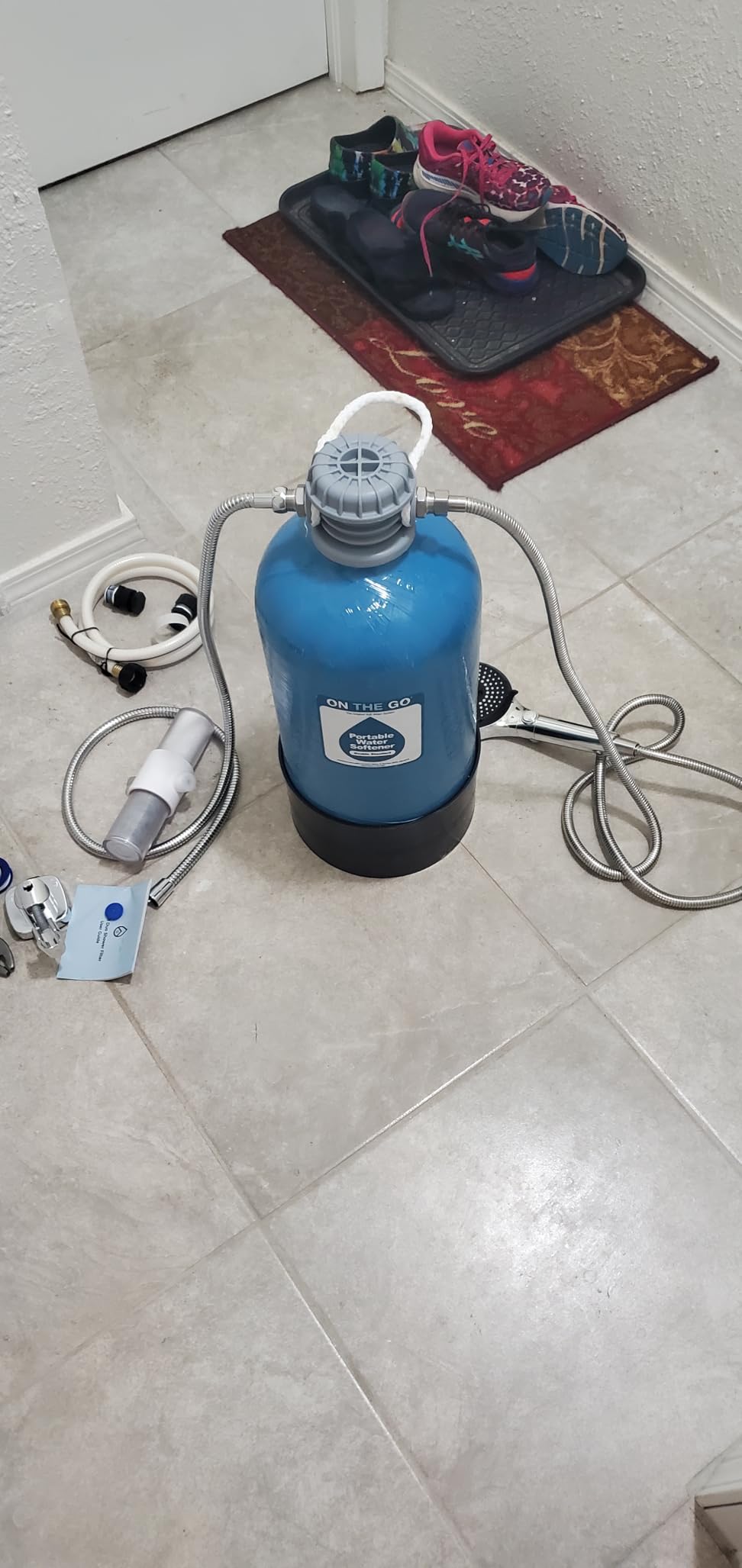
Owner evidence is consistent and measurable rather than glowing. Buyers report test-strip readings falling from extremely hard sources in the 10 to 11 grain range down to 1 or 2 within a day of connection. Multiple owners describe shower glass and faucet sprayer deposits dropping to near zero within days, and one long-haul owner who delayed setup until April noticed the deposits first, then reported noticeably softer laundry and clear glass afterward.
A full-timer with more than four years on the road described it as having handled hard water all over the USA and Canada, and it is the single most repeated brand recommendation across both the iRV2 and RV Forum threads. At 4.7 stars across 1,899 reviews, that is the strongest combination of rating and review volume in the group, which is why it takes the top spot. If you want the broader picture on taste and odor, our whole house filter guide covers the fixed-home side of the same problem.
How much water the 16,000 grain capacity really covers
Run the math on your own usage rather than trusting the label. If your park water tests at 300 ppm, that works out to roughly 17.5 grains per gallon, so a 16,000 grain tank delivers about 900 gallons before it needs salt. Two adults using 8 gallons a day would exhaust it in a little over three months.
That interval is what makes the 40-day figure on moderately hard water believable and what makes it misleading on very hard water. Owners who measured 425 ppm before and 0 ppm after their unit saw the same tank exhausted in far fewer days, and a minority of reviewers on this and comparable models report regenerating every three days in extreme conditions. Test your source first, then decide how often you are willing to carry salt.
Where this softener falls short
Build quality is the honest weak point. A recurring complaint is that the blue fiberglass tank sits crooked in the black base, and another is plastic fittings rather than brass at this capability level, which matters more on an RV where vibration and road heat work at every connection.
Regeneration also demands somewhere to dump water. A full-timer near a Texas well at 450 ppm, who calculated grain requirements in the tens of thousands for two people, effectively concluded that portable units cannot keep up with water at that level. At that point the answer is professional analysis, a fixed system, or reverse osmosis, not a bigger portable tank.
2. NPGLOBAL 16,000 Grain Portable Softener – Best for High-Iron Well Sources
NPGLOBAL RV Water Softener Portable – 16,000 Grain, 3/4″ GHT Fittings, Convenient Water Softener for RVs, Trailers, Boats, Mobile Car Washing, Pressure Washing
- Test strips show 500-1000 ppm source water dropping to about 50 ppm
- Arrives charged and ready to use
- Limited lifetime warranty and responsive service
- Works for RVs
- boats
- spas and pressure washing
- Brass fittings in the lid are loose in the plastic threads on first use
- Included quick-connect valves lack proper O-rings
- Only one pair of quick-connects supplied
This one earns its place on a specific strength: the manufacturer lists a maximum supported TDS of 350 ppm, the only explicit ceiling stated among the portable softeners here. Buyers on hard wells report some of the widest before-and-after swings we saw among them, with test strips reading 500 to 1,000 ppm on the way in and around 50 ppm after.
It arrives charged, so you can put it in service in four to six minutes rather than waiting through a first regeneration cycle. Regeneration itself takes as little as 30 minutes with table salt, and the 3/4 inch GHT fittings and ion-exchange method match a standard campground spigot. The resin is NSF certified food-grade material, and the body is freestanding polyethylene.
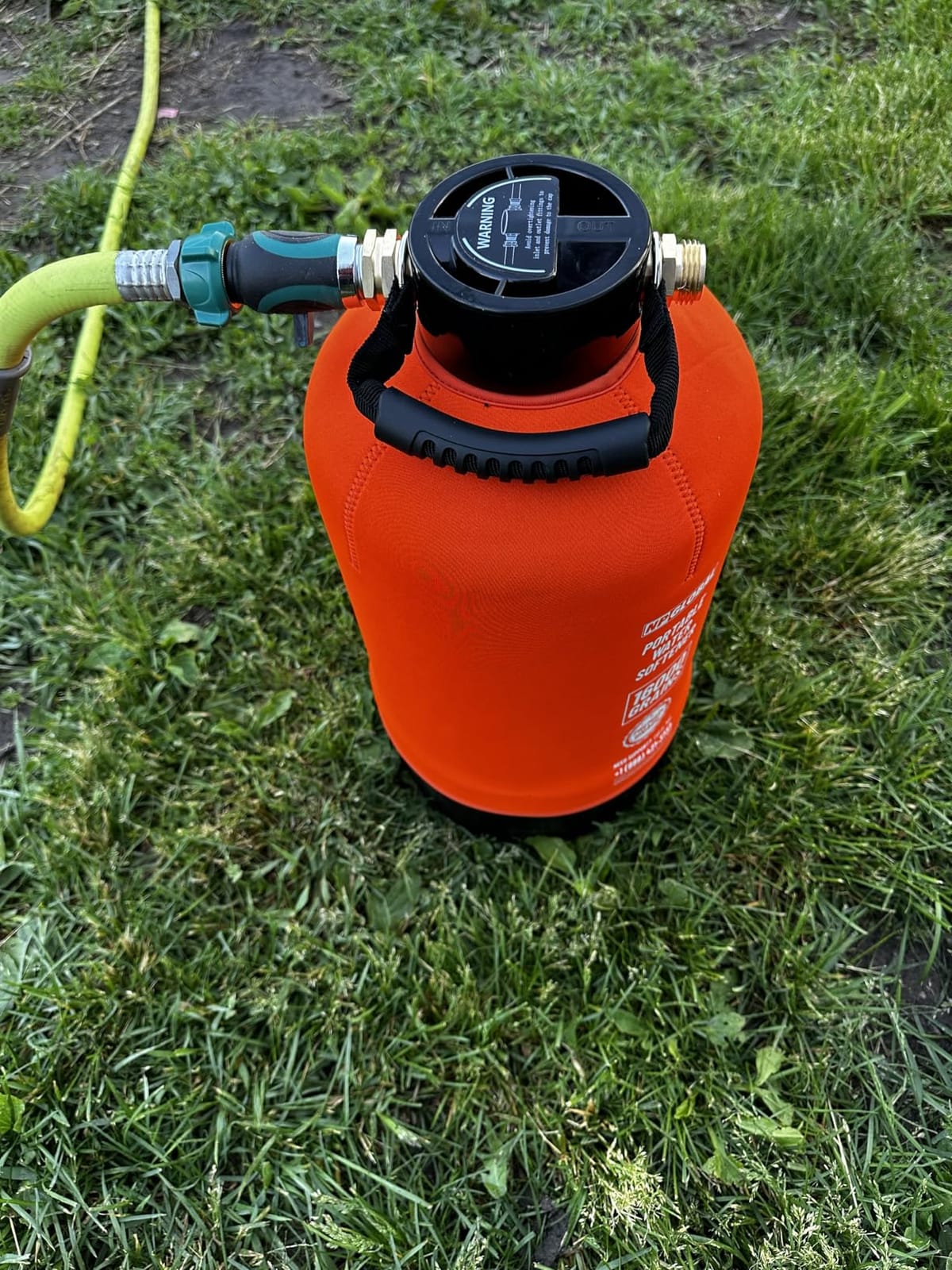
Customer support came up more than once in the reviews, including a free replacement of a cracked head. The listed warranty is a limited lifetime warranty, which is longer than most portable tanks in this category offer. It also weighs 31 pounds and measures just under 9.5 inches square by about 19.7 inches tall, so it stores like the others here.
The listed maximum of 350 ppm TDS is a double-edged specification. Read as a ceiling, it tells you where the manufacturer stops claiming performance. Read as a sizing target, it is a useful warning: if your source tests above that number, treat the readings owners report as a best case rather than a promise.
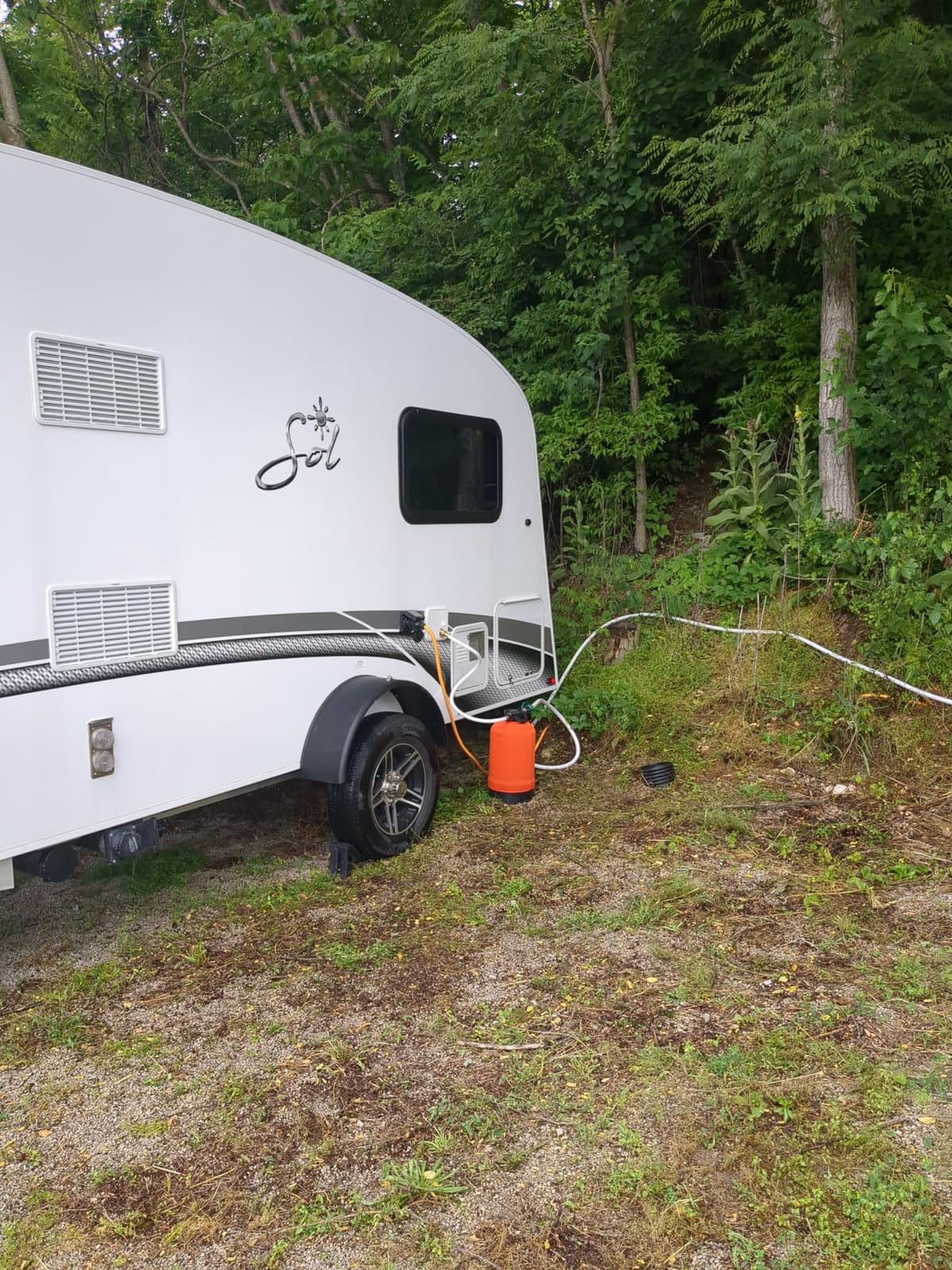
Does it handle iron as well as hardness
Partly, and the distinction is worth understanding. The manufacturer states the system reduces exposure to iron, lead, radium and other heavy metals, and the real-world readings back that up for moderate levels. But a softener that has run out of capacity, or a source with heavy ferrous iron, will show it as staining, and the fix is a dedicated iron media or a sediment stage ahead of the tank rather than more salt.
Practical takeaway: if your well has both hardness and iron, run this softener behind a fine sediment filter so the resin is not fouled by particles, and keep spare cartridges with you. Reviews also note it holds the lowest hardness reading for weeks between regenerations, which matters when you are moving between sources.
Where this softener falls short
The most repeated complaint is mechanical and specific: the brass fittings in the lid sit loose in the plastic threads and can leak on first use unless you wrap them in PTFE tape. Reviewers also find the supplied quick-connect valves low quality with poor O-rings, and only one pair is included.
Budget five minutes and a roll of tape before first hookup, and consider buying a spare set of quick-connects. Leaks at unfamiliar campground spigots are a recurring complaint across this whole category, and the fittings are where almost all of them start.
3. PRO+AQUA 16,000 Grain Portable Softener – Best Complete Kit for Boondockers
PRO+AQUA 16,000 Grain Portable Water Softener for RV, Trailers, Boats, Mobile Car Wash, Pressure Wash – Protects Water Systems
- Comes fully assembled with quick-connects
- pre-filter
- brine hose and kit
- Ready to use in 5 minutes with no electricity or tools
- Large grain capacity in a compact 10 by 19.5 inch footprint
- Pre-filled with NSF certified food-grade resin
- Designed in the US with a 2-year warranty
- Higher cost than comparable 16000 grain portable softeners
- Some buyers need extra fittings beyond what is included
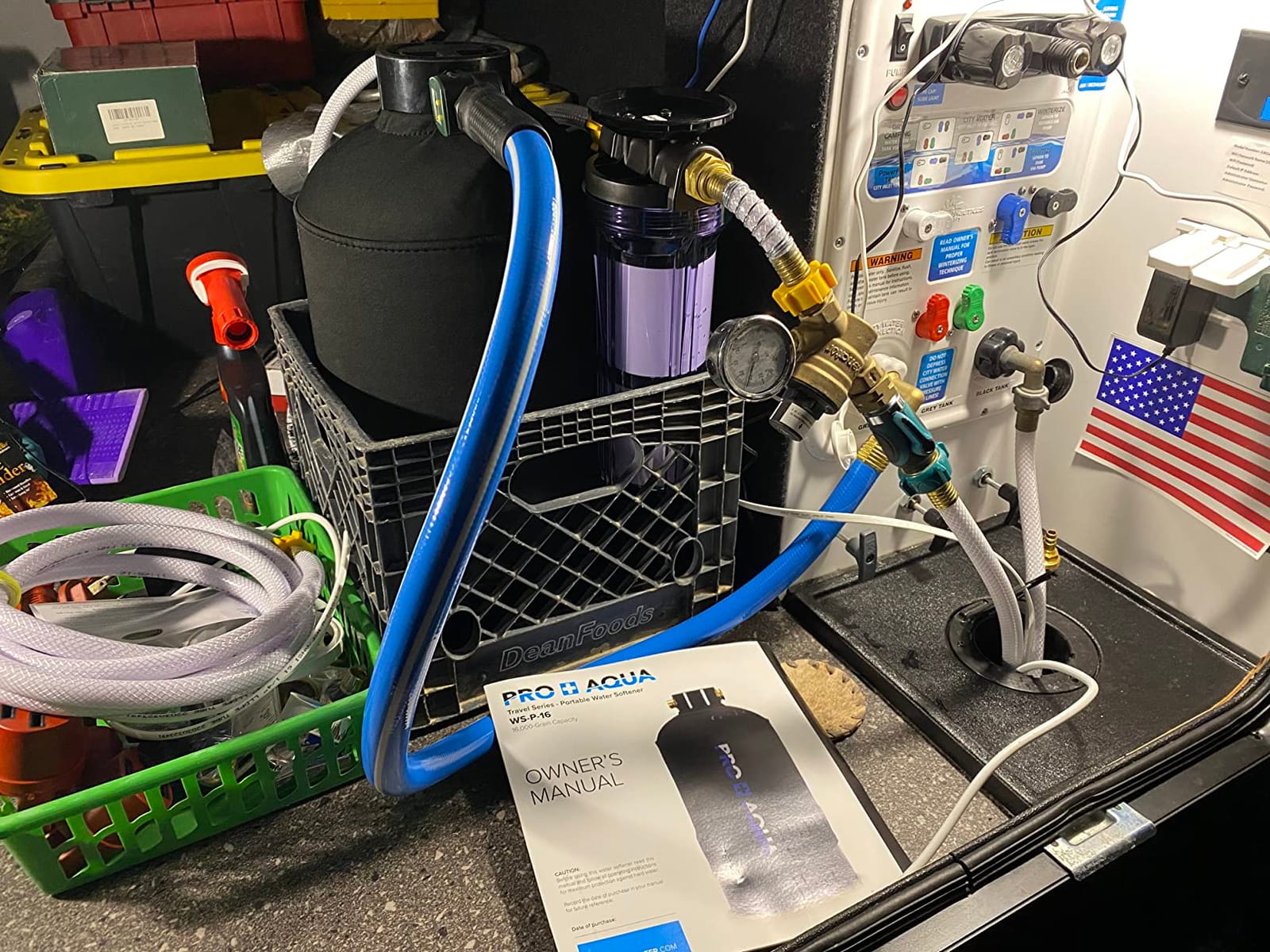
The difference with this unit is what arrives in the box. A pre-filter, a regeneration kit, a brine hose and quick-connect fittings all ship with the tank, so a boondocker moving camp to camp is not hunting for hardware at a hardware store between stops. For a rig that lives on unknown water, that completeness is worth more than a small spec difference.
Capacity is listed at 16,000 grains, which the manufacturer rates at up to 60 days or about 2,000 gallons of softened water. In and out ports are 3/4 inch high-flow garden hose, and the system is ready to use in five minutes with no tools and no electricity. Regeneration uses two boxes of common table salt in under 30 minutes.
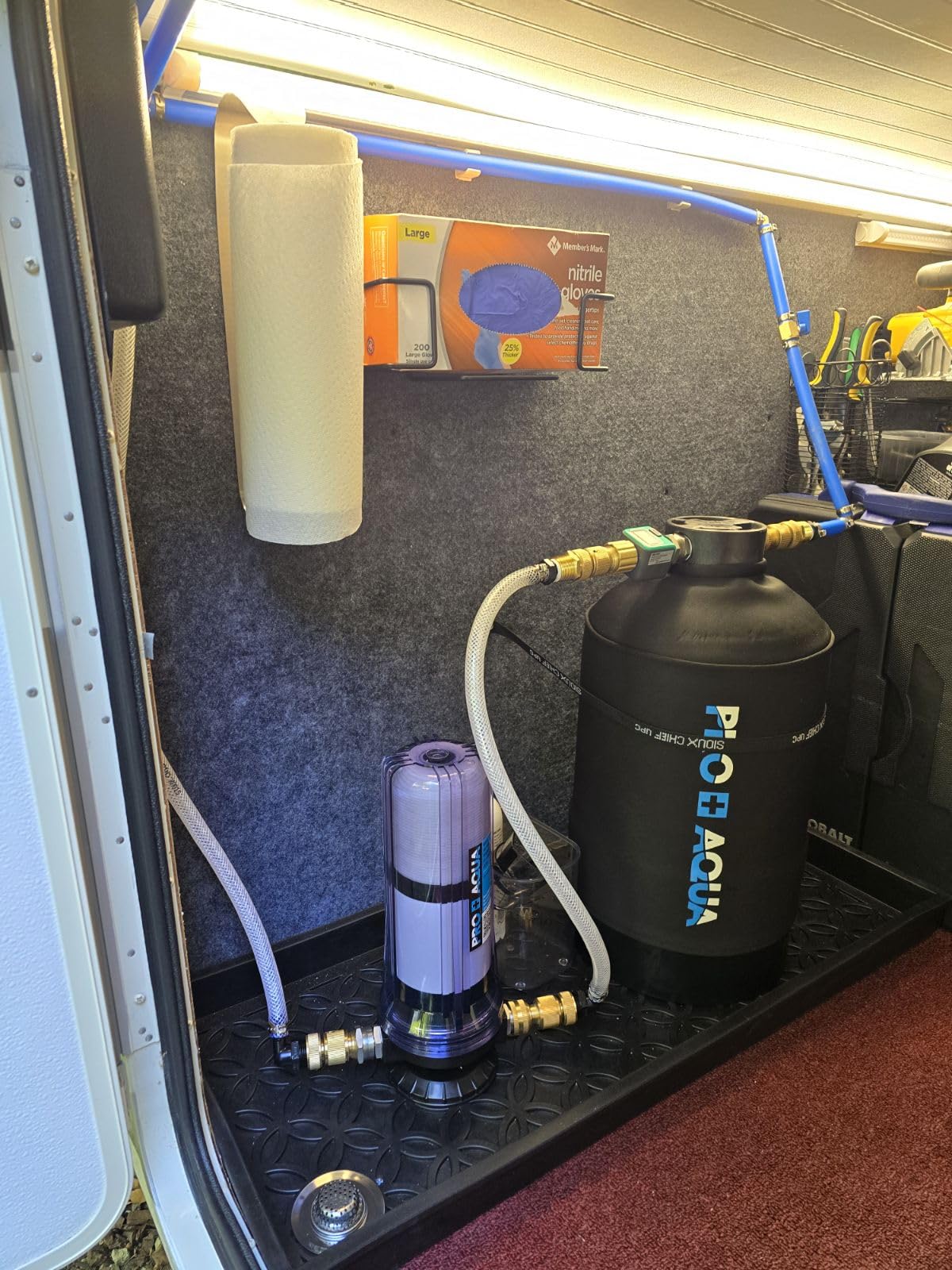
The tank is rugged NSF polyethylene reinforced with fiberglass, pre-filled with NSF certified food-grade resin, and it measures 10 by 10 by 19.5 inches at 35 pounds. The manufacturer lists the system as reducing calcium, magnesium, iron, lead, radium and other heavy metals, and it is rated for both city and well water.
At 4.4 stars across 1,258 reviews, satisfaction tracks with setup simplicity. Owners point out that it hooks to any standard campground or park faucet hose and needs nothing beyond what is in the box. The 2-year warranty is shorter than the NPGLOBAL’s, but the bundled parts make that difference less likely to matter in the field.
Why the included pre-filter matters for hard water
Scale-laden water carries fine mineral particles alongside the dissolved load, and those particles are exactly what clogs resin beads. A sediment stage ahead of the tank protects the resin bed and stretches the time between regenerations, which is the single most useful thing you can do for a softener in hard country.
Owners on very hard sources also report shorter intervals than the 60-day figure, so treat that number as a best case. The practical routine is simple: keep the pre-filter in the box, swap it when flow drops at the faucet, and salt the tank whenever the test strips start climbing again.
Where this softener falls short
The honest drawback is cost relative to peers: several buyers note it costs more than other 16,000 grain portable softeners of the same class. If you compare on sticker numbers alone, this one looks expensive, but the included pre-filter and hardware kit are a meaningful part of what you are paying for.
A second, smaller issue is that some buyers needed additional fittings beyond the supplied set. Treat the included kit as a starting point rather than a guarantee, and carry a couple of spare 3/4 inch quick-connects. Check the manual for this specific model rather than assuming an exact regeneration procedure from another brand.
4. RVGUARD 16,000 Grain Portable Softener – Best for First-Time Softener Owners
- Verified softening within about two weeks using hardness test strips
- One of the least expensive 16000 grain portable softeners
- Complete accessory kit makes setup and break-down quick
- Improved water feel
- taste and less staining on dark fixtures
- Some units arrive with loose lid fittings needing extra PTFE tape
- Large tank takes about 5 minutes to circulate water through
This is the one to buy if this is your first portable softener and you do not want to assemble a parts list. The box includes a water hose, two hose adapters, an F-F connector, a quick connector, a Y-splitter, a shut-off valve, a 90-degree elbow connector, plus sealing O-rings and PTFE tape. Nothing else to buy before the first hookup.
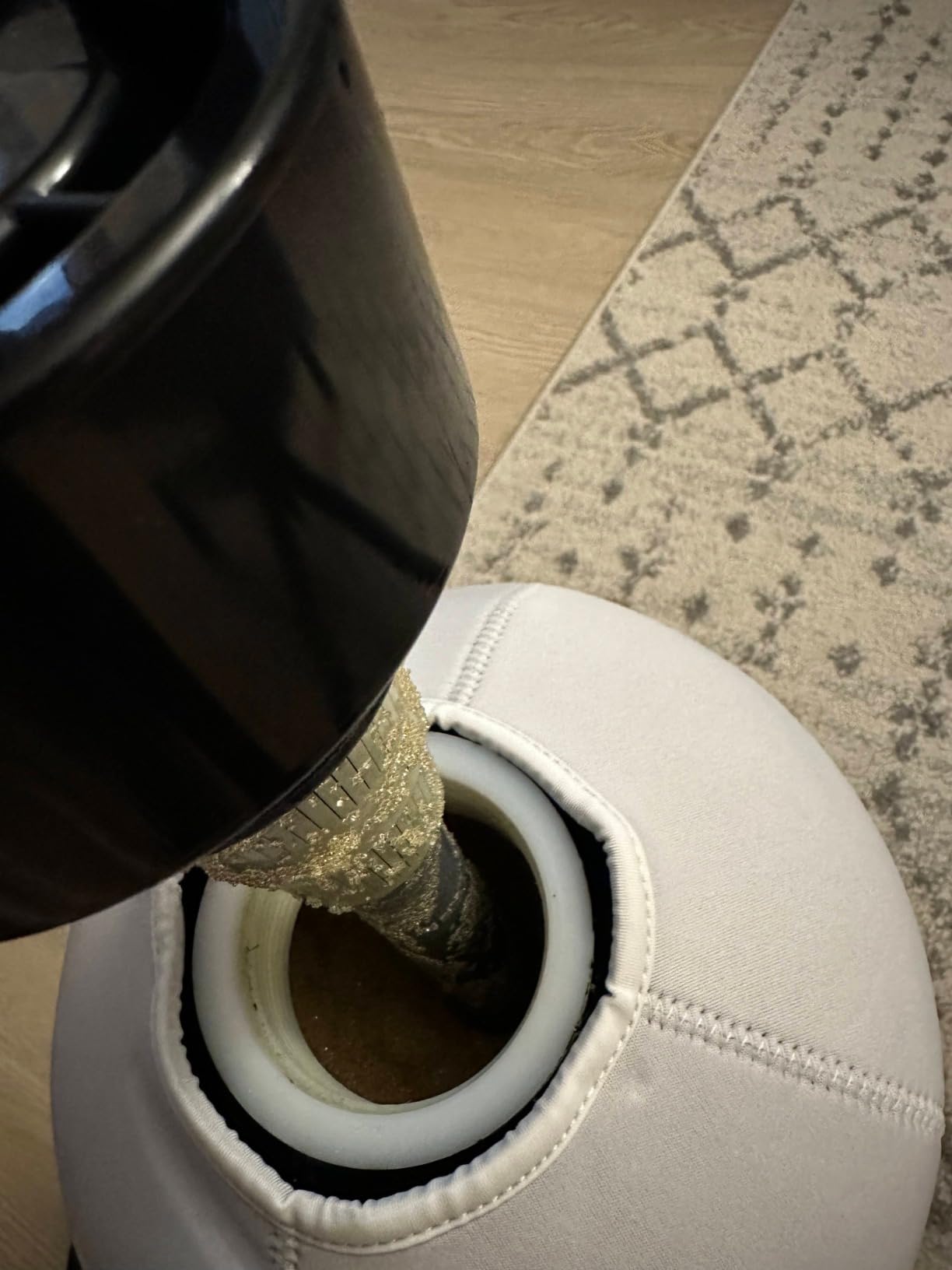
The tank is 16,000 grain ion exchange with food-grade premium resin and is listed as delivering roughly 40 percent softer water before a regeneration is needed. It arrives pre-filled and ready to use, which removes the most common beginner mistake of forgetting the first salt charge. Verified softening shows up within about two weeks on test strips.
Owners report improved water feel and taste along with reduced staining on black bathroom fixtures, which is the easiest scale symptom to see. The review set here is smaller than the big three softeners in this roundup at 99 reviews, so treat the pattern of feedback as consistent but not as statistically deep.
For a full 16,000 grain capacity with every connector included, reviews describe it as among the least expensive softeners in this class, and the accessory kit alone would otherwise cost a new owner a second trip to a store.
Is it big enough for two people in hard country
On paper, yes: 16,000 grain with an ion-exchange bed is the same capacity class as every other softener here. The practical difference between units is how quickly each is exhausted, which depends entirely on your source hardness and how much water you use, not on the label.
Because it is freestanding with a convenient carry handle, you can move it between hookups rather than letting resin sit in a drained tank. That matters more for a part-time or weekend rig than for a full-timer, and it is a real convenience when you break camp in a hurry.
Where this softener falls short
Two recurring nits. Some units arrive with loose lid fittings that need extra PTFE tape before first use, which is the same first-hookup leak pattern reported across most portable tanks in this category. Second, the large tank takes about five minutes to circulate water through, so do not judge softening performance in the first few minutes after connecting.
With a smaller review base than the leaders, this is the pick to scrutinize on arrival. Check the lid fittings, confirm the hose and shut-off valve are present, and run a hardness test strip before and after a full day of use.
5. VEVOR 16,000 Grain Portable Softener – Best for Brass Fittings and Wide Ports
VEVOR RV Water Softener, 16,000 Grain Portable Water Softener, with 3/4″ Brass Fittings and 42″ Hose, Soften Hard Water Filter System for RVs, Trailers, Boats, Mobile Car Washing, Pressure Washing
- Test strips show 425 ppm source water dropping to 0 ppm
- Brass fittings
- 42 inch hose and accessories for a five-minute setup
- Large 3/4 inch ports maintain good flow and pressure
- Resin rated for roughly 5 years of use
- Hose fittings and garden adapters prone to leaking or cross-threading
- Salt cap is easy to cross-thread when closing
- Heavy once filled and awkward to move
- Some owners exhaust capacity in about three days on very hard water
The specification that separates this softener is hardware. It includes brass connectors and a 42-inch water hose, and the 3/4 inch inlet and outlet hose connections are rated to 150 psi. On an RV, where every connection sees road vibration and thermal cycling, brass and a wide port are worth real money over plastic.
Performance figures are specific. The unit is rated at 16,000 grain adsorption capacity and reduces hardness to 0 to 3 grains per gallon. Under 6.5 gpg source water it regenerates 2,461 gallons, up to 50 days of use, consuming about 52 ounces of salt. The food-grade resin is usable for approximately five years, and the shell is a durable glass fiber and polyethylene combination.
Owner test readings here are among the most dramatic we found: one buyer measured source water at 425 ppm and 0 ppm after the unit, and another reported handling 400 ppm tap water down to 0 ppm for pool top-ups. Setup takes about five minutes with no electricity and no tools, and the ergonomic carry handle helps with transport.
It measures 9.6 by 9.6 by 19.3 inches and weighs 30.8 pounds empty. Be realistic about the filled weight, because that is the number you feel when you are moving it across gravel in the dark.
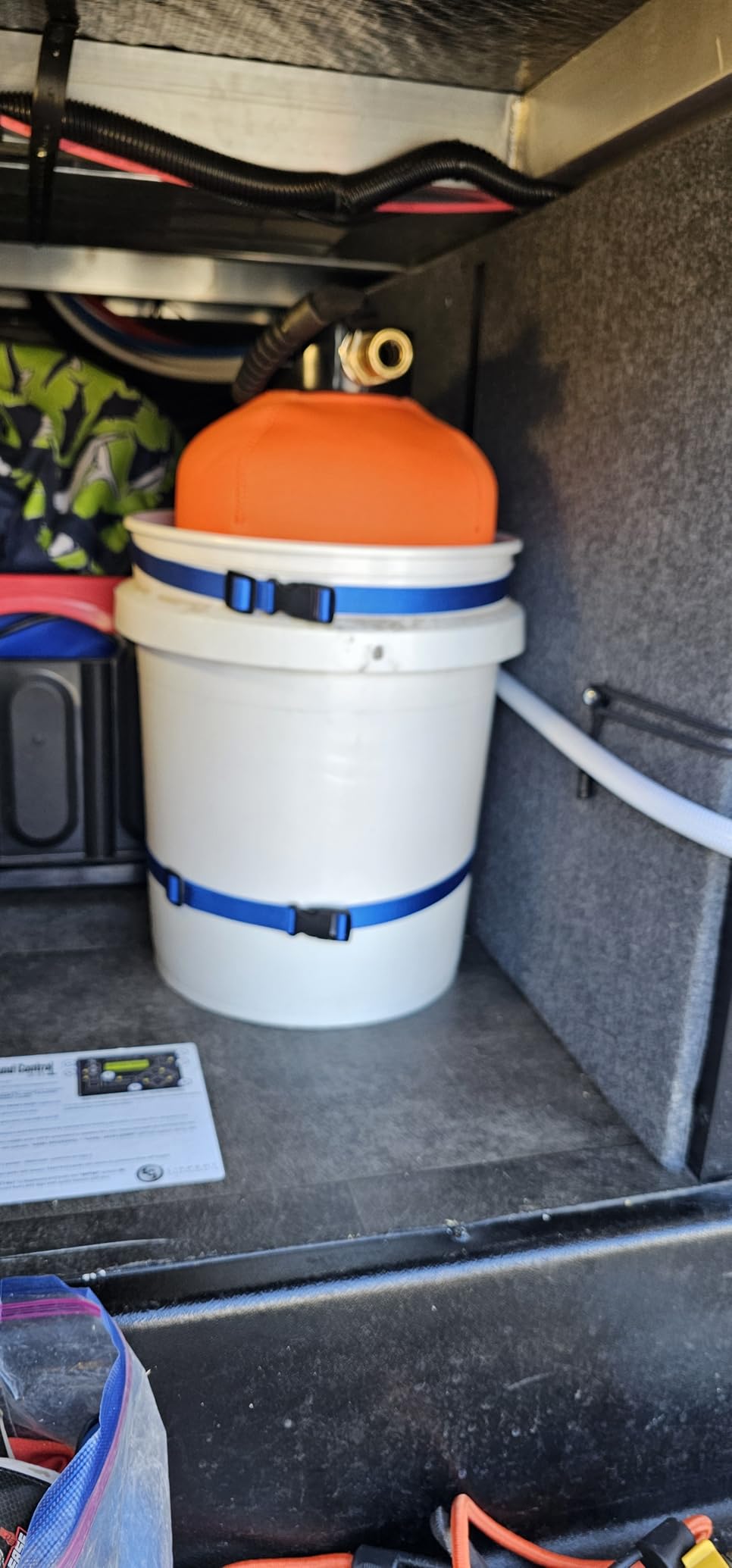
What the published gallon figures assume
The 2,461 gallon and 50 day claims are conditioned on source water below 6.5 grains per gallon, which is soft to moderately hard. Translate that to ppm and you can see the gap: 6.5 gpg is roughly 121 ppm, and much of the country parks where RVers travel run well above that.
At the 425 ppm reading some owners report, you are looking at roughly 24.8 gpg, close to four times the assumption behind those figures. That is why a minority of reviewers report regenerating every three days in very hard water. If your source is that hard, size for frequent regeneration or accept that a 16,000 grain tank is a short-interval system.
Where this softener falls short
Despite the brass hardware, connection problems are still the top complaint. Reviewers report hose fittings and garden-hose adapters prone to leaking, dripping or cross-threading, and the salt cap is easy to cross-thread when closing. Take your time on assembly rather than rushing it in a dark campground.
Second, the filled weight is a genuine travel issue. A 30.8 pound empty unit carrying water and salt is a lot to move between hookups. It suits a Class A, a parked fifth wheel or a spot where you can leave it connected rather than hauling it each move.
6. H and G Lifstyles Portable Water Softener 5A – Best Lightweight Unit for Small Rigs
- Test strips measured 350 ppm before connection and near 0 after
- Light enough to move easily with no noticeable pressure drop
- 10 percent crosslink resin resists chlorine better than conventional media
- Pre-filled and usable immediately without salt
- Cheap plastic threads on the inlet can strip and cause persistent leaks
- Carry handle is loose and slightly wobbly
- Regeneration steps differ from the written instructions
- Does not lower TDS and does not remove iron
At 13.62 pounds this is far and away the lightest softener in the roundup, a third of the weight of the tanks above it. For a Class B, a small travel trailer or anyone who moves the softener between hookups rather than parking it, that is the deciding number. The package measures 15.83 by 13.07 by 7.83 inches, so it tucks into a storage bay most tanks will not.
The resin is the differentiator. It is NSF certified 5A food-grade resin tested to NSF 42 and 60 standards, built with 10 percent crosslink cation resin upgraded from conventional 8 percent media for chlorine resistance and durability. The manufacturer claims reduction of up to 99.3 percent calcium and 99.8 percent magnesium, with a maximum capacity of about 2,600 gallons depending on local hardness and usage.
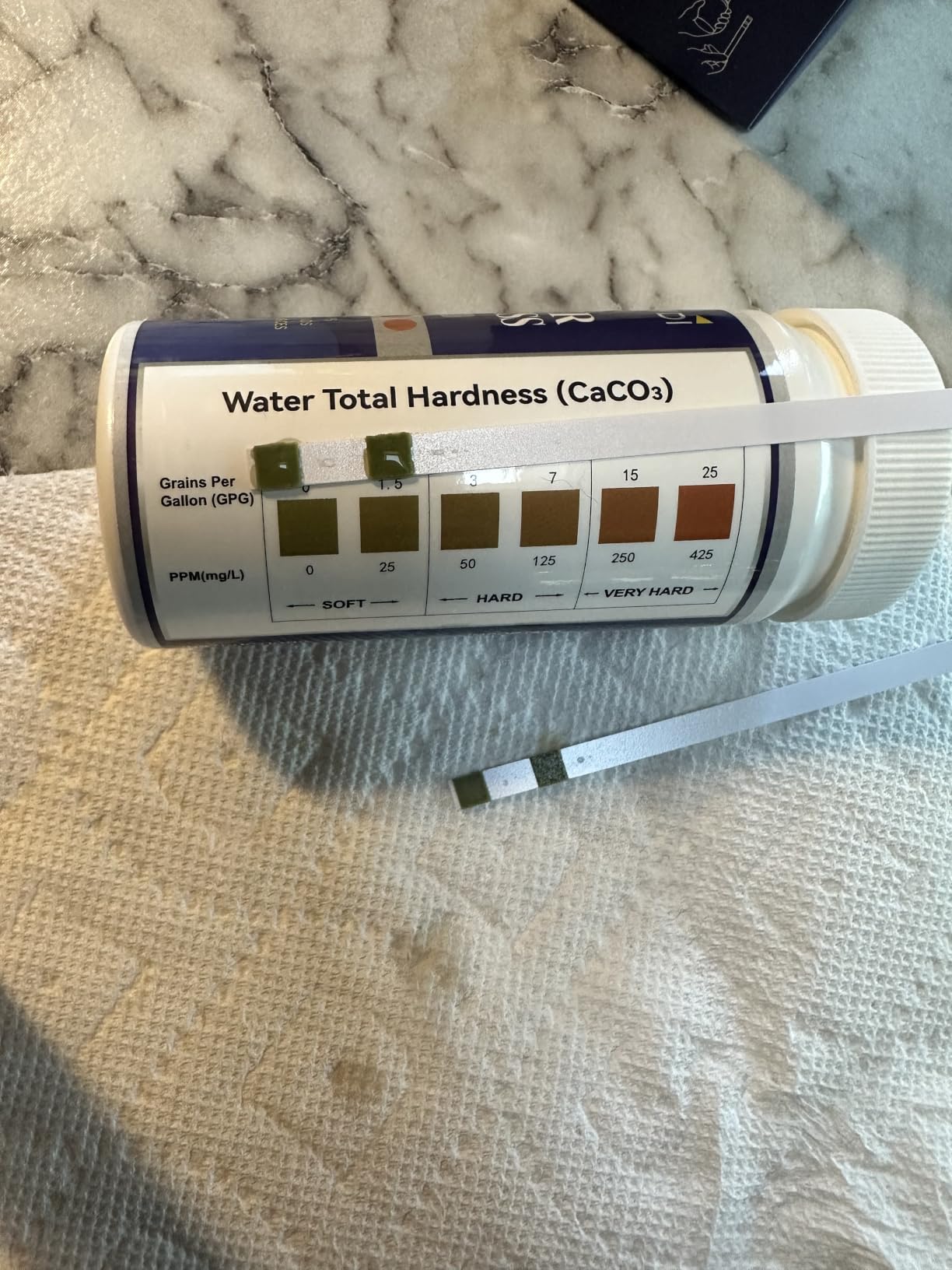
Owners confirm the headline claim with strips: 350 ppm before connection, effectively 0 after. They also report improved hair and skin, cleaner dishes and no more fixture spotting, with no noticeable pressure drop at the faucet. Food-grade 3/4 inch brass fittings and a hose make the hookup straightforward, and it arrives pre-filled so it works without a first salt charge.
Customer service appears twice in the feedback pattern, including a refund and a replacement lid after a fitting problem, which is the kind of support that matters most when your nearest hardware store is two hours away.
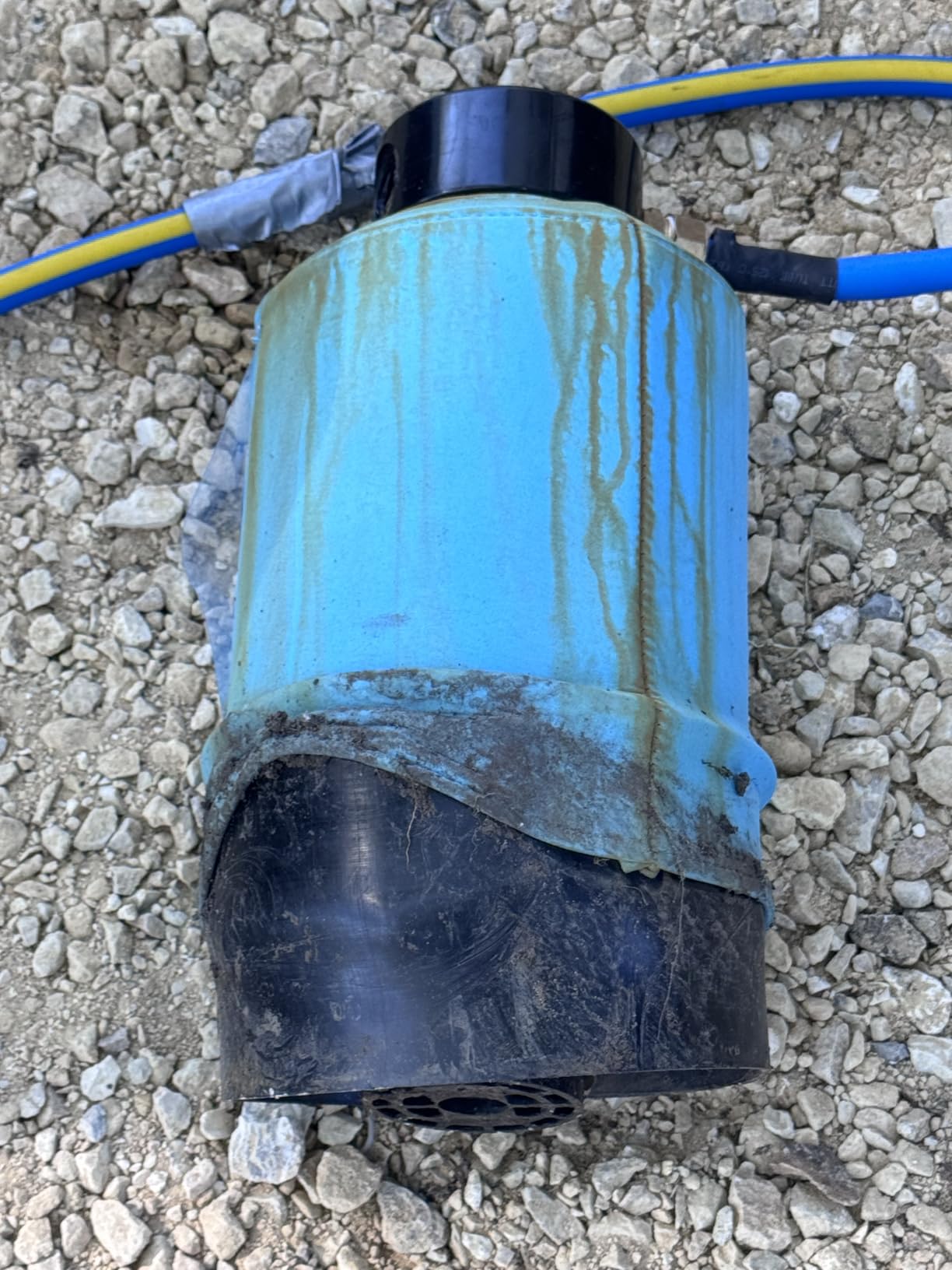
What the resin upgrade actually changes on the road
Chlorine is what destroys softener resin. Conventional 8 percent crosslink media degrades faster in chlorinated water, and campground supply is usually chlorinated. Moving to 10 percent crosslink buys you more usable resin life between replacements, which matters when the nearest supplier for a fresh tank of resin may be hundreds of miles away.
Owners also note no noticeable pressure drop, which on a shower head in a hot desert park is the difference between a comfortable morning and a frustrating one. The tapered thread interface is a deliberate design detail, and the instructions warn against over-tightening adapters because that is what cracks the fitting.
Where this softener falls short
The most serious limitation is stated plainly by the manufacturer: it does not lower TDS and does not remove iron. If your source has significant iron, this tank will not fix orange staining, and you need a dedicated iron filter ahead of it.
Build quality is the weak point. Reviewers report cheap plastic threads on the inlet connection that can strip and cause persistent leaks, a loose and slightly wobbly carry handle, and regeneration steps that differ from the written instructions. Read the manual for this specific model rather than following a video for another brand.
7. Nasibey External RV Dual Water Filter – Best Budget Two-Stage Filter
- Effective chlorine taste and odor removal from campground water
- Good flow rate for an RV fresh line
- Cut mineral scale on appliances such as ice machines
- Replaceable cartridges are inexpensive
- Inlet and O-ring seals prone to cross-threading and leaking
- Replacement cartridge size is not clearly stated for reordering
- Plastic housing less durable under road vibration than metal
Be clear about what this does. It is a two-stage filter, not a softener. The first stage is a 1 micron sediment filter for sand, dirt, silt and rust particles, and the second is a 100 percent coconut shell activated CTO carbon block that the manufacturer states reduces up to 99 percent of chlorine, VOCs, fine sediment and chemicals. It does not reduce dissolved hardness, so it belongs ahead of a softener in the chain.
Where it earns its place is as the guard in front of a softener. Fine mineral particles are what foul ion-exchange resin, and this stage catches them before they reach the tank. Users also report it works well on its own for drinking water quality at a campground where the complaint is taste and odor rather than scale.
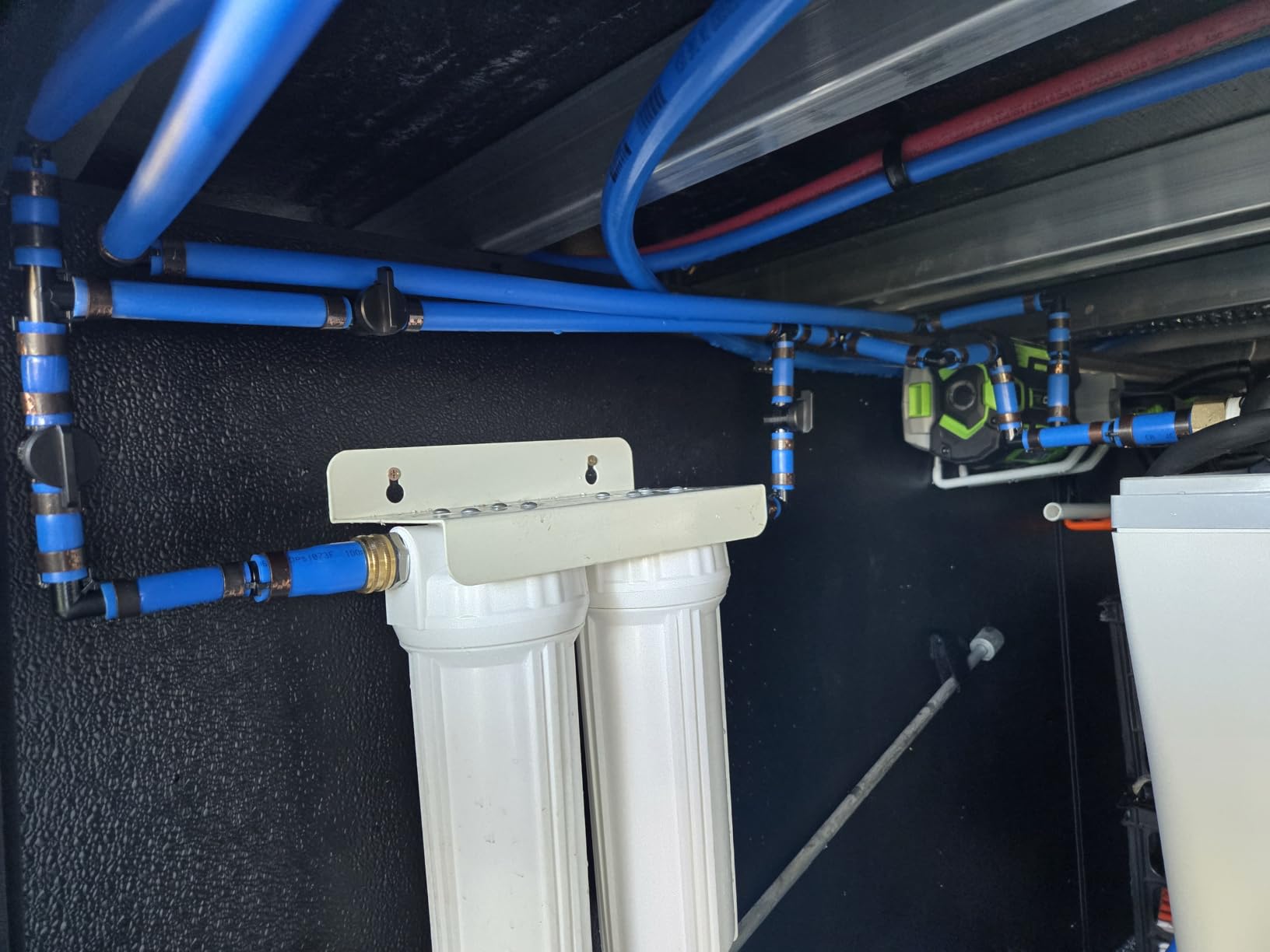
The connection hardware is better than the price suggests: a rustproof 304 stainless steel connector with a standard 3/4 inch GHT adapter, plus a heavy-duty mounting bracket. The internal filter threads are 1/2 inch NPT, and the system carries a 3-year structural warranty that excludes the cartridges, which the guidance says to replace every four to six months.
Owners report good flow rate for an RV fresh line, easy plumbing and servicing, and reduced scale on appliances such as ice machines. The cartridge footprint is 9.81 by 5.79 by 14.65 inches, so it mounts outside where there is no under-sink cabinet to use.
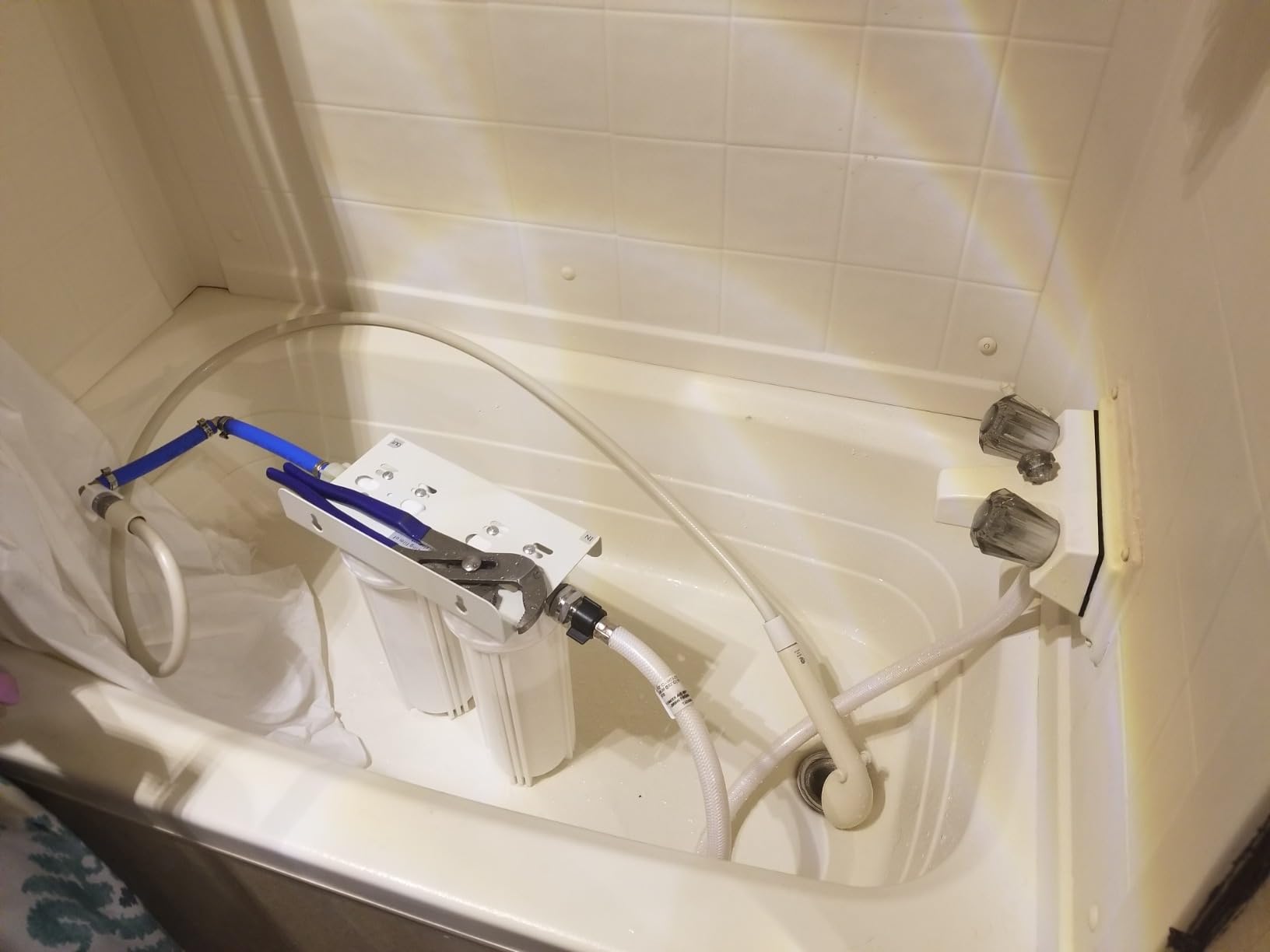
Where it belongs in a hard water setup
Put it on the inlet side of the softener, ahead of the resin bed. That single position change protects the most expensive part of the system and reduces how often you need to flush resin fouling out with rock salt. The same logic applies if you run a softener and an ice maker, where the 1 micron stage is doing quiet work.
As a standalone it is a solid choice for anyone whose main problem is chlorine taste and odor. If you also have spotting, add a softener behind it. Reviews note the cartridges are affordable to replace, which keeps the running cost of a two-stage arrangement reasonable.
Where this filter falls short
Assembly is the recurring problem. Reviewers flag inlet side and O-ring seals as prone to cross-threading and leaking, and the 1/2 inch NPT thread inside the housing is a step most owners are not expecting from a garden-hose-style part.
Two more practical limits. The replacement cartridge size is not clearly stated for reordering, so measure and record it before the first swap. And the plastic housing holds up less well under road vibration than a metal or brass design, which matters if it is mounted outside on a Class C or a truck camper.
8. Beech Lane External RV Dual Water Filter – Best Value Pre-Filter for the Softener
- Brass fittings resist leaks better than plastic competitors
- Dual 5 micron and 0.5 micron stages catch coarse and fine particles
- Long-standing RV-specific design with a lifetime manufacturer warranty
- Housing wrench included makes cartridge swaps straightforward
- Both cartridges need periodic replacement
- Twin-canister footprint takes more exterior or under-sink space
This is a long-established RV filter design, holding a 4.6 star average across 1,905 reviews. It is a dual canister system pairing a 5 micron sediment filter with a 0.5 micron carbon block, mounted externally with 3/4 inch lead-free brass inlet and outlet fixtures.
The two-stage split is the reason it earns a place in a hard water chain. The 5 micron stage takes the coarse load that would blind a softener’s resin, and the 0.5 micron carbon block polishes after it. Owners value the brass fittings as a genuine step above plastic competitors for leak resistance, which is the failure point that ruins most RV filter installs.
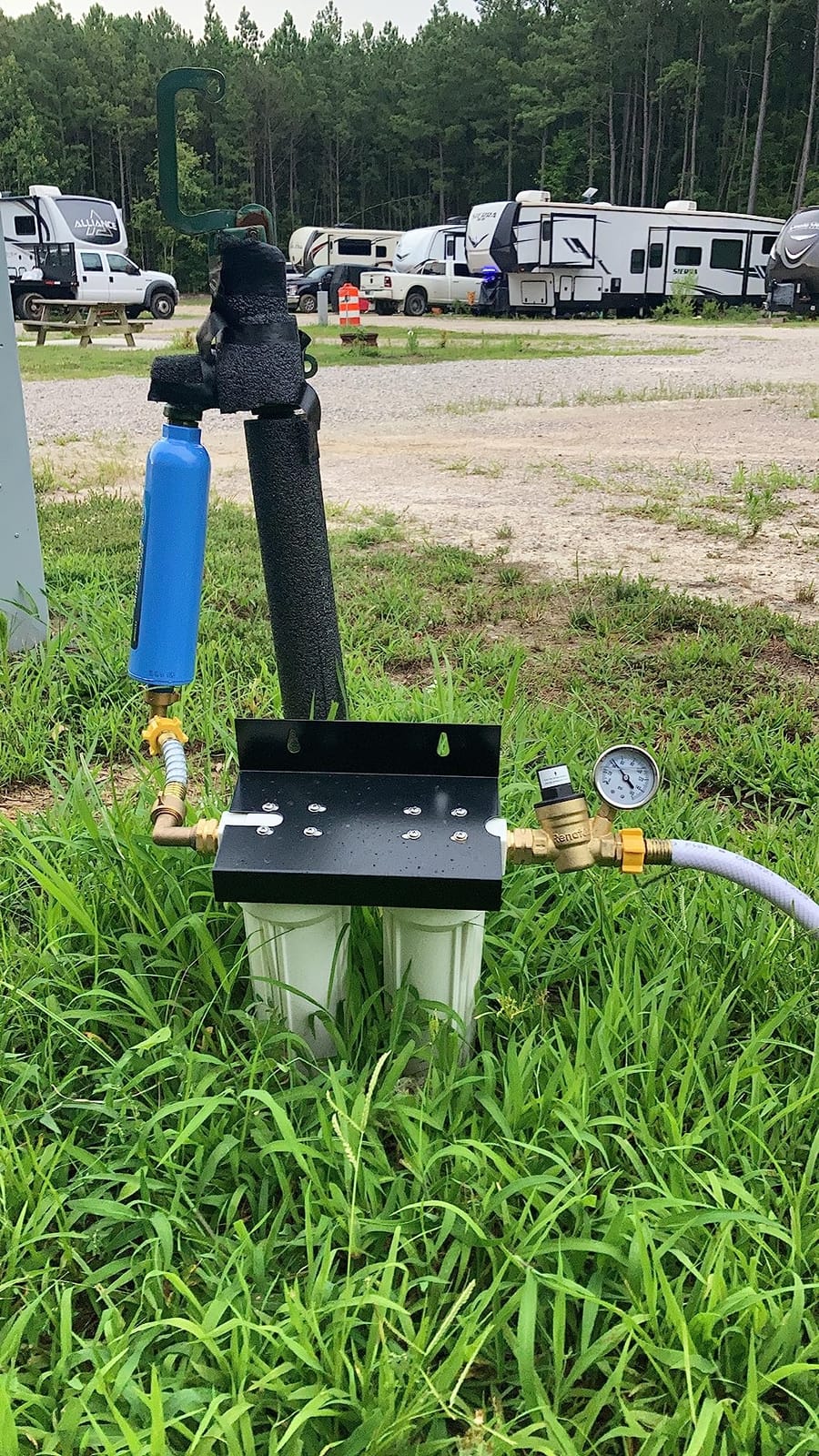
Build details are aimed squarely at an RV. Thick-walled canisters, tight seals and hardware built for outdoor use, a housing wrench in the box for filter changes, and compatibility with any brand of the same filter specification, so you are not locked into one replacement stream. The manufacturer lists a lifetime warranty and a maximum supported TDS of 2,000 ppm.
Because it is carbon block purification with manual operation, it is a fixed-format canister pair. Plan mounting space before you buy, and if you are pairing it with a softener, mount the filter first in the line so the resin stays clean.
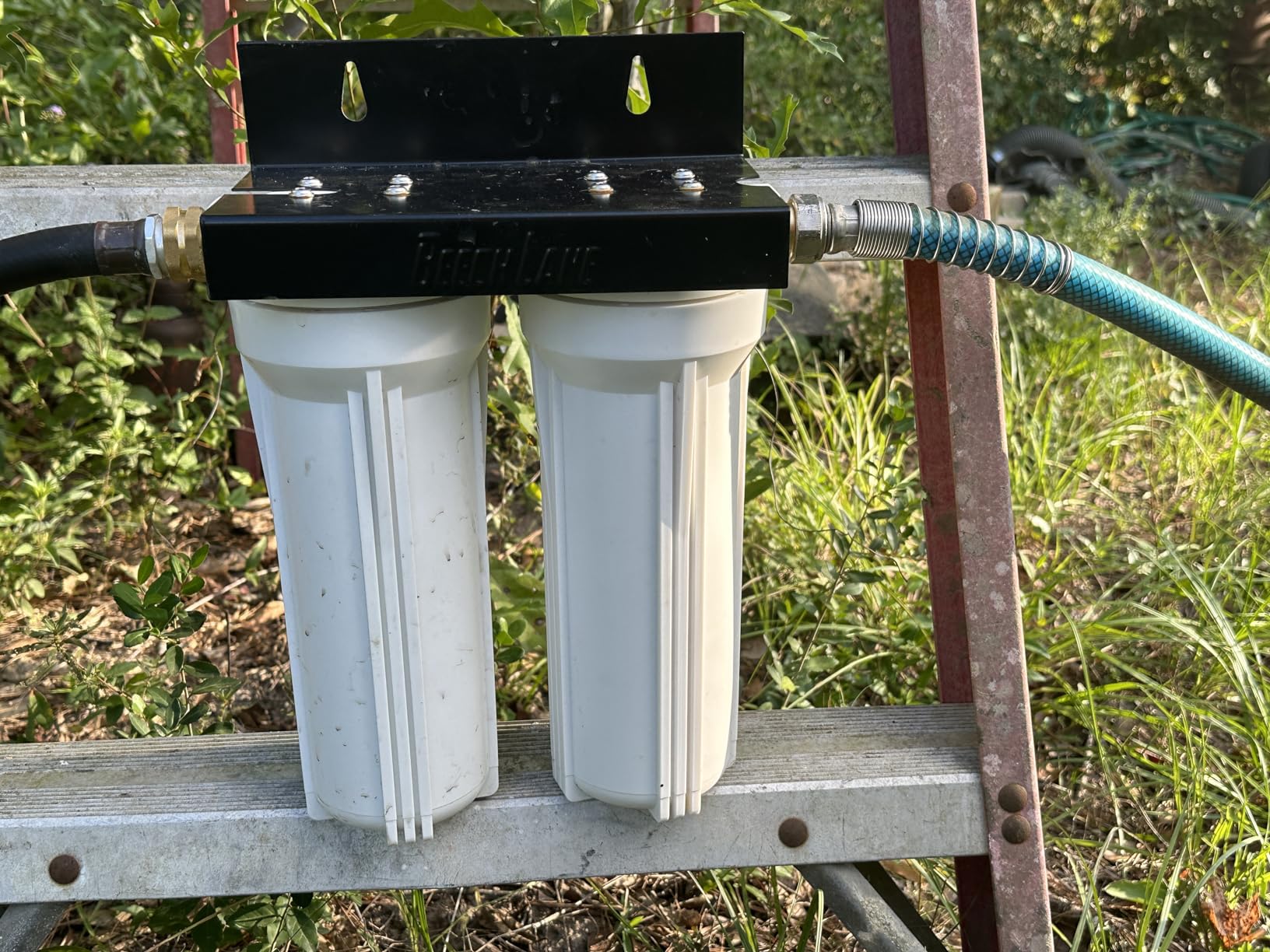
Why brass fittings matter more than stage count
On paper, adding stages sounds better. In practice, an RV filter connection is the weak point, and a fitting that drips at a campground spigot dumps your filtered water onto the ground while you troubleshoot. Lead-free brass at both inlet and outlet is the difference between a connection you forget about and one you check every time.
The 0.5 micron carbon block is also finer than most RV cartridges, which improves the clarity of what comes out. If you also care about taste at the tap, the carbon stage is doing the work, and our countertop filter picks cover the same goal in a different format.
Where this filter falls short
It does not soften water, and the 2,000 ppm TDS figure describes what the housing tolerates, not what it removes. Set it behind a softener rather than expecting it to fix spotting.
The two ongoing costs are straightforward. Both cartridges need periodic replacement, which is the running cost of any filtration chain, and the twin-canister footprint is bulkier than a single inline filter, so it takes more exterior or under-sink space than a hose-end model.
9. FS-TFC Garden Hose Sediment and Scale Filter – Best for Laundry, Pools and Water Heater Intakes
FS-TFC Garden Hose Filter for Washing Machine, RV, Pool & Pet – High-Efficiency Sediment & Scale Water Filter with Replaceable Cartridge Design,3/4″ GHT,Anti-Corrosion, NSF Certified
- Reduced mineral buildup on evaporative cooler pads in heavily mineralized water
- Tool-free twist-and-swap cartridges cut replacement cost and plastic waste
- Installs in about 30 seconds on standard 3/4 inch connections
- Owners report noticeably cleaner laundry output
- Plastic housing can shear if a metal adapter is pushed on sideways
- Can plug quickly on sediment-heavy well water and starve the appliance of flow
- Some units leak at the housing seam
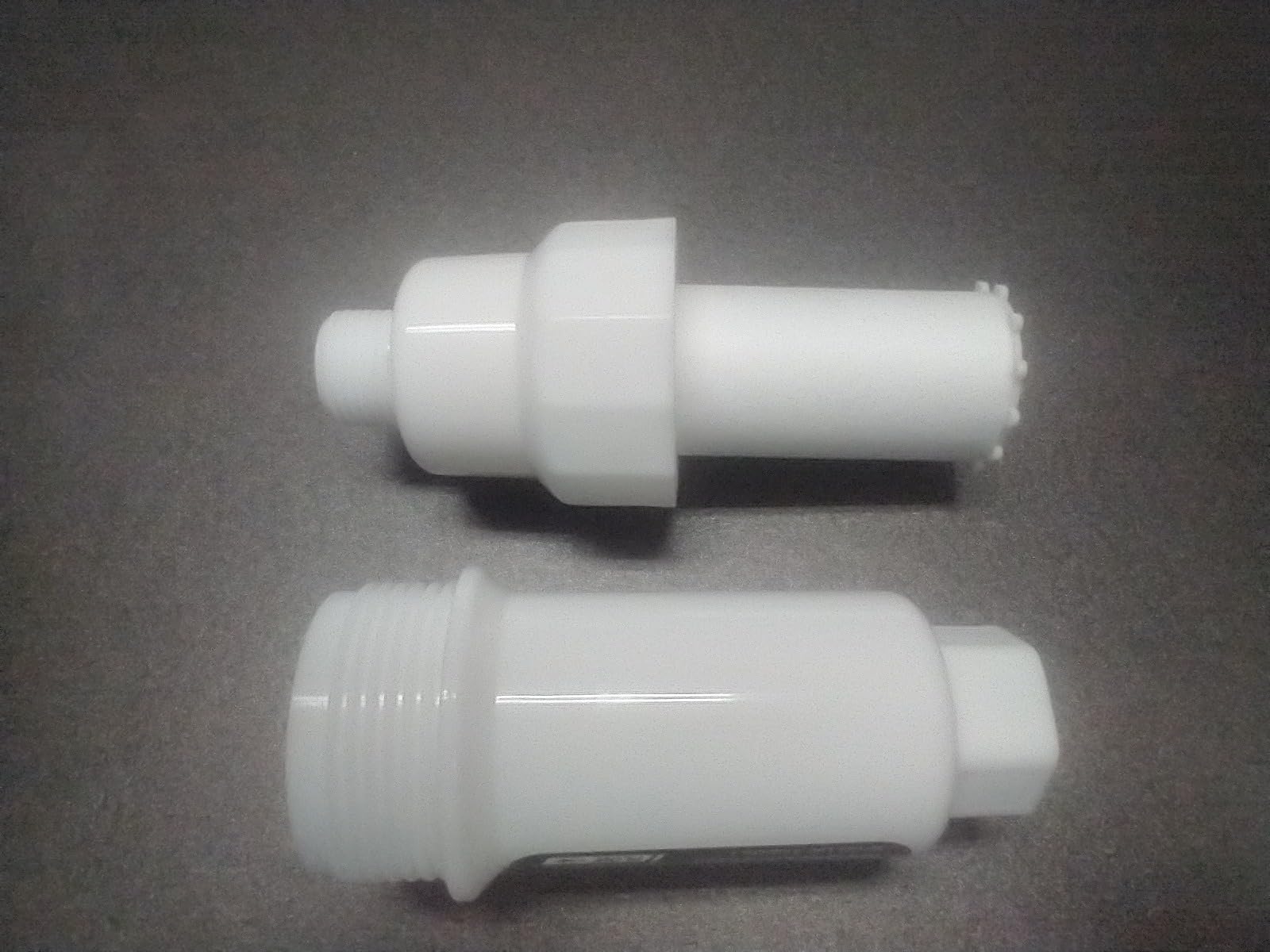
This is a hose-end filter with 1 micron filtration, which the manufacturer states is 20 times finer than a typical 20 micron hose filter. The media is a scale-inhibition compound with multi-layer anti-corrosion treatment, sitting in a reusable heavy-duty housing with tool-free twist-and-swap cartridges. It is NSF and ANSI 42 material safety certified, RoHS compliant, FCM food-contact approved and SGS tested.
Its job is targeted rather than general. It is designed to attach to washer inlets, water heater intakes, RV water lines, pool pumps and pet bathing stations, and it fits standard 3/4 inch US garden hose threads in about 30 seconds. The body is ABS and measures 2.36 inches in diameter by 6.98 inches tall at 6.4 ounces, so it is genuinely portable.
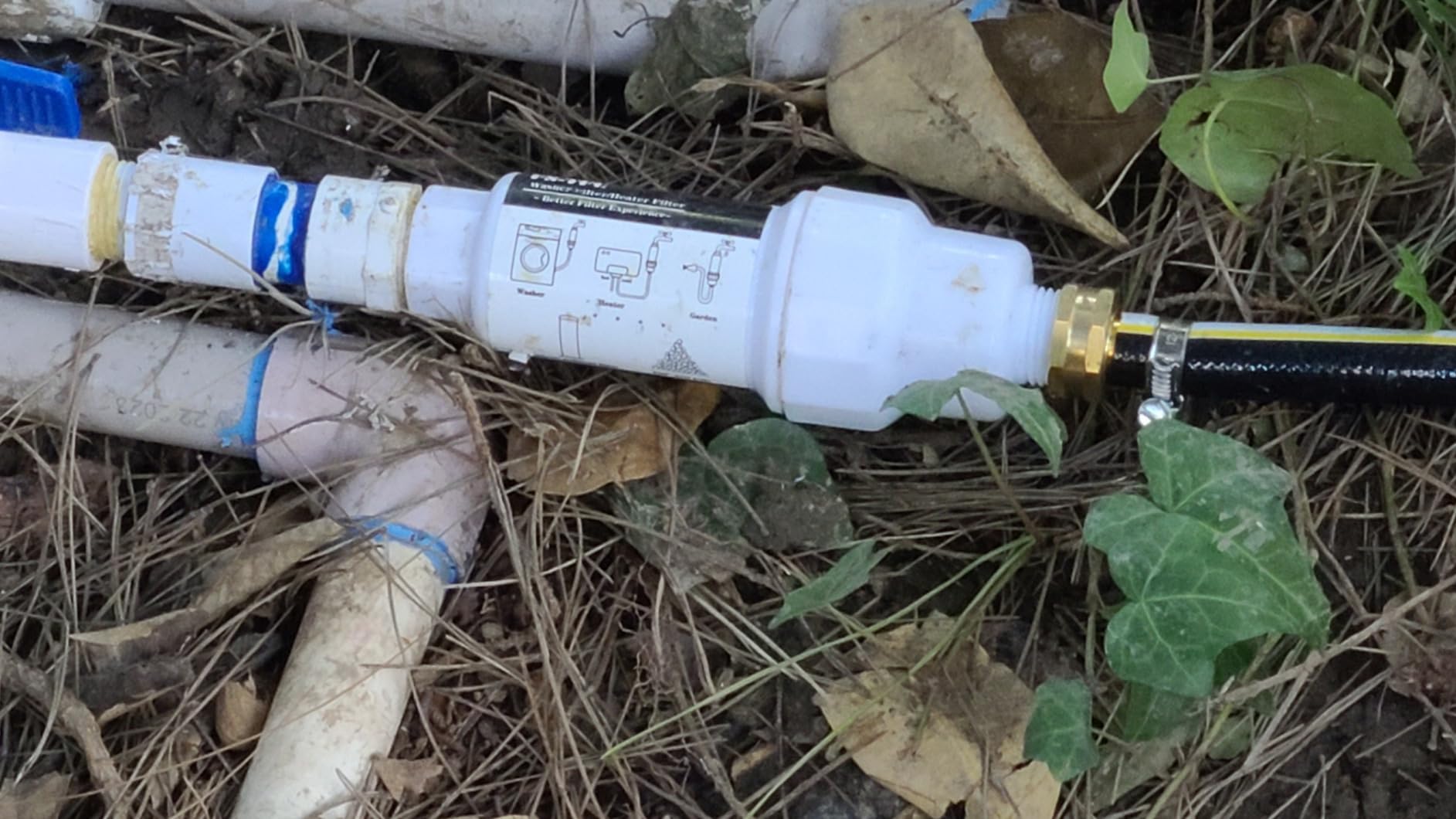
Owners report noticeably reduced mineral buildup on evaporative cooler pads in heavily mineralized water, which is one of the clearest scale demonstrations you can get. The reusable cartridge is the other draw: replacing media rather than discarding a plastic shell cuts both cost and waste, and reviews single out the tool-free swap as a time saver.
Laundry is the quiet win. Owners on very hard water report cleaner output, which follows simply from less mineral binding to fabric. If the main thing bothering you is stiff, faded laundry rather than shower glass, this is a targeted and inexpensive place to start.
Why a scale-inhibition filter is not a softener
Scale-inhibition media coats surfaces and discourages mineral deposit from forming, and sediment filtration strains particles. Neither process exchanges ions, so hardness stays in the water. That is a genuine improvement for a washer or a cooler pad, and it is not the same result as softened water at your shower.
Think of it as protection for appliances, not treatment for the person. Water heater intake protection is a reasonable use, though it does not remove the scale already inside the tank; that needs a flush, which we cover further down.
Where this filter falls short
Three honest limits. The plastic housing can shear if a metal adapter is pushed on sideways, which is a real risk when you are connecting to a rigid plumbing line rather than a soft hose. It can also plug up quickly on sediment-heavy well water and starve the appliance of downstream flow, so a weekly check is worthwhile in dirty sources.
Finally, some units leak from the housing seam. For drinking water quality specifically, reach for a canister system like the Beech Lane rather than a hose-end unit with a plastic body.
10. AQUA CREST Hard Water Rinse Filter – Best for Car Wash and Final-Rinse Spots
AQUA CREST Hard Water Filter for Hose Car Wash, Reduces Hard Water Spots
- One user measured hardness dropping from 400 to 80
- another saw TDS fall from 355 plus to 10-12
- Reduces drying spots and makes air-drying and waxing easier
- Compact and lighter than a cart-based filter with no resin activation
- Works as a final-rinse inline filter for pressure washers
- Small media capacity
- with hardness returning after a few rinses
- Noticeable reduction in water flow through the filter
- Resin performance degrades after roughly 2-3 gallons of use
- Not suitable for drinking water
Read the last line of the specification before anything else: this is not a drinking water filter, and the manufacturer does not recommend it for drinking water or fish farming. It is a spot-reduction filter for washing, and it does that job well on very hard water.
The media is an upgraded composite resin with multiple filtration stages at a 5 micron aperture, targeting chlorine, aluminum, cadmium, magnesium, iron, lead, mercury and sediment. One user measured a hardness reading of 400 dropping to 80, and another reported measuring 10 to 12 TDS from source water above 355 ppm. Those are large reductions in a short window.
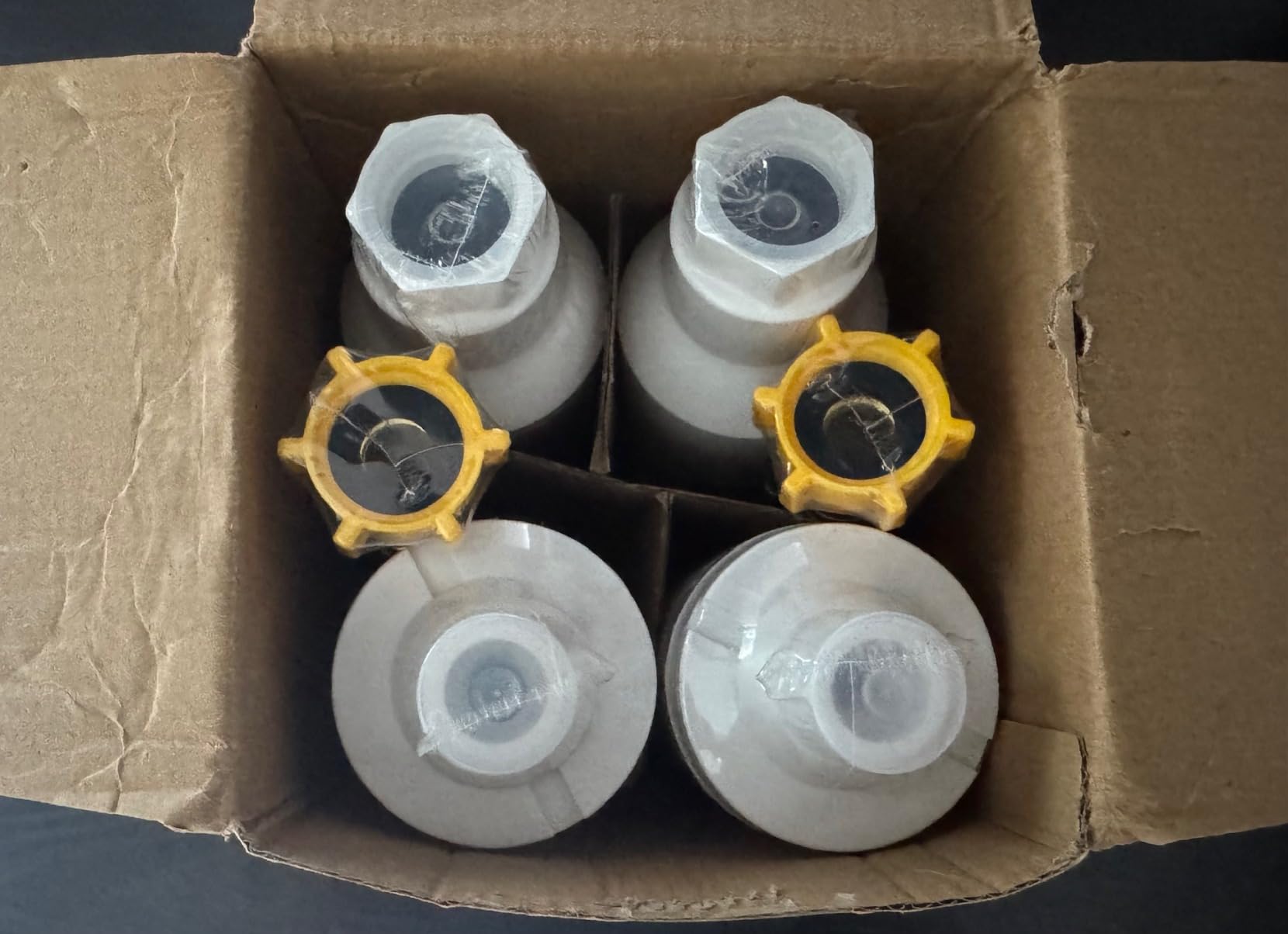
Owners use it as a final-rinse inline filter on a pressure washer and report that drying spots drop noticeably, which also makes air-drying and waxing easier since the surface rinses cleaner. The pack includes four filters and two anti-kink flexible hose protectors, and it fits any standard 3/4 inch garden hose thread.
It is also lighter and more compact than traditional cart-based car wash filters, and it needs no resin activation step. For a Class B or a van camper washing on the road, that convenience is the point of the design.
Where a rinse filter saves the most
Drying spots are the most visible cost of hard water outside the coach, and they appear fastest when a vehicle air-dries in desert sun. Attaching this at the end of a hose for the final rinse is the highest-value placement, because that is where minerals would otherwise be left on paint as water evaporates.
It also has a use inside the campground wash bay for gear, bikes and a tow car. Since the media is magnesium and iron targeted, it addresses exactly the minerals that cause spotting, which a plain sediment cartridge would not.
Where this filter falls short
Capacity is the real constraint. Media performance degrades after roughly 2-3 gallons of use, and some users see hardness returning after only a few rinses, so this is a consumable you replace often rather than a system you install once.
Expect a noticeable reduction in water flow through the filter, which is acceptable for a rinse hose and annoying on anything else. And keep it away from drinking water, both for the stated reason and because the application it is sized for does not translate to a potable line.
How to Test Your RV Water Hardness and Size a Softener
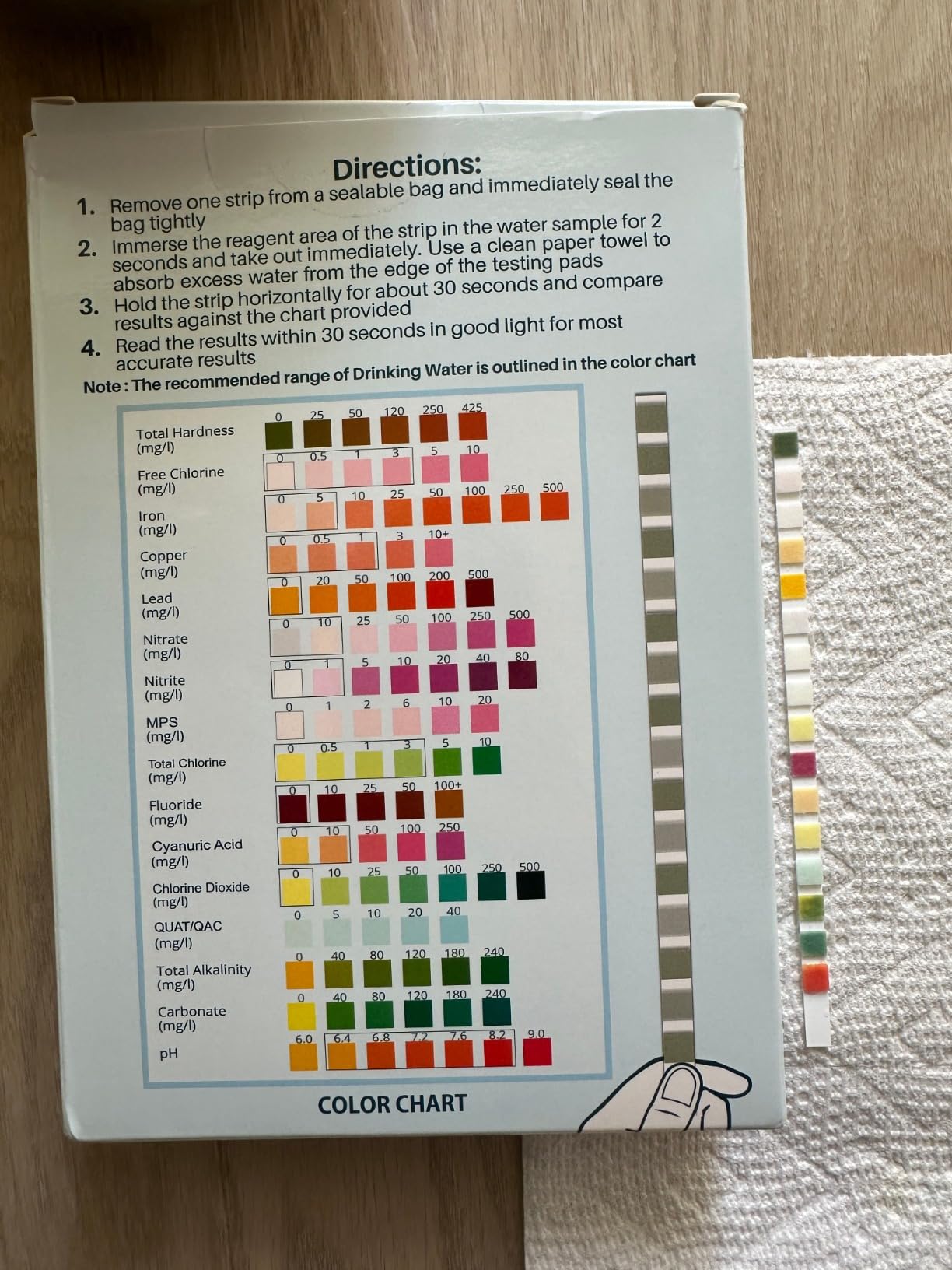
Every sizing decision downstream of this depends on one number you can get in about five minutes. Fill a clean glass with the water you actually plan to drink, at the campground or well you are worried about, and use a hardness test strip. Read the total hardness figure in ppm, not the general hard, very hard or extremely hard label, because the label spans a range wide enough to change your system size.
Convert it with one formula: grains per gallon equals ppm divided by 17.1. So 100 ppm is about 5.9 gpg, 300 ppm is about 17.5 gpg, and 450 ppm is about 26.3 gpg. A reading above 300 ppm is genuinely hard water by any standard, and it is the level at which portable RV gear starts to struggle.
Next, estimate how many gallons you will push through the softener. A two-person rig drinks, cooks, showers and washes around 8 to 12 gallons a day. Multiply that by your trip length in days, then divide by gpg to get the grains you need. At 450 ppm, two people over 60 days need roughly 31,500 grains, which is where an iRV2 user computed 72,000-plus grains for a longer stretch and concluded portable softeners could not cope.
Divide that total by 1,600 to get regeneration count. A 16,000 grain tank at 450 ppm holds about 610 gallons, so a two-person rig on 10 gallons a day regenerates roughly every 60 days, not every 40 as the marketing figures assume. That is the recalculation that tells you whether to add capacity, shorten your trips, or plan for a fixed system.
Region matters more than most guides admit. Texas hill country wells commonly run 300 to 450 ppm. Arizona, West Texas and desert park supply frequently sit in the same band, and snowbird rigs that live there eight months a year are the ones with the most noticeable scale. Boondocking from an unknown source is the opposite case: you cannot test what you have not found, so a filter ahead of the softener matters more there than anywhere else.
Stacking Order: Pre-Filter, Then Softener, Then Carbon
The sequence owners converge on independently in the forum threads we read is a 10 micron carbon pre-filter, then the softener, then a 0.5 micron carbon post-filter. That order is not arbitrary, and understanding why saves you from a wasted purchase.
Step one is the pre-filter. Its job is to catch sediment, rust flakes and fine particles so they never reach the resin bed. Ion-exchange resin fouled with sediment works poorly and regenerates inefficiently, so this stage protects the most expensive component in the chain. The Nasibey dual filter or the Beech Lane dual canister both work here, and either reduces what the softener has to fight.
Step two is the softener, which does the actual hardness reduction. Nothing before it can substitute, and nothing after it improves on it. If you test before and after this stage and the gpg number does not drop, the problem is capacity, regeneration frequency or source iron, not the filter.
Step three is the post carbon. The 0.5 micron carbon block stage polishes the water after softening, catching any fine resin particles and finishing the taste and odor work. The Beech Lane 0.5 micron stage is the natural fit here. The same thread also settles the sulfur question: a softener does not remove a rotten-egg smell, and owners who expected it to were corrected by people using one. That odor needs a catalytic carbon stage of its own.
One practical note on connections. Nearly every leak report in this category traces back to quick-connects and cross-threaded adapters at an unfamiliar spigot, so wrap male threads in PTFE tape, hand-tighten plus a quarter turn, and carry a spare set. That ten-minute habit costs less than one round trip for fittings.
Maintenance, Winterization and Three-Year Running Costs
Regeneration is a schedule, not a reaction. At moderate hardness, salt the tank when the test strips start climbing rather than when the shower feels hard again. Regenerating on a fixed rhythm, for example the first morning after every campground move, gives you predictable water use and stops you from planning a long shower into an exhausted tank.
Cartridges are the other rhythm. Guidance for the dual filters here is replacement every four to six months on typical supply, and shorter on sediment-heavy well water. Check the hose-end filter weekly in dirty sources, because a plugged cartridge starves the appliance downstream of it and gets misread as a pressure problem.
Running costs break into three parts over three years: the system, the salt, and the cartridges. Salt is the predictable one, since a regeneration is measured in boxes of table salt and the tank has to be refilled each time. Cartridges are the variable one and scale with how much sediment your source carries, which is why a pre-filter adds a line item but reduces how often you replace downstream media. The third part people forget is regeneration water, because every cycle sends a few gallons down the drain whether you need it or not.
Freeze protection is the item that keeps owners from setting a softener up at all, so it deserves a straight answer. Freeze anxiety is a documented problem in the forums, with at least one owner who bought a tank and never hooked it up because of it. Tanks are portable by design, so the answer is storage rather than modification: bring the unit inside when the forecast drops below freezing, or leave it disconnected and drained in a heated storage bay.
Drain it fully between uses, cap the ports so residual water cannot freeze in the lines, and store it upright on its base to keep the resin bed settled. The travel cap and plug that come with the On The Go tank are designed for exactly this. Doing this in October rather than during a freeze emergency in January is the whole difference between a five-minute job and a split tank.
Fixing Scale Damage You Already Have
Installing a softener stops new scale. It does not remove the scale already inside your fixtures, and expecting otherwise is the fastest way to conclude the system does not work. Four steps clear what is already there.
Soak aerators and sprayers overnight in a vinegar solution, then scrub the openings with a pick so the dissolved calcium actually comes out of the holes.
Remove showerheads and soak the face plate and nozzles the same way, checking for the white crust that forms in the spray pattern holes.
Flush the water heater once after a softener is running, because a tank that scaled before softening holds that deposit until you flush it.
Re-test with a hardness strip on the outlet side of the softener to confirm the new reading holds, and photograph your shower glass so the before-and-after is obvious.
On that last point, one owner who delayed setup until April described the sequence clearly: deposits on the kitchen faucet sprayer and hard streaks on the shower glass first, then noticeably softer laundry and clear glass after the tank was connected and salted. Take the same before photo. It is the fastest proof that the system is doing something.
Frequently Asked Questions
Do RV water filters soften water?
No. Filters strain out sediment and adsorb chlorine with carbon media, but dissolved calcium and magnesium are too small to be filtered. Only an ion-exchange softener that swaps sodium for calcium and magnesium reduces hardness, which is why hard water needs a softener in the chain.
What is the best water filter for very hard water?
There is no single filter. Use a fine sediment or carbon pre-filter in front, an ion-exchange softener in the middle, and a carbon post-filter behind. A 16,000 grain portable softener paired with a dual canister filter is the combination most full-time RVers settle on.
Is there a water filter that helps with hard water?
A filter helps protect your softener by catching sediment that would foul the resin, and some scale-inhibition media reduce deposit on appliances such as ice makers and washer inlets. Neither reduces dissolved hardness, so the softening still has to come from a resin tank.
What is the best RV water softener and filter system?
A dual canister pre-filter ahead of a 16,000 grain portable softener, with a carbon post-filter behind it. That sequence was independently recommended across RV forum threads and protects the resin from the particles that shorten its life.
What is the best water softener for extremely hard water?
At 300 ppm and above, look for the largest grain capacity you can carry and be ready to regenerate more often. A 16,000 grain tank holds about 610 gallons at 450 ppm, so very hard water means frequent salt cycles rather than a bigger promise on the label.
How do I convert ppm to grains per gallon for a softener?
Divide the ppm reading by 17.1. So 100 ppm is about 5.9 grains per gallon and 450 ppm is about 26.3 gpg. Multiply your daily water use in gallons by the gpg to get the grains consumed per day, and divide the tank capacity by that figure to get your interval between regenerations.
How often should I regenerate an RV water softener?
Regenerate whenever a test strip reading starts climbing rather than on a fixed calendar, and salt the tank after every cycle. At moderate hardness a 16,000 grain tank lasts roughly 40 days for two people; at 450 ppm expect closer to every 60 days of typical household use.
Can you use an RV water softener in freezing weather?
You can, but store it rather than operate it in a freeze. Bring the tank inside, or disconnect and drain it completely, cap the ports so residual water cannot freeze in the lines, and store it upright on its base. Doing it ahead of the first freeze takes five minutes.
Will a water softener fix a rotten egg smell in my RV?
No. A rotten egg smell is sulfur and it needs a catalytic carbon stage, not ion exchange. Owners who expected their softener to clear it were corrected by people using one. Add a dedicated sulfur stage, and expect a softener to solve hardness alone.
Is my water problem hardness or iron?
Hardness is dissolved calcium and magnesium and needs resin. Ferrous iron is a particle that sediment or catalytic media can catch, and some softeners claim iron reduction but do not deliver it at high levels. If you see orange staining, add an iron-rated stage rather than only a softener.
Which Hard Water Setup Suits Your RV
For a full-timer or a snowbird wintering in desert and Southwest parks, the On The Go Double Standard 16,000 grain is the pick. It holds a 4.7 star average across 1,899 ratings, delivers up to 1,600 gallons per regeneration, and regenerates with two boxes of table salt in under 30 minutes with no electricity. Put a Beech Lane or Nasibey dual filter ahead of it and you have the complete chain.
For a boondocker moving between unknown sources, the PRO+AQUA package makes the most sense because the pre-filter, brine hose, regeneration kit and quick-connects all arrive with the tank. For a Class B or small trailer where weight is the deciding factor, the H and G Lifstyles unit at 13.62 pounds is the one that fits the bay. And if your problem is the car rather than the coach, the AQUA CREST rinse filter reduces drying spots at the final rinse.
The single most important step is not a purchase at all. Test your water with a strip, convert the ppm reading using the divide-by-17.1 formula, and size from there. Whatever you buy, the best rv water filters for hard water answer is always the pair of products that matches your measured hardness and your weekly water use, not the one with the longest spec sheet.