
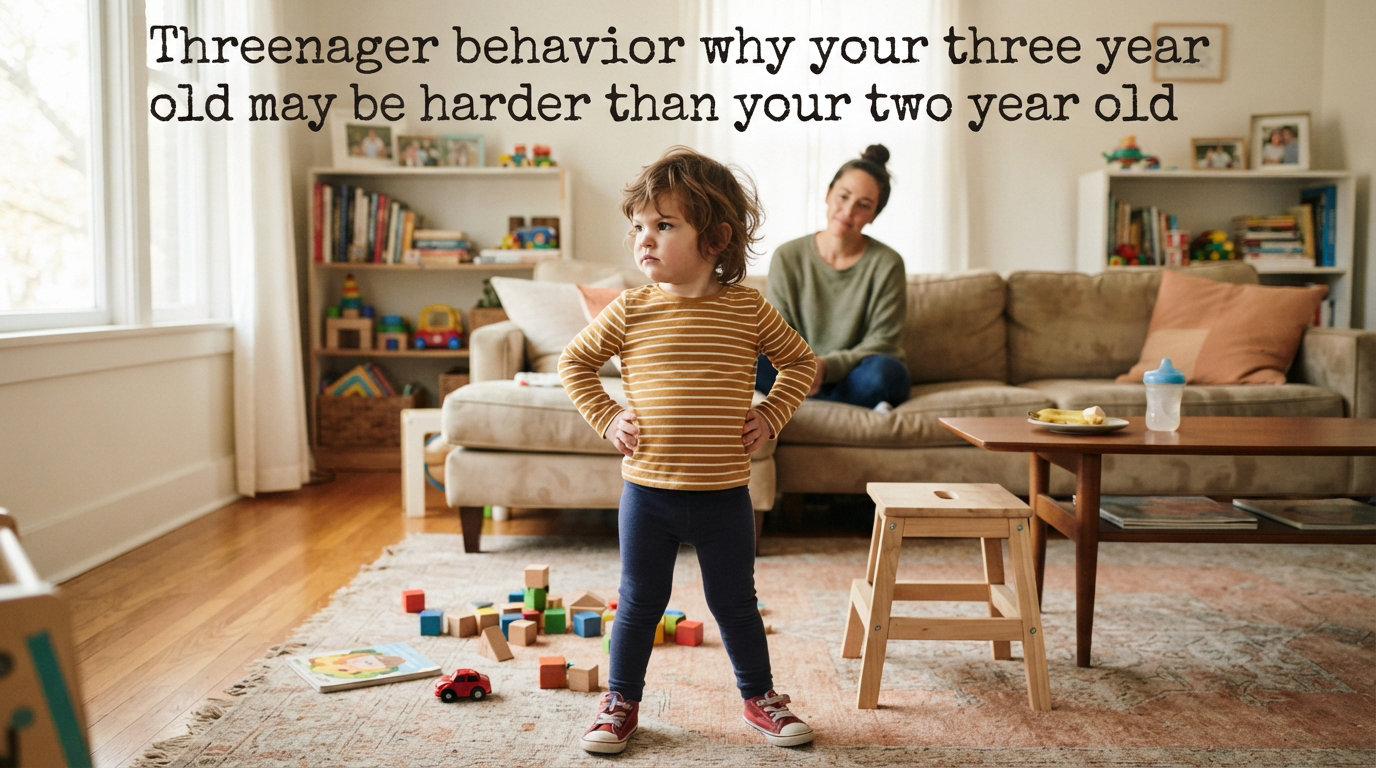
You knew the terrible twos were coming. Every parent warned you about the tantrums, the meltdowns, the irrational demands. You braced yourself for age two and survived. Then your child turned three.
Welcome to the threenager stage. This is where parenting gets truly interesting. If you are currently in the trenches with a three-year-old who acts like a miniature teenager, you are not imagining things. The threenager phase is real, and for many parents, it is significantly harder than the terrible twos ever were.
In this guide, we will explore the science behind threenager behavior and explain why your three-year-old might be harder than your two-year-old was. I will share practical strategies that have worked for thousands of parents, including insights from child development experts and real experiences from parents who have survived this stage.
Table of Contents
What Is a Threenager? Understanding the Term
A threenager is a three-year-old who exhibits the attitude, independence, and emotional intensity typically associated with teenagers. The term combines “three” and “teenager” to describe this unique developmental phase where children develop strong opinions, negotiation skills, and emotional volatility while still lacking the self-regulation to manage their big feelings.
The word has become popular in parenting circles for good reason. At age three, children experience what researchers call a “language explosion” combined with increased independence. They can express complex desires and objections but cannot yet regulate the emotions that come with those desires. This creates what one parent in our research described as “easily at least 2000% worse than the terrible twos.”
Developmental psychologists recognize this as a normal and healthy stage. Your child is not being manipulative or naughty. They are developing a sense of self, testing boundaries, and learning how to exist as an independent person. The challenge is that their cognitive abilities have outpaced their emotional regulation skills by several years.
Age 2 vs Age 3: Key Behavioral Differences
Let us look at exactly what changes between age two and age three. Understanding these differences helps explain why parents often feel blindsided by the intensity of the threenager phase.
The Evolution of Tantrums
At age two, tantrums are often physical and reactive. A two-year-old might collapse on the floor because they cannot communicate what they want. They can often be redirected with a shiny object, a snack, or a change of scenery. Distraction works because their attention span is short and their memory is still developing.
By age three, tantrums become intentional, sustained, and emotionally complex. A threenager knows exactly what they want and will negotiate, argue, or escalate until they get it or exhaust themselves trying. One parent described the difference perfectly: “Twos was like a soothing bubble bath compared to the hurricane of three.”
Language and Communication
Two-year-olds are building vocabulary. They might know 200-300 words and are starting to combine two words together. Frustration comes from not being able to express needs.
Three-year-olds speak in full sentences, ask “why” questions constantly, and can argue with surprising logic. The problem is they use this new language power to debate bedtime, refuse vegetables, and explain why they absolutely cannot wear pants today. Their communication skills have evolved, but their emotional maturity has not kept pace.
Independence vs Helplessness
Two-year-olds want to do things themselves but often need help. They might struggle with zippers, buttons, and opening containers. This can be frustrating, but it is manageable.
Three-year-olds demand complete independence. They want to pour their own milk, buckle their own car seat, and choose their own clothes. When they cannot do these things perfectly, which is often, the resulting meltdown can be epic. They have the will but not always the skill.
Why Is Age 3 Harder Than Age 2?
The transition from two to three represents one of the most significant developmental leaps your child will make. Here are the seven key reasons why this age can feel so much harder than the terrible twos.
1. They Cannot Be Distracted Anymore
At age two, distraction was your superpower. A cookie, a toy, or a silly song could redirect a meltdown in seconds. By age three, that strategy stops working entirely. Threenagers have longer attention spans and better memory. They remember what they were upset about thirty minutes ago and will return to it with fresh intensity.
As one parent shared in our research: “At 3 you have to be direct and in control. You don’t need to explain away everything or make a ton of choices available.” The distraction phase is over. Now you need real strategies.
2. They Know Exactly What They Want
Three-year-olds develop hyper-specific preferences. The peanut butter sandwich must be cut into triangles, not squares. The blue cup is acceptable on Tuesdays but not on Wednesdays. Socks must be pulled up to exactly the same height on both legs.
These preferences are not random. They represent your child’s developing sense of control and order. However, when reality does not match their internal vision, the disappointment is profound and loud. Two-year-olds have preferences. Three-yeargers have requirements.
3. Language Explosion Without Emotional Maturity
Between ages two and three, most children go from speaking 200-300 words to using 1000+ words and speaking in full sentences. This language explosion is exciting but creates a perfect storm.
Your child can now tell you exactly what they want and argue why they should get it. They can negotiate, debate, and stall with surprising skill. However, they still lack the emotional regulation to handle hearing “no.” They have adult-level communication desires with toddler-level emotional control. This mismatch creates daily power struggles.
4. The Brain Development Leap
Here is the science behind the chaos. Between ages two and four, your child’s brain undergoes massive development in the prefrontal cortex. This region controls executive function, impulse control, and emotional regulation.
The prefrontal cortex is under construction during the threenager years. It will not be fully developed until their mid-twenties. So when your three-year-old seems incapable of controlling their emotions or impulses, that is literally true. Their brain hardware for self-regulation does not exist yet. Understanding this helps explain why reasoning with a threenager often feels impossible.
5. Boundary Testing Becomes Intentional
Two-year-olds test boundaries accidentally. They touch the forbidden vase because it is shiny and interesting. When corrected, they might look surprised.
Three-year-olds test boundaries intentionally. They look at you, look at the rule, and then deliberately break it to see what happens. This is not defiance for its own sake. It is how they learn where the limits actually are. But knowing the developmental reason does not make living through it any easier.
6. Physical Capabilities Exceed Judgment
Three-year-olds can climb, run, open doors, use scissors, and operate tablets. Their physical abilities have expanded dramatically from age two. However, their risk assessment abilities remain at toddler level.
This creates constant safety challenges. They can climb to the top of the playground structure but cannot judge whether it is too high. They can open the front door but cannot understand why running into the street is dangerous. Parents of threenagers must be constantly vigilant in ways that were not necessary at age two.
7. The Nap Transition Phase
Many three-year-olds are in the process of dropping their afternoon nap. This transition is brutal for everyone involved. An overtired three-year-old has the emotional regulation of a hungry, sleep-deprived adult.
At age two, most children still nap reliably. By age three, some have stopped entirely while others nap sporadically. The inconsistency makes it hard to plan and predict behavior. One day they nap and are pleasant. The next day they skip the nap and have five meltdowns before dinner.
What Is Actually Happening in Your Child’s Brain?
Understanding the neuroscience behind threenager behavior can help you respond with empathy instead of frustration. Your child is not giving you a hard time. They are having a hard time.
The Prefrontal Cortex Under Construction
The prefrontal cortex, located behind the forehead, is responsible for executive function. This includes impulse control, emotional regulation, planning, and decision-making. In adults, this region helps us pause before reacting, consider consequences, and calm ourselves down.
In three-year-olds, the prefrontal cortex is actively developing but far from complete. Neural connections are being formed at an incredible rate, but the infrastructure for self-regulation simply does not exist yet. When your child has a meltdown over the wrong color cup, they are not choosing to be difficult. They genuinely cannot control the emotional response.
The Amygdala Hijack
While the prefrontal cortex is underdeveloped, the amygdala, the brain’s emotional center, is fully functional. This creates a situation where emotions are felt intensely but cannot be regulated effectively.
Child development experts call this an “amygdala hijack.” The emotional brain takes over completely, and the rational brain cannot step in to calm things down. This is why your child might seem completely irrational during a tantrum. In that moment, they are operating from pure emotion without any regulatory capacity.
The Language-Emotion Gap
Research shows that three-year-olds understand far more language than they can use to regulate themselves. They can tell you what is wrong but cannot talk themselves through the feelings. This gap creates the intense frustration that drives many threenager meltdowns.
As one parent expressed in our research: “My threenager’s emotions are destroying my sanity. Dealing with a threenager’s intense and rapidly shifting emotions can be utterly exhausting.” This is why validation and naming emotions is so important. You are essentially lending your child your prefrontal cortex until theirs develops.
Threenager Survival Guide: 10 Practical Strategies That Work
Now that you understand why your three-year-old behaves the way they do, let us talk about what you can actually do about it. These strategies have been tested by thousands of parents and validated by child development experts.
1. Stay Calm and Unruffled
Your calm becomes their calm. When you react emotionally to their meltdown, you add fuel to the fire. Janet Lansbury, author of “No Bad Kids,” teaches what she calls the “unruffled” approach. This means responding to chaos with matter-of-fact calmness.
Your child needs to know that you can handle their big feelings without falling apart yourself. This creates safety. When you stay calm during their storm, you communicate that their emotions are manageable even when they feel overwhelming.
2. Offer Limited Choices
Three-year-olds need to feel in control, but too many choices overwhelm them. The sweet spot is two options. “Do you want the red shirt or the blue shirt?” “Would you like milk or water?” “Should we brush teeth before or after pajamas?”
Notice that all the choices lead to the same outcome. They will wear a shirt, drink a beverage, and brush their teeth. But giving them agency within the structure reduces power struggles significantly.
3. Use Transition Warnings
Three-year-olds live in the moment. When they are absorbed in an activity, switching to something else feels like an emergency. Transition warnings give their developing brains time to adjust.
Give a five-minute warning, then a two-minute warning, then a one-minute warning. Use visual timers if helpful. This simple practice can prevent half the meltdowns in your day. The world feels more predictable, and predictability reduces anxiety.
4. Validate Big Emotions
Name the feeling without fixing it immediately. “You are frustrated because we have to leave the park.” “You are angry that your tower fell down.” “You are disappointed that we are not having ice cream.”
Validation does not mean giving in. You can acknowledge their feelings while holding your boundary. “I know you are sad about leaving. We will come back tomorrow. Right now it is time to go home.” This helps children feel seen and understood.
5. Pick Your Battles Strategically
Not everything is worth a fight. Safety issues are non-negotiable. Kindness is non-negotiable. But the color of their cup, the order they put on clothes, or whether they wear a raincoat can usually be released.
Ask yourself whether this issue will matter in five years. If the answer is no, consider letting it go. You only have so much energy for battles. Save it for the things that actually matter.
6. Maintain Predictable Routines
Threenagers feel safest when they know what to expect. Consistent routines reduce anxiety and prevent meltdowns. The same bedtime sequence, the same morning routine, the same mealtime rituals all create a sense of security.
When routines must change, give plenty of warning. Visual schedules can help three-year-olds understand the flow of their day. The more predictable their world, the less they need to fight for control.
7. Use Connection Before Correction
Traditional time-outs often backfire with three-year-olds. They feel abandoned in their distress, which increases the behavior you are trying to reduce. Instead, try what some call “time with.”
When your child is struggling, move closer, not farther away. Get down on their level. Offer a hug or simple presence. Once they are regulated, then you can address the behavior. Connection builds cooperation. Isolation builds resentment.
8. Give Them Important Jobs
Three-year-olds desperately want to feel capable and needed. Give them real responsibilities. Let them help with cooking, folding laundry, or caring for pets. These tasks will take longer and be messier than if you did them yourself, but the payoff is worth it.
When children feel competent and helpful, they act out less. They are getting their need for power and significance met in positive ways instead of through negative behavior.
9. Practice Patience with Transitions
Everything takes longer with a three-year-old. Build extra time into your schedule. If you need to leave by nine, start getting ready at eight-thirty. Rushing creates stress, and stress creates meltdowns.
Remember that your child is not trying to make you late. They are trying to master skills that are genuinely difficult for them. Allowing extra time removes the pressure that triggers many power struggles.
10. Prioritize Your Own Wellbeing
You cannot pour from an empty cup. Parenting a threenager is exhausting, and you need care too. Find small moments for yourself. Exercise, social connection, and adequate sleep are not luxuries. They are essential tools for staying regulated yourself.
When you are running on empty, every small challenge feels like a crisis. When you are rested and supported, you can handle the storms with grace. Your wellbeing directly impacts your child’s wellbeing.
Common Threenager Scenarios and How to Handle Them
Let us get specific about the daily battles you are probably facing. Here are strategies for the most common threenager scenarios.
Grocery Store Meltdowns
The grocery store is a threenager minefield. Bright lights, tempting candy, boredom, and the cart strap all create potential for disaster. Go at the right time, not when your child is hungry or tired. Bring snacks. Give them a job like holding the shopping list or finding specific items.
If a meltdown happens anyway, stay calm. Do not negotiate with the audience. Get through checkout as quickly as possible and address the emotions once you are outside. Sometimes you just have to abandon the cart and try again later.
Bedtime Battles
Three-year-olds know that bedtime means separation from you, and they will deploy every stalling tactic known to childkind. More water, different pajamas, one more story, checking for monsters. The key is a consistent routine that is non-negotiable.
Set clear expectations ahead of time. “We will read three books, then lights out.” Use a visual chart if helpful. When they ask for more, validate the desire but hold the boundary. “I know you want more stories. Three books is our limit. I love you. Goodnight.” Then leave.
Mealtime Struggles
Picky eating often emerges at age three. Your child who ate everything at two now only accepts three foods. This is normal and usually temporary. Offer a variety of foods without pressure. Include at least one thing they usually like at each meal.
The parent decides what and when to eat. The child decides whether and how much. Do not make mealtime a battleground. If they refuse dinner, that is their choice. The kitchen closes after mealtime, but do not offer alternative foods. Hunger is a natural consequence that teaches better than any lecture.
Getting Dressed Wars
Morning battles over clothing waste precious energy. Offer limited choices the night before. Lay out two outfits and let them pick. If they refuse both, you choose. Stay calm and matter-of-fact.
Some parents find success by having their child sleep in the next day’s clothes if mornings are particularly difficult. Others keep a small bin of “school clothes” that are all acceptable options. Find what works for your family and stick with it.
Public Tantrums
Nothing tests your resolve like a screaming child in public. Remember that every parent in that store has been there. Most are feeling sympathy, not judgment. Do not let embarrassment pressure you into giving in.
Stay calm. Get to a quieter space if possible. Wait it out without adding fuel. Once the storm passes, comfort your child and move on. Your consistent response teaches them that tantrums do not work, even in public.
When to Seek Professional Help: Red Flags to Watch For
While threenager behavior is challenging, it is typically within the range of normal development. However, some behaviors warrant professional evaluation. Here are the red flags to watch for.
Behavioral Red Flags
Extreme aggression that hurts others regularly is concerning. Occasional hitting is normal at three. Daily violent outbursts that do not respond to intervention may indicate a deeper issue. Regression that lasts more than a few weeks, such as loss of language or toilet skills, should be evaluated.
Complete withdrawal from interaction or play is also a concern. Three-year-olds should engage with others, even if they are sometimes shy or moody. If your child seems disconnected from people entirely, mention it to your pediatrician.
Developmental Concerns
By age three, most children speak in sentences, follow two-step directions, and engage in pretend play. If your child is not meeting these milestones, an evaluation can help identify whether support is needed. Early intervention makes a significant difference when challenges exist.
Trust your instincts. You know your child better than anyone. If something feels wrong, ask your pediatrician. They would rather evaluate a child who turns out to be fine than miss a child who needs support.
FAQ: Threenager Questions Answered
Threenager Behavior: Why Your Three-Year-Old May Be Harder Than Your Two-Year-Old
If you are currently parenting a threenager, know this. The intensity you are experiencing is temporary. This phase, while exhausting, is a sign that your child is developing exactly as they should. The boundary testing, the big emotions, and the fierce independence are all evidence of a healthy, growing brain.
The strategies in this guide have helped thousands of parents navigate this challenging stage. Stay calm. Pick your battles. Validate emotions. Maintain routines. And most importantly, take care of yourself so you can show up fully for your child.
You are not failing. You are parenting through one of the most intense developmental periods your child will experience. The threenager who exhausts you today will be a confident, capable four-year-old before you know it. This too shall pass. And when it does, you will have built the foundation for a strong, connected relationship that lasts a lifetime.
Remember what parents who have survived this stage consistently report. Age three is hard, but it is also magical. The same child who melts down over the wrong color cup will also tell you “I love you” with perfect clarity, create elaborate imaginative worlds, and astound you with their growing competence. The threenager stage is not just about surviving. It is about witnessing the incredible transformation from baby to child.