
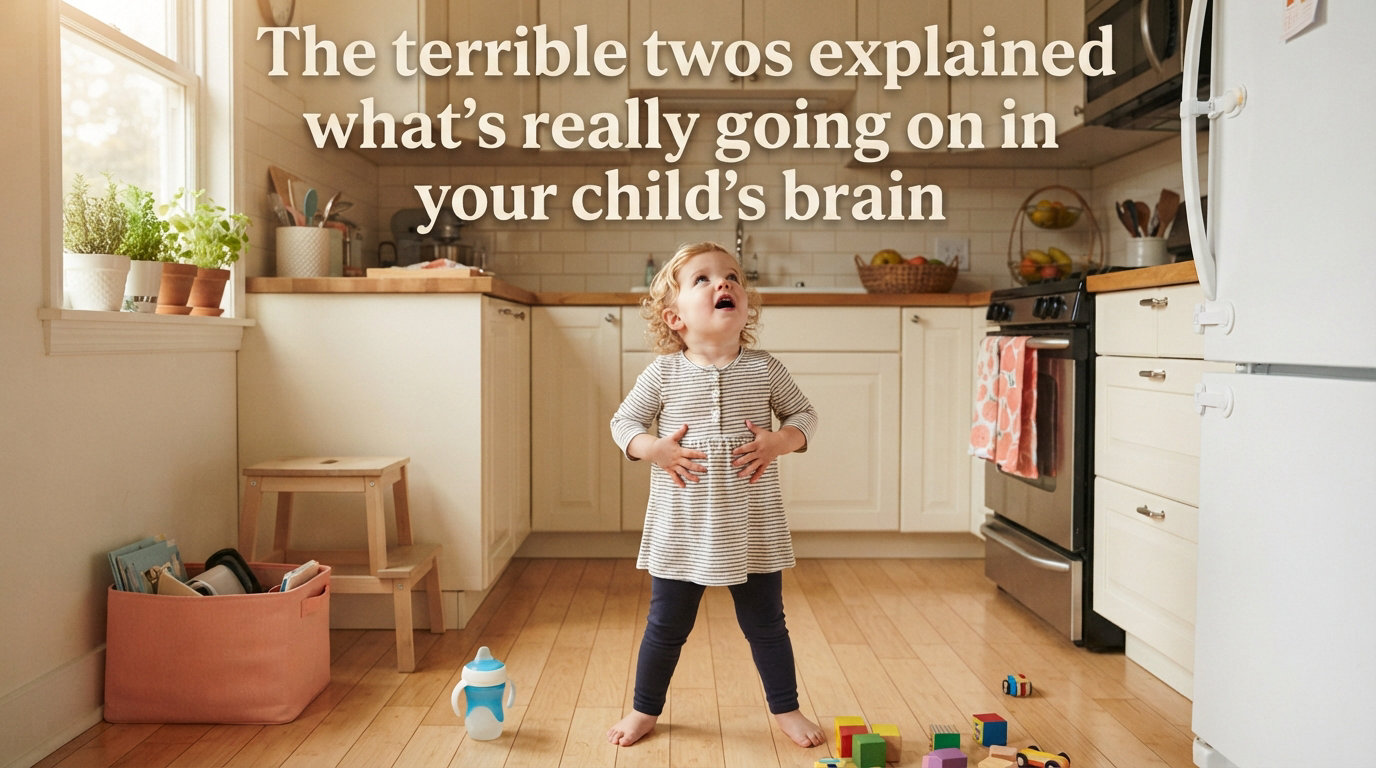
You are standing in the cereal aisle. Your two-year-old is lying face-down on the linoleum, screaming because you handed them the blue cup instead of the red one. The stares burn into your back. You feel the heat rising up your neck as you whisper-hiss, “Please get up.” Nothing works.
I have been there three times with my own children. What I wish I knew then was this: your child is not giving you a hard time. They are having a hard time. And there is fascinating science behind why.
The terrible twos explained through brain science reveals something remarkable. Your toddler’s brain is undergoing one of the most dramatic growth spurts since infancy. This article shows you exactly what is happening in your child’s brain during this phase and gives you practical, science-backed scripts to navigate the storm.
Table of Contents
What Are the Terrible Twos (and Why They Are Actually Incredible)
The terrible twos are a normal developmental phase where toddlers experience rapid brain growth, emerging independence, and a gap between their desires and their ability to communicate them. This typically begins around 18 months and can extend to age three or four.
I prefer to call them the incredible twos.
Yes, the tantrums are exhausting. The defiance tests every ounce of your patience. But beneath those challenging behaviors, your child’s brain is building the foundation for emotional intelligence, self-regulation, and complex reasoning that will serve them for life.
During this window, the brain adds neural connections at a rate of approximately one million per second according to Harvard’s Center on the Developing Child. Your toddler is not broken. They are under construction.
Timeline: When Do the Terrible Twos Start and End
Most parents notice the shift around 18 months when language bursts begin and mobility increases. The peak intensity typically hits between 24 and 30 months. By age three, many children show improved emotional regulation, though some extend into the “threenager” phase.
There is no fixed endpoint. Every brain develops on its own schedule. Your child might sail through at two and hit turbulence at three. Or they might start early and calm by two and a half. Variation is normal.
What Is Happening in Your Child’s Brain During the Terrible Twos
To understand your toddler’s behavior, you need to picture two competing brain systems that are developing at completely different speeds.
The Prefrontal Cortex: The CEO Under Construction
The prefrontal cortex sits behind your forehead and handles executive function. This includes impulse control, emotional regulation, decision-making, and logical reasoning. In adults, this region governs our reactions and keeps us from shouting in grocery stores.
In toddlers, the prefrontal cortex is barely online.
It will not reach full maturity until the mid-twenties. During the terrible twos, it is essentially a construction zone. Neural pathways are being laid, but they are not yet insulated with myelin, the fatty substance that lets signals travel fast. When you ask your two-year-old to “use your words” or “calm down,” you are asking a brain that physically cannot comply yet.
This is why logical reasoning fails during a tantrum. The rational brain is simply not available.
The Amygdala: The Fully Charged Alarm System
While the prefrontal cortex develops slowly, the amygdala is fully operational from birth. This almond-shaped structure deep in the brain processes emotions, especially fear and anger. It is your child’s alarm system, and at age two, it is hypersensitive.
When your toddler encounters frustration, the amygdala fires instantly. It floods the brain with stress hormones before the prefrontal cortex can even register what happened. This is called amygdala hijack, and it explains why a minor disappointment triggers a major meltdown.
Your child is not choosing to overreact. Their brain’s threat detection system is fully armed while their calming system is still being wired.
Neural Pathways and Pruning
The toddler brain creates far more neural connections than it needs. Through a process called synaptic pruning, unused connections get eliminated while frequently used ones strengthen. This is why early experiences matter so much. Every tantrum you navigate with empathy helps build neural pathways for emotional regulation.
Think of it like trails through a forest. The more you walk a path, the clearer it becomes. The terrible twos are when your child is forging the pathways they will use for life to handle big emotions.
The Neuroscience of Tantrums: Why They Cannot Just Calm Down
Here is what most parents do not know. During a full-blown tantrum, your child’s body is experiencing a genuine physiological stress response similar to what an adult feels during a panic attack.
Cortisol: The Stress Hormone Flood
When the amygdala detects a threat (like the wrong cup color), it signals the adrenal glands to release cortisol. This stress hormone prepares the body for fight or flight. Heart rate increases. Breathing accelerates. Blood rushes to muscles and away from the digestive system.
It takes approximately 20 to 30 minutes for cortisol levels to return to baseline after activation. This is why asking a child to “calm down” during a tantrum is biologically unrealistic. Their body is literally in survival mode.
The prefrontal cortex needs cortisol levels to drop before it can come back online. Your job is not to stop the tantrum. Your job is to keep your child safe while their nervous system completes the stress cycle.
Dopamine and the Reward System
Toddlers also have an immature dopamine reward system. Dopamine drives motivation and pleasure. When your child wants something, their brain anticipates a dopamine reward. Being told no triggers a genuine sense of loss at the neurochemical level.
This explains the intensity of reactions to seemingly minor disappointments. To a toddler brain, not getting the blue cup feels like a threat to survival because the anticipated dopamine hit does not arrive.
The Language Gap
At age two, most children understand far more words than they can speak. This receptive language outpaces expressive language by months. Your child knows exactly what they want. They just cannot tell you.
When words fail, the body takes over. Screaming, hitting, and flailing become the communication method. This is not manipulation. It is a child doing the best they can with the tools they have.
Common Terrible Twos Behaviors and the Brain Science Behind Them
Every challenging behavior you see has a neurological explanation. Understanding the why does not mean tolerating harmful behavior, but it does change how you respond.
Defiance and “No”
Two-year-olds say no constantly because they are discovering autonomy. The brain is wired to test boundaries as part of developing a separate self. This is actually healthy. Your child is learning where they end and you begin.
Mood Swings
One minute your toddler is laughing, the next they are sobbing. These rapid mood shifts happen because the brain’s emotional regulation system is still primitive. Without a mature prefrontal cortex to modulate feelings, emotions surge and crash like waves.
Physical Aggression
Biting, hitting, and hair-pulling are communication attempts when language fails. The impulse to strike travels from amygdala to action before the barely-formed prefrontal cortex can intervene. Your child needs you to be their external brain until their internal one develops.
Clinginess and Separation Anxiety
Even as toddlers push for independence, they still need the security of attachment. The brain is learning that you can leave and come back, but this concept is not yet solid. Clinginess peaks when your child is stressed or overtired because their nervous system seeks co-regulation with yours.
How Sleep and Hunger Physically Alter the Toddler Brain
Two biological factors can make the difference between a manageable day and a meltdown marathon. Sleep deprivation and low blood sugar directly impact your child’s ability to regulate emotions.
The Sleep Connection
During sleep, the brain processes experiences and consolidates learning. It also clears cortisol and replenishes neurotransmitters. A tired toddler has an amygdala that fires faster and a prefrontal cortex that functions even slower than usual.
Studies show that even 30 minutes less sleep than needed can significantly reduce a child’s ability to handle frustration. The brain literally loses capacity for impulse control when sleep-deprived.
Blood Sugar and the Brain
The brain consumes 20% of the body’s energy but makes up only 2% of body weight. It is a glucose hog. When blood sugar drops, the prefrontal cortex is the first system to suffer because it requires so much fuel.
A hungry toddler has diminished capacity for self-control before they ever feel physical hunger pangs. Regular protein-rich snacks can prevent many tantrums before they start.
Practical Strategies and Parent Scripts for Tantrum Moments
Now for the part you have been waiting for. What do you actually do when your child is screaming in the cereal aisle? Here are science-backed strategies with exact scripts you can use.
Strategy 1: Co-Regulation Before Direction
Your calm nervous system is your child’s best tool for regulation. When you get loud or tense, their amygdala reads danger and escalates. When you stay calm, your body literally helps theirs settle.
Script: “You are safe. I am right here. We are going to get through this together.”
Say this softly while breathing slowly. Your calm breathing signals safety to their brain. Do not try to reason yet. Just be present.
Strategy 2: Name the Emotion
Labeling emotions activates the prefrontal cortex and begins to downregulate the amygdala. This is called affect labeling in neuroscience research. When children hear their feelings named, the rational brain starts waking up.
Script: “You really wanted the red cup. You are feeling frustrated and disappointed. That is hard.”
Notice there is no “but” in this script. Do not negate the feeling with logic. Just name it and validate it.
Strategy 3: Offer Limited Choices
The toddler brain craves autonomy. Offering controlled choices satisfies this need without creating chaos. Keep choices simple and limited to two options you can live with.
Script: “You can walk to the car or I can carry you. Which works better for you?”
Follow through calmly if they do not choose. “I see you need help. I will carry you now.”
Strategy 4: Wait for the Cortisol Drop
Remember that 20 to 30 minute cortisol window. Do not try to teach, correct, or process during the peak of a tantrum. Your child’s brain cannot absorb it. Keep them safe, stay nearby, and wait.
Script: “I am going to sit right here with you until your body feels better. Take your time.”
After the storm passes and breathing normalizes, then you can talk about what happened.
Strategy 5: Connection Over Correction
When the tantrum ends, your child feels shame and confusion. They need reassurance that your love is unconditional, not contingent on perfect behavior. This builds the secure attachment that will help them develop self-regulation faster.
Script: “That was really hard. I love you even when you have big feelings. We will figure this out together.”
Avoid post-tantrum lectures. The learning happens through co-regulation, not words.
When to Seek Help vs. What Is Normal?
Most terrible twos behavior is completely normal, even when it feels extreme. But there are red flags that warrant professional consultation.
What Is Normal
Daily tantrums that last 2 to 20 minutes are typical. Aggression that decreases as language increases is normal.
Mood swings throughout the day are expected. Defiance is developmentally appropriate.
Red Flags to Discuss with Your Pediatrician
Tantrums that last longer than 25 minutes multiple times daily may signal a need for support. Aggression that does not decrease as language develops could indicate underlying challenges.
Regression in skills like toilet training or language warrants evaluation. Extreme withdrawal or fearfulness that persists needs attention. Trust your instincts. You know your child better than any article. If something feels off, ask. Early intervention helps when challenges exist.
Frequently Asked Questions About the Terrible Twos
What is the 7 7 7 rule for parenting?
The 7 7 7 rule suggests asking yourself if a parenting issue will matter in 7 days, 7 weeks, or 7 years. If it will not matter in 7 days, let it go. This perspective helps parents focus on what truly matters for long-term development rather than getting caught in daily power struggles.
How long do the terrible twos usually last?
The terrible twos typically begin around 18 months and peak between 24 to 30 months. Most children show significant improvement by age three, though some continue into the threenager phase. Every child develops on their own timeline. Some breeze through quickly while others need more time for their prefrontal cortex to mature.
What is the 80 20 rule for toddlers?
The 80 20 rule for toddlers suggests picking your battles. Let 80% of minor issues go and focus your energy on the 20% that actually matters for safety and core values. This reduces power struggles while maintaining necessary boundaries. Not every hill is worth dying on when parenting a two-year-old.
Do 2 year olds remember being yelled at?
Yes, two-year-olds can remember being yelled at, though not in the same way adults do. They store emotional memories in the amygdala before explicit memory systems develop. Repeated yelling can shape their stress response systems and attachment patterns. It affects how safe they feel with you, even if they cannot recount specific incidents later.
What is the psychology behind the terrible twos?
The psychology of the terrible twos centers on autonomy versus shame and doubt, Erikson’s second developmental stage. Toddlers are discovering they are separate people with their own wills. Their brains crave independence but lack the skills to execute it. This creates an internal conflict between wanting to do everything themselves and needing help, producing frustration that manifests as tantrums and defiance.
What is the 3 3 3 rule for toddlers?
The 3 3 3 rule is a grounding technique adapted for young children. Have them name 3 things they can see, 3 things they can hear, and 3 things they can touch. This simple sensory exercise helps activate the prefrontal cortex and calm the amygdala during emotional overwhelm. It works best when practiced during calm moments first.
What are the red flags for 2.5 year old behavior?
Red flags at 2.5 years include tantrums lasting over 25 minutes multiple times daily, aggression that is not decreasing as language develops, loss of previously acquired skills, extreme social withdrawal, lack of eye contact, and no interest in interactive play. Consult your pediatrician if you notice these patterns. Trust your instincts as a parent.
Conclusion: The Terrible Twos Explained Is a Story of Growth
When you understand the terrible twos explained through brain science, everything changes. Your child is not defying you. They are developing. Their brain is building the neural architecture for a lifetime of emotional intelligence and self-regulation.
Every tantrum you navigate with empathy strengthens the pathways they will use as adults to handle conflict, disappointment, and stress. You are not just surviving this phase. You are actively building your child’s brain.
The red cup versus blue cup battles will end. The screaming in grocery stores will fade. What remains are the neural connections formed through your calm presence during their hardest moments. That is the incredible part of the terrible twos.
You have got this. And your child has got you.