
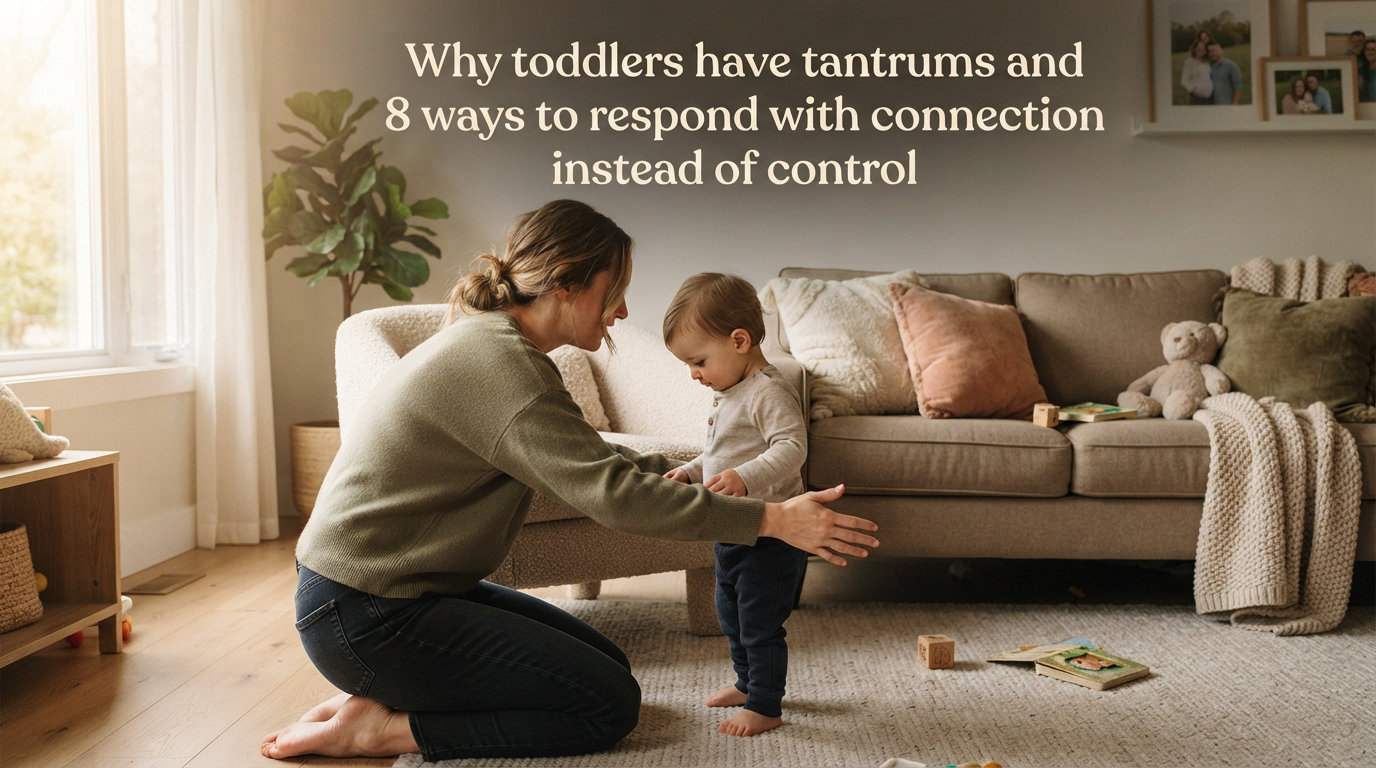
You’re in the grocery store checkout line. Your toddler collapses on the floor, screaming because they want a candy bar. Other shoppers are staring. You feel your face heating up, your heart racing, and that familiar mix of embarrassment, frustration, and helplessness washing over you.
We’ve all been there. Toddler tantrums are one of the most challenging aspects of parenting, leaving even the most patient caregivers feeling overwhelmed and questioning their approach.
But what if I told you that tantrums aren’t signs of bad parenting or a “difficult” child? What if these intense moments are actually opportunities to build connection, teach emotional regulation, and strengthen your relationship with your child?
In this guide, I’ll share why toddler tantrums happen from a brain science perspective, and eight connection-based strategies that transform these challenging moments into opportunities for growth and bonding.
Table of Contents
Why Toddlers Have Tantrums: The Brain Science Behind the Meltdowns
Toddler tantrums aren’t manipulation or defiance—they’re a normal, healthy part of child development. Understanding what’s happening in your child’s brain can help you respond with empathy instead of frustration.
The Developing Brain: Why Toddlers Can’t Self-Regulate
Your toddler’s brain is undergoing incredible growth and development. The prefrontal cortex—the part of the brain responsible for emotional regulation, impulse control, and rational thinking—won’t be fully developed until their mid-twenties.
Right now, your toddler’s brain is dominated by the amygdala, the emotional center that triggers fight, flight, or freeze responses. When big emotions hit, their amygdala activates and their underdeveloped prefrontal cortex can’t step in to help them regulate. The result? A full-blown tantrum.
This isn’t a behavior problem. It’s a developmental reality. Your child literally lacks the brain architecture to manage big emotions on their own. They need you to co-regulate with them—to lend them your calm until they develop their own.
Common Tantrum Triggers
Understanding what triggers tantrums can help you prevent some meltdowns and respond more effectively to others. Research shows that most toddler tantrums stem from a few core needs:
Overstimulation: Too much noise, activity, or sensory input overwhelms their developing nervous system
Frustration tolerance limits: They want to do something themselves but lack the motor skills or problem-solving abilities
Communication barriers: They understand more than they can express, creating intense frustration
Unmet physical needs: Hunger, fatigue, or discomfort make emotional regulation nearly impossible
Transition challenges: Switching activities or leaving something enjoyable is genuinely difficult for their developing brain
Boundary testing: They’re learning how the world works and need to test limits to understand them
Why Tantrums Are Actually Healthy
Here’s something that might surprise you: tantrums serve an important developmental purpose. During a tantrum, your child is practicing experiencing and expressing intense emotions. They’re learning that feelings—even overwhelming ones—are safe to feel and can pass.
Research shows that children who experience connection-based responses to tantrums develop better emotional regulation skills, stronger secure attachment, and even higher emotional intelligence as adults. These challenging moments aren’t problems to solve—they’re opportunities to teach your child that they’re safe, loved, and capable of handling big feelings.
Connection vs Control: Understanding the Difference
How you respond to your child’s tantrums shapes their developing brain and your long-term relationship. Let’s compare control-based approaches (which may stop the behavior in the moment) with connection-based approaches (which build skills and trust over time).
| Control-Based Response | Connection-Based Response |
|---|---|
| “Stop crying or I’ll give you something to cry about” | “I can see you’re really upset. I’m here with you.” |
| Time-out alone in another room | Time-in together: “Let’s take a break and breathe together” |
| Ignoring the tantrum completely | Validating emotions: “You really wanted that toy. It’s hard when we can’t have what we want.” |
| Distraction or bribing to stop crying | Staying present: “I’ll stay right here while you work through these big feelings.” |
| Shaming: “You’re acting like a baby” | Normalizing: “Big feelings are hard. Everyone feels this way sometimes.” |
| Punishment or consequences after the tantrum | Problem-solving after calm: “When you’re ready, let’s think about what might help next time.” |
| Short-term: May stop the behavior quickly | Long-term: Builds emotional regulation skills and trust |
| Long-term: Can damage attachment and increase anxiety | Long-term: Strengthens secure attachment and emotional intelligence |
8 Ways to Respond with Connection Instead of Control
Now let’s dive into eight practical, connection-based strategies you can use during your child’s next tantrum. These approaches work with your child’s developing brain rather than against it, teaching emotional regulation skills that last a lifetime.
1. Stay Calm and Regulate Yourself First
Before you can help your child regulate, you need to regulate yourself. This isn’t about being perfect—it’s about modeling that big feelings are manageable and that calm is possible even in intense moments.
Why this works: Your nervous system and your child’s are connected. When you stay calm, you activate your prefrontal cortex and can actually lend that regulation to your child through co-regulation.
Try these scripts:
“I’m going to take a deep breath. I can feel my own big feelings, and I’m okay.”
“I’m here. I can handle this. We’ll get through this together.”
“I feel frustrated too, and I’m going to take a moment to breathe.”
In practice: When your child melts down, pause. Take three slow breaths. Drop your shoulders. Remind yourself: this isn’t an emergency, this is development happening. Your calm presence is the most powerful tool you have.
2. Validate Their Emotions Without Judgment
Validation doesn’t mean giving in to whatever your child wants. It means acknowledging that their feelings are real and understandable, even when their behavior isn’t okay.
Why this works: When children feel understood, the intensity of their emotions often decreases. Validation communicates that their feelings matter and they’re not alone in experiencing them.
Try these scripts:
“You really wanted that candy bar. It’s disappointing when we can’t have what we want.”
“You’re so frustrated that the tower fell down. You worked hard on that.”
“You’re mad that we have to leave the park. You were having so much fun.”
“It feels unfair to you right now. I understand.”
In practice: Get down to your child’s eye level. Use a calm, gentle voice. Name what you see them feeling without trying to fix it or make it stop. Remember, feelings aren’t the problem—it’s how they express them that we’re teaching.
3. Offer Physical Connection and Comfort
Physical connection through gentle touch, hugs, or simply sitting near your child can be incredibly regulating during a tantrum. Of course, always respect your child’s boundaries if they push you away.
Why this works: Physical touch releases oxytocin, the bonding hormone that promotes calm and connection. For toddlers whose brains are developing, physical co-regulation is often more effective than words alone.
Try these approaches:
“I’m right here. Would you like a hug, or do you want some space?”
Sit nearby and offer a hand for them to hold if they want
Gentle back rubs or stroking their hair if they’re receptive
“I’ll stay close while you have these big feelings.”
In practice: Some children crave physical connection during tantrums, while others feel crowded and need space. Let your child guide you. The key is communicating that you’re available and not abandoning them, even when things are hard.
4. Use Simple, Clear Language
During a tantrum, your child’s thinking brain is offline. Long explanations and complex reasoning won’t penetrate the emotional storm. Keep your language simple, direct, and repetitive.
Why this works: The prefrontal cortex, responsible for processing complex language and logic, is essentially shut down during intense emotion. Simple words are more likely to be understood and provide a sense of predictability and safety.
Try these scripts:
“You’re safe. I’m here.”
“Big feelings. I’ll stay with you.”
“It’s okay to cry. I’m not going anywhere.”
“You’re mad. That’s okay. I love you.”
In practice: Repeat the same comforting phrase rather than offering new information. Think of yourself as a steady anchor in their emotional storm—consistent, calm, and present. Save the teaching and problem-solving for after the storm passes.
5. Create a Safe Space for Big Feelings
Designate a calm-down corner or cozy space where your child can experience big emotions safely. This isn’t a punishment space—it’s a tool for emotional regulation.
Why this works: A dedicated calm-down space provides sensory tools and a predictable environment that supports emotional regulation. Over time, children learn to use this space independently when they feel overwhelmed.
What to include:
Soft pillows or a bean bag chair
Sensory tools: squishy toys, weighted animals, textured items
Calming visuals: glitter jars, calm-down bottles
Comfort items: stuffed animals, blankets
Books about feelings
Try these scripts:
“Let’s go to our calm-down space together.”
“You’re having big feelings. Let’s go get cozy.”
“Would the glitter jar help you feel calmer?”
In practice: Introduce the calm-down space during happy times, not during tantrums. Practice using it together so it feels familiar and safe when emotions run high. Remember, this isn’t time-out—you go WITH them, not sending them alone.
6. Practice Time-In Instead of Time-Out
Time-in means staying with your child through their big emotions rather than sending them away to regulate alone. This connection-based approach teaches emotional regulation through relationship.
Why this works: Children learn emotional regulation through co-regulation—they need to experience calm in the presence of another person before they can access it themselves. Time-in builds the neural pathways for self-regulation over time.
Try these scripts:
“I’m going to stay right here with you while you feel these big feelings.”
“You’re having a hard time. Let’s take a time-in together.”
“I’m not going anywhere. I’ll keep you safe while you’re upset.”
In practice: Sit near your child, perhaps offering gentle touch if they’re receptive. Model calm breathing. You don’t need to do anything special—your calm, steady presence is enough. You’re teaching them that they don’t have to be alone with difficult emotions.
7. Set Clear Boundaries with Empathy
Connection doesn’t mean permissive parenting. You can hold boundaries firmly while also empathizing with your child’s feelings about those boundaries. In fact, children feel safer when they know the limits.
Why this works: Boundaries communicated with empathy teach children that their feelings are acceptable even when their behavior isn’t. This distinction is crucial for developing emotional intelligence and self-regulation.
Try these scripts:
“I won’t let you hit. Hitting hurts. You can be mad, but I won’t let you hurt anyone.”
“We’re not buying a toy today. I know that’s disappointing. It’s okay to feel sad about it.”
“I can’t let you throw food. If you need to throw something, let’s throw this soft ball instead.”
“The boundary is no screen time right now. You can be upset about that. I’ll sit with you while you feel mad.”
In practice: Hold the boundary firmly but kindly. Validate the feelings while redirecting the behavior. Remember: you’re teaching them how to handle disappointment, which is a crucial life skill they’ll need forever.
8. Reconnect After the Storm
Once the tantrum passes and your child is calm, take time to reconnect and repair any disconnection that occurred during the emotional storm. This is also the time for teaching and problem-solving.
Why this works: The post-tantrum period is when your child’s thinking brain comes back online. This is when learning can happen, and when you can strengthen your relationship after a challenging moment.
Try these scripts:
“You worked through those big feelings. I’m proud of you.”
“That was really hard, wasn’t it? We did it together.”
“I love you, no matter what you’re feeling.”
“Next time, what might help? Would you like to try taking deep breaths together?”
In practice: Offer a hug. Talk briefly about what happened, keeping it simple. Focus on problem-solving rather than shame: “Next time you’re frustrated, we can try…”. And remember to forgive yourself for any moments where you didn’t respond perfectly—we’re all learning.
Prevention Strategies: Reducing Tantrum Triggers
While tantrums are a normal part of toddler development, some meltdowns can be prevented or minimized with thoughtful strategies:
Maintain consistent routines: Predictability creates safety for toddlers. Try to keep meals, naps, and bedtime at consistent times.
Offer choices: Give your toddler age-appropriate control: “Would you like the red cup or blue cup?” This reduces power struggles.
Preview transitions: Give warnings before changes: “In five minutes, we’re leaving the park.” Use visual timers if helpful.
Check basic needs: Many tantrums stem from hunger, fatigue, or discomfort. Regular snacks and rest can prevent meltdowns.
Reduce overstimulation: Notice your child’s tolerance for noise, activity, and sensory input. Build in quiet time before they become overwhelmed.
Teach emotional vocabulary: Name feelings throughout the day: “You look frustrated that the puzzle piece won’t fit.” This helps them identify emotions before they become overwhelming.
When to Seek Professional Help
While tantrums are normal, there are times when professional support can be helpful. Consider consulting your pediatrician or a child development specialist if:
Tantrums continue past age 4 with no improvement
Your child hurts themselves or others during tantrums frequently
Tantrums occur more than 10-15 times per day
Your child has difficulty with language, social interaction, or other developmental areas
You feel overwhelmed or are having difficulty staying safe during tantrums
Tantrums seem particularly intense or prolonged compared to other children the same age
Seeking help isn’t a sign of failure—it’s a sign of proactive, attentive parenting. Sometimes professional support can make a tremendous difference for both child and caregiver.
FAQs
How to respond when a toddler is having a tantrum?
Stay calm and get down to their eye level. Validate their emotions without judgment: You really wanted that toy. It’s hard when we can’t have what we want. Offer physical connection if they want it. Use simple, repetitive language like I’m here, you’re safe. Hold boundaries firmly but with empathy. Stay present through the storm rather than sending them away. Reconnect and problem-solve after they’re calm.
What is the 80 20 rule for toddlers?
The 80/20 rule suggests that 80% of your interactions with your child should be positive, warm, and responsive, while only 20% involve correction or discipline. This ratio builds a strong relationship and makes your child more receptive to guidance. When the relationship bucket is full of positive connection, children are better able to handle the necessary boundaries and limits.
What is the psychology of toddler tantrums?
Toddler tantrums stem from immature brain development. The prefrontal cortex, responsible for emotional regulation and impulse control, won’t fully develop until the mid-twenties. When toddlers experience big emotions, their amygdala emotional brain activates and their underdeveloped thinking brain can’t regulate it. Tantrums are their way of expressing overwhelming feelings with the tools they currently have.
Should I ignore 2 year old tantrums?
Ignoring tantrums can make children feel abandoned and alone with overwhelming emotions, which increases distress and damages attachment. Connection-based approaches recommend staying present and calm while validating feelings. This doesn’t mean giving in to whatever they want—it means acknowledging their emotional experience while holding boundaries. Your calm presence teaches them emotional regulation through co-regulation.
How long do toddler tantrums typically last?
Most toddler tantrums last between 2-15 minutes, though they can feel much longer to parents. The duration varies based on the child’s temperament, how tired or hungry they are, and how adults respond. Connection-based responses that validate emotions and stay present often result in shorter tantrums over time as children learn to trust their feelings and regulate more effectively. If tantrums regularly last longer than 30 minutes or occur multiple times daily, consult your pediatrician.
Conclusion: Tantrums as Opportunities for Connection
Toddler tantrums are exhausting, challenging, and sometimes downright embarrassing. But they’re also opportunities—opportunities to teach your child that they’re safe, that their feelings matter, and that they can handle big emotions with support.
When you respond with connection instead of control, you’re building neural pathways for emotional regulation that will serve your child for a lifetime. You’re strengthening secure attachment and teaching them that they don’t have to be alone with difficult feelings. Most importantly, you’re preserving your relationship while teaching crucial skills.
The next time your child melts down in the grocery store, take a deep breath. Remember: this isn’t an emergency, this is development. Your calm, connected presence is exactly what they need. You’ve got this, and you’re not alone in this journey.
Remember, responding with connection doesn’t mean every tantrum will disappear or that you’ll never feel frustrated again. It means you’re choosing to build relationship and skills rather than just stopping behavior in the moment. And that choice matters—for your child’s developing brain and for your long-term relationship.