
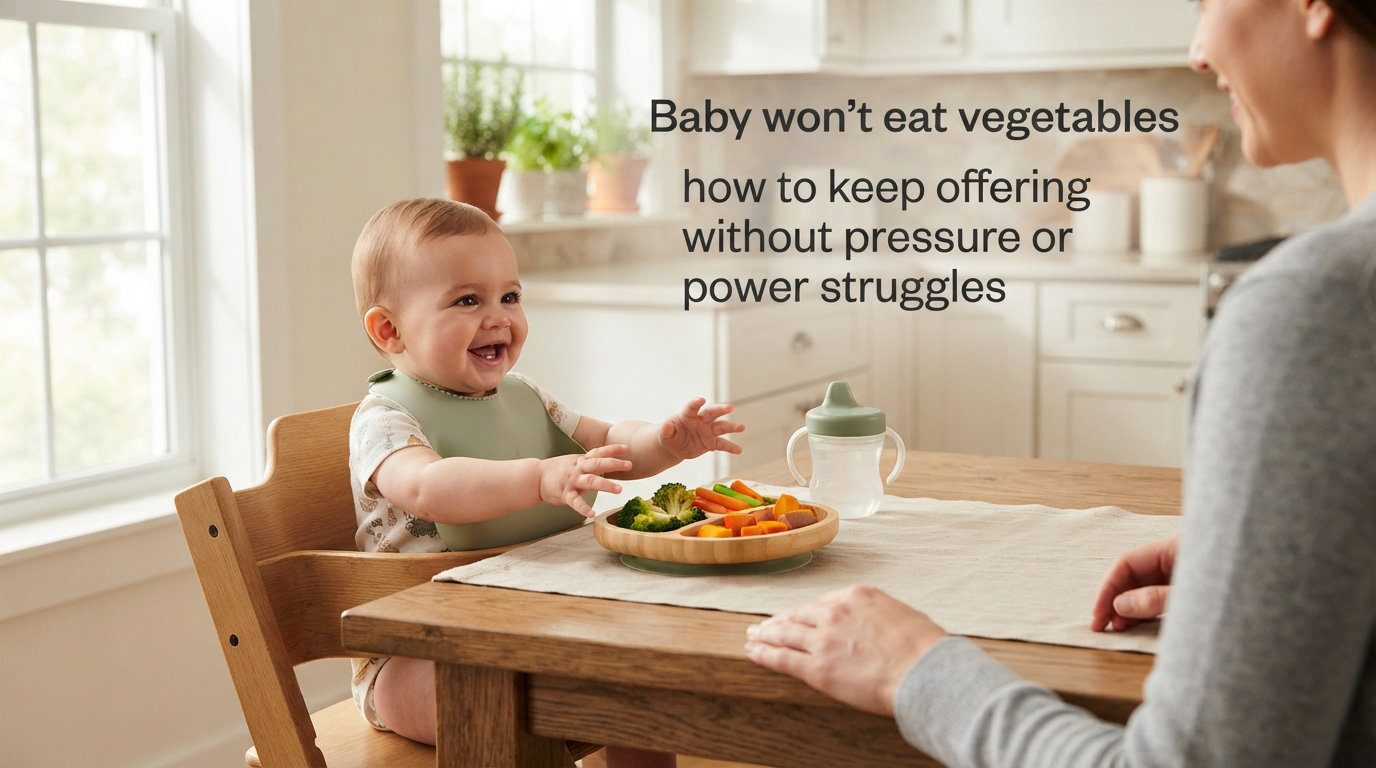
You’ve done everything right. You started with vegetables during weaning. You modeled healthy eating. You read all the books about baby won’t eat vegetables how to keep offering without pressure. Yet here you are, watching your little one push away yet another piece of broccoli with a look of pure disgust.
I hear you. After raising four children and talking with thousands of parents over the years, I can tell you this: you are not failing. Your baby is not broken. Vegetable refusal is one of the most common developmental phases parents face, and it is almost always temporary.
The parents I talk with often share the same feelings of defeat. One mother told me she cried after her 21-month-old refused every vegetable for three weeks straight. Another dad confessed he felt judged at family dinners when his toddler ate only bread. These emotions are real, and they matter. But so does your response to them.
Table of Contents
Quick Answer: 10 Ways to Help Your Baby Accept Vegetables Without Pressure
If you need strategies you can use today, here are the ten most effective approaches for helping babies and toddlers accept vegetables:
- Keep offering the same vegetable 10 to 20 times before deciding they don’t like it
- Model eating vegetables yourself without pushing them to do the same
- Involve your baby in washing, tearing, or preparing vegetables
- Serve vegetables first when they are hungriest
- Try raw versions with dips instead of always serving cooked
- Make it fun with silly faces, shapes, or playful names
- Offer frozen peas or vegetables as crunchy snacks
- Allow food play and exploration without correcting them
- Keep portions tiny – one bite is enough
- Never force, bribe, or use vegetables as a condition for dessert
Why Babies and Toddlers Refuse Vegetables
Understanding why your baby rejects vegetables helps you respond with patience instead of frustration. There are biological and developmental reasons for this behavior that have nothing to do with your parenting.
Food Neophobia: The Fear of New Foods
Food neophobia is a natural survival instinct. In evolutionary terms, being cautious about unfamiliar foods protected young children from eating poisonous plants. This instinct typically peaks between ages two and six, but it can start as early as the first birthday. Your baby is not being stubborn. They are being human.
Taste Buds and Bitter Sensitivity
Babies are born with more taste buds than adults, and many are particularly sensitive to bitter compounds found in vegetables like broccoli, Brussels sprouts, and kale. What tastes mildly pleasant to you might taste intensely bitter to your child. This sensitivity typically decreases with age, which is one reason repeated exposure works.
Texture Sensitivity and Oral Motor Development
Some babies gag on certain textures because their oral motor skills are still developing. Gagging is actually a protective reflex, not a sign that something is wrong. A parent on Reddit shared that her baby “gags SO badly on vegetables then refuses another bite.” This is developmentally normal. Softening textures or offering smoother preparations can help during this phase.
The Independence Phase
Between 12 and 24 months, most children enter a phase of asserting autonomy. Controlling what goes into their mouth is one of the few ways they can exercise independence. When you pressure them to eat vegetables, they may refuse precisely because they feel you are taking away their control. This is why a no-pressure approach works so well.
Why the No-Pressure Approach Works
When we pressure our children to eat vegetables, we unintentionally create the exact outcome we are trying to avoid. The research on feeding dynamics is clear: children who experience pressure around eating develop more persistent picky eating patterns than those who are allowed to explore food at their own pace.
The 5 P’s of Picky Eating
Understanding the 5 P’s helps identify what might be driving your child’s refusal:
- Palette: The actual taste experience, including sensitivity to bitter flavors
- Pain: Physical discomfort from digestive issues, teething, or oral motor challenges
- Processing: Sensory processing differences that make certain textures overwhelming
- Pressure: External demands that create anxiety around eating
- Power: The struggle for autonomy and control at mealtime
The first three P’s are physical factors that require accommodation. The last two are relational factors that parents can directly influence. Removing pressure and power struggles addresses half the equation immediately.
Building Trust at the Table
Every time you respect your child’s “no thank you” without pushing, you build trust. That trust is the foundation for future food acceptance. One parent on Reddit shared their success story: “Keeping offering without pressure – eventually child took a bite.” It took weeks, but the lack of pressure allowed the child to explore on their own terms.
Core Strategies for Vegetable Acceptance
These ten strategies give you practical tools for helping your baby develop a positive relationship with vegetables. Use them consistently, and remember that patience matters more than perfection.
1. The 10 to 20 Times Rule
Research consistently shows that children need 10 to 20 exposures to a new food before accepting it. An exposure means the food is on their plate, not that they eat it. Keep offering that zucchini without comment. One day, they might surprise you.
2. Model Without Pushing
Eat vegetables yourself. Enjoy them visibly. Comment casually about how crunchy the carrots are or how sweet the peppers taste. But never say “see, mommy likes it, you should too.” That creates pressure. One parent found success with “over-the-top ‘yum yum’ expressions” without directing the performance at the child.
3. Involve Them in Preparation
Even babies can participate. A 10-month-old can watch you wash vegetables. A toddler can tear lettuce or snap green beans. When children help prepare food, they feel ownership and curiosity. This involvement creates positive associations before the food even reaches their plate.
4. Serve Vegetables First
When your baby is hungriest, they are most likely to try new foods. Put vegetables on the table first, before the main course or starches. Many parents report that “serving veggies first when child is hungry worked better” than offering everything at once.
5. Try Raw Instead of Cooked
Some babies prefer the crisp texture of raw vegetables over soft cooked versions. Raw cucumbers, bell peppers, and carrots (age-appropriately prepared) might be more appealing than their cooked counterparts. Always consider choking hazards and offer appropriate sizes and textures for your child’s developmental stage.
6. Offer Dips and Sauces
Hummus, yogurt-based ranch, mashed avocado, or bean dips can make vegetables more approachable. Dips add flavor, moisture, and an element of play. Let your child control how much dip they use. Some might dip a carrot and lick the hummus off ten times before taking a bite. That counts as exposure.
7. Make It Fun and Silly
Play reduces tension. Make broccoli “trees” that dinosaurs eat. Create a cucumber “train” on the plate. Have vegetables “talk” to each other in funny voices. Occupational therapists emphasize that silly engagement strategies work because they shift the emotional tone from anxious to curious.
8. Try Frozen Vegetables as Snacks
Frozen peas, corn, or even green beans can be refreshing teething relief and an interesting snack. The cold temperature changes the flavor profile and adds sensory interest. Multiple parents have shared that “frozen peas as snack was a surprising win” when all other vegetables failed.
9. Allow Food Play
Let your baby squish cooked carrots. Allow them to stack pepper slices. If they want to line up green beans instead of eating them, that’s okay. Food play is food exploration. As one occupational therapist explained, exploration leads to eating. The more comfortable they become handling a food, the more likely they are to taste it.
10. Keep Portions Tiny
One bite is enough. A full plate of rejected broccoli feels like failure. A single piece of broccoli that gets touched or licked is progress. Serve micro-portions alongside familiar foods. This reduces overwhelm and gives your child a sense of manageability.
Raw vs. Cooked: Finding What Works
Many parents assume cooked vegetables are easier for babies, but texture preferences vary widely. Some babies gag on mushy foods but happily gum a raw cucumber slice. Others prefer the soft consistency of roasted vegetables. Experiment with both approaches.
| Raw Vegetables | Cooked Vegetables |
|---|---|
| Crunchy, fresh texture | Soft, easy to gum |
| More intense flavors | Milder, sweeter flavors |
| Good for teething relief | Easier for limited oral motor skills |
| Best options: cucumber, peppers, carrots (grated), avocado | Best options: roasted squash, steamed broccoli, mashed sweet potato |
| Serve with dips for moisture | Can be mixed with familiar foods |
Try offering the same vegetable both ways on different days. Your child might reject cooked carrots but happily accept grated raw carrot. Texture is often the deciding factor, not the vegetable itself.
Cooking Together: The Secret Weapon
Involving your baby in food preparation is one of the most powerful strategies for building vegetable acceptance. When children participate in cooking, they develop curiosity and investment in the outcome.
Age-Appropriate Kitchen Tasks
Even young children can participate meaningfully. Here are ways to involve them by age:
6 to 12 months: Watch from a high chair while you wash and chop. Let them touch safe ingredients. Narrate what you are doing.
12 to 18 months: Tear lettuce leaves, snap green beans, or wash vegetables in a bowl of water. Let them explore textures with supervision.
18 to 24 months: Stir ingredients, place vegetables on a tray for roasting, or help transfer cut vegetables to a bowl.
2 years and up: Help with peeling (soft items), using child-safe cutters, or sprinkling seasonings.
The Taste-Testing Window
While cooking, taste ingredients casually without asking your child to do the same. Pick up a piece of pepper and eat it while continuing your task. This modeling during preparation creates low-pressure exposure. One parent noted that “occasionally picking out a bite and tasting it so they see the action as an option” worked better than direct requests.
The 90-90-90 Rule for Better Eating
Proper positioning at meals supports better eating. The 90-90-90 rule refers to three right angles that create optimal stability for feeding.
- 90 degrees at the hips: Bottom positioned back in the chair or high chair
- 90 degrees at the knees: Legs bent comfortably with feet supported
- 90 degrees at the ankles: Feet flat on a footrest or floor
When a child’s feet dangle, they use core muscles to stabilize instead of focusing on eating. Proper positioning helps them feel secure and in control. This stability is especially important for babies who are tentative about new textures. Many high chairs have adjustable footrests, or you can use a box or step stool to create foot support.
When to Seek Professional Help
Most vegetable refusal is a normal developmental phase that resolves with time and consistent, low-pressure exposure. However, some signs indicate that professional support might be helpful.
Signs That Warrant Evaluation
- Your child eats fewer than 20 different foods consistently
- They eliminate entire food groups or all foods of a certain texture
- They show extreme distress, gagging, or vomiting when presented with new foods
- Weight gain has stalled or they are losing weight
- Mealtimes are consistently stressful for the entire family
- They have difficulty swallowing or frequent choking incidents
Feeding Therapy Options
Pediatric feeding therapists, often occupational therapists or speech-language pathologists, specialize in helping children with feeding challenges. They can assess oral motor skills, sensory processing, and mealtime dynamics. If you are concerned, ask your pediatrician for a referral to a feeding clinic or therapist.
How Long Is Too Long?
If your baby has refused all vegetables for more than three months despite consistent exposure, or if their food repertoire is shrinking instead of expanding, consider consulting a professional. Trust your instincts. You know your child better than anyone, and seeking help is a sign of strength, not failure.
Frequently Asked Questions
What to do if my baby won’t eat vegetables?
Keep offering vegetables without pressure. Model eating them yourself, involve your baby in preparation, and try different textures and cooking methods. Allow 10 to 20 exposures before expecting acceptance. Never force or bribe. Make it fun, serve tiny portions, and consider dips or sauces. Most vegetable refusal is a normal developmental phase.
What is the 90 90 90 rule for feeding?
The 90-90-90 rule refers to three right angles that create optimal eating posture: 90 degrees at the hips, 90 degrees at the knees, and 90 degrees at the ankles. This positioning provides stability so your child can focus on eating instead of balancing. Feet should be supported on a footrest or floor, not dangling.
What can I give my child who won’t eat vegetables?
Focus on fruits with similar nutrients while continuing vegetable exposure. Berries, oranges, and kiwi offer vitamin C. Sweet potatoes and mango provide beta-carotene. You can also try vegetable-based smoothies, soups, or fortified foods. Remember these are temporary bridges, not permanent replacements. Keep offering vegetables regularly.
What are the 5 P’s of picky eating?
The 5 P’s are Palette (taste sensitivity including bitterness), Pain (physical discomfort), Processing (sensory issues), Pressure (external demands), and Power (control struggles). The first three are physical factors requiring accommodation. The last two are relational factors parents can address by removing pressure and avoiding power struggles.
How many times should I offer the same vegetable?
Research shows children need 10 to 20 exposures to accept a new food. An exposure means the food appears on their plate, not that they eat it. Continue offering the same vegetable in different preparations without pressure. One day they might touch it, another day smell it, and eventually taste it.
Should I hide vegetables in other foods?
Hiding vegetables can provide nutrition but does not teach acceptance. If you hide them, also continue offering visible vegetables. Some children detect hidden vegetables and feel tricked, which damages trust. A better approach is mixing vegetables openly into familiar dishes like pasta sauce or muffins while also serving some vegetables plainly.
Final Thoughts: This Too Shall Pass
If you take one message from this guide, let it be this: your child’s vegetable refusal is not a reflection of your parenting. It is a reflection of their development. The parents who succeed are not those with magical recipes or perfect techniques. They are the ones who keep offering without pressure, who trust the process, and who remember that baby won’t eat vegetables how to keep offering without pressure is a journey, not a destination.
Some day, perhaps soon, your child will surprise you. They might pick up that piece of broccoli. They might ask for carrots. They might even say “more peas, please.” And when that day comes, you will know that your patience, your consistency, and your refusal to turn mealtimes into battles created the space for that growth.
Until then, be gentle with yourself. You are doing the best you can with the information you have. That is always enough.