
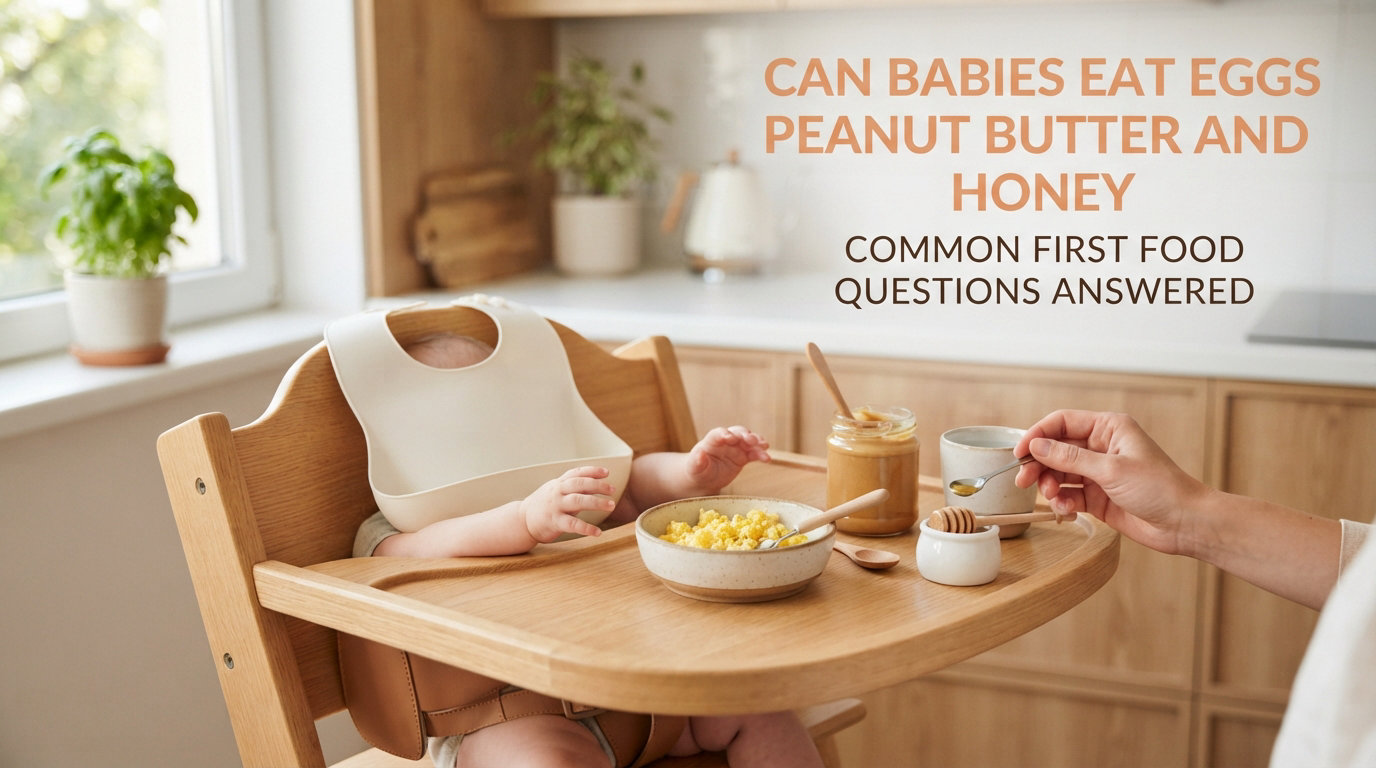
Can babies eat eggs peanut butter and honey? This is one of the most common questions new parents ask when starting solid foods. Our team has spent months reviewing the latest pediatric guidelines and talking with feeding specialists to bring you clear, evidence-based answers.
The short answer is yes, babies can eat eggs and peanut butter starting around 4-6 months when they show signs of readiness. However, honey should never be given to babies under 12 months due to the risk of infant botulism. In this guide, we will walk you through everything you need to know about introducing these foods safely.
Table of Contents
When Can Babies Eat Eggs Peanut Butter and Honey?
Understanding the right timing for each food is essential for your baby’s safety and healthy development. Here is what current research and pediatric guidelines tell us:
Eggs: You can introduce eggs to your baby between 4 and 6 months of age. The egg should always be well-cooked, never raw or runny. Most pediatricians recommend starting with a small amount and watching for any reactions over the next 2 hours.
Peanut Butter: Like eggs, peanut butter can be introduced between 4 and 6 months. The key is to use smooth peanut butter only and thin it out with breast milk, formula, or fruit puree to prevent choking. Research from the National Institutes of Health shows that early introduction actually helps prevent peanut allergies later in life.
Honey: Never give honey to a baby under 12 months old. This is the one food on this list that should be completely avoided during the first year. Even a small amount can cause infant botulism, a serious and potentially fatal illness.
Introducing Eggs to Your Baby
Can eggs be a baby’s first food? Yes, absolutely. Eggs are nutrient-dense and provide high-quality protein, iron, and choline that support brain development. Many parents successfully introduce eggs as one of the first solid foods around 6 months of age.
How to Prepare Eggs for Babies:
The egg must be well-cooked. Raw or undercooked eggs can contain salmonella bacteria that can make your baby sick. Here are the best preparation methods:
Scrambled eggs are often the easiest for babies to eat. Cook them thoroughly until firm, then cut into small, soft pieces. You can mix a little breast milk or formula into the eggs while cooking to make them even softer.
Hard-boiled eggs work well too. Mash the yolk finely and mix it with a bit of breast milk, formula, or pureed fruit. Some babies prefer the texture of mashed hard-boiled egg over scrambled.
Omelet strips cooked firm can work for babies doing baby-led weaning. Cut the omelet into finger-sized strips that your baby can grip and gum.
How Much to Serve:
Start with just a small amount, about 1 to 2 teaspoons of well-cooked egg. Watch your baby closely for the next 2 hours for any signs of an allergic reaction. Once you know your baby tolerates eggs, you can gradually increase the portion size.
Maintaining Tolerance:
Once your baby has successfully tried eggs, aim to serve them 2 to 3 times per week. Regular exposure helps maintain tolerance and prevents the development of egg allergies. This is one of the key findings from recent allergy prevention research.
How to Introduce Peanut Butter to Babies
Introducing peanut butter to babies early, between 4 and 6 months, can actually reduce the risk of developing a peanut allergy by up to 80 percent. This finding comes from landmark studies that completely changed how pediatricians approach allergenic foods.
Why Early Introduction Matters:
Before 2015, doctors told parents to delay introducing peanut butter until age 3. New research proved this advice was wrong. The LEAP study (Learning Early About Peanut Allergy) found that babies who ate peanut protein regularly from infancy had significantly fewer allergies by age 5 compared to those who avoided it.
The Right Way to Introduce Peanut Butter:
Never give your baby thick, sticky peanut butter straight from the jar. This is a choking hazard. Instead, thin it out first. Mix 2 teaspoons of smooth peanut butter with 2 to 3 teaspoons of warm water, breast milk, or formula until it reaches a thin, yogurt-like consistency.
Another safe method is mixing peanut butter into infant cereal or pureed fruit like applesauce or banana. The cereal or fruit helps dilute the thickness while adding familiar flavors your baby already enjoys.
Peanut Butter Serving Size:
Start with just 2 teaspoons of the thinned peanut butter mixture. Offer it to your baby on a soft spoon or mix it into their regular food. Watch for any reactions for the next 2 hours before offering more.
High-Risk Infants Need Extra Care:
If your baby has severe eczema or an existing egg allergy, they are considered high-risk for peanut allergy. Talk to your pediatrician before introducing peanut butter. Your doctor may recommend allergy testing first or having the first introduction done in a supervised medical setting.
What About Whole Peanuts and Peanut Pieces?
Whole peanuts, chopped peanuts, and chunky peanut butter are choking hazards for babies and young children. Wait until your child is at least 4 years old before introducing these forms. Stick to smooth peanut butter only during infancy and toddlerhood.
Why Honey Is Dangerous for Babies Under 1 Year
Honey is the one food on this list that should never be given to babies under 12 months. While honey is natural and generally healthy for older children and adults, it can be deadly for infants.
The Risk: Infant Botulism:
Honey can contain spores of Clostridium botulinum bacteria. These spores are harmless to older children and adults because our mature digestive systems can handle them. But in babies under 1 year, their immature digestive tracts provide the perfect environment for these spores to grow and produce a dangerous toxin.
This toxin causes infant botulism, a rare but serious condition that affects the nerves and causes muscle weakness. Symptoms include constipation, poor feeding, floppy movements, drooping eyelids, and difficulty breathing. Infant botulism requires immediate hospitalization and treatment.
No Exceptions Before 12 Months:
This rule has no exceptions. It does not matter if the honey is raw or pasteurized, local or organic, or mixed into other foods. The spores can survive pasteurization and processing. Avoid all forms of honey including:
Raw honey
Pasteurized honey
Honey in baked goods
Honey in cereals
Honey-sweetened yogurt or snacks
Honey on pacifiers (an old folk remedy for teething)
Check Processed Foods:
Some processed foods contain honey as a sweetener. Always read ingredient labels on cereals, crackers, breads, and snacks before giving them to your baby. Look for “honey” in the ingredient list and avoid those products until after your baby’s first birthday.
After 12 Months:
Once your baby turns 1 year old, their digestive system is mature enough to handle honey safely. At this point, you can introduce honey as you would any other sweetener, keeping in mind that babies do not need added sugars in their diet.
What Is the 3 6 9 Rule for Babies
You may have heard other parents or grandparents mention the “3-6-9 rule” for introducing baby foods. This is a general guideline, not a strict medical rule, that helps parents remember the progression of food textures and types.
3 Months: At this stage, babies are typically still on breast milk or formula only. Some babies may start showing interest in food, but most are not developmentally ready for solids yet. The American Academy of Pediatrics recommends waiting until around 6 months, but some babies may be ready as early as 4 months.
6 Months: This is the ideal time to start solid foods for most babies. At 6 months, babies can typically handle purees and smooth textures. This is also the recommended time to introduce eggs and peanut butter for allergy prevention. Many babies are ready for soft finger foods at this age too.
9 Months: By 9 months, most babies can handle more textured foods, mashed table foods, and soft finger foods. They are developing their pincer grasp and enjoying more variety in flavors and textures. Continue offering allergenic foods 2 to 3 times per week to maintain tolerance.
Remember that every baby develops at their own pace. Some babies are ready for solids earlier, while others need more time. Watch for signs of readiness like sitting up with support, showing interest in food, and losing the tongue-thrust reflex.
Signs of Allergic Reactions and When to Call the Doctor
Knowing the signs of an allergic reaction can help you act quickly if your baby has a response to eggs, peanut butter, or other new foods. Most allergic reactions in babies are mild, but some can be serious.
Mild Allergic Reaction Signs:
Mild reactions may include skin symptoms like hives, rash, or eczema flares. Your baby might develop redness or swelling around the mouth or face. Some babies experience mild vomiting or diarrhea. These symptoms typically appear within minutes to 2 hours after eating the food.
If you see mild symptoms, stop feeding the food and watch your baby closely. You can call your pediatrician for guidance. Many babies with mild reactions can be evaluated and monitored without emergency care.
Severe Allergic Reaction Signs (Anaphylaxis):
Severe reactions require immediate emergency attention. Call 911 or go to the emergency room if your baby shows any of these signs:
Difficulty breathing or wheezing
Swelling of the tongue or throat
Blue or pale skin color
Sudden lethargy or unresponsiveness
Repetitive vomiting with distress
High-pitched breathing sounds
The 2-Hour Wait Rule:
When introducing any new allergenic food, wait 2 hours before offering other new foods or putting your baby down for a long nap. Most allergic reactions happen within this window. Stay with your baby and watch for any concerning signs.
One New Food at a Time:
Introduce one allergenic food at a time, spaced at least 3 to 5 days apart. This makes it easier to identify which food caused a reaction if one occurs. Once you know your baby tolerates a food, you can combine it with other foods.
Choking Hazards: What Is the #1 Food That Kids Choke On
Understanding choking hazards is just as important as knowing about allergies. While eggs and properly prepared peanut butter are safe, certain foods and preparation methods can put your baby at risk.
Hot Dogs Are the #1 Choking Food:
Hot dogs are consistently ranked as the most common food that causes choking in young children. Their cylindrical shape, compressible texture, and perfect airway diameter make them particularly dangerous. If you offer hot dogs, always cut them lengthwise into thin strips, then cut those into small pieces.
Peanut Butter Thickness Risks:
Thick, sticky peanut butter can block a baby’s airway. This is why we always emphasize thinning peanut butter with liquids. Never put peanut butter on a spoon and offer it plain. Never give chunky peanut butter to babies.
Age-Appropriate Textures:
At 4-6 months, offer smooth purees and thinned cereals. At 6-9 months, introduce mashed foods and soft finger foods that dissolve easily. At 9-12 months, offer more textured soft foods and small, soft pieces of table foods.
Never Leave Baby Unattended:
Always supervise your baby during meals. Sit them upright in a high chair and avoid feeding in car seats or reclined positions. Learn infant CPR and choking rescue techniques for peace of mind.
Frequently Asked Questions
When to introduce egg, peanut butter, and other common food allergens to a baby?
Eggs and peanut butter can be introduced between 4-6 months when your baby shows readiness signs like sitting with support and interest in food. Start with small amounts (1-2 teaspoons) and introduce one allergen at a time, waiting 2-3 days between new foods. Wait until 12 months for honey due to infant botulism risk.
What is the 3 6 9 rule for babies?
The 3-6-9 rule is a general guideline for food progression: 3 months is typically milk-only, 6 months is when most babies start solids including eggs and peanut butter, and 9 months brings more textured foods. It is not a strict rule, and babies develop at different rates.
What is the #1 food that kids choke on?
Hot dogs are the #1 choking food for children due to their size, shape, and compressible texture. Always cut them lengthwise into thin strips. Thick peanut butter is also a choking hazard for babies and must always be thinned with breast milk, formula, or puree.
Can eggs be a baby’s first food?
Yes, eggs can be a baby’s first food. Well-cooked eggs provide excellent nutrition including protein and choline for brain development. Start with 1-2 teaspoons of scrambled or mashed hard-boiled egg and watch for reactions for 2 hours.
Can I give my 4-month-old peanut butter?
Yes, you can introduce peanut butter at 4 months if your baby shows signs of readiness and has already started other solids. Thin 2 teaspoons of smooth peanut butter with warm water, breast milk, or formula to a yogurt-like consistency. Avoid if your baby has severe eczema or known egg allergy without consulting a pediatrician first.
Final Thoughts on Introducing Eggs, Peanut Butter, and Honey
Can babies eat eggs peanut butter and honey? Now you have the complete answer. Eggs and peanut butter can be safely introduced between 4 and 6 months when your baby shows readiness signs. Early introduction of these allergenic foods actually helps prevent allergies later in life.
Honey remains the exception. Never give honey to babies under 12 months due to the risk of infant botulism. This is a hard rule with no exceptions, regardless of the type of honey or how it is prepared.
Remember to introduce one new allergen at a time, wait 2 hours for any reactions, and maintain regular exposure (2-3 times per week) once tolerance is established. If you have concerns about your baby’s risk factors or reaction history, consult your pediatrician before introducing allergenic foods.
Starting solids is an exciting milestone. With these evidence-based guidelines, you can introduce eggs and peanut butter confidently while keeping your baby safe from choking hazards and honey-related risks.