
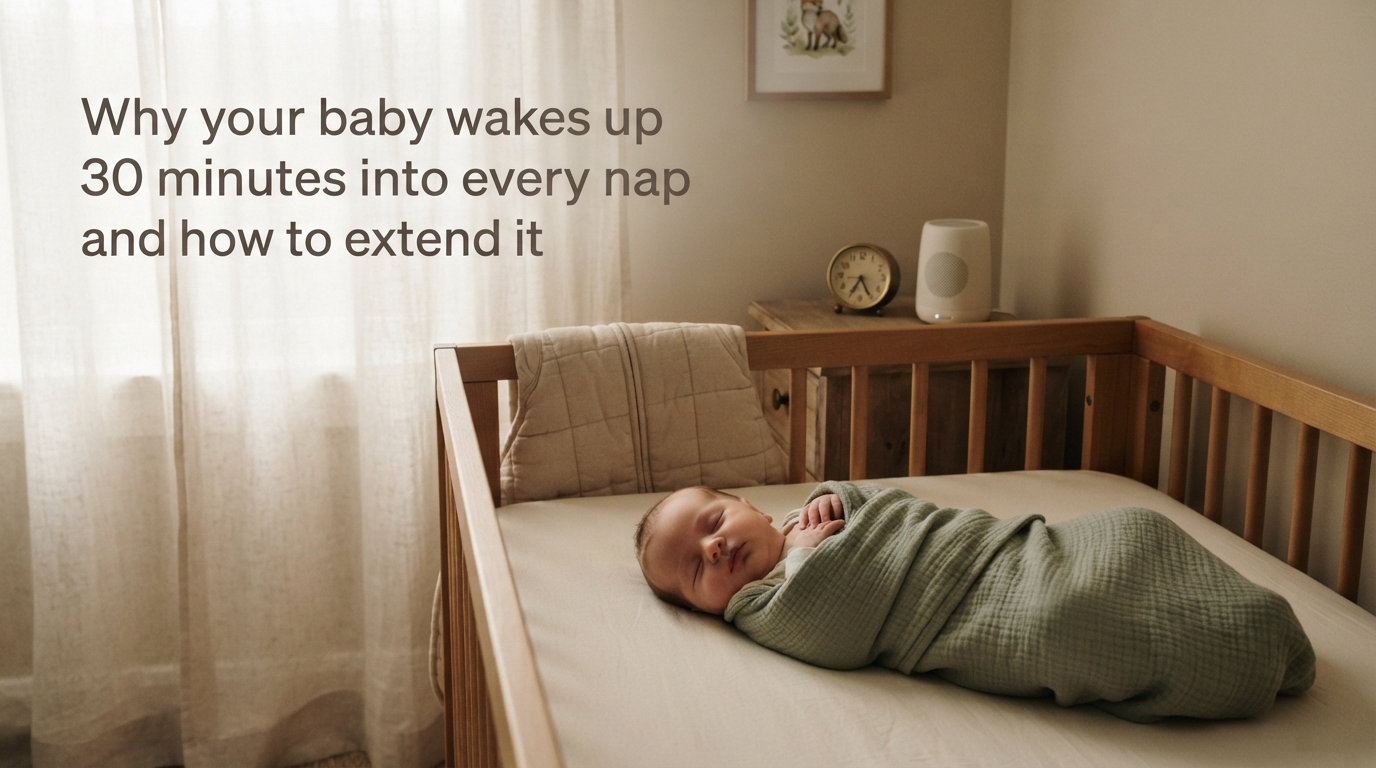
If you’ve found yourself staring at the baby monitor, watching the clock tick past the 28-minute mark with a knot in your stomach, you’re not alone. The 30-minute nap is one of the most frustrating and common sleep challenges parents face. Your baby wakes up 30 minutes into every nap exactly like clockwork, sometimes happy, sometimes crying, but always after that same brief window of rest.
I’ve worked with hundreds of families over the past decade, and I can tell you this: the 30-minute nap phase is developmentally normal, incredibly common, and absolutely fixable. In this guide, I’ll explain why your baby wakes up after exactly 30 minutes and walk you through proven techniques to help them nap longer.
By the end of this article, you’ll understand the science behind short naps, know exactly which techniques match your parenting style, and have a clear action plan to extend those frustratingly brief naps into the restorative sleep your baby needs.
Table of Contents
Why Your Baby Wakes Up After Exactly 30 Minutes?
The 30-minute nap happens because your baby has completed one full sleep cycle and cannot yet connect to the next one independently. For most babies, a single sleep cycle lasts between 30 and 45 minutes. When they reach the end of that cycle, they briefly wake to check their environment.
Think of it like this: your baby’s brain runs a quick systems check at the 30-minute mark. Is everything safe? Am I comfortable? Are my sleep conditions the same as when I fell asleep? If the answer to any of these questions triggers concern, or if your baby hasn’t yet learned to self-soothe, they fully wake instead of drifting into the next sleep cycle.
This is why so many parents describe their baby as a “clockwork napper.” The timing isn’t random. It’s biology. Your baby’s sleep cycles are shorter than yours, and their ability to bridge those cycles smoothly develops over time.
The Science of Sleep Cycles in Babies
Understanding sleep cycles is the key to solving short naps. Adult sleep cycles last about 90 minutes, but infant sleep cycles are much shorter, typically 30 to 50 minutes depending on age. Each cycle consists of active sleep (similar to REM) and quiet sleep (similar to deep, non-REM sleep).
During the first 10 to 20 minutes of a nap, your baby is in active sleep. This is light sleep where they may twitch, make noises, or even have their eyes partially open. After this phase, they transition into quiet sleep, which is deeper and more restorative. At the end of the cycle, around that 30-minute mark, they surface toward wakefulness.
The critical moment happens at the transition between cycles. Babies who can self-soothe will briefly wake, check their surroundings, and drift back to sleep. Babies who rely on external sleep associations, like being rocked or fed to sleep, will often fully wake and signal for help.
What Is the 45-Minute Intruder?
You may have heard other parents talk about the “45-minute intruder.” This is essentially the same phenomenon as the 30-minute nap, just timed slightly differently based on your baby’s individual sleep cycle length. Some babies run on 30-minute cycles, others on 35, 40, or 45-minute cycles.
The “intruder” is simply that moment when your baby reaches the end of their first sleep cycle and surfaces toward consciousness. It’s not an external force or random occurrence. It’s your baby’s natural sleep architecture at work.
Babies who wake at 45 minutes rather than 30 may simply have slightly longer sleep cycles. The techniques for extending these naps are the same regardless of whether your little one is a 30-minute, 35-minute, or 45-minute napper.
Understanding Your Baby’s Sleep Cycles
Let’s dive deeper into how sleep cycles work in infants. Unlike adults, who spend about 20% of their sleep in REM, babies spend roughly 50% of their sleep in active REM-like sleep. This is developmentally necessary for their rapidly growing brains, but it also means they wake more easily.
Each sleep cycle has distinct phases. Your baby enters sleep through active sleep, which is why they may seem restless or noisy when they first drift off. After 10 to 15 minutes, they transition into quiet sleep, which is deeper and harder to wake from. This quiet sleep phase is what makes the middle of a nap more stable.
The problem arises at the end of the cycle when your baby transitions back toward wakefulness. If conditions aren’t optimal, or if they don’t have the skills to self-settle, they pop awake instead of sliding into the next cycle.
How Sleep Cycles Change with Age
Newborns have very irregular sleep cycles that aren’t yet fully developed. Around 4 to 6 months of age, sleep cycles mature into more predictable patterns, which is coincidentally when many parents notice the 30-minute nap pattern solidifying.
Between 5 and 6 months, most babies develop the neurological ability to connect sleep cycles. However, having the ability and using it are two different things. Many babies need practice, the right environment, and sometimes gentle guidance to start consolidating their naps.
By 8 to 9 months, most babies who were previously taking three short naps transition to two longer naps as their wake windows expand and their sleep cycles naturally lengthen.
Why Some Babies Can Connect Cycles and Others Can’t
The ability to bridge sleep cycles depends on several factors. First, there’s temperament. Some babies are naturally more adaptable sleepers who transition between cycles smoothly. Others are more sensitive to changes in their environment and wake fully at every transition.
Second, sleep associations play a huge role. If your baby falls asleep being rocked, fed, or held, they’ll expect those same conditions when they surface between cycles. When they find themselves in the crib instead of your arms, they wake fully and call for help.
Third, environmental factors matter enormously. Light, noise, temperature, and comfort all influence whether your baby can smoothly transition between cycles or wake completely at the 30-minute mark.
Common Causes of 30-Minute Naps
Before we get to solutions, let’s identify what might be causing your baby’s short naps. Understanding the root cause helps you choose the right intervention.
Overtiredness and the Cortisol Connection
One of the most common causes of 30-minute naps is overtiredness. When a baby stays awake too long, their body produces cortisol, a stress hormone that acts like adrenaline. Cortisol makes it harder for your baby to fall asleep and stay asleep.
Here’s how the cycle works: your baby takes a short nap and wakes up still tired. Because they’re tired, they can’t stay awake as long as they should before the next nap. They take another short nap. The day becomes a cascade of brief sleeps and overtired wakings. By bedtime, they’re wired and cranky.
Many parents don’t realize that overtired babies often fall asleep quickly and look peaceful at first. The cortisol doesn’t prevent sleep initially, but it causes frequent wakings and prevents deep, restorative rest.
Undertiredness: The Opposite Problem
On the flip side, putting your baby down before they’ve built up enough sleep pressure can also cause short naps. Sleep pressure is the biological drive to sleep that builds the longer we’re awake. If your baby hasn’t been awake long enough, they don’t have enough sleep pressure to sustain a long nap.
Undertired babies often take a long time to fall asleep, play in their crib, or wake up after 30 minutes completely refreshed and ready to party. They don’t need more sleep yet, so their brain keeps them awake.
Finding the balance between overtired and undertired is tricky but essential. The key is understanding wake windows appropriate for your baby’s age.
Sleep Environment Issues
The sleep environment is often the easiest fix for short naps. Light, noise, and temperature changes can all wake a baby at the 30-minute transition point when they’re already surfacing toward consciousness.
Many parents make the mistake of creating a too-quiet, too-bright sleep space. In reality, babies often sleep better with consistent white noise and complete darkness. When the dishwasher cycles on at 28 minutes into the nap, a baby sleeping in silence wakes abruptly. A baby sleeping with white noise never notices.
Temperature matters too. Babies who are too warm or too cold are more likely to wake between sleep cycles. The ideal sleep temperature is between 68 and 72 degrees Fahrenheit.
Hunger and Feeding Timing
Hunger can absolutely cause short naps, especially in younger babies. If your baby goes down for a nap hungry or gets hungry during the first sleep cycle, they’ll wake at 30 minutes ready to eat.
The timing of feeds relative to naps matters. A baby who feeds right before sleeping may develop a feed-to-sleep association. A baby who ate two hours ago may be hungry mid-nap. Finding the right feeding schedule takes some experimentation.
Sleep Associations and Dependency
Sleep associations are the conditions your baby needs to fall asleep. Some associations, like a sleep sack or white noise, are healthy and sustainable. Others, like rocking, nursing, or patting to sleep, require your presence and can’t be replicated when your baby wakes between cycles.
If your baby falls asleep in your arms and wakes up 30 minutes later in the crib, they’re disoriented. The conditions changed while they slept, and they don’t have the skills to settle themselves back to sleep in the new environment.
| Sign | Overtired Baby | Undertired Baby |
|---|---|---|
| Time to fall asleep | Falls asleep instantly | Plays in crib 20+ minutes |
| Waking behavior | Wakes crying, fussy | Wakes happy, chatty |
| Pre-sleep cues | Hyper, rubbing eyes, clumsy | Content, not showing sleep cues |
| Post-nap mood | Cranky within 30 minutes | Happy for 1+ hour |
| Bedtime impact | Resists bedtime, wakes at night | Resists bedtime, wired |
How to Extend Your Baby’s Naps: Proven Techniques
Now let’s get to the solutions. These techniques have helped thousands of families move from 30-minute naps to long, restorative sleep sessions. You don’t need to use all of them. Pick the ones that fit your parenting style and your baby’s temperament.
Technique 1: The Crib Hour Method
The crib hour technique is one of the most effective strategies for extending naps. Here’s how it works: regardless of how long your baby sleeps, they stay in the crib for a full hour from when they fell asleep.
If your baby wakes at 30 minutes, they stay in the crib for the remaining 30 minutes. This isn’t about forcing them back to sleep. It’s about giving them the opportunity and space to practice connecting sleep cycles.
During crib hour, you can respond to your baby if they’re upset, but you keep the interaction minimal and calm. Some parents pat their baby’s back briefly. Others simply sit nearby offering verbal reassurance. The key is staying consistent with the one-hour timeframe.
Most babies need 1 to 2 weeks of consistent crib hour practice before they start extending naps on their own. Some figure it out in just a few days. The technique teaches them that the crib is a place for extended rest, not just brief catnaps.
Technique 2: The Wake-to-Sleep Method
The wake-to-sleep method sounds counterintuitive, but it’s remarkably effective for some babies. Here’s the approach: you gently rouse your baby about 5 minutes before their typical waking time.
If your baby always wakes at 30 minutes, you’d go in at 25 minutes and make a small adjustment. This might mean gently shifting their position, making a brief sound, or lightly touching their hand. The goal isn’t to fully wake them but to slightly stir them, which resets their sleep cycle and helps them transition into the next one.
Wake-to-sleep works by interrupting the automatic waking pattern your baby has developed. By stirring them before they would naturally wake, you help their brain reset and potentially skip that wakeful transition.
This technique requires good timing and doesn’t work for every baby. Some babies get annoyed and wake fully. Others settle right back into a deeper sleep and nap much longer. It’s worth trying for a week to see if your baby responds well.
Technique 3: Optimize the Sleep Environment
Creating an optimal sleep environment is the foundation of good napping. This is often the easiest fix with the fastest results.
First, make the room as dark as possible. Blackout curtains or blackout blinds are essential for most babies. Light coming through regular curtains can signal wakefulness to your baby’s brain at that 30-minute transition point.
Second, use white noise consistently. A white noise machine masks household sounds and provides a soothing auditory cue that it’s time to sleep. Choose a true white noise or brown noise setting rather than lullabies or nature sounds, which have volume fluctuations that can wake a light sleeper.
Third, keep the room cool. Between 68 and 72 degrees is ideal for baby sleep. Overheating is a common cause of wakefulness between sleep cycles.
Fourth, use a sleep sack consistently. Sleep sacks provide comfort, warmth, and a positive sleep association without the safety risks of loose blankets.
Technique 4: Master Wake Windows
Getting wake windows right is critical for nap success. A wake window is the amount of time your baby can comfortably stay awake between sleep periods. The right wake window builds enough sleep pressure for a long nap without pushing into overtired territory.
| Age | Wake Window | Number of Naps | Typical Nap Length |
|---|---|---|---|
| 0-2 months | 45-60 minutes | 4-6 naps | 30-120 minutes |
| 3-4 months | 1.25-1.75 hours | 4 naps | 30-60 minutes |
| 5-6 months | 2-2.5 hours | 3 naps | 45-90 minutes |
| 7-8 months | 2.5-3 hours | 2-3 naps | 60-120 minutes |
| 9-12 months | 3-4 hours | 2 naps | 60-120 minutes |
| 13-18 months | 4-6 hours | 1-2 naps | 60-150 minutes |
These are general guidelines, and individual babies vary. Some need slightly shorter windows, others slightly longer. Watch your baby for sleepy cues like rubbing eyes, pulling ears, becoming less engaged with toys, or getting fussy.
If your baby is taking 30 minutes to fall asleep, their wake window is likely too short. If they’re falling asleep instantly but waking at 30 minutes, their wake window is likely too long.
Technique 5: Save the Nap
When your baby wakes at 30 minutes, you have a choice: get them up or try to save the nap. Both are valid options depending on the situation.
To save the nap, try these interventions in order. First, wait 10 to 15 minutes to see if they’ll resettle on their own. Many babies fuss briefly between cycles and go back to sleep if given the chance.
If they’re crying and not settling, try a quick check-in. Keep the lights off, don’t make eye contact, and offer minimal intervention. A brief back pat or shush might be enough.
If that doesn’t work, you can try a contact nap rescue. Pick your baby up and hold them or wear them in a carrier. Many babies who won’t sleep in the crib at this point will doze off on you. Even a 20-minute extension helps.
Know when to give up. If you’ve tried for 15 to 20 minutes and your baby is clearly awake and alert, it’s okay to end the nap and try again later.
Technique 6: The Bridge Nap
When your baby takes a short first nap, you can use a bridge nap to get them to the next scheduled sleep period without becoming overtired. A bridge nap is a brief 10 to 15 minute sleep that prevents your baby from being awake too long.
Bridge naps often happen in the car, stroller, or carrier. They aren’t restorative sleep, but they prevent cortisol from building up. If your baby took a 30-minute morning nap, a bridge nap around 11 AM can help them make it to their afternoon nap without becoming a mess.
Use bridge naps strategically while you’re working on extending the main naps. They’re a temporary tool, not a permanent solution, but they can save your sanity while you implement other techniques.
Age-by-Age Nap Expectations and Solutions
Your approach to 30-minute naps should vary based on your baby’s age. What works for a 4-month-old differs from what works for a 9-month-old.
Newborns to 3 Months
During the newborn phase, short naps are completely normal and expected. Newborns have immature sleep cycles and can’t self-regulate. Don’t stress about extending naps at this age.
Focus on preventing overtiredness by offering frequent naps and watching for sleepy cues. Many babies this age sleep best in arms or in a carrier, and that’s perfectly fine. Contact naps are biologically appropriate for newborns.
If you want to practice crib naps, go ahead, but don’t stress if they only last 30 minutes. This phase passes quickly.
4 to 6 Months
This is when the 30-minute nap pattern often becomes frustratingly consistent. Around 4 months, many babies experience the “4-month sleep regression” as their sleep cycles mature and they develop more adult-like sleep patterns.
This is a great age to start implementing crib hour and optimizing the sleep environment. Babies at this age are often ready to learn self-soothing skills, though full sleep training is a personal choice.
Many babies naturally start consolidating naps around 5 to 6 months without intervention. If your baby is approaching 6 months and still taking exclusively 30-minute naps, it’s a good time to be more intentional about nap extension.
6 to 9 Months
By 6 months, most babies are capable of longer naps. If your baby is still stuck at 30 minutes, it’s worth being more proactive with techniques. This is also when many babies transition from three naps to two.
During the 3-to-2 nap transition, short naps are common as your baby adjusts to longer wake windows. Be patient and flexible during this period. A baby who takes two 30-minute naps while transitioning might suddenly start taking one 90-minute nap once the schedule stabilizes.
At this age, undertiredness becomes a more common culprit for short naps. Make sure your wake windows have expanded appropriately.
9 to 12 Months
By 9 months, most babies are taking two solid naps. If your baby is still consistently taking 30-minute naps at this age, it’s definitely time to try the techniques in this guide more consistently.
This age group responds well to the crib hour method and environmental optimization. They’re old enough to understand patterns and routines but young enough that new habits form relatively quickly.
Some babies at this age resist the second nap. If your baby takes a great morning nap but only sleeps 30 minutes in the afternoon, that’s common. The afternoon nap is often the first to shorten before the 2-to-1 nap transition around 15 months.
12 Months and Beyond
Between 12 and 18 months, most babies transition from two naps to one. During this transition, naps often become chaotic. Your baby might take one short nap and one long nap, or resist one nap entirely.
If your toddler is taking only 30-minute naps after the transition to one nap, check their schedule. They may need a slightly earlier nap time or a longer morning wake window to build sufficient sleep pressure.
Most toddlers settle into a solid 1.5 to 2.5 hour nap by 18 months. If your toddler consistently takes short naps beyond this point, consider whether they’re getting too much night sleep or if the nap timing needs adjustment.
Troubleshooting: Your Action Plan for 30-Minute Wakings
When your baby wakes at 30 minutes, you need a clear decision tree. Here’s exactly what to do step by step.
Step 1: Wait and Observe
When you see movement on the monitor, don’t rush in immediately. Many babies stir and fuss between cycles without fully waking. Give your baby 5 to 10 minutes to see if they’ll settle back to sleep.
If your baby is just talking, playing, or making occasional sounds, wait longer. These are signs they’re trying to settle. If the fussing escalates to crying, move to the next step.
Step 2: Quick Check-In
If your baby is crying, do a brief check-in. Keep the room dark, don’t turn on lights, and avoid eye contact if possible. Offer a quick pat, a shush, or a brief reassurance that you’re there.
Stay for 30 to 60 seconds, then leave. See if your baby settles. Some babies just need to know you’re there and will drift back to sleep.
Step 3: Decide to Intervene or End the Nap
If your baby doesn’t settle after 10 to 15 minutes of trying, decide whether to keep working on it or call the nap done. Consider these factors:
How tired is your baby? If they’re clearly still tired and miserable, it’s worth trying to extend the nap with a contact nap or carrier.
What time is it? If it’s the last nap of the day and close to bedtime, you might just move bedtime earlier rather than fighting for a late nap.
What’s your baby’s mood? If they wake happy and seem content, they may genuinely be done. Get them up and try again next nap.
Step 4: Adjust the Rest of the Day
After a short nap, adjust your schedule. If it’s early in the day, offer the next nap slightly earlier to prevent overtiredness. If it’s the last nap, move bedtime 30 to 60 minutes earlier.
Don’t try to “make up” for lost sleep by forcing extra naps or longer naps later. That often backfires and creates more overtiredness. Just accept the short nap, adjust the schedule, and try again tomorrow.
Warning: Avoid the temptation to keep your baby awake longer to “tire them out” for the next nap. This almost always backfires and leads to more cortisol-driven short naps. Stick to age-appropriate wake windows even after a short nap.
A Note for Parents: You’re Doing Great
Before we wrap up, I want to say something important. Chronic short naps are exhausting. They leave you feeling trapped at home, anxious about your baby’s development, and frustrated that you can’t figure out the solution.
Every parent I’ve worked with who struggled with 30-minute naps felt like they were failing. They weren’t. Short naps are one of the hardest sleep challenges because they’re developmentally normal but practically difficult.
You’re not doing anything wrong. Some babies are just more sensitive sleepers. Some take longer to consolidate naps. Your baby will eventually nap longer. Most babies naturally outgrow 30-minute naps between 5 and 6 months, and nearly all do by 9 months.
Take care of yourself during this phase. Ask for help so you can nap too. Lower your standards for the housework. Remember that this is a season, not a permanent state.
Frequently Asked Questions About 30-Minute Naps
How to extend baby naps beyond 30 minutes?
To extend baby naps beyond 30 minutes, optimize the sleep environment with blackout curtains and white noise, follow age-appropriate wake windows, use the crib hour technique, ensure full feedings before naps, and help your baby learn to connect sleep cycles independently. Most babies need 1-2 weeks of consistent practice with these techniques.
What to do when baby wakes up 30 minutes into nap?
When your baby wakes at 30 minutes, wait 10-15 minutes before intervening to see if they will resettle. If crying escalates, try a brief check-in with minimal interaction. If they don’t fall back asleep within 15-20 minutes, end the nap and adjust the rest of your schedule accordingly.
Will baby grow out of 30 minute naps?
Yes, most babies naturally outgrow 30-minute naps between 5-6 months of age as their sleep cycles mature and they develop the ability to connect sleep cycles independently. By 8-9 months, babies typically take 2 naps lasting 1-2 hours each.
Do naps help lower cortisol?
Yes, adequate naps help regulate cortisol levels in babies. When babies become overtired from short naps, cortisol rises, making it harder for them to fall asleep and stay asleep. This creates a cycle where overtiredness leads to more short naps, which leads to more overtiredness.
Why is it taking 30+ minutes for my baby to fall asleep for a nap?
If your baby takes 30+ minutes to fall asleep, they may be undertired and haven’t built up enough sleep pressure, or overtired with elevated cortisol keeping them wired. Check that you’re following age-appropriate wake windows and watching for early sleepy cues before they become overtired.
Is it okay for a baby to nap only 30 minutes?
For babies under 5-6 months, 30-minute naps are developmentally normal and acceptable. While not as restorative as longer naps, they provide some rest. If your baby wakes happy and makes it to the next sleep period without becoming overtired, short naps are fine temporarily.
Why does my baby wake up at exactly 30 minutes every time?
Your baby wakes at exactly 30 minutes because that’s the length of their sleep cycle. At the end of each cycle, they briefly surface toward wakefulness to check their environment. If conditions aren’t optimal or they lack self-soothing skills, they fully wake instead of transitioning to the next cycle.
Patience and Consistency Win the Day
The 30-minute nap is one of parenting’s most universal frustrations. Understanding why your baby wakes up 30 minutes into every nap gives you the foundation to fix it. When you know that your baby is simply completing a sleep cycle and struggling to connect to the next one, the solution becomes clearer.
Remember that no single technique works for every baby. Try crib hour for a week. Optimize your sleep environment. Adjust those wake windows. Pay attention to overtiredness versus undertiredness. With consistent effort over 1 to 2 weeks, most babies start consolidating their naps.
If you’re feeling overwhelmed, start with just one change. Make the room darker. Or try waiting 10 minutes before going in when your baby wakes. Small adjustments often lead to big improvements.
Your baby will nap longer eventually. Nearly all babies outgrow the 30-minute nap pattern by 6 to 9 months. Until then, use the techniques in this guide, be gentle with yourself, and remember that you’re doing a great job navigating one of parenting’s trickiest phases.
Sweet dreams are coming. Hang in there.